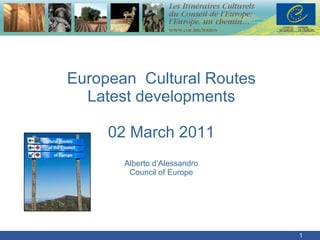
European  Cultural Routes Latest developments 02 March 2011 Alberto d’Alessandro Council of Europe
Council of Europe  Cultural Routes Launched in 1987 in order to illustrate, through a journey through space and time, the interconnections between different elements of European heritage and promote the notion of a common heritage
CRs programme is a mean to illustrate and implement the fundamental principles on the COE in the cultural field: United in the diversity  That is how the heritage of the different countries of Europe constitute a common cultural heritage, enriched by local diversities  and identities. -reinforcing European citizenship and belonging -sense of sharing a common European identity
Affirming COEs cultural rights: -Cultural rights -Cultural democracy -Democratic participation to culture -Respect to diversity
Implementing Dialogue between people and nations -Enhancing intercultural dialogue -Encouraging Interreligious dialogue -Protecting cultural minorities-Valorising intangible heritage and traditions of European people
Safeguard and enhance the natural and cultural heritage: -Valorising and safeguarding landscapes -Respecting biodiversity -Valorising sustainable and respectful tourism -Promoting eco tourism -Improving the quality of life, social and economic development
The Council of Europe cultural routes Programme The Cultural Routes of the Council of Europe are an invitation to take a trip – both imaginary and real –to discover the material and immaterial heritage of the majority of the  50 signatory countries of the  European  Cultural Convention, and of the other continents involved with Europe and linked to the  themes of the cultural routes (Asia, the Middle East, the American continent  and Africa).
The Council of Europe cultural routes Programme Starting with the first cultural route, the Santiago  de Compostela pilgrim routes,  29 European thematic  cultural routes have now been awarded the certification  “Cultural Route of the Council of Europe”, according to the Resolution (2007)12 of the Committee of Ministers of the Council of Europe
Themes of Cultural Routes PILGRIM ROUTES The Santiago de Compostela  pilgrim routes The Via Francigena The Saint Michael’s Ways The Route of Saint Olav  Ways
Themes of Cultural Routes FORTIFIED ARCHITECTURE AND ARTISTIC HERITAGE The Wenzel and Vauban Routes Transromanica The Routes of prehistoric rupestral art European Route of Thermal  Heritage and Thermal Towns
Themes of Cultural Routes EUROPEAN FIGURES Saint Martin of Tours, a great European figure, a symbol of sharing Don Quixote Route  The Schickhardt Route The Mozart Route
Themes of Cultural Routes LANDSCAPE AND CIVILIZATION Parks and Gardens, Landscapes The Olive Tree Routes Itervitis – The Vineyard Ways in Europe The legacy of Al-Andalus The Via Carolingia
Themes of Cultural Routes RELIGIOUS HERITAGE The European Route of Cistercian Abbeys The Network of Cluniac Sites European Jewish Heritage Routes The Route of Cemeteries in Europe
Themes of Cultural Routes COMMERCIAL AND MARITIM ROUTES The Phoenicians’ Route The Vikings Route. Vikings and Normans The Hansa The Via Regia
Themes of Cultural Routes INDUSTRIAL HERITAGE The Iron Road in Central Europe The Iron Route in the Pyrenees MIGRATORY HERITAGE The European Route of Migration Heritage The Route of the Castilian  Language and its expansion in the Mediterranean: the Sephardic Routes
www.coe.int/routes
The Engine for Cultural Tourism
 
Cultural Routes Crossroads in Europe
Karlovy Vary(CZ)  Bath (UK)  Spa (B) Bagni di Lucca,  Salsomaggiore Terme,  Acqui Terme (I)  Chaves (PT)  Piestany (SK) ……
The European Route of Historical Thermal Towns Origin:  project “Thermae Europae” financed by the EC “Culture” Programme which finished in 2009  Managed by an Association whose head office is in France and the Secretariat in Italy, The network is composed of the most traditional thermal stations in Europe, including 11 countries and 15 towns
Developing touristic and cultural activities that cause economical impacts on tourism and spas, enhancing  not only material heritage (such as the architectural  Heritage) but also immaterial heritage (such as  traditions, philosophies, cultures, techniques and Knowledge) that are all part of thermal heritage. The European Route of Historical Thermal Towns
The European Route of Historical Thermal Towns
The Santiago de Compostela Pilgrim Routes
The Santiago de Compostela Pilgrim Routes The first cultural route which awarded certification in 1987 A symbol of what the movement toward Compostella has meant for shaping the  European identity , giving birth to an enlarged  space for transmitting  values  and practicing  intercultural dialogue  through the generations.
The Santiago de Compostela Pilgrim Routes Infrastructures, restoration, accommodation facilities and other creative SMEs have been  multiplying during these years along the Santiago  de Compostella pilgrim routes.
The Santiago de Compostela Pilgrim Routes Europa Compostela 2010 - The French Federation of the Associations of the Santiago of Compostella Pilgrim Routes - A long and great pedestrian relay,  - Start: 28 th  April from different points in Europe  - End : 18 th  September in Santiago of Compostela, Covering more than  20.000 km and planning many events along the way.
 
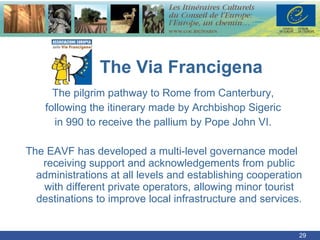
  v  The Via Francigena The pilgrim pathway to Rome from Canterbury, following the itinerary made by Archbishop Sigeric in 990 to receive the pallium by Pope John VI. The EAVF has developed a multi-level governance model  receiving support and acknowledgements from public administrations at all levels and establishing cooperation with different private operators, allowing minor tourist destinations to improve local infrastructure and services.
 
 
Euro-Mediterranean area The Phoenicians’ Route The Legacy of Al-Andalus The Olive Tree Route
While developing Euro-Mediterranean relations, these cultural routes put into  connection commercial, cultural, tourist and  educational organizations to carry out cross- border activities: Intercultural dialogue Long-term cooperation Territorial products
The Phoenicians’ Route
The Phoenicians’ Route Itineraries of discovery Didactic workshops Heritage pedagogy
Archeotrekking
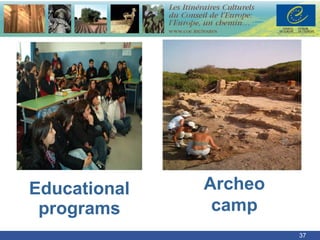
Educational programs Archeo camp
The legacy of Al Andalus 11 trails highlight the contribution of Muslims to European culture, heritage, writing, music and landscape
The objectives set by El legado andalusí Foundation are based on the reassessment  and dissemination of the Spanish-Muslim  civilization through its art and culture and  historical and social relationship with Europe,  the Arab world, the Mediterranean  environment and Latin America. The Legacy of Al-Andalus
Several routes integrating and  connecting European, Arab and American countries , Promotion of cultural and rural tourism, traditional arts, proposed in  tourist guides  about itineraries in the Maghreb, Africa, Middle East, Spain, by bike, on foot, by car, etc. Use  creative spaces  and new technologies to raise awareness about Arabic contribution in Western Europe (Pavillion al-Andalus – Parco de la Ciencia, Granada managed by the Foundation El Legado Andalusi
The Olive Tree Route
The Olive Tree Route A common initiative by the Cultural Foundation “The Routes of the Olive Tree” and the Chamber of Commerce in Messenia, The network aims at preserving and enhancing local diversity, promoting olive culture and olive oil producing regions throughout Europe, Pan-European projects: Messinia – Pekin 2008 by motorbike; promotional travels until Northern Europe, summer 2010
A partnership with the network  Odyssea  let Itervitis to work with maritime ports and cities linked to the wine commerce, developing ITC tools, audioguides and providing information about local wine producer. Itervitis -  The VineyardRoute in Europe
The Via Regia The longest and oldest road linking East and West of  Europe which has been brought into a renewed  knowledge by the association “Via Regia-Culture for  Europe”, having its head office in Germany
An increasing number of cultural visitors are visiting the Via Regia,  Crossing in some cities other cultural routes of the Council of Europe, like Transromanica, Santiago of Compostela Pilgrim Route, the Route of Saint Martin of Tours, A geographical information system based on an interactive map where old and current courses of the VIA REGIA are visible and clickable (possibility to create the own itinerary and download information)
Transromanica A European cultural network connecting the  common Romanesque heritage of ten regions  in eight countries between the Baltic Sea  and the Mediterranean.
New Political Framework for the European Cultural Routs A)  Joint Programmes with the EU  Commission B)  Involvement of the EU Parliament C)  Cooperation agreement with  NECSTOUR D) EPA - Enlarged Partial Agreement
A)  Joint Programmes with the EU Commission   -Communication of Tourism –  Commissioner Tajani - -JP – Study  “  Impact of European Cultural Routes on SME’s Innovation and Competitiveness » - Participation to the EPA
B)  Involvement of the European Parliament   - Definition of a Preparatory Action  on Cultural nTourism and Cultural  Routes -Involvment of the Comission for Culture and Tourism -Creation of an EP Intergroup  on Cultural Routes
C)  Cooperation agreement with NECSTOUR   - Agreement with NECSTOUR signed the during the ETD in Brussels the 27 september 2010 -NECSTOUR  (Network of European regions for a sustainable and competitive tourism) involving 22 regions at the moment -Development of a common strategies for the used of Structural Funds for the development of CRs in Europe
D) EPA  Enlarged Partial Agreement Resolution CM/Res (2010) 53 adopted by the Committee of Ministers on 8 dicember 2010 13 Founding members:  Austria, Azerbaijan, Bulgaria, Cyprus, France, Greece, Italy, Luxembourg, Montenegro, Portugal, Russian Federation, Slovenia, Spain + Norway = 14 countries participating at the moment
Enlarged Partial Agreement Main Objectives: -Promotion of European identity and citizenship -Promoting the principles of the COE -Development and promotion of Cultural Routes concept -Promotion of Europe as a tourism destination
EPA  Enlarged Partial Agreement Organisation:   - Governing Board   - Executive Secretary -  Forum of CRs – Advisory platform - Agreement with the EICR
Enlarged Partial Agreement Actions programmed in 2011/12: -Data base on CRs and Experts -Building Capacity -International Forum in Delphes -Support to Roma Route -European Festival of Cultural  Routes - Definition of Marketing policies -Participation to tourism fairs
THANK YOU FOR YOUR ATTENTION

A. Dalessandro

  • 1.
    European CulturalRoutes Latest developments 02 March 2011 Alberto d’Alessandro Council of Europe
  • 2.
    Council of Europe Cultural Routes Launched in 1987 in order to illustrate, through a journey through space and time, the interconnections between different elements of European heritage and promote the notion of a common heritage
  • 3.
    CRs programme isa mean to illustrate and implement the fundamental principles on the COE in the cultural field: United in the diversity That is how the heritage of the different countries of Europe constitute a common cultural heritage, enriched by local diversities and identities. -reinforcing European citizenship and belonging -sense of sharing a common European identity
  • 4.
    Affirming COEs culturalrights: -Cultural rights -Cultural democracy -Democratic participation to culture -Respect to diversity
  • 5.
    Implementing Dialogue betweenpeople and nations -Enhancing intercultural dialogue -Encouraging Interreligious dialogue -Protecting cultural minorities-Valorising intangible heritage and traditions of European people
  • 6.
    Safeguard and enhancethe natural and cultural heritage: -Valorising and safeguarding landscapes -Respecting biodiversity -Valorising sustainable and respectful tourism -Promoting eco tourism -Improving the quality of life, social and economic development
  • 7.
    The Council ofEurope cultural routes Programme The Cultural Routes of the Council of Europe are an invitation to take a trip – both imaginary and real –to discover the material and immaterial heritage of the majority of the 50 signatory countries of the European Cultural Convention, and of the other continents involved with Europe and linked to the themes of the cultural routes (Asia, the Middle East, the American continent and Africa).
  • 8.
    The Council ofEurope cultural routes Programme Starting with the first cultural route, the Santiago de Compostela pilgrim routes, 29 European thematic cultural routes have now been awarded the certification “Cultural Route of the Council of Europe”, according to the Resolution (2007)12 of the Committee of Ministers of the Council of Europe
  • 9.
    Themes of CulturalRoutes PILGRIM ROUTES The Santiago de Compostela pilgrim routes The Via Francigena The Saint Michael’s Ways The Route of Saint Olav Ways
  • 10.
    Themes of CulturalRoutes FORTIFIED ARCHITECTURE AND ARTISTIC HERITAGE The Wenzel and Vauban Routes Transromanica The Routes of prehistoric rupestral art European Route of Thermal Heritage and Thermal Towns
  • 11.
    Themes of CulturalRoutes EUROPEAN FIGURES Saint Martin of Tours, a great European figure, a symbol of sharing Don Quixote Route The Schickhardt Route The Mozart Route
  • 12.
    Themes of CulturalRoutes LANDSCAPE AND CIVILIZATION Parks and Gardens, Landscapes The Olive Tree Routes Itervitis – The Vineyard Ways in Europe The legacy of Al-Andalus The Via Carolingia
  • 13.
    Themes of CulturalRoutes RELIGIOUS HERITAGE The European Route of Cistercian Abbeys The Network of Cluniac Sites European Jewish Heritage Routes The Route of Cemeteries in Europe
  • 14.
    Themes of CulturalRoutes COMMERCIAL AND MARITIM ROUTES The Phoenicians’ Route The Vikings Route. Vikings and Normans The Hansa The Via Regia
  • 15.
    Themes of CulturalRoutes INDUSTRIAL HERITAGE The Iron Road in Central Europe The Iron Route in the Pyrenees MIGRATORY HERITAGE The European Route of Migration Heritage The Route of the Castilian Language and its expansion in the Mediterranean: the Sephardic Routes
  • 16.
  • 17.
    The Engine forCultural Tourism
  • 18.
  • 19.
  • 20.
    Karlovy Vary(CZ) Bath (UK) Spa (B) Bagni di Lucca, Salsomaggiore Terme, Acqui Terme (I) Chaves (PT) Piestany (SK) ……
  • 21.
    The European Routeof Historical Thermal Towns Origin: project “Thermae Europae” financed by the EC “Culture” Programme which finished in 2009 Managed by an Association whose head office is in France and the Secretariat in Italy, The network is composed of the most traditional thermal stations in Europe, including 11 countries and 15 towns
  • 22.
    Developing touristic andcultural activities that cause economical impacts on tourism and spas, enhancing not only material heritage (such as the architectural Heritage) but also immaterial heritage (such as traditions, philosophies, cultures, techniques and Knowledge) that are all part of thermal heritage. The European Route of Historical Thermal Towns
  • 23.
    The European Routeof Historical Thermal Towns
  • 24.
    The Santiago deCompostela Pilgrim Routes
  • 25.
    The Santiago deCompostela Pilgrim Routes The first cultural route which awarded certification in 1987 A symbol of what the movement toward Compostella has meant for shaping the European identity , giving birth to an enlarged space for transmitting values and practicing intercultural dialogue through the generations.
  • 26.
    The Santiago deCompostela Pilgrim Routes Infrastructures, restoration, accommodation facilities and other creative SMEs have been multiplying during these years along the Santiago de Compostella pilgrim routes.
  • 27.
    The Santiago deCompostela Pilgrim Routes Europa Compostela 2010 - The French Federation of the Associations of the Santiago of Compostella Pilgrim Routes - A long and great pedestrian relay, - Start: 28 th April from different points in Europe - End : 18 th September in Santiago of Compostela, Covering more than 20.000 km and planning many events along the way.
  • 28.
  • 29.
    v The Via Francigena The pilgrim pathway to Rome from Canterbury, following the itinerary made by Archbishop Sigeric in 990 to receive the pallium by Pope John VI. The EAVF has developed a multi-level governance model receiving support and acknowledgements from public administrations at all levels and establishing cooperation with different private operators, allowing minor tourist destinations to improve local infrastructure and services.
  • 30.
  • 31.
  • 32.
    Euro-Mediterranean area ThePhoenicians’ Route The Legacy of Al-Andalus The Olive Tree Route
  • 33.
    While developing Euro-Mediterraneanrelations, these cultural routes put into connection commercial, cultural, tourist and educational organizations to carry out cross- border activities: Intercultural dialogue Long-term cooperation Territorial products
  • 34.
  • 35.
    The Phoenicians’ RouteItineraries of discovery Didactic workshops Heritage pedagogy
  • 36.
  • 37.
  • 38.
    The legacy ofAl Andalus 11 trails highlight the contribution of Muslims to European culture, heritage, writing, music and landscape
  • 39.
    The objectives setby El legado andalusí Foundation are based on the reassessment and dissemination of the Spanish-Muslim civilization through its art and culture and historical and social relationship with Europe, the Arab world, the Mediterranean environment and Latin America. The Legacy of Al-Andalus
  • 40.
    Several routes integratingand connecting European, Arab and American countries , Promotion of cultural and rural tourism, traditional arts, proposed in tourist guides about itineraries in the Maghreb, Africa, Middle East, Spain, by bike, on foot, by car, etc. Use creative spaces and new technologies to raise awareness about Arabic contribution in Western Europe (Pavillion al-Andalus – Parco de la Ciencia, Granada managed by the Foundation El Legado Andalusi
  • 41.
  • 42.
    The Olive TreeRoute A common initiative by the Cultural Foundation “The Routes of the Olive Tree” and the Chamber of Commerce in Messenia, The network aims at preserving and enhancing local diversity, promoting olive culture and olive oil producing regions throughout Europe, Pan-European projects: Messinia – Pekin 2008 by motorbike; promotional travels until Northern Europe, summer 2010
  • 43.
    A partnership withthe network Odyssea let Itervitis to work with maritime ports and cities linked to the wine commerce, developing ITC tools, audioguides and providing information about local wine producer. Itervitis - The VineyardRoute in Europe
  • 44.
    The Via RegiaThe longest and oldest road linking East and West of Europe which has been brought into a renewed knowledge by the association “Via Regia-Culture for Europe”, having its head office in Germany
  • 45.
    An increasing numberof cultural visitors are visiting the Via Regia, Crossing in some cities other cultural routes of the Council of Europe, like Transromanica, Santiago of Compostela Pilgrim Route, the Route of Saint Martin of Tours, A geographical information system based on an interactive map where old and current courses of the VIA REGIA are visible and clickable (possibility to create the own itinerary and download information)
  • 46.
    Transromanica A Europeancultural network connecting the common Romanesque heritage of ten regions in eight countries between the Baltic Sea and the Mediterranean.
  • 47.
    New Political Frameworkfor the European Cultural Routs A) Joint Programmes with the EU Commission B) Involvement of the EU Parliament C) Cooperation agreement with NECSTOUR D) EPA - Enlarged Partial Agreement
  • 48.
    A) JointProgrammes with the EU Commission -Communication of Tourism – Commissioner Tajani - -JP – Study “ Impact of European Cultural Routes on SME’s Innovation and Competitiveness » - Participation to the EPA
  • 49.
    B) Involvementof the European Parliament - Definition of a Preparatory Action on Cultural nTourism and Cultural Routes -Involvment of the Comission for Culture and Tourism -Creation of an EP Intergroup on Cultural Routes
  • 50.
    C) Cooperationagreement with NECSTOUR - Agreement with NECSTOUR signed the during the ETD in Brussels the 27 september 2010 -NECSTOUR (Network of European regions for a sustainable and competitive tourism) involving 22 regions at the moment -Development of a common strategies for the used of Structural Funds for the development of CRs in Europe
  • 51.
    D) EPA Enlarged Partial Agreement Resolution CM/Res (2010) 53 adopted by the Committee of Ministers on 8 dicember 2010 13 Founding members: Austria, Azerbaijan, Bulgaria, Cyprus, France, Greece, Italy, Luxembourg, Montenegro, Portugal, Russian Federation, Slovenia, Spain + Norway = 14 countries participating at the moment
  • 52.
    Enlarged Partial AgreementMain Objectives: -Promotion of European identity and citizenship -Promoting the principles of the COE -Development and promotion of Cultural Routes concept -Promotion of Europe as a tourism destination
  • 53.
    EPA EnlargedPartial Agreement Organisation: - Governing Board - Executive Secretary - Forum of CRs – Advisory platform - Agreement with the EICR
  • 54.
    Enlarged Partial AgreementActions programmed in 2011/12: -Data base on CRs and Experts -Building Capacity -International Forum in Delphes -Support to Roma Route -European Festival of Cultural Routes - Definition of Marketing policies -Participation to tourism fairs
  • 55.
    THANK YOU FORYOUR ATTENTION

Editor's Notes

  • #3 Connecting to heritage gives people greater confidence in their identity and a feeling of belonging to a community. This principle is the foundational stone of the Council of Europe Cultural Routes programme. The Council of Europe Cultural Routes also contribute to the propagation of a democratic concept of heritage. Industrial heritage; agricultural and lifestyle-related heritage are the basis for some of our cultural routes such as the European Iron Route and the Route of the Olive tree. Broad participation and membership in the routes networks is encouraged and the routes develop different tracks and strands following a multitude of grassroots initiatives. The Council of Europe’s focus is not on exceptional heritage but on the link between heritage and the community and on heritage as a resource for sustainable development.
  • #4 Council of Europe Cultural routes also have a strong intercultural potential – which we are now seeking to optimise . The European Route of Jewish Heritage or the Legacy of Al-andalus which presents the contribution by the Arab world to Western Europe’s philosophy, sciences, arts and literature are examples of routes which encourage mutual knowledge and recognition between different cultural components of our diverse societies. We will soon begin work on a Cultural Route of the Roma memory, a potentially pan-European undertaking, which we hope will add another dimension to political discourse and many social programmes for Roma integration.
  • #5 Council of Europe Cultural routes also have a strong intercultural potential – which we are now seeking to optimise . The European Route of Jewish Heritage or the Legacy of Al-andalus which presents the contribution by the Arab world to Western Europe’s philosophy, sciences, arts and literature are examples of routes which encourage mutual knowledge and recognition between different cultural components of our diverse societies. We will soon begin work on a Cultural Route of the Roma memory, a potentially pan-European undertaking, which we hope will add another dimension to political discourse and many social programmes for Roma integration.
  • #6 Council of Europe Cultural routes also have a strong intercultural potential – which we are now seeking to optimise . The European Route of Jewish Heritage or the Legacy of Al-andalus which presents the contribution by the Arab world to Western Europe’s philosophy, sciences, arts and literature are examples of routes which encourage mutual knowledge and recognition between different cultural components of our diverse societies. We will soon begin work on a Cultural Route of the Roma memory, a potentially pan-European undertaking, which we hope will add another dimension to political discourse and many social programmes for Roma integration.
  • #7 Council of Europe Cultural routes also have a strong intercultural potential – which we are now seeking to optimise . The European Route of Jewish Heritage or the Legacy of Al-andalus which presents the contribution by the Arab world to Western Europe’s philosophy, sciences, arts and literature are examples of routes which encourage mutual knowledge and recognition between different cultural components of our diverse societies. We will soon begin work on a Cultural Route of the Roma memory, a potentially pan-European undertaking, which we hope will add another dimension to political discourse and many social programmes for Roma integration.
  • #8 Council of Europe Cultural routes also have a strong intercultural potential – which we are now seeking to optimise . The European Route of Jewish Heritage or the Legacy of Al-andalus which presents the contribution by the Arab world to Western Europe’s philosophy, sciences, arts and literature are examples of routes which encourage mutual knowledge and recognition between different cultural components of our diverse societies. We will soon begin work on a Cultural Route of the Roma memory, a potentially pan-European undertaking, which we hope will add another dimension to political discourse and many social programmes for Roma integration.
  • #9 Council of Europe Cultural routes also have a strong intercultural potential – which we are now seeking to optimise . The European Route of Jewish Heritage or the Legacy of Al-andalus which presents the contribution by the Arab world to Western Europe’s philosophy, sciences, arts and literature are examples of routes which encourage mutual knowledge and recognition between different cultural components of our diverse societies. We will soon begin work on a Cultural Route of the Roma memory, a potentially pan-European undertaking, which we hope will add another dimension to political discourse and many social programmes for Roma integration.
  • #10 Council of Europe Cultural routes also have a strong intercultural potential – which we are now seeking to optimise . The European Route of Jewish Heritage or the Legacy of Al-andalus which presents the contribution by the Arab world to Western Europe’s philosophy, sciences, arts and literature are examples of routes which encourage mutual knowledge and recognition between different cultural components of our diverse societies. We will soon begin work on a Cultural Route of the Roma memory, a potentially pan-European undertaking, which we hope will add another dimension to political discourse and many social programmes for Roma integration.
  • #11 Council of Europe Cultural routes also have a strong intercultural potential – which we are now seeking to optimise . The European Route of Jewish Heritage or the Legacy of Al-andalus which presents the contribution by the Arab world to Western Europe’s philosophy, sciences, arts and literature are examples of routes which encourage mutual knowledge and recognition between different cultural components of our diverse societies. We will soon begin work on a Cultural Route of the Roma memory, a potentially pan-European undertaking, which we hope will add another dimension to political discourse and many social programmes for Roma integration.
  • #12 Council of Europe Cultural routes also have a strong intercultural potential – which we are now seeking to optimise . The European Route of Jewish Heritage or the Legacy of Al-andalus which presents the contribution by the Arab world to Western Europe’s philosophy, sciences, arts and literature are examples of routes which encourage mutual knowledge and recognition between different cultural components of our diverse societies. We will soon begin work on a Cultural Route of the Roma memory, a potentially pan-European undertaking, which we hope will add another dimension to political discourse and many social programmes for Roma integration.
  • #13 Council of Europe Cultural routes also have a strong intercultural potential – which we are now seeking to optimise . The European Route of Jewish Heritage or the Legacy of Al-andalus which presents the contribution by the Arab world to Western Europe’s philosophy, sciences, arts and literature are examples of routes which encourage mutual knowledge and recognition between different cultural components of our diverse societies. We will soon begin work on a Cultural Route of the Roma memory, a potentially pan-European undertaking, which we hope will add another dimension to political discourse and many social programmes for Roma integration.
  • #14 Council of Europe Cultural routes also have a strong intercultural potential – which we are now seeking to optimise . The European Route of Jewish Heritage or the Legacy of Al-andalus which presents the contribution by the Arab world to Western Europe’s philosophy, sciences, arts and literature are examples of routes which encourage mutual knowledge and recognition between different cultural components of our diverse societies. We will soon begin work on a Cultural Route of the Roma memory, a potentially pan-European undertaking, which we hope will add another dimension to political discourse and many social programmes for Roma integration.
  • #15 Council of Europe Cultural routes also have a strong intercultural potential – which we are now seeking to optimise . The European Route of Jewish Heritage or the Legacy of Al-andalus which presents the contribution by the Arab world to Western Europe’s philosophy, sciences, arts and literature are examples of routes which encourage mutual knowledge and recognition between different cultural components of our diverse societies. We will soon begin work on a Cultural Route of the Roma memory, a potentially pan-European undertaking, which we hope will add another dimension to political discourse and many social programmes for Roma integration.
  • #16 Council of Europe Cultural routes also have a strong intercultural potential – which we are now seeking to optimise . The European Route of Jewish Heritage or the Legacy of Al-andalus which presents the contribution by the Arab world to Western Europe’s philosophy, sciences, arts and literature are examples of routes which encourage mutual knowledge and recognition between different cultural components of our diverse societies. We will soon begin work on a Cultural Route of the Roma memory, a potentially pan-European undertaking, which we hope will add another dimension to political discourse and many social programmes for Roma integration.
  • #17 w
  • #18 Council of Europe Cultural routes also have a strong intercultural potential – which we are now seeking to optimise . The European Route of Jewish Heritage or the Legacy of Al-andalus which presents the contribution by the Arab world to Western Europe’s philosophy, sciences, arts and literature are examples of routes which encourage mutual knowledge and recognition between different cultural components of our diverse societies. We will soon begin work on a Cultural Route of the Roma memory, a potentially pan-European undertaking, which we hope will add another dimension to political discourse and many social programmes for Roma integration.
  • #19 Council of Europe Cultural routes also have a strong intercultural potential – which we are now seeking to optimise . The European Route of Jewish Heritage or the Legacy of Al-andalus which presents the contribution by the Arab world to Western Europe’s philosophy, sciences, arts and literature are examples of routes which encourage mutual knowledge and recognition between different cultural components of our diverse societies. We will soon begin work on a Cultural Route of the Roma memory, a potentially pan-European undertaking, which we hope will add another dimension to political discourse and many social programmes for Roma integration.
  • #20 Council of Europe Cultural routes also have a strong intercultural potential – which we are now seeking to optimise . The European Route of Jewish Heritage or the Legacy of Al-andalus which presents the contribution by the Arab world to Western Europe’s philosophy, sciences, arts and literature are examples of routes which encourage mutual knowledge and recognition between different cultural components of our diverse societies. We will soon begin work on a Cultural Route of the Roma memory, a potentially pan-European undertaking, which we hope will add another dimension to political discourse and many social programmes for Roma integration.
  • #26 On the base of these criteria we identified some cultural routes that are worth of a particular attention for the well balanced combination of the above mentioned criteria. Some of these cultural routes are here today to present their networks, their activities and, in particular, the ways in which their projects interact with enterprises (products, service contracts); and on the ways in which it would be possible to measure the impact of their initiatives on the SMEs creation, strengthening and clustering.
  • #39 Al-Andalus means the land of the vandals in Arabic and is the name that was given to the part of the Iberian Peninsula which was occupied by the Muslims from the early 8th to the late 15th centuries. The occupiers consisted of groups and families of Arab nobles from the East and Berber tribes from North Africa. The arrival of the Muslims did not cause a complete break with the Hispanic culture that had grown up in these lands. In fact, the alliance of the two peoples was a remarkable one, clearly marking the distinction between the eastern and western branches of Islam.   This long period produced a wealth of intellectual and physical assets. It was marked by an indispensable contribution by the Arab world to western Europe’s philosophy, sciences, arts and literature and even helped to disseminate Greek culture in its universities. It also had a lasting influence on regional planning and the development of agricultural technology, including improvements to irrigation techniques, the introduction of mulberry growing and silkworm rearing and a key contribution to the art of gardening. This period ended with the reconquest by the Catholic Kings. In 1492, after years of fighting with the Castilians and the Aragonese, King Boabdil, Abu Abd Allah, capitulated to the Catholic Kings and surrendered Granada.   The organisers of the Legacy of Al-Andalus Cultural Route, which was initially launched as the cultural project of the Sierra Nevada Winter Olympic Games in 1996, have succeeded since in setting up physical European and African routes – eleven have been mapped out and signposted – highlighting the cities and heritage and landscape sites but also the writing and music which provide living testimony to this period during which Muslim culture contributed so much to Europe.   These routes, spreading out on other side of the Mediterranean, provide a tangible input into the debate on the historical importance of inter-religious dialogue in forging European civilisation.
  • #42 This route, dedicated to the symbol of the olive tree, will leave from Messinia on the 14th July 2008, to transfer the « Peace Flame » by motorbikes, across 16 countries, up to Beijing and Moscow, on the occasion of the 2008 Olympic Games.
  • #46 As in the case of other mentioned cultural routes, The Via Regia developed a geographical information system based on an interactive map where old and current courses of the VIA REGIA are visible and clickable. The map allows the user to compose his individual tour, downloading information and detailed description about sites of interest, infrastructure, services and events.  
  • #48 Connecting to heritage gives people greater confidence in their identity and a feeling of belonging to a community. This principle is the foundational stone of the Council of Europe Cultural Routes programme. The Council of Europe Cultural Routes also contribute to the propagation of a democratic concept of heritage. Industrial heritage; agricultural and lifestyle-related heritage are the basis for some of our cultural routes such as the European Iron Route and the Route of the Olive tree. Broad participation and membership in the routes networks is encouraged and the routes develop different tracks and strands following a multitude of grassroots initiatives. The Council of Europe’s focus is not on exceptional heritage but on the link between heritage and the community and on heritage as a resource for sustainable development.
  • #49 Connecting to heritage gives people greater confidence in their identity and a feeling of belonging to a community. This principle is the foundational stone of the Council of Europe Cultural Routes programme. The Council of Europe Cultural Routes also contribute to the propagation of a democratic concept of heritage. Industrial heritage; agricultural and lifestyle-related heritage are the basis for some of our cultural routes such as the European Iron Route and the Route of the Olive tree. Broad participation and membership in the routes networks is encouraged and the routes develop different tracks and strands following a multitude of grassroots initiatives. The Council of Europe’s focus is not on exceptional heritage but on the link between heritage and the community and on heritage as a resource for sustainable development.
  • #50 Connecting to heritage gives people greater confidence in their identity and a feeling of belonging to a community. This principle is the foundational stone of the Council of Europe Cultural Routes programme. The Council of Europe Cultural Routes also contribute to the propagation of a democratic concept of heritage. Industrial heritage; agricultural and lifestyle-related heritage are the basis for some of our cultural routes such as the European Iron Route and the Route of the Olive tree. Broad participation and membership in the routes networks is encouraged and the routes develop different tracks and strands following a multitude of grassroots initiatives. The Council of Europe’s focus is not on exceptional heritage but on the link between heritage and the community and on heritage as a resource for sustainable development.
  • #51 Connecting to heritage gives people greater confidence in their identity and a feeling of belonging to a community. This principle is the foundational stone of the Council of Europe Cultural Routes programme. The Council of Europe Cultural Routes also contribute to the propagation of a democratic concept of heritage. Industrial heritage; agricultural and lifestyle-related heritage are the basis for some of our cultural routes such as the European Iron Route and the Route of the Olive tree. Broad participation and membership in the routes networks is encouraged and the routes develop different tracks and strands following a multitude of grassroots initiatives. The Council of Europe’s focus is not on exceptional heritage but on the link between heritage and the community and on heritage as a resource for sustainable development.
  • #52 Connecting to heritage gives people greater confidence in their identity and a feeling of belonging to a community. This principle is the foundational stone of the Council of Europe Cultural Routes programme. The Council of Europe Cultural Routes also contribute to the propagation of a democratic concept of heritage. Industrial heritage; agricultural and lifestyle-related heritage are the basis for some of our cultural routes such as the European Iron Route and the Route of the Olive tree. Broad participation and membership in the routes networks is encouraged and the routes develop different tracks and strands following a multitude of grassroots initiatives. The Council of Europe’s focus is not on exceptional heritage but on the link between heritage and the community and on heritage as a resource for sustainable development.
  • #53 Connecting to heritage gives people greater confidence in their identity and a feeling of belonging to a community. This principle is the foundational stone of the Council of Europe Cultural Routes programme. The Council of Europe Cultural Routes also contribute to the propagation of a democratic concept of heritage. Industrial heritage; agricultural and lifestyle-related heritage are the basis for some of our cultural routes such as the European Iron Route and the Route of the Olive tree. Broad participation and membership in the routes networks is encouraged and the routes develop different tracks and strands following a multitude of grassroots initiatives. The Council of Europe’s focus is not on exceptional heritage but on the link between heritage and the community and on heritage as a resource for sustainable development.
  • #54 Connecting to heritage gives people greater confidence in their identity and a feeling of belonging to a community. This principle is the foundational stone of the Council of Europe Cultural Routes programme. The Council of Europe Cultural Routes also contribute to the propagation of a democratic concept of heritage. Industrial heritage; agricultural and lifestyle-related heritage are the basis for some of our cultural routes such as the European Iron Route and the Route of the Olive tree. Broad participation and membership in the routes networks is encouraged and the routes develop different tracks and strands following a multitude of grassroots initiatives. The Council of Europe’s focus is not on exceptional heritage but on the link between heritage and the community and on heritage as a resource for sustainable development.
  • #55 Connecting to heritage gives people greater confidence in their identity and a feeling of belonging to a community. This principle is the foundational stone of the Council of Europe Cultural Routes programme. The Council of Europe Cultural Routes also contribute to the propagation of a democratic concept of heritage. Industrial heritage; agricultural and lifestyle-related heritage are the basis for some of our cultural routes such as the European Iron Route and the Route of the Olive tree. Broad participation and membership in the routes networks is encouraged and the routes develop different tracks and strands following a multitude of grassroots initiatives. The Council of Europe’s focus is not on exceptional heritage but on the link between heritage and the community and on heritage as a resource for sustainable development.
  • #56 Connecting to heritage gives people greater confidence in their identity and a feeling of belonging to a community. This principle is the foundational stone of the Council of Europe Cultural Routes programme. The Council of Europe Cultural Routes also contribute to the propagation of a democratic concept of heritage. Industrial heritage; agricultural and lifestyle-related heritage are the basis for some of our cultural routes such as the European Iron Route and the Route of the Olive tree. Broad participation and membership in the routes networks is encouraged and the routes develop different tracks and strands following a multitude of grassroots initiatives. The Council of Europe’s focus is not on exceptional heritage but on the link between heritage and the community and on heritage as a resource for sustainable development.