Program Name: BCA+MCA Faculty Name: Dr. Monika Bansal
Program: BCA+MCA
Course Code: MCAN2330
Course Name: Design & Analysis of Algorithms
By:
Dr. Monika Bansal
Associate Professor, SCSE
Program Name: BCA+MCA Faculty Name: Dr. Monika Bansal
Program Name: Faculty Name:
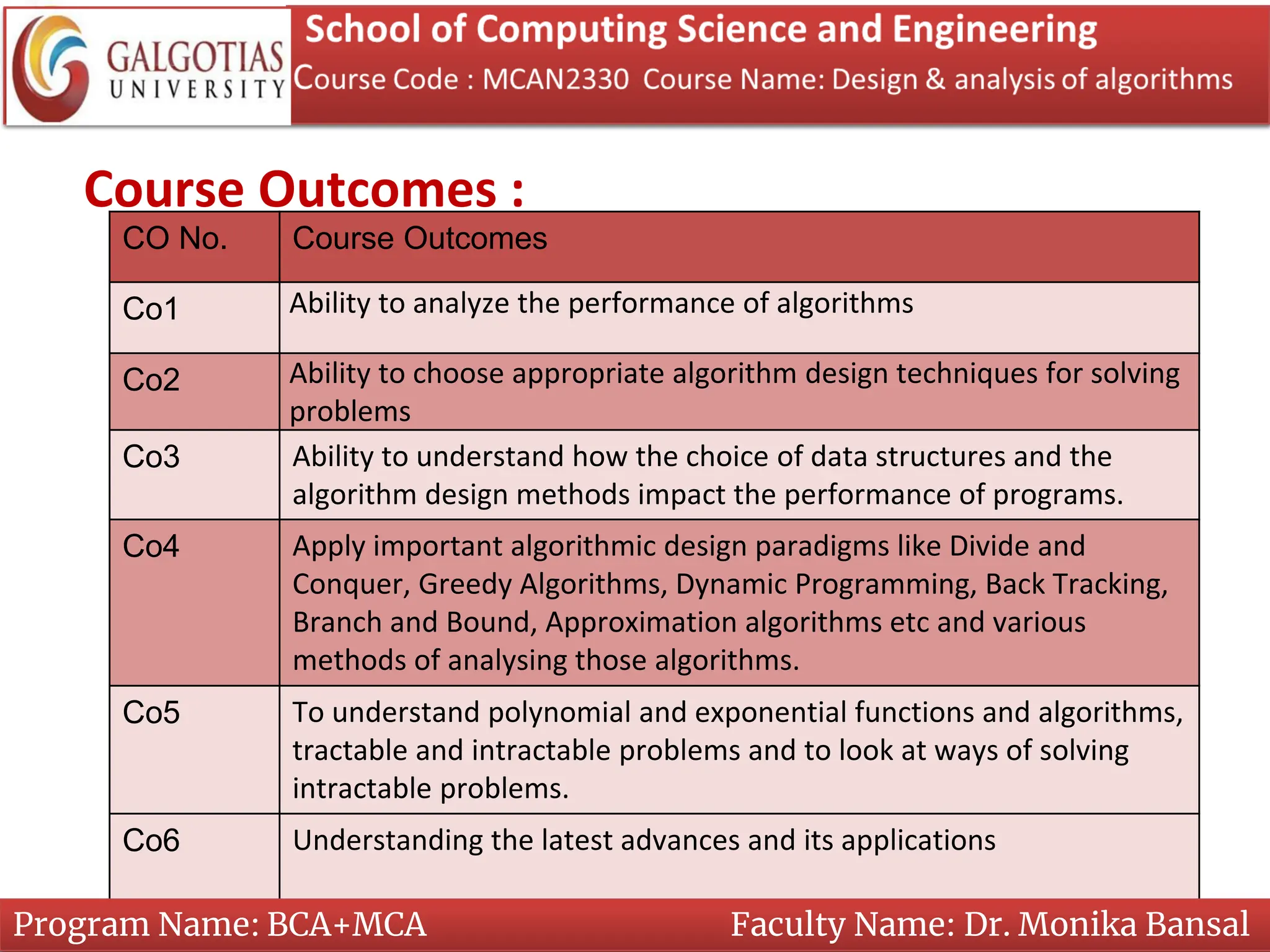
Course Outcomes :
CO No. Course Outcomes
Co1 Ability to analyze the performance of algorithms
Co2 Ability to choose appropriate algorithm design techniques for solving
problems
Co3 Ability to understand how the choice of data structures and the
algorithm design methods impact the performance of programs.
Co4 Apply important algorithmic design paradigms like Divide and
Conquer, Greedy Algorithms, Dynamic Programming, Back Tracking,
Branch and Bound, Approximation algorithms etc and various
methods of analysing those algorithms.
Co5 To understand polynomial and exponential functions and algorithms,
tractable and intractable problems and to look at ways of solving
intractable problems.
Co6 Understanding the latest advances and its applications
Program Name: BCA+MCA Faculty Name: Dr. Monika Bansal
Course Prerequisites
• Data Structure
Program Name: BCA+MCA Faculty Name: Dr. Monika Bansal
Syllabus
Unit I: Introduction to Algorithms
Unit II: Advanced Data Structure
Unit III: Advance Design and Analysis
Techniques
Unit IV: Graph Algorithms
Unit V: Advanced Algorithms Design
Unit VI: Research
Program Name: BCA+MCA Faculty Name: Dr. Monika Bansal
Recommended Books
Text Books:
T. Cormen, C.E. Leiserson, R.L. Rivest& C. Stein – Introduction to Algorithms – PHI
– 2nd Edition, 2005
Reference Book:
1. Knuth E. Donald, Art of Computer Programming Sorting and Searching Vol3,
Second Edition, Pearson Education.
2. Brassard Bratley, “Fundamental of Algorithms”, PHI
3. A V Ahoetal, “The Design and analysis of Algorithms”, Pearson Education
4. Adam Drozdek, “Data Structures and Algorithms in C++”, Thomson Asia
Program Name: BCA+MCA Faculty Name: Dr. Monika Bansal
Design and Analysis of Algorithms
• Analysis: predict the cost of an algorithm in
terms of resources and performance
• Design: design algorithms which minimize the
cost
Program Name: BCA+MCA Faculty Name: Dr. Monika Bansal
Our Machine Model
Generic Random Access Machine (RAM)
• Executes operations sequentially
• Set of primitive operations:
– Arithmetic. Logical, Comparisons, Function calls
• Simplifying assumption: all ops cost 1 unit
– Eliminates dependence on the speed of our computer,
otherwise impossible to verify and to compare
Program Name: BCA+MCA Faculty Name: Dr. Monika Bansal
Grading Scheme
Internal
Assessment
(IA)
Mid Term
Test (MTE)
End Term
Test (ETE)
Total
Marks
20 30 50 100
Program Name: BCA+MCA Faculty Name: Dr. Monika Bansal
Design and Analysis of Algorithms
• Analysis: predict the cost of an algorithm in
terms of resources and performance
• Design: design algorithms which minimize the
cost
Program Name: BCA+MCA Faculty Name: Dr. Monika Bansal
The problem of sorting
Input: sequence a1, a2, …, an of numbers.
Example:
Input: 8 2 4 9 3 6
Output: 2 3 4 6 8 9
Output: permutation a'1, a'2, …, a'n such
that a'1  a'2  …  a'n .
Program Name: BCA+MCA Faculty Name: Dr. Monika Bansal
Insertion sort
INSERTION-SORT (A, n) ⊳ A[1 . . n]
for j ← 2 to n
do key ← A[ j]
i ← j – 1
while i > 0 and A[i] > key
do A[i+1] ← A[i]
i ← i – 1
A[i+1] = key
“pseudocode”
i j
key
sorted
A:
1 n
Program Name: BCA+MCA Faculty Name: Dr. Monika Bansal
Example of insertion sort
8 2 4 9 3 6
Program Name: BCA+MCA Faculty Name: Dr. Monika Bansal
Example of insertion sort
8 2 4 9 3 6
Program Name: BCA+MCA Faculty Name: Dr. Monika Bansal
Example of insertion sort
8 2 4 9 3 6
2 8 4 9 3 6
Program Name: BCA+MCA Faculty Name: Dr. Monika Bansal
Example of insertion sort
8 2 4 9 3 6
2 8 4 9 3 6
Program Name: BCA+MCA Faculty Name: Dr. Monika Bansal
Example of insertion sort
8 2 4 9 3 6
2 8 4 9 3 6
2 4 8 9 3 6
Program Name: BCA+MCA Faculty Name: Dr. Monika Bansal
Example of insertion sort
8 2 4 9 3 6
2 8 4 9 3 6
2 4 8 9 3 6
Program Name: BCA+MCA Faculty Name: Dr. Monika Bansal
Example of insertion sort
8 2 4 9 3 6
2 8 4 9 3 6
2 4 8 9 3 6
2 4 8 9 3 6
Program Name: BCA+MCA Faculty Name: Dr. Monika Bansal
Example of insertion sort
8 2 4 9 3 6
2 8 4 9 3 6
2 4 8 9 3 6
2 4 8 9 3 6
Program Name: BCA+MCA Faculty Name: Dr. Monika Bansal
Example of insertion sort
8 2 4 9 3 6
2 8 4 9 3 6
2 4 8 9 3 6
2 4 8 9 3 6
2 3 4 8 9 6
Program Name: BCA+MCA Faculty Name: Dr. Monika Bansal
Example of insertion sort
8 2 4 9 3 6
2 8 4 9 3 6
2 4 8 9 3 6
2 4 8 9 3 6
2 3 4 8 9 6
Program Name: BCA+MCA Faculty Name: Dr. Monika Bansal
Example of insertion sort
8 2 4 9 3 6
2 8 4 9 3 6
2 4 8 9 3 6
2 4 8 9 3 6
2 3 4 8 9 6
2 3 4 6 8 9 done
Program Name: BCA+MCA Faculty Name: Dr. Monika Bansal
Running time
• The running time depends on the input: an
already sorted sequence is easier to sort.
• Major Simplifying Convention:
Parameterize the running time by the size of
the input, since short sequences are easier to
sort than long ones.
➢TA(n) = time of A on length n inputs
• Generally, we seek upper bounds on the
running time, to have a guarantee of
performance.
Program Name: BCA+MCA Faculty Name: Dr. Monika Bansal
Kinds of analyses
Worst-case: (usually)
• T(n) = maximum time of algorithm
on any input of size n.
Average-case: (sometimes)
• T(n) = expected time of algorithm
over all inputs of size n.
• Need assumption of statistical
distribution of inputs.
Best-case: (NEVER)
• Cheat with a slow algorithm that
works fast on some input.
Program Name: BCA+MCA Faculty Name: Dr. Monika Bansal
Machine-independent time
What is insertion sort’s worst-case time?
BIG IDEAS:
• Ignore machine dependent constants,
otherwise impossible to verify and to compare algorithms
• Look at growth of T(n) as n → ∞ .
“Asymptotic Analysis”
Program Name: BCA+MCA Faculty Name: Dr. Monika Bansal
Q-notation
• Drop low-order terms; ignore leading constants.
• Example: 3n3 + 90n2 – 5n + 6046 = Q(n3)
DEF:
Q(g(n)) = { f (n) : there exist positive constants c1, c2, and
n0 such that 0  c1 g(n)  f (n)  c2 g(n)
for all n  n0 }
Basic manipulations:
Program Name: BCA+MCA Faculty Name: Dr. Monika Bansal
Asymptotic performance
n
T(n)
n0
.
• Asymptotic analysis is a
useful tool to help to
structure our thinking
toward better algorithm
• We shouldn’t ignore
asymptotically slower
algorithms, however.
• Real-world design
situations often call for a
careful balancing
When n gets large enough, a Q(n2) algorithm
always beats a Q(n3) algorithm.
Program Name: BCA+MCA Faculty Name: Dr. Monika Bansal
Insertion sort analysis
Worst case: Input reverse sorted.
( )

=
Q
=
Q
=
n
j
n
j
n
T
2
2
)
(
)
(
Average case: All permutations equally likely.
( )

=
Q
=
Q
=
n
j
n
j
n
T
2
2
)
2
/
(
)
(
Is insertion sort a fast sorting algorithm?
• Moderately so, for small n.
• Not at all, for large n.
[arithmetic series]

1-introduction to Design and Analysis of Algorithms.pdf

  • 1.
    Program Name: BCA+MCAFaculty Name: Dr. Monika Bansal Program Name: BCA+MCA Faculty Name: Dr. Monika Bansal Program: BCA+MCA Course Code: MCAN2330 Course Name: Design & Analysis of Algorithms By: Dr. Monika Bansal Associate Professor, SCSE Program Name: BCA+MCA Faculty Name: Dr. Monika Bansal
  • 2.
    Program Name: BCA+MCAFaculty Name: Dr. Monika Bansal Program Name: BCA+MCA Faculty Name: Dr. Monika Bansal Program Name: Faculty Name: Course Outcomes : CO No. Course Outcomes Co1 Ability to analyze the performance of algorithms Co2 Ability to choose appropriate algorithm design techniques for solving problems Co3 Ability to understand how the choice of data structures and the algorithm design methods impact the performance of programs. Co4 Apply important algorithmic design paradigms like Divide and Conquer, Greedy Algorithms, Dynamic Programming, Back Tracking, Branch and Bound, Approximation algorithms etc and various methods of analysing those algorithms. Co5 To understand polynomial and exponential functions and algorithms, tractable and intractable problems and to look at ways of solving intractable problems. Co6 Understanding the latest advances and its applications Program Name: BCA+MCA Faculty Name: Dr. Monika Bansal
  • 3.
    Program Name: BCA+MCAFaculty Name: Dr. Monika Bansal Program Name: BCA+MCA Faculty Name: Dr. Monika Bansal Course Prerequisites • Data Structure Program Name: BCA+MCA Faculty Name: Dr. Monika Bansal
  • 4.
    Program Name: BCA+MCAFaculty Name: Dr. Monika Bansal Program Name: BCA+MCA Faculty Name: Dr. Monika Bansal Syllabus Unit I: Introduction to Algorithms Unit II: Advanced Data Structure Unit III: Advance Design and Analysis Techniques Unit IV: Graph Algorithms Unit V: Advanced Algorithms Design Unit VI: Research Program Name: BCA+MCA Faculty Name: Dr. Monika Bansal
  • 5.
    Program Name: BCA+MCAFaculty Name: Dr. Monika Bansal Program Name: BCA+MCA Faculty Name: Dr. Monika Bansal Recommended Books Text Books: T. Cormen, C.E. Leiserson, R.L. Rivest& C. Stein – Introduction to Algorithms – PHI – 2nd Edition, 2005 Reference Book: 1. Knuth E. Donald, Art of Computer Programming Sorting and Searching Vol3, Second Edition, Pearson Education. 2. Brassard Bratley, “Fundamental of Algorithms”, PHI 3. A V Ahoetal, “The Design and analysis of Algorithms”, Pearson Education 4. Adam Drozdek, “Data Structures and Algorithms in C++”, Thomson Asia Program Name: BCA+MCA Faculty Name: Dr. Monika Bansal
  • 6.
    Program Name: BCA+MCAFaculty Name: Dr. Monika Bansal Program Name: BCA+MCA Faculty Name: Dr. Monika Bansal Program Name: BCA+MCA Faculty Name: Dr. Monika Bansal Design and Analysis of Algorithms • Analysis: predict the cost of an algorithm in terms of resources and performance • Design: design algorithms which minimize the cost
  • 7.
    Program Name: BCA+MCAFaculty Name: Dr. Monika Bansal Program Name: BCA+MCA Faculty Name: Dr. Monika Bansal Program Name: BCA+MCA Faculty Name: Dr. Monika Bansal Our Machine Model Generic Random Access Machine (RAM) • Executes operations sequentially • Set of primitive operations: – Arithmetic. Logical, Comparisons, Function calls • Simplifying assumption: all ops cost 1 unit – Eliminates dependence on the speed of our computer, otherwise impossible to verify and to compare
  • 8.
    Program Name: BCA+MCAFaculty Name: Dr. Monika Bansal Grading Scheme Internal Assessment (IA) Mid Term Test (MTE) End Term Test (ETE) Total Marks 20 30 50 100
  • 9.
    Program Name: BCA+MCAFaculty Name: Dr. Monika Bansal Design and Analysis of Algorithms • Analysis: predict the cost of an algorithm in terms of resources and performance • Design: design algorithms which minimize the cost
  • 10.
    Program Name: BCA+MCAFaculty Name: Dr. Monika Bansal The problem of sorting Input: sequence a1, a2, …, an of numbers. Example: Input: 8 2 4 9 3 6 Output: 2 3 4 6 8 9 Output: permutation a'1, a'2, …, a'n such that a'1  a'2  …  a'n .
  • 11.
    Program Name: BCA+MCAFaculty Name: Dr. Monika Bansal Insertion sort INSERTION-SORT (A, n) ⊳ A[1 . . n] for j ← 2 to n do key ← A[ j] i ← j – 1 while i > 0 and A[i] > key do A[i+1] ← A[i] i ← i – 1 A[i+1] = key “pseudocode” i j key sorted A: 1 n
  • 12.
    Program Name: BCA+MCAFaculty Name: Dr. Monika Bansal Example of insertion sort 8 2 4 9 3 6
  • 13.
    Program Name: BCA+MCAFaculty Name: Dr. Monika Bansal Example of insertion sort 8 2 4 9 3 6
  • 14.
    Program Name: BCA+MCAFaculty Name: Dr. Monika Bansal Example of insertion sort 8 2 4 9 3 6 2 8 4 9 3 6
  • 15.
    Program Name: BCA+MCAFaculty Name: Dr. Monika Bansal Example of insertion sort 8 2 4 9 3 6 2 8 4 9 3 6
  • 16.
    Program Name: BCA+MCAFaculty Name: Dr. Monika Bansal Example of insertion sort 8 2 4 9 3 6 2 8 4 9 3 6 2 4 8 9 3 6
  • 17.
    Program Name: BCA+MCAFaculty Name: Dr. Monika Bansal Example of insertion sort 8 2 4 9 3 6 2 8 4 9 3 6 2 4 8 9 3 6
  • 18.
    Program Name: BCA+MCAFaculty Name: Dr. Monika Bansal Example of insertion sort 8 2 4 9 3 6 2 8 4 9 3 6 2 4 8 9 3 6 2 4 8 9 3 6
  • 19.
    Program Name: BCA+MCAFaculty Name: Dr. Monika Bansal Example of insertion sort 8 2 4 9 3 6 2 8 4 9 3 6 2 4 8 9 3 6 2 4 8 9 3 6
  • 20.
    Program Name: BCA+MCAFaculty Name: Dr. Monika Bansal Example of insertion sort 8 2 4 9 3 6 2 8 4 9 3 6 2 4 8 9 3 6 2 4 8 9 3 6 2 3 4 8 9 6
  • 21.
    Program Name: BCA+MCAFaculty Name: Dr. Monika Bansal Example of insertion sort 8 2 4 9 3 6 2 8 4 9 3 6 2 4 8 9 3 6 2 4 8 9 3 6 2 3 4 8 9 6
  • 22.
    Program Name: BCA+MCAFaculty Name: Dr. Monika Bansal Example of insertion sort 8 2 4 9 3 6 2 8 4 9 3 6 2 4 8 9 3 6 2 4 8 9 3 6 2 3 4 8 9 6 2 3 4 6 8 9 done
  • 23.
    Program Name: BCA+MCAFaculty Name: Dr. Monika Bansal Running time • The running time depends on the input: an already sorted sequence is easier to sort. • Major Simplifying Convention: Parameterize the running time by the size of the input, since short sequences are easier to sort than long ones. ➢TA(n) = time of A on length n inputs • Generally, we seek upper bounds on the running time, to have a guarantee of performance.
  • 24.
    Program Name: BCA+MCAFaculty Name: Dr. Monika Bansal Kinds of analyses Worst-case: (usually) • T(n) = maximum time of algorithm on any input of size n. Average-case: (sometimes) • T(n) = expected time of algorithm over all inputs of size n. • Need assumption of statistical distribution of inputs. Best-case: (NEVER) • Cheat with a slow algorithm that works fast on some input.
  • 25.
    Program Name: BCA+MCAFaculty Name: Dr. Monika Bansal Machine-independent time What is insertion sort’s worst-case time? BIG IDEAS: • Ignore machine dependent constants, otherwise impossible to verify and to compare algorithms • Look at growth of T(n) as n → ∞ . “Asymptotic Analysis”
  • 26.
    Program Name: BCA+MCAFaculty Name: Dr. Monika Bansal Q-notation • Drop low-order terms; ignore leading constants. • Example: 3n3 + 90n2 – 5n + 6046 = Q(n3) DEF: Q(g(n)) = { f (n) : there exist positive constants c1, c2, and n0 such that 0  c1 g(n)  f (n)  c2 g(n) for all n  n0 } Basic manipulations:
  • 27.
    Program Name: BCA+MCAFaculty Name: Dr. Monika Bansal Asymptotic performance n T(n) n0 . • Asymptotic analysis is a useful tool to help to structure our thinking toward better algorithm • We shouldn’t ignore asymptotically slower algorithms, however. • Real-world design situations often call for a careful balancing When n gets large enough, a Q(n2) algorithm always beats a Q(n3) algorithm.
  • 28.
    Program Name: BCA+MCAFaculty Name: Dr. Monika Bansal Insertion sort analysis Worst case: Input reverse sorted. ( )  = Q = Q = n j n j n T 2 2 ) ( ) ( Average case: All permutations equally likely. ( )  = Q = Q = n j n j n T 2 2 ) 2 / ( ) ( Is insertion sort a fast sorting algorithm? • Moderately so, for small n. • Not at all, for large n. [arithmetic series]