Introduction To Algorithms 4th Thomas H Cormen Charles E Leiserson
Introduction To Algorithms 4th Thomas H Cormen Charles E Leiserson
Introduction To Algorithms 4th Thomas H Cormen Charles E Leiserson
Introduction To Algorithms 4th Thomas H Cormen Charles E Leiserson
Introduction To Algorithms 4th Thomas H Cormen Charles E Leiserson
1.
Introduction To Algorithms4th Thomas H Cormen
Charles E Leiserson download
https://ebookbell.com/product/introduction-to-algorithms-4th-
thomas-h-cormen-charles-e-leiserson-49159656
Explore and download more ebooks at ebookbell.com
2.
Here are somerecommended products that we believe you will be
interested in. You can click the link to download.
Introduction To Algorithms Fourth Edition 4th Edition Thomas H Cormen
https://ebookbell.com/product/introduction-to-algorithms-fourth-
edition-4th-edition-thomas-h-cormen-47617544
Introduction To Algorithms And Data Structures 1 A Solid Foundation
For The Real World Of Machine Learning And Data Analytics Bolakale
Aremu
https://ebookbell.com/product/introduction-to-algorithms-and-data-
structures-1-a-solid-foundation-for-the-real-world-of-machine-
learning-and-data-analytics-bolakale-aremu-49988476
Introduction To Algorithms Data Structures 2 A Solid Foundation For
The Real World Of Machine Learning And Data Analytics Bolakale Aremu
https://ebookbell.com/product/introduction-to-algorithms-data-
structures-2-a-solid-foundation-for-the-real-world-of-machine-
learning-and-data-analytics-bolakale-aremu-49988480
Introduction To Algorithms 3rd Edition 3rd Edition Thomas H Cormen
https://ebookbell.com/product/introduction-to-algorithms-3rd-
edition-3rd-edition-thomas-h-cormen-50277138
3.
Introduction To AlgorithmsFlejoles Rp
https://ebookbell.com/product/introduction-to-algorithms-flejoles-
rp-51233584
Introduction To Algorithms Data Structures 3 Learn Linear Data
Structures With Videos Interview Questions 1st Edition Aremu Bolakale
https://ebookbell.com/product/introduction-to-algorithms-data-
structures-3-learn-linear-data-structures-with-videos-interview-
questions-1st-edition-aremu-bolakale-52327550
Cormen Thomas H Charles E Leiserson Ronald L Rivest Clifford Stein
Introduction To Algorithms Isbn 0262032937
https://ebookbell.com/product/cormen-thomas-h-charles-e-leiserson-
ronald-l-rivest-clifford-stein-introduction-to-algorithms-
isbn-0262032937-56389230
Introduction To Algorithms Thomas H Cormen
https://ebookbell.com/product/introduction-to-algorithms-thomas-h-
cormen-56401350
Introduction To Algorithms A Comprehensive Guide For Beginners
Unlocking Computational Thinking Technologies
https://ebookbell.com/product/introduction-to-algorithms-a-
comprehensive-guide-for-beginners-unlocking-computational-thinking-
technologies-57811906
Thomas H. Cormen
CharlesE. Leiserson
Ronald L. Rivest
Clifford Stein
Introduction to Algorithms
Fourth Edition
The MIT Press
Cambridge, Massachusetts London, England
10.
c
2022 Massachusetts Instituteof Technology
All rights reserved. No part of this book may be reproduced in any form or by any electronic or mechanical means
(including photocopying, recording, or information storage and retrieval) without permission in writing from the
publisher.
The MIT Press would like to thank the anonymous peer reviewers who provided comments on drafts of this book.
The generous work of academic experts is essential for establishing the authority and quality of our publications.
We acknowledge with gratitude the contributions of these otherwise uncredited readers.
This book was set in Times Roman and MathTime Professional II by the authors.
Names: Cormen, Thomas H., author. jLeiserson, Charles Eric, author. j
Rivest, Ronald L., author. jStein, Clifford, author.
Title: Introduction to algorithms / Thomas H. Cormen, Charles E. Leiserson,
Ronald L. Rivest, Clifford Stein.
Description: Fourth edition. jCambridge, Massachusetts : The MIT Press,
[2022] jIncludes bibliographical references and index.
Identiûers: LCCN 2021037260 jISBN 9780262046305
Subjects: LCSH: Computer programming. jComputer algorithms.
Classiûcation: LCC QA76.6 .C662 2022 jDDC 005.13--dc23
LC record available at http://lccn.loc.gov/2021037260
10 9 8 7 6 5 4 3 2 1
11.
Contents
Preface xiii
I Foundations
Introduction3
1 The Role of Algorithms in Computing 5
1.1 Algorithms 5
1.2 Algorithms as a technology 12
2 Getting Started 17
2.1 Insertion sort 17
2.2 Analyzing algorithms 25
2.3 Designing algorithms 34
3 Characterizing Running Times 49
3.1 O-notation, �-notation, and ‚-notation 50
3.2 Asymptotic notation: formal deûnitions 53
3.3 Standard notations and common functions 63
4 Divide-and-Conquer 76
4.1 Multiplying square matrices 80
4.2 Strassen’s algorithm for matrix multiplication 85
4.3 The substitution method for solving recurrences 90
4.4 The recursion-tree method for solving recurrences 95
4.5 The master method for solving recurrences 101
? 4.6 Proof of the continuous master theorem 107
? 4.7 Akra-Bazzi recurrences 115
12.
vi Contents
5 ProbabilisticAnalysis and Randomized Algorithms 126
5.1 The hiring problem 126
5.2 Indicator random variables 130
5.3 Randomized algorithms 134
? 5.4 Probabilistic analysis and further uses of indicator random variables
140
II Sorting and Order Statistics
Introduction 157
6 Heapsort 161
6.1 Heaps 161
6.2 Maintaining the heap property 164
6.3 Building a heap 167
6.4 The heapsort algorithm 170
6.5 Priority queues 172
7 Quicksort 182
7.1 Description of quicksort 183
7.2 Performance of quicksort 187
7.3 A randomized version of quicksort 191
7.4 Analysis of quicksort 193
8 Sorting in Linear Time 205
8.1 Lower bounds for sorting 205
8.2 Counting sort 208
8.3 Radix sort 211
8.4 Bucket sort 215
9 Medians and Order Statistics 227
9.1 Minimum and maximum 228
9.2 Selection in expected linear time 230
9.3 Selection in worst-case linear time 236
III Data Structures
Introduction 249
10 Elementary Data Structures 252
10.1 Simple array-based data structures: arrays, matrices, stacks, queues
252
10.2 Linked lists 258
10.3 Representing rooted trees 265
13.
Contents vii
11 HashTables 272
11.1 Direct-address tables 273
11.2 Hash tables 275
11.3 Hash functions 282
11.4 Open addressing 293
11.5 Practical considerations 301
12 Binary Search Trees 312
12.1 What is a binary search tree? 312
12.2 Querying a binary search tree 316
12.3 Insertion and deletion 321
13 Red-Black Trees 331
13.1 Properties of red-black trees 331
13.2 Rotations 335
13.3 Insertion 338
13.4 Deletion 346
IV Advanced Design and Analysis Techniques
Introduction 361
14 Dynamic Programming 362
14.1 Rod cutting 363
14.2 Matrix-chain multiplication 373
14.3 Elements of dynamic programming 382
14.4 Longest common subsequence 393
14.5 Optimal binary search trees 400
15 Greedy Algorithms 417
15.1 An activity-selection problem 418
15.2 Elements of the greedy strategy 426
15.3 Huffman codes 431
15.4 Ofüine caching 440
16 Amortized Analysis 448
16.1 Aggregate analysis 449
16.2 The accounting method 453
16.3 The potential method 456
16.4 Dynamic tables 460
14.
viii Contents
V AdvancedData Structures
Introduction 477
17 Augmenting Data Structures 480
17.1 Dynamic order statistics 480
17.2 How to augment a data structure 486
17.3 Interval trees 489
18 B-Trees 497
18.1 Deûnition of B-trees 501
18.2 Basic operations on B-trees 504
18.3 Deleting a key from a B-tree 513
19 Data Structures for Disjoint Sets 520
19.1 Disjoint-set operations 520
19.2 Linked-list representation of disjoint sets 523
19.3 Disjoint-set forests 527
? 19.4 Analysis of union by rank with path compression 531
VI Graph Algorithms
Introduction 547
20 Elementary Graph Algorithms 549
20.1 Representations of graphs 549
20.2 Breadth-ûrst search 554
20.3 Depth-ûrst search 563
20.4 Topological sort 573
20.5 Strongly connected components 576
21 Minimum Spanning Trees 585
21.1 Growing a minimum spanning tree 586
21.2 The algorithms of Kruskal and Prim 591
22 Single-Source Shortest Paths 604
22.1 The Bellman-Ford algorithm 612
22.2 Single-source shortest paths in directed acyclic graphs 616
22.3 Dijkstra’s algorithm 620
22.4 Difference constraints and shortest paths 626
22.5 Proofs of shortest-paths properties 633
15.
Contents ix
23 All-PairsShortest Paths 646
23.1 Shortest paths and matrix multiplication 648
23.2 The Floyd-Warshall algorithm 655
23.3 Johnson’s algorithm for sparse graphs 662
24 Maximum Flow 670
24.1 Flow networks 671
24.2 The Ford-Fulkerson method 676
24.3 Maximum bipartite matching 693
25 Matchings in Bipartite Graphs 704
25.1 Maximum bipartite matching (revisited) 705
25.2 The stable-marriage problem 716
25.3 The Hungarian algorithm for the assignment problem 723
VII Selected Topics
Introduction 745
26 Parallel Algorithms 748
26.1 The basics of fork-join parallelism 750
26.2 Parallel matrix multiplication 770
26.3 Parallel merge sort 775
27 Online Algorithms 791
27.1 Waiting for an elevator 792
27.2 Maintaining a search list 795
27.3 Online caching 802
28 Matrix Operations 819
28.1 Solving systems of linear equations 819
28.2 Inverting matrices 833
28.3 Symmetric positive-deûnite matrices and least-squares approximation
838
29 Linear Programming 850
29.1 Linear programming formulations and algorithms 853
29.2 Formulating problems as linear programs 860
29.3 Duality 866
30 Polynomials and the FFT 877
30.1 Representing polynomials 879
30.2 The DFT and FFT 885
30.3 FFT circuits 894
16.
x Contents
31 Number-TheoreticAlgorithms 903
31.1 Elementary number-theoretic notions 904
31.2 Greatest common divisor 911
31.3 Modular arithmetic 916
31.4 Solving modular linear equations 924
31.5 The Chinese remainder theorem 928
31.6 Powers of an element 932
31.7 The RSA public-key cryptosystem 936
? 31.8 Primality testing 942
32 String Matching 957
32.1 The naive string-matching algorithm 960
32.2 The Rabin-Karp algorithm 962
32.3 String matching with ûnite automata 967
? 32.4 The Knuth-Morris-Pratt algorithm 975
32.5 Sufûx arrays 985
33 Machine-Learning Algorithms 1003
33.1 Clustering 1005
33.2 Multiplicative-weights algorithms 1015
33.3 Gradient descent 1022
34 NP-Completeness 1042
34.1 Polynomial time 1048
34.2 Polynomial-time veriûcation 1056
34.3 NP-completeness and reducibility 1061
34.4 NP-completeness proofs 1072
34.5 NP-complete problems 1080
35 Approximation Algorithms 1104
35.1 The vertex-cover problem 1106
35.2 The traveling-salesperson problem 1109
35.3 The set-covering problem 1115
35.4 Randomization and linear programming 1119
35.5 The subset-sum problem 1124
VIII Appendix: Mathematical Background
Introduction 1139
A Summations 1140
A.1 Summation formulas and properties 1140
A.2 Bounding summations 1145
17.
Contents xi
B Sets,Etc. 1153
B.1 Sets 1153
B.2 Relations 1158
B.3 Functions 1161
B.4 Graphs 1164
B.5 Trees 1169
C Counting and Probability 1178
C.1 Counting 1178
C.2 Probability 1184
C.3 Discrete random variables 1191
C.4 The geometric and binomial distributions 1196
? C.5 The tails of the binomial distribution 1203
D Matrices 1214
D.1 Matrices and matrix operations 1214
D.2 Basic matrix properties 1219
Bibliography 1227
Index 1251
19.
Preface
Not so longago, anyone who had heard the word <algorithm= was almost certainly
a computer scientist or mathematician. With computers having become prevalent in
our modern lives, however, the term is no longer esoteric. If you look around your
home, you’ll ûnd algorithms running in the most mundane places: your microwave
oven, your washing machine, and, of course, your computer. You ask algorithms
to make recommendations to you: what music you might like or what route to
take when driving. Our society, for better or for worse, asks algorithms to suggest
sentences for convicted criminals. You even rely on algorithms to keep you alive,
or at least not to kill you: the control systems in your car or in medical equipment.1
The word <algorithm= appears somewhere in the news seemingly every day.
Therefore, it behooves you to understand algorithms not just as a student or
practitioner of computer science, but as a citizen of the world. Once you understand
algorithms, you can educate others about what algorithms are, how they operate,
and what their limitations are.
This book provides a comprehensive introduction to the modern study of com-
puter algorithms. It presents many algorithms and covers them in considerable
depth, yet makes their design accessible to all levels of readers. All the analyses
are laid out, some simple, some more involved. We have tried to keep explanations
clear without sacriûcing depth of coverage or mathematical rigor.
Each chapter presents an algorithm, a design technique, an application area, or a
related topic. Algorithms are described in English and in a pseudocode designed to
be readable by anyone who has done a little programming. The book contains 231
ûgures4many with multiple parts4illustrating how the algorithms work. Since
we emphasize efficiency as a design criterion, we include careful analyses of the
running times of the algorithms.
1 To understand many of the ways in which algorithms inüuence our daily lives, see the book by
Fry [162].
20.
xiv Preface
The textis intended primarily for use in undergraduate or graduate courses in
algorithms or data structures. Because it discusses engineering issues in algorithm
design, as well as mathematical aspects, it is equally well suited for self-study by
technical professionals.
In this, the fourth edition, we have once again updated the entire book. The
changes cover a broad spectrum, including new chapters and sections, color illus-
trations, and what we hope you’ll ûnd to be a more engaging writing style.
To the teacher
We have designed this book to be both versatile and complete. You should ûnd it
useful for a variety of courses, from an undergraduate course in data structures up
through a graduate course in algorithms. Because we have provided considerably
more material than can ût in a typical one-term course, you can select the material
that best supports the course you wish to teach.
You should ûnd it easy to organize your course around just the chapters you
need. We have made chapters relatively self-contained, so that you need not
worry about an unexpected and unnecessary dependence of one chapter on an-
other. Whereas in an undergraduate course, you might use only some sections
from a chapter, in a graduate course, you might cover the entire chapter.
We have included 931 exercises and 162 problems. Each section ends with exer-
cises, and each chapter ends with problems. The exercises are generally short ques-
tions that test basic mastery of the material. Some are simple self-check thought
exercises, but many are substantial and suitable as assigned homework. The prob-
lems include more elaborate case studies which often introduce new material. They
often consist of several parts that lead the student through the steps required to ar-
rive at a solution.
As with the third edition of this book, we have made publicly available solutions
to some, but by no means all, of the problems and exercises. You can ûnd these so-
lutions on our website, http://mitpress.mit.edu/algorithms/. You will want to check
this site to see whether it contains the solution to an exercise or problem that you
plan to assign. Since the set of solutions that we post might grow over time, we
recommend that you check the site each time you teach the course.
We have starred (?) the sections and exercises that are more suitable for graduate
students than for undergraduates. A starred section is not necessarily more difû-
cult than an unstarred one, but it may require an understanding of more advanced
mathematics. Likewise, starred exercises may require an advanced background or
more than average creativity.
21.
Preface xv
To thestudent
We hope that this textbook provides you with an enjoyable introduction to the ûeld
of algorithms. We have attempted to make every algorithm accessible and inter-
esting. To help you when you encounter unfamiliar or difûcult algorithms, we
describe each one in a step-by-step manner. We also provide careful explanations
of the mathematics needed to understand the analysis of the algorithms and sup-
porting ûgures to help you visualize what is going on.
Since this book is large, your class will probably cover only a portion of its
material. Although we hope that you will ûnd this book helpful to you as a course
textbook now, we have also tried to make it comprehensive enough to warrant space
on your future professional bookshelf.
What are the prerequisites for reading this book?
You need some programming experience. In particular, you should understand
recursive procedures and simple data structures, such as arrays and linked lists
(although Section 10.2 covers linked lists and a variant that you may ûnd new).
You should have some facility with mathematical proofs, and especially proofs
by mathematical induction. A few portions of the book rely on some knowledge
of elementary calculus. Although this book uses mathematics throughout, Part I
and Appendices A–D teach you all the mathematical techniques you will need.
Our website, http://mitpress.mit.edu/algorithms/, links to solutions for some of
the problems and exercises. Feel free to check your solutions against ours. We ask,
however, that you not send your solutions to us.
To the professional
The wide range of topics in this book makes it an excellent handbook on algo-
rithms. Because each chapter is relatively self-contained, you can focus on the
topics most relevant to you.
Since most of the algorithms we discuss have great practical utility, we address
implementation concerns and other engineering issues. We often provide practical
alternatives to the few algorithms that are primarily of theoretical interest.
If you wish to implement any of the algorithms, you should ûnd the transla-
tion of our pseudocode into your favorite programming language to be a fairly
straightforward task. We have designed the pseudocode to present each algorithm
clearly and succinctly. Consequently, we do not address error handling and other
software-engineering issues that require speciûc assumptions about your program-
ming environment. We attempt to present each algorithm simply and directly with-
out allowing the idiosyncrasies of a particular programming language to obscure its
essence. If you are used to 0-origin arrays, you might ûnd our frequent practice of
22.
xvi Preface
indexing arraysfrom 1 a minor stumbling block. You can always either subtract 1
from our indices or just overallocate the array and leave position 0 unused.
We understand that if you are using this book outside of a course, then you
might be unable to check your solutions to problems and exercises against solutions
provided by an instructor. Our website, http://mitpress.mit.edu/algorithms/, links
to solutions for some of the problems and exercises so that you can check your
work. Please do not send your solutions to us.
To our colleagues
We have supplied an extensive bibliography and pointers to the current literature.
Each chapter ends with a set of chapter notes that give historical details and ref-
erences. The chapter notes do not provide a complete reference to the whole ûeld
of algorithms, however. Though it may be hard to believe for a book of this size,
space constraints prevented us from including many interesting algorithms.
Despite myriad requests from students for solutions to problems and exercises,
we have adopted the policy of not citing references for them, removing the temp-
tation for students to look up a solution rather than to discover it themselves.
Changes for the fourth edition
As we said about the changes for the second and third editions, depending on how
you look at it, the book changed either not much or quite a bit. A quick look at the
table of contents shows that most of the third-edition chapters and sections appear
in the fourth edition. We removed three chapters and several sections, but we have
added three new chapters and several new sections apart from these new chapters.
We kept the hybrid organization from the ûrst three editions. Rather than
organizing chapters only by problem domains or only according to techniques,
this book incorporates elements of both. It contains technique-based chapters on
divide-and-conquer, dynamic programming, greedy algorithms, amortized analy-
sis, augmenting data structures, NP-completeness, and approximation algorithms.
But it also has entire parts on sorting, on data structures for dynamic sets, and on
algorithms for graph problems. We ûnd that although you need to know how to ap-
ply techniques for designing and analyzing algorithms, problems seldom announce
to you which techniques are most amenable to solving them.
Some of the changes in the fourth edition apply generally across the book, and
some are speciûc to particular chapters or sections. Here is a summary of the most
signiûcant general changes:
We added 140 new exercises and 22 new problems. We also improved many of
the old exercises and problems, often as the result of reader feedback. (Thanks
to all readers who made suggestions.)
23.
Preface xvii
Wehave color! With designers from the MIT Press, we selected a limited
palette, devised to convey information and to be pleasing to the eye. (We are
delighted to display red-black trees in4get this4red and black!) To enhance
readability, deûned terms, pseudocode comments, and page numbers in the in-
dex are in color.
Pseudocode procedures appear on a tan background to make them easier to spot,
and they do not necessarily appear on the page of their ûrst reference. When
they don’t, the text directs you to the relevant page. In the same vein, nonlocal
references to numbered equations, theorems, lemmas, and corollaries include
the page number.
We removed topics that were rarely taught. We dropped in their entirety the
chapters on Fibonacci heaps, van Emde Boas trees, and computational geom-
etry. In addition, the following material was excised: the maximum-subarray
problem, implementing pointers and objects, perfect hashing, randomly built
binary search trees, matroids, push-relabel algorithms for maximum üow, the
iterative fast Fourier transform method, the details of the simplex algorithm for
linear programming, and integer factorization. You can ûnd all the removed
material on our website, http://mitpress.mit.edu/algorithms/.
We reviewed the entire book and rewrote sentences, paragraphs, and sections
to make the writing clearer, more personal, and gender neutral. For example,
the <traveling-salesman problem= in the previous editions is now called the
<traveling-salesperson problem.= We believe that it is critically important for
engineering and science, including our own ûeld of computer science, to be
welcoming to everyone. (The one place that stumped us is in Chapter 13, which
requires a term for a parent’s sibling. Because the English language has no such
gender-neutral term, we regretfully stuck with <uncle.=)
The chapter notes, bibliography, and index were updated, reüecting the dra-
matic growth of the ûeld of algorithms since the third edition.
We corrected errors, posting most corrections on our website of third-edition
errata. Those that were reported while we were in full swing preparing this
edition were not posted, but were corrected in this edition. (Thanks again to all
readers who helped us identify issues.)
The speciûc changes for the fourth edition include the following:
We renamed Chapter 3 and added a section giving an overview of asymptotic
notation before delving into the formal deûnitions.
Chapter 4 underwent substantial changes to improve its mathematical founda-
tion and make it more robust and intuitive. The notion of an algorithmic re-
currence was introduced, and the topic of ignoring üoors and ceilings in recur-
24.
xviii Preface
rences wasaddressed more rigorously. The second case of the master theorem
incorporates polylogarithmic factors, and a rigorous proof of a <continuous=
version of the master theorem is now provided. We also present the powerful
and general Akra-Bazzi method (without proof).
The deterministic order-statistic algorithm in Chapter 9 is slightly different, and
the analyses of both the randomized and deterministic order-statistic algorithms
have been revamped.
In addition to stacks and queues, Section 10.1 discusses ways to store arrays
and matrices.
Chapter 11 on hash tables includes a modern treatment of hash functions. It
also emphasizes linear probing as an efûcient method for resolving collisions
when the underlying hardware implements caching to favor local searches.
To replace the sections on matroids in Chapter 15, we converted a problem in
the third edition about ofüine caching into a full section.
Section 16.4 now contains a more intuitive explanation of the potential func-
tions to analyze table doubling and halving.
Chapter 17 on augmenting data structures was relocated from Part III to Part V,
reüecting our view that this technique goes beyond basic material.
Chapter 25 is a new chapter about matchings in bipartite graphs. It presents
algorithms to ûnd a matching of maximum cardinality, to solve the stable-
marriage problem, and to ûnd a maximum-weight matching (known as the <as-
signment problem=).
Chapter 26, on task-parallel computing, has been updated with modern termi-
nology, including the name of the chapter.
Chapter 27, which covers online algorithms, is another new chapter. In an
online algorithm, the input arrives over time, rather than being available in its
entirety at the start of the algorithm. The chapter describes several examples
of online algorithms, including determining how long to wait for an elevator
before taking the stairs, maintaining a linked list via the move-to-front heuristic,
and evaluating replacement policies for caches.
In Chapter 29, we removed the detailed presentation of the simplex algorithm,
as it was math heavy without really conveying many algorithmic ideas. The
chapter now focuses on the key aspect of how to model problems as linear
programs, along with the essential duality property of linear programming.
Section 32.5 adds to the chapter on string matching the simple, yet powerful,
structure of sufûx arrays.
25.
Preface xix
Chapter33, on machine learning, is the third new chapter. It introduces sev-
eral basic methods used in machine learning: clustering to group similar items
together, weighted-majority algorithms, and gradient descent to ûnd the mini-
mizer of a function.
Section 34.5.6 summarizes strategies for polynomial-time reductions to show
that problems are NP-hard.
The proof of the approximation algorithm for the set-covering problem in Sec-
tion 35.3 has been revised.
Website
You can use our website, http://mitpress.mit.edu/algorithms/, to obtain supplemen-
tary information and to communicate with us. The website links to a list of known
errors, material from the third edition that is not included in the fourth edition,
solutions to selected exercises and problems, Python implementations of many of
the algorithms in this book, a list explaining the corny professor jokes (of course),
as well as other content, which we may add to. The website also tells you how to
report errors or make suggestions.
How we produced this book
Like the previous three editions, the fourth edition was produced in L
A
TEX 2". We
used the Times font with mathematics typeset using the MathTime Professional II
fonts. As in all previous editions, we compiled the index using Windex, a C pro-
gram that we wrote, and produced the bibliography using BIBTEX. The PDF ûles
for this book were created on a MacBook Pro running macOS 10.14.
Our plea to Apple in the preface of the third edition to update MacDraw Pro for
macOS 10 went for naught, and so we continued to draw illustrations on pre-Intel
Macs running MacDraw Pro under the Classic environment of older versions of
macOS 10. Many of the mathematical expressions appearing in illustrations were
laid in with the psfrag package for L
A
TEX 2".
Acknowledgments for the fourth edition
We have been working with the MIT Press since we started writing the ûrst edi-
tion in 1987, collaborating with several directors, editors, and production staff.
Throughout our association with the MIT Press, their support has always been out-
standing. Special thanks to our editors Marie Lee, who put up with us for far too
long, and Elizabeth Swayze, who pushed us over the ûnish line. Thanks also to
Director Amy Brand and to Alex Hoopes.
26.
xx Preface
As inthe third edition, we were geographically distributed while producing
the fourth edition, working in the Dartmouth College Department of Computer
Science; the MIT Computer Science and Artiûcial Intelligence Laboratory and
the MIT Department of Electrical Engineering and Computer Science; and the
Columbia University Department of Industrial Engineering and Operations Re-
search, Department of Computer Science, and Data Science Institute. During the
COVID-19 pandemic, we worked largely from home. We thank our respective
universities and colleagues for providing such supportive and stimulating environ-
ments. As we complete this book, those of us who are not retired are eager to return
to our respective universities now that the pandemic seems to be abating.
Julie Sussman, P.P.A., came to our rescue once again with her technical copy-
editing under tremendous time pressure. If not for Julie, this book would be riddled
with errors (or, let’s say, many more errors than it has) and would be far less read-
able. Julie, we will be forever indebted to you. Errors that remain are the responsi-
bility of the authors (and probably were inserted after Julie read the material).
Dozens of errors in previous editions were corrected in the process of creating
this edition. We thank our readers4too many to list them all4who have reported
errors and suggested improvements over the years.
We received considerable help in preparing some of the new material in this
edition. Neville Campbell (unafûliated), Bill Kuszmaul of MIT, and Chee Yap of
NYU provided valuable advice regarding the treatment of recurrences in Chapter 4.
Yan Gu of the University of California, Riverside, provided feedback on parallel
algorithms in Chapter 26. Rob Shapire of Microsoft Research altered our approach
to the material on machine learning with his detailed comments on Chapter 33. Qi
Qi of MIT helped with the analysis of the Monty Hall problem (Problem C-1).
Molly Seaman and Mary Reilly of the MIT Press helped us select the color
palette in the illustrations, and Wojciech Jarosz of Dartmouth College suggested
design improvements to our newly colored ûgures. Yichen (Annie) Ke and Linda
Xiao, who have since graduated from Dartmouth, aided in colorizing the illus-
trations, and Linda also produced many of the Python implementations that are
available on the book’s website.
Finally, we thank our wives4Wendy Leiserson, Gail Rivest, Rebecca Ivry, and
the late Nicole Cormen4and our families. The patience and encouragement of
those who love us made this project possible. We affectionately dedicate this book
to them.
THOMAS H. CORMEN Lebanon, New Hampshire
CHARLES E. LEISERSON Cambridge, Massachusetts
RONALD L. RIVEST Cambridge, Massachusetts
CLIFFORD STEIN New York, New York
June, 2021
Introduction
When you designand analyze algorithms, you need to be able to describe how they
operate and how to design them. You also need some mathematical tools to show
that your algorithms do the right thing and do it efûciently. This part will get you
started. Later parts of this book will build upon this base.
Chapter 1 provides an overview of algorithms and their place in modern com-
puting systems. This chapter deûnes what an algorithm is and lists some examples.
It also makes a case for considering algorithms as a technology, alongside tech-
nologies such as fast hardware, graphical user interfaces, object-oriented systems,
and networks.
In Chapter 2, we see our ûrst algorithms, which solve the problem of sorting
a sequence of n numbers. They are written in a pseudocode which, although not
directly translatable to any conventional programming language, conveys the struc-
ture of the algorithm clearly enough that you should be able to implement it in the
language of your choice. The sorting algorithms we examine are insertion sort,
which uses an incremental approach, and merge sort, which uses a recursive tech-
nique known as <divide-and-conquer.= Although the time each requires increases
with the value of n, the rate of increase differs between the two algorithms. We
determine these running times in Chapter 2, and we develop a useful <asymptotic=
notation to express them.
Chapter 3 precisely deûnes asymptotic notation. We’ll use asymptotic notation
to bound the growth of functions4most often, functions that describe the running
time of algorithms4from above and below. The chapter starts by informally deûn-
ing the most commonly used asymptotic notations and giving an example of how to
apply them. It then formally deûnes ûve asymptotic notations and presents conven-
tions for how to put them together. The rest of Chapter 3 is primarily a presentation
of mathematical notation, more to ensure that your use of notation matches that in
this book than to teach you new mathematical concepts.
30.
4 Part IFoundations
Chapter 4 delves further into the divide-and-conquer method introduced in
Chapter 2. It provides two additional examples of divide-and-conquer algorithms
for multiplying square matrices, including Strassen’s surprising method. Chapter 4
contains methods for solving recurrences, which are useful for describing the run-
ning times of recursive algorithms. In the substitution method, you guess an answer
and prove it correct. Recursion trees provide one way to generate a guess. Chap-
ter 4 also presents the powerful technique of the <master method,= which you can
often use to solve recurrences that arise from divide-and-conquer algorithms. Al-
though the chapter provides a proof of a foundational theorem on which the master
theorem depends, you should feel free to employ the master method without delv-
ing into the proof. Chapter 4 concludes with some advanced topics.
Chapter 5 introduces probabilistic analysis and randomized algorithms. You
typically use probabilistic analysis to determine the running time of an algorithm
in cases in which, due to the presence of an inherent probability distribution, the
running time may differ on different inputs of the same size. In some cases, you
might assume that the inputs conform to a known probability distribution, so that
you are averaging the running time over all possible inputs. In other cases, the
probability distribution comes not from the inputs but from random choices made
during the course of the algorithm. An algorithm whose behavior is determined
not only by its input but by the values produced by a random-number generator is a
randomized algorithm. You can use randomized algorithms to enforce a probability
distribution on the inputs4thereby ensuring that no particular input always causes
poor performance4or even to bound the error rate of algorithms that are allowed
to produce incorrect results on a limited basis.
Appendices A–D contain other mathematical material that you will ûnd helpful
as you read this book. You might have seen much of the material in the appendix
chapters before having read this book (although the speciûc deûnitions and nota-
tional conventions we use may differ in some cases from what you have seen in
the past), and so you should think of the appendices as reference material. On the
other hand, you probably have not already seen most of the material in Part I. All
the chapters in Part I and the appendices are written with a tutorial üavor.
31.
1 The Roleof Algorithms in Computing
What are algorithms? Why is the study of algorithms worthwhile? What is the role
of algorithms relative to other technologies used in computers? This chapter will
answer these questions.
1.1 Algorithms
Informally, an algorithm is any well-deûned computational procedure that takes
some value, or set of values, as input and produces some value, or set of values, as
output in a ûnite amount of time. An algorithm is thus a sequence of computational
steps that transform the input into the output.
You can also view an algorithm as a tool for solving a well-speciûed computa-
tional problem. The statement of the problem speciûes in general terms the desired
input/output relationship for problem instances, typically of arbitrarily large size.
The algorithm describes a speciûc computational procedure for achieving that in-
put/output relationship for all problem instances.
As an example, suppose that you need to sort a sequence of numbers into mono-
tonically increasing order. This problem arises frequently in practice and provides
fertile ground for introducing many standard design techniques and analysis tools.
Here is how we formally deûne the sorting problem:
Input: A sequence of n numbers ha1; a2; : : : ; ani.
Output: A permutation (reordering) ha0
1; a0
2; : : : ; a0
ni of the input sequence such
that a0
1 හ a0
2 හ හ a0
n.
Thus, given the input sequence h31; 41; 59; 26; 41; 58i, a correct sorting algorithm
returns as output the sequence h26; 31; 41; 41; 58; 59i. Such an input sequence is
32.
6 Chapter 1The Role of Algorithms in Computing
called an instance of the sorting problem. In general, an instance of a problem1
consists of the input (satisfying whatever constraints are imposed in the problem
statement) needed to compute a solution to the problem.
Because many programs use it as an intermediate step, sorting is a fundamental
operation in computer science. As a result, you have a large number of good sort-
ing algorithms at your disposal. Which algorithm is best for a given application
depends on4among other factors4the number of items to be sorted, the extent
to which the items are already somewhat sorted, possible restrictions on the item
values, the architecture of the computer, and the kind of storage devices to be used:
main memory, disks, or even4archaically4tapes.
An algorithm for a computational problem is correct if, for every problem in-
stance provided as input, it halts4ûnishes its computing in ûnite time4and out-
puts the correct solution to the problem instance. A correct algorithm solves the
given computational problem. An incorrect algorithm might not halt at all on some
input instances, or it might halt with an incorrect answer. Contrary to what you
might expect, incorrect algorithms can sometimes be useful, if you can control
their error rate. We’ll see an example of an algorithm with a controllable error rate
in Chapter 31 when we study algorithms for ûnding large prime numbers. Ordi-
narily, however, we’ll concern ourselves only with correct algorithms.
An algorithm can be speciûed in English, as a computer program, or even as
a hardware design. The only requirement is that the speciûcation must provide a
precise description of the computational procedure to be followed.
What kinds of problems are solved by algorithms?
Sorting is by no means the only computational problem for which algorithms have
been developed. (You probably suspected as much when you saw the size of this
book.) Practical applications of algorithms are ubiquitous and include the follow-
ing examples:
The Human Genome Project has made great progress toward the goals of iden-
tifying all the roughly 30,000 genes in human DNA, determining the sequences
of the roughly 3 billion chemical base pairs that make up human DNA, stor-
ing this information in databases, and developing tools for data analysis. Each
of these steps requires sophisticated algorithms. Although the solutions to the
various problems involved are beyond the scope of this book, many methods to
solve these biological problems use ideas presented here, enabling scientists to
accomplish tasks while using resources efûciently. Dynamic programming, as
1 Sometimes, when the problem context is known, problem instances are themselves simply called
<problems.=
33.
1.1 Algorithms 7
inChapter 14, is an important technique for solving several of these biological
problems, particularly ones that involve determining similarity between DNA
sequences. The savings realized are in time, both human and machine, and in
money, as more information can be extracted by laboratory techniques.
The internet enables people all around the world to quickly access and retrieve
large amounts of information. With the aid of clever algorithms, sites on the
internet are able to manage and manipulate this large volume of data. Exam-
ples of problems that make essential use of algorithms include ûnding good
routes on which the data travels (techniques for solving such problems appear
in Chapter 22), and using a search engine to quickly ûnd pages on which par-
ticular information resides (related techniques are in Chapters 11 and 32).
Electronic commerce enables goods and services to be negotiated and ex-
changed electronically, and it depends on the privacy of personal informa-
tion such as credit card numbers, passwords, and bank statements. The core
technologies used in electronic commerce include public-key cryptography and
digital signatures (covered in Chapter 31), which are based on numerical algo-
rithms and number theory.
Manufacturing and other commercial enterprises often need to allocate scarce
resources in the most beneûcial way. An oil company might wish to know
where to place its wells in order to maximize its expected proût. A political
candidate might want to determine where to spend money buying campaign ad-
vertising in order to maximize the chances of winning an election. An airline
might wish to assign crews to üights in the least expensive way possible, mak-
ing sure that each üight is covered and that government regulations regarding
crew scheduling are met. An internet service provider might wish to determine
where to place additional resources in order to serve its customers more effec-
tively. All of these are examples of problems that can be solved by modeling
them as linear programs, which Chapter 29 explores.
Although some of the details of these examples are beyond the scope of this
book, we do give underlying techniques that apply to these problems and problem
areas. We also show how to solve many speciûc problems, including the following:
You have a road map on which the distance between each pair of adjacent in-
tersections is marked, and you wish to determine the shortest route from one
intersection to another. The number of possible routes can be huge, even if you
disallow routes that cross over themselves. How can you choose which of all
possible routes is the shortest? You can start by modeling the road map (which
is itself a model of the actual roads) as a graph (which we will meet in Part VI
and Appendix B). In this graph, you wish to ûnd the shortest path from one
vertex to another. Chapter 22 shows how to solve this problem efûciently.
34.
8 Chapter 1The Role of Algorithms in Computing
Given a mechanical design in terms of a library of parts, where each part may
include instances of other parts, list the parts in order so that each part appears
before any part that uses it. If the design comprises n parts, then there are nŠ
possible orders, where nŠ denotes the factorial function. Because the factorial
function grows faster than even an exponential function, you cannot feasibly
generate each possible order and then verify that, within that order, each part
appears before the parts using it (unless you have only a few parts). This prob-
lem is an instance of topological sorting, and Chapter 20 shows how to solve
this problem efûciently.
A doctor needs to determine whether an image represents a cancerous tumor or
a benign one. The doctor has available images of many other tumors, some of
which are known to be cancerous and some of which are known to be benign.
A cancerous tumor is likely to be more similar to other cancerous tumors than
to benign tumors, and a benign tumor is more likely to be similar to other be-
nign tumors. By using a clustering algorithm, as in Chapter 33, the doctor can
identify which outcome is more likely.
You need to compress a large ûle containing text so that it occupies less space.
Many ways to do so are known, including <LZW compression,= which looks for
repeating character sequences. Chapter 15 studies a different approach, <Huff-
man coding,= which encodes characters by bit sequences of various lengths,
with characters occurring more frequently encoded by shorter bit sequences.
These lists are far from exhaustive (as you again have probably surmised from
this book’s heft), but they exhibit two characteristics common to many interesting
algorithmic problems:
1. They have many candidate solutions, the overwhelming majority of which do
not solve the problem at hand. Finding one that does, or one that is <best,= with-
out explicitly examining each possible solution, can present quite a challenge.
2. They have practical applications. Of the problems in the above list, ûnding the
shortest path provides the easiest examples. A transportation ûrm, such as a
trucking or railroad company, has a ûnancial interest in ûnding shortest paths
through a road or rail network because taking shorter paths results in lower
labor and fuel costs. Or a routing node on the internet might need to ûnd the
shortest path through the network in order to route a message quickly. Or a
person wishing to drive from New York to Boston might want to ûnd driving
directions using a navigation app.
Not every problem solved by algorithms has an easily identiûed set of candi-
date solutions. For example, given a set of numerical values representing samples
of a signal taken at regular time intervals, the discrete Fourier transform converts
35.
1.1 Algorithms 9
thetime domain to the frequency domain. That is, it approximates the signal as a
weighted sum of sinusoids, producing the strength of various frequencies which,
when summed, approximate the sampled signal. In addition to lying at the heart of
signal processing, discrete Fourier transforms have applications in data compres-
sion and multiplying large polynomials and integers. Chapter 30 gives an efûcient
algorithm, the fast Fourier transform (commonly called the FFT), for this problem.
The chapter also sketches out the design of a hardware FFT circuit.
Data structures
This book also presents several data structures. A data structure is a way to store
and organize data in order to facilitate access and modiûcations. Using the appro-
priate data structure or structures is an important part of algorithm design. No sin-
gle data structure works well for all purposes, and so you should know the strengths
and limitations of several of them.
Technique
Although you can use this book as a <cookbook= for algorithms, you might some-
day encounter a problem for which you cannot readily ûnd a published algorithm
(many of the exercises and problems in this book, for example). This book will
teach you techniques of algorithm design and analysis so that you can develop al-
gorithms on your own, show that they give the correct answer, and analyze their ef-
ûciency. Different chapters address different aspects of algorithmic problem solv-
ing. Some chapters address speciûc problems, such as ûnding medians and order
statistics in Chapter 9, computing minimum spanning trees in Chapter 21, and de-
termining a maximum üow in a network in Chapter 24. Other chapters introduce
techniques, such as divide-and-conquer in Chapters 2 and 4, dynamic programming
in Chapter 14, and amortized analysis in Chapter 16.
Hard problems
Most of this book is about efûcient algorithms. Our usual measure of efûciency
is speed: how long does an algorithm take to produce its result? There are some
problems, however, for which we know of no algorithm that runs in a reasonable
amount of time. Chapter 34 studies an interesting subset of these problems, which
are known as NP-complete.
Why are NP-complete problems interesting? First, although no efûcient algo-
rithm for an NP-complete problem has ever been found, nobody has ever proven
that an efûcient algorithm for one cannot exist. In other words, no one knows
whether efûcient algorithms exist for NP-complete problems. Second, the set of
36.
10 Chapter 1The Role of Algorithms in Computing
NP-complete problems has the remarkable property that if an efûcient algorithm
exists for any one of them, then efûcient algorithms exist for all of them. This re-
lationship among the NP-complete problems makes the lack of efûcient solutions
all the more tantalizing. Third, several NP-complete problems are similar, but not
identical, to problems for which we do know of efûcient algorithms. Computer
scientists are intrigued by how a small change to the problem statement can cause
a big change to the efûciency of the best known algorithm.
You should know about NP-complete problems because some of them arise sur-
prisingly often in real applications. If you are called upon to produce an efûcient
algorithm for an NP-complete problem, you are likely to spend a lot of time in a
fruitless search. If, instead, you can show that the problem is NP-complete, you
can spend your time developing an efûcient approximation algorithm, that is, an
algorithm that gives a good, but not necessarily the best possible, solution.
As a concrete example, consider a delivery company with a central depot. Each
day, it loads up delivery trucks at the depot and sends them around to deliver goods
to several addresses. At the end of the day, each truck must end up back at the depot
so that it is ready to be loaded for the next day. To reduce costs, the company wants
to select an order of delivery stops that yields the lowest overall distance traveled by
each truck. This problem is the well-known <traveling-salesperson problem,= and it
is NP-complete.2
It has no known efûcient algorithm. Under certain assumptions,
however, we know of efûcient algorithms that compute overall distances close to
the smallest possible. Chapter 35 discusses such <approximation algorithms.=
Alternative computing models
For many years, we could count on processor clock speeds increasing at a steady
rate. Physical limitations present a fundamental roadblock to ever-increasing clock
speeds, however: because power density increases superlinearly with clock speed,
chips run the risk of melting once their clock speeds become high enough. In or-
der to perform more computations per second, therefore, chips are being designed
to contain not just one but several processing <cores.= We can liken these multi-
core computers to several sequential computers on a single chip. In other words,
they are a type of <parallel computer.= In order to elicit the best performance
from multicore computers, we need to design algorithms with parallelism in mind.
Chapter 26 presents a model for =task-parallel= algorithms, which take advantage
of multiple processing cores. This model has advantages from both theoretical and
2 To be precise, only decision problems4those with a <yes/no= answer4can be NP-complete. The
decision version of the traveling salesperson problem asks whether there exists an order of stops
whose distance totals at most a given amount.
37.
1.1 Algorithms 11
practicalstandpoints, and many modern parallel-programming platforms embrace
something similar to this model of parallelism.
Most of the examples in this book assume that all of the input data are available
when an algorithm begins running. Much of the work in algorithm design makes
the same assumption. For many important real-world examples, however, the input
actually arrives over time, and the algorithm must decide how to proceed without
knowing what data will arrive in the future. In a data center, jobs are constantly
arriving and departing, and a scheduling algorithm must decide when and where to
run a job, without knowing what jobs will be arriving in the future. Trafûc must
be routed in the internet based on the current state, without knowing about where
trafûc will arrive in the future. Hospital emergency rooms make triage decisions
about which patients to treat ûrst without knowing when other patients will be
arriving in the future and what treatments they will need. Algorithms that receive
their input over time, rather than having all the input present at the start, are online
algorithms, which Chapter 27 examines.
Exercises
1.1-1
Describe your own real-world example that requires sorting. Describe one that
requires ûnding the shortest distance between two points.
1.1-2
Other than speed, what other measures of efûciency might you need to consider in
a real-world setting?
1.1-3
Select a data structure that you have seen, and discuss its strengths and limitations.
1.1-4
How are the shortest-path and traveling-salesperson problems given above similar?
How are they different?
1.1-5
Suggest a real-world problem in which only the best solution will do. Then come
up with one in which <approximately= the best solution is good enough.
1.1-6
Describe a real-world problem in which sometimes the entire input is available
before you need to solve the problem, but other times the input is not entirely
available in advance and arrives over time.
38.
12 Chapter 1The Role of Algorithms in Computing
1.2 Algorithms as a technology
If computers were inûnitely fast and computer memory were free, would you have
any reason to study algorithms? The answer is yes, if for no other reason than that
you would still like to be certain that your solution method terminates and does so
with the correct answer.
If computers were inûnitely fast, any correct method for solving a problem
would do. You would probably want your implementation to be within the bounds
of good software engineering practice (for example, your implementation should
be well designed and documented), but you would most often use whichever
method was the easiest to implement.
Of course, computers may be fast, but they are not inûnitely fast. Computing
time is therefore a bounded resource, which makes it precious. Although the saying
goes, <Time is money,= time is even more valuable than money: you can get back
money after you spend it, but once time is spent, you can never get it back. Memory
may be inexpensive, but it is neither inûnite nor free. You should choose algorithms
that use the resources of time and space efûciently.
Efûciency
Different algorithms devised to solve the same problem often differ dramatically in
their efûciency. These differences can be much more signiûcant than differences
due to hardware and software.
As an example, Chapter 2 introduces two algorithms for sorting. The ûrst,
known as insertion sort, takes time roughly equal to c1n2 to sort n items, where c1
is a constant that does not depend on n. That is, it takes time roughly proportional
to n2. The second, merge sort, takes time roughly equal to c2n lg n, where lg n
stands for log2 n and c2 is another constant that also does not depend on n. Inser-
tion sort typically has a smaller constant factor than merge sort, so that c1 < c2.
We’ll see that the constant factors can have far less of an impact on the running
time than the dependence on the input size n. Let’s write insertion sort’s running
time as c1n n and merge sort’s running time as c2n lg n. Then we see that where
insertion sort has a factor of n in its running time, merge sort has a factor of lg n,
which is much smaller. For example, when n is 1000, lg n is approximately 10, and
when n is 1,000,000, lg n is approximately only 20. Although insertion sort usu-
ally runs faster than merge sort for small input sizes, once the input size n becomes
large enough, merge sort’s advantage of lg n versus n more than compensates for
the difference in constant factors. No matter how much smaller c1 is than c2, there
is always a crossover point beyond which merge sort is faster.
39.
1.2 Algorithms asa technology 13
For a concrete example, let us pit a faster computer (computer A) running inser-
tion sort against a slower computer (computer B) running merge sort. They each
must sort an array of 10 million numbers. (Although 10 million numbers might
seem like a lot, if the numbers are eight-byte integers, then the input occupies
about 80 megabytes, which ûts in the memory of even an inexpensive laptop com-
puter many times over.) Suppose that computer A executes 10 billion instructions
per second (faster than any single sequential computer at the time of this writing)
and computer B executes only 10 million instructions per second (much slower
than most contemporary computers), so that computer A is 1000 times faster than
computer B in raw computing power. To make the difference even more dramatic,
suppose that the world’s craftiest programmer codes insertion sort in machine lan-
guage for computer A, and the resulting code requires 2n2 instructions to sort n
numbers. Suppose further that just an average programmer implements merge
sort, using a high-level language with an inefûcient compiler, with the resulting
code taking 50 n lg n instructions. To sort 10 million numbers, computer A takes
2 .107/2 instructions
1010 instructions/second
D 20,000 seconds (more than 5:5 hours) ;
while computer B takes
50 107 lg 107 instructions
107 instructions/second
1163 seconds (under 20 minutes) :
By using an algorithm whose running time grows more slowly, even with a poor
compiler, computer B runs more than 17 times faster than computer A! The ad-
vantage of merge sort is even more pronounced when sorting 100 million numbers:
where insertion sort takes more than 23 days, merge sort takes under four hours.
Although 100 million might seem like a large number, there are more than 100 mil-
lion web searches every half hour, more than 100 million emails sent every minute,
and some of the smallest galaxies (known as ultra-compact dwarf galaxies) con-
tain about 100 million stars. In general, as the problem size increases, so does the
relative advantage of merge sort.
Algorithms and other technologies
The example above shows that you should consider algorithms, like computer hard-
ware, as a technology. Total system performance depends on choosing efûcient
algorithms as much as on choosing fast hardware. Just as rapid advances are being
made in other computer technologies, they are being made in algorithms as well.
You might wonder whether algorithms are truly that important on contemporary
computers in light of other advanced technologies, such as
40.
14 Chapter 1The Role of Algorithms in Computing
advanced computer architectures and fabrication technologies,
easy-to-use, intuitive, graphical user interfaces (GUIs),
object-oriented systems,
integrated web technologies,
fast networking, both wired and wireless,
machine learning,
and mobile devices.
The answer is yes. Although some applications do not explicitly require algorith-
mic content at the application level (such as some simple, web-based applications),
many do. For example, consider a web-based service that determines how to travel
from one location to another. Its implementation would rely on fast hardware, a
graphical user interface, wide-area networking, and also possibly on object ori-
entation. It would also require algorithms for operations such as ûnding routes
(probably using a shortest-path algorithm), rendering maps, and interpolating ad-
dresses.
Moreover, even an application that does not require algorithmic content at the
application level relies heavily upon algorithms. Does the application rely on fast
hardware? The hardware design used algorithms. Does the application rely on
graphical user interfaces? The design of any GUI relies on algorithms. Does the
application rely on networking? Routing in networks relies heavily on algorithms.
Was the application written in a language other than machine code? Then it was
processed by a compiler, interpreter, or assembler, all of which make extensive use
of algorithms. Algorithms are at the core of most technologies used in contempo-
rary computers.
Machine learning can be thought of as a method for performing algorithmic tasks
without explicitly designing an algorithm, but instead inferring patterns from data
and thereby automatically learning a solution. At ûrst glance, machine learning,
which automates the process of algorithmic design, may seem to make learning
about algorithms obsolete. The opposite is true, however. Machine learning is
itself a collection of algorithms, just under a different name. Furthermore, it cur-
rently seems that the successes of machine learning are mainly for problems for
which we, as humans, do not really understand what the right algorithm is. Promi-
nent examples include computer vision and automatic language translation. For
algorithmic problems that humans understand well, such as most of the problems
in this book, efûcient algorithms designed to solve a speciûc problem are typically
more successful than machine-learning approaches.
Data science is an interdisciplinary ûeld with the goal of extracting knowledge
and insights from structured and unstructured data. Data science uses methods
41.
Problems for Chapter1 15
from statistics, computer science, and optimization. The design and analysis of
algorithms is fundamental to the ûeld. The core techniques of data science, which
overlap signiûcantly with those in machine learning, include many of the algo-
rithms in this book.
Furthermore, with the ever-increasing capacities of computers, we use them to
solve larger problems than ever before. As we saw in the above comparison be-
tween insertion sort and merge sort, it is at larger problem sizes that the differences
in efûciency between algorithms become particularly prominent.
Having a solid base of algorithmic knowledge and technique is one characteristic
that deûnes the truly skilled programmer. With modern computing technology, you
can accomplish some tasks without knowing much about algorithms, but with a
good background in algorithms, you can do much, much more.
Exercises
1.2-1
Give an example of an application that requires algorithmic content at the applica-
tion level, and discuss the function of the algorithms involved.
1.2-2
Suppose that for inputs of size n on a particular computer, insertion sort runs in 8n2
steps and merge sort runs in 64 n lg n steps. For which values of n does insertion
sort beat merge sort?
1.2-3
What is the smallest value of n such that an algorithm whose running time is 100n2
runs faster than an algorithm whose running time is 2n on the same machine?
Problems
1-1 Comparison of running times
For each function f .n/ and time t in the following table, determine the largest
size n of a problem that can be solved in time t, assuming that the algorithm to
solve the problem takes f .n/ microseconds.
42.
16 Chapter 1The Role of Algorithms in Computing
1 1 1 1 1 1 1
second minute hour day month year century
lg n
pn
n
n lg n
n2
n3
2n
nŠ
Chapter notes
There are many excellent texts on the general topic of algorithms, including those
by Aho, Hopcroft, and Ullman [5, 6], Dasgupta, Papadimitriou, and Vazirani [107],
Edmonds [133], Erickson [135], Goodrich and Tamassia [195, 196], Kleinberg
and Tardos [257], Knuth [259, 260, 261, 262, 263], Levitin [298], Louridas [305],
Mehlhorn and Sanders [325], Mitzenmacher and Upfal [331], Neapolitan [342],
Roughgarden [385, 386, 387, 388], Sanders, Mehlhorn, Dietzfelbinger, and De-
mentiev [393], Sedgewick and Wayne [402], Skiena [414], Soltys-Kulinicz [419],
Wilf [455], and Williamson and Shmoys [459]. Some of the more practical as-
pects of algorithm design are discussed by Bentley [49, 50, 51], Bhargava [54],
Kochenderfer and Wheeler [268], and McGeoch [321]. Surveys of the ûeld of al-
gorithms can also be found in books by Atallah and Blanton [27, 28] and Mehta and
Sahhi [326]. For less technical material, see the books by Christian and Grifûths
[92], Cormen [104], Erwig [136], MacCormick [307], and V¨
ocking et al. [448].
Overviews of the algorithms used in computational biology can be found in books
by Jones and Pevzner [240], Elloumi and Zomaya [134], and Marchisio [315].
43.
2 Getting Started
Thischapter will familiarize you with the framework we’ll use throughout the book
to think about the design and analysis of algorithms. It is self-contained, but it does
include several references to material that will be introduced in Chapters 3 and 4.
(It also contains several summations, which Appendix A shows how to solve.)
We’ll begin by examining the insertion sort algorithm to solve the sorting prob-
lem introduced in Chapter 1. We’ll specify algorithms using a pseudocode that
should be understandable to you if you have done computer programming. We’ll
see why insertion sort correctly sorts and analyze its running time. The analysis
introduces a notation that describes how running time increases with the number
of items to be sorted. Following a discussion of insertion sort, we’ll use a method
called divide-and-conquer to develop a sorting algorithm called merge sort. We’ll
end with an analysis of merge sort’s running time.
2.1 Insertion sort
Our ûrst algorithm, insertion sort, solves the sorting problem introduced in Chap-
ter 1:
Input: A sequence of n numbers ha1; a2; : : : ; ani.
Output: A permutation (reordering) ha
0
1; a
0
2; : : : ; a
0
ni of the input sequence such
that a
0
1 හ a
0
2 හ හ a
0
n.
The numbers to be sorted are also known as the keys. Although the problem is con-
ceptually about sorting a sequence, the input comes in the form of an array with
n elements. When we want to sort numbers, it’s often because they are the keys
associated with other data, which we call satellite data. Together, a key and satel-
lite data form a record. For example, consider a spreadsheet containing student
records with many associated pieces of data such as age, grade-point average, and
number of courses taken. Any one of these quantities could be a key, but when the
44.
18 Chapter 2Getting Started
spreadsheet sorts, it moves the associated record (the satellite data) with the key.
When describing a sorting algorithm, we focus on the keys, but it is important to
remember that there usually is associated satellite data.
In this book, we’ll typically describe algorithms as procedures written in a pseu-
docode that is similar in many respects to C, C++, Java, Python,1
or JavaScript.
(Apologies if we’ve omitted your favorite programming language. We can’t list
them all.) If you have been introduced to any of these languages, you should have
little trouble understanding algorithms <coded= in pseudocode. What separates
pseudocode from real code is that in pseudocode, we employ whatever expres-
sive method is most clear and concise to specify a given algorithm. Sometimes
the clearest method is English, so do not be surprised if you come across an En-
glish phrase or sentence embedded within a section that looks more like real code.
Another difference between pseudocode and real code is that pseudocode often ig-
nores aspects of software engineering4such as data abstraction, modularity, and
error handling4in order to convey the essence of the algorithm more concisely.
We start with insertion sort, which is an efûcient algorithm for sorting a small
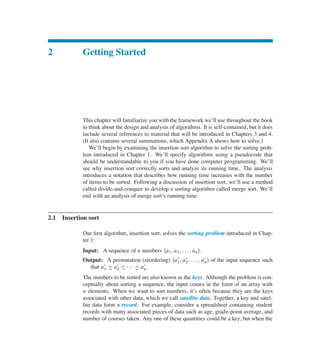
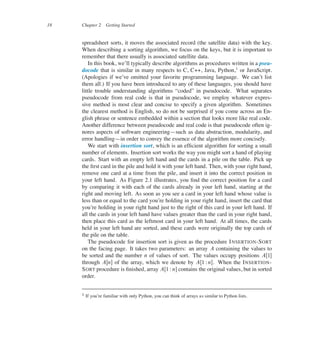
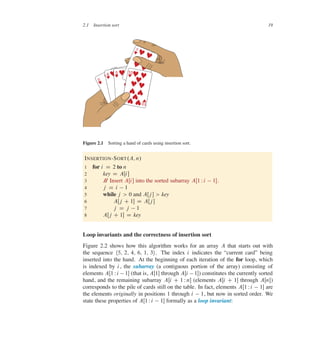
number of elements. Insertion sort works the way you might sort a hand of playing
cards. Start with an empty left hand and the cards in a pile on the table. Pick up
the ûrst card in the pile and hold it with your left hand. Then, with your right hand,
remove one card at a time from the pile, and insert it into the correct position in
your left hand. As Figure 2.1 illustrates, you ûnd the correct position for a card
by comparing it with each of the cards already in your left hand, starting at the
right and moving left. As soon as you see a card in your left hand whose value is
less than or equal to the card you’re holding in your right hand, insert the card that
you’re holding in your right hand just to the right of this card in your left hand. If
all the cards in your left hand have values greater than the card in your right hand,
then place this card as the leftmost card in your left hand. At all times, the cards
held in your left hand are sorted, and these cards were originally the top cards of
the pile on the table.
The pseudocode for insertion sort is given as the procedure INSERTION-SORT
on the facing page. It takes two parameters: an array A containing the values to
be sorted and the number n of values of sort. The values occupy positions AŒ1�
through AŒn� of the array, which we denote by AŒ1 W n�. When the INSERTION-
SORT procedure is ûnished, array AŒ1 W n� contains the original values, but in sorted
order.
1 If you’re familiar with only Python, you can think of arrays as similar to Python lists.
45.
2.1 Insertion sort19
2
♥
♥
♥ 2
♥
4
♥♥ ♥
♥
♥ 4
♥
5
♥♥ ♥
♥
♥ 5
♥
♥
7
♥
♥
♥
♥ ♥
♥
♥
7
♥
♥
10
♥
♥
♥ ♥
♥ ♥
♥
♥
♥
♥
♥
1
0
♥
Figure 2.1 Sorting a hand of cards using insertion sort.
INSERTION-SORT.A; n/
1 for i D 2 to n
2 key D AŒi�
3 /
/ Insert AŒi� into the sorted subarray AŒ1 Wi 1�.
4 j D i 1
5 while j > 0 and AŒj � > key
6 AŒj C 1� D AŒj �
7 j D j 1
8 AŒj C 1� D key
Loop invariants and the correctness of insertion sort
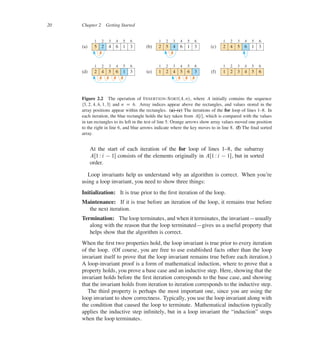
Figure 2.2 shows how this algorithm works for an array A that starts out with
the sequence h5; 2; 4; 6; 1; 3i. The index i indicates the <current card= being
inserted into the hand. At the beginning of each iteration of the for loop, which
is indexed by i, the subarray (a contiguous portion of the array) consisting of
elements AŒ1 Wi 1� (that is, AŒ1� through AŒi 1�) constitutes the currently sorted
hand, and the remaining subarray AŒi C 1 Wn� (elements AŒi C 1� through AŒn�)
corresponds to the pile of cards still on the table. In fact, elements AŒ1 Wi 1� are
the elements originally in positions 1 through i 1, but now in sorted order. We
state these properties of AŒ1 Wi 1� formally as a loop invariant:
46.
20 Chapter 2Getting Started
1 2 3 4 5 6
5 2 4 6 1 3
(a)
1 2 3 4 5 6
2 5 4 6 1 3
(b)
1 2 3 4 5 6
2 4 5 6 1 3
(c)
1 2 3 4 5 6
2 4 5 6 1 3
(d)
1 2 3 4 5 6
2 4 5 6
1 3
(e)
1 2 3 4 5 6
2 4 5 6
1 3
(f)
Figure 2.2 The operation of INSERTION-SORT.A; n/, where A initially contains the sequence
h5; 2; 4; 6; 1; 3i and n D 6. Array indices appear above the rectangles, and values stored in the
array positions appear within the rectangles. (a)–(e) The iterations of the for loop of lines 138. In
each iteration, the blue rectangle holds the key taken from AŒi�, which is compared with the values
in tan rectangles to its left in the test of line 5. Orange arrows show array values moved one position
to the right in line 6, and blue arrows indicate where the key moves to in line 8. (f) The ûnal sorted
array.
At the start of each iteration of the for loop of lines 138, the subarray
AŒ1 Wi 1� consists of the elements originally in AŒ1 Wi 1�, but in sorted
order.
Loop invariants help us understand why an algorithm is correct. When you’re
using a loop invariant, you need to show three things:
Initialization: It is true prior to the ûrst iteration of the loop.
Maintenance: If it is true before an iteration of the loop, it remains true before
the next iteration.
Termination: The loop terminates, and when it terminates, the invariant4usually
along with the reason that the loop terminated4gives us a useful property that
helps show that the algorithm is correct.
When the ûrst two properties hold, the loop invariant is true prior to every iteration
of the loop. (Of course, you are free to use established facts other than the loop
invariant itself to prove that the loop invariant remains true before each iteration.)
A loop-invariant proof is a form of mathematical induction, where to prove that a
property holds, you prove a base case and an inductive step. Here, showing that the
invariant holds before the ûrst iteration corresponds to the base case, and showing
that the invariant holds from iteration to iteration corresponds to the inductive step.
The third property is perhaps the most important one, since you are using the
loop invariant to show correctness. Typically, you use the loop invariant along with
the condition that caused the loop to terminate. Mathematical induction typically
applies the inductive step inûnitely, but in a loop invariant the <induction= stops
when the loop terminates.
47.
2.1 Insertion sort21
Let’s see how these properties hold for insertion sort.
Initialization: We start by showing that the loop invariant holds before the ûrst
loop iteration, when i D 2.2
The subarray AŒ1 Wi 1� consists of just the
single element AŒ1�, which is in fact the original element in AŒ1�. Moreover,
this subarray is sorted (after all, how could a subarray with just one value not
be sorted?), which shows that the loop invariant holds prior to the ûrst iteration
of the loop.
Maintenance: Next, we tackle the second property: showing that each iteration
maintains the loop invariant. Informally, the body of the for loop works by
moving the values in AŒi 1�, AŒi 2�, AŒi 3�, and so on by one position
to the right until it ûnds the proper position for AŒi� (lines 437), at which point
it inserts the value of AŒi� (line 8). The subarray AŒ1 Wi� then consists of the
elements originally in AŒ1 Wi�, but in sorted order. Incrementing i (increasing
its value by 1) for the next iteration of the for loop then preserves the loop
invariant.
A more formal treatment of the second property would require us to state and
show a loop invariant for the while loop of lines 537. Let’s not get bogged
down in such formalism just yet. Instead, we’ll rely on our informal analysis to
show that the second property holds for the outer loop.
Termination: Finally, we examine loop termination. The loop variable i starts
at 2 and increases by 1 in each iteration. Once i’s value exceeds n in line 1, the
loop terminates. That is, the loop terminates once i equals n C 1. Substituting
n C1 for i in the wording of the loop invariant yields that the subarray AŒ1 Wn�
consists of the elements originally in AŒ1 Wn�, but in sorted order. Hence, the
algorithm is correct.
This method of loop invariants is used to show correctness in various places
throughout this book.
Pseudocode conventions
We use the following conventions in our pseudocode.
Indentation indicates block structure. For example, the body of the for loop that
begins on line 1 consists of lines 238, and the body of the while loop that
2 When the loop is a for loop, the loop-invariant check just prior to the ûrst iteration occurs immedi-
ately after the initial assignment to the loop-counter variable and just before the ûrst test in the loop
header. In the case of INSERTION-SORT, this time is after assigning 2 to the variable i but before the
ûrst test of whether i හ n.
48.
22 Chapter 2Getting Started
begins on line 5 contains lines 637 but not line 8. Our indentation style applies
to if-else statements3
as well. Using indentation instead of textual indicators
of block structure, such as begin and end statements or curly braces, reduces
clutter while preserving, or even enhancing, clarity.4
The looping constructs while, for, and repeat-until and the if-else conditional
construct have interpretations similar to those in C, C++, Java, Python, and
JavaScript.5
In this book, the loop counter retains its value after the loop is
exited, unlike some situations that arise in C++ and Java. Thus, immediately
after a for loop, the loop counter’s value is the value that ûrst exceeded the for
loop bound.6
We used this property in our correctness argument for insertion
sort. The for loop header in line 1 is for i D 2 to n, and so when this loop
terminates, i equals nC1. We use the keyword to when a for loop increments its
loop counter in each iteration, and we use the keyword downto when a for loop
decrements its loop counter (reduces its value by 1 in each iteration). When
the loop counter changes by an amount greater than 1, the amount of change
follows the optional keyword by.
The symbol </
/= indicates that the remainder of the line is a comment.
Variables (such as i, j , and key) are local to the given procedure. We won’t use
global variables without explicit indication.
We access array elements by specifying the array name followed by the index
in square brackets. For example, AŒi� indicates the ith element of the array A.
Although many programming languages enforce 0-origin indexing for arrays (0
is the smallest valid index), we choose whichever indexing scheme is clearest
for human readers to understand. Because people usually start counting at 1,
not 0, most4but not all4of the arrays in this book use 1-origin indexing. To be
3 In an if-else statement, we indent else at the same level as its matching if. The ûrst executable line
of an else clause appears on the same line as the keyword else. For multiway tests, we use elseif for
tests after the ûrst one. When it is the ûrst line in an else clause, an if statement appears on the line
following else so that you do not misconstrue it as elseif.
4 Each pseudocode procedure in this book appears on one page so that you do not need to discern
levels of indentation in pseudocode that is split across pages.
5 Most block-structured languages have equivalent constructs, though the exact syntax may differ.
Python lacks repeat-until loops, and its for loops operate differently from the for loops in this book.
Think of the pseudocode line <for i D 1 to n= as equivalent to <for i in range(1, n+1)= in Python.
6 In Python, the loop counter retains its value after the loop is exited, but the value it retains is the
value it had during the ûnal iteration of the for loop, rather than the value that exceeded the loop
bound. That is because a Python for loop iterates through a list, which may contain nonnumeric
values.
49.
2.1 Insertion sort23
clear about whether a particular algorithm assumes 0-origin or 1-origin index-
ing, we’ll specify the bounds of the arrays explicitly. If you are implementing
an algorithm that we specify using 1-origin indexing, but you’re writing in a
programming language that enforces 0-origin indexing (such as C, C++, Java,
Python, or JavaScript), then give yourself credit for being able to adjust. You
can either always subtract 1 from each index or allocate each array with one
extra position and just ignore position 0.
The notation <W= denotes a subarray. Thus, AŒi Wj � indicates the subarray of A
consisting of the elements AŒi�; AŒi C 1�; : : : ; AŒj �.7
We also use this notation
to indicate the bounds of an array, as we did earlier when discussing the array
AŒ1 Wn�.
We typically organize compound data into objects, which are composed of
attributes. We access a particular attribute using the syntax found in many
object-oriented programming languages: the object name, followed by a dot,
followed by the attribute name. For example, if an object x has attribute f , we
denote this attribute by x:f.
We treat a variable representing an array or object as a pointer (known as a
reference in some programming languages) to the data representing the array
or object. For all attributes f of an object x, setting y D x causes y:f to
equal x:f. Moreover, if we now set x:f D 3, then afterward not only does x:f
equal 3, but y:f equals 3 as well. In other words, x and y point to the same
object after the assignment y D x. This way of treating arrays and objects is
consistent with most contemporary programming languages.
Our attribute notation can <cascade.= For example, suppose that the attribute f
is itself a pointer to some type of object that has an attribute g. Then the notation
x:f:g is implicitly parenthesized as .x:f/:g. In other words, if we had assigned
y D x:f, then x:f:g is the same as y:g.
Sometimes a pointer refers to no object at all. In this case, we give it the special
value NIL.
We pass parameters to a procedure by value: the called procedure receives its
own copy of the parameters, and if it assigns a value to a parameter, the change
is not seen by the calling procedure. When objects are passed, the pointer to
the data representing the object is copied, but the object’s attributes are not. For
example, if x is a parameter of a called procedure, the assignment x D y within
7 If you’re used to programming in Python, bear in mind that in this book, the subarray AŒi Wj�
includes the element AŒj�. In Python, the last element of AŒi Wj� is AŒj 1�. Python allows negative
indices, which count from the back end of the list. This book does not use negative array indices.
50.
24 Chapter 2Getting Started
the called procedure is not visible to the calling procedure. The assignment
x:f D 3, however, is visible if the calling procedure has a pointer to the same
object as x. Similarly, arrays are passed by pointer, so that a pointer to the array
is passed, rather than the entire array, and changes to individual array elements
are visible to the calling procedure. Again, most contemporary programming
languages work this way.
A return statement immediately transfers control back to the point of call in
the calling procedure. Most return statements also take a value to pass back to
the caller. Our pseudocode differs from many programming languages in that
we allow multiple values to be returned in a single return statement without
having to create objects to package them together.8
The boolean operators <and= and <or= are short circuiting. That is, evaluate
the expression <x and y= by ûrst evaluating x. If x evaluates to FALSE, then
the entire expression cannot evaluate to TRUE, and therefore y is not evaluated.
If, on the other hand, x evaluates to TRUE, y must be evaluated to determine
the value of the entire expression. Similarly, in the expression <x or y= the ex-
pression y is evaluated only if x evaluates to FALSE. Short-circuiting operators
allow us to write boolean expressions such as <x ¤ NIL and x:f D y= without
worrying about what happens upon evaluating x:f when x is NIL.
The keyword error indicates that an error occurred because conditions were
wrong for the procedure to have been called, and the procedure immediately
terminates. The calling procedure is responsible for handling the error, and so
we do not specify what action to take.
Exercises
2.1-1
Using Figure 2.2 as a model, illustrate the operation of INSERTION-SORT on an
array initially containing the sequence h31; 41; 59; 26; 41; 58i.
2.1-2
Consider the procedure SUM-ARRAY on the facing page. It computes the sum of
the n numbers in array AŒ1 Wn�. State a loop invariant for this procedure, and use
its initialization, maintenance, and termination properties to show that the SUM-
ARRAY procedure returns the sum of the numbers in AŒ1 Wn�.
8 Python’s tuple notation allows return statements to return multiple values without creating objects
from a programmer-deûned class.
51.
2.2 Analyzing algorithms25
SUM-ARRAY.A; n/
1 sum D 0
2 for i D 1 to n
3 sum D sum C AŒi�
4 return sum
2.1-3
Rewrite the INSERTION-SORT procedure to sort into monotonically decreasing in-
stead of monotonically increasing order.
2.1-4
Consider the searching problem:
Input: A sequence of n numbers ha1; a2; : : : ; ani stored in array AŒ1 Wn� and a
value x.
Output: An index i such that x equals AŒi� or the special value NIL if x does not
appear in A.
Write pseudocode for linear search, which scans through the array from begin-
ning to end, looking for x. Using a loop invariant, prove that your algorithm is
correct. Make sure that your loop invariant fulûlls the three necessary properties.
2.1-5
Consider the problem of adding two n-bit binary integers a and b, stored in two
n-element arrays AŒ0 Wn 1� and BŒ0 Wn 1�, where each element is either 0
or 1, a D
Pn1
iD0 AŒi� 2i, and b D
Pn1
iD0 BŒi� 2i . The sum c D a C b of the
two integers should be stored in binary form in an .n C 1/-element array C Œ0 Wn�,
where c D
Pn
iD0 CŒi� 2i. Write a procedure ADD-BINARY-INTEGERS that takes
as input arrays A and B, along with the length n, and returns array C holding the
sum.
2.2 Analyzing algorithms
Analyzing an algorithm has come to mean predicting the resources that the algo-
rithm requires. You might consider resources such as memory, communication
bandwidth, or energy consumption. Most often, however, you’ll want to measure
computational time. If you analyze several candidate algorithms for a problem,
52.
26 Chapter 2Getting Started
you can identify the most efûcient one. There might be more than just one viable
candidate, but you can often rule out several inferior algorithms in the process.
Before you can analyze an algorithm, you need a model of the technology that
it runs on, including the resources of that technology and a way to express their
costs. Most of this book assumes a generic one-processor, random-access ma-
chine (RAM) model of computation as the implementation technology, with the
understanding that algorithms are implemented as computer programs. In the RAM
model, instructions execute one after another, with no concurrent operations. The
RAM model assumes that each instruction takes the same amount of time as any
other instruction and that each data access4using the value of a variable or storing
into a variable4takes the same amount of time as any other data access. In other
words, in the RAM model each instruction or data access takes a constant amount
of time4even indexing into an array.9
Strictly speaking, we should precisely deûne the instructions of the RAM model
and their costs. To do so, however, would be tedious and yield little insight into al-
gorithm design and analysis. Yet we must be careful not to abuse the RAM model.
For example, what if a RAM had an instruction that sorts? Then you could sort
in just one step. Such a RAM would be unrealistic, since such instructions do
not appear in real computers. Our guide, therefore, is how real computers are de-
signed. The RAM model contains instructions commonly found in real computers:
arithmetic (such as add, subtract, multiply, divide, remainder, üoor, ceiling), data
movement (load, store, copy), and control (conditional and unconditional branch,
subroutine call and return).
The data types in the RAM model are integer, üoating point (for storing real-
number approximations), and character. Real computers do not usually have a
separate data type for the boolean values TRUE and FALSE. Instead, they often test
whether an integer value is 0 (FALSE) or nonzero (TRUE), as in C. Although we
typically do not concern ourselves with precision for üoating-point values in this
book (many numbers cannot be represented exactly in üoating point), precision is
crucial for most applications. We also assume that each word of data has a limit on
the number of bits. For example, when working with inputs of size n, we typically
9 We assume that each element of a given array occupies the same number of bytes and that the
elements of a given array are stored in contiguous memory locations. For example, if array AŒ1 Wn�
starts at memory address 1000 and each element occupies four bytes, then element AŒi� is at address
1000 C4.i 1/. In general, computing the address in memory of a particular array element requires
at most one subtraction (no subtraction for a 0-origin array), one multiplication (often implemented
as a shift operation if the element size is an exact power of 2), and one addition. Furthermore, for
code that iterates through the elements of an array in order, an optimizing compiler can generate the
address of each element using just one addition, by adding the element size to the address of the
preceding element.
53.
2.2 Analyzing algorithms27
assume that integers are represented by c log2 n bits for some constant c 1. We
require c 1 so that each word can hold the value of n, enabling us to index
the individual input elements, and we restrict c to be a constant so that the word
size does not grow arbitrarily. (If the word size could grow arbitrarily, we could
store huge amounts of data in one word and operate on it all in constant time4an
unrealistic scenario.)
Real computers contain instructions not listed above, and such instructions rep-
resent a gray area in the RAM model. For example, is exponentiation a constant-
time instruction? In the general case, no: to compute xn when x and n are general
integers typically takes time logarithmic in n (see equation (31.34) on page 934),
and you must worry about whether the result ûts into a computer word. If n is an
exact power of 2, however, exponentiation can usually be viewed as a constant-time
operation. Many computers have a <shift left= instruction, which in constant time
shifts the bits of an integer by n positions to the left. In most computers, shifting
the bits of an integer by 1 position to the left is equivalent to multiplying by 2, so
that shifting the bits by n positions to the left is equivalent to multiplying by 2n.
Therefore, such computers can compute 2n in 1 constant-time instruction by shift-
ing the integer 1 by n positions to the left, as long as n is no more than the number
of bits in a computer word. We’ll try to avoid such gray areas in the RAM model
and treat computing 2n and multiplying by 2n as constant-time operations when
the result is small enough to ût in a computer word.
The RAM model does not account for the memory hierarchy that is common
in contemporary computers. It models neither caches nor virtual memory. Sev-
eral other computational models attempt to account for memory-hierarchy effects,
which are sometimes signiûcant in real programs on real machines. Section 11.5
and a handful of problems in this book examine memory-hierarchy effects, but for
the most part, the analyses in this book do not consider them. Models that include
the memory hierarchy are quite a bit more complex than the RAM model, and so
they can be difûcult to work with. Moreover, RAM-model analyses are usually
excellent predictors of performance on actual machines.
Although it is often straightforward to analyze an algorithm in the RAM model,
sometimes it can be quite a challenge. You might need to employ mathematical
tools such as combinatorics, probability theory, algebraic dexterity, and the ability
to identify the most signiûcant terms in a formula. Because an algorithm might
behave differently for each possible input, we need a means for summarizing that
behavior in simple, easily understood formulas.
Analysis of insertion sort
How long does the INSERTION-SORT procedure take? One way to tell would be for
you to run it on your computer and time how long it takes to run. Of course, you’d
54.
28 Chapter 2Getting Started
ûrst have to implement it in a real programming language, since you cannot run our
pseudocode directly. What would such a timing test tell you? You would ûnd out
how long insertion sort takes to run on your particular computer, on that particular
input, under the particular implementation that you created, with the particular
compiler or interpreter that you ran, with the particular libraries that you linked
in, and with the particular background tasks that were running on your computer
concurrently with your timing test (such as checking for incoming information over
a network). If you run insertion sort again on your computer with the same input,
you might even get a different timing result. From running just one implementation
of insertion sort on just one computer and on just one input, what would you be able
to determine about insertion sort’s running time if you were to give it a different
input, if you were to run it on a different computer, or if you were to implement it
in a different programming language? Not much. We need a way to predict, given
a new input, how long insertion sort will take.
Instead of timing a run, or even several runs, of insertion sort, we can determine
how long it takes by analyzing the algorithm itself. We’ll examine how many times
it executes each line of pseudocode and how long each line of pseudocode takes
to run. We’ll ûrst come up with a precise but complicated formula for the running
time. Then, we’ll distill the important part of the formula using a convenient no-
tation that can help us compare the running times of different algorithms for the
same problem.
How do we analyze insertion sort? First, let’s acknowledge that the running time
depends on the input. You shouldn’t be terribly surprised that sorting a thousand
numbers takes longer than sorting three numbers. Moreover, insertion sort can take
different amounts of time to sort two input arrays of the same size, depending on
how nearly sorted they already are. Even though the running time can depend on
many features of the input, we’ll focus on the one that has been shown to have
the greatest effect, namely the size of the input, and describe the running time of a
program as a function of the size of its input. To do so, we need to deûne the terms
<running time= and <input size= more carefully. We also need to be clear about
whether we are discussing the running time for an input that elicits the worst-case
behavior, the best-case behavior, or some other case.
The best notion for input size depends on the problem being studied. For many
problems, such as sorting or computing discrete Fourier transforms, the most nat-
ural measure is the number of items in the input4for example, the number n of
items being sorted. For many other problems, such as multiplying two integers,
the best measure of input size is the total number of bits needed to represent the
input in ordinary binary notation. Sometimes it is more appropriate to describe the
size of the input with more than just one number. For example, if the input to an
algorithm is a graph, we usually characterize the input size by both the number
cheaper than inCoblenz, none of them as high as four marks, even
with war tax, poor tax, and “wardrobe.” The house was crowded with
the serious-minded of all classes, Poles as well as Germans; the
actors were of higher histrionic ability than the average American
town of the size of Bromberg sees once a year. Yet equally splendid
performances were offered here at these slight prices all the year
round. As I strolled hotelward with that pleasant sensation of
satisfaction that comes from an evening of genuine entertainment, I
could not but wonder whether this, and those other undeniable
advantages of German Kultur, whatever sins might justly be charged
against it, would be kept up after the Poles had taken Bromberg into
their own keeping.
As to the walking trip through these eastern provinces which I had
planned, fate was once more against me. I might, to be sure, have set
out on foot toward the region already amputated from the Empire,
but in the course of an hour I should have had the privilege of
walking back again. The German-Polish front was just six kilometers
from Bromberg, and a wandering stranger would have had exactly
the same chance of crossing its succession of trenches as of entering
Germany from France a year before. The one and only way of
reaching the province of Posen was by train from the village of Kreuz,
back along the railway by which I had come.
The place had all the appearance of an international frontier, a
frontier hastily erected and not yet in efficient running order.
Arrangements for examining travelers and baggage consisted only of
an improvised fence along the station platform, strewn pellmell with
a heterogeneous throng bound in both directions, and their
multifarious coffers and bundles. The soldiers who patrolled the line
of demarkation with fixed bayonets were callow, thin-faced youths,
or men past middle age who had plainly reached the stage of
uselessness as combat troops. All wore on their collars the silver oak-
leaves of the recently formed “frontier guard.” Their manner toward
the harassed travelers was either brutal or cringingly friendly. The
Germans in civilian garb who examined passports and baggage were
cantankerous and gruff, as if they resented the existence of a frontier
where the Fatherland had never admitted that a frontier existed.
They vented their wrath especially against men of military age who
wished to enter Polish territory—and their interpretation of their
57.
duties in thatrespect was by no means charitable. Among others, a
wretched little dwarf past fifty, whom a glance sufficed to recognize
as useless from a military point of view, even had his papers not been
stamped with the official Untauglich, was wantonly turned back.
Many a family was left only the choice of abandoning the attempt to
reach its home or of leaving its adult male members behind.
The churls allowed me to pass readily enough, but rescinded their
action a moment later. Once beyond the barrier, I had paused to
photograph the pandemonium that reigned about it. A lieutenant
bellowed and a group of soldiers and officials quickly swarmed about
me. Did I not know that photography was forbidden at the front? I
protested that the station scenes of Kreuz could scarcely be called
military information. What of that? I knew that it was within the
zone of the armies, did I not? Rules were rules; it was not the
privilege of every Tom, Dick, and Harry to interpret them to his own
liking. A lean, hawk-faced civilian, who seemed to be in command,
ordered me to open my kodak and confiscated the film it contained.
If I set great store by the pictures on it, he would have it developed by
the military authorities and let me have those that proved harmless,
upon my return. I thanked him for his leniency and strolled toward
the compartment I had chosen. Before I had reached it he called me
back.
“Let me see your papers again,” he demanded, in a far gruffer tone.
He glanced casually at them, thrust them into a pocket of his coat,
and snapped angrily: “Get your baggage off the train! I am not going
to let you through.”
It was plain that he was acting from personal rather than official
motives. Probably he considered my failure to raise my hat and to
smile the sycophant smile with which my fellow-passengers
addressed him as an affront to his high Prussian caste. Fortunately
he was not alone in command. A more even-tempered official
without his dyspeptic leanness beckoned him aside and whispered in
his ear. Perhaps he called his attention to the importance of my
credentials from Wilhelmstrasse. At any rate, he surrendered my
papers after some argument, with an angry shrug of the shoulders,
and his less hungry-looking companion brought them back to me.
“It has all been arranged,” he smirked. “You may take the train.”
58.
This was stillmanned by a German crew. For every car that left
their territory, however, the Poles required that one of the same class
and condition be delivered to them in exchange. Several long freight-
trains, loaded from end to end with potatoes, rumbled past us on the
parallel track. Two hundred thousand tons of tubers were sent to
Germany each month in exchange for coal. It was at that date the
only commercial intercourse between the two countries, and
explained why potatoes were the one foodstuff of comparative
abundance even in Berlin. At Biala the station guards were Polish,
but there was little indeed to distinguish them from those of Kreuz
and Bromberg. Their uniforms, their rifles, every detail of their
equipment, were German, except that some of them wore the square
and rather clumsy-looking Polish cap or had decorated their round,
red-banded fatigue bonnets with the silver double-eagle of the
resurrected empire. Many were without even this insignia of their
new allegiance, and only the absence of oak-leaves on their collars
showed that they were no longer soldiers of the Fatherland.
We halted at Wronki for two hours, which made our departure
three hours later, for clocks and watches were turned ahead to
correspond with Polish time. Frontier formalities were even more
leisurely and disorganized than they had been in Kreuz. The Poles
seemed to have something of the amiable but headless temperament
of the French. Their officers, too, in their impressive new uniforms
with broad red or yellow bands, and their rattling sabers, bore a
certain resemblance to children on Christmas morning that did not
help to expedite matters under their jurisdiction. They were a bit less
“snappy” than the more experienced Germans, somewhat inclined to
strut and to flirt, and there were suggestions in their manner that
they might not have been horrified at the offer of a tip. When at
length my turn had come they found my credentials unsatisfactory.
Why had they not been viséed by the Polish consul in Berlin, as well
as by the Germans at Frankfurt? I had never dreamed that Berlin
boasted a Polish consul. Indeed! Who, then, did I suppose handled
the interests of their nation there? However, it was all right. As an
American and a fellow-Ally they would let me pass. But I must
promise to report at a certain office in Posen within twenty-four
hours of my arrival.
59.
Barefoot boys wereselling huge slabs of bread and generous
lengths of sausage through the car windows. All things are relative,
and to the travelers from Germany these “ticket-free” viands of
doubtful origin seemed a kingly repast. With every mile forward now
it was easier to understand why the loss of the province of Posen had
been so serious a blow to the hungry Empire. Here were no arid,
sandy stretches, but an endless expanse of rich black loam, capable
of feeding many times its rather sparse population. If it had been
“pumped dry” by the former oppressors, it was already well on the
road to recovery. Wheat, corn, and potatoes covered the flat plains to
the horizons on either hand. Cattle and sheep were by no means rare;
pigs, goats, ducks, and chickens flocked about every village and farm-
house, evidently living in democratic equality with the human
inhabitants. There were other suggestions that we were approaching
the easy-going East. Men in high Russian boots sauntered behind
their draft animals with the leisureliness of those who know the
world was not built in a day, nor yet in a year. Churches of Oriental
aspect, with steep roofs that were still not Gothic, broke the
sameness of the prevailing German architecture. There was
something softly un-Occidental in the atmosphere of the great city
into which we rumbled at sunset, a city which huge new sign-boards
on the station platform stridently announced was no longer Posen,
but “Poznan.”
60.
T
XI
AN AMPUTATED MEMBER
(Posenunder the Poles)
he same spirit that had led the Poles to impress so forcibly upon
the traveler the fact that the city in which he had just arrived was
now called Poznan (pronounced Poznánya) had manifested itself in a
thousand other changes. In so far as time had permitted, every
official signboard had already been rendered into Polish and the
detested German ones cast into outer darkness. Only those familiar
with the Slavic tongue of the new rulers could have guessed what all
those glitteringly new enameled placards that adorned the still
Boche-featured station were commanding them to do or not to do.
Every street in town had been baptized into the new faith and gaily
boasted that fact on every corner. For a time the names had been
announced in both languages, as in Metz; but a month or so before
my arrival the radicals had prevailed and the older placards had been
abolished. True, in most cases the new ones were merely translations
of the old. But what did it help the German resident who had
neglected to learn Polish to know that the “Alte Markt” was still the
“Old Market” so long as he could not recognize it under the new
designation of “Stary Rynek”? Imagine, if you can, the sensation of
waking up some morning to find that Main Street has become Ulica
Glòwna, or to discover that the street-car you had always taken no
longer runs to Forest Park but to Ogrott Lass.
Nothing but the few things that defied quick change, such as post-
boxes or names deeply cut into stone façades, had escaped the all-
embracing renovation. Indeed, many of these had been deliberately
defaced. The cast-iron “Haltestelle der Strassenbahn” high up on the
61.
trolley-supports had beendaubed with red paint, though they were
still recognizable to motormen and would-be passengers. Many
business houses had followed the official lead, and private signs were
more apt than not to have the German words that had once called
attention to the excellence of the wares within crudely effaced or
changed to the new tongue. Sometimes it was not merely the
language that had been altered, but the whole tenor of the
proprietor’s allegiance. A popular underground beer-hall in the heart
of town was no longer the “Bismarck Tunnel,” but the “Tunel
Wilsona.” German trucks thundering by on their iron tires bore the
white eagle of Poland instead of the black Prussian bird of prey.
German newspapers were still published, but as the streets they
mentioned were nowhere to be found in all Poznan, their
advertisements and much of their news were rather pointless. It gave
me a curiously helpless feeling to find myself for the first time in
years unable to guess a word of the language about me. Fortunately
all Poznan still spoke German. Only once during my stay there did I
find myself hampered by my ignorance of Polish—when a theater-
ticket office proved to be in charge of a pair recently arrived from
Warsaw. On more than one occasion my advances were received
coldly, sometimes with scowls. But a reply was always forthcoming,
and whenever I announced myself an American, who spoke the less
welcome of the two tongues by necessity rather than by choice,
apology and friendly overtures immediately followed.
Having effaced the lingual reminders of their late oppressors, the
Poznanians had proceeded to pay their respects to the bronze heroes
they had left behind. The Germans, as is their custom, had littered
the public squares with statues of their chief sword-brandishers, in
gigantic size—tender reminders to the conquered people of the
blessings that had been forced upon them. The downfall of these had
been sudden and unceremonious. Some had descended so hastily
that the allegorical figures at their feet had suffered the fate so often
overtaking faithful henchmen of the fallen mighty. The stone image
of an old woman representing “Sorrow” looked doubly sorrowful
with broken nose, legs, and fingers. Kaiser Friedrich, Doctor
Bismarck with his panacea of “blood and iron,” the world-famed
Wilhelm, had all left behind them imposing pedestals, like university
chairs awaiting exponents of newer and more lasting doctrines. Here
62.
and there astatue had remained, because it was Polish, but these
were few and small and tucked away into the more obscure corners.
Next to its change of tongue the most striking feature of the new
Poznan was its military aspect. The streets swarmed with soldiers
even during the day; in the evening the chief gathering-places
became pulsating seas of field gray. For it was still the garb of their
former servitude that clothed the vast majority of these warriors of
the reborn nation. The silver double-eagle on his service-faded cap
was all that was needed to turn a wearer of the German uniform into
a soldier of Poland. Many still wore their “Gott mit uns” belt-buckles
and their Prussian buttons. A scattering minority, officers for the
most part, were conspicuous in the full new Polish uniform—double-
breasted, with a forest-green tinge. The high, square cap, distinctive
only of the province of Poznan, was more widely in evidence; the less
cumbersome headgear of military visitors from Warsaw or Galizia
now and then broke the red-banded monotony. But the only
universal sign of new fealty was the silver double-eagle. This gleamed
everywhere. Men in civilian garb wore it on their hats or in their coat
lapels; women adorned their bodices with it; boys and girls proudly
displayed it in some conspicuous position. It fluttered on a thousand
banners; it bedecked every Polish shop-front; it stared from the
covers of newly appeared books, pamphlets, music-sheets in the
popular tongue; the very church spires had replaced their crosses
with it. One could buy the resurrected insignia, of any size or
material, in almost any shop—providing one could produce
“legitimation papers” or other proof that it would not be used to
disguise a German as a Pole.
An over-abundance of swords tended to give the new army a
comic-opera aspect, but this detail was offset by the genuine military
bearing of all but a few of the multitude in uniform. The great
majority, of course, had had German training. Now, however, they
put the “pep” of a new game into the old forms of soldierly etiquette.
Their two-finger salute was rendered with the precision of ambitious
recruits and at the same time with the exactitude of “old-timers.”
They sprang unfailingly to attention at sight of a superior officer and
stood like automatons until he turned away. Yet there seemed to be
an un-German comradeship between the rank and file and the
commissioned personnel, a democracy of endeavor, a feeling that
63.
they were allembarked together on the same big new adventure.
There were, to be sure, some officers and a few men whose sidewalk
manners suggested that they had learned Prussian ways a bit too
thoroughly, but they were lost in a mass that had something of the
easy-going temperament of the East or the South.
All classes of the Polish population were represented in the new
army from the bulking countryman who ran after me to say that the
photograph I had just taken of him would not be a success because
he had not been looking at the lens during the operation to the major
who granted me special permission to use my kodak in spite of
military rules. This officer had been late in reaching his office, and I
passed the time in his anteroom in conversation with his sergeant-
major. When he entered at last the entire office force sprang to its
feet with what in an older army would have been an exaggeration of
discipline. The sergeant-major, his middle finger glued to the seams
of his trousers, explained my presence and request. The major asked
several questions in Polish, which the sergeant repeated to me in
German, relaying my replies back to the major in his native tongue.
When the latter had nodded his approval and disappeared, and the
office force had relaxed into mere human beings, I expressed my
surprise that an officer of such high rank knew no German.
“Knows no German!” cried the sergeant-major, bursting into
laughter. “The major was for nine years a captain in the German
army. He is a graduate of the War College in Berlin and was a
member of Hindenburg’s staff. But he never lets a word of the
accursed tongue pass his lips if he can possibly avoid it.”
The new Polish government had established a conscription act as
drastic as if it had been taken bodily from the old German statute-
books. All males between the ages of seventeen and forty-five were
liable to service. Those between eighteen and thirty had already been
called to the colors, though thus far German residents had been
tacitly exempted. Every afternoon of my stay in Poznan a hundred or
two of recruits, flower-bedecked and carrying each his carton of
travel rations, marched in column of squads from the railway station
to what had once been the Kaiser’s barracks, singing as they went
some rousing Polish song of the olden days. At least half of them
wore more or less complete German uniforms. Some were so under-
sized that a rifle in their hands would have resembled a machine-
64.
gun. But withfew exceptions their military bearing testified to
previous training under the exacting drill-sergeants of their former
rulers. Watching this new addition each day to the hordes in uniform
that already crowded the city, one could not but wonder whether the
new Poland was not giving refuge, perhaps unconsciously, to the
discredited spirit of militarism that had so recently been expelled
from its German Fatherland.
The “revolution,” or “Putsch,” as the Poles call it, that brought
about all this new state of affairs had been brief and to the point.
Paderewski, relying, perhaps, on Germany’s promise to help re-
establish the ancient Polish Kingdom, had come to Posen for the
Christmas holidays. The hotel he occupied had been decorated with
the flags of the Allies. It is scarcely surprising that the Germans
proceeded to tear them down in spite of the armistice that had
recently been concluded. According to several observers, they might
even have “got away with” this had they not persisted in their
Prussian aggressiveness. On December 27th a Polish youth paused to
ask another for a light from his cigarette. Matches had long been
precious things in Posen. A German officer pounced upon the pair
and demanded to know what conspiracy they were hatching
together. The Polish youths quite properly knocked him down. Their
companions joined in the fracas. The Polish turnvereins had long
had everything prepared for just such an eventuality. Word swept
like prairie fire through the city. French and Italian prisoners of war
sprang to such arms as they could lay hands on and added their
assistance. The soldiers of the garrison, being chiefly Poles or of
Polish sympathies, walked out almost in a body and joined the revolt.
It raged for twenty-four hours. In the words of the sergeant-major
already introduced: “It was a busy day from four in the morning until
the following dawn. At least sixty ribs were broken—mostly German
ones.” There have been bloodier revolutions, however, for the
number killed is set at ten. The Polish leaders were soon masters of
the situation. In three days they had established order. Their search
for arms was thorough and included Polish as well as German
houses. The government they had already established in secret soon
tautened the reins that had been struck from the hands of the
Germans, and by New Year’s Day Poznan had already settled down
to peace and to a contentment it had not known in more than a
century.
65.
As far, atleast, as outward appearances go, there was nothing
particularly oppressive about the new rule. Civilians were not
permitted on the streets after midnight, but those with any legitimate
excuse for night-hawking were granted special passes. The Poles
showed a tendency to meet half-way their next-door neighbor and
late oppressor. With the exception of a few “Polen-fresser,” German
residents were not driven out, as in Metz and Strassburg. Boche
merchants continued to do business at the old stand. Newspapers
published in Germany were refused admittance, but that was a fair
retaliation for similar action by the new authorities of the late
Empire. Even the detested statues were not overthrown until March,
when the Germans declined to give the Poles port facilities at Danzig.
The language of the schools, as well as of government offices, was
changed to Polish; but as soon as Berlin consented to a reciprocal
arrangement, German was restored to the curriculum, though it was
taught only a few hours a week, as a foreign tongue. In short, the
conditions of Bromberg had been nicely reversed in Poznan. It must,
to be sure, have been rather a tough life for the town braggart who
had always espoused the German cause; but there was apparently
nothing to be feared by those who know how to hold their tongues
and confine their attention to their own affairs—and the German is a
past-master at lying low when it is to his interest to do so. His native
tongue was almost never heard on the streets, such arrogance as
existed was confined now to the Poles, and the just-let-us-alone-and-
we’ll-be-good rôle had been assumed by the Teutons.
There were suggestions, however, that the Poles were not yet
adepts at governing, nor likely soon to establish a modern Utopia.
Already they had succeeded in encumbering themselves with fully as
much red-tape as the French. A musician as national leader and
rallying-point seemed to be in keeping with the Polish temperament.
There was a lack of practical directness in their methods, a tendency
toward the erratic, at the expense of orderly progress. One of their
foremost business men turned high official, to whom I applied for a
signature and the imprint of a government stamp, received me with a
protest that he was “too busy to breathe”—and spent two hours
reciting Polish poetry to me and demonstrating how he had
succeeded in photographing every secret document that had reached
Posen during the war without being once suspected by the Germans.
“I am not experienced in this business of government,” he
66.
apologized, when Isucceeded at last in taking my leave, “but I am
ready to sacrifice myself and all I have to the new Poland.”
The statement rang true in his case, but there were others whose
repetition of it would have raised grave suspicions that they were
putting the cart before the horse. The rush for government jobs
under the new régime had in it something of the attitude of the
faithful henchmen toward the periodical return to power of their
beloved Tammany. There were tender reminiscences of the A. E. F.
in the flocks of incompetent pretty girls who encumbered
government offices, dipping their charming noses into everything
except that which concerned them, as there was in the tendency on
the part of both sexes to consider government transportation
synonymous with opportunity for “joy-riding.” It will be strange if
the Polish servant-girls and factory hands who come to us in the
future bring with them the accept-anything spirit of the past, at least
after the period of orientation to their new environment is over. They
are “feeling their oats” at home now and will be apt to set their worth
and their rights to full equality correspondingly higher.
The Poles, evidently, are not by nature a frolicsome people, but
they seemed to have thrown away the “lid” in Poznan and given free
play to all the joy within them. Pianos were more in evidence than
they had been during all the twenty months I had spent in war-torn
Europe. Children appeared to have taken on a new gaiety. Night life
was almost Parisian, except in the more reprehensible features of the
“City of Light.” It may have been due only to a temporary difference
of mood in the two races, but Polish Poznan struck me as a far more
livable place than German Berlin. Evidently the people of the
provinces were not letting this new attractiveness of the restored city
escape them; the newspapers bristled with offers of reward for any
one giving information of apartments or houses for rent. Underneath
their merriness, however, the religious current of the race still ran
strong and swift. The churches discharged multitudes daily at the
end of morning mass; no male, be he coachman, policeman, soldier,
or newsboy, ever passed the crucifix at the end of the principal bridge
without reverently raising his hat. There are Protestant Poles, but
they apparently do not live in Poznan. Now and again, too, there
were episodes quite the opposite of gay to give the city pause in the
midst of its revelry—the drunken sots in uniform, for instance, who
67.
canvassed the shopsdemanding alms and prophesying the firing-
squad for those who declined to contribute. Were they not perhaps
the outposts of Bolshevism? But all this was immersed in the general
gaiety, tinged with a mild Orientalism that showed itself not only in
the architecture, but in such leisurely customs as closing shops and
offices from one to three, in defiance of nearly a century and a half of
the sterner German influence.
It is quite possible that the increased liveliness of the Poznanians
was as much due to the fact that they had plenty to eat as to their
release from Teutonic bondage. The two things had come together.
Being perhaps the richest agricultural district of the late Empire, the
province of Posen was quick to recover its alimentary footing, once
its frontiers had been closed against the all-devouring German. With
the exception of potatoes, of which the supply was well in excess of
local needs, the exportation of foodstuffs toward the hungry West
had absolutely ceased. The result was more than noticeable in
Poznan; it was conspicuous, all but overpowering, particularly to
those arriving from famished Germany. Street after street was lined
with a constant tantalization to the new-comer from the West,
arousing his resentment at the appetite that was so easily satisfied
after its constant vociferations in days gone by—and still to come.
Butcher shops displayed an abundance of everything from
frankfurters to sides of beef. Cheese, butter, eggs by the bushel,
candy, sugar, sweetmeats were heaped high behind glass fronts that
would have been slight protection for them in Berlin. In what were
now known as “restauracya” one might order a breakfast of eggs,
bacon, milk, butter, and all the other things the mere mention of
which would have turned a German Wirt livid with rage, without so
much as exciting a ripple on the waiter’s brow. At the rathskeller of
Poznan’s artistic old city hall a “steak and everything,” such a steak
as not even a war-profiteer could command anywhere in Germany,
cost a mere seven marks, including the inevitable mug of beer and
the “10 per cent. for service” that was exacted here also by the
Kellners’ union. With the low rate of exchange—for Poznan was still
using German money—the price was considerably less than it would
have been in New York at the same date. Far from being short of fats,
the Poles were overgenerous with their grease and gravies. Bacon
could be had in any quantity at six marks a pound; eggs at thirty
pfennigs each. Bread, brown but excellent, was unlimited. Food-
68.
tickets, unknown inhotels and restaurants, were theoretically
required for a few of the principal articles in the shops, but there was
little difficulty in purchasing without them, at least with the payment
of a slight “premium.” On market-days the immense square allotted
to them was densely crowded from corner to corner by curiously
garbed female hawkers and countrymen offering every conceivable
product of their farms and gardens. Poznan still consumed a few
things that do not appear on the American bill of fare, such as doves,
gull eggs, and various species of weeds and grasses; but the fact
remains that the well-to-do could get anything their appetites craved,
and the poor were immensely better off than in any city of Germany.
There was only one shortage that irked the popular soul. Expression
of it rang incessantly in my ears—“Please tell America to send us
tobacco!” The queues before tobacconists’ shops were as long and as
persistent as in Germany. Ragged men of the street eagerly parted
with a precious fifty-pfennig “shin-plaster” for a miserable
“cigarette” filled for only half its length with an unsuccessful
imitation of tobacco. The principal café, having husbanded its supply
of the genuine article, placed a thousand of them on sale each
evening at eight, “as a special favor to our clients.” By that hour
entrance was quite impossible, and though only two were allowed
each purchaser, there was nothing but the empty box left five
minutes later.
Unselfishness is not one of mankind’s chief virtues, particularly in
that chaos of conflicting interests known to the world as central
Europe. In view of all they had won in so short a time, and amid the
German shrieks of protest, it was disconcerting to find that the Poles
were far from satisfied with what had been granted them by the
Peace Conference. From high government officials to the man in the
street they deluged me with their complaints, often naïvely implying
that I had personally had some hand in framing the terms of the
proposed treaty, or at least the power to have them altered before it
was too late. They were dissatisfied with the western frontier that
had been set for them, especially in West Prussia; they were
particularly disgruntled because they had not been given Danzig
outright. A nation of thirty million people should have a harbor of its
own. Danzig was essentially Polish in its sympathies, in spite of the
deliberate Germanization that had been practised upon it. Strangely
enough they accused America of having blocked their aspirations in
69.
that particular. Theyblamed Wilson personally for having shut them
out of Danzig, as well as for the annoying delay in drawing up the
treaty. The Germans had “got at him” through the Jews. The latter
had far too much power in the American government, as well as in
American finances. The impression was wide-spread in Poznan that
Mrs. Wilson is Jewish. The Germans and the Jews had always stuck
together. Poland had always been far too lenient with the Jews. She
had let them in too easily; had granted them citizenship too readily.
As they spoke either Yiddish, an offshoot of German, or Russian,
they had always lined up with the enemies of Poland. Half the
German spies, every one of the Russian spies with whom Polish
territory had been flooded during the war, had been Jews. The Poles
in America had gathered money for the alleviation of suffering in
their home-land, and had given it to Jews, Germans, and Poles,
irrespective of race. The Jews in America had collected similar funds
and had expended them only among the Jews. From whatever point
of view one approached him, the resident of Poznan had nothing
good to say of the Chosen People.
The story of Posen’s existence under German rule, now happily
ended, was largely a repetition of what had already been told me in
Bromberg. In some ways this region had been even more harshly
treated, if my informants were trustworthy. Polish skilled workmen
“clear down to button-makers” had been driven out of the province.
Great numbers had been more or less forcibly compelled to migrate
into Germany. There were at least four hundred thousand Poles in
the mines and factories of Westphalia. Saxony was half Polish; the
district between Hamburg and Bremen was almost entirely Slavish in
population. The Ansiedler—the German settlers whom the
government had brought to Posen—had acquired all the best land.
On the other hand, German Catholics were not allowed to establish
themselves in the province of Posen, lest they join their coreligionists
against the Protestant oppressors. Perhaps the thing that rankled
most was the banishment of the Polish language from the schools.
One could scarcely speak it with one’s children at home, for fear of
their using it before the teacher. Many of the youngsters had never
more than half learned it. In twenty years more no one would have
dared speak Polish in public. Men had been given three, and even
four, months in prison for privately teaching their children Polish
history. The schools were hopelessly Prussianized; the German
70.
teachers received aspecial premium of one thousand marks or more
a year over the regular salaries. All railway jobs went to Germans,
except those of section men at two marks a day. There had been
Polish newspapers and theaters, but they had never been allowed any
freedom of thought or action.
“The trouble with the German, or at least the Prussian,” one new
official put in, “is that it is his nature to get things by force. He was
born that way. Why, the Prussians stole even their name; it was
originally Barrusen, as the little corner of Russia was called where
the robbers first banded together. They marauded their way
westward and southward, treading first little people and then little
nations under their iron heels. The very word the German uses for
“get” or “obtain” tells his history. It is kriegen, to win by war—krieg.
You seldom hear him use the gentler bekommen. Everything he
possesses he has gekriegt. Then he is such a hypocrite! In 1916, when
we Poles first began to suffer seriously from hunger, some German
officers came with baskets of fruit and sandwiches, gathered a group
of Polish urchins, filled their hands with the food, and had
themselves photographed with them, to show the world how
generous and kind-hearted they were. But they did not tell the world
that the moment the photographs had been taken the food was
snatched away from the hungry children again, some of the officers
boxing their ears, and sent back to the German barracks. How do you
think the Poles who have been crippled for life fighting for the
‘Fatherland’ feel as they hobble about our streets? What would you
say to serving five years in the German army only to be interned as a
dangerous enemy alien at the end of it, as is the case with thousands
of our sons who were not able to get across the frontier in time? No,
the Germans in Poznan are not oppressed as our people were under
their rule. We are altogether too soft-hearted with them.”
The German residents themselves, as was to be expected, took a
different view of the situation. When the Polish authorities had
decorated my passport with permission to return to Berlin, I took no
chances of being held up by the cantankerous dyspeptic at Kreuz and
applied for a new visé by the German Volksrat of Posen. It occupied
a modest little dwelling-house on the wide, curving avenue no longer
recognizable under its former title of “Kaiser Wilhelm Ring.” Barely
had I established my identity when the gloomy Germans took me to
71.
their bosom. HadI been fully informed of their side of the situation?
Would I not do them the kindness to return at eleven, when they
would see to it that men of high standing were there to give me the
real facts of the case? My impressions of Posen would be wholly false
if I left it after having consorted only with Poles.
As a matter of fact I had already “consorted” with no small number
of German residents, chiefly of the small-merchant class. Those I had
found somewhat mixed in their minds. A few still prophesied a
“peasants’ war” in the territory allotted to Poland; a number of them
shivered with apprehension of a “general Bolshevist uprising.” But
fully as many pooh-poohed both those cheerful bogies. One thing
only was certain—that without exception they were doing business as
usual and would continue to do so as long as the Poles permitted it.
The feeling for the “Fatherland” did not seem strong enough among
the overwhelming majority of them to stand the strain of personal
sacrifice.
When I returned at eleven the Volksrat had been convoked in
unofficial special session. A half-dozen of the men who had formerly
held high places in the Municipal Council rose ostentatiously to their
feet as I was ushered into the chief sanctum, and did not sit down
again until I had been comfortably seated. The chief spokesman had
long been something corresponding to chairman of the Board of
Aldermen. His close-cropped head glistened in the sunshine that
entered through the window at his elbow, and his little ferret-like
eyes alternately sought to bore their way into my mental processes
and to light up with a winsome naïveté which he did not really
possess. Most of the words I set down here are his, though some of
them were now and then thrown in by his subservient but approving
companions.
“With us Germans,” he began, “it has become a case of ‘Vogel friss
oder starb’—eat crow or die. We are forced, for the time at least, to
accept what the Poles see fit to allow us. The German residents of
Posen are not exactly oppressed, but our lives are hemmed in by a
thousand petty annoyances, some of them highly discouraging. Take,
for instance, this matter of the street names. Granted that the Poles
had the right to put them up in their own language. It was certainly a
sign of fanaticism to tear down the German names. More than a
fourth of the residents of Posen cannot read the new street placards.
72.
There is nota Polish map of the city in existence. When the province
of Posen came back to us the Polish street names were allowed to
remain until 1879—for more than a hundred years. It is a sign of
childishness, of retarded mentality, to daub with red paint all the
German signs they cannot remove! It isn’t much more than that to
have forbidden the use of our tongue in governmental affairs. We
Germans used both languages officially clear up to 1876. We even
had the old Prussian laws translated into Polish. It is only during the
last ten years that nothing but German was permitted in the public
schools; and there have always been plenty of Polish private schools.
I am still technically a member of the Municipal Council, but I
cannot understand a word of the proceedings, because they are in
Polish. Our lawyers cannot practise unless they use that language,
although the judges, who pretend not to know German, speak it as
readily as you or I. Yet these same lawyers cannot get back into
Germany. At least give us time to learn Polish before abolishing
German! Many a man born here cannot speak it. There are German
children of eighteen or twenty, who have never been outside the
province, who are now learning Polish—that is, to write and speak it
correctly.
“Oh yes, to be sure, we can most of us get permission in three or
four weeks to leave the province, but only by abandoning most of our
possessions and taking an oath never to return. No wonder so many
Germans become Poles overnight. You can hardly expect otherwise,
when they have lived here all their lives and have all their property
and friends and interests here. No, military service is not required of
Germans, even if they were born here; but many of our youths have
voluntarily become Polish soldiers, for the same reason that their
parents have suddenly turned Poles. Naturally, there is fighting along
the boundary of the province. The Poles want to fight, so they can
have an excuse to keep their men under arms, and what can
Germany do but protect herself? Poland is planning to become an
aggressive, militaristic nation, as was falsely charged against the
Fatherland by her enemies.
“The complaints of the Poles at our rule were ridiculous. We paid
German teachers a premium because they had harder work in
teaching German to Polish children and in seeing that they did not
speak the language that was unwisely used at home. Railroad jobs,
73.
except common labor,were given to Germans because they were
more efficient and trustworthy. Besides, does not Germany own the
railroads? They complain that the best land was taken by German
settlers; but the Poles were only too glad to sell to our Ansiedler—at
high prices. Now they are attacking us with a fanaticism of the
Middle Ages. Eighteen hundred German teachers, men who have
been educating the Poles for twenty or twenty-five years, have
suddenly been discharged and ordered to vacate government
property within four weeks—yet they are not allowed to go back to
Germany. The Pole is still part barbarian; he is more heartless than
his cousin the Russian.
“Seventy per cent. of the taxes in the province of Posen are paid by
Germans. Yet no German who was not born here can vote, though
Poles who were not can. I know a village where there are seventy
Germans and five Poles—and the five Poles run things to suit
themselves. Husbands, wives, and sons often have different rights of
suffrage. The family of Baron X has lived here for a hundred and fifty
years. The baron himself happens to have been born in Berlin,
because his mother went there to see a doctor. So he cannot vote,
though his Polish coachman, who has not been here ten years, has all
the rights of citizenship. The result is that government affairs are
getting into a hopeless muddle. An ignorant fellow by the name of
Korfanti—a Polish ‘German-eater’—has now the chief voice in the
Municipal Council. The Poles boycott German merchants. They
deluge the city with placards and appeals not to buy of Germans. For
a long time they refused to trade even a miserable little Polish
theater for our splendid big Stadttheater. When the director of that
finally got permission to take over the wholly inadequate little
playhouse for next season he had to advertise in order to find out
how many Germans intend to stay in Posen—as you have seen in our
German paper. What can the Poles do with our magnificent
Stadttheater? They have no classics to give in it, nor people of
sufficient culture to make up an audience. We are still allowed to give
German opera, because they know they cannot run that themselves,
and a few of the more educated Poles like it. But our splendid spoken
classics seem to be doomed.
“Then there is their ridiculous hatred of the Jews. The race may
have its faults, but the five or six thousand Jews of Posen province
74.
play a mostimportant business and financial rôle. They have always
understood the advantages of German Kultur far better than the
Poles. There is a Jewish Volksrat here that tries to keep independent
of both the other elements of the population; but the great majority
of the Jews stand with the Germans. They have no use for this new
Zionism—except for the other fellow—unless you take seriously the
aspirations of a few impractical young idealists”—a statement, by the
way, which I heard from Jews of all classes in various parts of
Germany.
“We Germans lifted the Poles out of their semi-savagery. We
brought them Kultur. Do not be deceived by what you see in Posen.
It is a magnificent city, is it not?—finer, perhaps, than you Americans
found Coblenz? Yet everything that gives it magnificence was built by
the Germans—the well-paved streets, the big, wide boulevards, the
splendid parks, all the government buildings and the best of the
private ones, the street-cars, the electric lights, even the higher state
of civilization you find among the masses. There is not a Pole in the
province of Posen who cannot read and write. Do not make the
mistake of thinking all these things are Polish because the Poles have
stolen them. Before you leave, go and compare Posen with the Polish
cities outside Germany. That will tell the story. In non-German
Poland you will be struck by the appalling lack of schools, roads,
doctors, hospitals, education, culture, by the sad condition of the
workmen and the peasants—all those things that are included in the
German word Kultur. In Galizia, where Austria virtually allowed the
Poles to run themselves, the houses are only six feet high, and you
could walk all day without finding a man who can read and write, or
who can even speak German. Their cities are sunk in a degradation
of the Middle Ages. Posen will fall into the same state, if the present
Municipal Council continues in power. There are already frontier
troubles between German and Russian Poland, and quarrels between
the different sections that confirm what we Germans have always
known—that the Poles cannot govern themselves. Warsaw does not
wish to keep up our splendid system of workmen and old-age
insurance because there is none in Russian Poland. Galizia
complains that farm land is several times higher in price in the
province of Posen, without admitting that it is German railroads and
German settlers that have made it so. That advantage will soon
disappear. The Poles will make a mess of the whole province and will
75.
have it sunkinto the degradation in which we found it by the time a
real ruling nation takes charge of it again.”
Just how much truth there was mixed in with the considerable
amount of patent nonsense in the ex-chairman’s declamation only a
long stay in Poznan, or time itself, would show. The fact that the
Poles allowed many of these statements, particularly the protests
against the sudden change of language, to be published in the local
German newspaper speaks at least for their spirit of tolerance.
Though the new government was visibly making mistakes, and had
not yet settled down to the orderliness that should come from
experience, no one but a prejudiced critic could have discovered
immediate evidence that it was making any such complete “mess” of
matters as the German Volksrat testified. Even if it had been, at least
the mass of the population showed itself happy and contented with
the change, and contentment, after all, may in time result in more
genuine and lasting progress than that which comes from the forcible
feeding of German Kultur.
I dropped in at the Teatro Apollo one evening, chiefly to find out
how it feels to see a play without understanding a word of it. An
immense barnlike building, that looked as if it had once been a
skating-rink or a dancing-pavilion, was crowded to suffocation with
Poles of every class and variety, from servant-girls in their curious
leg-of-mutton sleeves to colonels in the latest cut of Polish uniform.
The actors—if they could have been dignified with that title—had
recently been imported from Warsaw, and the alleged play they
perpetrated could scarcely have been equaled by our silliest rough-
and-tumble “comedians.” The herd-like roar with which their inane
sallies were unfailingly greeted testified that the audience found
them entertaining. But it may be that Poznan was in a particularly
simple-minded mood during its first months of relief from a century
of bitter oppression. I hope so, for I should regret to find that the
startling contrast between this Polish audience and the German one
at the artistic Stadttheater the following evening fairly represented
the difference between the two races. I believe I am not prejudiced by
the fact that the Volksrat presented me with a free ticket when I say
that the latter performance was one of which any manager might
have been justly proud. The audience, too, resembled the other about
as a gathering of college professors resembles a collection of factory
76.
hands. There wasa well-bred solemnity about it that could not, in
this case, have been due merely to hunger, for there was no
munching whatever between the acts, none even under cover of the
darkened house, except here and there of candy, a luxury so long
since forgotten in Berlin that the happy possessor would never have
dreamed of giving his attention at the same time to the merely
esthetic appeal of the theater. There may have been Poles in the
house, but at least the new army was conspicuous by its absence. Not
a uniform was to be seen, with the exception of three scattered
through the “peanut gallery.” Two crown boxes, destined only for
Hohenzollern royalty or its representatives, sat empty, with
something of the solemn demeanor of the vacant chair at the head of
the table the day after the funeral. Who would occupy them when the
Poles had taken over the playhouse? What, moreover, would they do
toward maintaining the high standards of the stage before us? For
the most indefatigable enemy of the Germans must have admitted
that here was something that could ill be spared. If only they had
been contented with bringing the masses these genuine benefits,
without militarism, with more open competition, without so much
appeal to the doctrine of force—but it has ever been Germany’s
contention that only by force can the mass of mankind be lifted to
higher levels; that only an army can protect the self-appointed
missionaries of a loftier civilization.
Armed with what those who read Polish assured me was
permission to do so, I set out on foot one morning to the eastward.
Beyond the last group of guards wearing the silver double-eagle on
their threadbare German uniforms, I fell in with three barefooted
Polish peasant women. They were barely thirty, yet all three were
already well-nigh toothless, and their hardy forms and faces were
plainly marked with the signs that testify to grueling labor and the
constant bearing of children. The German they spoke was far
superior to the dialects of many regions of purely Teutonic
population. Their demeanor was cheerful, yet behind it one caught
frequent glimpses of that background of patient, unquestioning
acceptance of life as it is which distinguishes the country people of
Europe.
The most energetic of the trio showed a willingness to enter into
conversation; the others confined themselves to an occasional nod of
77.
approval, as ifthe exertion of keeping pace with us left them no
strength to expend in mere words. It was plain from the beginning
that they were not enthusiastic on the subject then uppermost in the
city behind us. They greeted my first reference to it with expressions
that might have been called indifferent, had they not been tinged
with evidence of a mild resentment.
“What does it matter to us people of the fields,” retorted the less
taciturn of the group, “whether Poles or Germans sit in the comfort
of government offices, so long as they let us alone? Things were all
right as they were, before the war came. Why trouble us with all
these changes? Now they are breaking our backs with new burdens,
as if we had not had enough of them for five years. First they take our
men and leave us to do their work. I have not a male relative left,
except my husband, and he is so sickly that he is no longer a man. He
is paid twelve marks for eight hours’ work; fifteen for ten. But what
help is that when he cannot work ten hours, or even eight? They
offered him the iron cross. He told them he would rather have
something to feed his family with at home. They asked him if he was
not already getting forty marks a month for the support of his family.
How could I feed four children, even after the other two had died,
with forty marks a month? For three winters I had nothing but dried
potatoes and salt. I could not have bread for myself because the flour
for the children took all the tickets. Now the war is over, yet they are
still taking away what we have left. The same soldiers come and drive
off our horses—for the silver eagle on their caps has not changed
their natures. Pay for them? Ach, what is eight hundred marks for a
horse that is worth six thousand? And how can we cultivate our fields
without them? Who started the war? Ach, they are all arguing. What
does it matter, so long as they stop it? Will the Germans sign? They
should, and have done with it. If they don’t, all the men over fifty,
including the Germans and even the Jews”—there was a sneer in this
last word, even in the country—“will be at it again. We have had
enough of it. Yet if the soldiers come and tell my husband to go he
must go, sick though he is.”
The basket each of the trio carried contained the midday lunch of
her husband in the fields. I turned aside to the grassy slope on which
two of the couples assembled. The men insisted that I share their
meal with them. It was more nourishing than a ten-mark repast in a
78.
Berlin restaurant, butthe absence of bread was significant. When I
gave the men each a pinch of tobacco crumbs they announced
themselves delighted at the exchange, and mumbled halting words
about the well-known generosity of Americans. As I turned my kodak
upon them they greeted it with a laughing “Oh, là là!” There was no
need to ask where they had picked up that expression. It oriented
their war experiences as definitely as it will distinguish for years to
come the Americans, in whatever garb one finds them, who were
members of the A. E. F. in France.
The men were less indifferent to the recent change of government
than their wives, but even they could not have been called
enthusiastic. What struck one most was the wider outlook on life the
Germans had been forced to give them in spite of themselves. Had
they been left to till their farms, these plodding peasants would
probably still have swallowed whole the specious propaganda of their
erstwhile rulers. Now, after four years of military service that had
carried them through all central Europe, they had developed the
habit of forming their own opinions on all questions; they took any
unverified statement, from whatever source, with more than a grain
of salt. It would be a mistake nowadays to think of the European
peasant as the prejudiced conservative, the plaything of deliberate
misinformation, which he was five years ago. In the light of his new
experiences he is in many cases doing more individual thinking than
the average city resident.
Yet, I must admit, the conclusions of this well-traveled pair did not
boil down into anything very different from the consensus of
opinion, even though they reached them by their own peculiar trains
of thought. Germany, they were convinced, had the full guilt of the
war; not the Kaiser particularly—they call him “Wilhelm” in Posen
province now, and even there one detects now and again a tendency
toward the old idolatry he seems personally to have enjoyed
throughout the whole Empire—but the military crowd, “and the
capitalists.” They disclaimed any hatred of the Germans, “until they
wanted to rule the earth” and sought to make the peasants the
instruments of their ambition. They, too, charged Wilson personally
with delaying the conclusion of peace—on the fate of Danzig they
seemed to be supremely indifferent.
79.
“It’s all politics,anyway,” concluded one of them. “They are all
playing politics. If the Germans don’t sign they will be divided up as
Poland was a hundred and forty years ago. But this new government
in Posen is no better than the old. What we need is something
entirely new—a government of the peasants and of the working-
classes.”
The women had from the beginning tried to lead their husbands
away from “arguing politics,” chiefly with ludicrously heavy attempts
at coquetry, and at length they succeeded. I regained the highway.
On either hand lay slightly rolling fields of fertile black soil, well
cultivated as far as the eye could see, with only a scattering of trees.
Miles away an abandoned Zeppelin hangar bulked into the sky.
There were more women laborers than men; several gangs of them
were working with picks and shovels; another group was slowly but
patiently loading bricks. Horses were to be seen here and there, but
oxen were in the majority. Farm-houses showed a rough comfort and
a tolerable cleanliness, villages a passable neatness that may or may
not have been due to German influence. Certainly the architecture,
the farming methods, the communal customs, were little different
from those of Prussia or the Rhineland.
The dinner served me in the chief tavern of a village of some two
thousand inhabitants was nothing to complain of, either in variety or
price. A general-shop keeper stated that “with the exception of a few
semi-luxuries, such as cocoa and toilet soap,” his grocery department
could still meet the decreased demands made upon it. In the clothing
lines everything was scarce or wholly lacking. Worst of all, there was
nothing fit to drink or smoke. The strong spirits that had once been
his chief trade had become so weak no one but boys would drink
them. If only America would send concentrated alcohol they could
doctor the stock of liquor they had on hand so that no one would
know the difference. Then if they could only get some American
tobacco! Life was not what it used to be, without a real cigarette from
one month’s end to the other. The German rule, on the whole, had
not been so bad as many of the Allies seemed to believe. They got
along, though it was rather pleasant to be relieved of the arrogant
fellows, or see them crawl into their shells. No German resident in
the village had given any sign of intending to move away. The
communal school was still teaching the German language—two or
80.
three hours aweek now. No one had noticed any other change of any
importance. The French prisoners confined in the province during
the war had been brutally treated. There was no doubt about that; he
had seen it himself. But on the whole the German authorities had not
been much harder on the Polish population than upon their own
people, in Prussia and elsewhere. It was all part of the war, and every
one in the Empire had to bear his share of the burdens. Happily, it
was over now, if only the new Polish government did not grow
ambitious for military conquests also, with the millions of soldiers,
some of them patriotic to the point of self-sacrifice, under its
command.
My hope of walking out of Posen province suffered the same fate
as my plan of tramping into it from Germany. In the end I was forced
to return to Poznan and make my exit by train over the same route
by which I had entered. In the third-class compartment I occupied
there were five German residents who had renounced forever their
right to return, for the privilege of leaving now with the more
portable of their possessions. Two of them had been born in the
amputated province; the others had lived there most of their lives.
All spoke Polish as readily as German. One masterly, yet scholarly
youth, who had served through the war as a lieutenant, was a school-
teacher by profession, as was the uncle who accompanied him. They
had taught six and twenty-six years, respectively, but had been
dispossessed of their positions and of their government dwellings by
the new rulers. Up to the time we reached the frontier all five of my
companions laid careful emphasis on the statement that they were
going to seek re-establishment in their civilian professions in what
was left of the Fatherland.
At Wronki the Polish authorities were far more inquisitive than
they had been toward travelers from the other direction. One by one
each compartment group was herded together, bag and baggage, and
strained through the sieve of a careful search-and-questioning
bureau. The soldier who examined my knapsack glared at the half-
dozen precious American cigars I had left as if nothing but the
presence of his superiors could have prevented him from
confiscating them. Only sufficient food for the day’s journey was
allowed to pass. In some cases this rule was interpreted rather
liberally, but no one got through with more than ten or twelve
81.
pounds to theperson. The amount that was confiscated easily
sufficed to feed the garrison of Wronki for the twenty-four hours
before the next westbound train was due. An old woman, riding
fourth class, who resembled one of India’s famine victims, was
despoiled of almost the entire contents of her trunk-sized chest—
several sacks of flour, a dozen huge loaves of bread, and a generous
supply of sausage. The fact that she spoke only Polish did not seem to
impress the searchers in her favor, who silenced her wails at last by
bundling her bodily back into the coach and tossing her empty coffer
after her.
When at last we were under way again the Germans in my
compartment took to comparing notes. One, a doctor, was bewailing
the “plain theft” of a surgical appliance of rubber which the Poles had
confiscated in spite of what seemed to be complete proof that it was
his private property and not part of the German army supplies. A
foxy-faced country youth, who had carefully changed from shoes to
high boots just before the arrival at Wronki, changed back again now
with the announcement that there were some four thousand marks
concealed between the boot soles. The younger schoolmaster threw
off the disguise with which he had covered his real thoughts and
announced, vociferously:
“You drive me out to work for my livelihood! I will work for my
Fatherland at the same time. I will go to Bromberg this very evening
and join the army again. We shall see whether the Poles can keep
Posen.”
The two other young men asserted that they, too, had left with
exactly that intention. An indignation meeting against the Poles
raged for an hour or more.
“I could have remained and kept my position,” went on the
schoolmaster, “if I had wanted to turn Polack. Both my parents were
Polish; I spoke it before I did German; but I shall always remain a
true son of the Fatherland, no matter what happens to it.”
A few hundred yards from Kreuz station our train halted for more
than an hour and gave us the pleasure of watching the Berlin express
go on without us. Though it would have been a matter of twenty
seconds to have sprinted across the delta between the two lines,
armed boy soldiers prevented any one from leaving his
compartment. To all appearances it was a case of “pure meanness”
82.
on the partof the German authorities. Our wrath at being forced to
wait a half-day for a dawdling local train was soon appeased,
however, by the announcement that we were the last travelers who
would be allowed to enter Germany from the province of Posen “until
the war was over.” The frontier had been closed by orders from
Berlin. It is a long way round from Poland to Holland, and amid the
turmoil of gloomy men, disheveled women, and squalling children
who had been turned back with their goal so near I found cause to be
personally thankful, particularly as I succeeded in eluding during all
the afternoon the glassy eye of the cantankerous dyspeptic, who
buffeted his way now and then through the throng.
Some things are still cheap in Germany. A twelve-word telegram
from Kreuz to Berlin cost me nine cents—and it was delivered in
telegraphic haste. The hungry passengers from farther east with
whom I shared a compartment that evening eyed me greedily as I
supped on the supplies I had brought from Posen. One man wearing
several diamonds leaned toward me as I was cutting my coffee-
brown loaf and sighed, reminiscently, “What beautiful white bread!”
When I offered to share it with him, however, he refused vigorously,
as if his pride would not permit him to accept what his appetite was
so loudly demanding. Unable to find a place in the section to which
my third-class ticket entitled me, I was riding second-class. The
train-guard on his rounds confiscated my ticket and ignored my offer
to pay the difference, with a stern, “It is unlawful to ride in a higher
class.” On the Friedrichstrasse platform, however, instead of
conducting me to his superiors, he sidled up to me in the darkness
and murmured, “If you have a five-mark note with you it will be all
right.” Germany is changing indeed if her very railway employees are
taking on these Latin characteristics.
83.
A
XII
ON THE ROADIN BAVARIA
n excellent express raced all day southward across a Germany
lush-green with May. Cattle were scarcer in the fields, horses so
rare a sight as to be almost conspicuous, but the fields themselves
seemed as intensively, as thoroughly cultivated as my memory
pictured them fifteen and ten years before. Within the train there
was no crowding; the wide aisles and corridors were free from
soldiers and their packs, for though there were a hundred or more in
uniform scattered between the engine and the last car, a furlong
behind, seats were still to be had. The question naturally arose, Are
the Germans so short of rolling-stock, after complying with the terms
of the armistice, as they pretend? A traveler racing across the Empire
in this roomy, almost luxurious Schnellzug might easily have
concluded that their whining on that score was mere camouflage.
There were even curtains at the wide windows, though of rather
shoddy stuff, and the window-straps of paper were so nicely
disguised as to be almost indistinguishable from real leather. He who
took pains, however, to dip a bit more deeply into the question found
that even this great trunk line was carrying barely a third of its
peace-time traffic. The red figures, indicating expresses, on the huge
porcelain time-tables decorating station walls were nearly all pasted
over with slips of paper, while the black ones of Personenzüge, the
stop-everywhere-a-long-time trains, were more than half canceled.
The branch lines had contributed even more to the Allies. Nor did
our aristocratic Berlin-München express entirely escape
overburdening. At Nürnberg came with sunset such hordes of
passengers of all grades that every available foot of the train was as
densely packed as a fourth-class coach on market-day. The throng it
84.
disgorged at Munichwas sufficient to have peopled a town of very
respectable size.
I had made the sudden leap to the southern end of the Empire as a
starting-point of a tramp across it instead of reversing the process in
the hope that here at last I should find “something doing,” some
remnants of excitement. Munich had just been snatched from the
hands of the Sparticists—or the Bolshevists; the distinction between
the two dreaded groups is not very clear in the German mind. Leviné,
the half-mad Russian Jew who was reputed the organizing spirit of
the revolt, was still dodging from one hiding-place to another
somewhere in the vicinity. To read the breathless cables to the
foreign press was to fancy Munich under a constant hail of shrapnel
and machine-gun bullets. Ours was the second passenger-train that
had ventured into the city in weeks. All Bavaria was blazing with
huge posters, often blood-red in color, headed by the dread word
“Standrecht” in letters to be seen a hundred yards away,
proclaiming martial law and threatening sudden and dire fate to any
one who strayed from the straight and narrow path of absolute
submission to the “government-faithful” troops that were still
pouring in from the north. Surely here, if anywhere, was a chance for
a wandering American to get into trouble.
Like so many dreadful things, however, martial law and
beleaguered cities prove more terrible at a distance than on the spot.
True, a group of soldiers in full fighting equipment held the station
exit; but their only act of belligerency toward the invading throng
was to hand each of us a red slip granting permission to walk the
streets until two in the morning. A bedraggled hotel directly across
the way spared me that necessity. The information its registry-pad
required of guests was more exacting than its interior aspect, but
neither here nor at the station exit was there any demand for proof of
identity.
Toward midnight, as I was falling asleep, a score of erratically
spaced shots and the brief rat-a-tat of a machine-gun sounded
somewhere not far away. Their direction was too uncertain, however,
to make it worth while to accept the permission granted by the red
slip. In the morning the city was thronged with the business-bent
quite as if disorders had never dodged in and out of its wide streets.
The main hotels, however, had been partly taken over by the staffs of
85.
the newly arrivedtroops, and pulsated with field gray. At the doors
very young men in iron hats leaned their fixed bayonets in the crook
of an elbow while they examined the Ausweis with which each
civilian was supposed to prove his identity. I entered several of them
in the vain hope that the flash of my American passport would “start
something.” The youths in uniform handed it back each time without
so much as a flicker of curiosity on their rather dull faces. Inside,
another boy volunteer ran his hands hastily over me in quest of
concealed weapons; but not even the most obviously harmless
Bavarian escaped that attention.
The staff evidently had no secrets from the world at large. At any
rate, I wandered into a dozen hotel rooms that had been turned into
offices and idled about undisturbed while majors gave captains their
orders for the day and lieutenants explained to sergeants the latest
commands from higher up. What had become of that stern discipline
and the far-famed secrecy of the German army? The soldiers of
democratic America were automatons in the presence of their
officers compared with these free-and-easy youths in gray; over in
Posen the Poles were manyfold more exacting. Had I been a spy,
there were several opportunities to have pocketed papers strewn
about tables and improvised desks. When at last an officer looked up
at me inquiringly I explained my presence by asking for written
permission to take photographs within the beleaguered city, and it
was granted at once without question.
Berlin had been sinister of aspect; Munich was bland, a softer,
gentler, less verboten land. Its citizens were not merely courteous;
they were aggressively good-natured, their cheerfulness bubbled over
on all who came in contact with them. It was almost as easy to
distinguish a native from the stiff Prussians who had descended
upon them as if the two groups had worn distinctive uniforms. Yet
Munich had by no means escaped war-time privations. Long lines of
hollow-eyed women flowed sluggishly in and out of under-stocked
food-shops; still longer ones, chiefly though not entirely male, crept
forward to the door of the rare tobacconists prepared to receive
them, and emerged clutching two half-length cigarettes each, their
faces beaming as if they had suddenly come into an unexpected
inheritance. They were good-natured in spite of what must have been
the saddest cut of all from the Bavarian point of view—the weakness
86.
and high costof their beloved beer. In those vast underground
Bierhallen for which Munich had been far-famed for centuries,
where customers of both sexes and any age that can toddle pick out a
stone mug and serve themselves, the price per liter had risen to the
breathless height of thirty-four pfennigs. As if this calamity were not
of itself enough to disrupt the serenity of the Bavarian temperament,
the foaming beverage had sunk to a mere shadow of its former robust
strength.
In the “cellar” of the beautiful Rathaus a buxom barmaid
reminded me that Tuesday and Friday were meatless days in
Germany. The fish she served instead brought me the added
information that Munich is far from the sea. My fellow-sufferers
constituted a truly democratic gathering. The still almost portly
mayor chuckled with his cronies at a table barely visible through the
smoke-screened forest of massive pillars. Collarless laborers clinked
their mugs, quite unawed by the presence of city councilors or “big
merchants.” A leather-skinned old peasant sat down opposite me and
opened conversation at once, with no suggestion of that aloofness of
the north. From the rucksack that had slipped from his shoulders he
took a half-loaf of dull-brown peasant bread and a square of boiled
smoked pork, ordering nothing but a half-bottle of wine. Beer, he
explained, had fallen too low in its estate to be worthy of his
patronage, at least city beer. In his village, three hours away, he
could still endure it. Ach, how the famous beer of Munich had
deteriorated! How far away those happy days seemed! And to think
of paying three marks for a half-bottle of wine! Why, in the good old
days.... And this dinner of mine—a plate of fish bones, some stewed
grass, city bread, and city beer—worthless stuff—potatoes, to be sure,
but not enough to keep a man’s legs under him for half the afternoon
—and a bill of more than eight marks! I restrained my impulse to tell
him of that prize dinner in Berlin.
He had not always been a peasant. Twenty years before he had
started a factory—roof tiles and bricks. But in 1915 he had gone back
to the farm. At least a Bauer got something to eat. The peace terms?
What else could Germany do but sign? If the shoe had been on the
other foot the war lords in Berlin would have demanded as much or
more. If they hadn’t wanted war in the first place! Wilhelm and all
his crowd should have quit two or three years ago while the quitting
87.
was good. Whatdid it all matter, anyway, so long as order returned
and the peasants could work without being pestered with all this
military service, and the taxes, not to mention the “hamsterers,” the
pests! American, was I? He had noticed I was not a Bavarian. (So had
I, straining my ears to catch the meaning of his atrocious dialect.) He
had taken me for a man from the north, a Hamburger perhaps.
American? They say that is a rich country. He had read somewhere
that even the peasants sometimes had automobiles! How about the
beer? Deteriorating there, too, eh? Ach, this war! Going to abolish
beer! What an insane idea! What will people live on? They can’t
afford wine, and Schnapps is not good for a man in the long run, and
too strong for the women and children. Well, he must be getting back
to his beet-field. Glad to have met an American. He had often heard
of them. Good day and a happy journey.
Troops were still pouring into Munich. That afternoon what before
the war would have looked to Americans like a large army marched
in column of fours along the bank of the swift, pale-blue Isar and
swung in through the heart of town. There were infantry, machine-
gun, and light-artillery sections, both horse- and motor-drawn, and
from end to end they were decorated with flowers, which clung even
to the horses’ bridles and peered from the mouths of the cannon. All
the aspect of a conquering army was there, an army that had retaken
one of its own cities after decades of occupation by the enemy.
Greetings showered upon the columns, a trifle stiff and irresponsive
with pride, after the manner of popular heroes; but it was chiefly
voiceless greetings, the waving of hands and handkerchiefs, in
striking contrast to similar scenes among the French.
The Boy Scouts of a year or two ago filled a large portion, possibly
a majority, of the ranks. The older men scattered among them bore
plainly imprinted on their faces the information that they had
remained chiefly for lack of ambition or opportunity to re-enter civil
life. Their bronzed features were like frames for those of the eager,
life-tasting youths they surrounded, not so much in color as in their
disillusioned, nothing-new-to-us expressions. All wore on their
collars the gold or silver oak-leaves of volunteers for “home and
border protection”; an insignia belonging to generals only before the
flight of the Kaiser. Rumor had it, however, that there were many
still held under the old conscription laws, particularly those of Polish
88.
blood. The sameinarticulate voices whispered that, despite the
opinion of Allied staffs, Germany still had a million men under arms;
on the books they were carried as discharged; in reality they were
sustained by the government as “out-of-works” and housed in
barracks near enough to arsenals or munition dumps to equip
themselves in a twinkling. What percentage of truth the assertion
possessed could only have been determined by long and deliberate
study, for though Munich, like many another city and even the
country districts, seemed to swarm with soldiers, many of them were
so only in outward appearance. Discharged men were permitted to
use their uniforms until they were worn out; the mere removal of the
shoulder-straps made one a civilian—unlike the soldiers resident in
the occupied region, where civilian garb of field gray was furnished
with the discharged papers—and boys of all ages, in many cases large
enough to have the appearance of real soldiers, were as apt to wear
the uniform and the red-banded cap without visor as anything else.
The Sparticist uprising in Munich, now crushed, evidently made
less trouble on the spot, as usual, than in foreign newspapers. All
classes of the population—except perhaps that to which the turn of
events had brought the wisdom of silence—admitted that it had been
a nuisance, but it had left none of them ashen with fear or gaunt with
suffering. Indeed, business seemed to have gone on as usual during
all but the two or three days of retaking the city. Banks and the larger
merchants had been more or less heavily levied upon; lawyers and a
few other classes whom the new doctrine ranked as “parasitic” had
found it wise to leave their offices closed; but in the main all agreed
that the population at large was never troubled in their homes and
seldom on the street. The mistreatment of women, with rumors of
which foreign newspapers reeked, was asserted to have been rare,
and their “nationalization,” which the cables seem to have
announced, had not, so far, at least, been contemplated. All in all, the
Bavarian capital suffered far less than Winnipeg under a similar
uprising of like date.
The moving spirit had come from Russia, as already mentioned,
with a few local theorists or self-seekers of higher social standing as
its chief auxiliaries. The rank and file of the movement were escaped
Russian prisoners and Munich’s own out-of-works, together with
such disorderly elements as always hover about any upheaval
89.
promising loot orunearned gain. But the city’s chief scare seemed to
have been its recapture by government troops under orders from
Berlin. Then for some fifty hours the center of town was no proper
place for those to dally who had neglected their insurance premiums.
A hundred more or less of fashionable shop-fronts bore witness to
the ease with which a machine-gunner can make a plate-glass look
like a transparent sieve without once cracking it; rival sharpshooters
had all but rounded off the corners of a few of the principal
buildings. The meek, plaster-faced Protestant church had been the
worst sufferer, as so often happens to the innocent bystander. The
most fire-eating Münchener admitted that barter and business had
lagged in the heart of town during that brief period.
But Munich’s red days had already faded to a memory. Even the
assassination of hostages, among them some of the city’s most
pompous citizens, by the fleeing Sparticists was now mentioned in
much the same impersonal tone with which the Swiss might refer to
the death of William Tell or an Englishman regret the loss of
Kitchener. The blue-and-white flag of Bavaria fluttered again from
the staffs that had been briefly usurped by the red banner of revolt;
the dark-blue uniform of the once half-autonomous kingdom again
asserted its sway over local matters in the new Volksreich Bayern. At
the Deutsches Theater a large audience placidly sipping its beer set
on little shelves before each seat alternately roared and sniffled at the
bare-kneed mountaineers in feathered hats and the buxom Mädels
who bounced through a home-made but well-done “custom picture”
in the local dialect. It was evident that life in Munich was not likely to
afford any more excitement than had the apathetic north. The
atmosphere of the place only helped to confirm the ever-hardening
conviction that the German, north or south, east or west, had little
real sympathy for revolutions compared with the privilege of
pursuing his calling steadily and undisturbed. It was high time to
take to the road while a faint hope still remained that something
might lay in wait for me along the way to put a bit of ginger into a
journey that had thus far lamentably failed to fulfil its promise.
I breakfasted next morning with the German staff. At least I was
the only civilian in the palm-decked dining-room where a score of
high ranking wearers of the iron cross munched their black bread
and purple Ersatz marmalade with punctilious formality. Away from
90.
Welcome to ourwebsite – the perfect destination for book lovers and
knowledge seekers. We believe that every book holds a new world,
offering opportunities for learning, discovery, and personal growth.
That’s why we are dedicated to bringing you a diverse collection of
books, ranging from classic literature and specialized publications to
self-development guides and children's books.
More than just a book-buying platform, we strive to be a bridge
connecting you with timeless cultural and intellectual values. With an
elegant, user-friendly interface and a smart search system, you can
quickly find the books that best suit your interests. Additionally,
our special promotions and home delivery services help you save time
and fully enjoy the joy of reading.
Join us on a journey of knowledge exploration, passion nurturing, and
personal growth every day!
ebookbell.com



![c
2022 Massachusetts Institute of Technology
All rights reserved. No part of this book may be reproduced in any form or by any electronic or mechanical means
(including photocopying, recording, or information storage and retrieval) without permission in writing from the
publisher.
The MIT Press would like to thank the anonymous peer reviewers who provided comments on drafts of this book.
The generous work of academic experts is essential for establishing the authority and quality of our publications.
We acknowledge with gratitude the contributions of these otherwise uncredited readers.
This book was set in Times Roman and MathTime Professional II by the authors.
Names: Cormen, Thomas H., author. jLeiserson, Charles Eric, author. j
Rivest, Ronald L., author. jStein, Clifford, author.
Title: Introduction to algorithms / Thomas H. Cormen, Charles E. Leiserson,
Ronald L. Rivest, Clifford Stein.
Description: Fourth edition. jCambridge, Massachusetts : The MIT Press,
[2022] jIncludes bibliographical references and index.
Identiûers: LCCN 2021037260 jISBN 9780262046305
Subjects: LCSH: Computer programming. jComputer algorithms.
Classiûcation: LCC QA76.6 .C662 2022 jDDC 005.13--dc23
LC record available at http://lccn.loc.gov/2021037260
10 9 8 7 6 5 4 3 2 1](https://image.slidesharecdn.com/24579828-250519115247-b16e7ec0/85/Introduction-To-Algorithms-4th-Thomas-H-Cormen-Charles-E-Leiserson-10-320.jpg)
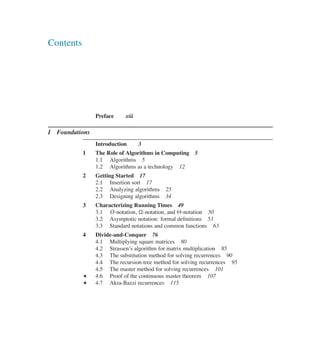
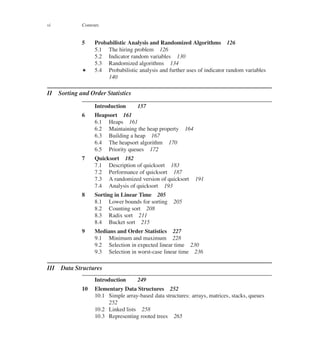
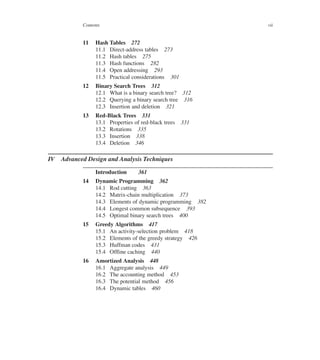
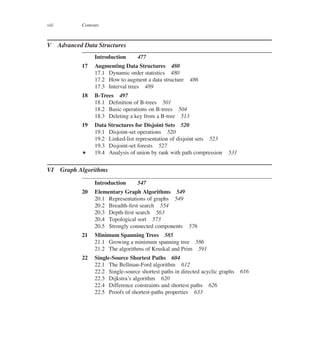
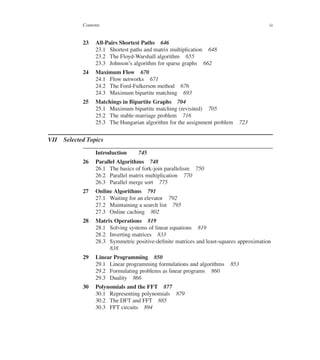
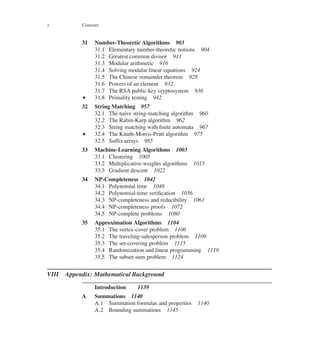
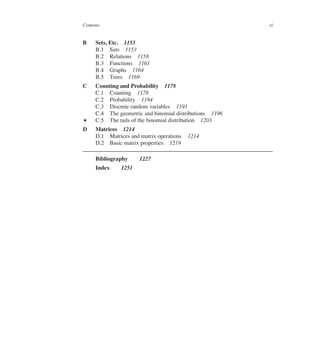

![Preface
Not so long ago, anyone who had heard the word <algorithm= was almost certainly
a computer scientist or mathematician. With computers having become prevalent in
our modern lives, however, the term is no longer esoteric. If you look around your
home, you’ll ûnd algorithms running in the most mundane places: your microwave
oven, your washing machine, and, of course, your computer. You ask algorithms
to make recommendations to you: what music you might like or what route to
take when driving. Our society, for better or for worse, asks algorithms to suggest
sentences for convicted criminals. You even rely on algorithms to keep you alive,
or at least not to kill you: the control systems in your car or in medical equipment.1
The word <algorithm= appears somewhere in the news seemingly every day.
Therefore, it behooves you to understand algorithms not just as a student or
practitioner of computer science, but as a citizen of the world. Once you understand
algorithms, you can educate others about what algorithms are, how they operate,
and what their limitations are.
This book provides a comprehensive introduction to the modern study of com-
puter algorithms. It presents many algorithms and covers them in considerable
depth, yet makes their design accessible to all levels of readers. All the analyses
are laid out, some simple, some more involved. We have tried to keep explanations
clear without sacriûcing depth of coverage or mathematical rigor.
Each chapter presents an algorithm, a design technique, an application area, or a
related topic. Algorithms are described in English and in a pseudocode designed to
be readable by anyone who has done a little programming. The book contains 231
ûgures4many with multiple parts4illustrating how the algorithms work. Since
we emphasize efficiency as a design criterion, we include careful analyses of the
running times of the algorithms.
1 To understand many of the ways in which algorithms inüuence our daily lives, see the book by
Fry [162].](https://image.slidesharecdn.com/24579828-250519115247-b16e7ec0/85/Introduction-To-Algorithms-4th-Thomas-H-Cormen-Charles-E-Leiserson-19-320.jpg)


![16 Chapter 1 The Role of Algorithms in Computing
1 1 1 1 1 1 1
second minute hour day month year century
lg n
pn
n
n lg n
n2
n3
2n
nŠ
Chapter notes
There are many excellent texts on the general topic of algorithms, including those
by Aho, Hopcroft, and Ullman [5, 6], Dasgupta, Papadimitriou, and Vazirani [107],
Edmonds [133], Erickson [135], Goodrich and Tamassia [195, 196], Kleinberg
and Tardos [257], Knuth [259, 260, 261, 262, 263], Levitin [298], Louridas [305],
Mehlhorn and Sanders [325], Mitzenmacher and Upfal [331], Neapolitan [342],
Roughgarden [385, 386, 387, 388], Sanders, Mehlhorn, Dietzfelbinger, and De-
mentiev [393], Sedgewick and Wayne [402], Skiena [414], Soltys-Kulinicz [419],
Wilf [455], and Williamson and Shmoys [459]. Some of the more practical as-
pects of algorithm design are discussed by Bentley [49, 50, 51], Bhargava [54],
Kochenderfer and Wheeler [268], and McGeoch [321]. Surveys of the ûeld of al-
gorithms can also be found in books by Atallah and Blanton [27, 28] and Mehta and
Sahhi [326]. For less technical material, see the books by Christian and Grifûths
[92], Cormen [104], Erwig [136], MacCormick [307], and V¨
ocking et al. [448].
Overviews of the algorithms used in computational biology can be found in books
by Jones and Pevzner [240], Elloumi and Zomaya [134], and Marchisio [315].](https://image.slidesharecdn.com/24579828-250519115247-b16e7ec0/85/Introduction-To-Algorithms-4th-Thomas-H-Cormen-Charles-E-Leiserson-42-320.jpg)