SPEJ & Associates
Chartered Accountants
1 Strictly Confidential: For internal use only and not for circulation
ICAI Dubai Chapter NPIO
Practical Insights to IFRS 9 – Expected Credit Loss
27th April 2021
S P E J & Associates
Chartered Accountants
2 Strictly Confidential: For internal use only and not for circulation
SPEJ & Associates
Chartered Accountants
 1. IFRS 9 - Introduction & UAE’s Impact Analysis
 2. Classification of financial assets & Financial
Liabilities
 3. Impairment of Financial Assets
 Simplified Approach
 General Approach
 POCI Approach
 4. How About Some Examples?
 5. Q&A
IFRS 9 – Expected Credit Loss - Topics of Discussion
3 Strictly Confidential: For internal use only and not for circulation
SPEJ & Associates
Chartered Accountants
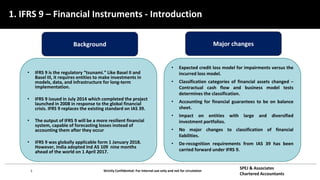
1. IFRS 9 – Financial Instruments - Introduction
• IFRS 9 is the regulatory “tsunami.” Like Basel II and
Basel III, it requires entities to make investments in
models, data, and infrastructure for long-term
implementation.
• IFRS 9 issued in July 2014 which completed the project
launched in 2008 in response to the global financial
crisis. IFRS 9 replaces the existing standard on IAS 39.
• The output of IFRS 9 will be a more resilient financial
system, capable of forecasting losses instead of
accounting them after they occur
• IFRS 9 was globally applicable form 1 January 2018.
However, India adopted Ind AS 109 nine months
ahead of the world on 1 April 2017.
• Expected credit loss model for impairments versus the
incurred loss model.
• Classification categories of financial assets changed –
Contractual cash flow and business model tests
determines the classification.
• Accounting for financial guarantees to be on balance
sheet.
• Impact on entities with large and diversified
investment portfolios.
• No major changes to classification of financial
liabilities.
• De-recognition requirements from IAS 39 has been
carried forward under IFRS 9.
Background Major changes
4 Strictly Confidential: For internal use only and not for circulation
SPEJ & Associates
Chartered Accountants
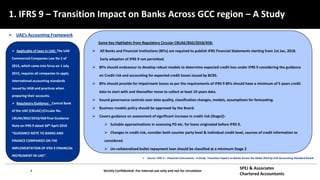
1. IFRS 9 – Transition Impact on Banks Across GCC region – A Study
 Source: IFRS 9 – Financial Instruments : A Study: Transition Impact on Banks Across the Globe 2019 by ICAI Accounting Standard Board
 UAE’s Accounting Framework
 Applicable of laws in UAE: The UAE
Commercial Companies Law No 2 of
2015, which came into force on 1 July
2015, requires all companies to apply
international accounting standards
issued by IASB and practices when
preparing their accounts.
 Regulatory Guidance: Central Bank
of the UAE (CBUAE) (Circular No.
CBUAE/BSD/2018/458 final Guidance
Note on IFRS 9 dated 30th April 2018
“GUIDANCE NOTE TO BANKS AND
FINANCE COMPANIES ON THE
IMPLEMENTATION OF IFRS 9 FINANCIAL
INSTRUMENT IN UAE”.
Some Key Highlights from Regulatory Circular CBUAE/BSD/2018/458:
 All Banks and Financial Institutions (BFIs) are required to publish IFRS Financial Statements starting from 1st Jan, 2018.
Early adoption of IFRS 9 not permitted.
 BFIs should endeavour to develop robust models to determine expected credit loss under IFRS 9 considering the guidance
on Credit risk and accounting for expected credit losses issued by BCBS.
 BFIs should provide for impairment losses as per the requirements of IFRS 9 BFIs should have a minimum of 5 years credit
data to start with and thereafter move to collect at least 10 years data.
 Sound governance controls over data quality, classification changes, models, assumptions for forecasting.
 Business models policy should be approved by the Board.
 Covers guidance on assessment of significant increase in credit risk (Stage2)-
 Suitable approximations in assessing PD etc. for loans originated before IFRS 9,
 Changes in credit risk, consider both counter party level & individual credit level, sources of credit information to
considered
 Un-collateralised bullet repayment loan should be classified at a minimum Stage 2
5 Strictly Confidential: For internal use only and not for circulation
SPEJ & Associates
Chartered Accountants
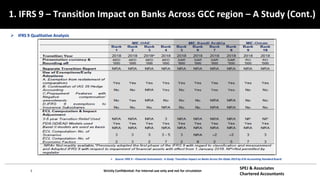
1. IFRS 9 – Transition Impact on Banks Across GCC region – A Study (Cont.)
 Source: IFRS 9 – Financial Instruments : A Study: Transition Impact on Banks Across the Globe 2019 by ICAI Accounting Standard Board
 IFRS 9 Qualitative Analysis
6 Strictly Confidential: For internal use only and not for circulation
SPEJ & Associates
Chartered Accountants
1. IFRS 9 – Transition Impact on Banks Across GCC region – A Study (Cont.)
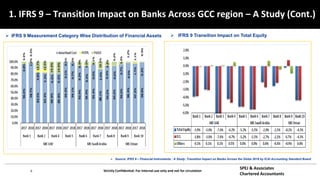
 IFRS 9 Measurement Category Wise Distribution of Financial Assets  IFRS 9 Transition Impact on Total Equity
 Source: IFRS 9 – Financial Instruments : A Study: Transition Impact on Banks Across the Globe 2019 by ICAI Accounting Standard Board
7 Strictly Confidential: For internal use only and not for circulation
SPEJ & Associates
Chartered Accountants
1. IFRS 9 – Transition Impact on Banks Across GCC region – A Study (Cont.)
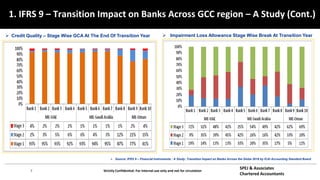
 Credit Quality – Stage Wise GCA At The End Of Transition Year  Impairment Loss Allowance Stage Wise Break At Transition Year
 Source: IFRS 9 – Financial Instruments : A Study: Transition Impact on Banks Across the Globe 2019 by ICAI Accounting Standard Board
8 Strictly Confidential: For internal use only and not for circulation
SPEJ & Associates
Chartered Accountants
IFRS 9 – Expected Credit Loss - Topics of Discussion
 1. IFRS 9 - Introduction & UAE’s Impact Analysis
 2. Classification: Financial Assets & Financial Liabilities
 3. Impairment of Financial Assets
 Simplified Approach
 General Approach
 POCI Approach
 4. How About Some Examples?
 5. Q&A
9 Strictly Confidential: For internal use only and not for circulation
SPEJ & Associates
Chartered Accountants
Debt (including hybrid contracts)
Pass
No
Neither (1)
nor (2)
BM with objective that
results in collecting
contractual cash flows
and selling FA
1 3
2
No
Yes
Derivatives Equity
No
Yes
Amortised
cost
FVTPL
FVTOCI
(with recycling)
FVTOCI
(no recycling)
‘Contractual cash flow characteristics’ test (at
instrument level)
Fail
Hold to collect
contractual cash
flows
Conditional fair value
option (FVO) elected?
Fail Fail
Held for trading?
Yes No
FVTOCI option
elected ?
‘Business model’ assessment
(at an aggregate level)
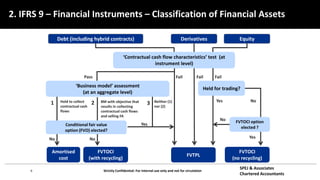
2. IFRS 9 – Financial Instruments – Classification of Financial Assets
10 Strictly Confidential: For internal use only and not for circulation
SPEJ & Associates
Chartered Accountants
Step 1: SPPI Assessment
Cash flows solely payments of principal and interest
FVTPL
Step 2: Business model assessment
Is the business model’s objective to hold to collect contractual
cash flows?
Are assets in the business model managed both to collect
contractual cash flows and for sale?
Amortised cost*
FVOCI (debt instruments)*
 Interest revenue, credit impairments and foreign exchange gain or
loss recognised in P&L in same manner as amortised cost
 Other gains and losses in OCI
 On derecognition, cumulative gains and losses in OCI reclassified to
P&L
No
Yes
Yes
Yes
*FVTPL designation is available only to eliminate or significantly reduce accounting mismatch
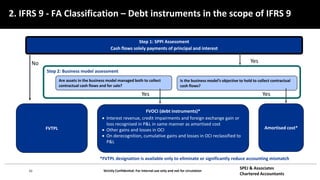
2. IFRS 9 - FA Classification – Debt instruments in the scope of IFRS 9
11 Strictly Confidential: For internal use only and not for circulation
SPEJ & Associates
Chartered Accountants
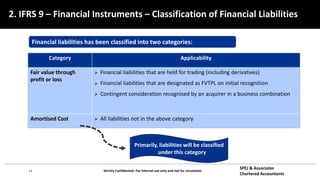
Category Applicability
Fair value through
profit or loss
 Financial liabilities that are held for trading (including derivatives)
 Financial liabilities that are designated as FVTPL on initial recognition
 Contingent consideration recognised by an acquirer in a business combination
Amortised Cost  All liabilities not in the above category
Financial liabilities has been classified into two categories:
Primarily, liabilities will be classified
under this category
2. IFRS 9 – Financial Instruments – Classification of Financial Liabilities
12 Strictly Confidential: For internal use only and not for circulation
SPEJ & Associates
Chartered Accountants
IFRS 9 – Expected Credit Loss - Topics of Discussion
 1. IFRS 9 - Introduction & UAE’s Impact Analysis
 2. Classification: financial assets & Financial Liabilities
 3. Impairment of Financial Assets
 Simplified Approach
 General Approach
 POCI Approach
 4. How About Some Examples?
 5. Q&A
13 Strictly Confidential: For internal use only and not for circulation
SPEJ & Associates
Chartered Accountants
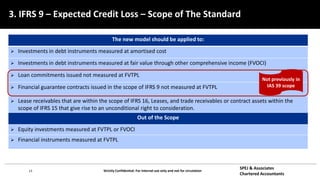
The new model should be applied to:
 Investments in debt instruments measured at amortised cost
 Investments in debt instruments measured at fair value through other comprehensive income (FVOCI)
 Loan commitments issued not measured at FVTPL
 Financial guarantee contracts issued in the scope of IFRS 9 not measured at FVTPL
 Lease receivables that are within the scope of IFRS 16, Leases, and trade receivables or contract assets within the
scope of IFRS 15 that give rise to an unconditional right to consideration.
Out of the Scope
 Equity investments measured at FVTPL or FVOCI
 Financial instruments measured at FVTPL
Not previously in
IAS 39 scope
3. IFRS 9 – Expected Credit Loss – Scope of The Standard
14 Strictly Confidential: For internal use only and not for circulation
SPEJ & Associates
Chartered Accountants
3. IFRS 9 – Expected Credit Loss – Method of ECL
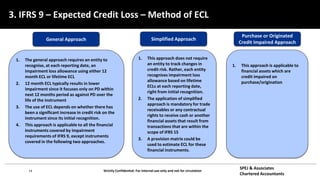
1. This approach does not require
an entity to track changes in
credit risk. Rather, each entity
recognises impairment loss
allowance based on lifetime
ECLs at each reporting date,
right from initial recognition.
2. The application of simplified
approach is mandatory for trade
receivables or any contractual
rights to receive cash or another
financial assets that result from
transactions that are within the
scope of IFRS 15
3. A provision matrix could be
used to estimate ECL for these
financial instruments.
Simplified Approach
1. This approach is applicable to
financial assets which are
credit impaired on
purchase/origination
Purchase or Originated
Credit Impaired Approach
General Approach
1. The general approach requires an entity to
recognise, at each reporting date, an
impairment loss allowance using either 12
month ECL or lifetime ECL
2. 12 month ECL typically results in lower
impairment since it focuses only on PD within
next 12 months period as against PD over the
life of the instrument
3. The use of ECL depends on whether there has
been a significant increase in credit risk on the
instrument since its initial recognition.
4. This approach is applicable to all the financial
instruments covered by impairment
requirements of IFRS 9, except instruments
covered in the following two approaches.
15 Strictly Confidential: For internal use only and not for circulation
SPEJ & Associates
Chartered Accountants
Is asset being tested a trade receivable, lease
receivable (IFRS 16/IFRS 17) or contract asset
(IFRS 15)?
Policy choice
Calculate the credit loss provision using the 3 stage IFRS 9 model
Analyse credit risk deterioration or improvement since initial recognition
[Stage 1, 2 and 3]
Stage 1:
12 month expected credit loss
Stage 2 and 3:
Lifetime expected credit loss
No
Consider forward looking information
Does the asset have a significant financing
component?
Yes
No
Yes
Lifetime expected credit losses
3 stage IFRS 9 model
Provision matrix
approach
3. IFRS 9 – Impairment model – Decision Tree
Option 1
Option 2
16 Strictly Confidential: For internal use only and not for circulation
SPEJ & Associates
Chartered Accountants
3. IFRS 9 – Expected Credit Loss – Significant Increase in Credit Risk
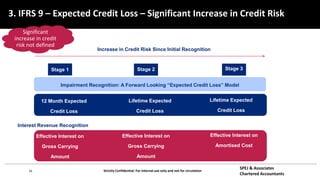
Stage 1 Stage 2 Stage 3
12 Month Expected
Credit Loss
Lifetime Expected
Credit Loss
Lifetime Expected
Credit Loss
Effective Interest on
Gross Carrying
Amount
Effective Interest on
Gross Carrying
Amount
Effective Interest on
Amortised Cost
Impairment Recognition: A Forward Looking “Expected Credit Loss” Model
Increase in Credit Risk Since Initial Recognition
Interest Revenue Recognition
Significant
increase in credit
risk not defined
17 Strictly Confidential: For internal use only and not for circulation
SPEJ & Associates
Chartered Accountants
Factors to consider: The calculation of ECL should reflect:
1 an unbiased and probability weighted amount;
2 the time value of money; and
3 reasonable and supportable information that is available without undue cost or effort
►A credit loss is the difference between the cash flows that are due to an entity in accordance with the contract and the cash flows that the entity
expects to receive discounted at the original effective interest rate
►An Expected Credit Loss (ECL) is the probability weighted estimate of credit loss over the life of a financial instrument
Dual measurement approach: The model uses two approaches for measurement of expected credit loss:
12 month Expected Credit Loss
(12M EL)
Cash shortfalls that will result if a default occurs within 12 months (or shorter period if the expected life is
less than 12 months), weighted by probability of the default
Lifetime Expected Credit Loss
(Lifetime EL)
Cash shortfalls that will result from default events occurring over the expected life (residual maturity) of
financial instruments, weighted by probability of the default
3. IFRS 9 – Expected Credit Loss – Standard Guidelines
18 Strictly Confidential: For internal use only and not for circulation
SPEJ & Associates
Chartered Accountants
ECL = PD * LGD * EAD * D
ECL Parameters Description
Probability of default
(PD)
IFRS 9 requires PD to be Point-in-Time and the ECL estimates shall be Forward Looking depending on the Macro-Economic
Outlook. (Refer next slide for detailed explanation)
12 month PD: 12 month probability of default is likelihood of an obligor defaulting in 12 months from the reporting date
required for Stage 1 provisioning
Lifetime PD: Lifetime probability of default is likelihood of an obligor defaulting over the lifetime of the loan. PIT estimates
would be adjusted using survival rates for Stage 2 provisioning.
Loss given default (LGD) “LGD - Loss Given Default” is the portion of the exposure that the entity will lose in case of default. It is based on the
difference between contractual cash flows that are due and expected to be received including from collateral.
(Refer next slide for detailed explanation)
Exposure at default
(EAD)
EAD is one of the key component for ECL computation. EAD can be seen as an estimation of the extent to which the financial
entity may be exposed to a counterparty in the event of a default and at the time of the counterparty default.
Discount Rate (D) Used to discount an expected loss to a present value at the reporting date using the effective interest rate at initial
recognition
3. IFRS 9 – Expected Credit Loss – Calculation
19 Strictly Confidential: For internal use only and not for circulation
SPEJ & Associates
Chartered Accountants
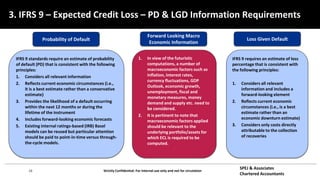
3. IFRS 9 – Expected Credit Loss – PD & LGD Information Requirements
1. In view of the futuristic
computations, a number of
macroeconomic factors such as
inflation, interest rates,
currency fluctuations, GDP
Outlook, economic growth,
unemployment, fiscal and
monetary measures, money
demand and supply etc. need to
be considered.
2. It is pertinent to note that
macroeconomic factors applied
should be relevant to the
underlying portfolio/assets for
which ECL is required to be
computed.
Forward Looking Macro
Economic Information
IFRS 9 requires an estimate of loss
percentage that is consistent with
the following principles:
1. Considers all relevant
information and includes a
forward-looking element
2. Reflects current economic
circumstances (i.e., is a best
estimate rather than an
economic downturn estimate)
3. Considers only costs directly
attributable to the collection
of recoveries
Loss Given Default
Probability of Default
IFRS 9 standards require an estimate of probability
of default (PD) that is consistent with the following
principles:
1. Considers all relevant information
2. Reflects current economic circumstances (i.e.,
it is a best estimate rather than a conservative
estimate)
3. Provides the likelihood of a default occurring
within the next 12 months or during the
lifetime of the instrument
4. Includes forward-looking economic forecasts
5. Existing internal ratings-based (IRB) Basel
models can be reused but particular attention
should be paid to point-in-time versus through-
the-cycle models.
20 Strictly Confidential: For internal use only and not for circulation
SPEJ & Associates
Chartered Accountants
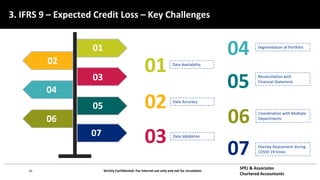
3. IFRS 9 – Expected Credit Loss – Key Challenges
01
02
03
05
04
01
02
Data Availability
Data Accuracy
04 Segmentation of Portfolio
05 Reconciliation with
Financial Statement
Data Validation
03
06 06 Coordination with Multiple
Departments
07
07 Overlay Assessment during
COVID 19 times
21 Strictly Confidential: For internal use only and not for circulation
SPEJ & Associates
Chartered Accountants
IFRS 9 – Expected Credit Loss - Topics of Discussion
 1. IFRS 9 - Introduction & UAE’s Impact Analysis
 2. Classification: Financial assets & Financial Liabilities
 3. Impairment of Financial Assets
 Simplified Approach
 General Approach
 POCI Approach
 4. How About Some Examples?
 5. Q&A
22 Strictly Confidential: For internal use only and not for circulation
SPEJ & Associates
Chartered Accountants
IFRS 9 – Expected Credit Loss – Calculation (Cont.)
S P E J & Associates
Chartered Accountants
Questions?
Page 23
SP Associates
Chartered Accountants
Strictly Confidential: For internal use only and not for circulation
Contact us:
Mithul Shah
Mobile: +91 98401 51891
Email ID: mithul.shah@spej.in
LinkedIn ID: mithul-shah-594aa3149
This presentation deck is the property of SPEJ & Associates. Any circulation
without the prior approval of the firm is strictly prohibited.
Some data & information are extracted from public domain. The Firm and its
Partners are not liable in any manner for any liabilities arising at later point of
time.
Nitin Jain
Mobile: +91 98400 84477
Email ID: nitin.jain@spej.in
LinkedIn ID: nitin-jain-b0aa4135
S P E J & Associates
Chartered Accountants
Our service brochures for list of services offered by the firm are available upon request
Thank You!

1_icai_dubai_ifrs_9_expected_credit_loss_final.pdf

  • 1.
    SPEJ & Associates CharteredAccountants 1 Strictly Confidential: For internal use only and not for circulation ICAI Dubai Chapter NPIO Practical Insights to IFRS 9 – Expected Credit Loss 27th April 2021 S P E J & Associates Chartered Accountants
  • 2.
    2 Strictly Confidential:For internal use only and not for circulation SPEJ & Associates Chartered Accountants  1. IFRS 9 - Introduction & UAE’s Impact Analysis  2. Classification of financial assets & Financial Liabilities  3. Impairment of Financial Assets  Simplified Approach  General Approach  POCI Approach  4. How About Some Examples?  5. Q&A IFRS 9 – Expected Credit Loss - Topics of Discussion
  • 3.
    3 Strictly Confidential:For internal use only and not for circulation SPEJ & Associates Chartered Accountants 1. IFRS 9 – Financial Instruments - Introduction • IFRS 9 is the regulatory “tsunami.” Like Basel II and Basel III, it requires entities to make investments in models, data, and infrastructure for long-term implementation. • IFRS 9 issued in July 2014 which completed the project launched in 2008 in response to the global financial crisis. IFRS 9 replaces the existing standard on IAS 39. • The output of IFRS 9 will be a more resilient financial system, capable of forecasting losses instead of accounting them after they occur • IFRS 9 was globally applicable form 1 January 2018. However, India adopted Ind AS 109 nine months ahead of the world on 1 April 2017. • Expected credit loss model for impairments versus the incurred loss model. • Classification categories of financial assets changed – Contractual cash flow and business model tests determines the classification. • Accounting for financial guarantees to be on balance sheet. • Impact on entities with large and diversified investment portfolios. • No major changes to classification of financial liabilities. • De-recognition requirements from IAS 39 has been carried forward under IFRS 9. Background Major changes
  • 4.
    4 Strictly Confidential:For internal use only and not for circulation SPEJ & Associates Chartered Accountants 1. IFRS 9 – Transition Impact on Banks Across GCC region – A Study  Source: IFRS 9 – Financial Instruments : A Study: Transition Impact on Banks Across the Globe 2019 by ICAI Accounting Standard Board  UAE’s Accounting Framework  Applicable of laws in UAE: The UAE Commercial Companies Law No 2 of 2015, which came into force on 1 July 2015, requires all companies to apply international accounting standards issued by IASB and practices when preparing their accounts.  Regulatory Guidance: Central Bank of the UAE (CBUAE) (Circular No. CBUAE/BSD/2018/458 final Guidance Note on IFRS 9 dated 30th April 2018 “GUIDANCE NOTE TO BANKS AND FINANCE COMPANIES ON THE IMPLEMENTATION OF IFRS 9 FINANCIAL INSTRUMENT IN UAE”. Some Key Highlights from Regulatory Circular CBUAE/BSD/2018/458:  All Banks and Financial Institutions (BFIs) are required to publish IFRS Financial Statements starting from 1st Jan, 2018. Early adoption of IFRS 9 not permitted.  BFIs should endeavour to develop robust models to determine expected credit loss under IFRS 9 considering the guidance on Credit risk and accounting for expected credit losses issued by BCBS.  BFIs should provide for impairment losses as per the requirements of IFRS 9 BFIs should have a minimum of 5 years credit data to start with and thereafter move to collect at least 10 years data.  Sound governance controls over data quality, classification changes, models, assumptions for forecasting.  Business models policy should be approved by the Board.  Covers guidance on assessment of significant increase in credit risk (Stage2)-  Suitable approximations in assessing PD etc. for loans originated before IFRS 9,  Changes in credit risk, consider both counter party level & individual credit level, sources of credit information to considered  Un-collateralised bullet repayment loan should be classified at a minimum Stage 2
  • 5.
    5 Strictly Confidential:For internal use only and not for circulation SPEJ & Associates Chartered Accountants 1. IFRS 9 – Transition Impact on Banks Across GCC region – A Study (Cont.)  Source: IFRS 9 – Financial Instruments : A Study: Transition Impact on Banks Across the Globe 2019 by ICAI Accounting Standard Board  IFRS 9 Qualitative Analysis
  • 6.
    6 Strictly Confidential:For internal use only and not for circulation SPEJ & Associates Chartered Accountants 1. IFRS 9 – Transition Impact on Banks Across GCC region – A Study (Cont.)  IFRS 9 Measurement Category Wise Distribution of Financial Assets  IFRS 9 Transition Impact on Total Equity  Source: IFRS 9 – Financial Instruments : A Study: Transition Impact on Banks Across the Globe 2019 by ICAI Accounting Standard Board
  • 7.
    7 Strictly Confidential:For internal use only and not for circulation SPEJ & Associates Chartered Accountants 1. IFRS 9 – Transition Impact on Banks Across GCC region – A Study (Cont.)  Credit Quality – Stage Wise GCA At The End Of Transition Year  Impairment Loss Allowance Stage Wise Break At Transition Year  Source: IFRS 9 – Financial Instruments : A Study: Transition Impact on Banks Across the Globe 2019 by ICAI Accounting Standard Board
  • 8.
    8 Strictly Confidential:For internal use only and not for circulation SPEJ & Associates Chartered Accountants IFRS 9 – Expected Credit Loss - Topics of Discussion  1. IFRS 9 - Introduction & UAE’s Impact Analysis  2. Classification: Financial Assets & Financial Liabilities  3. Impairment of Financial Assets  Simplified Approach  General Approach  POCI Approach  4. How About Some Examples?  5. Q&A
  • 9.
    9 Strictly Confidential:For internal use only and not for circulation SPEJ & Associates Chartered Accountants Debt (including hybrid contracts) Pass No Neither (1) nor (2) BM with objective that results in collecting contractual cash flows and selling FA 1 3 2 No Yes Derivatives Equity No Yes Amortised cost FVTPL FVTOCI (with recycling) FVTOCI (no recycling) ‘Contractual cash flow characteristics’ test (at instrument level) Fail Hold to collect contractual cash flows Conditional fair value option (FVO) elected? Fail Fail Held for trading? Yes No FVTOCI option elected ? ‘Business model’ assessment (at an aggregate level) 2. IFRS 9 – Financial Instruments – Classification of Financial Assets
  • 10.
    10 Strictly Confidential:For internal use only and not for circulation SPEJ & Associates Chartered Accountants Step 1: SPPI Assessment Cash flows solely payments of principal and interest FVTPL Step 2: Business model assessment Is the business model’s objective to hold to collect contractual cash flows? Are assets in the business model managed both to collect contractual cash flows and for sale? Amortised cost* FVOCI (debt instruments)*  Interest revenue, credit impairments and foreign exchange gain or loss recognised in P&L in same manner as amortised cost  Other gains and losses in OCI  On derecognition, cumulative gains and losses in OCI reclassified to P&L No Yes Yes Yes *FVTPL designation is available only to eliminate or significantly reduce accounting mismatch 2. IFRS 9 - FA Classification – Debt instruments in the scope of IFRS 9
  • 11.
    11 Strictly Confidential:For internal use only and not for circulation SPEJ & Associates Chartered Accountants Category Applicability Fair value through profit or loss  Financial liabilities that are held for trading (including derivatives)  Financial liabilities that are designated as FVTPL on initial recognition  Contingent consideration recognised by an acquirer in a business combination Amortised Cost  All liabilities not in the above category Financial liabilities has been classified into two categories: Primarily, liabilities will be classified under this category 2. IFRS 9 – Financial Instruments – Classification of Financial Liabilities
  • 12.
    12 Strictly Confidential:For internal use only and not for circulation SPEJ & Associates Chartered Accountants IFRS 9 – Expected Credit Loss - Topics of Discussion  1. IFRS 9 - Introduction & UAE’s Impact Analysis  2. Classification: financial assets & Financial Liabilities  3. Impairment of Financial Assets  Simplified Approach  General Approach  POCI Approach  4. How About Some Examples?  5. Q&A
  • 13.
    13 Strictly Confidential:For internal use only and not for circulation SPEJ & Associates Chartered Accountants The new model should be applied to:  Investments in debt instruments measured at amortised cost  Investments in debt instruments measured at fair value through other comprehensive income (FVOCI)  Loan commitments issued not measured at FVTPL  Financial guarantee contracts issued in the scope of IFRS 9 not measured at FVTPL  Lease receivables that are within the scope of IFRS 16, Leases, and trade receivables or contract assets within the scope of IFRS 15 that give rise to an unconditional right to consideration. Out of the Scope  Equity investments measured at FVTPL or FVOCI  Financial instruments measured at FVTPL Not previously in IAS 39 scope 3. IFRS 9 – Expected Credit Loss – Scope of The Standard
  • 14.
    14 Strictly Confidential:For internal use only and not for circulation SPEJ & Associates Chartered Accountants 3. IFRS 9 – Expected Credit Loss – Method of ECL 1. This approach does not require an entity to track changes in credit risk. Rather, each entity recognises impairment loss allowance based on lifetime ECLs at each reporting date, right from initial recognition. 2. The application of simplified approach is mandatory for trade receivables or any contractual rights to receive cash or another financial assets that result from transactions that are within the scope of IFRS 15 3. A provision matrix could be used to estimate ECL for these financial instruments. Simplified Approach 1. This approach is applicable to financial assets which are credit impaired on purchase/origination Purchase or Originated Credit Impaired Approach General Approach 1. The general approach requires an entity to recognise, at each reporting date, an impairment loss allowance using either 12 month ECL or lifetime ECL 2. 12 month ECL typically results in lower impairment since it focuses only on PD within next 12 months period as against PD over the life of the instrument 3. The use of ECL depends on whether there has been a significant increase in credit risk on the instrument since its initial recognition. 4. This approach is applicable to all the financial instruments covered by impairment requirements of IFRS 9, except instruments covered in the following two approaches.
  • 15.
    15 Strictly Confidential:For internal use only and not for circulation SPEJ & Associates Chartered Accountants Is asset being tested a trade receivable, lease receivable (IFRS 16/IFRS 17) or contract asset (IFRS 15)? Policy choice Calculate the credit loss provision using the 3 stage IFRS 9 model Analyse credit risk deterioration or improvement since initial recognition [Stage 1, 2 and 3] Stage 1: 12 month expected credit loss Stage 2 and 3: Lifetime expected credit loss No Consider forward looking information Does the asset have a significant financing component? Yes No Yes Lifetime expected credit losses 3 stage IFRS 9 model Provision matrix approach 3. IFRS 9 – Impairment model – Decision Tree Option 1 Option 2
  • 16.
    16 Strictly Confidential:For internal use only and not for circulation SPEJ & Associates Chartered Accountants 3. IFRS 9 – Expected Credit Loss – Significant Increase in Credit Risk Stage 1 Stage 2 Stage 3 12 Month Expected Credit Loss Lifetime Expected Credit Loss Lifetime Expected Credit Loss Effective Interest on Gross Carrying Amount Effective Interest on Gross Carrying Amount Effective Interest on Amortised Cost Impairment Recognition: A Forward Looking “Expected Credit Loss” Model Increase in Credit Risk Since Initial Recognition Interest Revenue Recognition Significant increase in credit risk not defined
  • 17.
    17 Strictly Confidential:For internal use only and not for circulation SPEJ & Associates Chartered Accountants Factors to consider: The calculation of ECL should reflect: 1 an unbiased and probability weighted amount; 2 the time value of money; and 3 reasonable and supportable information that is available without undue cost or effort ►A credit loss is the difference between the cash flows that are due to an entity in accordance with the contract and the cash flows that the entity expects to receive discounted at the original effective interest rate ►An Expected Credit Loss (ECL) is the probability weighted estimate of credit loss over the life of a financial instrument Dual measurement approach: The model uses two approaches for measurement of expected credit loss: 12 month Expected Credit Loss (12M EL) Cash shortfalls that will result if a default occurs within 12 months (or shorter period if the expected life is less than 12 months), weighted by probability of the default Lifetime Expected Credit Loss (Lifetime EL) Cash shortfalls that will result from default events occurring over the expected life (residual maturity) of financial instruments, weighted by probability of the default 3. IFRS 9 – Expected Credit Loss – Standard Guidelines
  • 18.
    18 Strictly Confidential:For internal use only and not for circulation SPEJ & Associates Chartered Accountants ECL = PD * LGD * EAD * D ECL Parameters Description Probability of default (PD) IFRS 9 requires PD to be Point-in-Time and the ECL estimates shall be Forward Looking depending on the Macro-Economic Outlook. (Refer next slide for detailed explanation) 12 month PD: 12 month probability of default is likelihood of an obligor defaulting in 12 months from the reporting date required for Stage 1 provisioning Lifetime PD: Lifetime probability of default is likelihood of an obligor defaulting over the lifetime of the loan. PIT estimates would be adjusted using survival rates for Stage 2 provisioning. Loss given default (LGD) “LGD - Loss Given Default” is the portion of the exposure that the entity will lose in case of default. It is based on the difference between contractual cash flows that are due and expected to be received including from collateral. (Refer next slide for detailed explanation) Exposure at default (EAD) EAD is one of the key component for ECL computation. EAD can be seen as an estimation of the extent to which the financial entity may be exposed to a counterparty in the event of a default and at the time of the counterparty default. Discount Rate (D) Used to discount an expected loss to a present value at the reporting date using the effective interest rate at initial recognition 3. IFRS 9 – Expected Credit Loss – Calculation
  • 19.
    19 Strictly Confidential:For internal use only and not for circulation SPEJ & Associates Chartered Accountants 3. IFRS 9 – Expected Credit Loss – PD & LGD Information Requirements 1. In view of the futuristic computations, a number of macroeconomic factors such as inflation, interest rates, currency fluctuations, GDP Outlook, economic growth, unemployment, fiscal and monetary measures, money demand and supply etc. need to be considered. 2. It is pertinent to note that macroeconomic factors applied should be relevant to the underlying portfolio/assets for which ECL is required to be computed. Forward Looking Macro Economic Information IFRS 9 requires an estimate of loss percentage that is consistent with the following principles: 1. Considers all relevant information and includes a forward-looking element 2. Reflects current economic circumstances (i.e., is a best estimate rather than an economic downturn estimate) 3. Considers only costs directly attributable to the collection of recoveries Loss Given Default Probability of Default IFRS 9 standards require an estimate of probability of default (PD) that is consistent with the following principles: 1. Considers all relevant information 2. Reflects current economic circumstances (i.e., it is a best estimate rather than a conservative estimate) 3. Provides the likelihood of a default occurring within the next 12 months or during the lifetime of the instrument 4. Includes forward-looking economic forecasts 5. Existing internal ratings-based (IRB) Basel models can be reused but particular attention should be paid to point-in-time versus through- the-cycle models.
  • 20.
    20 Strictly Confidential:For internal use only and not for circulation SPEJ & Associates Chartered Accountants 3. IFRS 9 – Expected Credit Loss – Key Challenges 01 02 03 05 04 01 02 Data Availability Data Accuracy 04 Segmentation of Portfolio 05 Reconciliation with Financial Statement Data Validation 03 06 06 Coordination with Multiple Departments 07 07 Overlay Assessment during COVID 19 times
  • 21.
    21 Strictly Confidential:For internal use only and not for circulation SPEJ & Associates Chartered Accountants IFRS 9 – Expected Credit Loss - Topics of Discussion  1. IFRS 9 - Introduction & UAE’s Impact Analysis  2. Classification: Financial assets & Financial Liabilities  3. Impairment of Financial Assets  Simplified Approach  General Approach  POCI Approach  4. How About Some Examples?  5. Q&A
  • 22.
    22 Strictly Confidential:For internal use only and not for circulation SPEJ & Associates Chartered Accountants IFRS 9 – Expected Credit Loss – Calculation (Cont.) S P E J & Associates Chartered Accountants Questions?
  • 23.
    Page 23 SP Associates CharteredAccountants Strictly Confidential: For internal use only and not for circulation Contact us: Mithul Shah Mobile: +91 98401 51891 Email ID: mithul.shah@spej.in LinkedIn ID: mithul-shah-594aa3149 This presentation deck is the property of SPEJ & Associates. Any circulation without the prior approval of the firm is strictly prohibited. Some data & information are extracted from public domain. The Firm and its Partners are not liable in any manner for any liabilities arising at later point of time. Nitin Jain Mobile: +91 98400 84477 Email ID: nitin.jain@spej.in LinkedIn ID: nitin-jain-b0aa4135 S P E J & Associates Chartered Accountants Our service brochures for list of services offered by the firm are available upon request Thank You!