The views expressed in this presentation are those of the
presenter, not necessarily those of the IASB or IFRS Foundation.
© IFRS Foundation. 30 Cannon Street | London EC4M 6XH | UK. www.ifrs.org
International Financial Reporting
Standards
IFRS 9
Financial Instruments
Classification and measurement
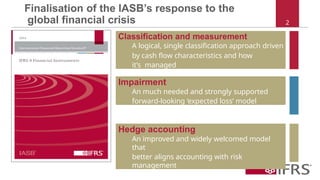
A logical, single classification approach driven
by cash flow characteristics and how
it’s managed
Finalisation of the IASB’s response to the
global financial crisis 2
Impairment
An much needed and strongly supported
forward-looking ‘expected loss’ model
Hedge accounting
An improved and widely welcomed model
that
better aligns accounting with risk
management
International Financial Reporting
Standards
The views expressed in this presentation are those of the
presenter, not necessarily those of the IASB or IFRS Foundation
Classification and
measurement
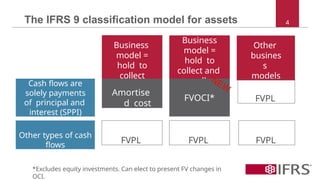
The IFRS 9 classification model for assets 4
Cash flows are
solely payments
of principal and
interest (SPPI)
Business
model =
hold to
collect
Business
model =
hold to
collect and
sell
Other
busines
s
models
Other types of cash
flows
Amortise
d cost
FVOCI*
FVPL FVPL
FVPL
FVPL
*Excludes equity investments. Can elect to present FV changes in
OCI.
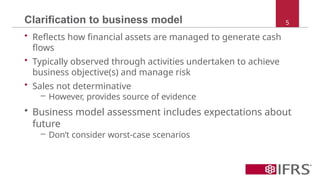
• Reflects how financial assets are managed to generate cash
flows
• Typically observed through activities undertaken to achieve
business objective(s) and manage risk
• Sales not determinative
– However, provides source of evidence
• Business model assessment includes expectations about
future
– Don’t consider worst-case scenarios
Clarification to business model 5
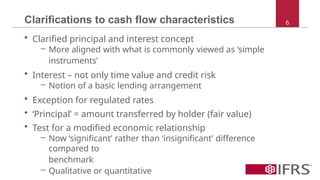
• Clarified principal and interest concept
– More aligned with what is commonly viewed as ‘simple
instruments’
• Interest – not only time value and credit risk
– Notion of a basic lending arrangement
• Exception for regulated rates
• ‘Principal’ = amount transferred by holder (fair value)
• Test for a modified economic relationship
– Now ‘significant’ rather than ‘insignificant’ difference
compared to
benchmark
– Qualitative or quantitative
Clarifications to cash flow characteristics 6
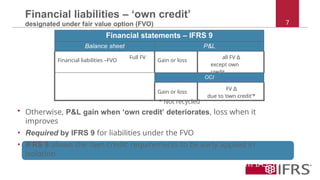
7
Financial liabilities – ‘own credit’
designated under fair value option (FVO)
Financial statements – IFRS 9
Balance sheet P&L
Financial liabilities –FVO
Full FV
Gain or loss
all FV ∆
except own
credit
OCI
Gain or loss
FV ∆
due to ‘own credit’*
* Not recycled
• Otherwise, P&L gain when ‘own credit’ deteriorates, loss when it
improves
• Required by IFRS 9 for liabilities under the FVO
• IFRS 9 allows the ‘own credit’ requirements to be early applied in
isolation
Treatment of financial liabilities is carried forward from IAS 39
essentially unchanged
International Financial Reporting
Standards
The views expressed in this presentation are those of the
presenter, not necessarily those of the IASB or IFRS Foundation
Impairme
nt
9
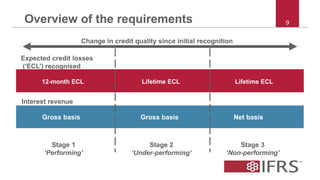
Interest revenue
Gross basis Gross basis Net basis
Stage 1
‘Performing’
Stage 2
‘Under-performing’
Stage 3
‘Non-performing’
Change in credit quality since initial recognition
Expected credit losses
(‘ECL’) recognised
12-month ECL Lifetime ECL Lifetime ECL
Overview of the requirements
Scope of the impairment requirements
• Financial assets measured at amortised cost
• Financial assets measured at FVOCI
• Lease receivables
• Trade receivables and contract assets
• Loan commitments and financial guarantee contracts not
measured at FVPL
10
1
1
Financial assets measured at FVOCI
Financial statements – IFRS 9
Balance sheet P&L
Financial asset - FVOCI
Full FV
Interest, impairment
etc
Same as for amortised cost
OCI
Gain or loss
FV ∆
Other than those recognised in P&L
• Financial assets measured at FVOCI recognised in balance sheet at FV
• Loss allowance does not reduce carrying amount, but is recognised in OCI
• P&L information is the same as for financial assets measured at amortised
cost
Amounts accumulated in OCI are recycled to P&L
upon derecognition
Key clarifications
• Enhanced responsiveness to changes in credit risk
– Recognise lifetime expected credit losses on all significant
increases
in credit risk, whether individual or collective
• Provided solutions to noted operational concerns:
– Don’t require mechanistic approach
– Assessment compared to initial maximum credit
risk on homogeneous portfolios
– Counterparty assessment if it meets objectives of
model
• Rebuttable presumption of 90 days past due for
default
• Can use an expected life for some loan commitments
12
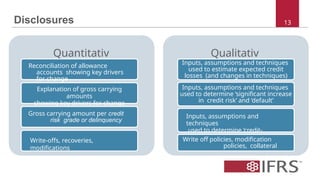
Disclosures 13
Quantitativ
e
Reconciliation of allowance
accounts showing key drivers
for change
Explanation of gross carrying
amounts
showing key drivers for change
Gross carrying amount per credit
risk grade or delinquency
Write-offs, recoveries,
modifications
Qualitativ
e
Inputs, assumptions and techniques
used to estimate expected credit
losses (and changes in techniques)
Inputs, assumptions and techniques
used to determine ‘significant increase
in credit risk’ and ‘default’
Inputs, assumptions and
techniques
used to determine ‘credit-
impaired’
Write off policies, modification
policies, collateral
International Financial Reporting
Standards
The views expressed in this presentation are those of the
presenter, not necessarily those of the IASB or IFRS Foundation
Hedge
accounting
© 2013 IFRS Foundation. 30 Cannon Street | London EC4M 6XH | UK.
www.ifrs.org
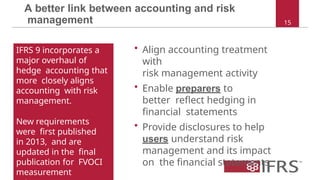
A better link between accounting and risk
management
• Align accounting treatment
with
risk management activity
• Enable preparers to
better reflect hedging in
financial statements
• Provide disclosures to help
users understand risk
management and its impact
on the financial statements
15
IFRS 9 incorporates a
major overhaul of
hedge accounting that
more closely aligns
accounting with risk
management.
New requirements
were first published
in 2013, and are
updated in the final
publication for FVOCI
measurement
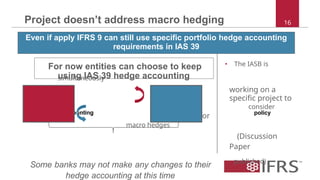
Project doesn’t address macro hedging 16
Even if apply IFRS 9 can still use specific portfolio hedge accounting
requirements in IAS 39
For now entities can choose to keep • The IASB is
using IAS 39 hedge accounting
simultaneously
working on a
specific project to
IAS 39 IFRS 9 consider
hedge Accounting hedge accounting for accountingpolicy
choice
accounting macro hedges
(Discussion
Paper
Some banks may not make any changes to their published)
hedge accounting at this time
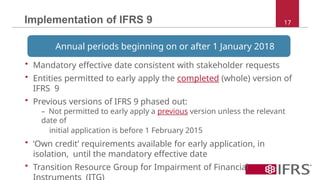
Implementation of IFRS 9 17
Annual periods beginning on or after 1 January 2018
• Mandatory effective date consistent with stakeholder requests
• Entities permitted to early apply the completed (whole) version of
IFRS 9
• Previous versions of IFRS 9 phased out:
– Not permitted to early apply a previous version unless the relevant
date of
initial application is before 1 February 2015
• ‘Own credit’ requirements available for early application, in
isolation, until the mandatory effective date
• Transition Resource Group for Impairment of Financial
Questions and comments 18
© IFRS Foundation. 30 Cannon Street | London EC4M 6XH | UK.
www.ifrs.org

ifrs9-webinar Financial Instruments- Financial

  • 1.
    The views expressedin this presentation are those of the presenter, not necessarily those of the IASB or IFRS Foundation. © IFRS Foundation. 30 Cannon Street | London EC4M 6XH | UK. www.ifrs.org International Financial Reporting Standards IFRS 9 Financial Instruments
  • 2.
    Classification and measurement Alogical, single classification approach driven by cash flow characteristics and how it’s managed Finalisation of the IASB’s response to the global financial crisis 2 Impairment An much needed and strongly supported forward-looking ‘expected loss’ model Hedge accounting An improved and widely welcomed model that better aligns accounting with risk management
  • 3.
    International Financial Reporting Standards Theviews expressed in this presentation are those of the presenter, not necessarily those of the IASB or IFRS Foundation Classification and measurement
  • 4.
    The IFRS 9classification model for assets 4 Cash flows are solely payments of principal and interest (SPPI) Business model = hold to collect Business model = hold to collect and sell Other busines s models Other types of cash flows Amortise d cost FVOCI* FVPL FVPL FVPL FVPL *Excludes equity investments. Can elect to present FV changes in OCI.
  • 5.
    • Reflects howfinancial assets are managed to generate cash flows • Typically observed through activities undertaken to achieve business objective(s) and manage risk • Sales not determinative – However, provides source of evidence • Business model assessment includes expectations about future – Don’t consider worst-case scenarios Clarification to business model 5
  • 6.
    • Clarified principaland interest concept – More aligned with what is commonly viewed as ‘simple instruments’ • Interest – not only time value and credit risk – Notion of a basic lending arrangement • Exception for regulated rates • ‘Principal’ = amount transferred by holder (fair value) • Test for a modified economic relationship – Now ‘significant’ rather than ‘insignificant’ difference compared to benchmark – Qualitative or quantitative Clarifications to cash flow characteristics 6
  • 7.
    7 Financial liabilities –‘own credit’ designated under fair value option (FVO) Financial statements – IFRS 9 Balance sheet P&L Financial liabilities –FVO Full FV Gain or loss all FV ∆ except own credit OCI Gain or loss FV ∆ due to ‘own credit’* * Not recycled • Otherwise, P&L gain when ‘own credit’ deteriorates, loss when it improves • Required by IFRS 9 for liabilities under the FVO • IFRS 9 allows the ‘own credit’ requirements to be early applied in isolation Treatment of financial liabilities is carried forward from IAS 39 essentially unchanged
  • 8.
    International Financial Reporting Standards Theviews expressed in this presentation are those of the presenter, not necessarily those of the IASB or IFRS Foundation Impairme nt
  • 9.
    9 Interest revenue Gross basisGross basis Net basis Stage 1 ‘Performing’ Stage 2 ‘Under-performing’ Stage 3 ‘Non-performing’ Change in credit quality since initial recognition Expected credit losses (‘ECL’) recognised 12-month ECL Lifetime ECL Lifetime ECL Overview of the requirements
  • 10.
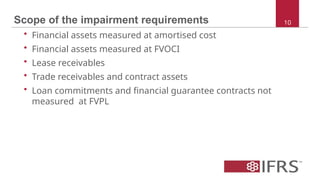
    Scope of theimpairment requirements • Financial assets measured at amortised cost • Financial assets measured at FVOCI • Lease receivables • Trade receivables and contract assets • Loan commitments and financial guarantee contracts not measured at FVPL 10
  • 11.
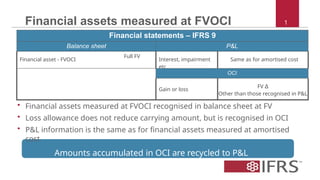
    1 1 Financial assets measuredat FVOCI Financial statements – IFRS 9 Balance sheet P&L Financial asset - FVOCI Full FV Interest, impairment etc Same as for amortised cost OCI Gain or loss FV ∆ Other than those recognised in P&L • Financial assets measured at FVOCI recognised in balance sheet at FV • Loss allowance does not reduce carrying amount, but is recognised in OCI • P&L information is the same as for financial assets measured at amortised cost Amounts accumulated in OCI are recycled to P&L upon derecognition
  • 12.
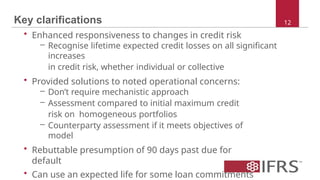
    Key clarifications • Enhancedresponsiveness to changes in credit risk – Recognise lifetime expected credit losses on all significant increases in credit risk, whether individual or collective • Provided solutions to noted operational concerns: – Don’t require mechanistic approach – Assessment compared to initial maximum credit risk on homogeneous portfolios – Counterparty assessment if it meets objectives of model • Rebuttable presumption of 90 days past due for default • Can use an expected life for some loan commitments 12
  • 13.
    Disclosures 13 Quantitativ e Reconciliation ofallowance accounts showing key drivers for change Explanation of gross carrying amounts showing key drivers for change Gross carrying amount per credit risk grade or delinquency Write-offs, recoveries, modifications Qualitativ e Inputs, assumptions and techniques used to estimate expected credit losses (and changes in techniques) Inputs, assumptions and techniques used to determine ‘significant increase in credit risk’ and ‘default’ Inputs, assumptions and techniques used to determine ‘credit- impaired’ Write off policies, modification policies, collateral
  • 14.
    International Financial Reporting Standards Theviews expressed in this presentation are those of the presenter, not necessarily those of the IASB or IFRS Foundation Hedge accounting © 2013 IFRS Foundation. 30 Cannon Street | London EC4M 6XH | UK. www.ifrs.org
  • 15.
    A better linkbetween accounting and risk management • Align accounting treatment with risk management activity • Enable preparers to better reflect hedging in financial statements • Provide disclosures to help users understand risk management and its impact on the financial statements 15 IFRS 9 incorporates a major overhaul of hedge accounting that more closely aligns accounting with risk management. New requirements were first published in 2013, and are updated in the final publication for FVOCI measurement
  • 16.
    Project doesn’t addressmacro hedging 16 Even if apply IFRS 9 can still use specific portfolio hedge accounting requirements in IAS 39 For now entities can choose to keep • The IASB is using IAS 39 hedge accounting simultaneously working on a specific project to IAS 39 IFRS 9 consider hedge Accounting hedge accounting for accountingpolicy choice accounting macro hedges (Discussion Paper Some banks may not make any changes to their published) hedge accounting at this time
  • 17.
    Implementation of IFRS9 17 Annual periods beginning on or after 1 January 2018 • Mandatory effective date consistent with stakeholder requests • Entities permitted to early apply the completed (whole) version of IFRS 9 • Previous versions of IFRS 9 phased out: – Not permitted to early apply a previous version unless the relevant date of initial application is before 1 February 2015 • ‘Own credit’ requirements available for early application, in isolation, until the mandatory effective date • Transition Resource Group for Impairment of Financial
  • 18.
    Questions and comments18 © IFRS Foundation. 30 Cannon Street | London EC4M 6XH | UK. www.ifrs.org