School to school strategic partnership
2018 - 1 - AT01 - KA229 - 039251
Let’s Stop Bullying Together
C2 - Short-term exchanges of groups of pupils
Define, identify and recognize bullying and bullying behaviours in EU schools
17/02/2019 – 23/02/2019
IES Joaquin Turina (Spain)
Lycée D’Alembert Paris
FRANCE
STOP BULLYING
https://www.youtube.com/watch?time_continue=67&v=HVXJZjJf5Rc
Swatted
Artiste : Ismaël Joffroy Chandoutis
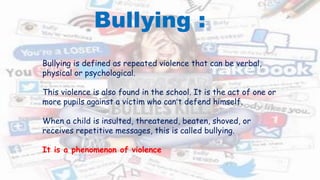
Bullying :
Bullying is defined as repeated violence that can be verbal,
physical or psychological.
This violence is also found in the school. It is the act of one or
more pupils against a victim who can’t defend himself.
When a child is insulted, threatened, beaten, shoved, or
receives repetitive messages, this is called bullying.
It is a phenomenon of violence
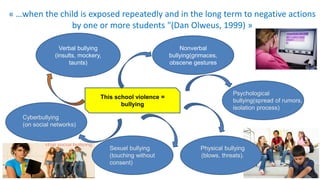
« …when the child is exposed repeatedly and in the long term to negative actions
by one or more students "(Dan Olweus, 1999) »
Verbal bullying
(insults, mockery,
taunts)
Nonverbal
bullying(grimaces,
obscene gestures
Physical bullying
(blows, threats).
Psychological
bullying(spread of rumors,
isolation process)
This school violence =
bullying
Sexuel bullying
(touching without
consent)
Cyberbullying
(on social networks)
The framework of school harassment
School bullying is (almost)
always a group
phenomenon.
The stalker needs
witnesses, laughs,
spectators.
Harassment is hardly
visible by adults as it
occurs outside of their
presence.
Characteristics of school bullying:
Repetition: violence is repeated, reproduced, reiterated over a long
period of time making the infernal child's life for days and days.
The relationship of domination is imposed insincerely. There is an
abuse of power, a power takeover from one child to another. The
aggression is made of a student "stronger" against a pupil more "weak"
or having difficulties to defend themselves in this situation; or a group
against an isolated student; or older ones against younger ones.
Intention to harm: the "game" that is not initially malicious or
offensive, becomes it when the process settles in the duration. The
aggressor deliberately intends to harm even if he almost always pretends
that it is a "simple game", "it's for fun".
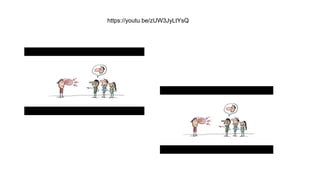
https://youtu.be/zUW3JyLtYsQ
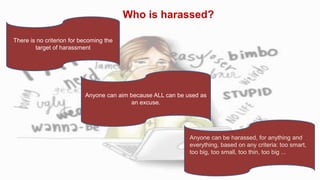
Who is harassed?
There is no criterion for becoming the
target of harassment
Anyone can aim because ALL can be used as
an excuse.
Anyone can be harassed, for anything and
everything, based on any criteria: too smart,
too big, too small, too thin, too big ...
Signs of bullying
How do you recognize a
harassed child?
The symptoms are the same as
those of post-traumatic stress: child
fleeing, avoiding, worried,
insomnia, anxiety ... The body
speaks: either statufié, rigid, or it
cracks.
Reviviscences
(or rumination):
Repetitive and intrusive
memories of the event
nightmares
flashbacks
Distress or physiological
reactivity when exposed to
stimuli associated with the
traumatic event
Cognitive and emotional
alterations:
Persistent and exaggerated
negative beliefs about self,
others or the world
Trend to blame
Persistent negative emotions
(fear, horror, anger, guilt,
shame)
Decrease of interest in
activities
Sense of detachment from
others
Restrictions of positive
emotions
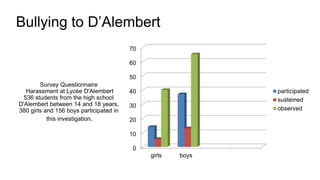
Bullying to D’Alembert
Survey Questionnaire
Harassment at Lycée D'Alembert
536 students from the high school
D'Alembert between 14 and 18 years,
380 girls and 156 boys participated in
this investigation.
0
10
20
30
40
50
60
70
girls boys
participated
susteined
observed
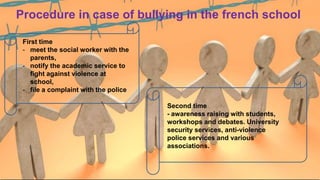
Procedure in case of bullying in the french school
First time
- meet the social worker with the
parents,
- notify the academic service to
fight against violence at
school,
- file a complaint with the police
Second time
- awareness raising with students,
workshops and debates. University
security services, anti-violence
police services and various
associations.

1cseseville_franceppt.pdf

  • 1.
    School to schoolstrategic partnership 2018 - 1 - AT01 - KA229 - 039251 Let’s Stop Bullying Together C2 - Short-term exchanges of groups of pupils Define, identify and recognize bullying and bullying behaviours in EU schools 17/02/2019 – 23/02/2019 IES Joaquin Turina (Spain) Lycée D’Alembert Paris FRANCE STOP BULLYING
  • 2.
  • 3.
    Bullying : Bullying isdefined as repeated violence that can be verbal, physical or psychological. This violence is also found in the school. It is the act of one or more pupils against a victim who can’t defend himself. When a child is insulted, threatened, beaten, shoved, or receives repetitive messages, this is called bullying. It is a phenomenon of violence
  • 4.
    « …when thechild is exposed repeatedly and in the long term to negative actions by one or more students "(Dan Olweus, 1999) » Verbal bullying (insults, mockery, taunts) Nonverbal bullying(grimaces, obscene gestures Physical bullying (blows, threats). Psychological bullying(spread of rumors, isolation process) This school violence = bullying Sexuel bullying (touching without consent) Cyberbullying (on social networks)
  • 5.
    The framework ofschool harassment School bullying is (almost) always a group phenomenon. The stalker needs witnesses, laughs, spectators. Harassment is hardly visible by adults as it occurs outside of their presence.
  • 6.
    Characteristics of schoolbullying: Repetition: violence is repeated, reproduced, reiterated over a long period of time making the infernal child's life for days and days. The relationship of domination is imposed insincerely. There is an abuse of power, a power takeover from one child to another. The aggression is made of a student "stronger" against a pupil more "weak" or having difficulties to defend themselves in this situation; or a group against an isolated student; or older ones against younger ones. Intention to harm: the "game" that is not initially malicious or offensive, becomes it when the process settles in the duration. The aggressor deliberately intends to harm even if he almost always pretends that it is a "simple game", "it's for fun".
  • 7.
  • 8.
    Who is harassed? Thereis no criterion for becoming the target of harassment Anyone can aim because ALL can be used as an excuse. Anyone can be harassed, for anything and everything, based on any criteria: too smart, too big, too small, too thin, too big ...
  • 9.
    Signs of bullying Howdo you recognize a harassed child? The symptoms are the same as those of post-traumatic stress: child fleeing, avoiding, worried, insomnia, anxiety ... The body speaks: either statufié, rigid, or it cracks. Reviviscences (or rumination): Repetitive and intrusive memories of the event nightmares flashbacks Distress or physiological reactivity when exposed to stimuli associated with the traumatic event Cognitive and emotional alterations: Persistent and exaggerated negative beliefs about self, others or the world Trend to blame Persistent negative emotions (fear, horror, anger, guilt, shame) Decrease of interest in activities Sense of detachment from others Restrictions of positive emotions
  • 11.
    Bullying to D’Alembert SurveyQuestionnaire Harassment at Lycée D'Alembert 536 students from the high school D'Alembert between 14 and 18 years, 380 girls and 156 boys participated in this investigation. 0 10 20 30 40 50 60 70 girls boys participated susteined observed
  • 12.
    Procedure in caseof bullying in the french school First time - meet the social worker with the parents, - notify the academic service to fight against violence at school, - file a complaint with the police Second time - awareness raising with students, workshops and debates. University security services, anti-violence police services and various associations.