Starting with the End in MindWith Maria Keckler
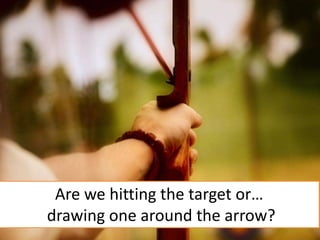
Are we hitting the target or… drawing one around the arrow?
“Not many of you should presume to be teachers, my brothers, because you know that we who teach will be judged more strictly.”James 3:1
Teaching Best-Practices:My motto: “Show, Don’t Tell.” Everything is part of the lessonSet the bar highbusy work not allowed, but evidence of understanding Required
“From the time he was a kid, Steve thought his products could change the world.”
Sometimes less is more…
How about you?Who is your audience?Do you know what makes them tick? Do you know how to capture their attention?
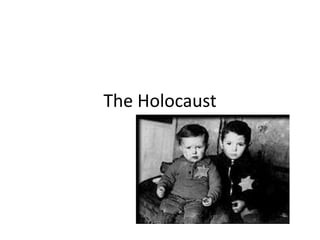
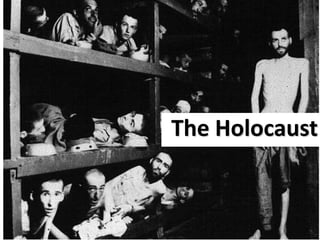
The Holocaust
The Holocaust (1941-45)Of the 60 million World War II deaths, 11 million people died in German death camps including 3.5 million Russians, and 6 million Jews (2/3rds of all European Jews)The word Holocaust was given to the killing of the 6 million Jews because it was a war of extermination designed to wipe out an entire group of people.Hitler’s “Final Solution”Systematic genocide
Holocaust ChronologyJuly 14, 1933 - Nazi Party is declared the only legal party in Germany; Also, Nazis pass Law to strip Jewish immigrants from Poland of their German citizenship. July 1933- Nazis pass law allowing for forced sterilization of those found by a Hereditary Health Court to have genetic defects. Nov 24, 1933 - Nazis pass a Law against Habitual and Dangerous Criminals, which allows beggars, the homeless, alcoholics and the unemployed to be sent to concentration camps. Sept 15, 1935 - Nuremberg Race Laws against Jews decreed.
Nuremberg Race Laws of 1935 Deprived German Jews of their rights of citizenship, giving them the status of "subjects" in Hitler's Reich. The laws also made it forbidden for Jews to marry or have sexual relations with Aryans. The Nuremberg Laws had the unexpected result of causing confusion and heated debate over who was a "full Jew." The Nazis settled on defining a "full Jew" as a person with three Jewish grandparents. Those with less were designated as Mischlinge.After the Nuremberg Laws of 1935, a dozen supplemental Nazi decrees were issued that eventually outlawed the Jews completely, depriving them of their rights as human beings.
The Holocaust
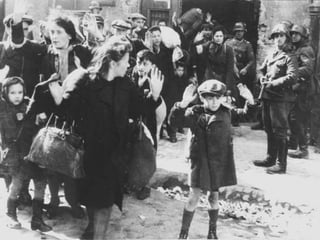
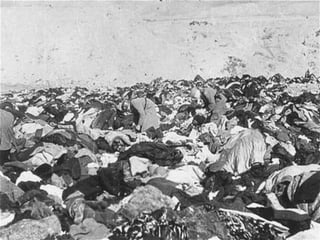
Whose clothes?
What can I do hit target… more often?

1a starting with the end in mind

  • 1.
    Starting with theEnd in MindWith Maria Keckler
  • 2.
    Are we hittingthe target or… drawing one around the arrow?
  • 3.
    “Not many ofyou should presume to be teachers, my brothers, because you know that we who teach will be judged more strictly.”James 3:1
  • 4.
    Teaching Best-Practices:My motto:“Show, Don’t Tell.” Everything is part of the lessonSet the bar highbusy work not allowed, but evidence of understanding Required
  • 5.
    “From the timehe was a kid, Steve thought his products could change the world.”
  • 6.
  • 7.
    How about you?Whois your audience?Do you know what makes them tick? Do you know how to capture their attention?
  • 8.
  • 9.
    The Holocaust (1941-45)Ofthe 60 million World War II deaths, 11 million people died in German death camps including 3.5 million Russians, and 6 million Jews (2/3rds of all European Jews)The word Holocaust was given to the killing of the 6 million Jews because it was a war of extermination designed to wipe out an entire group of people.Hitler’s “Final Solution”Systematic genocide
  • 10.
    Holocaust ChronologyJuly 14,1933 - Nazi Party is declared the only legal party in Germany; Also, Nazis pass Law to strip Jewish immigrants from Poland of their German citizenship. July 1933- Nazis pass law allowing for forced sterilization of those found by a Hereditary Health Court to have genetic defects. Nov 24, 1933 - Nazis pass a Law against Habitual and Dangerous Criminals, which allows beggars, the homeless, alcoholics and the unemployed to be sent to concentration camps. Sept 15, 1935 - Nuremberg Race Laws against Jews decreed.
  • 11.
    Nuremberg Race Lawsof 1935 Deprived German Jews of their rights of citizenship, giving them the status of "subjects" in Hitler's Reich. The laws also made it forbidden for Jews to marry or have sexual relations with Aryans. The Nuremberg Laws had the unexpected result of causing confusion and heated debate over who was a "full Jew." The Nazis settled on defining a "full Jew" as a person with three Jewish grandparents. Those with less were designated as Mischlinge.After the Nuremberg Laws of 1935, a dozen supplemental Nazi decrees were issued that eventually outlawed the Jews completely, depriving them of their rights as human beings.
  • 13.
  • 15.
  • 16.
    What can Ido hit target… more often?

Editor's Notes

  • #2 A disclaimer: I’m providing you with a copy of my PowerPoint notes pages, which don’t go through extensive proofreading—since the audience usually never gets to see them. Excuse typos, please. My hope is that my notes will be a resources for you beyond our time together.Maria
  • #3 Let’s set the stage with this story: Long time ago, a master archer began to search the land for an archer of even greater talent so that he might study, learn, and improve his craft. After many months of walking through forests, meadows, and towns, he came upon a tree with an arrow in the exact middle of a painted target drawn on the tree. He became curious as he walked on and saw another tree with a perfectly centered bull’s-eye. Soon, he saw more and more trees that displayed straight arrows perfectly centered within the round targets. Perfect bull’s-eyes peppered the forest. Suddenly, he entered a clearing and looked up and saw a barn with row after row after row of perfect bull’s-eyes. He knew he had found his mentor and began asking everyone he saw on the road, “Whose barn is it that displays so many perfectly centered arrows?” When he found the owner, the archer saw that he was a simple man, slow of speech, and seemingly awkward in his movements. Unperturbed, he asked the man to share his secrets. “How do you do it?” he asked.The man explained. “Anyone can. After I shoot the arrow, I take some paint and draw a target around the arrow. Here’s the question before us: As teachers (ministry or academic), are we hitting the target? Or are we drawing one around the arrow? As you move through the reading, lessons, and activities in this course, you will begin to understand that “teaching” means that learning and transformation are taking place. And if no one is learning, are we teaching? Higher education and ministry is ailed with brilliant minds and passionate teachers. Yet many of them have never taken a class on how to teach and engage the new generation of learners… This results in stale teaching… and frustrated teachers.
  • #4 If we are going to engage learners and transform lives, we need to be teachable about the art and craft of “teaching.” And we need to remember James’ warning the high calling of the teacher… I believe this warning is not meant to deter us from our calling and desire to teach. I believe it’s meant as a reminder that we can’t take our ministry lightly.
  • #5 During teacher training, I hope to model the four basic teaching best practices:“Show, Don’t Tell” is my personal teaching motto. It comes from my background as a writer and a writing instructor. You may remember your Freshman Comp teacher telling you that “Showing” is more powerful than “Telling”… as in, “Don’t tell me the meadow is beautiful… Show me with vivid and descriptive language that evokes all my senses. When I teach I try to engage you with a variety of stories, multimedia resources, and real life examples that will help you experience the concepts that are important in this class. Every word, every slide, every activity, every video is intended for a purpose. Everything is meant to challenge you assumptions, and push students to think and reflect. Even the frustrations that they may experience are part of the lesson. But we, teachers, need to make that explicit from day one.Students will often aim to meet your expectations. If you set the bar low from the beginning, they will meet you there. As a teacher, I tell students that I show up to the class with the assumption that they have done the reading, which they will have to demonstrate during discussions. For that reason, I try not bore them with a lecture that simply restates what’s in the text books. Instead, the lectures are meant to augment that information and fill in gaps in creative ways.I abhor busy work and therefore refuse to subject my students to it. Determine what is the learning you want to meet. In some classes, rote memorization has no intrinsic value, so design activities that show case true comprehension and learning. For example, if objective quizzes have no value to show critical thinking (and that’s one of the course’s learning objectives) tell students how you will be evaluating their learning process (i.e., insightful references to the content in the class, their ability to take broad knowledge and apply it to their own situation, etc.) Let’s begin!
  • #6 Remember the archer story at the beginning of this lecture? Let’s borrow a real life example. What does it look like when someone is hitting the target…In his book, “The Presentation Secrets of Steve Jobs: How to be Insanely Great in Front of Any Audience,” Carmine Gallo said that “From the time he was a kid, Steve thought his products could change the world.” …Although this book is written primarily for the business sector, there is a key lesson we can take away, as potential teachers who want to capture the attention of an audience with our message:
  • #7 As Apple’s primary evangelist, Jobs has mastered the art of communicating his message with incredible simplicity… so that it resonates with his target audienceThink about how Jobs has successfully become the Mac evangelist…He has mastered the art of “Less is More”It is said that he has “Developed a Messianic Sense of Purpose, believing that” “We’re here to put a dent in the universe.”Do we see our roles in educational ministries in this same way?
  • #8 Take a few minutes and consider the following questions:Who is your audience? D you know how to relate to them?Do you know hot to capture their attention? Your reading contains some of the answers to those questions, which we will discuss for the rest of this class. Consider the following: Whereas K-12 teachers spend years learning how to teach, higher education professors or even Christian Ministry teachers seldom take one single class to teach them to be effective teachers or communicators. However, as technology is exploding, even K-12 trained teachers are facing the challenge of educating a new type of learner…
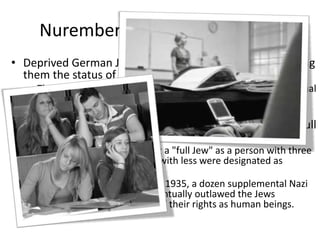
  • #9 Here’s an example of a passionate teacher who is NOT hitting the target. This teacher is about to teach a lesson on the Holocaust…with bullet points!
  • #10 Have you ever sat through a presentation like this… and the teacher stood in front of the class, with his or her back to the class, reading every bullet point verbatim? The actual presentation… contains 48 slides similar to this one!What would Howard Hendricks say about this lesson? When I’m training teachers, I tell that that If the only emotion students experience during this lessons is “boredom,” the teacher has failed… When teaching about the Holocaust—or the Bible—every single emotion should be going in the room—except boredom.
  • #11 Does the student care?
  • #12 Do we want to be teachers that inspire learning and curiosity and inquiry?Or do we want to merely “present” information?
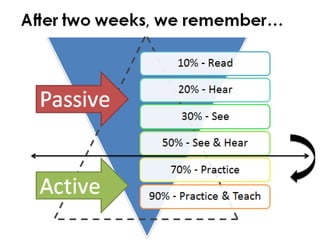
  • #13 Research shows us how we learnAfter two weeks we remember…10% of what we read20% of what we hear30% of what we see50% of what we see and hear70% of what we practiceAnd 90% of what we practice and teach.Click: What we have here is a dividing line that separatesClick: Passive Learning Click: From Active Learning…Click: Also, note that dotted triangle indicates that less learning happens with less engagement (at the top of the pyramid) Our job as educators is to invert this triangle, so that the deeper we get into the subject, the more active the learner’s participation becomes. The blue triangle symbolizes the depth of knowledge. The more engaged we are with content, the deeper our understanding is—this is key.As you read through your two texts, keep this model in mind (I’ve made this graphic available to you in the hand outs section). Print it and keep it handy because your goal is to learn how to move students from passive learning to active learning…at which point their level of engagement and transformation take place.
  • #17 Remember, we must always start with the end in mind… And as you prepare yourself to teach in ministry or lead educational ministries, you’ll need to constantly ask yourself…”What can I do to hit the target more often?That’s why you’re are here.