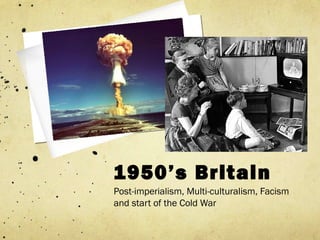
1950’s Britain
Post-imperialism, Multi-culturalism, Facism
and start of the Cold War
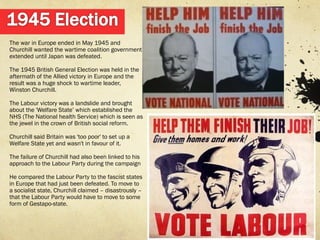
The war in Europe ended in May 1945 and
Churchill wanted the wartime coalition government
extended until Japan was defeated.

The 1945 British General Election was held in the
aftermath of the Allied victory in Europe and the
result was a huge shock to wartime leader,
Winston Churchill.

The Labour victory was a landslide and brought
about the 'Welfare State’ which established the
NHS (The National health Service) which is seen as
the jewel in the crown of British social reform.

Churchill said Britain was 'too poor' to set up a
Welfare State yet and wasn't in favour of it.

The failure of Churchill had also been linked to his
approach to the Labour Party during the campaign

He compared the Labour Party to the fascist states
in Europe that had just been defeated. To move to
a socialist state, Churchill claimed – disastrously –
that the Labour Party would have to move to some
form of Gestapo-state.
1950s Britain was still pockmarked by bombsites
and wearing the heavy features of a nation
rebuilding after the Second World War.

After the difficulties of rationing and shortages,
Britain enjoyed an economic boom in the 'never
had it so good' years of the second half of the 50s.

Edmund Hilary scaling of the world's highest
mountain, Mount Everest.

The decommissioning of the rationing book.

Homes started to be filled with refrigerators,
televisions and washing machines; the dawn of the
household durable goods began.

Britain was becoming a fully fledged consumerist
society.
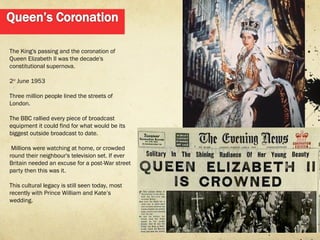
The King's passing and the coronation of
Queen Elizabeth II was the decade's
constitutional supernova.

2nd June 1953

Three million people lined the streets of
London.

The BBC rallied every piece of broadcast
equipment it could find for what would be its
biggest outside broadcast to date.

 Millions were watching at home, or crowded
round their neighbour's television set. If ever
Britain needed an excuse for a post-War street
party then this was it.

This cultural legacy is still seen today, most
recently with Prince William and Kate’s
wedding.
Between 1948 and 1970 nearly half a million
people left their homes in the West Indies to
live in Britain.

 The West Indies consists of more than 20
islands in the Caribbean, including Jamaica,
Barbados and Trinidad.

These people changed the face of modern
Britain.

They were all British citizens and, although they
had never lived in Britain before, they had the
right to enter, work and settle here if they
wanted to.

Some were seeking better opportunities for
themselves and their children. Some came to
work for a while, save money and return home.

Some had been recruited because Britain was
short of workers to run the transport system,
postal service and hospitals. Other West
Indians were returning soldiers who had fought
for Britain during the Second World War (1939-
1945).
The growth in the British economy in the 1950s and 1960s
was relatively slow compared with the other major
European economies

Experienced crises over the balance of payments, the role
of sterling as an international currency and by worries about
inflation.

A realisation by British leaders and people of their country's
declining world status.

In this situation immigration was seen rather as an added
burden than as a valuable asset.

In 1957 prime minister Harold Macmillan famously said,
“Most of our people have never had it so good.”

But this was not the experience of either black or white
people living in the squalid slums of Notting Hill.

Tensions started to increase and by far the worst incidents
of violence were the riots in Notting Hill and Nottingham in
1958.

Oswald Mosley’s Union Movement and other fascist groups
were already leafleting, holding rallies and daubing KBW
(Keep Britain White) on walls around Notting Hill.

Notting Hill riots started with racists outraged that black
and white people were mixing.
Although the riots became a blueprint for
generations it also resulted in the Notting Hill
Carnival, a celebration of diversity and music.

Organised by Claudia Jones (black
nationalist, journalist, activist and local) as a
response to the race tensions of ’58, the
festival  was a huge success, despite being
held indoors.


.
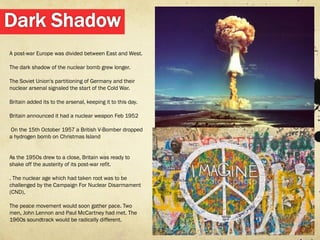
A post-war Europe was divided between East and West.

The dark shadow of the nuclear bomb grew longer.

The Soviet Union's partitioning of Germany and their
nuclear arsenal signaled the start of the Cold War.

Britain added its to the arsenal, keeping it to this day.

Britain announced it had a nuclear weapon Feb 1952

On the 15th October 1957 a British V-Bomber dropped
a hydrogen bomb on Christmas Island


As the 1950s drew to a close, Britain was ready to
shake off the austerity of its post-war refit.

. The nuclear age which had taken root was to be
challenged by the Campaign For Nuclear Disarmament
(CND),

The peace movement would soon gather pace. Two
men, John Lennon and Paul McCartney had met. The
1960s soundtrack would be radically different.

1950s britain

  • 1.
  • 2.
    The war inEurope ended in May 1945 and Churchill wanted the wartime coalition government extended until Japan was defeated. The 1945 British General Election was held in the aftermath of the Allied victory in Europe and the result was a huge shock to wartime leader, Winston Churchill. The Labour victory was a landslide and brought about the 'Welfare State’ which established the NHS (The National health Service) which is seen as the jewel in the crown of British social reform. Churchill said Britain was 'too poor' to set up a Welfare State yet and wasn't in favour of it. The failure of Churchill had also been linked to his approach to the Labour Party during the campaign He compared the Labour Party to the fascist states in Europe that had just been defeated. To move to a socialist state, Churchill claimed – disastrously – that the Labour Party would have to move to some form of Gestapo-state.
  • 3.
    1950s Britain wasstill pockmarked by bombsites and wearing the heavy features of a nation rebuilding after the Second World War. After the difficulties of rationing and shortages, Britain enjoyed an economic boom in the 'never had it so good' years of the second half of the 50s. Edmund Hilary scaling of the world's highest mountain, Mount Everest. The decommissioning of the rationing book. Homes started to be filled with refrigerators, televisions and washing machines; the dawn of the household durable goods began. Britain was becoming a fully fledged consumerist society.
  • 4.
    The King's passingand the coronation of Queen Elizabeth II was the decade's constitutional supernova. 2nd June 1953 Three million people lined the streets of London. The BBC rallied every piece of broadcast equipment it could find for what would be its biggest outside broadcast to date. Millions were watching at home, or crowded round their neighbour's television set. If ever Britain needed an excuse for a post-War street party then this was it. This cultural legacy is still seen today, most recently with Prince William and Kate’s wedding.
  • 5.
    Between 1948 and1970 nearly half a million people left their homes in the West Indies to live in Britain. The West Indies consists of more than 20 islands in the Caribbean, including Jamaica, Barbados and Trinidad. These people changed the face of modern Britain. They were all British citizens and, although they had never lived in Britain before, they had the right to enter, work and settle here if they wanted to. Some were seeking better opportunities for themselves and their children. Some came to work for a while, save money and return home. Some had been recruited because Britain was short of workers to run the transport system, postal service and hospitals. Other West Indians were returning soldiers who had fought for Britain during the Second World War (1939- 1945).
  • 6.
    The growth inthe British economy in the 1950s and 1960s was relatively slow compared with the other major European economies Experienced crises over the balance of payments, the role of sterling as an international currency and by worries about inflation. A realisation by British leaders and people of their country's declining world status. In this situation immigration was seen rather as an added burden than as a valuable asset. In 1957 prime minister Harold Macmillan famously said, “Most of our people have never had it so good.” But this was not the experience of either black or white people living in the squalid slums of Notting Hill. Tensions started to increase and by far the worst incidents of violence were the riots in Notting Hill and Nottingham in 1958. Oswald Mosley’s Union Movement and other fascist groups were already leafleting, holding rallies and daubing KBW (Keep Britain White) on walls around Notting Hill. Notting Hill riots started with racists outraged that black and white people were mixing.
  • 7.
    Although the riotsbecame a blueprint for generations it also resulted in the Notting Hill Carnival, a celebration of diversity and music. Organised by Claudia Jones (black nationalist, journalist, activist and local) as a response to the race tensions of ’58, the festival  was a huge success, despite being held indoors. .
  • 8.
    A post-war Europewas divided between East and West. The dark shadow of the nuclear bomb grew longer. The Soviet Union's partitioning of Germany and their nuclear arsenal signaled the start of the Cold War. Britain added its to the arsenal, keeping it to this day. Britain announced it had a nuclear weapon Feb 1952 On the 15th October 1957 a British V-Bomber dropped a hydrogen bomb on Christmas Island As the 1950s drew to a close, Britain was ready to shake off the austerity of its post-war refit. . The nuclear age which had taken root was to be challenged by the Campaign For Nuclear Disarmament (CND), The peace movement would soon gather pace. Two men, John Lennon and Paul McCartney had met. The 1960s soundtrack would be radically different.