World War II
Debt, ID cards, National Health and Bad
Food!
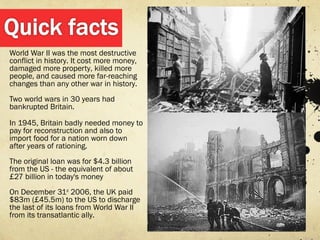
World War II was the most destructive
conflict in history. It cost more money,
damaged more property, killed more
people, and caused more far-reaching
changes than any other war in history.
Two world wars in 30 years had
bankrupted Britain.

In 1945, Britain badly needed money to
pay for reconstruction and also to
import food for a nation worn down
after years of rationing.
The original loan was for $4.3 billion
from the US - the equivalent of about
£27 billion in today's money
On December 31st 2006, the UK paid
$83m (£45.5m) to the US to discharge
the last of its loans from World War II
from its transatlantic ally.
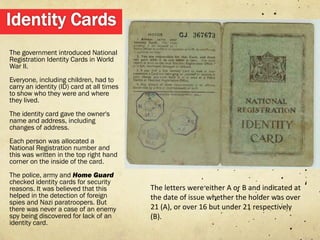
The government introduced National
Registration Identity Cards in World
War II.
Everyone, including children, had to
carry an identity (ID) card at all times
to show who they were and where
they lived.
The identity card gave the owner's
name and address, including
changes of address.
Each person was allocated a
National Registration number and
this was written in the top right hand
corner on the inside of the card.
The police, army and Home Guard
checked identity cards for security
reasons. It was believed that this         The letters were either A or B and indicated at
helped in the detection of foreign         the date of issue whether the holder was over
spies and Nazi paratroopers. But
there was never a case of an enemy         21 (A), or over 16 but under 21 respectively
spy being discovered for lack of an        (B).
identity card.
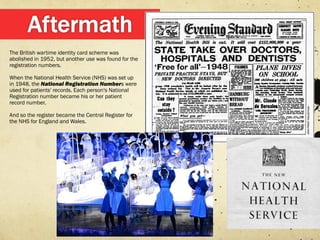
The British wartime identity card scheme was
abolished in 1952, but another use was found for the
registration numbers.

When the National Health Service (NHS) was set up
in 1948, the National Registration Numbers were
used for patients' records. Each person's National
Registration number became his or her patient
record number.

And so the register became the Central Register for
the NHS for England and Wales.
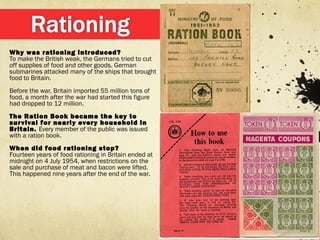
Why was rationing introduced?
To make the British weak, the Germans tried to cut
off supplies of food and other goods. German
submarines attacked many of the ships that brought
food to Britain.
Before the war, Britain imported 55 million tons of
food, a month after the war had started this figure
had dropped to 12 million.
The Ration Book became the key to
survival for nearly every household in
Britain. Every member of the public was issued
with a ration book.
When did food rationing stop?
Fourteen years of food rationing in Britain ended at
midnight on 4 July 1954, when restrictions on the
sale and purchase of meat and bacon were lifted.
This happened nine years after the end of the war.
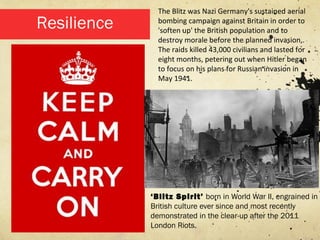
The Blitz was Nazi Germany's sustained aerial
Resilience     bombing campaign against Britain in order to
               'soften up' the British population and to
               destroy morale before the planned invasion,.
               The raids killed 43,000 civilians and lasted for
               eight months, petering out when Hitler began
               to focus on his plans for Russian invasion in
               May 1941.


             ‘Blitz Spirit’ born in World War II, engrained in
             British culture ever since and most recently
             demonstrated in the clear-up after the 2011
             London Riots.
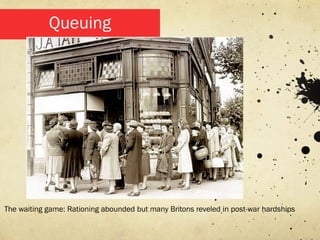
Queuing


The waiting game: Rationing abounded but many Britons reveled in post-war hardships
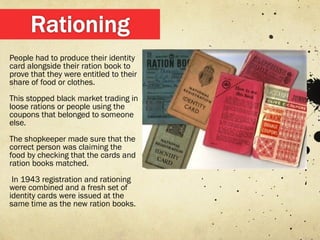
People had to produce their identity
card alongside their ration book to
prove that they were entitled to their
share of food or clothes.
This stopped black market trading in
loose rations or people using the
coupons that belonged to someone
else.
The shopkeeper made sure that the
correct person was claiming the
food by checking that the cards and
ration books matched.
 In 1943 registration and rationing
were combined and a fresh set of
identity cards were issued at the
same time as the new ration books.
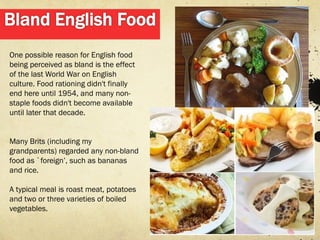
One possible reason for English food
being perceived as bland is the effect
of the last World War on English
culture. Food rationing didn't finally
end here until 1954, and many non-
staple foods didn't become available
until later that decade.


Many Brits (including my
grandparents) regarded any non-bland
food as `foreign’, such as bananas
and rice.

A typical meal is roast meat, potatoes
and two or three varieties of boiled
vegetables.
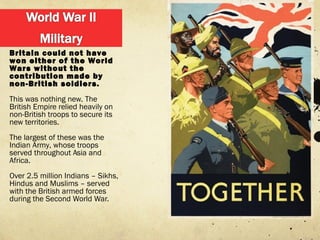
Britain could not have
won either of the World
Wars without the
contribution made by
non-British soldiers.
This was nothing new. The
British Empire relied heavily on
non-British troops to secure its
new territories.
The largest of these was the
Indian Army, whose troops
served throughout Asia and
Africa.
Over 2.5 million Indians – Sikhs,
Hindus and Muslims – served
with the British armed forces
during the Second World War.
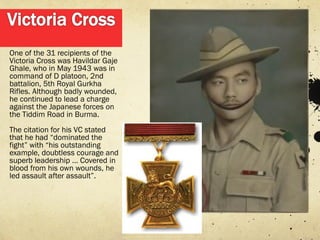
One of the 31 recipients of the
Victoria Cross was Havildar Gaje
Ghale, who in May 1943 was in
command of D platoon, 2nd
battalion, 5th Royal Gurkha
Rifles. Although badly wounded,
he continued to lead a charge
against the Japanese forces on
the Tiddim Road in Burma.
The citation for his VC stated
that he had “dominated the
fight” with “his outstanding
example, doubtless courage and
superb leadership … Covered in
blood from his own wounds, he
led assault after assault”.
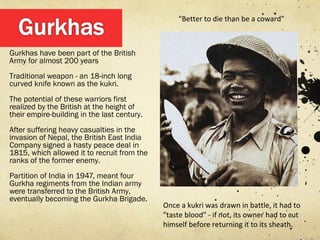
"Better to die than be a coward”


Gurkhas have been part of the British
Army for almost 200 years
Traditional weapon - an 18-inch long
curved knife known as the kukri.
The potential of these warriors first
realized by the British at the height of
their empire-building in the last century.
After suffering heavy casualties in the
invasion of Nepal, the British East India
Company signed a hasty peace deal in
1815, which allowed it to recruit from the
ranks of the former enemy.
Partition of India in 1947, meant four
Gurkha regiments from the Indian army
were transferred to the British Army,
eventually becoming the Gurkha Brigade.
                                             Once a kukri was drawn in battle, it had to
                                             "taste blood" - if not, its owner had to cut
                                             himself before returning it to its sheath.
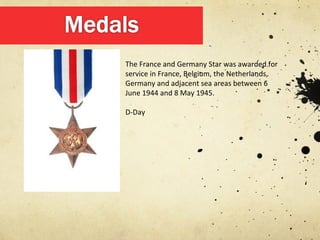
The France and Germany Star was awarded for
service in France, Belgium, the Netherlands,
Germany and adjacent sea areas between 6
June 1944 and 8 May 1945.

D-Day
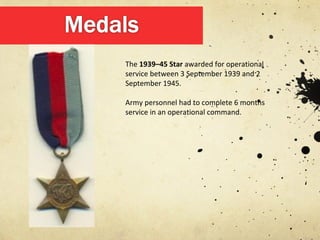
The 1939–45 Star awarded for operational
service between 3 September 1939 and 2
September 1945.

Army personnel had to complete 6 months
service in an operational command.
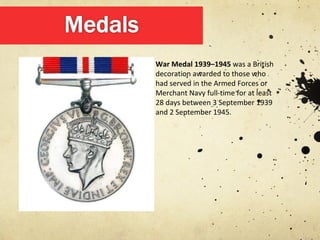
War Medal 1939–1945 was a British
decoration awarded to those who
had served in the Armed Forces or
Merchant Navy full-time for at least
28 days between 3 September 1939
and 2 September 1945.

World War Two

  • 1.
    World War II Debt,ID cards, National Health and Bad Food!
  • 2.
    World War IIwas the most destructive conflict in history. It cost more money, damaged more property, killed more people, and caused more far-reaching changes than any other war in history. Two world wars in 30 years had bankrupted Britain. In 1945, Britain badly needed money to pay for reconstruction and also to import food for a nation worn down after years of rationing. The original loan was for $4.3 billion from the US - the equivalent of about £27 billion in today's money On December 31st 2006, the UK paid $83m (£45.5m) to the US to discharge the last of its loans from World War II from its transatlantic ally.
  • 3.
    The government introducedNational Registration Identity Cards in World War II. Everyone, including children, had to carry an identity (ID) card at all times to show who they were and where they lived. The identity card gave the owner's name and address, including changes of address. Each person was allocated a National Registration number and this was written in the top right hand corner on the inside of the card. The police, army and Home Guard checked identity cards for security reasons. It was believed that this The letters were either A or B and indicated at helped in the detection of foreign the date of issue whether the holder was over spies and Nazi paratroopers. But there was never a case of an enemy 21 (A), or over 16 but under 21 respectively spy being discovered for lack of an (B). identity card.
  • 4.
    The British wartimeidentity card scheme was abolished in 1952, but another use was found for the registration numbers. When the National Health Service (NHS) was set up in 1948, the National Registration Numbers were used for patients' records. Each person's National Registration number became his or her patient record number. And so the register became the Central Register for the NHS for England and Wales.
  • 5.
    Why was rationingintroduced? To make the British weak, the Germans tried to cut off supplies of food and other goods. German submarines attacked many of the ships that brought food to Britain. Before the war, Britain imported 55 million tons of food, a month after the war had started this figure had dropped to 12 million. The Ration Book became the key to survival for nearly every household in Britain. Every member of the public was issued with a ration book. When did food rationing stop? Fourteen years of food rationing in Britain ended at midnight on 4 July 1954, when restrictions on the sale and purchase of meat and bacon were lifted. This happened nine years after the end of the war.
  • 6.
    The Blitz wasNazi Germany's sustained aerial Resilience bombing campaign against Britain in order to 'soften up' the British population and to destroy morale before the planned invasion,. The raids killed 43,000 civilians and lasted for eight months, petering out when Hitler began to focus on his plans for Russian invasion in May 1941. ‘Blitz Spirit’ born in World War II, engrained in British culture ever since and most recently demonstrated in the clear-up after the 2011 London Riots.
  • 7.
    Queuing The waiting game:Rationing abounded but many Britons reveled in post-war hardships
  • 8.
    People had toproduce their identity card alongside their ration book to prove that they were entitled to their share of food or clothes. This stopped black market trading in loose rations or people using the coupons that belonged to someone else. The shopkeeper made sure that the correct person was claiming the food by checking that the cards and ration books matched. In 1943 registration and rationing were combined and a fresh set of identity cards were issued at the same time as the new ration books.
  • 9.
    One possible reasonfor English food being perceived as bland is the effect of the last World War on English culture. Food rationing didn't finally end here until 1954, and many non- staple foods didn't become available until later that decade. Many Brits (including my grandparents) regarded any non-bland food as `foreign’, such as bananas and rice. A typical meal is roast meat, potatoes and two or three varieties of boiled vegetables.
  • 10.
    Britain could nothave won either of the World Wars without the contribution made by non-British soldiers. This was nothing new. The British Empire relied heavily on non-British troops to secure its new territories. The largest of these was the Indian Army, whose troops served throughout Asia and Africa. Over 2.5 million Indians – Sikhs, Hindus and Muslims – served with the British armed forces during the Second World War.
  • 11.
    One of the31 recipients of the Victoria Cross was Havildar Gaje Ghale, who in May 1943 was in command of D platoon, 2nd battalion, 5th Royal Gurkha Rifles. Although badly wounded, he continued to lead a charge against the Japanese forces on the Tiddim Road in Burma. The citation for his VC stated that he had “dominated the fight” with “his outstanding example, doubtless courage and superb leadership … Covered in blood from his own wounds, he led assault after assault”.
  • 12.
    "Better to diethan be a coward” Gurkhas have been part of the British Army for almost 200 years Traditional weapon - an 18-inch long curved knife known as the kukri. The potential of these warriors first realized by the British at the height of their empire-building in the last century. After suffering heavy casualties in the invasion of Nepal, the British East India Company signed a hasty peace deal in 1815, which allowed it to recruit from the ranks of the former enemy. Partition of India in 1947, meant four Gurkha regiments from the Indian army were transferred to the British Army, eventually becoming the Gurkha Brigade. Once a kukri was drawn in battle, it had to "taste blood" - if not, its owner had to cut himself before returning it to its sheath.
  • 17.
    The France andGermany Star was awarded for service in France, Belgium, the Netherlands, Germany and adjacent sea areas between 6 June 1944 and 8 May 1945. D-Day
  • 18.
    The 1939–45 Starawarded for operational service between 3 September 1939 and 2 September 1945. Army personnel had to complete 6 months service in an operational command.
  • 19.
    War Medal 1939–1945was a British decoration awarded to those who had served in the Armed Forces or Merchant Navy full-time for at least 28 days between 3 September 1939 and 2 September 1945.