What is the anatomy of da butt?
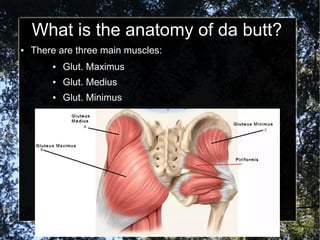
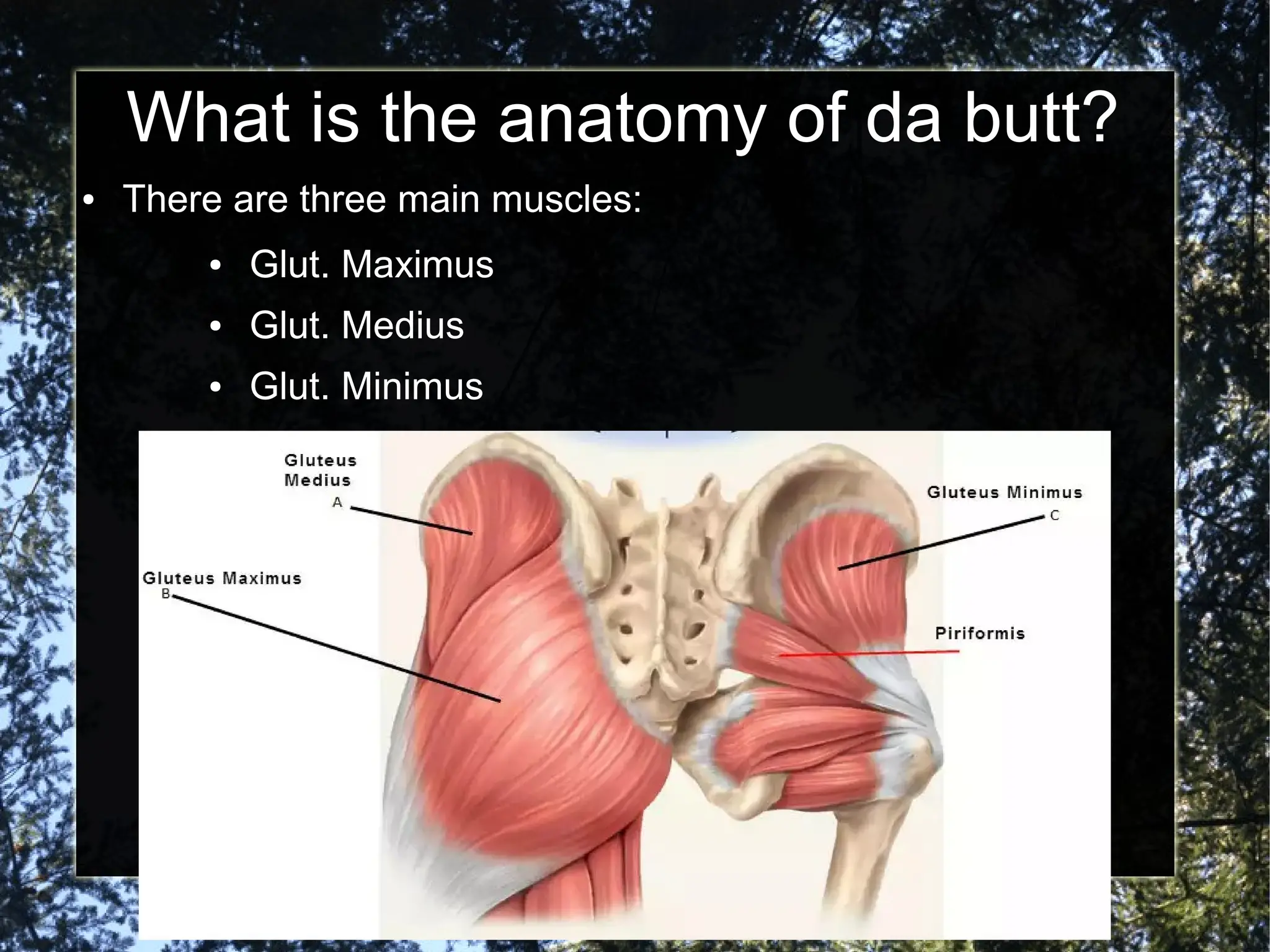
● There are three main muscles:
● Glut. Maximus
● Glut. Medius
● Glut. Minimus
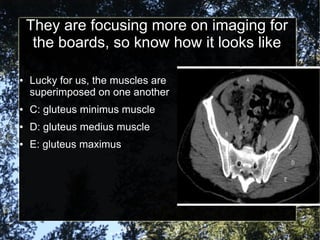
They are focusing more on imaging for
the boards, so know how it looks like
● Lucky for us, the muscles are
superimposed on one another
● C: gluteus minimus muscle
● D: gluteus medius muscle
● E: gluteus maximus
What does your glutes do?
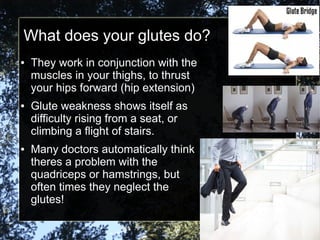
● They work in conjunction with the
muscles in your thighs, to thrust
your hips forward (hip extension)
● Glute weakness shows itself as
difficulty rising from a seat, or
climbing a flight of stairs.
● Many doctors automatically think
theres a problem with the
quadriceps or hamstrings, but
often times they neglect the
glutes!
What's a special role that your
gluteus medius plays?
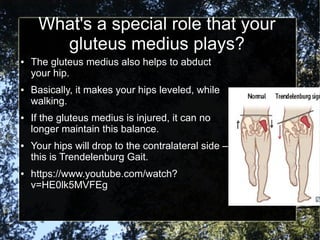
● The gluteus medius also helps to abduct
your hip.
● Basically, it makes your hips leveled, while
walking.
● If the gluteus medius is injured, it can no
longer maintain this balance.
● Your hips will drop to the contralateral side –
this is Trendelenburg Gait.
● https://www.youtube.com/watch?
v=HE0lk5MVFEg
What innervates your glutes?
● There are two nerves:
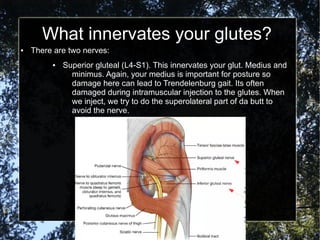
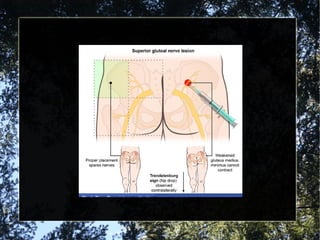
● Superior gluteal (L4-S1). This innervates your glut. Medius and
minimus. Again, your medius is important for posture so
damage here can lead to Trendelenburg gait. Its often
damaged during intramuscular injection to the glutes. When
we inject, we try to do the superolateral part of da butt to
avoid the nerve.
What innervates your glutes?
● The second nerve:
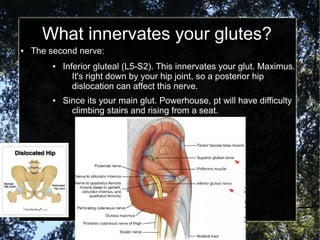
● Inferior gluteal (L5-S2). This innervates your glut. Maximus.
It's right down by your hip joint, so a posterior hip
dislocation can affect this nerve.
● Since its your main glut. Powerhouse, pt will have difficulty
climbing stairs and rising from a seat.
Thighs
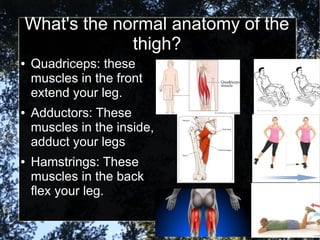
What's the normal anatomy of the
thigh?
● Quadriceps: these
muscles in the front
extend your leg.
● Adductors: These
muscles in the inside,
adduct your legs
● Hamstrings: These
muscles in the back
flex your leg.
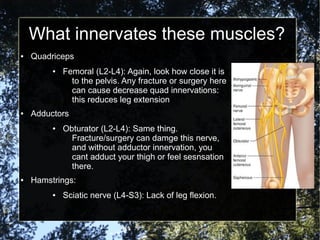
What innervates these muscles?
● Quadriceps
● Femoral (L2-L4): Again, look how close it is
to the pelvis. Any fracture or surgery here
can cause decrease quad innervations:
this reduces leg extension
● Adductors
● Obturator (L2-L4): Same thing.
Fracture/surgery can damge this nerve,
and without adductor innervation, you
cant adduct your thigh or feel sesnsation
there.
● Hamstrings:
● Sciatic nerve (L4-S3): Lack of leg flexion.
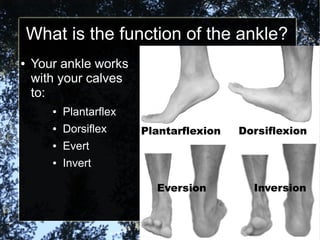
What is the function of the ankle?
● Your ankle works
with your calves
to:
● Plantarflex
● Dorsiflex
● Evert
● Invert
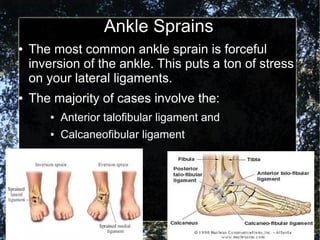
Ankle Sprains
● The most common ankle sprain is forceful
inversion of the ankle. This puts a ton of stress
on your lateral ligaments.
● The majority of cases involve the:
● Anterior talofibular ligament and
● Calcaneofibular ligament
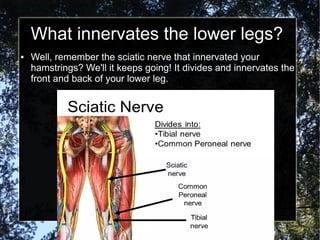
What innervates the lower legs?
● Well, remember the sciatic nerve that innervated your
hamstrings? We'll it keeps going! It divides and innervates the
front and back of your lower leg.
What are the branches of the
sciatic nerve (L4-S3)?
● The two branches are:
● Common peroneal (L4-S2): This nerve helps
you evert and dorsiflex. Thus, if its injured,
you get inversion and plantarflex (foot drop).
● Tibial (L4-S3): This nerve helps you invert and
plantarflex. It also supples the sensation to
your sole. Thus if its injured you get eversion
and loss of sensation to the sole.
● “PED”: Peroneal Everts and Dorsiflexes
● If injured, foot dropPED
● “TIP”: Tibial Inverts and Plantarflexes
● If injured, cant stand on TIPtoes
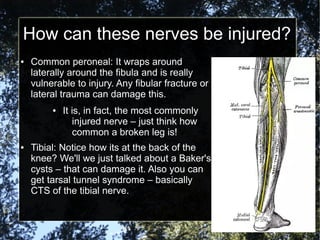
How can these nerves be injured?
● Common peroneal: It wraps around
laterally around the fibula and is really
vulnerable to injury. Any fibular fracture or
lateral trauma can damage this.
● It is, in fact, the most commonly
injured nerve – just think how
common a broken leg is!
● Tibial: Notice how its at the back of the
knee? We'll we just talked about a Baker's
cysts – that can damage it. Also you can
get tarsal tunnel syndrome – basically
CTS of the tibial nerve.
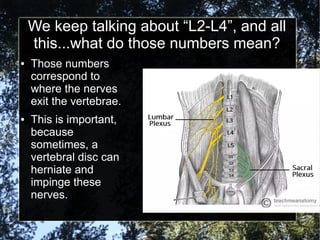
We keep talking about “L2-L4”, and all
this...what do those numbers mean?
● Those numbers
correspond to
where the nerves
exit the vertebrae.
● This is important,
because
sometimes, a
vertebral disc can
herniate and
impinge these
nerves.
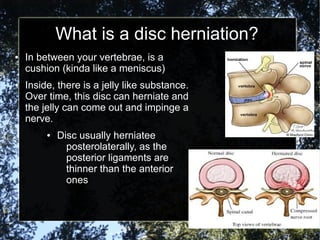
What is a disc herniation?
● In between your vertebrae, is a
cushion (kinda like a meniscus)
● Inside, there is a jelly like substance.
Over time, this disc can herniate and
the jelly can come out and impinge a
nerve.
● Disc usually herniatee
posterolaterally, as the
posterior ligaments are
thinner than the anterior
ones
What does that mean for us?
● Well, when it impinges a nerve, you get
weakness to whatever it innervates. So:
● Disk hernation (L3-L4): Weakness in knee
extension and patellar reflex (knee jerk)
● L4-L5: Weakness of dorsiflexion – diffulcty in
walking on the heels.
● L5-S1: Weakness on plantarflexion: difficulty in
walking on the toes. Decreased Achilles
reflex

19 Neurology Lower Limb.pdf

  • 1.
    What is theanatomy of da butt? ● There are three main muscles: ● Glut. Maximus ● Glut. Medius ● Glut. Minimus
  • 2.
    They are focusingmore on imaging for the boards, so know how it looks like ● Lucky for us, the muscles are superimposed on one another ● C: gluteus minimus muscle ● D: gluteus medius muscle ● E: gluteus maximus
  • 3.
    What does yourglutes do? ● They work in conjunction with the muscles in your thighs, to thrust your hips forward (hip extension) ● Glute weakness shows itself as difficulty rising from a seat, or climbing a flight of stairs. ● Many doctors automatically think theres a problem with the quadriceps or hamstrings, but often times they neglect the glutes!
  • 4.
    What's a specialrole that your gluteus medius plays? ● The gluteus medius also helps to abduct your hip. ● Basically, it makes your hips leveled, while walking. ● If the gluteus medius is injured, it can no longer maintain this balance. ● Your hips will drop to the contralateral side – this is Trendelenburg Gait. ● https://www.youtube.com/watch? v=HE0lk5MVFEg
  • 5.
    What innervates yourglutes? ● There are two nerves: ● Superior gluteal (L4-S1). This innervates your glut. Medius and minimus. Again, your medius is important for posture so damage here can lead to Trendelenburg gait. Its often damaged during intramuscular injection to the glutes. When we inject, we try to do the superolateral part of da butt to avoid the nerve.
  • 6.
    What innervates yourglutes? ● The second nerve: ● Inferior gluteal (L5-S2). This innervates your glut. Maximus. It's right down by your hip joint, so a posterior hip dislocation can affect this nerve. ● Since its your main glut. Powerhouse, pt will have difficulty climbing stairs and rising from a seat.
  • 8.
  • 9.
    What's the normalanatomy of the thigh? ● Quadriceps: these muscles in the front extend your leg. ● Adductors: These muscles in the inside, adduct your legs ● Hamstrings: These muscles in the back flex your leg.
  • 10.
    What innervates thesemuscles? ● Quadriceps ● Femoral (L2-L4): Again, look how close it is to the pelvis. Any fracture or surgery here can cause decrease quad innervations: this reduces leg extension ● Adductors ● Obturator (L2-L4): Same thing. Fracture/surgery can damge this nerve, and without adductor innervation, you cant adduct your thigh or feel sesnsation there. ● Hamstrings: ● Sciatic nerve (L4-S3): Lack of leg flexion.
  • 11.
    What is thefunction of the ankle? ● Your ankle works with your calves to: ● Plantarflex ● Dorsiflex ● Evert ● Invert
  • 12.
    Ankle Sprains ● Themost common ankle sprain is forceful inversion of the ankle. This puts a ton of stress on your lateral ligaments. ● The majority of cases involve the: ● Anterior talofibular ligament and ● Calcaneofibular ligament
  • 13.
    What innervates thelower legs? ● Well, remember the sciatic nerve that innervated your hamstrings? We'll it keeps going! It divides and innervates the front and back of your lower leg.
  • 14.
    What are thebranches of the sciatic nerve (L4-S3)? ● The two branches are: ● Common peroneal (L4-S2): This nerve helps you evert and dorsiflex. Thus, if its injured, you get inversion and plantarflex (foot drop). ● Tibial (L4-S3): This nerve helps you invert and plantarflex. It also supples the sensation to your sole. Thus if its injured you get eversion and loss of sensation to the sole.
  • 15.
    ● “PED”: PeronealEverts and Dorsiflexes ● If injured, foot dropPED ● “TIP”: Tibial Inverts and Plantarflexes ● If injured, cant stand on TIPtoes
  • 16.
    How can thesenerves be injured? ● Common peroneal: It wraps around laterally around the fibula and is really vulnerable to injury. Any fibular fracture or lateral trauma can damage this. ● It is, in fact, the most commonly injured nerve – just think how common a broken leg is! ● Tibial: Notice how its at the back of the knee? We'll we just talked about a Baker's cysts – that can damage it. Also you can get tarsal tunnel syndrome – basically CTS of the tibial nerve.
  • 17.
    We keep talkingabout “L2-L4”, and all this...what do those numbers mean? ● Those numbers correspond to where the nerves exit the vertebrae. ● This is important, because sometimes, a vertebral disc can herniate and impinge these nerves.
  • 18.
    What is adisc herniation? ● In between your vertebrae, is a cushion (kinda like a meniscus) ● Inside, there is a jelly like substance. Over time, this disc can herniate and the jelly can come out and impinge a nerve. ● Disc usually herniatee posterolaterally, as the posterior ligaments are thinner than the anterior ones
  • 19.
    What does thatmean for us? ● Well, when it impinges a nerve, you get weakness to whatever it innervates. So: ● Disk hernation (L3-L4): Weakness in knee extension and patellar reflex (knee jerk) ● L4-L5: Weakness of dorsiflexion – diffulcty in walking on the heels. ● L5-S1: Weakness on plantarflexion: difficulty in walking on the toes. Decreased Achilles reflex