International Nonproprietary Names
Dr Raffaella Balocco Mattavelli, Manager of the INN Programme

Dr Raffaella Balocco Mattavelli, Manager of the INN Programme
Biotherapeutics Medicines, Latin America Conference
Lima, 19-20 November, 2013
Introduction to INN Programme
"Some activities undertaken by WHO are largely
invisible, quietly protecting the health of
every person on this planet, every day. By
assigning a single international name to drugs,
WHO helps ensure that a prescription filled
abroad is what doctor ordered back home."
Dr Margaret Chan, Director General – Working
for Health: An introduction to the WHO

Dr Raffaella Balocco Mattavelli, Manager of the INN Programme
Biotherapeutics Medicines, Latin America Conference
Lima, 19-20 November, 2013
WHO some basic facts
 193 Member States

 Two governing bodies:
– World Health Assembly
– Executive Board
 WHO Secretariat:
– HQ
– six Regional Offices
– WHO Expert Panels

(e.g. on the International Pharmacopoeia and Pharmaceutical Preparations etc.)

–


Constitution 1946, in force since 7 April 1948 (World Health Day)
 Article 2 (u)

International standards

Dr Raffaella Balocco Mattavelli, Manager of the INN Programme
Biotherapeutics Medicines, Latin America Conference
Lima, 19-20 November, 2013
The WHO International Nonproprietary Name (INN) Programme

To provide one single name worldwide for active
pharmaceutical substances

 Initiated in 1950 by resolution WHA3.11
 Operational since 1953

 Based on WHO Constitution
 Insulin human (48)(22)
Dr Raffaella Balocco Mattavelli, Manager of the INN Programme
Biotherapeutics Medicines, Latin America Conference
Lima, 19-20 November, 2013
The WHO International Nonproprietary Name (INN) Programme

 WHO has responsibility to develop, establish and promote
international standards for pharmaceutical and biological
products

 Need for universally available and accepted name for drug
substance
 INN is a unique generic name that is recognized globally and is
public property
 Intended for use in drug regulation, prescription,
pharmacopoeias, labeling advertising, scientific literature

Dr Raffaella Balocco Mattavelli, Manager of the INN Programme
Biotherapeutics Medicines, Latin America Conference
Lima, 19-20 November, 2013
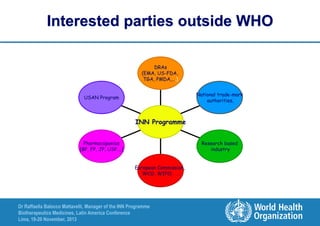
Interested parties outside WHO
DRAs
(EMA, US-FDA,
TGA, PMDA,….)
National trade-mark
authorities,

USAN Program

INN Programme
Pharmacopoeias
(BP, FP, JP, USP….)

Research based
industry
European Commission,
WCO, WIPO, …

Dr Raffaella Balocco Mattavelli, Manager of the INN Programme
Biotherapeutics Medicines, Latin America Conference
Lima, 19-20 November, 2013
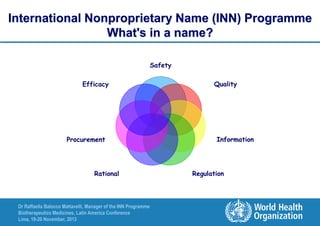
International Nonproprietary Name (INN) Programme
What's in a name?
Safety
Efficacy

Procurement

Rational use

Dr Raffaella Balocco Mattavelli, Manager of the INN Programme
Biotherapeutics Medicines, Latin America Conference
Lima, 19-20 November, 2013

Quality

Information

Regulation
INNs…
 unique name
 distinctive in sound and spelling
 not liable to confusion with other names in common use
 formally placed by WHO in the public domain, (hence
their designation as nonproprietary)
 can be used without any restriction to identify
pharmaceutical substances
Dr Raffaella Balocco Mattavelli, Manager of the INN Programme
Biotherapeutics Medicines, Latin America Conference
Lima, 19-20 November, 2013
The INN System
 WHO Secretariat
 INN Expert Group
– Can call on further experts if necessary
– INN Advisory Group on Biologicals
 Publications

Dr Raffaella Balocco Mattavelli, Manager of the INN Programme
Biotherapeutics Medicines, Latin America Conference
Lima, 19-20 November, 2013
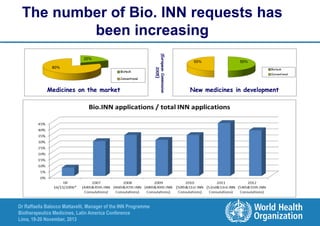
The number of Bio. INN requests has
been increasing

Dr Raffaella Balocco Mattavelli, Manager of the INN Programme
Biotherapeutics Medicines, Latin America Conference
Lima, 19-20 November, 2013

(European Commission
2005)

Medicines on the market

New medicines in development
Current INN position for biological products
 20 biological groups with stems
 5 groups with an INN nomenclature scheme
 Generals policies developed for 10 groups of biological
products
 'INN for biological and biotechnological substances a
review'http://www.who.int/medicines/services/inn/INN_Biorev11-06.pdf

Dr Raffaella Balocco Mattavelli, Manager of the INN Programme
Biotherapeutics Medicines, Latin America Conference
Lima, 19-20 November, 2013
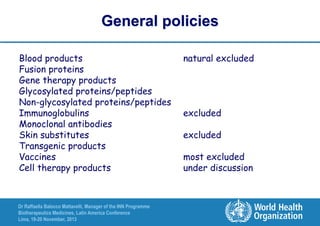
General policies
Blood products
Fusion proteins
Gene therapy products
Glycosylated proteins/peptides
Non-glycosylated proteins/peptides
Immunoglobulins
Monoclonal antibodies
Skin substitutes
Transgenic products
Vaccines
Cell therapy products

Dr Raffaella Balocco Mattavelli, Manager of the INN Programme
Biotherapeutics Medicines, Latin America Conference
Lima, 19-20 November, 2013

natural excluded

excluded

excluded
most excluded
under discussion
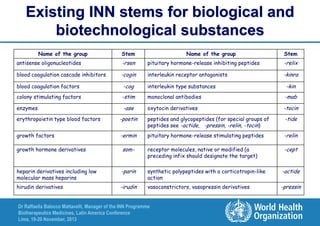
Existing INN stems for biological and
biotechnological substances
Name of the group

Stem

Name of the group

Stem

antisense oligonucleotides

-rsen

pituitary hormone-release inhibiting peptides

-relix

blood coagulation cascade inhibitors

-cogin

interleukin receptor antagonists

-kinra

blood coagulation factors

-cog

interleukin type substances

-kin

colony stimulating factors

-stim

monoclonal antibodies

-mab

enzymes

-ase

oxytocin derivatives

-tocin

erythropoietin type blood factors

-poetin

peptides and glycopeptides (for special groups of
peptides see -actide, -pressin, -relin, -tocin)

-tide

growth factors

-ermin

pituitary hormone-release stimulating peptides

-relin
-cept

growth hormone derivatives

som-

receptor molecules, native or modified (a
preceding infix should designate the target)

heparin derivatives including low
molecular mass heparins

-parin

synthetic polypeptides with a corticotropin-like
action

-actide

hirudin derivatives

-irudin

vasoconstrictors, vasopressin derivatives

-pressin

Dr Raffaella Balocco Mattavelli, Manager of the INN Programme
Biotherapeutics Medicines, Latin America Conference
Lima, 19-20 November, 2013
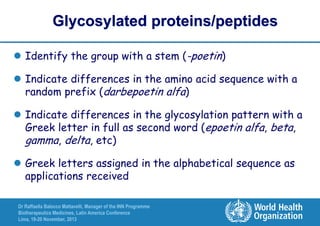
Glycosylated proteins/peptides
 Identify the group with a stem (-poetin)

 Indicate differences in the amino acid sequence with a
random prefix (darbepoetin alfa)
 Indicate differences in the glycosylation pattern with a
Greek letter in full as second word (epoetin alfa, beta,
gamma, delta, etc)
 Greek letters assigned in the alphabetical sequence as
applications received
Dr Raffaella Balocco Mattavelli, Manager of the INN Programme
Biotherapeutics Medicines, Latin America Conference
Lima, 19-20 November, 2013
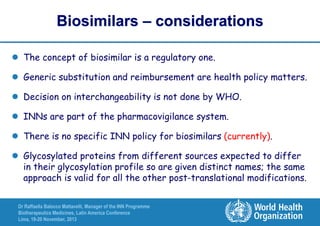
Biosimilars – considerations
 The concept of biosimilar is a regulatory one.
 Generic substitution and reimbursement are health policy matters.
 Decision on interchangeability is not done by WHO.
 INNs are part of the pharmacovigilance system.
 There is no specific INN policy for biosimilars (currently).

 Glycosylated proteins from different sources expected to differ
in their glycosylation profile so are given distinct names; the same
approach is valid for all the other post-translational modifications.
Dr Raffaella Balocco Mattavelli, Manager of the INN Programme
Biotherapeutics Medicines, Latin America Conference
Lima, 19-20 November, 2013
Naming of Similar Biotherapeutics Products
The WHO INN Programme exists to facilitate the
identification of medicines so that they:
– have a unique name that is globally recognised; and
– are prescribed and used rationally
At present SBPs are not specifically named, but the
general naming principles are applied.

Dr Raffaella Balocco Mattavelli, Manager of the INN Programme
Biotherapeutics Medicines, Latin America Conference
Lima, 19-20 November, 2013
Current WHO policy
In practice, this means that:
 some SBPs (all unglycosylated, like somatropin and filgrastim)
have the same nonproprietary name as the reference substance;
 glycosylated SBPs are likely to have different nonproprietary
names to the reference;

 different interpretations of this policy has led to different
countries having different nonproprietary names for the same
product; and
 when different nonproprietary names are used, the reference
substance to which the SBP was compared is not identified.
Dr Raffaella Balocco Mattavelli, Manager of the INN Programme
Biotherapeutics Medicines, Latin America Conference
Lima, 19-20 November, 2013
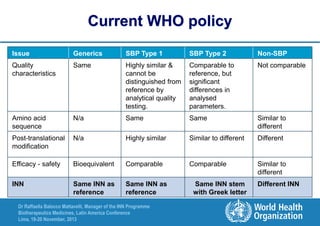
Current WHO policy
Issue

Generics

SBP Type 1

SBP Type 2

Non-SBP

Quality
characteristics

Same

Highly similar &
cannot be
distinguished from
reference by
analytical quality
testing.

Comparable to
reference, but
significant
differences in
analysed
parameters.

Not comparable

Amino acid
sequence

N/a

Same

Same

Similar to
different

Post-translational
modification

N/a

Highly similar

Similar to different

Different

Efficacy - safety

Bioequivalent

Comparable

Comparable

Similar to
different

INN

Same INN as
reference

Same INN as
reference

Dr Raffaella Balocco Mattavelli, Manager of the INN Programme
Biotherapeutics Medicines, Latin America Conference
Lima, 19-20 November, 2013

Same INN stem
with Greek letter

Different INN
Naming SBPs an INN issue?
 Means to distinguish SBPs from each other ?
 As prescription by nonproprietary name is common,
and in some countries encouraged, the issue of the
naming of SBPs does affect the INN Programme
 If individual regulatory bodies develop their own
naming policy for SBPs, there will a diversity in
names, not “a unique name that is globally
recognised”.
Dr Raffaella Balocco Mattavelli, Manager of the INN Programme
Biotherapeutics Medicines, Latin America Conference
Lima, 19-20 November, 2013
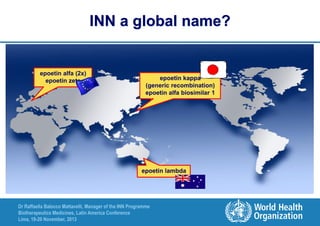
INN a global name?

epoetin alfa (2x)
epoetin zeta

epoetin kappa
(generic recombination)
epoetin alfa biosimilar 1

epoetin lambda

Dr Raffaella Balocco Mattavelli, Manager of the INN Programme
Biotherapeutics Medicines, Latin America Conference
Lima, 19-20 November, 2013
Proposed INN naming of SBPs
It is therefore under discussion a proposal that all SBPs should be
clearly identified:

1. All SBPs should have the INN of the reference product as the
first part of the name. This effectively and unambiguously
identifies the reference product for that SBP.
2. A parallel system could be developed creating a Biological
Qualifier that could uniquely identify the substance.

Dr Raffaella Balocco Mattavelli, Manager of the INN Programme
Biotherapeutics Medicines, Latin America Conference
Lima, 19-20 November, 2013
Proposed INN naming of SBPs
There has also been some discussion about how this system should
be implemented. The most viable options are:
1.The Biological Qualifier is assigned by the INN Programme

according to an agreed policy;
2.The INN Programme produces an advice document laying out an
agreed naming scheme which may be applied by national regulatory
authorities.
Dr Raffaella Balocco Mattavelli, Manager of the INN Programme
Biotherapeutics Medicines, Latin America Conference
Lima, 19-20 November, 2013
Conclusion
This is an issue that does need to be addressed globally, and soon while the number of registered SBP’s is relatively small.
The WHO INN Programme has a clear mandate.

The INN Expert Group recommended WHO secretariat to further
work on principles of establishing a Biological Qualifier system in

conjunction with exploring its feasibility. This would entail further
consultations with the major stakeholders, including but not limited
to, regulatory and industrial parties
Dr Raffaella Balocco Mattavelli, Manager of the INN Programme
Biotherapeutics Medicines, Latin America Conference
Lima, 19-20 November, 2013
Current challenges
 The complexity of substances

 The number-induced difficulty

 The emerging of new types of substances (new policies?)

 Biological Qualifier? International set of standards?

Dr Raffaella Balocco Mattavelli, Manager of the INN Programme
Biotherapeutics Medicines, Latin America Conference
Lima, 19-20 November, 2013
Thank you-спасибо
Merci! Obrigado ! Gracias 谢谢!ありがう!ARIGATOU!Danke! Dziękuję! Dank je / u!
Mulţumesc! Teşekkür ederim! Tack!Tack så mycket Grazie! Kiitos! ‫תודה‬
!‫לך‬Takk! ďakujem, ďakujem vám ; Hvala! !ً shokran Ευχαριστώ! 감사합니다
‫شكرا‬
Děkuji! Tak skal du have! Dankon! Hvala, Hvala lepa, Najlepša hvala Gràcies!
Faleminderit Hvala! Ačiū, De’koju, Labai ačiū ขอบคุณ ; ขอบคุณมาก(khàwp khun) ; (khàwp
khun mâak) shukrīya ((ً‫بہت( شكريه‬bahut( Cảm ơn cô ; Cảm ơn cô nhiều;
Благодаря!Благодаря! Obrigado!” Gracias Þakka þér! baie dankie ; Takk fyri! Sipas
dekem !‫متشکرم‬Благодарам! Hvala Vam! V Təşəkkür Paldies!Pateicos! /
Tencinu! Terima kasih Дуже дякую ;Дякую ; Спасибі! Баярлалаа ; Гялайлаа ; Танд
их баярлалаа Terima kasih ধনযবাদ (dhonyobād( Salamat! Trugarez ! Mersi
!Trugarez Danke!

http://mednet.who.int/
innprogramme@who.int
http://www.who.int/medicines/services/inn/en/index.html
Dr Raffaella Balocco Mattavelli, Manager of the INN Programme
Biotherapeutics Medicines, Latin America Conference
Lima, 19-20 November, 2013

18. Raffaella Balocco - WHO

  • 1.
    International Nonproprietary Names DrRaffaella Balocco Mattavelli, Manager of the INN Programme Dr Raffaella Balocco Mattavelli, Manager of the INN Programme Biotherapeutics Medicines, Latin America Conference Lima, 19-20 November, 2013
  • 2.
    Introduction to INNProgramme "Some activities undertaken by WHO are largely invisible, quietly protecting the health of every person on this planet, every day. By assigning a single international name to drugs, WHO helps ensure that a prescription filled abroad is what doctor ordered back home." Dr Margaret Chan, Director General – Working for Health: An introduction to the WHO Dr Raffaella Balocco Mattavelli, Manager of the INN Programme Biotherapeutics Medicines, Latin America Conference Lima, 19-20 November, 2013
  • 3.
    WHO some basicfacts  193 Member States  Two governing bodies: – World Health Assembly – Executive Board  WHO Secretariat: – HQ – six Regional Offices – WHO Expert Panels (e.g. on the International Pharmacopoeia and Pharmaceutical Preparations etc.) –  Constitution 1946, in force since 7 April 1948 (World Health Day)  Article 2 (u) International standards Dr Raffaella Balocco Mattavelli, Manager of the INN Programme Biotherapeutics Medicines, Latin America Conference Lima, 19-20 November, 2013
  • 4.
    The WHO InternationalNonproprietary Name (INN) Programme To provide one single name worldwide for active pharmaceutical substances  Initiated in 1950 by resolution WHA3.11  Operational since 1953  Based on WHO Constitution  Insulin human (48)(22) Dr Raffaella Balocco Mattavelli, Manager of the INN Programme Biotherapeutics Medicines, Latin America Conference Lima, 19-20 November, 2013
  • 5.
    The WHO InternationalNonproprietary Name (INN) Programme  WHO has responsibility to develop, establish and promote international standards for pharmaceutical and biological products  Need for universally available and accepted name for drug substance  INN is a unique generic name that is recognized globally and is public property  Intended for use in drug regulation, prescription, pharmacopoeias, labeling advertising, scientific literature Dr Raffaella Balocco Mattavelli, Manager of the INN Programme Biotherapeutics Medicines, Latin America Conference Lima, 19-20 November, 2013
  • 6.
    Interested parties outsideWHO DRAs (EMA, US-FDA, TGA, PMDA,….) National trade-mark authorities, USAN Program INN Programme Pharmacopoeias (BP, FP, JP, USP….) Research based industry European Commission, WCO, WIPO, … Dr Raffaella Balocco Mattavelli, Manager of the INN Programme Biotherapeutics Medicines, Latin America Conference Lima, 19-20 November, 2013
  • 7.
    International Nonproprietary Name(INN) Programme What's in a name? Safety Efficacy Procurement Rational use Dr Raffaella Balocco Mattavelli, Manager of the INN Programme Biotherapeutics Medicines, Latin America Conference Lima, 19-20 November, 2013 Quality Information Regulation
  • 8.
    INNs…  unique name distinctive in sound and spelling  not liable to confusion with other names in common use  formally placed by WHO in the public domain, (hence their designation as nonproprietary)  can be used without any restriction to identify pharmaceutical substances Dr Raffaella Balocco Mattavelli, Manager of the INN Programme Biotherapeutics Medicines, Latin America Conference Lima, 19-20 November, 2013
  • 9.
    The INN System WHO Secretariat  INN Expert Group – Can call on further experts if necessary – INN Advisory Group on Biologicals  Publications Dr Raffaella Balocco Mattavelli, Manager of the INN Programme Biotherapeutics Medicines, Latin America Conference Lima, 19-20 November, 2013
  • 10.
    The number ofBio. INN requests has been increasing Dr Raffaella Balocco Mattavelli, Manager of the INN Programme Biotherapeutics Medicines, Latin America Conference Lima, 19-20 November, 2013 (European Commission 2005) Medicines on the market New medicines in development
  • 11.
    Current INN positionfor biological products  20 biological groups with stems  5 groups with an INN nomenclature scheme  Generals policies developed for 10 groups of biological products  'INN for biological and biotechnological substances a review'http://www.who.int/medicines/services/inn/INN_Biorev11-06.pdf Dr Raffaella Balocco Mattavelli, Manager of the INN Programme Biotherapeutics Medicines, Latin America Conference Lima, 19-20 November, 2013
  • 12.
    General policies Blood products Fusionproteins Gene therapy products Glycosylated proteins/peptides Non-glycosylated proteins/peptides Immunoglobulins Monoclonal antibodies Skin substitutes Transgenic products Vaccines Cell therapy products Dr Raffaella Balocco Mattavelli, Manager of the INN Programme Biotherapeutics Medicines, Latin America Conference Lima, 19-20 November, 2013 natural excluded excluded excluded most excluded under discussion
  • 13.
    Existing INN stemsfor biological and biotechnological substances Name of the group Stem Name of the group Stem antisense oligonucleotides -rsen pituitary hormone-release inhibiting peptides -relix blood coagulation cascade inhibitors -cogin interleukin receptor antagonists -kinra blood coagulation factors -cog interleukin type substances -kin colony stimulating factors -stim monoclonal antibodies -mab enzymes -ase oxytocin derivatives -tocin erythropoietin type blood factors -poetin peptides and glycopeptides (for special groups of peptides see -actide, -pressin, -relin, -tocin) -tide growth factors -ermin pituitary hormone-release stimulating peptides -relin -cept growth hormone derivatives som- receptor molecules, native or modified (a preceding infix should designate the target) heparin derivatives including low molecular mass heparins -parin synthetic polypeptides with a corticotropin-like action -actide hirudin derivatives -irudin vasoconstrictors, vasopressin derivatives -pressin Dr Raffaella Balocco Mattavelli, Manager of the INN Programme Biotherapeutics Medicines, Latin America Conference Lima, 19-20 November, 2013
  • 14.
    Glycosylated proteins/peptides  Identifythe group with a stem (-poetin)  Indicate differences in the amino acid sequence with a random prefix (darbepoetin alfa)  Indicate differences in the glycosylation pattern with a Greek letter in full as second word (epoetin alfa, beta, gamma, delta, etc)  Greek letters assigned in the alphabetical sequence as applications received Dr Raffaella Balocco Mattavelli, Manager of the INN Programme Biotherapeutics Medicines, Latin America Conference Lima, 19-20 November, 2013
  • 15.
    Biosimilars – considerations The concept of biosimilar is a regulatory one.  Generic substitution and reimbursement are health policy matters.  Decision on interchangeability is not done by WHO.  INNs are part of the pharmacovigilance system.  There is no specific INN policy for biosimilars (currently).  Glycosylated proteins from different sources expected to differ in their glycosylation profile so are given distinct names; the same approach is valid for all the other post-translational modifications. Dr Raffaella Balocco Mattavelli, Manager of the INN Programme Biotherapeutics Medicines, Latin America Conference Lima, 19-20 November, 2013
  • 16.
    Naming of SimilarBiotherapeutics Products The WHO INN Programme exists to facilitate the identification of medicines so that they: – have a unique name that is globally recognised; and – are prescribed and used rationally At present SBPs are not specifically named, but the general naming principles are applied. Dr Raffaella Balocco Mattavelli, Manager of the INN Programme Biotherapeutics Medicines, Latin America Conference Lima, 19-20 November, 2013
  • 17.
    Current WHO policy Inpractice, this means that:  some SBPs (all unglycosylated, like somatropin and filgrastim) have the same nonproprietary name as the reference substance;  glycosylated SBPs are likely to have different nonproprietary names to the reference;  different interpretations of this policy has led to different countries having different nonproprietary names for the same product; and  when different nonproprietary names are used, the reference substance to which the SBP was compared is not identified. Dr Raffaella Balocco Mattavelli, Manager of the INN Programme Biotherapeutics Medicines, Latin America Conference Lima, 19-20 November, 2013
  • 18.
    Current WHO policy Issue Generics SBPType 1 SBP Type 2 Non-SBP Quality characteristics Same Highly similar & cannot be distinguished from reference by analytical quality testing. Comparable to reference, but significant differences in analysed parameters. Not comparable Amino acid sequence N/a Same Same Similar to different Post-translational modification N/a Highly similar Similar to different Different Efficacy - safety Bioequivalent Comparable Comparable Similar to different INN Same INN as reference Same INN as reference Dr Raffaella Balocco Mattavelli, Manager of the INN Programme Biotherapeutics Medicines, Latin America Conference Lima, 19-20 November, 2013 Same INN stem with Greek letter Different INN
  • 19.
    Naming SBPs anINN issue?  Means to distinguish SBPs from each other ?  As prescription by nonproprietary name is common, and in some countries encouraged, the issue of the naming of SBPs does affect the INN Programme  If individual regulatory bodies develop their own naming policy for SBPs, there will a diversity in names, not “a unique name that is globally recognised”. Dr Raffaella Balocco Mattavelli, Manager of the INN Programme Biotherapeutics Medicines, Latin America Conference Lima, 19-20 November, 2013
  • 20.
    INN a globalname? epoetin alfa (2x) epoetin zeta epoetin kappa (generic recombination) epoetin alfa biosimilar 1 epoetin lambda Dr Raffaella Balocco Mattavelli, Manager of the INN Programme Biotherapeutics Medicines, Latin America Conference Lima, 19-20 November, 2013
  • 21.
    Proposed INN namingof SBPs It is therefore under discussion a proposal that all SBPs should be clearly identified: 1. All SBPs should have the INN of the reference product as the first part of the name. This effectively and unambiguously identifies the reference product for that SBP. 2. A parallel system could be developed creating a Biological Qualifier that could uniquely identify the substance. Dr Raffaella Balocco Mattavelli, Manager of the INN Programme Biotherapeutics Medicines, Latin America Conference Lima, 19-20 November, 2013
  • 22.
    Proposed INN namingof SBPs There has also been some discussion about how this system should be implemented. The most viable options are: 1.The Biological Qualifier is assigned by the INN Programme according to an agreed policy; 2.The INN Programme produces an advice document laying out an agreed naming scheme which may be applied by national regulatory authorities. Dr Raffaella Balocco Mattavelli, Manager of the INN Programme Biotherapeutics Medicines, Latin America Conference Lima, 19-20 November, 2013
  • 23.
    Conclusion This is anissue that does need to be addressed globally, and soon while the number of registered SBP’s is relatively small. The WHO INN Programme has a clear mandate. The INN Expert Group recommended WHO secretariat to further work on principles of establishing a Biological Qualifier system in conjunction with exploring its feasibility. This would entail further consultations with the major stakeholders, including but not limited to, regulatory and industrial parties Dr Raffaella Balocco Mattavelli, Manager of the INN Programme Biotherapeutics Medicines, Latin America Conference Lima, 19-20 November, 2013
  • 24.
    Current challenges  Thecomplexity of substances  The number-induced difficulty  The emerging of new types of substances (new policies?)  Biological Qualifier? International set of standards? Dr Raffaella Balocco Mattavelli, Manager of the INN Programme Biotherapeutics Medicines, Latin America Conference Lima, 19-20 November, 2013
  • 25.
    Thank you-спасибо Merci! Obrigado! Gracias 谢谢!ありがう!ARIGATOU!Danke! Dziękuję! Dank je / u! Mulţumesc! Teşekkür ederim! Tack!Tack så mycket Grazie! Kiitos! ‫תודה‬ !‫לך‬Takk! ďakujem, ďakujem vám ; Hvala! !ً shokran Ευχαριστώ! 감사합니다 ‫شكرا‬ Děkuji! Tak skal du have! Dankon! Hvala, Hvala lepa, Najlepša hvala Gràcies! Faleminderit Hvala! Ačiū, De’koju, Labai ačiū ขอบคุณ ; ขอบคุณมาก(khàwp khun) ; (khàwp khun mâak) shukrīya ((ً‫بہت( شكريه‬bahut( Cảm ơn cô ; Cảm ơn cô nhiều; Благодаря!Благодаря! Obrigado!” Gracias Þakka þér! baie dankie ; Takk fyri! Sipas dekem !‫متشکرم‬Благодарам! Hvala Vam! V Təşəkkür Paldies!Pateicos! / Tencinu! Terima kasih Дуже дякую ;Дякую ; Спасибі! Баярлалаа ; Гялайлаа ; Танд их баярлалаа Terima kasih ধনযবাদ (dhonyobād( Salamat! Trugarez ! Mersi !Trugarez Danke! http://mednet.who.int/ innprogramme@who.int http://www.who.int/medicines/services/inn/en/index.html Dr Raffaella Balocco Mattavelli, Manager of the INN Programme Biotherapeutics Medicines, Latin America Conference Lima, 19-20 November, 2013