Kidney Problems and Dialysis

      Made
   by:Redmond
       Lim
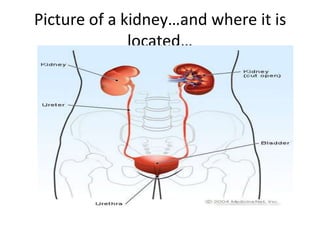
Picture of a kidney…and where it is
              located…
Kidneys..
• The kidneys are a pair of bean-shaped organs that
  lie on either side of the spine in the lower middle of
  the back. Each kidney weighs about ¼ pound and
  contains approximately one million filtering units
  called nephrons. Each nephron is made of a
  glomerulus and a tubule. The glomerulus is a
  miniature filtering or sieving device while the
  tubule is a tiny tube like structure attached to the
  glomerulus.
Words…
Nephrons
- filtering units
Glomerulus
-a miniature filtering or sieving device
Tubule
-a tiny tube like structure attached to the glomerulus.

Kidney is also called renal.
Knowing the KIDNEY

How do our kidneys work?
 We can live quite well with only one kidney and
some people live a healthy life even though born
with one missing. But while bones can break,
muscles can waste away and the brain can sleep
without risk to life, if both of your kidneys fail, as
happens in end stage kidney failure, bone, muscle
or brain can not carry on. Without any kidney
function our body dies. Kidney function is essential
for life!
What can your kidneys do?
• Healthy kidneys act like a filter to make sure the right
  amount of wastes and fluids are removed, they keep
  the proper balance of salts and acids in the body, and
  produce hormones. Each day your kidneys process
  around 200 litres of blood, with around 1 to 2 litres of
  waste leaving the body as urine. Our kidneys make
  three important hormones, erythropoietin, renin and
  active vitamin D. Erythropoietin stimulates the
  production of red blood cells, renin is involved in the
  control of blood pressure and active vitamin D controls
  calcium uptake and helps make strong bones.
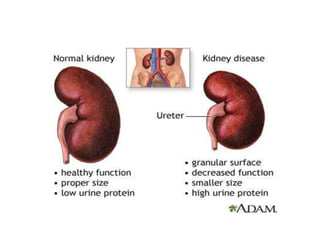
Common Kidney Diseases
•   Diabetes - thought to cause about half of all cases
•   Hypertension (high blood pressure) - thought to cause about one quarter of all cases
•   Inflammation of the kidney (glomerulonephritis)
•   Malaria
•   Long-term exposure to lead, solvents and fuels
•   Systemic lupus erythematosus - body's own immune system attacks the kidneys
•   Polycystic kidney disease - inherited
•   Physical injury, such as a heavy blow to the kidney
•   Kidney infection (pyelonephritis)
•   Jaundice
•   Over consumption of some medications
•   Unborn baby does not normally developing kidneys
•   Yellow fever
•   Written by Christian Nordqvist
    Copyright: Medical News Today
CKD
• Chronic kidney disease (CKD), also known
  as chronic renal disease, is a progressive loss
  in renal function over a period of months or years. The
  symptoms of worsening kidney function are unspecific,
  and might include feeling generally unwell and
  experiencing a reduced appetite. Often, chronic kidney
  disease is diagnosed as a result of screening of
  people known to be at risk of kidney problems, such
  as those with high blood pressure or diabetesand
  those with a blood relative with chronic kidney
  disease. Chronic kidney disease may also be
  identified when it leads to one of its recognized
  complications, such as cardiovascular
  disease, anemia or pericarditis.[1]
Common symptoms or signs of CKD
• The best way to determine whether a person is suffering from CKD is to
  create a checklist of its symptoms and signs. If most of the symptoms in
  the list are experienced by a person suspected of CKD, then there is a huge
  possibility that he or she has really developed chronic kidney disease.

• As the functioning of the kidney decreases, the common symptoms of CKD
  subsequently emerge. These symptoms include increased blood pressure
  levels caused by the overproduction of vasoactive hormones, increase in
  uric levels and rapid accumulation of potassium in the human
  bloodstream.

• Increasing blood pressure levels usually lead to hypertension or congestive
  heart failure. Meanwhile, accumulated urea in the body causes uremia, a
  medical condition wherein a person becomes lethargic and the fibrous sac
  in his or her heart becomes inflamed and sore. Lastly, accumulated
  potassium in the bloodstream, also known as hyperkalemia, could make a
  person experience fatal episodes of cardiac arrhythmias.
Treatment for Chronic Kidney Diseases
• People who undergo therapy for CKD usually aim to control the
  progressive decrease in their kidney function. The main focus of
  such therapies is to control the patient’s blood pressure levels and
  to treat the original causes of the patient’s disease. Substances
  used for the therapy of this disease usually include angiotensin
  converting enzyme inhibitors or substances that are antagonistic to
  angiotensin II receptor.

• These are the most important information you should know about
  CKD. If you want to prevent yourself from experiencing this fatal
  disease, you should take care of your kidneys and make sure that
  they are functioning at their optimal levels. You can take good care
  of your kidneys by adopting a healthy diet, quitting smoking and
  regulating your alcohol intakes. Once you have done these
  important management tips, you would become less vulnerable to
  chronic kidney disease.
• Anemia - People with chronic kidney disease are
  usually affected by anemia (90% of them). When
  levels of EPO (erythropoietin), which is produced
  by the kidneys, are low, anemia can develop. EPO
  makes the body produce red blood cells. When
  your red blood cell count is low you have
  anemia. Chronic kidney failure patients who have
  anemia are usually given an ESA (erythropoiesis-
  stimulating agent) injection. A study found that
  Ferumoxytol, a novel intravenous form of iron that
  permits rapid administration of large doses, is
  effective for treating iron deficiency in chronic
  kidney disease (CKD) patients on dialysis.
Dialysis
Kidney Dialysis
• This kidney dialysis procedure is performed 3 times a
  week with the help of adialysis technician. What this
  procedure does is remove the waste products of the
  body’s normal metabolism from the blood stream. The
  kidneys’ remove waste products from the blood twenty
  four hours a day seven days a week. In other words it
  does this process slowly and continuously. So when a
  kidney dialysis procedure is performed on a patient it is
  completed in about 3 to 4 hours. Because of the rapid
  cleaning of the blood the patient can suffer from side
  effects such as nausea and headaches. Either a dialysis
  nurse ordialysis technician will help you through this
• Dialysis alone does not effectively remove all
  the waste from the body, and in between
  treatments toxins and waste products
  continue to build in the body. One way to
  assist the body in between dialysis
  appointments is to eat a physician approved
  renal diet. A dialysis diet will limit the waste
  produced, maintain a balance of electrolytes,
  minerals, and fluid in patients who are on
  dialysis.
How The Kidney Dialysis Procedure Is
             Performed
• The patient will be prepped for their treatment by having their
  AV shunt accessed by a nurse. Usually at this point the
  dialysis technician will take over to observe the patient and
  machine during the procedure. The patient may need
  medicine for nausea during the procedure, so the technician
  and nurse communicate frequently during the dialysis
  treatment.
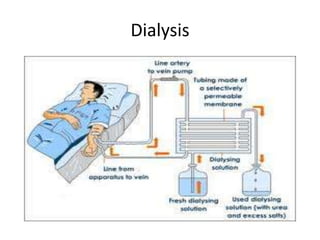
• Most patients will have what is called an arterio/venous shunt
  in one of their arms. What this does is allow for a large bore
  needle to be inserted into this shunt for the dialysis procedure.
  The blood will then be pulled through the dialysis machine
  and cleansed before being returned to the body.
• For those with end stage renal disease the kidney dialysis
  procedure is literally a life preserving action.
The End….


THANK YOU FOR LISTENING!!!

18. kidney problems and dialysis

  • 1.
    Kidney Problems andDialysis Made by:Redmond Lim
  • 2.
    Picture of akidney…and where it is located…
  • 3.
    Kidneys.. • The kidneysare a pair of bean-shaped organs that lie on either side of the spine in the lower middle of the back. Each kidney weighs about ¼ pound and contains approximately one million filtering units called nephrons. Each nephron is made of a glomerulus and a tubule. The glomerulus is a miniature filtering or sieving device while the tubule is a tiny tube like structure attached to the glomerulus.
  • 4.
    Words… Nephrons - filtering units Glomerulus -aminiature filtering or sieving device Tubule -a tiny tube like structure attached to the glomerulus. Kidney is also called renal.
  • 5.
    Knowing the KIDNEY Howdo our kidneys work? We can live quite well with only one kidney and some people live a healthy life even though born with one missing. But while bones can break, muscles can waste away and the brain can sleep without risk to life, if both of your kidneys fail, as happens in end stage kidney failure, bone, muscle or brain can not carry on. Without any kidney function our body dies. Kidney function is essential for life!
  • 6.
    What can yourkidneys do? • Healthy kidneys act like a filter to make sure the right amount of wastes and fluids are removed, they keep the proper balance of salts and acids in the body, and produce hormones. Each day your kidneys process around 200 litres of blood, with around 1 to 2 litres of waste leaving the body as urine. Our kidneys make three important hormones, erythropoietin, renin and active vitamin D. Erythropoietin stimulates the production of red blood cells, renin is involved in the control of blood pressure and active vitamin D controls calcium uptake and helps make strong bones.
  • 8.
    Common Kidney Diseases • Diabetes - thought to cause about half of all cases • Hypertension (high blood pressure) - thought to cause about one quarter of all cases • Inflammation of the kidney (glomerulonephritis) • Malaria • Long-term exposure to lead, solvents and fuels • Systemic lupus erythematosus - body's own immune system attacks the kidneys • Polycystic kidney disease - inherited • Physical injury, such as a heavy blow to the kidney • Kidney infection (pyelonephritis) • Jaundice • Over consumption of some medications • Unborn baby does not normally developing kidneys • Yellow fever • Written by Christian Nordqvist Copyright: Medical News Today
  • 9.
    CKD • Chronic kidneydisease (CKD), also known as chronic renal disease, is a progressive loss in renal function over a period of months or years. The symptoms of worsening kidney function are unspecific, and might include feeling generally unwell and experiencing a reduced appetite. Often, chronic kidney disease is diagnosed as a result of screening of people known to be at risk of kidney problems, such as those with high blood pressure or diabetesand those with a blood relative with chronic kidney disease. Chronic kidney disease may also be identified when it leads to one of its recognized complications, such as cardiovascular disease, anemia or pericarditis.[1]
  • 10.
    Common symptoms orsigns of CKD • The best way to determine whether a person is suffering from CKD is to create a checklist of its symptoms and signs. If most of the symptoms in the list are experienced by a person suspected of CKD, then there is a huge possibility that he or she has really developed chronic kidney disease. • As the functioning of the kidney decreases, the common symptoms of CKD subsequently emerge. These symptoms include increased blood pressure levels caused by the overproduction of vasoactive hormones, increase in uric levels and rapid accumulation of potassium in the human bloodstream. • Increasing blood pressure levels usually lead to hypertension or congestive heart failure. Meanwhile, accumulated urea in the body causes uremia, a medical condition wherein a person becomes lethargic and the fibrous sac in his or her heart becomes inflamed and sore. Lastly, accumulated potassium in the bloodstream, also known as hyperkalemia, could make a person experience fatal episodes of cardiac arrhythmias.
  • 11.
    Treatment for ChronicKidney Diseases • People who undergo therapy for CKD usually aim to control the progressive decrease in their kidney function. The main focus of such therapies is to control the patient’s blood pressure levels and to treat the original causes of the patient’s disease. Substances used for the therapy of this disease usually include angiotensin converting enzyme inhibitors or substances that are antagonistic to angiotensin II receptor. • These are the most important information you should know about CKD. If you want to prevent yourself from experiencing this fatal disease, you should take care of your kidneys and make sure that they are functioning at their optimal levels. You can take good care of your kidneys by adopting a healthy diet, quitting smoking and regulating your alcohol intakes. Once you have done these important management tips, you would become less vulnerable to chronic kidney disease.
  • 12.
    • Anemia -People with chronic kidney disease are usually affected by anemia (90% of them). When levels of EPO (erythropoietin), which is produced by the kidneys, are low, anemia can develop. EPO makes the body produce red blood cells. When your red blood cell count is low you have anemia. Chronic kidney failure patients who have anemia are usually given an ESA (erythropoiesis- stimulating agent) injection. A study found that Ferumoxytol, a novel intravenous form of iron that permits rapid administration of large doses, is effective for treating iron deficiency in chronic kidney disease (CKD) patients on dialysis.
  • 13.
  • 14.
    Kidney Dialysis • Thiskidney dialysis procedure is performed 3 times a week with the help of adialysis technician. What this procedure does is remove the waste products of the body’s normal metabolism from the blood stream. The kidneys’ remove waste products from the blood twenty four hours a day seven days a week. In other words it does this process slowly and continuously. So when a kidney dialysis procedure is performed on a patient it is completed in about 3 to 4 hours. Because of the rapid cleaning of the blood the patient can suffer from side effects such as nausea and headaches. Either a dialysis nurse ordialysis technician will help you through this
  • 15.
    • Dialysis alonedoes not effectively remove all the waste from the body, and in between treatments toxins and waste products continue to build in the body. One way to assist the body in between dialysis appointments is to eat a physician approved renal diet. A dialysis diet will limit the waste produced, maintain a balance of electrolytes, minerals, and fluid in patients who are on dialysis.
  • 16.
    How The KidneyDialysis Procedure Is Performed • The patient will be prepped for their treatment by having their AV shunt accessed by a nurse. Usually at this point the dialysis technician will take over to observe the patient and machine during the procedure. The patient may need medicine for nausea during the procedure, so the technician and nurse communicate frequently during the dialysis treatment. • Most patients will have what is called an arterio/venous shunt in one of their arms. What this does is allow for a large bore needle to be inserted into this shunt for the dialysis procedure. The blood will then be pulled through the dialysis machine and cleansed before being returned to the body. • For those with end stage renal disease the kidney dialysis procedure is literally a life preserving action.
  • 17.
    The End…. THANK YOUFOR LISTENING!!!