Predicting Azure Churn with Deep Learning and
Explaining Predictions with LIME
Feng Zhu (Speaker)
Chao Zhong
Shijing Fang
Ryan Bouchard
Val Fontama
San Francisco
May 16, 2017
• Azure customers and churn
• Customer data and features
• Current ML pipelines and challenges
• Apply deep learning to improve model performance
• Explain model predictions using LIME
Azure Customers and Churn
Customer attrition is expensive!
Industry growth leaders (>35% YoY) spend ~40% of
revenue on acquiring new customers via sales and
marketing. For renewal customers, they incentivize their
sales team with 7%+ commission.
The fastest growing companies generate up to 40% of th
revenue from upsells (avg. is 16%) with goals of <3%
monthly attrition.
Not all customers are acquired equallyAcquiring customers is expensive
Sales & marketing spend Customer acquisition cost
Source: 2015 Pacific Crest SaaS Survey (parts 1+2): http://www.forentrepreneurs.com/2015-saas-survey-part-1/
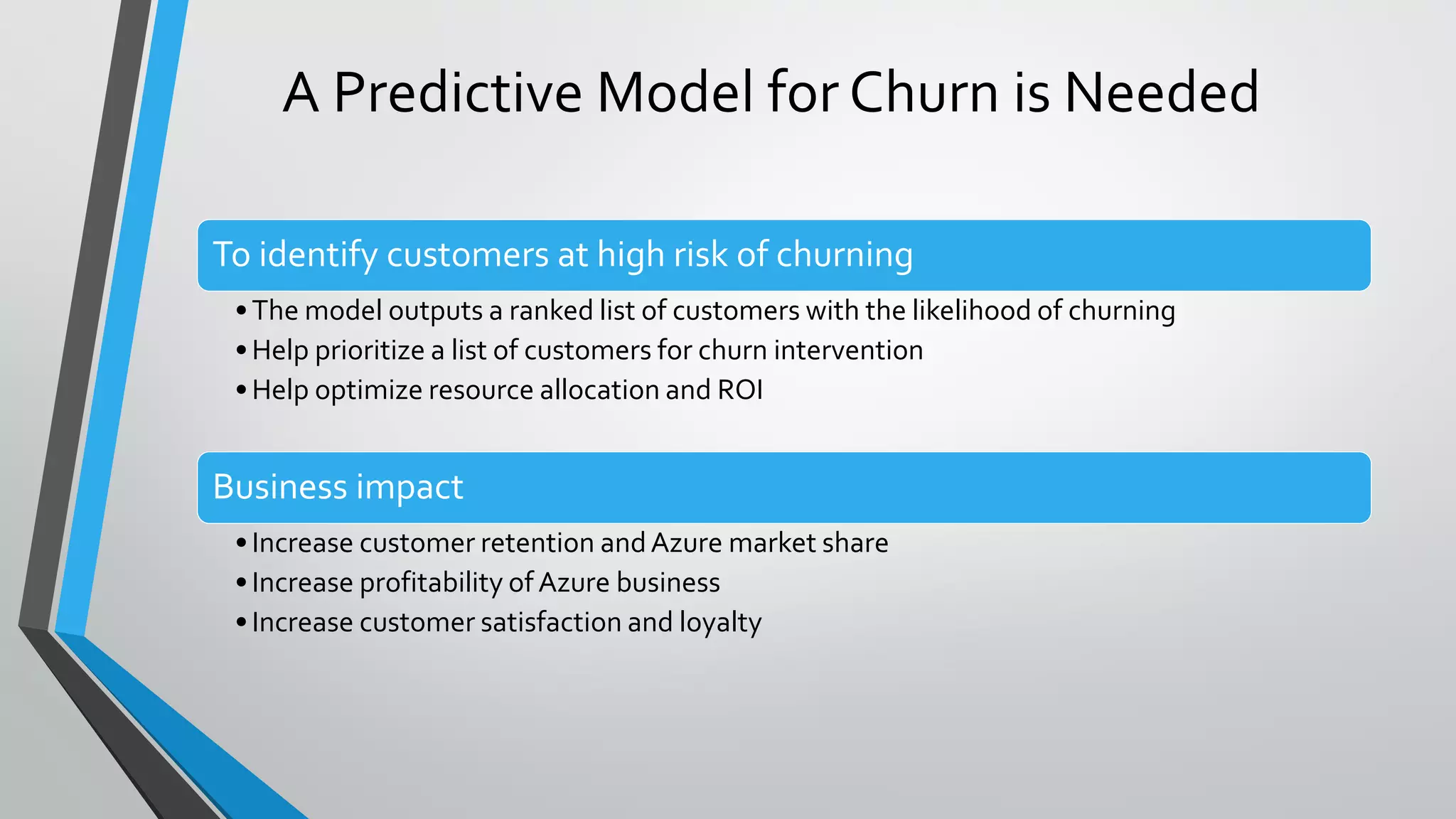
A Predictive Model for Churn is Needed
To identify customers at high risk of churning
•The model outputs a ranked list of customers with the likelihood of churning
•Help prioritize a list of customers for churn intervention
•Help optimize resource allocation and ROI
Business impact
•Increase customer retention andAzure market share
•Increase profitability of Azure business
•Increase customer satisfaction and loyalty
Customer Features and ML Pipelines
Customer and Churn Definitions
Subscription
Data
Subscription
Level
Customer
Level
Customer ID 1
Subscription ID 1
Billing status data
Time series usage
data…
Subscription ID n
 Each customer can have multiple
subscriptions across multiple cloud
services
 Most usage and billing data are
generated at subscription level and
then aggregated to customer level.
 Two types of churns
- Usage churn: No active usage in 28
days
- Systems churn: Cancel all
subscriptions
Mar Apr May Jun
Mar Apr May
Customer Data and Features
Snapshot
Data
• OfferType
• Tenure Age
• Segmentation
Time Series
Data
• Overall Usage
• Usage of Different
Services
• Free Usage
Churn
Labels
• Usage Churn
Label
• System
Churn Label
 Customer profiles consists of
two types of data.
- Snapshot data (billing info)
- Time series data (detailed
usage info)
 Use 8 weeks of snapshot and
time series data to build
customer feature sets.
 Label customers as churn or
not churn in next 4 weeks
Feature Extraction fromTime Series Data
Time Series
(20+)
• FreeUsage
• Usage of Cloud Services
• …
Extraction
Functions
(20+)
• Min Max Mean SD Median
• Number of Zero Values
• Slope
• Sum of Last Interval Values
• …
Extracted
Features
(400+)
• FreeUsage.min
• TotalUnits.max
• …
…
Customer ID 1
ChurnV1 ML Pipeline
Customer Data
• Time series usage
• Snapshot billing
status
Feature
Engineering
• Extract features
from time series
• Combine all
features together
Random Forest
Model
• Classification
model
• 400+ features
Churn Risk Scores
• Weekly scores for all
active customers
End Users
• Take actions
based on
prediction scores
1.“Feature explosion?” – As we increase # of time series, features extracted from time series
will grow exponentially.
1
2
3
3. “Should I trust model/scores?” - If end users do not trust a model or a prediction, they will
not use it
2. “Squeeze more juice?” – Can we further improve the model performance?
Churn V2 ML Pipeline
Customer Usage
Data
• Time series usage
• Snapshot billing
status
Deep Learning
Model
• Deep neural
networks
• Recurrent neural
networks
Risk Scores
• Weekly scores for all
active customers
Model
Explaining
• LIME algorithms
• Explain the scores
at customer level
End Users
• Trust the model
more
• Easy to start the
conversion
• Take actions based
on churn scores
1.Deep learning model – 1) “automated” feature engineering 2) boosts prediction accuracy
1 2
2. LIME – An interface to explain model and predictions to end users
Deep Learning Models
What is Deep Learning (DL)?
• Deep learning is a class of neural
network based ML algorithms
• Transform raw inputs through multiple
layers of neural networks
• “unreasonably effective” in
speech/image recognition and NLP.
• DL excels with unstructured data
• Deep learning can be applied to
many business problems.
• Churn prediction
• Recommender
https://blogs.microsoft.com/next/2016/01/25/microsoft-releases-cntk-its-open-source-deep-learning-toolkit-on-git
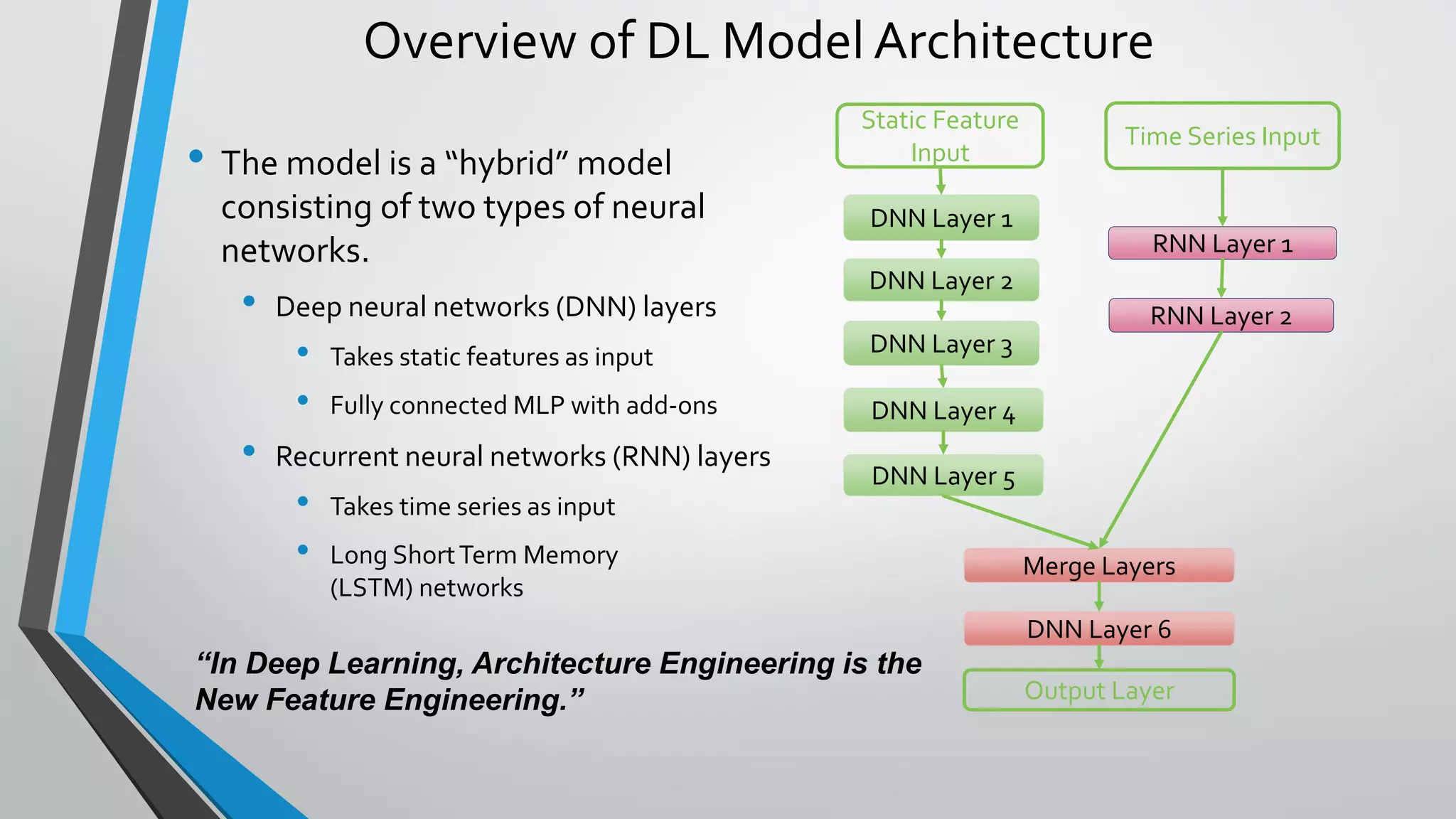
Overview of DL Model Architecture
• The model is a “hybrid” model
consisting of two types of neural
networks.
• Deep neural networks (DNN) layers
• Takes static features as input
• Fully connected MLP with add-ons
• Recurrent neural networks (RNN) layers
• Takes time series as input
• Long ShortTerm Memory
(LSTM) networks
DNN Layer 1
DNN Layer 2
DNN Layer 3
DNN Layer 4
DNN Layer 5
RNN Layer 1
RNN Layer 2
Output Layer
Static Feature
Input
Time Series Input
Merge Layers
DNN Layer 6
“In Deep Learning, Architecture Engineering is the
New Feature Engineering.”
DNN Layers (Left Path)
• Five identical DNN layers are stacked to
transform static features.
• Input dimension of DNN layer 1 equals input
dimension of static feature input
• DNN 2-5 have the same input and output
dimensions
• Batch normalization layer is for faster
convergence and “gradient vanishing”
mitigation
• Highway-like structure is to mitigate
“gradient vanishing” and improve accuracy
• The output of DNN layers is the merged
output from each layer
Output Layer
DNN Layer 1
…
DNN Layer 5
Dense Layer
Batch Normalization
Activation Layer
Merge Layer (concat)
Static Feature Input
RNN Layers (Right Path)
• Two identical RNN (LSTM) layers
are stacked to transform time series
data.
• The input dimension is 18*56. (18 time
series and 56 time steps).
• Each LSTM layer has 128*56 hidden
states. (128 hidden nodes and 56 time
steps)
• Highway-like structure is also added to
mitigate “gradient vanishing” and
improve accuracy
• The final output of RNN layers is the
merged states from the last time step. h1 h2 … h5
…
…
…
LSTM Layer 1
Time Series Input
LSTM Layer 2
x1 x2 … x56
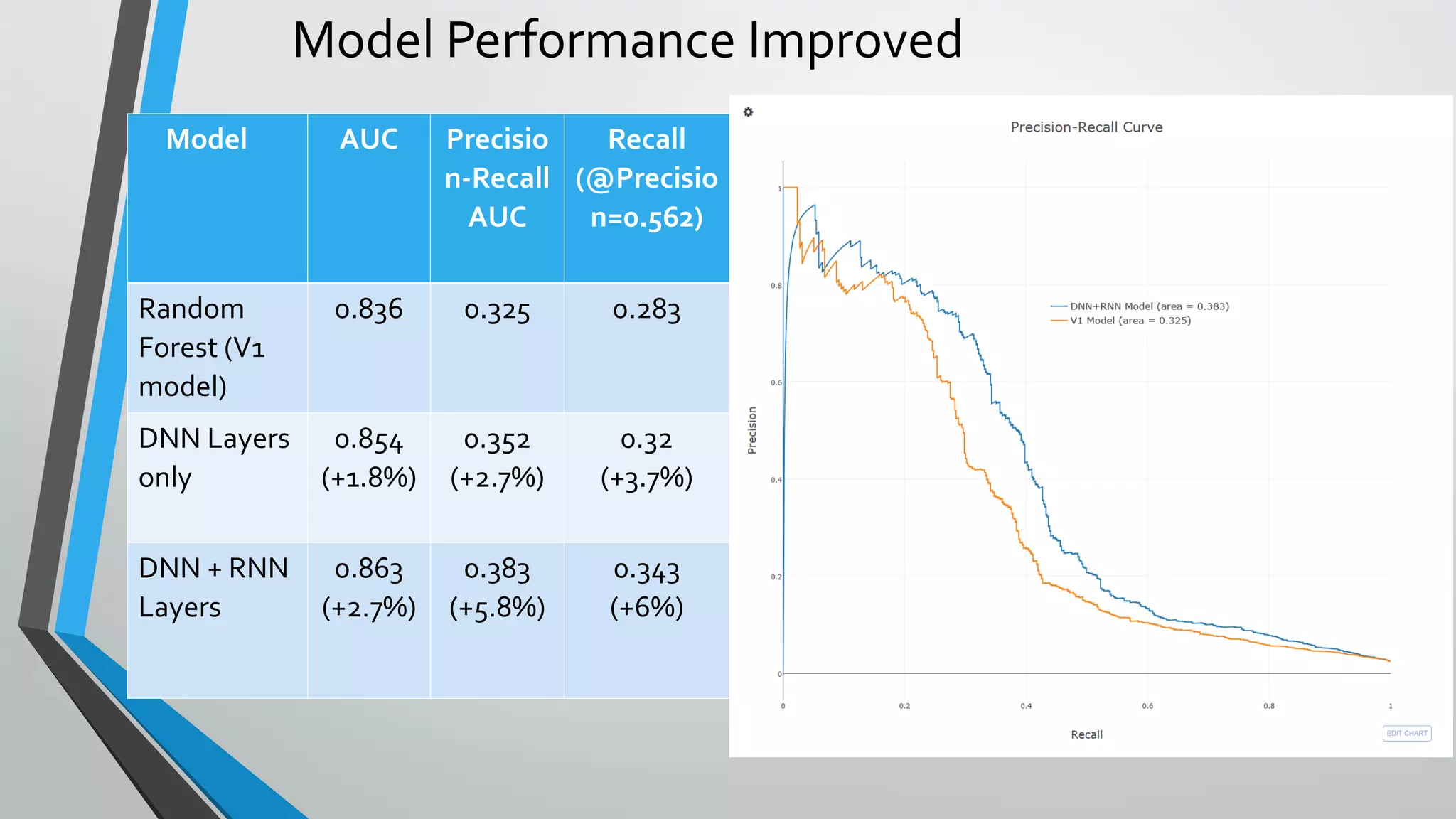
Model Performance Improved
Model AUC Precisio
n-Recall
AUC
Recall
(@Precisio
n=0.562)
Random
Forest (V1
model)
0.836 0.325 0.283
DNN Layers
only
0.854
(+1.8%)
0.352
(+2.7%)
0.32
(+3.7%)
DNN + RNN
Layers
0.863
(+2.7%)
0.383
(+5.8%)
0.343
(+6%)
Business Impact
• The payout curve shows significant
potential margin from DL model.
• Select top X percent of customer
ranked by the scores
• Apply churn intervention to these
customers
• Assume revenue per churning
customer is $m, cost of intervention
per customer is $n
• Y = Payout = total revenue saved –
total cost of intervention
• Payout of new model - Payout of old
model
Explaining Model Predictions Using LIME
Customer Usage
Data
• Time series usage
• Snapshot billing
status
Deep Learning
Model
• Deep neural
networks
• Recurrent neural
networks
Risk Scores
• Weekly scores for
all active customers
Model
Explaining
• LIME algorithms
• Explain the scores
at customer level
End Users
• Trust the model
more
• Easy to start the
conversion
• Take actions based
on churn scores
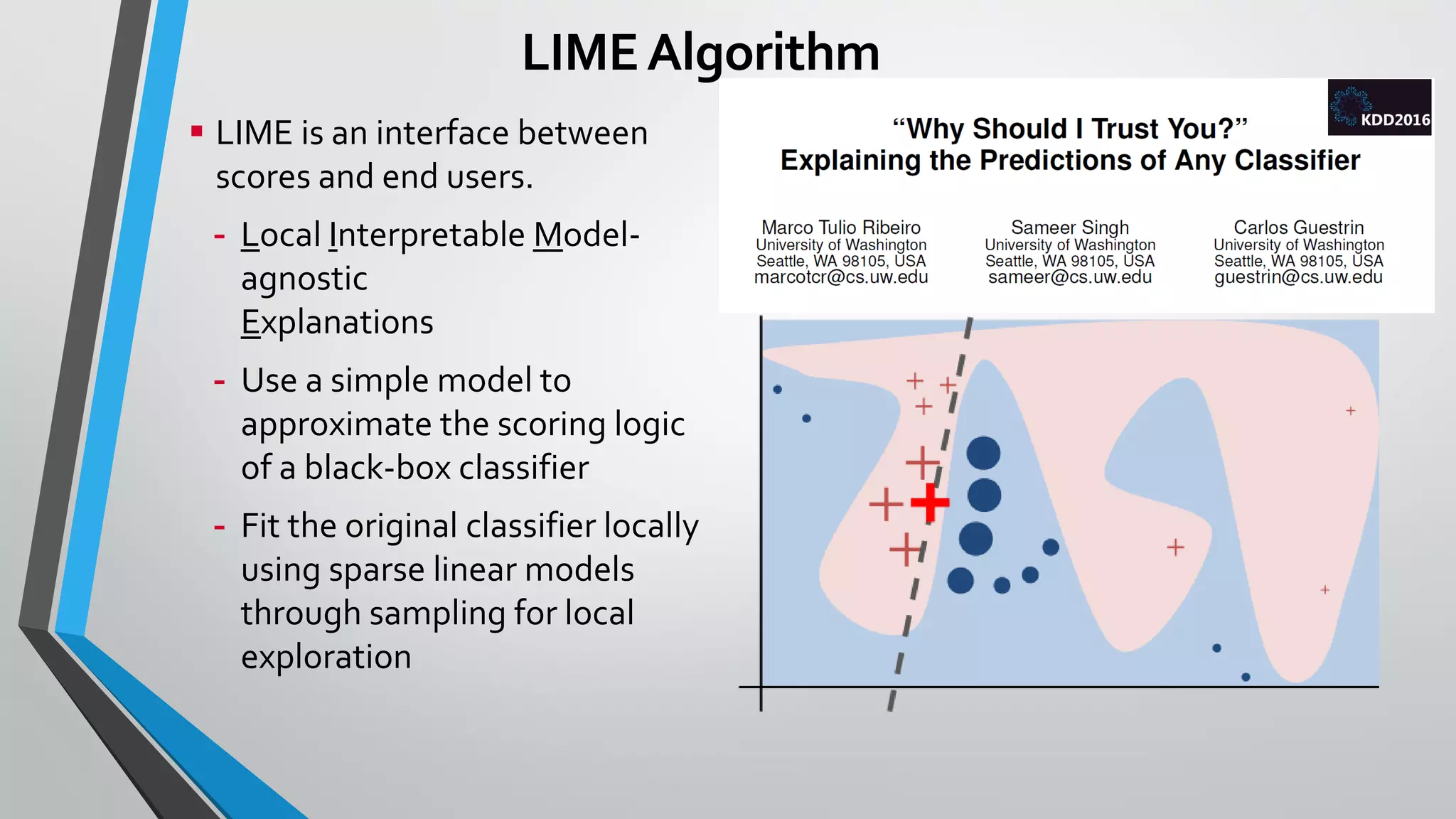
LIMEAlgorithm
 LIME is an interface between
scores and end users.
- Local Interpretable Model-
agnostic
Explanations
- Use a simple model to
approximate the scoring logic
of a black-box classifier
- Fit the original classifier locally
using sparse linear models
through sampling for local
exploration
An ExampleUsing LIME
 LIME takes a scoring function
and a test instance as input.
- Assume a model is trained
and its scoring function
(classifier.predict_pr
oba) is obtained.
- Choose a test instance
(test_example) which
needs to explain.
- A sparse linear model is built
from the perturbations of
the test instance.
- Show the coefficients as
supporting evidences of
predictions for this test
instance.
Explaining Churn Score of A Customer
 LIME can provide the evidences of
churning and reduce “information
overwhelm”
- Pick on customer for explaining
- Supporting features are shown
along with the score
- Visualize only the related time
series (out of many time series)
- End users can make informed
decisions on if they should reach
out to the customer.
Summary
Lessons Learned and Future Plans
• Lessons learned
• “In Deep Learning, Architecture Engineering is the New Feature
Engineering.”
• Quantify the business value to motivate stakeholders
• Making sense of predictions helps operationalize the model.
• Future Plans
• Explore other network architectures for faster training and higher
accuracy
• Incorporate reinforcement learning to recommend the best churn
intervention action
Thanks! Questions?

1710 track3 zhu

  • 1.
    Predicting Azure Churnwith Deep Learning and Explaining Predictions with LIME Feng Zhu (Speaker) Chao Zhong Shijing Fang Ryan Bouchard Val Fontama San Francisco May 16, 2017
  • 2.
    • Azure customersand churn • Customer data and features • Current ML pipelines and challenges • Apply deep learning to improve model performance • Explain model predictions using LIME
  • 3.
  • 4.
    Customer attrition isexpensive! Industry growth leaders (>35% YoY) spend ~40% of revenue on acquiring new customers via sales and marketing. For renewal customers, they incentivize their sales team with 7%+ commission. The fastest growing companies generate up to 40% of th revenue from upsells (avg. is 16%) with goals of <3% monthly attrition. Not all customers are acquired equallyAcquiring customers is expensive Sales & marketing spend Customer acquisition cost Source: 2015 Pacific Crest SaaS Survey (parts 1+2): http://www.forentrepreneurs.com/2015-saas-survey-part-1/
  • 5.
    A Predictive Modelfor Churn is Needed To identify customers at high risk of churning •The model outputs a ranked list of customers with the likelihood of churning •Help prioritize a list of customers for churn intervention •Help optimize resource allocation and ROI Business impact •Increase customer retention andAzure market share •Increase profitability of Azure business •Increase customer satisfaction and loyalty
  • 6.
  • 7.
    Customer and ChurnDefinitions Subscription Data Subscription Level Customer Level Customer ID 1 Subscription ID 1 Billing status data Time series usage data… Subscription ID n  Each customer can have multiple subscriptions across multiple cloud services  Most usage and billing data are generated at subscription level and then aggregated to customer level.  Two types of churns - Usage churn: No active usage in 28 days - Systems churn: Cancel all subscriptions Mar Apr May Jun
  • 8.
    Mar Apr May CustomerData and Features Snapshot Data • OfferType • Tenure Age • Segmentation Time Series Data • Overall Usage • Usage of Different Services • Free Usage Churn Labels • Usage Churn Label • System Churn Label  Customer profiles consists of two types of data. - Snapshot data (billing info) - Time series data (detailed usage info)  Use 8 weeks of snapshot and time series data to build customer feature sets.  Label customers as churn or not churn in next 4 weeks
  • 9.
    Feature Extraction fromTimeSeries Data Time Series (20+) • FreeUsage • Usage of Cloud Services • … Extraction Functions (20+) • Min Max Mean SD Median • Number of Zero Values • Slope • Sum of Last Interval Values • … Extracted Features (400+) • FreeUsage.min • TotalUnits.max • … … Customer ID 1
  • 10.
    ChurnV1 ML Pipeline CustomerData • Time series usage • Snapshot billing status Feature Engineering • Extract features from time series • Combine all features together Random Forest Model • Classification model • 400+ features Churn Risk Scores • Weekly scores for all active customers End Users • Take actions based on prediction scores 1.“Feature explosion?” – As we increase # of time series, features extracted from time series will grow exponentially. 1 2 3 3. “Should I trust model/scores?” - If end users do not trust a model or a prediction, they will not use it 2. “Squeeze more juice?” – Can we further improve the model performance?
  • 11.
    Churn V2 MLPipeline Customer Usage Data • Time series usage • Snapshot billing status Deep Learning Model • Deep neural networks • Recurrent neural networks Risk Scores • Weekly scores for all active customers Model Explaining • LIME algorithms • Explain the scores at customer level End Users • Trust the model more • Easy to start the conversion • Take actions based on churn scores 1.Deep learning model – 1) “automated” feature engineering 2) boosts prediction accuracy 1 2 2. LIME – An interface to explain model and predictions to end users
  • 12.
  • 13.
    What is DeepLearning (DL)? • Deep learning is a class of neural network based ML algorithms • Transform raw inputs through multiple layers of neural networks • “unreasonably effective” in speech/image recognition and NLP. • DL excels with unstructured data • Deep learning can be applied to many business problems. • Churn prediction • Recommender https://blogs.microsoft.com/next/2016/01/25/microsoft-releases-cntk-its-open-source-deep-learning-toolkit-on-git
  • 14.
    Overview of DLModel Architecture • The model is a “hybrid” model consisting of two types of neural networks. • Deep neural networks (DNN) layers • Takes static features as input • Fully connected MLP with add-ons • Recurrent neural networks (RNN) layers • Takes time series as input • Long ShortTerm Memory (LSTM) networks DNN Layer 1 DNN Layer 2 DNN Layer 3 DNN Layer 4 DNN Layer 5 RNN Layer 1 RNN Layer 2 Output Layer Static Feature Input Time Series Input Merge Layers DNN Layer 6 “In Deep Learning, Architecture Engineering is the New Feature Engineering.”
  • 15.
    DNN Layers (LeftPath) • Five identical DNN layers are stacked to transform static features. • Input dimension of DNN layer 1 equals input dimension of static feature input • DNN 2-5 have the same input and output dimensions • Batch normalization layer is for faster convergence and “gradient vanishing” mitigation • Highway-like structure is to mitigate “gradient vanishing” and improve accuracy • The output of DNN layers is the merged output from each layer Output Layer DNN Layer 1 … DNN Layer 5 Dense Layer Batch Normalization Activation Layer Merge Layer (concat) Static Feature Input
  • 16.
    RNN Layers (RightPath) • Two identical RNN (LSTM) layers are stacked to transform time series data. • The input dimension is 18*56. (18 time series and 56 time steps). • Each LSTM layer has 128*56 hidden states. (128 hidden nodes and 56 time steps) • Highway-like structure is also added to mitigate “gradient vanishing” and improve accuracy • The final output of RNN layers is the merged states from the last time step. h1 h2 … h5 … … … LSTM Layer 1 Time Series Input LSTM Layer 2 x1 x2 … x56
  • 17.
    Model Performance Improved ModelAUC Precisio n-Recall AUC Recall (@Precisio n=0.562) Random Forest (V1 model) 0.836 0.325 0.283 DNN Layers only 0.854 (+1.8%) 0.352 (+2.7%) 0.32 (+3.7%) DNN + RNN Layers 0.863 (+2.7%) 0.383 (+5.8%) 0.343 (+6%)
  • 18.
    Business Impact • Thepayout curve shows significant potential margin from DL model. • Select top X percent of customer ranked by the scores • Apply churn intervention to these customers • Assume revenue per churning customer is $m, cost of intervention per customer is $n • Y = Payout = total revenue saved – total cost of intervention • Payout of new model - Payout of old model
  • 19.
  • 20.
    Customer Usage Data • Timeseries usage • Snapshot billing status Deep Learning Model • Deep neural networks • Recurrent neural networks Risk Scores • Weekly scores for all active customers Model Explaining • LIME algorithms • Explain the scores at customer level End Users • Trust the model more • Easy to start the conversion • Take actions based on churn scores
  • 21.
    LIMEAlgorithm  LIME isan interface between scores and end users. - Local Interpretable Model- agnostic Explanations - Use a simple model to approximate the scoring logic of a black-box classifier - Fit the original classifier locally using sparse linear models through sampling for local exploration
  • 22.
    An ExampleUsing LIME LIME takes a scoring function and a test instance as input. - Assume a model is trained and its scoring function (classifier.predict_pr oba) is obtained. - Choose a test instance (test_example) which needs to explain. - A sparse linear model is built from the perturbations of the test instance. - Show the coefficients as supporting evidences of predictions for this test instance.
  • 23.
    Explaining Churn Scoreof A Customer  LIME can provide the evidences of churning and reduce “information overwhelm” - Pick on customer for explaining - Supporting features are shown along with the score - Visualize only the related time series (out of many time series) - End users can make informed decisions on if they should reach out to the customer.
  • 24.
  • 25.
    Lessons Learned andFuture Plans • Lessons learned • “In Deep Learning, Architecture Engineering is the New Feature Engineering.” • Quantify the business value to motivate stakeholders • Making sense of predictions helps operationalize the model. • Future Plans • Explore other network architectures for faster training and higher accuracy • Incorporate reinforcement learning to recommend the best churn intervention action
  • 26.