Beyond the Realist
Model
Realist Model
National Interests Dominate National Security
Policy-Making
States have clear unambiguous goals
Changes in leaders and institutions are
overshadowed by
national interests
Geopolitical factors
Decisions are implemented faithfully
Decision-making in the Realist
Model
Identification of major
alternative courses of
action (options)
Accurate estimation of
costs/benefits of
options
Resist premature
cognitive closure
Distinguish between
possible & probable
events
Tolerate ambiguity
Assess situation from
others‘ perspective
Distinguish between
relevant & irrelevant
information
Resist premature action
Adjust to real changes
in situation
Other Models
Based on experimental studies in psychology & sociology,
historical case analysis by historians & political scientists
Call into question the assumptions of the realist model
Leaders Matter:
Individual Psychology & Crises (Holsti)
Individual Motivations & Psychology (Allison & Halperin),
(Jervis)
Group Dynamics Matters:
Pathologies of Group Psychology (Janis)
Institutions Matter:
Organizational Behavior (Allison & Halperin)
Individual Psychology
Crisis & Stress
(Holsti)
Crisis
situation of unanticipated
threat to important values
in a restricted decision
timeframe
High threat
Short time
High uncertainty
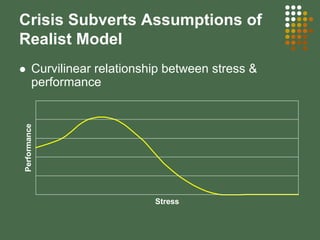
Crisis Subverts Assumptions of
Realist Model
Curvilinear relationship between stress &
performance
Stress
Performance
Stress & Performance
Time pressure is not just about clock time
complexity & importance of task
Crisis & stress acceleration of perception of time
passage
truncate search for options
resort to stereotypes of adversary & historical
metaphors for current situation
accept consonant information while filtering out
dissonant information (cognitive dissonance)
interpret ambiguous information as supporting prior
view
Stress & Performance
skews cost/benefit analysis to reinforce
preconceived assessments
Solidifyies decision-making group
Tendency to reduce “in” group size
select trusted friends & advisors (share common
values, visions, histories, perceptions, & political
fates with investment in current policies)
see JANIS for effects of this
Individual Psychology
Bureaucratic Politics
(Allison & Halperin)
Bureaucratic Politics Model
Government agenda-setting & option formulation
Driven by bargaining among hierarchically positioned
players in a policy game)
individualistic conceptions of national interests & threats
domestic political interests
personal interests
organizational interests
Awareness of existing implementing agents’ configuration,
resources, operating procedures, etc. constrains decision game
Bureaucratic Politics Model
Policy decisions follow from
Bargaining
Compromise
Decision “Action Games”
Implementation by subordinate
agencies
Cascading decisions to lower level
decision-makers
∑ decisions ≠ policy intent
Consequences
Decisions not a single rational choice
Or necessarily the “best” choice
“Mixed” motive outcome
National interests may be subordinate
to other interests
Group Think
(Janis)
Pathologies of Small Group
Decision-making
Highly cohesive small group
Isolation from larger policy making
environment
Lack of tradition of impartial/open leadership
Manifestations
Illusion of invulnerability, excessive optimism,
under-estimate risks
Unquestioned belief in group's morality,
including ethical/moral foundation of decision
Ability to discount information that might call
into question past decisions by the group
Manifestations
Stereotyping adversary as evil, weak, or
stupid and therefore not a reliable partner for
negotiation & compromise
Pressure to block deviation or dissention in
the group from consensus
Shared illusion of unanimity
Consequences
Incomplete survey of objective and alternatives
Failure to reexamine previously dismissed alternatives
Failure to fully analyze risks of preferred choice
Poor information search
Selective bias in processing information at hand
Failure to work out contingency plans
Organizational Politics
Organizations define themselves by their missions
Develop a self-image & sense of purpose
Large complex organizations need SOPs in order
to function
SOPs help large organization operate, but constrain
flexibility & innovation
Options are “build into” existing organizational missions,
routines – but not all options
Organizational SOPs & discretion can lead
implementation to differ from decision
Misperception
(Jervis)
Hypotheses
Decision-makers fit incoming information into
existing theories & images
Decision-makers often fail to realize that information
consistent with their theories may be consistent with other
views
Existing theories & images can easily resist
piecemeal flows of new information
Decision-makers often rush to judgment
Especially in the face of ambiguous information
Implementation of decisions may convey a different
message to the target than the sender intended
Hypotheses
Decision-makers tend to see the behavior of
others as more centralized, disciplined,
coordinated, and controlled than it is.
Decision-makers tend to believe that their
intentions are easily & accurately perceived

17 471 04_beyond_the_realist_model

  • 1.
  • 2.
    Realist Model National InterestsDominate National Security Policy-Making States have clear unambiguous goals Changes in leaders and institutions are overshadowed by national interests Geopolitical factors Decisions are implemented faithfully
  • 3.
    Decision-making in theRealist Model Identification of major alternative courses of action (options) Accurate estimation of costs/benefits of options Resist premature cognitive closure Distinguish between possible & probable events Tolerate ambiguity Assess situation from others‘ perspective Distinguish between relevant & irrelevant information Resist premature action Adjust to real changes in situation
  • 4.
    Other Models Based onexperimental studies in psychology & sociology, historical case analysis by historians & political scientists Call into question the assumptions of the realist model Leaders Matter: Individual Psychology & Crises (Holsti) Individual Motivations & Psychology (Allison & Halperin), (Jervis) Group Dynamics Matters: Pathologies of Group Psychology (Janis) Institutions Matter: Organizational Behavior (Allison & Halperin)
  • 5.
  • 6.
    Crisis situation of unanticipated threatto important values in a restricted decision timeframe High threat Short time High uncertainty
  • 7.
    Crisis Subverts Assumptionsof Realist Model Curvilinear relationship between stress & performance Stress Performance
  • 8.
    Stress & Performance Timepressure is not just about clock time complexity & importance of task Crisis & stress acceleration of perception of time passage truncate search for options resort to stereotypes of adversary & historical metaphors for current situation accept consonant information while filtering out dissonant information (cognitive dissonance) interpret ambiguous information as supporting prior view
  • 9.
    Stress & Performance skewscost/benefit analysis to reinforce preconceived assessments Solidifyies decision-making group Tendency to reduce “in” group size select trusted friends & advisors (share common values, visions, histories, perceptions, & political fates with investment in current policies) see JANIS for effects of this
  • 10.
  • 11.
    Bureaucratic Politics Model Governmentagenda-setting & option formulation Driven by bargaining among hierarchically positioned players in a policy game) individualistic conceptions of national interests & threats domestic political interests personal interests organizational interests Awareness of existing implementing agents’ configuration, resources, operating procedures, etc. constrains decision game
  • 12.
    Bureaucratic Politics Model Policydecisions follow from Bargaining Compromise
  • 13.
    Decision “Action Games” Implementationby subordinate agencies Cascading decisions to lower level decision-makers ∑ decisions ≠ policy intent
  • 14.
    Consequences Decisions not asingle rational choice Or necessarily the “best” choice “Mixed” motive outcome National interests may be subordinate to other interests
  • 15.
  • 16.
    Pathologies of SmallGroup Decision-making Highly cohesive small group Isolation from larger policy making environment Lack of tradition of impartial/open leadership
  • 17.
    Manifestations Illusion of invulnerability,excessive optimism, under-estimate risks Unquestioned belief in group's morality, including ethical/moral foundation of decision Ability to discount information that might call into question past decisions by the group
  • 18.
    Manifestations Stereotyping adversary asevil, weak, or stupid and therefore not a reliable partner for negotiation & compromise Pressure to block deviation or dissention in the group from consensus Shared illusion of unanimity
  • 19.
    Consequences Incomplete survey ofobjective and alternatives Failure to reexamine previously dismissed alternatives Failure to fully analyze risks of preferred choice Poor information search Selective bias in processing information at hand Failure to work out contingency plans
  • 20.
  • 21.
    Organizational Politics Organizations definethemselves by their missions Develop a self-image & sense of purpose Large complex organizations need SOPs in order to function SOPs help large organization operate, but constrain flexibility & innovation Options are “build into” existing organizational missions, routines – but not all options Organizational SOPs & discretion can lead implementation to differ from decision
  • 22.
  • 23.
    Hypotheses Decision-makers fit incominginformation into existing theories & images Decision-makers often fail to realize that information consistent with their theories may be consistent with other views Existing theories & images can easily resist piecemeal flows of new information Decision-makers often rush to judgment Especially in the face of ambiguous information Implementation of decisions may convey a different message to the target than the sender intended
  • 24.
    Hypotheses Decision-makers tend tosee the behavior of others as more centralized, disciplined, coordinated, and controlled than it is. Decision-makers tend to believe that their intentions are easily & accurately perceived