Get Homework/Assignment Done
Homeworkping.com
Homework Help
https://www.homeworkping.com/
Research Paper help
https://www.homeworkping.com/
Online Tutoring
https://www.homeworkping.com/
click here for freelancing tutoring sites
A Handbook of
Language study
for Corps Members
(Hausa)
Copy right
By
NYSC DIRECTORATE HEADQUARTERS
LAGOS
First published 1985
All right reserved. No part of this book may be reproduced, stored in
a retrieval system or transmitted in any form or by any means –
electronic, mechanical, photocopying, recording or otherwise –
without the prior permission in writing to the NYSC Directorate
Headquarters, Lagos.
FOREWORD
This language text if intended to provide, for corps members. A basic
linguistic guide to those languages spoken in the various
communities to which corps members are deployed.
The ultimate aim is not to give a comprehensive account of these
languages, but to give a snapshot of the basic vocabulary and
expressions needed by the corps members to integrate functionally
into the communities.
In furtherance of one of the cardinal objectives of the NYSC and,
more pertinently, the need and responsibility to encourage and
assist corps members in order to effectively integrate into any
cultural setting in Nigeria, texts have been developed in 10
languages. The ability to understand and speak languages other than
one’s own, especially when one has to live and work in a completely
different cultural milieu, has, undoubtedly, proved a great benefit to
man. It is expected, therefore, that corps members will utilize these
texts to benefit them immensely.
While commending these texts to corps members during the service
year, it is my hope that they will also encourage the corps members
to delve further into these languages and the cultures from which
they have grown.
PREFACE
This text is an outcome of a Language Study Workshop, organized by
the NYSC Directorate in May 1984, with participants mainly language
co-ordinators – drawn from all over the federation. The workshop
was consequent upon the trial use of our previous language texts.
The first language text published by the NYSC Directorate in 1979,
titled “Handbook of Nigerian Language – Hausa – Igbo - Yoruba”, was
written by three corps members Mr. O. B. C Nwolise, Mrs. G. M. Ojo
and Dr. Dikko.
The expressed aim of the authors of the Handbook is to particularly
meet the communication needs of corps members and foreigners
who are interested in learning the languages contained therein. This
secondary aim loomed quite large in the execution of the project as
is evidenced by the wide coverage of linguistic data of the three
target context covered in the Handbook is also wider than is really
needed by corps members, while the detailed grammatical
descriptions of each language goes beyond the scope of the learning
requirements of corps members. Experiences gained through states
(2 for each target language) confirmed these observation and
prompted the need for an abridged version tailored to the realities of
the language study programme in the orientation Camp.
In response to this expressed need and in order to ensure more
fruitful results, a committee was set up at the Directorate
Headquarters to review the original text in the light of these
experiences and recommendations from the field. The committee in
discharging its function, ensured that the selection of content is
strictly on the communicative needs of the prospective leaner.
Consequently, the extensive grammatical description of the target
language in the original Handbook was committed. Anticipating that
the learner’s use of the language will be for oral communication, the
spoken forms of the language was presented in the text. Finally, the
committee adhered more consistently to the situational approach in
the presentation of the language materials, with some illustrative
dialogues.
The Directorate also decided to print the three language into
separate texts with English as the common language to all.
What eventually evolved was the abridged version of the original
text, which was again committed to trial – use in the states during
the 1982/83 service year.
Experiences of the trial – use revealed that the content of the
abridged version even though now more suitable to the situational
needs of corps members, was rather too brief that the next was just
enough to be covered during the orientation course period.
Therefore, anticipation that corps members will need to continue
learning the language throughout the service year in the text to last
the twelve month period, it was decided at the workshop that the
content of the language texts be expended to incorporate materials
from both original Handbook and abridged version. A committee was
then assigned the task of drawing up the course content for the
language text, and what you now have is outcome of the
committee’s work.
At this juncture, it is essential to acknowledge with thanks the
immeasurable contributions of our language co-ordinators in
handling the translation of the course content into the various
language text. It is also noteworthy to mention that the enormous
task was handled free without monetary consideration, thereby
making their worthwhile contribution into the progress of the NYSC
Scheme.
We envisage that this current text will actually meet the dire needs
of corps members in the process of learning the local languages of
their states of deployment. The consequent understanding of the
local language by the corps members would undoubtedly be an
invaluable asset and would also help in fostering one of the cardinal
objectives of the NYSC which is to imbue in Nigerian youths a spirit of
selfless service to the community and to emphasize the spirit of
oneness and brotherhood of all Nigerians, irrespective of cultural
background.
F.N BALOGUN (MRS.) & A.K SOMEFUN (MR.)
PLANNING & EVALUATION DIVISION
N.Y.S.C DIRECTORATE HEADQUARTERS, LAGOS.
CONTENTS
Forward
Preface
CHAPTER 1
1. A BRIEF HISTORY OF HAUSA SPEAKING PEOPLE
2. Cultural Background
3. Dress
4. Religion
5. Family life
6. Housing
7. Occupation 2 – 1
CHAPTER 2
GREETINGS & INITIAL COMMUNICATION
SECTION A – GREETINGS
1. Morning
2. Afternoon
3. Evening
4. Night
5. Reception
6. Farewell
7. Greeting the worker
8. Greeting the Successful
9. Casual Greetings
10. Asking about members of the family 3 – 6
SECTION B – Hausa GREETINGS SITUATION TO BE USED
CHAPTER 3
MAKING ENQUIRIES REQUEST & SEEKING INFORMATION
7 – 11
CHAPTER 4
CARDINAL NUMERALS – ORDIAL NUMERALS 12 – 16
Counting of money
Counting of things
CHAPTER 5
TELLING TIME, DAY & WEEK
A. Nouns related to time and period
B. Time in hours
C. Days of the week
D. Months
E. Years 17 - 18
MARKET TRANSACTIONS
CHAPTER 6
A. NAMES OF DIFFERENT FOOD ITEMS AND SOUP INGRIDENTS
19 - 21
B. Sellers
C. Number and amount to aid pricing
D. Interaction in the market and possible Conversation.
CHAPTER 7
NAMES OF DIFFERENT KINDS OF TRANSPORT AND NOUNS RELATED
TO TRAVELING 22 - 23
1. Possible Conversation when negotiating for taxi
2. Informing neighbours about and intended journey
3. Finding your way
4. Boarding a vehicle
5. Cautioning the driver
CHAPTER 8
DINNING SITUATION SOME DINNING RELATED NOUNS
Possible Conversation asking for food
Asking for water
Other request
Substitution table to aid practice
Asking for drinks
Invitation to dinning 24 – 26
CHAPTER 9
EMOTIONAL EXPRESSIONS
Appeals and warning
Disapprovals
Warm words 27 - 28
CHAPTER 10
SIMPLE SENTENCES ON EVERY DAY EVENTS IDIOMS AND PROVERBS
29 – 30
APPENDIX 1
Alphabets 31 – 36
Capital letters A B C…………Z
Small letters a b c…………..z
APPENDIX 11
a. Nouns related to human body
b. Nouns related to the home
c. Nouns related to schools
d. Nouns related to animals
e. Nouns related to human relations
f. Nouns related to climate and whether
g. Nouns related to religion
h. verbs are words that enable us to make assertions personal
nouns
CHAPTER 1
A BRIEF HISTORY OF HAUSA SPEAKING PEOPLE
It is difficult to narrate the history of Hausa speaking people
comprehensively in a short chapter of this nature. However, efforts
will be made to only bring to light the salient points that will make
and introduce the reader to the background of Hausa language and
its speakers.
The Hausa speaking can be said to form the majority of the
people inhabiting Nigeria’s most northern states with concentration
in Kano, Kaduna and Sokoto States. It must, however, be noted that
in common with other people of the Sudan, it is difficult to trace the
true origin of the Hausa people, even though many attempts by
historians were made to explain through traditions, their origin.
Whatever the case, it is certain that at the present location of Kano
city, the capital of an Hausa city-state bearing the same name, there
existed a flourishing sedentary community by about 635 A.D. This is
further confirmed by the presence of an iron – working furnace from
that community’s civilization. Be that as it may, most traditions have
ascribed the origin of the Hausa states to the marriage of an old
legendary hero, a certain Bayajidda Prince of Baghdad, to certain
pre-historic Queen of Daura and their offsprings are said to have
founded the authentic seven Hausa states (Hausa Bakwai).
Going by the various traditions especially of the above legend,
the founders of the seven Hausa states were all direct desendants of
Bayajidda. Biram, the son of Bayajidda by a certain princess of Borno
is said to have founded a ruling dynasty; while Bawo, the son from
the cohabitation of Bayajidda and the famous Queen of Daura, is said
to have resulted into fathering the founders of the remaining
dynasties. By all means, our source of information on the origin of
the said city states is limited as history can only talk much on few of
the city states namely:- Gobin, Daura, Zazzau or Zaria, Kastina and
Kano.
It is interesting to note that besides the legend pertaining to
the original authentic Hausa Bakwai, there is another tradition that
tries to explain the origin of the so called un-authentic seven Hausa
states or popularly known as Banza Bakwai namely:- Zamfara, Kebbi,
Nupe, Gwari, Yawuri, Yoruba; and Kororofa. It is by all means
suggested that despite these rationalized traditions the Hausa
people seemed to have been the result of the arrival and gradual
integration of waves of immigrants into an indigenous community or
communities. It must be admitted that the rise in farming and other
professional associations led to the foundation of villages which later
on developed into walled cities – a prominent feature of most cities
in the northern states.
Whatever interpretation one might give the Hausa speaking
people; they are and can be found all over the country practicing one
profession or another and thereby spreading their language. Hausa is
said to be the most widely spoken language in Africa and perhaps
this is a lie.
CULTURAL BACKGROUND
The Hausa speaking people have a mode of life which is
perculiar to them as an entity. Perhaps it is right to point out the fact
that the people are very much tied to their culture that wherever
they are seen, their life pattern is almost not easily dispensed with
moves with them.
DRESS
The typical Hausa dressing consists of a big gown, jumper and a
cap for the men and a wrapper, a headtie and a shawl thrown over
the shoulders for the women. This is particularly borne out of the
ethic of the muslim religion which preaches against any form of
exposure of the body by women.
In addition to this, the typical Hausa woman weaves her hair in
the local fashion with all the simplicities in attendance.
RELIGION
Islam is the dominant religion practised by the Hausas.
Consequently, majority are Moslems although a very small
percentage are Christians. Religion plays an important part in the
lifestyle of the Hausas. The norms and principles of Islam influences
the behavioural pattern of the people. This may be the reason why
they are very much dedicated to their religion.
FAMILY LIFE
Basically, the husband (Maigida) is the head of the household.
He controls and directs the affairs of the home. The typical Hausa
home is a polygamous one. This again is tied to one of the doctrines
of the religion which allows the man to marry as many as four
women so long as he can cater for them.
The extended family system is also a way of life of the people
although this is also applicable to other ethnic groups.
HOUSING
The most prevalent type of houses inhabited by the people are
mainly round hunts with thatched roofs or flat tops as the case may
be. This is to shield off the effect of the scorching sun, as the
environment is a hot one.
OCCUPATION
The Hausa people are generally industrious and engage in a
number of professions as evidence in our major town and villages
where they are found. These professions include farming, fishing,
hunting, blacksmithing, carpentry, pottery, leather works, weaving
and a host of others. They are also good horse riders
Generally, the Hausas are a peaceful and rather hospitable
people who are usually prepared to socialize with people from other
ethnic groups. This has made it possible for the language to spread
far and wide and thus fast becoming widely spoken.
CHAPTER 2
GREETINGS AND INITIAL COMMUNICATION
SECTION A: GREETINGS
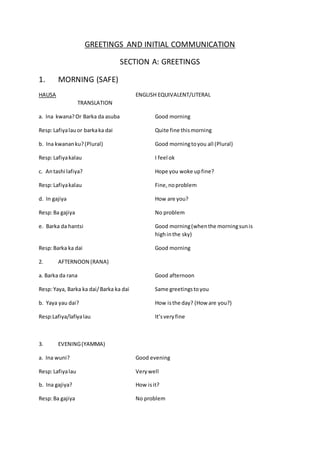
1. MORNING (SAFE)
HAUSA ENGLISH EQUIVALENT/LITERAL
TRANSLATION
a. Ina kwana?Or Barka da asuba Good morning
Resp:Lafiyalauor barkaka dai Quite fine thismorning
b. Ina kwananku?(Plural) Good morningtoyou all (Plural)
Resp:Lafiyakalau I feel ok
c. Antashi lafiya? Hope you woke upfine?
Resp:Lafiyakalau Fine,noproblem
d. In gajiya How are you?
Resp:Ba gajiya No problem
e. Barka da hantsi Good morning(whenthe morningsunis
highinthe sky)
Resp:Barka ka dai Good morning
2. AFTERNOON (RANA)
a. Barka da rana Good afternoon
Resp:Yaya, Barka ka dai/Barka ka dai Same greetingstoyou
b. Yaya yau dai? How isthe day? (How are you?)
Resp:Lafiya/lafiyalau It’sveryfine
3. EVENING(YAMMA)
a. Ina wuni? Good evening
Resp:Lafiyalau Verywell
b. Ina gajiya? How isit?
Resp:Ba gajiya No problem
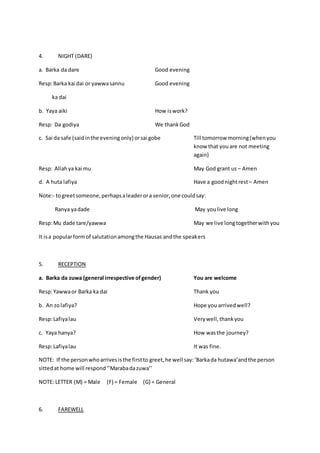
4. NIGHT (DARE)
a. Barka da dare Good evening
Resp:Barka kai dai or yawwasannu Good evening
ka dai
b. Yaya aiki How iswork?
Resp: Da godiya We thankGod
c. Sai da safe (saidinthe eveningonly) orsai gobe Till tomorrow morning(whenyou
know that youare not meeting
again)
Resp: Allahya kai mu May God grant us – Amen
d. A huta lafiya Have a goodnightrest – Amen
Note:- togreetsomeone,perhapsaleaderora senior,one couldsay:
Ranya yadade May youlive long
Resp:Mu dade tare/yawwa May we live longtogetherwithyou
It isa popularformof salutationamongthe Hausas andthe speakers
5. RECEPTION
a. Barka da zuwa (general irrespective ofgender) You are welcome
Resp:Yawwaor Barka ka dai Thank you
b. An zolafiya? Hope you arrivedwell?
Resp:Lafiyalau Verywell,thankyou
c. Yaya hanya? How wasthe journey?
Resp:Lafiyalau It was fine.
NOTE: If the personwhoarrivesisthe firstto greet,he well say:‘Barkada hutawa’andthe person
sittedat home will respond‘’Marabadazuwa’’
NOTE: LETTER (M) = Male (F) = Female (G) = General
6. FAREWELL
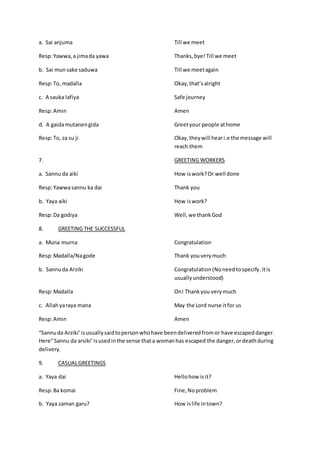
a. Sai anjuma Till we meet
Resp:Yawwa,a jimada yawa Thanks,bye! Till we meet
b. Sai munsake saduwa Till we meetagain
Resp:To, madalla Okay,that’salright
c. A sauka lafiya Safe journey
Resp:Amin Amen
d. A gaidamutanengida Greetyour people athome
Resp:To, za su ji Okay,theywill heari.e the message will
reach them
7. GREETING WORKERS
a. Sannu da aiki How iswork?Or well done
Resp:Yawwasannu ka dai Thank you
b. Yaya aiki How iswork?
Resp:Da godiya Well,we thankGod
8. GREETING THE SUCCESSFUL
a. Muna murna Congratulation
Resp:Madalla/Nagode Thank youverymuch
b. Sannuda Arziki Congratulation(Noneedtospecify.Itis
usuallyunderstood)
Resp:Madalla On! Thank you verymuch
c. Allahyaraya mana May the Lord nurse itfor us
Resp:Amin Amen
“Sannuda Arziki’isusuallysaidtopersonwhohave beendeliveredfromor have escapeddanger.
Here”Sannu da arsiki’isusedinthe sense thata womanhas escaped the danger,ordeathduring
delivery.
9. CASUALGREETINGS
a. Yaya dai Hellohow isit?
Resp:Ba komai Fine,Noproblem
b. Yaya zaman garu? How islife intown?
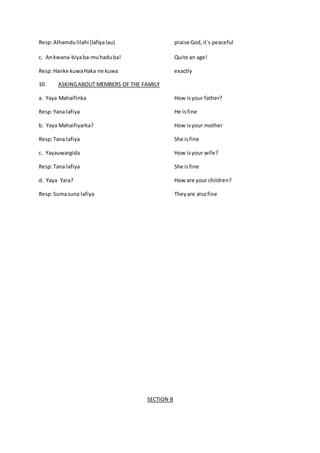
Resp:Alhamdulilahi (lafiyalau) praise God,it`s peaceful
c. Ankwana-biyaba-muhaduba! Quite an age!
Resp:Hanke kuwaHaka ne kuwa exactly
10. ASKINGABOUT MEMBERS OF THE FAMILY
a. Yaya Mahaifinka How isyour father?
Resp:Yana lafiya He isfine
b. Yaya Mahaifiyarka? How isyour mother
Resp:Tana lafiya She isfine
c. Yayauwargida How isyour wife?
Resp:Tana lafiya She isfine
d. Yaya Yara? How are your children?
Resp:Sumasuna lafiya Theyare alsofine
SECTION B
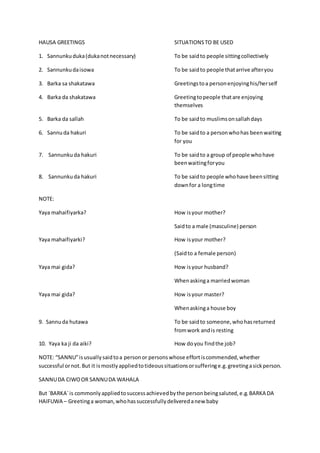
HAUSA GREETINGS SITUATIONSTO BE USED
1. Sannunkuduka(dukanotnecessary) To be saidto people sittingcollectively
2. Sannunkudaisowa To be saidto people thatarrive afteryou
3. Barka sa shakatawa Greetingstoa personenjoyinghis/herself
4. Barka da shakatawa Greetingtopeople thatare enjoying
themselves
5. Barka da sallah To be saidto muslimsonsallahdays
6. Sannuda hakuri To be saidto a personwhohas beenwaiting
for you
7. Sannunku da hakuri To be saidto a group of people whohave
beenwaitingforyou
8. Sannunkuda hakuri To be saidto people whohave beensitting
downfor a longtime
NOTE:
Yaya mahaifiyarka? How isyour mother?
Saidto a male (masculine) person
Yaya mahaifiyarki? How isyour mother?
(Saidto a female person)
Yaya mai gida? How isyour husband?
Whenaskinga marriedwoman
Yaya mai gida? How isyour master?
Whenaskinga house boy
9. Sannuda hutawa To be saidto someone,whohasreturned
fromwork andis resting
10. Yaya ka ji da aiki? How doyou findthe job?
NOTE: “SANNU”isusuallysaidtoa personor personswhose effortiscommended,whether
successful ornot.But it ismostlyappliedtotideoussituationsorsufferinge.g.greetingasickperson.
SANNUDA CIWOOR SANNUDA WAHALA
But `BARKA`is commonlyappliedtosuccessachievedbythe personbeingsaluted,e.g.BARKA DA
HAIFUWA – Greetinga woman,whohassuccessfullydeliveredanew baby
Sannunkuisusedforplural
Sannuis forsingular/andalsogeneral
Sannunkaisusedfor(masculine)gender
Sannunki isusedfor(feminine) gender
The RESPONSEto these situationsissimplySANNUKA DAI
CHAPTER 3
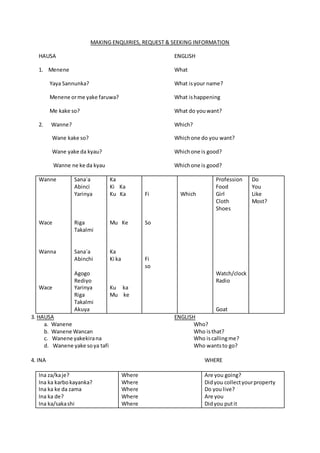
MAKING ENQUIRIES, REQUEST & SEEKING INFORMATION
HAUSA ENGLISH
1. Menene What
Yaya Sannunka? What isyour name?
Menene orme yake faruwa? What ishappening
Me kake so? What do youwant?
2. Wanne? Which?
Wane kake so? Whichone do you want?
Wane yake da kyau? Whichone is good?
Wanne ne ke da kyau Whichone is good?
Wanne
Wace
Wanna
Wace
Sana`a
Abinci
Yarinya
Riga
Takalmi
Sana`a
Abinchi
Agogo
Rediyo
Yarinya
Riga
Takalmi
Akuya
Ka
Ki Ka
Ku Ka
Mu Ke
Ka
Ki ka
Ku ka
Mu ke
Fi
So
Fi
so
Which
Profession
Food
Girl
Cloth
Shoes
Watch/clock
Radio
Goat
Do
You
Like
Most?
3. HAUSA ENGLISH
a. Wanene Who?
b. Wanene Wancan Who isthat?
c. Wanene yakekirana Who iscallingme?
d. Wanene yake soya tafi Who wantsto go?
4. INA WHERE
Ina za/kaje?
Ina ka karbokayanka?
Ina ka ke da zama
Ina ka de?
Ina ka/sakashi
Where
Where
Where
Where
Where
Are you going?
Didyou collectyourproperty
Do you live?
Are you
Didyou putit
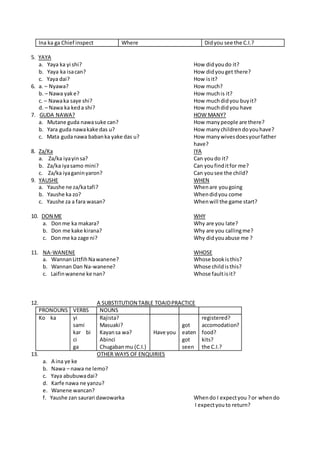
Ina ka ga Chief inspect Where Didyou see the C.I.?
5. YAYA
a. Yaya ka yi shi? How didyoudo it?
b. Yaya ka isacan? How didyouget there?
c. Yaya dai? How isit?
6. a. – Nyawa? How much?
b. – Nawa yake? How muchis it?
c. – Nawaka saye shi? How muchdidyou buyit?
d. – Nawa ka keda shi? How muchdidyou have
7. GUDA NAWA? HOW MANY?
a. Mutane guda nawasuke can? How manypeople are there?
b. Yara guda nawakake das u? How many childrendoyouhave?
c. Mata gudanawa babanka yake das u? How manywivesdoesyourfather
have?
8. Za/Ka IYA
a. Za/ka iyayinsa? Can youdo it?
b. Za/ka iyasamo mini? Can youfinditfor me?
c. Za/ka iyaganinyaron? Can yousee the child?
9. YAUSHE WHEN
a. Yaushe ne za/katafi? Whenare yougoing
b. Yaushe ka zo? Whendidyou come
c. Yaushe za a fara wasan? Whenwill the game start?
10. DON ME WHY
a. Donme ka makara? Why are you late?
b. Don me kake kirana? Why are you callingme?
c. Don me ka zage ni? Why didyouabuse me ?
11. NA-WANENE WHOSE
a. WannanLittfihNawanene? Whose bookisthis?
b. Wannan Dan Na-wanene? Whose childisthis?
c. Laifinwanene ke nan? Whose faultisit?
12. A SUBSTITUTION TABLE TOAIDPRACTICE
PRONOUNS VERBS NOUNS
Ko ka yi
sami
kar bi
ci
ga
Rajista?
Masuaki?
Kayansa wa?
Abinci
Chugabanmu (C.I.)
Have you
got
eaten
got
seen
registered?
accomodation?
food?
kits?
the C.I.?
13. OTHER WAYS OF ENQUIRIES
a. A ina ye ke
b. Nawa – nawa ne lemo?
c. Yaya abubuwadai?
d. Karfe nawa ne yanzu?
e. Wanene wancan?
f. Yaushe zan saurari dawowarka Whendo I expectyou ?or whendo
I expectyouto return?
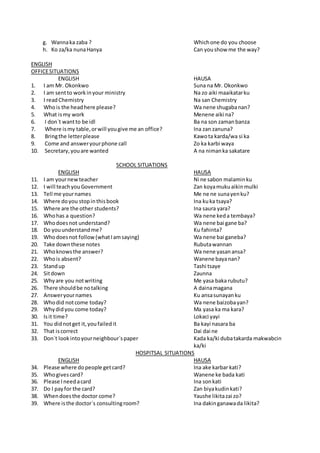
g. Wannaka zaba ? Whichone do you choose
h. Ko za/ka nunaHanya Can youshow me the way?
ENGLISH
OFFICESITUATIONS
ENGLISH HAUSA
1. I am Mr. Okonkwo Suna na Mr. Okonkwo
2. I am sentto workinyour ministry Na zo aiki maaikatarku
3. I readChemistry Na san Chemistry
4. Whois the headhere please? Wa nene shugabanan?
5. What ismy work Menene aiki na?
6. I don`t wantto be idl Ba na son zaman banza
7. Where ismy table,orwill yougive me an office? Ina zan zanuna?
8. Bringthe letterplease Kawota karda/wa si ka
9. Come and answeryourphone call Zo ka karbi waya
10. Secretary,youare wanted A na nimanka sakatare
SCHOOL SITUATIONS
ENGLISH HAUSA
11. I am yournewteacher Ni ne sabon malaminku
12. I will teachyouGovernment Zan koyamukuaikinmulki
13. Tell me yournames Me ne ne sunayenku?
14. Where doyou stopinthisbook Ina kuka tsaya?
15. Where are the other students? Ina saura yara?
16. Whohas a question? Wa nene keda tembaya?
17. Whodoesnot understand? Wa nene bai gane ba?
18. Do youunderstandme? Ku fahinta?
19. Whodoesnot follow(whatIamsaying) Wa nene bai ganeba?
20. Take down these notes Rubutawannan
21. Whoknowsthe answer? Wa nene yasanansa?
22. Whois absent? Wanene bayanan?
23. Standup Tashi tsaye
24. Sitdown Zaunna
25. Whyare you notwriting Me yasa baka rubutu?
26. There shouldbe notalking A dainamagana
27. Answeryournames Ku ansasunayanku
28. Whodid notcome today? Wa nene baizobayan?
29. Whydidyou come today? Ma yasa ka ma kara?
30. Isit time? Lokaci yayi
31. You didnotget it,youfailedit Ba kayi nasara ba
32. That iscorrect Dai dai ne
33. Don`t lookintoyourneighbour`spaper Kada ka/ki dubatakarda makwabcin
ka/ki
HOSPITSAL SITUATIONS
ENGLISH HAUSA
34. Please where dopeople getcard? Ina ake karbar kati?
35. Whogivescard? Wanene ke bada kati
36. Please Ineedacard Ina sonkati
37. Do I payfor the card? Zan biyakudinkati?
38. Whendoesthe doctor come? Yaushe likitazai zo?
39. Where isthe doctor`s consultingroom? Ina dakinganawada likita?
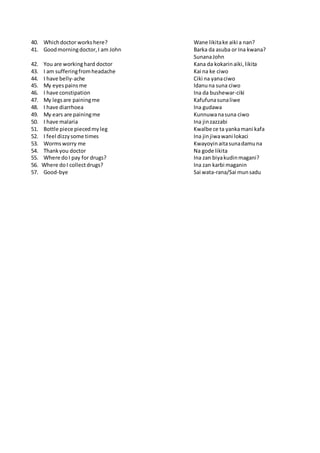
40. Whichdoctor workshere? Wane likitake aiki a nan?
41. Goodmorningdoctor,I am John Barka da asuba or Ina kwana?
SunanaJohn
42. You are workinghard doctor Kana da kokarinaiki,likita
43. I am sufferingfromheadache Kai na ke ciwo
44. I have belly-ache Ciki na yanaciwo
45. My eyespainsme Idanuna suna ciwo
46. I have constipation Ina da bushewar-ciki
47. My legsare painingme Kafufunasunaliwe
48. I have diarrhoea Ina gudawa
49. My ears are painingme Kunnuwanasuna ciwo
50. I have malaria Ina jinzazzabi
51. Bottle piece piecedmyleg Kwalbe ce ta yankamani kafa
52. I feel dizzysome times Ina jinjiwawani lokaci
53. Wormsworry me Kwayoyinaitasunadamuna
54. Thankyou doctor Na gode likita
55. Where do I pay for drugs? Ina zan biyakudinmagani?
56. Where doI collectdrugs? Ina zan karbi maganin
57. Good-bye Sai wata-rana/Sai munsadu
CHAPTER FOUR
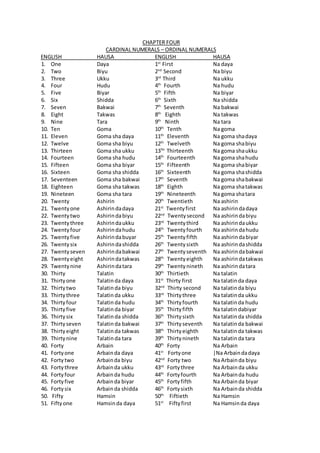
CARDINAL NUMERALS – ORDINAL NUMERALS
ENGLISH HAUSA ENGLISH HAUSA
1. One Daya 1st
First Na daya
2. Two Biyu 2nd
Second Na biyu
3. Three Ukku 3rd
Third Na ukku
4. Four Hudu 4th
Fourth Na hudu
5. Five Biyar 5th
Fifth Na biyar
6. Six Shidda 6th
Sixth Na shidda
7. Seven Bakwai 7th
Seventh Na bakwai
8. Eight Takwas 8th
Eighth Na takwas
9. Nine Tara 9th
Ninth Na tara
10. Ten Goma 10th
Tenth Na goma
11. Eleven Goma sha daya 11th
Eleventh Na goma shadaya
12. Twelve Goma sha biyu 12th
Twelveth Na goma shabiyu
13. Thirteen Goma sha ukku 13TH
Thirteenth Na goma shaukku
14. Fourteen Goma sha hudu 14th
Fourteenth Na goma shahudu
15. Fifteen Goma sha biyar 15th
Fifteenth Na goma shabiyar
16. Sixteen Goma sha shidda 16th
Sixteenth Na goma shashidda
17. Seventeen Goma sha bakwai 17th
Seventh Na goma shabakwai
18. Eighteen Goma sha takwas 18th
Eighth Na goma shatakwas
19. Nineteen Goma sha tara 19th
Nineteenth Na goma shatara
20. Twenty Ashirin 20th
Twentieth Na ashirin
21. Twentyone Ashirindadaya 21st
Twentyfirst Na ashirindadaya
22. Twentytwo Ashirindabiyu 22nd
Twentysecond Na ashirindabiyu
23. Twentythree Ashirindaukku 23rd
Twentythird Na ashirindaukku
24. Twentyfour Ashirindahudu 24th
Twentyfourth Na ashirindahudu
25. Twentyfive Ashirindabuyar 25th
Twentyfifth Na ashirindabiyar
26. Twentysix Ashirindashidda 26th
Twentysixth Na ashirindashidda
27. Twentyseven Ashirindabakwai 27th
Twentyseventh Na ashirindabakwai
28. Twentyeight Ashirindatakwas 28th
Twentyeighth Na ashirindatakwas
29. Twentynine Ashirindatara 29th
Twenty nineth Na ashirindatara
30. Thirty Talatin 30th
Thirtieth Na talatin
31. Thirtyone Talatinda daya 31st
Thirty first Na talatinda daya
32. Thirtytwo Talatinda biyu 32nd
Thirty second Na talatinda biyu
33. Thirtythree Talatinda ukku 33rd
Thirtythree Na talatinda ukku
34. Thirtyfour Talatinda hudu 34th
Thirtyfourth Na talatinda hudu
35. Thirtyfive Talatinda biyar 35th
Thirtyfifth Na talatindabiyar
36. Thirtysix Talatinda shidda 36th
Thirtysixth Na talatin da shidda
37. Thirtyseven Talatinda bakwai 37th
Thirtyseventh Na talatinda bakwai
38. Thirtyeight Talatinda takwas 38th
Thirtyeighth Na talatinda takwas
39. Thirtynine Talatinda tara 39th
Thirtynineth Na talatinda tara
40. Forty Arbain 40th
Forty Na Arbain
41. Fortyone Arbainda daya 41st
Fortyone |Na Arbaindadaya
42. Fortytwo Arbainda biyu 42nd
Forty two Na Arbainda biyu
43. Fortythree Arbainda ukku 43rd
Fortythree Na Arbainda ukku
44. Fortyfour Arbainda hudu 44th
Fortyfourth Na Arbainda hudu
45. Fortyfive Arbainda biyar 45th
Fortyfifth Na Arbainda biyar
46. Fortysix Arbainda shidda 46th
Fortysixth Na Arbainda shidda
50. Fifty Hamsin 50th
Fiftieth Na Hamsin
51. Fifty one Hamsinda daya 51st
Fiftyfirst Na Hamsinda daya
52. Fifty two Hamsinda biyu 52nd
Fiftysecond Na Hamsinda biyu
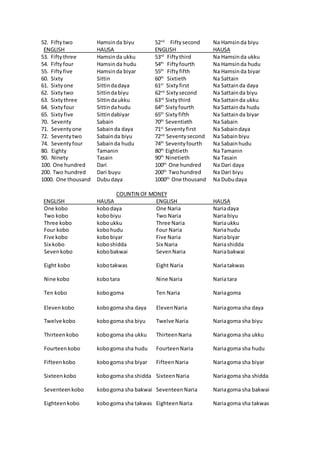
ENGLISH HAUSA ENGLISH HAUSA
53. Fifty three Hamsinda ukku 53rd
Fiftythird Na Hamsinda ukku
54. Fifty four Hamsinda hudu 54th
Fiftyfourth Na Hamsinda hudu
55. Fifty five Hamsinda biyar 55th
Fiftyfifth Na Hamsinda biyar
60. Sixty Sittin 60th
Sixtieth Na Sattain
61. Sixtyone Sittindadaya 61st
Sixtyfirst Na Sattainda daya
62. Sixtytwo Sittindabiyu 62nd
Sixtysecond Na Sattainda biyu
63. Sixtythree Sittindaukku 63rd
Sixtythird Na Sattainda ukku
64. Sixtyfour Sittindahudu 64th
Sixtyfourth Na Sattainda hudu
65. Sixtyfive Sittindabiyar 65th
Sixtyfifth Na Sattainda biyar
70. Seventy Sabain 70th
Seventieth Na Sabain
71. Seventyone Sabainda daya 71st
Seventyfirst Na Sabaindaya
72. Seventytwo Sabainda biyu 72nd
Seventysecond Na Sabainbiyu
74. Seventyfour Sabainda hudu 74th
Seventyfourth Na Sabainhudu
80. Eighty Tamanin 80th
Eightieth Na Tamanin
90. Ninety Tasain 90th
Ninetieth Na Tasain
100. One hundred Dari 100th
One hundred Na Dari daya
200. Two hundred Dari buyu 200th
Twohundred Na Dari biyu
1000. One thousand Dubudaya 1000th
One thousand Na Dubudaya
COUNTIN OF MONEY
ENGLISH HAUSA ENGLISH HAUSA
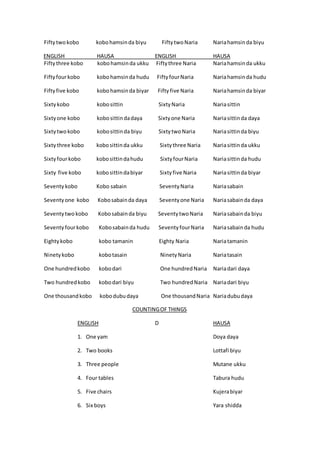
One kobo kobodaya One Naria Nariadaya
Two kobo kobobiyu Two Naria Nariabiyu
Three kobo koboukku Three Naria Nariaukku
Four kobo kobohudu Four Naria Nariahudu
Five kobo kobobiyar Five Naria Nariabiyar
Six kobo koboshidda Six Naria Nariashidda
Sevenkobo kobobakwai SevenNaria Nariabakwai
Eight kobo kobotakwas Eight Naria Nariatakwas
Nine kobo kobotara Nine Naria Nariatara
Ten kobo kobogoma Ten Naria Nariagoma
Elevenkobo kobogoma sha daya ElevenNaria Nariagoma sha daya
Twelve kobo kobogoma sha biyu Twelve Naria Nariagoma sha biyu
Thirteenkobo kobogoma sha ukku ThirteenNaria Nariagoma sha ukku
Fourteenkobo kobogoma sha hudu FourteenNaria Nariagoma sha hudu
Fifteenkobo kobogoma sha biyar FifteenNaria Nariagoma sha biyar
Sixteenkobo kobogoma sha shidda SixteenNaria Nariagoma sha shidda
Seventeenkobo kobogoma sha bakwai Seventeen Naria Nariagoma sha bakwai
Eighteenkobo kobogoma sha takwas EighteenNaria Nariagoma sha takwas
Nineteenkobo kobogoma sha tara NineteenNaria Nariagoma sha tara
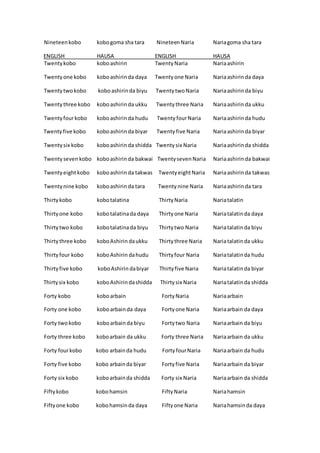
ENGLISH HAUSA ENGLISH HAUSA
Twentykobo koboashirin Twenty Naria Nariaashirin
Twentyone kobo koboashirinda daya Twenty one Naria Nariaashirinda daya
Twentytwokobo koboashirinda biyu Twenty twoNaria Nariaashirinda biyu
Twentythree kobo koboashirinda ukku Twentythree Naria Nariaashirinda ukku
Twentyfourkobo koboashirinda hudu Twenty fourNaria Nariaashirinda hudu
Twentyfive kobo koboashirinda biyar Twenty five Naria Nariaashirinda biyar
Twentysix kobo koboashirin da shidda Twenty six Naria Nariaashirinda shidda
Twentyseven kobo koboashirin da bakwai Twenty sevenNaria Nariaashirinda bakwai
Twentyeightkobo koboashirin da takwas Twenty eightNaria Nariaashirinda takwas
Twentynine kobo koboashirin da tara Twenty nine Naria Nariaashirinda tara
Thirtykobo kobotalatina ThirtyNaria Nariatalatin
Thirtyone kobo kobotalatinada daya Thirtyone Naria Nariatalatinda daya
Thirtytwo kobo kobotalatinada biyu Thirtytwo Naria Nariatalatinda biyu
Thirtythree kobo koboAshirin daukku Thirtythree Naria Nariatalatinda ukku
Thirtyfour kobo koboAshirin dahudu Thirtyfour Naria Nariatalatinda hudu
Thirtyfive kobo koboAshirin dabiyar Thirtyfive Naria Nariatalatinda biyar
Thirtysix kobo koboAshirin dashidda Thirtysix Naria Nariatalatinda shidda
Forty kobo koboarbain FortyNaria Nariaarbain
Forty one kobo koboarbainda daya Fortyone Naria Nariaarbain da daya
Forty two kobo koboarbainda biyu Fortytwo Naria Nariaarbain da biyu
Forty three kobo koboarbain da ukku Forty three Naria Nariaarbain da ukku
Forty fourkobo kobo arbainda hudu FortyfourNaria Nariaarbain da hudu
Forty five kobo kobo arbainda biyar Fortyfive Naria Nariaarbain da biyar
Forty six kobo koboarbainda shidda Forty six Naria Nariaarbain da shidda
Fiftykobo kobohamsin FiftyNaria Nariahamsin
Fiftyone kobo kobohamsinda daya Fiftyone Naria Nariahamsinda daya
Fiftytwokobo kobohamsinda biyu FiftytwoNaria Nariahamsinda biyu
ENGLISH HAUSA ENGLISH HAUSA
Fiftythree kobo kobohamsinda ukku Fiftythree Naria Nariahamsinda ukku
Fiftyfourkobo kobohamsinda hudu FiftyfourNaria Nariahamsinda hudu
Fiftyfive kobo kobohamsinda biyar Fiftyfive Naria Nariahamsinda biyar
Sixtykobo kobosittin SixtyNaria Nariasittin
Sixtyone kobo kobosittindadaya Sixtyone Naria Nariasittinda daya
Sixtytwokobo kobosittinda biyu SixtytwoNaria Nariasittinda biyu
Sixtythree kobo kobosittinda ukku Sixtythree Naria Nariasittinda ukku
Sixtyfourkobo kobosittindahudu SixtyfourNaria Nariasittinda hudu
Sixty five kobo kobosittindabiyar Sixtyfive Naria Nariasittinda biyar
Seventy kobo Kobo sabain SeventyNaria Nariasabain
Seventyone kobo Kobosabainda daya Seventyone Naria Nariasabainda daya
Seventytwo kobo Kobosabainda biyu SeventytwoNaria Nariasabainda biyu
Seventyfourkobo Kobosabainda hudu SeventyfourNaria Nariasabainda hudu
Eightykobo kobo tamanin Eighty Naria Nariatamanin
Ninetykobo kobotasain NinetyNaria Nariatasain
One hundredkobo kobodari One hundredNaria Nariadari daya
Two hundredkobo kobodari biyu Two hundredNaria Nariadari biyu
One thousandkobo kobodubudaya One thousandNaria Nariadubudaya
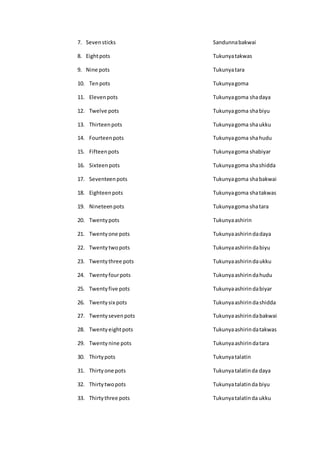
COUNTINGOF THINGS
ENGLISH D HAUSA
1. One yam Doya daya
2. Two books Lottafi biyu
3. Three people Mutane ukku
4. Four tables Tabura hudu
5. Five chairs Kujerabiyar
6. Six boys Yara shidda
7. Sevensticks Sandunnabakwai
8. Eightpots Tukunyatakwas
9. Nine pots Tukunyatara
10. Tenpots Tukunyagoma
11. Elevenpots Tukunyagoma shadaya
12. Twelve pots Tukunyagoma shabiyu
13. Thirteenpots Tukunyagoma shaukku
14. Fourteenpots Tukunyagoma shahudu
15. Fifteenpots Tukunyagoma shabiyar
16. Sixteenpots Tukunyagoma shashidda
17. Seventeenpots Tukunyagoma shabakwai
18. Eighteenpots Tukunyagoma shatakwas
19. Nineteenpots Tukunyagoma shatara
20. Twentypots Tukunyaashirin
21. Twentyone pots Tukunyaashirindadaya
22. Twenty twopots Tukunyaashirindabiyu
23. Twentythree pots Tukunyaashirindaukku
24. Twentyfourpots Tukunyaashirindahudu
25. Twentyfive pots Tukunyaashirindabiyar
26. Twentysix pots Tukunyaashirindashidda
27. Twentysevenpots Tukunyaashirindabakwai
28. Twentyeightpots Tukunyaashirindatakwas
29. Twentynine pots Tukunyaashirindatara
30. Thirtypots Tukunyatalatin
31. Thirtyone pots Tukunyatalatinda daya
32. Thirtytwopots Tukunyatalatinda biyu
33. Thirtythree pots Tukunyatalatinda ukku
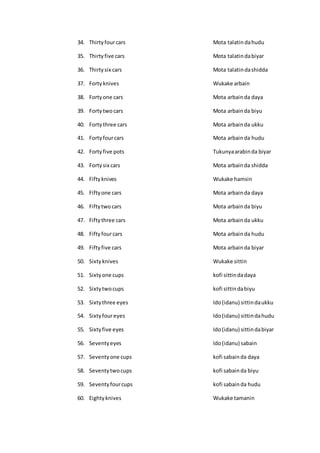
34. Thirtyfourcars Mota talatin dahudu
35. Thirtyfive cars Mota talatindabiyar
36. Thirtysix cars Mota talatindashidda
37. Forty knives Wukake arbain
38. Fortyone cars Mota arbainda daya
39. Fortytwo cars Mota arbainda biyu
40. Fortythree cars Mota arbainda ukku
41. Fortyfourcars Mota arbainda hudu
42. Fortyfive pots Tukunyaarabinda biyar
43. Fortysix cars Mota arbainda shidda
44. Fiftyknives Wukake hamsin
45. Fiftyone cars Mota arbainda daya
46. Fiftytwo cars Mota arbainda biyu
47. Fiftythree cars Mota arbainda ukku
48. Fiftyfourcars Mota arbainda hudu
49. Fiftyfive cars Mota arbainda biyar
50. Sixtyknives Wukake sittin
51. Sixtyone cups kofi sittindadaya
52. Sixtytwocups kofi sittindabiyu
53. Sixtythree eyes Ido(idanu) sittindaukku
54. Sixtyfoureyes Ido(idanu) sittindahudu
55. Sixtyfive eyes Ido(idanu) sittindabiyar
56. Seventyeyes Ido(idanu) sabain
57. Seventyone cups kofi sabainda daya
58. Seventytwocups kofi sabainda biyu
59. Seventyfourcups kofi sabainda hudu
60. Eightyknives Wukake tamanin
61. Ninetyhouses Gidaje tasain
62. One hundredcups kofi dari daya
63. Twohundredcups kofi dari biyu
64. One thousandcups kofi dubudaya
CHAPTER FIVE
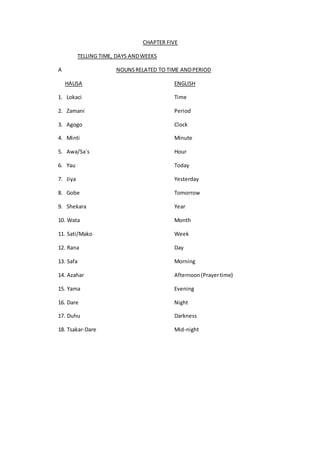
TELLING TIME, DAYS ANDWEEKS
A NOUNSRELATED TO TIME ANDPERIOD
HAUSA ENGLISH
1. Lokaci Time
2. Zamani Period
3. Agogo Clock
4. Minti Minute
5. Awa/Sa`s Hour
6. Yau Today
7. Jiya Yesterday
8. Gobe Tomorrow
9. Shekara Year
10. Wata Month
11. Sati/Mako Week
12. Rana Day
13. Safa Morning
14. Azahar Afternoon(Prayertime)
15. Yama Evening
16. Dare Night
17. Duhu Darkness
18. Tsakar-Dare Mid-night
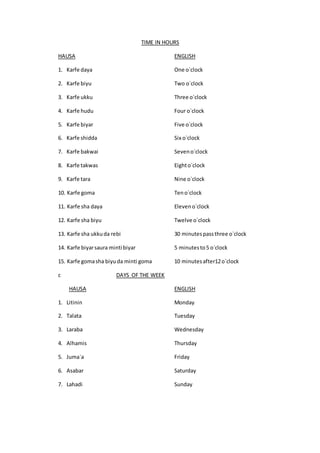
TIME IN HOURS
HAUSA ENGLISH
1. Karfe daya One o`clock
2. Karfe biyu Two o`clock
3. Karfe ukku Three o`clock
4. Karfe hudu Four o`clock
5. Karfe biyar Five o`clock
6. Karfe shidda Six o`clock
7. Karfe bakwai Seveno`clock
8. Karfe takwas Eighto`clock
9. Karfe tara Nine o`clock
10. Karfe goma Teno`clock
11. Karfe sha daya Eleveno`clock
12. Karfe sha biyu Twelve o`clock
13. Karfe sha ukkuda rebi 30 minutespassthree o`clock
14. Karfe biyarsaura minti biyar 5 minutesto5 o`clock
15. Karfe gomasha biyuda minti goma 10 minutesafter12o`clock
c DAYS OF THE WEEK
HAUSA ENGLISH
1. Litinin Monday
2. Talata Tuesday
3. Laraba Wednesday
4. Alhamis Thursday
5. Juma`a Friday
6. Asabar Saturday
7. Lahadi Sunday
MONTHS
HAUSA ENGLISH
1. Janairu January
2. Febrairu February
3. Maris March
4. Afiril April
5. Mayu May
6. Yuni June
7. Yuli July
8. Agusta August
9. Satumba September
10. Oktoba October
11. Nuwamba November
12. Discemba December
Notethatthere are twelve mothsin a year
SECTION D
YEARS
In thissectionthe yearsare countedjusta countingisdone in English
HAUSA ENGLISH
1. One year Shekaradaya
2. Two years Shekarabiyu
3. Three years Shekaraukku
4. Four years Shekarahudu
5. Five years Shekarabiyar
6. Six years Shekarashidda
7. Sevenyears Shekarabakwar
8. Eightyears Shekaratakwas
9. Nine years Shekaratara
10. Ten years Shekaragoma
11. Elevenyears Shekaragoma shadaya
12. Twelve years Shekaragoma shabiyu
CHAPTER SIX
MARKET TRANSACTIONS
NAMES OF DIFFERENT FOOD ITEMS AND SOUP
INGREDIENTS
HAUSA ENGLISH
1. Kasuwa Market
2. Doya Yam
3. Shinkafa Rice
4. Wake Beans
5. Manyan-Ayabaor pilanten Plantain
6. Ayaba Banana
7. Nama Meat
8. Kifi Fish
9. Kayan-miya Condiments
10. Barkono Pepper
11. Man-gyada Groundnutoil
12. Manja Palmoil
13. Gishiri Salt
14. Dankali Potato
15. Masara Maize
16. Garin-sawa Corn flour
17. Garin-rogo Cassavaflour
18. Rogo Cassava
19. Garin-doya Yam flour
20. Danyenkifi Freshfish
21. Kwai Eggs
22. Tumaturi Tomatoes
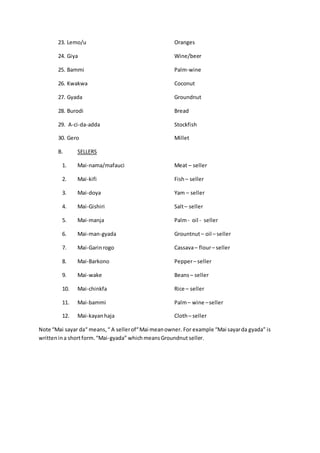
23. Lemo/u Oranges
24. Giya Wine/beer
25. Bammi Palm-wine
26. Kwakwa Coconut
27. Gyada Groundnut
28. Burodi Bread
29. A-ci-da-adda Stockfish
30. Gero Millet
B. SELLERS
1. Mai-nama/mafauci Meat – seller
2. Mai-kifi Fish– seller
3. Mai-doya Yam – seller
4. Mai-Gishiri Salt– seller
5. Mai-manja Palm- oil - seller
6. Mai-man-gyada Grountnut– oil – seller
7. Mai-Garinrogo Cassava– flour– seller
8. Mai-Barkono Pepper– seller
9. Mai-wake Beans– seller
10. Mai-chinkfa Rice – seller
11. Mai-bammi Palm– wine –seller
12. Mai-kayanhaja Cloth– seller
Note “Mai sayar da“ means,“ A sellerof“Mai meanowner. For example “Mai sayarda gyada” is
writtenina shortform.“Mai-gyada” whichmeansGroundnut seller.
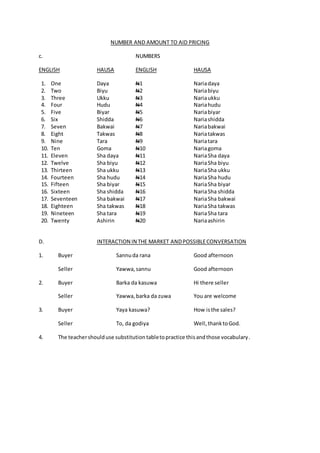
NUMBER AND AMOUNT TO AID PRICING
c. NUMBERS
ENGLISH HAUSA ENGLISH HAUSA
1. One Daya N1 Nariadaya
2. Two Biyu N2 Nariabiyu
3. Three Ukku N3 Nariaukku
4. Four Hudu N4 Nariahudu
5. Five Biyar N5 Nariabiyar
6. Six Shidda N6 Nariashidda
7. Seven Bakwai N7 Nariabakwai
8. Eight Takwas N8 Nariatakwas
9. Nine Tara N9 Nariatara
10. Ten Goma N10 Nariagoma
11. Eleven Sha daya N11 NariaSha daya
12. Twelve Sha biyu N12 NariaSha biyu
13. Thirteen Sha ukku N13 NariaSha ukku
14. Fourteen Sha hudu N14 NariaSha hudu
15. Fifteen Sha biyar N15 NariaSha biyar
16. Sixteen Sha shidda N16 NariaSha shidda
17. Seventeen Sha bakwai N17 NariaSha bakwai
18. Eighteen Sha takwas N18 NariaSha takwas
19. Nineteen Sha tara N19 NariaSha tara
20. Twenty Ashirin N20 Nariaashirin
D. INTERACTION IN THE MARKET ANDPOSSIBLECONVERSATION
1. Buyer Sannuda rana Good afternoon
Seller Yawwa,sannu Good afternoon
2. Buyer Barka da kasuwa Hi there seller
Seller Yawwa,barka da zuwa You are welcome
3. Buyer Yaya kasuwa? How isthe sales?
Seller To, da godiya Well,thanktoGod.
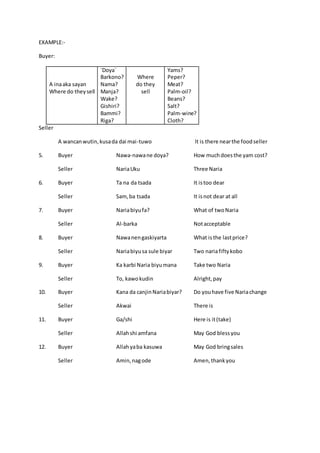
4. The teachershoulduse substitutiontabletopractice thisandthose vocabulary.
EXAMPLE:-
Buyer:
A inaaka sayan
Where do theysell
`Doya`
Barkono?
Nama?
Manja?
Wake?
Gishiri?
Bammi?
Riga?
Where
do they
sell
Yams?
Peper?
Meat?
Palm-oil?
Beans?
Salt?
Palm-wine?
Cloth?
Seller
A wancanwutin,kusada dai mai-tuwo It is there nearthe foodseller
5. Buyer Nawa-nawane doya? How muchdoesthe yam cost?
Seller NariaUku Three Naria
6. Buyer Ta na da tsada It istoo dear
Seller Sam,ba tsada It isnot dear at all
7. Buyer Nariabiyufa? What of twoNaria
Seller Al-barka Notacceptable
8. Buyer Nawanengaskiyarta What isthe lastprice?
Seller Nariabiyusa sule biyar Two nariafiftykobo
9. Buyer Ka karbi Naria biyumana Take two Naria
Seller To, kawokudin Alright,pay
10. Buyer Kana da canjinNariabiyar? Do youhave five Nariachange
Seller Akwai There is
11. Buyer Ga/shi Here is it(take)
Seller Allahshi amfana May God blessyou
12. Buyer Allahyaba kasuwa May God bringsales
Seller Amin,nagode Amen,thankyou
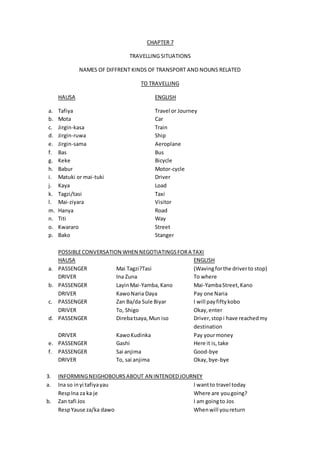
CHAPTER 7
TRAVELLING SITUATIONS
NAMES OF DIFFRENT KINDS OF TRANSPORT AND NOUNS RELATED
TO TRAVELLING
HAUSA ENGLISH
a. Tafiya Travel or Journey
b. Mota Car
c. Jirgin-kasa Train
d. Jirgin-ruwa Ship
e. Jirgin-sama Aeroplane
f. Bas Bus
g. Keke Bicycle
h. Babur Motor-cycle
i. Matuki or mai-tuki Driver
j. Kaya Load
k. Tagzi/tasi Taxi
l. Mai-ziyara Visitor
m. Hanya Road
n. Titi Way
o. Kwararo Street
p. Bako Stanger
POSSIBLECONVERSATION WHEN NEGOTIATINGSFORA TAXI
HAUSA ENGLISH
a. PASSENGER Mai Tagzi?Tasi (Wavingforthe driverto stop)
DRIVER Ina Zuna To where
b. PASSENGER LayinMai-Yamba,Kano Mai-YambaStreet,Kano
DRIVER KawoNaria Daya Pay one Naria
c. PASSENGER Zan Ba/da Sule Biyar I will payfiftykobo
DRIVER To, Shigo Okay,enter
d. PASSENGER Direbatsaya,Mun iso Driver,stopi have reachedmy
destination
DRIVER KawoKudinka Pay yourmoney
e. PASSENGER Gashi Here it is,take
f. PASSENGER Sai anjima Good-bye
DRIVER To, sai anjima Okay,bye-bye
3. INFORMINGNEIGHOBOURSABOUT AN INTENDEDJOURNEY
a. Ina so inyi tafiyayau I wantto travel today
RespIna za ka je Where are yougoing?
b. Zan tafi Jos I am goingto Jos
RespYause za/ka dawo Whenwill youreturn
c. Zan dawomako mai zuwa I shall returnnextweek
d. Ina rokonka,kalura mani da gida Please,take care of my house
RespTo, shi ke nan Okay,itsright
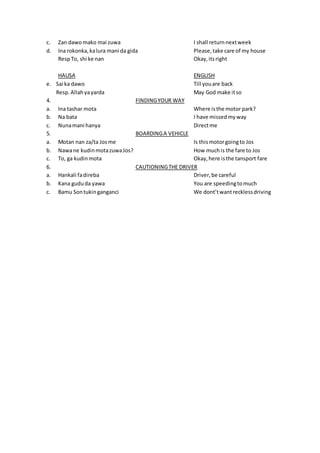
HAUSA ENGLISH
e. Sai ka dawo Till youare back
Resp.Allahyayarda May God make itso
4. FINDINGYOUR WAY
a. Ina tashar mota Where isthe motor park?
b. Na bata I have missedmyway
c. Nunamani hanya Directme
5. BOARDINGA VEHICLE
a. Motan nan za/ta Josme Is thismotorgoingto Jos
b. Nawane kudinmotazuwaJos? How muchis the fare to Jos
c. To, ga kudinmota Okay,here isthe tansport fare
6. CAUTIONINGTHE DRIVER
a. Hankali fadireba Driver,be careful
b. Kana gududa yawa You are speedingtomuch
c. Bamu Sontukinganganci We dont’twantrecklessdriving
CHAPTER 8
DINNING SITUATION
SOME DINNING RELATED NOUNS
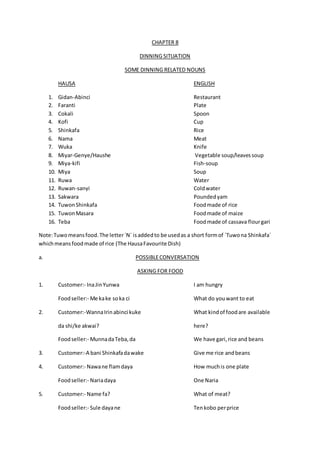
HAUSA ENGLISH
1. Gidan-Abinci Restaurant
2. Faranti Plate
3. Cokali Spoon
4. Kofi Cup
5. Shinkafa Rice
6. Nama Meat
7. Wuka Knife
8. Miyar-Genye/Haushe Vegetable soup/leavessoup
9. Miya-kifi Fish-soup
10. Miya Soup
11. Ruwa Water
12. Ruwan-sanyi Coldwater
13. Sakwara Poundedyam
14. TuwonShinkafa Foodmade of rice
15. TuwonMasara Foodmade of maize
16. Teba Foodmade of cassava flourgari
Note:Tuwomeansfood.The letter`N` isaddedto be usedas a short formof `Tuwona Shinkafa`
whichmeansfoodmade of rice (The HausaFavourite Dish)
a. POSSIBLECONVERSATION
ASKING FOR FOOD
1. Customer:- InaJinYunwa I am hungry
Foodseller:- Me kake soka ci What do youwant to eat
2. Customer:-WannaIrinabinci kuke What kindof foodare available
da shi/ke akwai? here?
Foodseller:- MunnadaTeba,da We have gari,rice and beans
3. Customer:-A bani Shinkafadawake Give me rice andbeans
4. Customer:- Nawane flamdaya How muchis one plate
Foodseller:- Nariadaya One Naria
5. Customer:- Name fa? What of meat?
Foodseller:- Sule dayane Tenkobo perprice
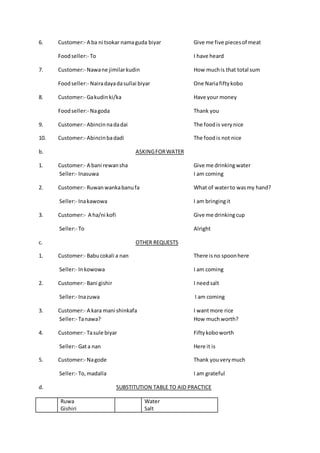
6. Customer:- A ba ni tsokar namaguda biyar Give me five piecesof meat
Foodseller:- To I have heard
7. Customer:- Nawane jimilarkudin How muchis that total sum
Foodseller:- Nairadayadasullai biyar One Nariafiftykobo
8. Customer:- Gakudinki/ka Have your money
Foodseller:- Nagoda Thank you
9. Customer:- Abincinnadadai The foodis verynice
10. Customer:- Abincinbadadi The foodis not nice
b. ASKINGFORWATER
1. Customer:- A bani rewansha Give me drinkingwater
Seller:- Inasuwa I am coming
2. Customer:- Ruwanwankabanufa What of waterto wasmy hand?
Seller:- Inakawowa I am bringingit
3. Customer:- A ha/ni kofi Give me drinkingcup
Seller:- To Alright
c. OTHER REQUESTS
1. Customer:- Babucokali a nan There isno spoonhere
Seller:- Inkowowa I am coming
2. Customer:- Bani gishir I needsalt
Seller:- Inazuwa I am coming
3. Customer:- A kara mani shinkafa I wantmore rice
Seller:- Tanawa? How muchworth?
4. Customer:- Tasule biyar Fiftykoboworth
Seller:- Gata nan Here it is
5. Customer:- Nagode Thank youverymuch
Seller:- To,madalla I am grateful
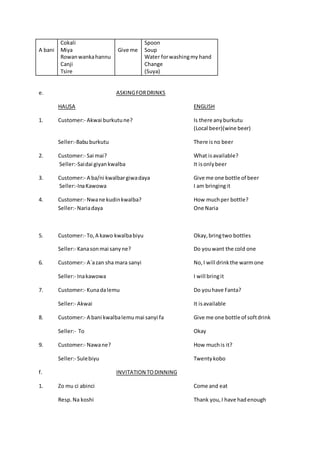
d. SUBSTITUTION TABLE TO AID PRACTICE
Ruwa
Gishiri
Water
Salt
A bani
Cokali
Miya
Rowanwankahannu
Canji
Tsire
Give me
Spoon
Soup
Water forwashingmy hand
Change
(Suya)
e. ASKINGFORDRINKS
HAUSA ENGLISH
1. Customer:- Akwai burkutune? Is there anyburkutu
(Local beer)(wine beer)
Seller:-Babuburkutu There isno beer
2. Customer:- Sai mai? What isavailable?
Seller:-Saidai giyankwalba It isonlybeer
3. Customer:- A ba/ni kwalbargiwadaya Give me one bottle of beer
Seller:-InaKawowa I am bringingit
4. Customer:- Nwane kudinkwalba? How muchper bottle?
Seller:- Nariadaya One Naria
5. Customer:- To,A kawo kwalbabiyu Okay,bringtwo bottles
Seller:- Kanasonmai sanyne? Do youwant the cold one
6. Customer:- A`azan sha mara sanyi No, I will drinkthe warmone
Seller:- Inakawowa I will bringit
7. Customer:- Kunadalemu Do youhave Fanta?
Seller:- Akwai It isavailable
8. Customer:- A bani kwalbalemu mai sanyi fa Give me one bottle of softdrink
Seller:- To Okay
9. Customer:- Nawane? How muchis it?
Seller:- Sulebiyu Twentykobo
f. INVITATION TODINNING
1. Zo mu ci abinci Come and eat
Resp.Na koshi Thank you,I have hadenough
2. Me ka ci haka? What have youeaten?
Resp.Nacitwonor Na riga na ci abinci I have eatenfood,made of rice
Note:Burkutuisa local brewedwine
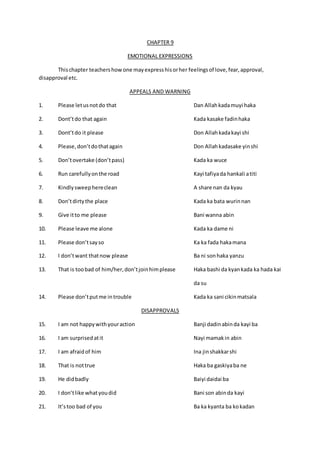
CHAPTER 9
EMOTIONAL EXPRESSIONS
Thischapter teachershowone mayexpresshisorher feelingsof love,fear,approval,
disapproval etc.
APPEALS AND WARNING
1. Please letusnotdo that Dan Allahkadamuyi haka
2. Dont’tdo that again Kada kasake fadinhaka
3. Dont’tdo it please Don Allahkadakayi shi
4. Please,don’tdothatagain Don Allahkadasake yinshi
5. Don’tovertake (don’tpass) Kada ka wuce
6. Run carefullyonthe road Kayi tafiyada hankali atiti
7. Kindlysweephereclean A share nan da kyau
8. Don’tdirtythe place Kada ka bata wurinnan
9. Give itto me please Bani wanna abin
10. Please leave me alone Kada ka dame ni
11. Please don’tsayso Ka ka fada hakamana
12. I don’twant thatnow please Ba ni sonhaka yanzu
13. That is toobad of him/her,don’tjoinhimplease Haka bashi da kyankada ka hada kai
da su
14. Please don’tputme introuble Kada ka sani cikinmatsala
DISAPPROVALS
15. I am not happywithyouraction Banji dadinabinda kayi ba
16. I am surprisedatit Nayi mamakin abin
17. I am afraidof him Ina jinshakkarshi
18. That is nottrue Haka ba gaskiyaba ne
19. He didbadly Baiyi daidai ba
20. I don’tlike whatyoudid Bani son abinda kayi
21. It’stoo bad of you Ba ka kyanta ba kokadan
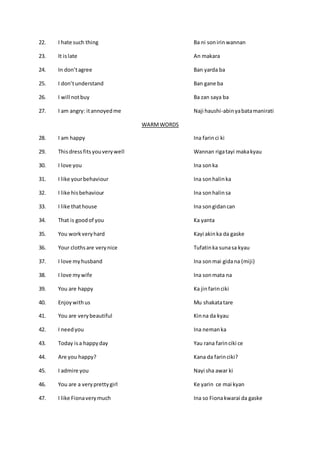
22. I hate such thing Ba ni sonirinwannan
23. It islate An makara
24. In don’tagree Ban yarda ba
25. I don’tunderstand Ban gane ba
26. I will notbuy Ba zan saya ba
27. I am angry: itannoyedme Naji haushi-abinyabatamanirati
WARMWORDS
28. I am happy Ina farinci ki
29. Thisdressfits youverywell Wannan rigatayi makakyau
30. I love you Ina sonka
31. I like yourbehaviour Ina sonhalinka
32. I like hisbehaviour Ina sonhalinsa
33. I like thathouse Ina songidancan
34. That is goodof you Ka yanta
35. You workveryhard Kayi akinka da gaske
36. Your clothsare verynice Tufatinka sunasa kyau
37. I love myhusband Ina sonmai gidana (miji)
38. I love mywife Ina sonmata na
39. You are happy Ka jinfarinciki
40. Enjoywithus Mu shakatatare
41. You are verybeautiful Kinna da kyau
42. I needyou Ina nemanka
43. Today isa happyday Yau rana farinciki ce
44. Are you happy? Kana da farinciki?
45. I admire you Nayi sha awar ki
46. You are a veryprettygirl Ke yarin ce mai kyan
47. I like Fionaverymuch Ina so Fionakwarai da gaske
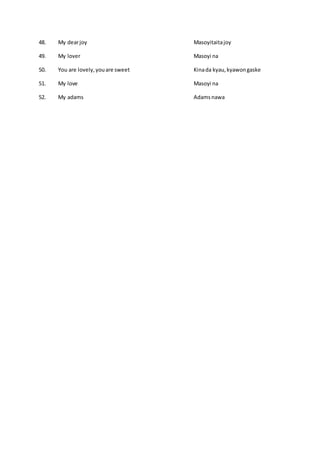
48. My dearjoy Masoyitaitajoy
49. My lover Masoyi na
50. You are lovely,youare sweet Kinada kyau,kyawongaske
51. My love Masoyi na
52. My adams Adamsnawa
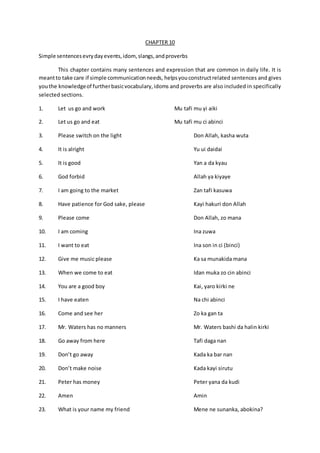
CHAPTER 10
Simple sentencesevrydayevents,idom, slangs,andproverbs
This chapter contains many sentences and expression that are common in daily life. It is
meantto take care if simple communicationneeds, helpsyouconstructrelated sentences and gives
youthe knowledgeof furtherbasicvocabulary,idoms and proverbs are also included in specifically
selected sections.
1. Let us go and work Mu tafi mu yi aiki
2. Let us go and eat Mu tafi mu ci abinci
3. Please switch on the light Don Allah, kasha wuta
4. It is alright Yu ui daidai
5. It is good Yan a da kyau
6. God forbid Allah ya kiyaye
7. I am going to the market Zan tafi kasuwa
8. Have patience for God sake, please Kayi hakuri don Allah
9. Please come Don Allah, zo mana
10. I am coming Ina zuwa
11. I want to eat Ina son in ci (binci)
12. Give me music please Ka sa munakida mana
13. When we come to eat Idan muka zo cin abinci
14. You are a good boy Kai, yaro kirki ne
15. I have eaten Na chi abinci
16. Come and see her Zo ka gan ta
17. Mr. Waters has no manners Mr. Waters bashi da halin kirki
18. Go away from here Tafi daga nan
19. Don’t go away Kada ka bar nan
20. Don’t make noise Kada kayi sirutu
21. Peter has money Peter yana da kudi
22. Amen Amin
23. What is your name my friend Mene ne sunanka, abokina?
24. We are going to the church Zamu tafi chochi (coci)
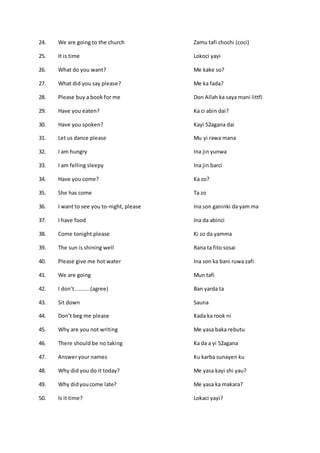
25. It is time Lokoci yayi
26. What do you want? Me kake so?
27. What did you say please? Me ka fada?
28. Please buy a book for me Don Allah ka saya mani littfi
29. Have you eaten? Ka ci abin dai?
30. Have you spoken? Kayi 52agana dai
31. Let us dance please Mu yi rawa mana
32. I am hungry Ina jin yunwa
33. I am felling sleepy Ina jin barci
34. Have you come? Ka zo?
35. She has come Ta zo
36. I want to see you to-night, please Ina son ganinki da yam ma
37. I have food Ina da abinci
38. Come tonight please Ki zo da yamma
39. The sun is shining well Rana ta fito sosai
40. Please give me hot water Ina son ka bani ruwa zafi
41. We are going Mun tafi
42. I don’t..........(agree) Ban yarda ta
43. Sit down Sauna
44. Don’t beg me please Kada ka rook ni
45. Why are you not writing Me yasa baka rebutu
46. There should be no taking Ka da a yi 52agana
47. Answer your names Ku karba sunayen ku
48. Why did you do it today? Me yasa kayi shi yau?
49. Why didyoucome late? Me yasa ka makara?
50. Is it time? Lokaci yayi?
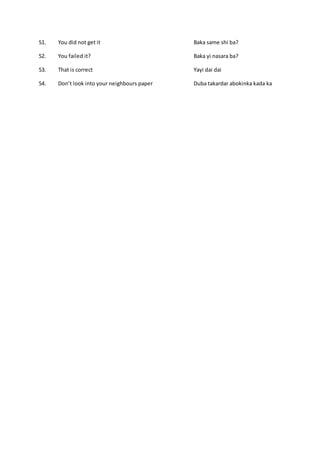
51. You did not get it Baka same shi ba?
52. You failed it? Baka yi nasara ba?
53. That is correct Yayi dai dai
54. Don’t look into your neighbours paper Duba takardar abokinka kada ka
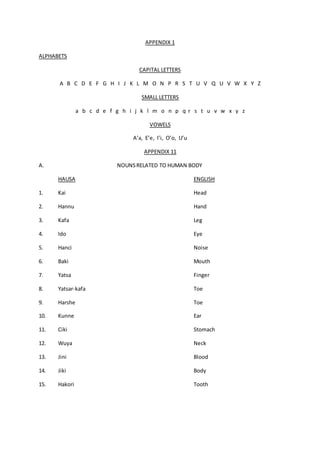
APPENDIX 1
ALPHABETS
CAPITAL LETTERS
A B C D E F G H I J K L M O N P R S T U V Q U V W X Y Z
SMALL LETTERS
a b c d e f g h i j k l m o n p q r s t u v w x y z
VOWELS
A’a, E’e, I’i, O’o, U’u
APPENDIX 11
A. NOUNSRELATED TO HUMAN BODY
HAUSA ENGLISH
1. Kai Head
2. Hannu Hand
3. Kafa Leg
4. Ido Eye
5. Hanci Noise
6. Baki Mouth
7. Yatsa Finger
8. Yatsar-kafa Toe
9. Harshe Toe
10. Kunne Ear
11. Ciki Stomach
12. Wuya Neck
13. Jini Blood
14. Jiki Body
15. Hakori Tooth
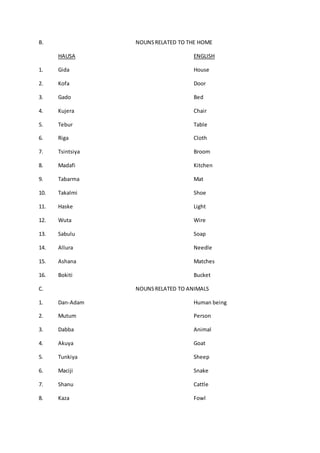
B. NOUNSRELATED TO THE HOME
HAUSA ENGLISH
1. Gida House
2. Kofa Door
3. Gado Bed
4. Kujera Chair
5. Tebur Table
6. Riga Cloth
7. Tsintsiya Broom
8. Madafi Kitchen
9. Tabarma Mat
10. Takalmi Shoe
11. Haske Light
12. Wuta Wire
13. Sabulu Soap
14. Allura Needle
15. Ashana Matches
16. Bokiti Bucket
C. NOUNSRELATED TO ANIMALS
1. Dan-Adam Human being
2. Mutum Person
3. Dabba Animal
4. Akuya Goat
5. Tunkiya Sheep
6. Maciji Snake
7. Shanu Cattle
8. Kaza Fowl
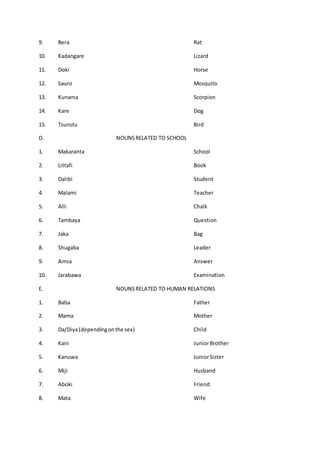
9. Bera Rat
10. Kadangare Lizard
11. Doki Horse
12. Sauro Mosquito
13. Kunama Scorpion
14. Kare Dog
15. Tsunstu Bird
D. NOUNSRELATED TO SCHOOL
1. Makaranta School
2. Littafi Book
3. Dalibi Student
4. Malami Teacher
5. Alli Chalk
6. Tambaya Question
7. Jaka Bag
8. Shugaba Leader
9. Amsa Answer
10. Jarabawa Examination
E. NOUNSRELATED TO HUMAN RELATIONS
1. Baba Father
2. Mama Mother
3. Da/Diya(dependingonthe sex) Child
4. Kani JuniorBrother
5. Kanuwa JuniorSister
6. Miji Husband
7. Aboki Friend
8. Mata Wife
9. Makwabci Neighbour
10. Namiji Man
11. Mace Woman
12. Yaro Boy
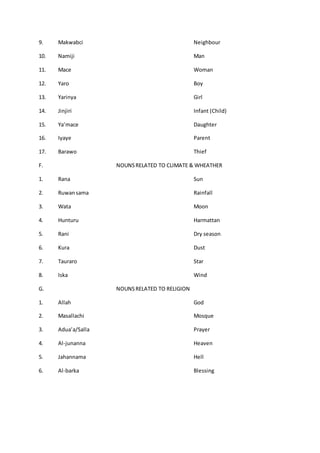
13. Yarinya Girl
14. Jinjiri Infant (Child)
15. Ya’mace Daughter
16. Iyaye Parent
17. Barawo Thief
F. NOUNSRELATED TO CLIMATE & WHEATHER
1. Rana Sun
2. Ruwansama Rainfall
3. Wata Moon
4. Hunturu Harmattan
5. Rani Dry season
6. Kura Dust
7. Tauraro Star
8. Iska Wind
G. NOUNSRELATED TO RELIGION
1. Allah God
2. Masallachi Mosque
3. Adua’a/Salla Prayer
4. Al-junanna Heaven
5. Jahannama Hell
6. Al-barka Blessing
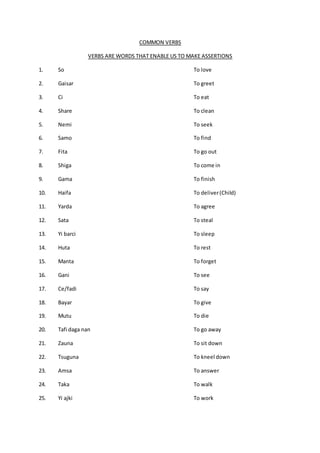
COMMON VERBS
VERBS ARE WORDS THAT ENABLE US TO MAKE ASSERTIONS
1. So To love
2. Gaisar To greet
3. Ci To eat
4. Share To clean
5. Nemi To seek
6. Samo To find
7. Fita To go out
8. Shiga To come in
9. Gama To finish
10. Haifa To deliver(Child)
11. Yarda To agree
12. Sata To steal
13. Yi barci To sleep
14. Huta To rest
15. Manta To forget
16. Gani To see
17. Ce/fadi To say
18. Bayar To give
19. Mutu To die
20. Tafi daga nan To go away
21. Zauna To sit down
22. Tsuguna To kneel down
23. Amsa To answer
24. Taka To walk
25. Yi ajki To work
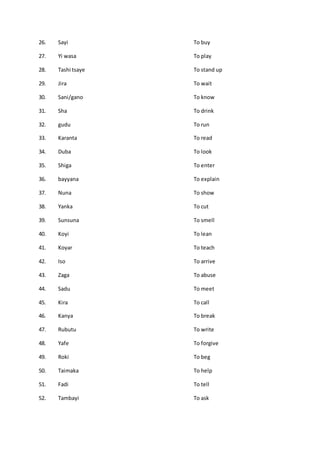
26. Sayi To buy
27. Yi wasa To play
28. Tashi tsaye To stand up
29. Jira To wait
30. Sani/gano To know
31. Sha To drink
32. gudu To run
33. Karanta To read
34. Duba To look
35. Shiga To enter
36. bayyana To explain
37. Nuna To show
38. Yanka To cut
39. Sunsuna To smell
40. Koyi To lean
41. Koyar To teach
42. Iso To arrive
43. Zaga To abuse
44. Sadu To meet
45. Kira To call
46. Kanya To break
47. Rubutu To write
48. Yafe To forgive
49. Roki To beg
50. Taimaka To help
51. Fadi To tell
52. Tambayi To ask
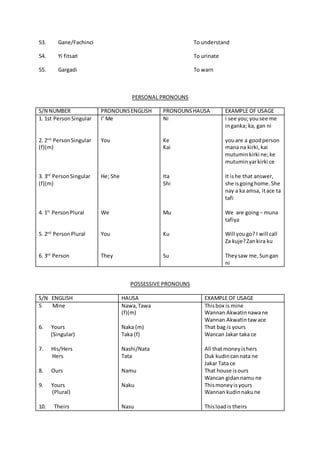
53. Gane/Fachinci To understand
54. Yi fitsari To urinate
55. Gargadi To warn
PERSONAL PRONOUNS
S/N NUMBER PRONOUNSENGLISH PRONOUNSHAUSA EXAMPLE OF USAGE
1. 1st PersonSingular
2. 2nd
PersonSingular
(f)(m)
3. 3rd
PersonSingular
(f)(m)
4. 1st
PersonPlural
5. 2nd
PersonPlural
6. 3rd
Person
I’ Me
You
He; She
We
You
They
Ni
Ke
Kai
Ita
Shi
Mu
Ku
Su
i see you;yousee me
inganka; ka, gan ni
youare a goodperson
mana na kirki,kai
mutuminkirki ne;ke
mutuminyarkirki ce
It ishe that answer,
she isgoinghome.She
nay a ka amsa, itace ta
tafi
We are going– muna
tafiya
Will yougo? I will call
Za kuje?Zankira ku
Theysaw me,Sungan
ni
POSSESSIVE PRONOUNS
S/N ENGLISH HAUSA EXAMPLE OF USAGE
5 Mine
6. Yours
(Singular)
7. His/Hers
Hers
8. Ours
9. Yours
(Plural)
10. Theirs
Nawa,Tawa
(f)(m)
Naka (m)
Taka (f)
Nashi/Nata
Tata
Namu
Naku
Nasu
Thisbox is mine
Wannan Akwatinnawane
Wannan Akwatintaw ace
That bag is yours
Wancan Jakar taka ce
All thatmoneyishers
Duk kudincannata ne
Jakar Tata ce
That house isours
Wancan gidannamu ne
Thismoneyisyours
Wannan kudinnakune
Thisloadis theirs
Wannan kayannasune

169242324 hausa-language-study-nysc

  • 1.
    Get Homework/Assignment Done Homeworkping.com HomeworkHelp https://www.homeworkping.com/ Research Paper help https://www.homeworkping.com/ Online Tutoring https://www.homeworkping.com/ click here for freelancing tutoring sites A Handbook of
  • 2.
    Language study for CorpsMembers (Hausa) Copy right By NYSC DIRECTORATE HEADQUARTERS
  • 3.
    LAGOS First published 1985 Allright reserved. No part of this book may be reproduced, stored in a retrieval system or transmitted in any form or by any means – electronic, mechanical, photocopying, recording or otherwise – without the prior permission in writing to the NYSC Directorate Headquarters, Lagos. FOREWORD This language text if intended to provide, for corps members. A basic linguistic guide to those languages spoken in the various communities to which corps members are deployed.
  • 4.
    The ultimate aimis not to give a comprehensive account of these languages, but to give a snapshot of the basic vocabulary and expressions needed by the corps members to integrate functionally into the communities. In furtherance of one of the cardinal objectives of the NYSC and, more pertinently, the need and responsibility to encourage and assist corps members in order to effectively integrate into any cultural setting in Nigeria, texts have been developed in 10 languages. The ability to understand and speak languages other than one’s own, especially when one has to live and work in a completely different cultural milieu, has, undoubtedly, proved a great benefit to man. It is expected, therefore, that corps members will utilize these texts to benefit them immensely. While commending these texts to corps members during the service year, it is my hope that they will also encourage the corps members to delve further into these languages and the cultures from which they have grown. PREFACE This text is an outcome of a Language Study Workshop, organized by the NYSC Directorate in May 1984, with participants mainly language co-ordinators – drawn from all over the federation. The workshop was consequent upon the trial use of our previous language texts.
  • 5.
    The first languagetext published by the NYSC Directorate in 1979, titled “Handbook of Nigerian Language – Hausa – Igbo - Yoruba”, was written by three corps members Mr. O. B. C Nwolise, Mrs. G. M. Ojo and Dr. Dikko. The expressed aim of the authors of the Handbook is to particularly meet the communication needs of corps members and foreigners who are interested in learning the languages contained therein. This secondary aim loomed quite large in the execution of the project as is evidenced by the wide coverage of linguistic data of the three target context covered in the Handbook is also wider than is really needed by corps members, while the detailed grammatical descriptions of each language goes beyond the scope of the learning requirements of corps members. Experiences gained through states (2 for each target language) confirmed these observation and prompted the need for an abridged version tailored to the realities of the language study programme in the orientation Camp. In response to this expressed need and in order to ensure more fruitful results, a committee was set up at the Directorate Headquarters to review the original text in the light of these experiences and recommendations from the field. The committee in discharging its function, ensured that the selection of content is strictly on the communicative needs of the prospective leaner. Consequently, the extensive grammatical description of the target language in the original Handbook was committed. Anticipating that the learner’s use of the language will be for oral communication, the spoken forms of the language was presented in the text. Finally, the committee adhered more consistently to the situational approach in the presentation of the language materials, with some illustrative dialogues.
  • 6.
    The Directorate alsodecided to print the three language into separate texts with English as the common language to all. What eventually evolved was the abridged version of the original text, which was again committed to trial – use in the states during the 1982/83 service year. Experiences of the trial – use revealed that the content of the abridged version even though now more suitable to the situational needs of corps members, was rather too brief that the next was just enough to be covered during the orientation course period. Therefore, anticipation that corps members will need to continue learning the language throughout the service year in the text to last the twelve month period, it was decided at the workshop that the content of the language texts be expended to incorporate materials from both original Handbook and abridged version. A committee was then assigned the task of drawing up the course content for the language text, and what you now have is outcome of the committee’s work. At this juncture, it is essential to acknowledge with thanks the immeasurable contributions of our language co-ordinators in handling the translation of the course content into the various language text. It is also noteworthy to mention that the enormous task was handled free without monetary consideration, thereby making their worthwhile contribution into the progress of the NYSC Scheme. We envisage that this current text will actually meet the dire needs of corps members in the process of learning the local languages of their states of deployment. The consequent understanding of the local language by the corps members would undoubtedly be an
  • 7.
    invaluable asset andwould also help in fostering one of the cardinal objectives of the NYSC which is to imbue in Nigerian youths a spirit of selfless service to the community and to emphasize the spirit of oneness and brotherhood of all Nigerians, irrespective of cultural background. F.N BALOGUN (MRS.) & A.K SOMEFUN (MR.) PLANNING & EVALUATION DIVISION N.Y.S.C DIRECTORATE HEADQUARTERS, LAGOS. CONTENTS Forward Preface CHAPTER 1 1. A BRIEF HISTORY OF HAUSA SPEAKING PEOPLE
  • 8.
    2. Cultural Background 3.Dress 4. Religion 5. Family life 6. Housing 7. Occupation 2 – 1 CHAPTER 2 GREETINGS & INITIAL COMMUNICATION SECTION A – GREETINGS 1. Morning 2. Afternoon 3. Evening 4. Night 5. Reception 6. Farewell 7. Greeting the worker 8. Greeting the Successful 9. Casual Greetings 10. Asking about members of the family 3 – 6 SECTION B – Hausa GREETINGS SITUATION TO BE USED
  • 9.
    CHAPTER 3 MAKING ENQUIRIESREQUEST & SEEKING INFORMATION 7 – 11 CHAPTER 4 CARDINAL NUMERALS – ORDIAL NUMERALS 12 – 16 Counting of money Counting of things CHAPTER 5 TELLING TIME, DAY & WEEK A. Nouns related to time and period B. Time in hours C. Days of the week D. Months E. Years 17 - 18 MARKET TRANSACTIONS CHAPTER 6 A. NAMES OF DIFFERENT FOOD ITEMS AND SOUP INGRIDENTS 19 - 21
  • 10.
    B. Sellers C. Numberand amount to aid pricing D. Interaction in the market and possible Conversation. CHAPTER 7 NAMES OF DIFFERENT KINDS OF TRANSPORT AND NOUNS RELATED TO TRAVELING 22 - 23 1. Possible Conversation when negotiating for taxi 2. Informing neighbours about and intended journey 3. Finding your way 4. Boarding a vehicle 5. Cautioning the driver CHAPTER 8 DINNING SITUATION SOME DINNING RELATED NOUNS Possible Conversation asking for food Asking for water Other request Substitution table to aid practice Asking for drinks Invitation to dinning 24 – 26
  • 11.
    CHAPTER 9 EMOTIONAL EXPRESSIONS Appealsand warning Disapprovals Warm words 27 - 28 CHAPTER 10 SIMPLE SENTENCES ON EVERY DAY EVENTS IDIOMS AND PROVERBS 29 – 30 APPENDIX 1 Alphabets 31 – 36 Capital letters A B C…………Z Small letters a b c…………..z APPENDIX 11 a. Nouns related to human body b. Nouns related to the home c. Nouns related to schools d. Nouns related to animals e. Nouns related to human relations f. Nouns related to climate and whether
  • 12.
    g. Nouns relatedto religion h. verbs are words that enable us to make assertions personal nouns CHAPTER 1 A BRIEF HISTORY OF HAUSA SPEAKING PEOPLE
  • 13.
    It is difficultto narrate the history of Hausa speaking people comprehensively in a short chapter of this nature. However, efforts will be made to only bring to light the salient points that will make and introduce the reader to the background of Hausa language and its speakers. The Hausa speaking can be said to form the majority of the people inhabiting Nigeria’s most northern states with concentration in Kano, Kaduna and Sokoto States. It must, however, be noted that in common with other people of the Sudan, it is difficult to trace the true origin of the Hausa people, even though many attempts by historians were made to explain through traditions, their origin. Whatever the case, it is certain that at the present location of Kano city, the capital of an Hausa city-state bearing the same name, there existed a flourishing sedentary community by about 635 A.D. This is further confirmed by the presence of an iron – working furnace from that community’s civilization. Be that as it may, most traditions have ascribed the origin of the Hausa states to the marriage of an old legendary hero, a certain Bayajidda Prince of Baghdad, to certain pre-historic Queen of Daura and their offsprings are said to have founded the authentic seven Hausa states (Hausa Bakwai). Going by the various traditions especially of the above legend, the founders of the seven Hausa states were all direct desendants of Bayajidda. Biram, the son of Bayajidda by a certain princess of Borno is said to have founded a ruling dynasty; while Bawo, the son from the cohabitation of Bayajidda and the famous Queen of Daura, is said to have resulted into fathering the founders of the remaining dynasties. By all means, our source of information on the origin of the said city states is limited as history can only talk much on few of the city states namely:- Gobin, Daura, Zazzau or Zaria, Kastina and Kano.
  • 14.
    It is interestingto note that besides the legend pertaining to the original authentic Hausa Bakwai, there is another tradition that tries to explain the origin of the so called un-authentic seven Hausa states or popularly known as Banza Bakwai namely:- Zamfara, Kebbi, Nupe, Gwari, Yawuri, Yoruba; and Kororofa. It is by all means suggested that despite these rationalized traditions the Hausa people seemed to have been the result of the arrival and gradual integration of waves of immigrants into an indigenous community or communities. It must be admitted that the rise in farming and other professional associations led to the foundation of villages which later on developed into walled cities – a prominent feature of most cities in the northern states. Whatever interpretation one might give the Hausa speaking people; they are and can be found all over the country practicing one profession or another and thereby spreading their language. Hausa is said to be the most widely spoken language in Africa and perhaps this is a lie. CULTURAL BACKGROUND The Hausa speaking people have a mode of life which is perculiar to them as an entity. Perhaps it is right to point out the fact that the people are very much tied to their culture that wherever they are seen, their life pattern is almost not easily dispensed with moves with them. DRESS The typical Hausa dressing consists of a big gown, jumper and a cap for the men and a wrapper, a headtie and a shawl thrown over the shoulders for the women. This is particularly borne out of the
  • 15.
    ethic of themuslim religion which preaches against any form of exposure of the body by women. In addition to this, the typical Hausa woman weaves her hair in the local fashion with all the simplicities in attendance. RELIGION Islam is the dominant religion practised by the Hausas. Consequently, majority are Moslems although a very small percentage are Christians. Religion plays an important part in the lifestyle of the Hausas. The norms and principles of Islam influences the behavioural pattern of the people. This may be the reason why they are very much dedicated to their religion. FAMILY LIFE Basically, the husband (Maigida) is the head of the household. He controls and directs the affairs of the home. The typical Hausa home is a polygamous one. This again is tied to one of the doctrines of the religion which allows the man to marry as many as four women so long as he can cater for them. The extended family system is also a way of life of the people although this is also applicable to other ethnic groups. HOUSING The most prevalent type of houses inhabited by the people are mainly round hunts with thatched roofs or flat tops as the case may be. This is to shield off the effect of the scorching sun, as the environment is a hot one. OCCUPATION
  • 16.
    The Hausa peopleare generally industrious and engage in a number of professions as evidence in our major town and villages where they are found. These professions include farming, fishing, hunting, blacksmithing, carpentry, pottery, leather works, weaving and a host of others. They are also good horse riders Generally, the Hausas are a peaceful and rather hospitable people who are usually prepared to socialize with people from other ethnic groups. This has made it possible for the language to spread far and wide and thus fast becoming widely spoken. CHAPTER 2
  • 17.
    GREETINGS AND INITIALCOMMUNICATION SECTION A: GREETINGS 1. MORNING (SAFE) HAUSA ENGLISH EQUIVALENT/LITERAL TRANSLATION a. Ina kwana?Or Barka da asuba Good morning Resp:Lafiyalauor barkaka dai Quite fine thismorning b. Ina kwananku?(Plural) Good morningtoyou all (Plural) Resp:Lafiyakalau I feel ok c. Antashi lafiya? Hope you woke upfine? Resp:Lafiyakalau Fine,noproblem d. In gajiya How are you? Resp:Ba gajiya No problem e. Barka da hantsi Good morning(whenthe morningsunis highinthe sky) Resp:Barka ka dai Good morning 2. AFTERNOON (RANA) a. Barka da rana Good afternoon Resp:Yaya, Barka ka dai/Barka ka dai Same greetingstoyou b. Yaya yau dai? How isthe day? (How are you?) Resp:Lafiya/lafiyalau It’sveryfine 3. EVENING(YAMMA) a. Ina wuni? Good evening Resp:Lafiyalau Verywell b. Ina gajiya? How isit? Resp:Ba gajiya No problem
  • 18.
    4. NIGHT (DARE) a.Barka da dare Good evening Resp:Barka kai dai or yawwasannu Good evening ka dai b. Yaya aiki How iswork? Resp: Da godiya We thankGod c. Sai da safe (saidinthe eveningonly) orsai gobe Till tomorrow morning(whenyou know that youare not meeting again) Resp: Allahya kai mu May God grant us – Amen d. A huta lafiya Have a goodnightrest – Amen Note:- togreetsomeone,perhapsaleaderora senior,one couldsay: Ranya yadade May youlive long Resp:Mu dade tare/yawwa May we live longtogetherwithyou It isa popularformof salutationamongthe Hausas andthe speakers 5. RECEPTION a. Barka da zuwa (general irrespective ofgender) You are welcome Resp:Yawwaor Barka ka dai Thank you b. An zolafiya? Hope you arrivedwell? Resp:Lafiyalau Verywell,thankyou c. Yaya hanya? How wasthe journey? Resp:Lafiyalau It was fine. NOTE: If the personwhoarrivesisthe firstto greet,he well say:‘Barkada hutawa’andthe person sittedat home will respond‘’Marabadazuwa’’ NOTE: LETTER (M) = Male (F) = Female (G) = General 6. FAREWELL
  • 19.
    a. Sai anjumaTill we meet Resp:Yawwa,a jimada yawa Thanks,bye! Till we meet b. Sai munsake saduwa Till we meetagain Resp:To, madalla Okay,that’salright c. A sauka lafiya Safe journey Resp:Amin Amen d. A gaidamutanengida Greetyour people athome Resp:To, za su ji Okay,theywill heari.e the message will reach them 7. GREETING WORKERS a. Sannu da aiki How iswork?Or well done Resp:Yawwasannu ka dai Thank you b. Yaya aiki How iswork? Resp:Da godiya Well,we thankGod 8. GREETING THE SUCCESSFUL a. Muna murna Congratulation Resp:Madalla/Nagode Thank youverymuch b. Sannuda Arziki Congratulation(Noneedtospecify.Itis usuallyunderstood) Resp:Madalla On! Thank you verymuch c. Allahyaraya mana May the Lord nurse itfor us Resp:Amin Amen “Sannuda Arziki’isusuallysaidtopersonwhohave beendeliveredfromor have escapeddanger. Here”Sannu da arsiki’isusedinthe sense thata womanhas escaped the danger,ordeathduring delivery. 9. CASUALGREETINGS a. Yaya dai Hellohow isit? Resp:Ba komai Fine,Noproblem b. Yaya zaman garu? How islife intown?
  • 20.
    Resp:Alhamdulilahi (lafiyalau) praiseGod,it`s peaceful c. Ankwana-biyaba-muhaduba! Quite an age! Resp:Hanke kuwaHaka ne kuwa exactly 10. ASKINGABOUT MEMBERS OF THE FAMILY a. Yaya Mahaifinka How isyour father? Resp:Yana lafiya He isfine b. Yaya Mahaifiyarka? How isyour mother Resp:Tana lafiya She isfine c. Yayauwargida How isyour wife? Resp:Tana lafiya She isfine d. Yaya Yara? How are your children? Resp:Sumasuna lafiya Theyare alsofine SECTION B
  • 21.
    HAUSA GREETINGS SITUATIONSTOBE USED 1. Sannunkuduka(dukanotnecessary) To be saidto people sittingcollectively 2. Sannunkudaisowa To be saidto people thatarrive afteryou 3. Barka sa shakatawa Greetingstoa personenjoyinghis/herself 4. Barka da shakatawa Greetingtopeople thatare enjoying themselves 5. Barka da sallah To be saidto muslimsonsallahdays 6. Sannuda hakuri To be saidto a personwhohas beenwaiting for you 7. Sannunku da hakuri To be saidto a group of people whohave beenwaitingforyou 8. Sannunkuda hakuri To be saidto people whohave beensitting downfor a longtime NOTE: Yaya mahaifiyarka? How isyour mother? Saidto a male (masculine) person Yaya mahaifiyarki? How isyour mother? (Saidto a female person) Yaya mai gida? How isyour husband? Whenaskinga marriedwoman Yaya mai gida? How isyour master? Whenaskinga house boy 9. Sannuda hutawa To be saidto someone,whohasreturned fromwork andis resting 10. Yaya ka ji da aiki? How doyou findthe job? NOTE: “SANNU”isusuallysaidtoa personor personswhose effortiscommended,whether successful ornot.But it ismostlyappliedtotideoussituationsorsufferinge.g.greetingasickperson. SANNUDA CIWOOR SANNUDA WAHALA But `BARKA`is commonlyappliedtosuccessachievedbythe personbeingsaluted,e.g.BARKA DA HAIFUWA – Greetinga woman,whohassuccessfullydeliveredanew baby
  • 22.
  • 23.
    MAKING ENQUIRIES, REQUEST& SEEKING INFORMATION HAUSA ENGLISH 1. Menene What Yaya Sannunka? What isyour name? Menene orme yake faruwa? What ishappening Me kake so? What do youwant? 2. Wanne? Which? Wane kake so? Whichone do you want? Wane yake da kyau? Whichone is good? Wanne ne ke da kyau Whichone is good? Wanne Wace Wanna Wace Sana`a Abinci Yarinya Riga Takalmi Sana`a Abinchi Agogo Rediyo Yarinya Riga Takalmi Akuya Ka Ki Ka Ku Ka Mu Ke Ka Ki ka Ku ka Mu ke Fi So Fi so Which Profession Food Girl Cloth Shoes Watch/clock Radio Goat Do You Like Most? 3. HAUSA ENGLISH a. Wanene Who? b. Wanene Wancan Who isthat? c. Wanene yakekirana Who iscallingme? d. Wanene yake soya tafi Who wantsto go? 4. INA WHERE Ina za/kaje? Ina ka karbokayanka? Ina ka ke da zama Ina ka de? Ina ka/sakashi Where Where Where Where Where Are you going? Didyou collectyourproperty Do you live? Are you Didyou putit
  • 24.
    Ina ka gaChief inspect Where Didyou see the C.I.? 5. YAYA a. Yaya ka yi shi? How didyoudo it? b. Yaya ka isacan? How didyouget there? c. Yaya dai? How isit? 6. a. – Nyawa? How much? b. – Nawa yake? How muchis it? c. – Nawaka saye shi? How muchdidyou buyit? d. – Nawa ka keda shi? How muchdidyou have 7. GUDA NAWA? HOW MANY? a. Mutane guda nawasuke can? How manypeople are there? b. Yara guda nawakake das u? How many childrendoyouhave? c. Mata gudanawa babanka yake das u? How manywivesdoesyourfather have? 8. Za/Ka IYA a. Za/ka iyayinsa? Can youdo it? b. Za/ka iyasamo mini? Can youfinditfor me? c. Za/ka iyaganinyaron? Can yousee the child? 9. YAUSHE WHEN a. Yaushe ne za/katafi? Whenare yougoing b. Yaushe ka zo? Whendidyou come c. Yaushe za a fara wasan? Whenwill the game start? 10. DON ME WHY a. Donme ka makara? Why are you late? b. Don me kake kirana? Why are you callingme? c. Don me ka zage ni? Why didyouabuse me ? 11. NA-WANENE WHOSE a. WannanLittfihNawanene? Whose bookisthis? b. Wannan Dan Na-wanene? Whose childisthis? c. Laifinwanene ke nan? Whose faultisit? 12. A SUBSTITUTION TABLE TOAIDPRACTICE PRONOUNS VERBS NOUNS Ko ka yi sami kar bi ci ga Rajista? Masuaki? Kayansa wa? Abinci Chugabanmu (C.I.) Have you got eaten got seen registered? accomodation? food? kits? the C.I.? 13. OTHER WAYS OF ENQUIRIES a. A ina ye ke b. Nawa – nawa ne lemo? c. Yaya abubuwadai? d. Karfe nawa ne yanzu? e. Wanene wancan? f. Yaushe zan saurari dawowarka Whendo I expectyou ?or whendo I expectyouto return?
  • 25.
    g. Wannaka zaba? Whichone do you choose h. Ko za/ka nunaHanya Can youshow me the way? ENGLISH OFFICESITUATIONS ENGLISH HAUSA 1. I am Mr. Okonkwo Suna na Mr. Okonkwo 2. I am sentto workinyour ministry Na zo aiki maaikatarku 3. I readChemistry Na san Chemistry 4. Whois the headhere please? Wa nene shugabanan? 5. What ismy work Menene aiki na? 6. I don`t wantto be idl Ba na son zaman banza 7. Where ismy table,orwill yougive me an office? Ina zan zanuna? 8. Bringthe letterplease Kawota karda/wa si ka 9. Come and answeryourphone call Zo ka karbi waya 10. Secretary,youare wanted A na nimanka sakatare SCHOOL SITUATIONS ENGLISH HAUSA 11. I am yournewteacher Ni ne sabon malaminku 12. I will teachyouGovernment Zan koyamukuaikinmulki 13. Tell me yournames Me ne ne sunayenku? 14. Where doyou stopinthisbook Ina kuka tsaya? 15. Where are the other students? Ina saura yara? 16. Whohas a question? Wa nene keda tembaya? 17. Whodoesnot understand? Wa nene bai gane ba? 18. Do youunderstandme? Ku fahinta? 19. Whodoesnot follow(whatIamsaying) Wa nene bai ganeba? 20. Take down these notes Rubutawannan 21. Whoknowsthe answer? Wa nene yasanansa? 22. Whois absent? Wanene bayanan? 23. Standup Tashi tsaye 24. Sitdown Zaunna 25. Whyare you notwriting Me yasa baka rubutu? 26. There shouldbe notalking A dainamagana 27. Answeryournames Ku ansasunayanku 28. Whodid notcome today? Wa nene baizobayan? 29. Whydidyou come today? Ma yasa ka ma kara? 30. Isit time? Lokaci yayi 31. You didnotget it,youfailedit Ba kayi nasara ba 32. That iscorrect Dai dai ne 33. Don`t lookintoyourneighbour`spaper Kada ka/ki dubatakarda makwabcin ka/ki HOSPITSAL SITUATIONS ENGLISH HAUSA 34. Please where dopeople getcard? Ina ake karbar kati? 35. Whogivescard? Wanene ke bada kati 36. Please Ineedacard Ina sonkati 37. Do I payfor the card? Zan biyakudinkati? 38. Whendoesthe doctor come? Yaushe likitazai zo? 39. Where isthe doctor`s consultingroom? Ina dakinganawada likita?
  • 26.
    40. Whichdoctor workshere?Wane likitake aiki a nan? 41. Goodmorningdoctor,I am John Barka da asuba or Ina kwana? SunanaJohn 42. You are workinghard doctor Kana da kokarinaiki,likita 43. I am sufferingfromheadache Kai na ke ciwo 44. I have belly-ache Ciki na yanaciwo 45. My eyespainsme Idanuna suna ciwo 46. I have constipation Ina da bushewar-ciki 47. My legsare painingme Kafufunasunaliwe 48. I have diarrhoea Ina gudawa 49. My ears are painingme Kunnuwanasuna ciwo 50. I have malaria Ina jinzazzabi 51. Bottle piece piecedmyleg Kwalbe ce ta yankamani kafa 52. I feel dizzysome times Ina jinjiwawani lokaci 53. Wormsworry me Kwayoyinaitasunadamuna 54. Thankyou doctor Na gode likita 55. Where do I pay for drugs? Ina zan biyakudinmagani? 56. Where doI collectdrugs? Ina zan karbi maganin 57. Good-bye Sai wata-rana/Sai munsadu
  • 27.
    CHAPTER FOUR CARDINAL NUMERALS– ORDINAL NUMERALS ENGLISH HAUSA ENGLISH HAUSA 1. One Daya 1st First Na daya 2. Two Biyu 2nd Second Na biyu 3. Three Ukku 3rd Third Na ukku 4. Four Hudu 4th Fourth Na hudu 5. Five Biyar 5th Fifth Na biyar 6. Six Shidda 6th Sixth Na shidda 7. Seven Bakwai 7th Seventh Na bakwai 8. Eight Takwas 8th Eighth Na takwas 9. Nine Tara 9th Ninth Na tara 10. Ten Goma 10th Tenth Na goma 11. Eleven Goma sha daya 11th Eleventh Na goma shadaya 12. Twelve Goma sha biyu 12th Twelveth Na goma shabiyu 13. Thirteen Goma sha ukku 13TH Thirteenth Na goma shaukku 14. Fourteen Goma sha hudu 14th Fourteenth Na goma shahudu 15. Fifteen Goma sha biyar 15th Fifteenth Na goma shabiyar 16. Sixteen Goma sha shidda 16th Sixteenth Na goma shashidda 17. Seventeen Goma sha bakwai 17th Seventh Na goma shabakwai 18. Eighteen Goma sha takwas 18th Eighth Na goma shatakwas 19. Nineteen Goma sha tara 19th Nineteenth Na goma shatara 20. Twenty Ashirin 20th Twentieth Na ashirin 21. Twentyone Ashirindadaya 21st Twentyfirst Na ashirindadaya 22. Twentytwo Ashirindabiyu 22nd Twentysecond Na ashirindabiyu 23. Twentythree Ashirindaukku 23rd Twentythird Na ashirindaukku 24. Twentyfour Ashirindahudu 24th Twentyfourth Na ashirindahudu 25. Twentyfive Ashirindabuyar 25th Twentyfifth Na ashirindabiyar 26. Twentysix Ashirindashidda 26th Twentysixth Na ashirindashidda 27. Twentyseven Ashirindabakwai 27th Twentyseventh Na ashirindabakwai 28. Twentyeight Ashirindatakwas 28th Twentyeighth Na ashirindatakwas 29. Twentynine Ashirindatara 29th Twenty nineth Na ashirindatara 30. Thirty Talatin 30th Thirtieth Na talatin 31. Thirtyone Talatinda daya 31st Thirty first Na talatinda daya 32. Thirtytwo Talatinda biyu 32nd Thirty second Na talatinda biyu 33. Thirtythree Talatinda ukku 33rd Thirtythree Na talatinda ukku 34. Thirtyfour Talatinda hudu 34th Thirtyfourth Na talatinda hudu 35. Thirtyfive Talatinda biyar 35th Thirtyfifth Na talatindabiyar 36. Thirtysix Talatinda shidda 36th Thirtysixth Na talatin da shidda 37. Thirtyseven Talatinda bakwai 37th Thirtyseventh Na talatinda bakwai 38. Thirtyeight Talatinda takwas 38th Thirtyeighth Na talatinda takwas 39. Thirtynine Talatinda tara 39th Thirtynineth Na talatinda tara 40. Forty Arbain 40th Forty Na Arbain 41. Fortyone Arbainda daya 41st Fortyone |Na Arbaindadaya 42. Fortytwo Arbainda biyu 42nd Forty two Na Arbainda biyu 43. Fortythree Arbainda ukku 43rd Fortythree Na Arbainda ukku 44. Fortyfour Arbainda hudu 44th Fortyfourth Na Arbainda hudu 45. Fortyfive Arbainda biyar 45th Fortyfifth Na Arbainda biyar 46. Fortysix Arbainda shidda 46th Fortysixth Na Arbainda shidda 50. Fifty Hamsin 50th Fiftieth Na Hamsin 51. Fifty one Hamsinda daya 51st Fiftyfirst Na Hamsinda daya
  • 28.
    52. Fifty twoHamsinda biyu 52nd Fiftysecond Na Hamsinda biyu ENGLISH HAUSA ENGLISH HAUSA 53. Fifty three Hamsinda ukku 53rd Fiftythird Na Hamsinda ukku 54. Fifty four Hamsinda hudu 54th Fiftyfourth Na Hamsinda hudu 55. Fifty five Hamsinda biyar 55th Fiftyfifth Na Hamsinda biyar 60. Sixty Sittin 60th Sixtieth Na Sattain 61. Sixtyone Sittindadaya 61st Sixtyfirst Na Sattainda daya 62. Sixtytwo Sittindabiyu 62nd Sixtysecond Na Sattainda biyu 63. Sixtythree Sittindaukku 63rd Sixtythird Na Sattainda ukku 64. Sixtyfour Sittindahudu 64th Sixtyfourth Na Sattainda hudu 65. Sixtyfive Sittindabiyar 65th Sixtyfifth Na Sattainda biyar 70. Seventy Sabain 70th Seventieth Na Sabain 71. Seventyone Sabainda daya 71st Seventyfirst Na Sabaindaya 72. Seventytwo Sabainda biyu 72nd Seventysecond Na Sabainbiyu 74. Seventyfour Sabainda hudu 74th Seventyfourth Na Sabainhudu 80. Eighty Tamanin 80th Eightieth Na Tamanin 90. Ninety Tasain 90th Ninetieth Na Tasain 100. One hundred Dari 100th One hundred Na Dari daya 200. Two hundred Dari buyu 200th Twohundred Na Dari biyu 1000. One thousand Dubudaya 1000th One thousand Na Dubudaya COUNTIN OF MONEY ENGLISH HAUSA ENGLISH HAUSA One kobo kobodaya One Naria Nariadaya Two kobo kobobiyu Two Naria Nariabiyu Three kobo koboukku Three Naria Nariaukku Four kobo kobohudu Four Naria Nariahudu Five kobo kobobiyar Five Naria Nariabiyar Six kobo koboshidda Six Naria Nariashidda Sevenkobo kobobakwai SevenNaria Nariabakwai Eight kobo kobotakwas Eight Naria Nariatakwas Nine kobo kobotara Nine Naria Nariatara Ten kobo kobogoma Ten Naria Nariagoma Elevenkobo kobogoma sha daya ElevenNaria Nariagoma sha daya Twelve kobo kobogoma sha biyu Twelve Naria Nariagoma sha biyu Thirteenkobo kobogoma sha ukku ThirteenNaria Nariagoma sha ukku Fourteenkobo kobogoma sha hudu FourteenNaria Nariagoma sha hudu Fifteenkobo kobogoma sha biyar FifteenNaria Nariagoma sha biyar Sixteenkobo kobogoma sha shidda SixteenNaria Nariagoma sha shidda Seventeenkobo kobogoma sha bakwai Seventeen Naria Nariagoma sha bakwai Eighteenkobo kobogoma sha takwas EighteenNaria Nariagoma sha takwas
  • 29.
    Nineteenkobo kobogoma shatara NineteenNaria Nariagoma sha tara ENGLISH HAUSA ENGLISH HAUSA Twentykobo koboashirin Twenty Naria Nariaashirin Twentyone kobo koboashirinda daya Twenty one Naria Nariaashirinda daya Twentytwokobo koboashirinda biyu Twenty twoNaria Nariaashirinda biyu Twentythree kobo koboashirinda ukku Twentythree Naria Nariaashirinda ukku Twentyfourkobo koboashirinda hudu Twenty fourNaria Nariaashirinda hudu Twentyfive kobo koboashirinda biyar Twenty five Naria Nariaashirinda biyar Twentysix kobo koboashirin da shidda Twenty six Naria Nariaashirinda shidda Twentyseven kobo koboashirin da bakwai Twenty sevenNaria Nariaashirinda bakwai Twentyeightkobo koboashirin da takwas Twenty eightNaria Nariaashirinda takwas Twentynine kobo koboashirin da tara Twenty nine Naria Nariaashirinda tara Thirtykobo kobotalatina ThirtyNaria Nariatalatin Thirtyone kobo kobotalatinada daya Thirtyone Naria Nariatalatinda daya Thirtytwo kobo kobotalatinada biyu Thirtytwo Naria Nariatalatinda biyu Thirtythree kobo koboAshirin daukku Thirtythree Naria Nariatalatinda ukku Thirtyfour kobo koboAshirin dahudu Thirtyfour Naria Nariatalatinda hudu Thirtyfive kobo koboAshirin dabiyar Thirtyfive Naria Nariatalatinda biyar Thirtysix kobo koboAshirin dashidda Thirtysix Naria Nariatalatinda shidda Forty kobo koboarbain FortyNaria Nariaarbain Forty one kobo koboarbainda daya Fortyone Naria Nariaarbain da daya Forty two kobo koboarbainda biyu Fortytwo Naria Nariaarbain da biyu Forty three kobo koboarbain da ukku Forty three Naria Nariaarbain da ukku Forty fourkobo kobo arbainda hudu FortyfourNaria Nariaarbain da hudu Forty five kobo kobo arbainda biyar Fortyfive Naria Nariaarbain da biyar Forty six kobo koboarbainda shidda Forty six Naria Nariaarbain da shidda Fiftykobo kobohamsin FiftyNaria Nariahamsin Fiftyone kobo kobohamsinda daya Fiftyone Naria Nariahamsinda daya
  • 30.
    Fiftytwokobo kobohamsinda biyuFiftytwoNaria Nariahamsinda biyu ENGLISH HAUSA ENGLISH HAUSA Fiftythree kobo kobohamsinda ukku Fiftythree Naria Nariahamsinda ukku Fiftyfourkobo kobohamsinda hudu FiftyfourNaria Nariahamsinda hudu Fiftyfive kobo kobohamsinda biyar Fiftyfive Naria Nariahamsinda biyar Sixtykobo kobosittin SixtyNaria Nariasittin Sixtyone kobo kobosittindadaya Sixtyone Naria Nariasittinda daya Sixtytwokobo kobosittinda biyu SixtytwoNaria Nariasittinda biyu Sixtythree kobo kobosittinda ukku Sixtythree Naria Nariasittinda ukku Sixtyfourkobo kobosittindahudu SixtyfourNaria Nariasittinda hudu Sixty five kobo kobosittindabiyar Sixtyfive Naria Nariasittinda biyar Seventy kobo Kobo sabain SeventyNaria Nariasabain Seventyone kobo Kobosabainda daya Seventyone Naria Nariasabainda daya Seventytwo kobo Kobosabainda biyu SeventytwoNaria Nariasabainda biyu Seventyfourkobo Kobosabainda hudu SeventyfourNaria Nariasabainda hudu Eightykobo kobo tamanin Eighty Naria Nariatamanin Ninetykobo kobotasain NinetyNaria Nariatasain One hundredkobo kobodari One hundredNaria Nariadari daya Two hundredkobo kobodari biyu Two hundredNaria Nariadari biyu One thousandkobo kobodubudaya One thousandNaria Nariadubudaya COUNTINGOF THINGS ENGLISH D HAUSA 1. One yam Doya daya 2. Two books Lottafi biyu 3. Three people Mutane ukku 4. Four tables Tabura hudu 5. Five chairs Kujerabiyar 6. Six boys Yara shidda
  • 31.
    7. Sevensticks Sandunnabakwai 8.Eightpots Tukunyatakwas 9. Nine pots Tukunyatara 10. Tenpots Tukunyagoma 11. Elevenpots Tukunyagoma shadaya 12. Twelve pots Tukunyagoma shabiyu 13. Thirteenpots Tukunyagoma shaukku 14. Fourteenpots Tukunyagoma shahudu 15. Fifteenpots Tukunyagoma shabiyar 16. Sixteenpots Tukunyagoma shashidda 17. Seventeenpots Tukunyagoma shabakwai 18. Eighteenpots Tukunyagoma shatakwas 19. Nineteenpots Tukunyagoma shatara 20. Twentypots Tukunyaashirin 21. Twentyone pots Tukunyaashirindadaya 22. Twenty twopots Tukunyaashirindabiyu 23. Twentythree pots Tukunyaashirindaukku 24. Twentyfourpots Tukunyaashirindahudu 25. Twentyfive pots Tukunyaashirindabiyar 26. Twentysix pots Tukunyaashirindashidda 27. Twentysevenpots Tukunyaashirindabakwai 28. Twentyeightpots Tukunyaashirindatakwas 29. Twentynine pots Tukunyaashirindatara 30. Thirtypots Tukunyatalatin 31. Thirtyone pots Tukunyatalatinda daya 32. Thirtytwopots Tukunyatalatinda biyu 33. Thirtythree pots Tukunyatalatinda ukku
  • 32.
    34. Thirtyfourcars Motatalatin dahudu 35. Thirtyfive cars Mota talatindabiyar 36. Thirtysix cars Mota talatindashidda 37. Forty knives Wukake arbain 38. Fortyone cars Mota arbainda daya 39. Fortytwo cars Mota arbainda biyu 40. Fortythree cars Mota arbainda ukku 41. Fortyfourcars Mota arbainda hudu 42. Fortyfive pots Tukunyaarabinda biyar 43. Fortysix cars Mota arbainda shidda 44. Fiftyknives Wukake hamsin 45. Fiftyone cars Mota arbainda daya 46. Fiftytwo cars Mota arbainda biyu 47. Fiftythree cars Mota arbainda ukku 48. Fiftyfourcars Mota arbainda hudu 49. Fiftyfive cars Mota arbainda biyar 50. Sixtyknives Wukake sittin 51. Sixtyone cups kofi sittindadaya 52. Sixtytwocups kofi sittindabiyu 53. Sixtythree eyes Ido(idanu) sittindaukku 54. Sixtyfoureyes Ido(idanu) sittindahudu 55. Sixtyfive eyes Ido(idanu) sittindabiyar 56. Seventyeyes Ido(idanu) sabain 57. Seventyone cups kofi sabainda daya 58. Seventytwocups kofi sabainda biyu 59. Seventyfourcups kofi sabainda hudu 60. Eightyknives Wukake tamanin
  • 33.
    61. Ninetyhouses Gidajetasain 62. One hundredcups kofi dari daya 63. Twohundredcups kofi dari biyu 64. One thousandcups kofi dubudaya
  • 34.
    CHAPTER FIVE TELLING TIME,DAYS ANDWEEKS A NOUNSRELATED TO TIME ANDPERIOD HAUSA ENGLISH 1. Lokaci Time 2. Zamani Period 3. Agogo Clock 4. Minti Minute 5. Awa/Sa`s Hour 6. Yau Today 7. Jiya Yesterday 8. Gobe Tomorrow 9. Shekara Year 10. Wata Month 11. Sati/Mako Week 12. Rana Day 13. Safa Morning 14. Azahar Afternoon(Prayertime) 15. Yama Evening 16. Dare Night 17. Duhu Darkness 18. Tsakar-Dare Mid-night
  • 35.
    TIME IN HOURS HAUSAENGLISH 1. Karfe daya One o`clock 2. Karfe biyu Two o`clock 3. Karfe ukku Three o`clock 4. Karfe hudu Four o`clock 5. Karfe biyar Five o`clock 6. Karfe shidda Six o`clock 7. Karfe bakwai Seveno`clock 8. Karfe takwas Eighto`clock 9. Karfe tara Nine o`clock 10. Karfe goma Teno`clock 11. Karfe sha daya Eleveno`clock 12. Karfe sha biyu Twelve o`clock 13. Karfe sha ukkuda rebi 30 minutespassthree o`clock 14. Karfe biyarsaura minti biyar 5 minutesto5 o`clock 15. Karfe gomasha biyuda minti goma 10 minutesafter12o`clock c DAYS OF THE WEEK HAUSA ENGLISH 1. Litinin Monday 2. Talata Tuesday 3. Laraba Wednesday 4. Alhamis Thursday 5. Juma`a Friday 6. Asabar Saturday 7. Lahadi Sunday
  • 36.
    MONTHS HAUSA ENGLISH 1. JanairuJanuary 2. Febrairu February 3. Maris March 4. Afiril April 5. Mayu May 6. Yuni June 7. Yuli July 8. Agusta August 9. Satumba September 10. Oktoba October 11. Nuwamba November 12. Discemba December Notethatthere are twelve mothsin a year SECTION D YEARS In thissectionthe yearsare countedjusta countingisdone in English HAUSA ENGLISH 1. One year Shekaradaya 2. Two years Shekarabiyu 3. Three years Shekaraukku 4. Four years Shekarahudu 5. Five years Shekarabiyar 6. Six years Shekarashidda 7. Sevenyears Shekarabakwar 8. Eightyears Shekaratakwas
  • 37.
    9. Nine yearsShekaratara 10. Ten years Shekaragoma 11. Elevenyears Shekaragoma shadaya 12. Twelve years Shekaragoma shabiyu
  • 38.
    CHAPTER SIX MARKET TRANSACTIONS NAMESOF DIFFERENT FOOD ITEMS AND SOUP INGREDIENTS HAUSA ENGLISH 1. Kasuwa Market 2. Doya Yam 3. Shinkafa Rice 4. Wake Beans 5. Manyan-Ayabaor pilanten Plantain 6. Ayaba Banana 7. Nama Meat 8. Kifi Fish 9. Kayan-miya Condiments 10. Barkono Pepper 11. Man-gyada Groundnutoil 12. Manja Palmoil 13. Gishiri Salt 14. Dankali Potato 15. Masara Maize 16. Garin-sawa Corn flour 17. Garin-rogo Cassavaflour 18. Rogo Cassava 19. Garin-doya Yam flour 20. Danyenkifi Freshfish 21. Kwai Eggs 22. Tumaturi Tomatoes
  • 39.
    23. Lemo/u Oranges 24.Giya Wine/beer 25. Bammi Palm-wine 26. Kwakwa Coconut 27. Gyada Groundnut 28. Burodi Bread 29. A-ci-da-adda Stockfish 30. Gero Millet B. SELLERS 1. Mai-nama/mafauci Meat – seller 2. Mai-kifi Fish– seller 3. Mai-doya Yam – seller 4. Mai-Gishiri Salt– seller 5. Mai-manja Palm- oil - seller 6. Mai-man-gyada Grountnut– oil – seller 7. Mai-Garinrogo Cassava– flour– seller 8. Mai-Barkono Pepper– seller 9. Mai-wake Beans– seller 10. Mai-chinkfa Rice – seller 11. Mai-bammi Palm– wine –seller 12. Mai-kayanhaja Cloth– seller Note “Mai sayar da“ means,“ A sellerof“Mai meanowner. For example “Mai sayarda gyada” is writtenina shortform.“Mai-gyada” whichmeansGroundnut seller.
  • 40.
    NUMBER AND AMOUNTTO AID PRICING c. NUMBERS ENGLISH HAUSA ENGLISH HAUSA 1. One Daya N1 Nariadaya 2. Two Biyu N2 Nariabiyu 3. Three Ukku N3 Nariaukku 4. Four Hudu N4 Nariahudu 5. Five Biyar N5 Nariabiyar 6. Six Shidda N6 Nariashidda 7. Seven Bakwai N7 Nariabakwai 8. Eight Takwas N8 Nariatakwas 9. Nine Tara N9 Nariatara 10. Ten Goma N10 Nariagoma 11. Eleven Sha daya N11 NariaSha daya 12. Twelve Sha biyu N12 NariaSha biyu 13. Thirteen Sha ukku N13 NariaSha ukku 14. Fourteen Sha hudu N14 NariaSha hudu 15. Fifteen Sha biyar N15 NariaSha biyar 16. Sixteen Sha shidda N16 NariaSha shidda 17. Seventeen Sha bakwai N17 NariaSha bakwai 18. Eighteen Sha takwas N18 NariaSha takwas 19. Nineteen Sha tara N19 NariaSha tara 20. Twenty Ashirin N20 Nariaashirin D. INTERACTION IN THE MARKET ANDPOSSIBLECONVERSATION 1. Buyer Sannuda rana Good afternoon Seller Yawwa,sannu Good afternoon 2. Buyer Barka da kasuwa Hi there seller Seller Yawwa,barka da zuwa You are welcome 3. Buyer Yaya kasuwa? How isthe sales? Seller To, da godiya Well,thanktoGod. 4. The teachershoulduse substitutiontabletopractice thisandthose vocabulary.
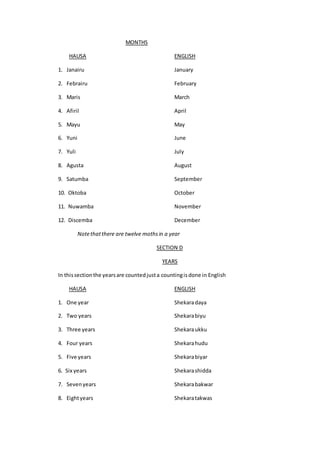
  • 41.
    EXAMPLE:- Buyer: A inaaka sayan Wheredo theysell `Doya` Barkono? Nama? Manja? Wake? Gishiri? Bammi? Riga? Where do they sell Yams? Peper? Meat? Palm-oil? Beans? Salt? Palm-wine? Cloth? Seller A wancanwutin,kusada dai mai-tuwo It is there nearthe foodseller 5. Buyer Nawa-nawane doya? How muchdoesthe yam cost? Seller NariaUku Three Naria 6. Buyer Ta na da tsada It istoo dear Seller Sam,ba tsada It isnot dear at all 7. Buyer Nariabiyufa? What of twoNaria Seller Al-barka Notacceptable 8. Buyer Nawanengaskiyarta What isthe lastprice? Seller Nariabiyusa sule biyar Two nariafiftykobo 9. Buyer Ka karbi Naria biyumana Take two Naria Seller To, kawokudin Alright,pay 10. Buyer Kana da canjinNariabiyar? Do youhave five Nariachange Seller Akwai There is 11. Buyer Ga/shi Here is it(take) Seller Allahshi amfana May God blessyou 12. Buyer Allahyaba kasuwa May God bringsales Seller Amin,nagode Amen,thankyou
  • 42.
    CHAPTER 7 TRAVELLING SITUATIONS NAMESOF DIFFRENT KINDS OF TRANSPORT AND NOUNS RELATED TO TRAVELLING HAUSA ENGLISH a. Tafiya Travel or Journey b. Mota Car c. Jirgin-kasa Train d. Jirgin-ruwa Ship e. Jirgin-sama Aeroplane f. Bas Bus g. Keke Bicycle h. Babur Motor-cycle i. Matuki or mai-tuki Driver j. Kaya Load k. Tagzi/tasi Taxi l. Mai-ziyara Visitor m. Hanya Road n. Titi Way o. Kwararo Street p. Bako Stanger POSSIBLECONVERSATION WHEN NEGOTIATINGSFORA TAXI HAUSA ENGLISH a. PASSENGER Mai Tagzi?Tasi (Wavingforthe driverto stop) DRIVER Ina Zuna To where b. PASSENGER LayinMai-Yamba,Kano Mai-YambaStreet,Kano DRIVER KawoNaria Daya Pay one Naria c. PASSENGER Zan Ba/da Sule Biyar I will payfiftykobo DRIVER To, Shigo Okay,enter d. PASSENGER Direbatsaya,Mun iso Driver,stopi have reachedmy destination DRIVER KawoKudinka Pay yourmoney e. PASSENGER Gashi Here it is,take f. PASSENGER Sai anjima Good-bye DRIVER To, sai anjima Okay,bye-bye 3. INFORMINGNEIGHOBOURSABOUT AN INTENDEDJOURNEY a. Ina so inyi tafiyayau I wantto travel today RespIna za ka je Where are yougoing? b. Zan tafi Jos I am goingto Jos RespYause za/ka dawo Whenwill youreturn

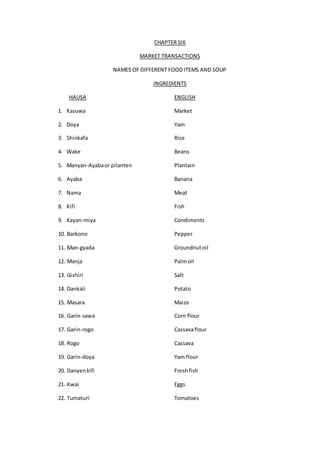
  • 43.
    c. Zan dawomakomai zuwa I shall returnnextweek d. Ina rokonka,kalura mani da gida Please,take care of my house RespTo, shi ke nan Okay,itsright HAUSA ENGLISH e. Sai ka dawo Till youare back Resp.Allahyayarda May God make itso 4. FINDINGYOUR WAY a. Ina tashar mota Where isthe motor park? b. Na bata I have missedmyway c. Nunamani hanya Directme 5. BOARDINGA VEHICLE a. Motan nan za/ta Josme Is thismotorgoingto Jos b. Nawane kudinmotazuwaJos? How muchis the fare to Jos c. To, ga kudinmota Okay,here isthe tansport fare 6. CAUTIONINGTHE DRIVER a. Hankali fadireba Driver,be careful b. Kana gududa yawa You are speedingtomuch c. Bamu Sontukinganganci We dont’twantrecklessdriving
  • 44.
    CHAPTER 8 DINNING SITUATION SOMEDINNING RELATED NOUNS HAUSA ENGLISH 1. Gidan-Abinci Restaurant 2. Faranti Plate 3. Cokali Spoon 4. Kofi Cup 5. Shinkafa Rice 6. Nama Meat 7. Wuka Knife 8. Miyar-Genye/Haushe Vegetable soup/leavessoup 9. Miya-kifi Fish-soup 10. Miya Soup 11. Ruwa Water 12. Ruwan-sanyi Coldwater 13. Sakwara Poundedyam 14. TuwonShinkafa Foodmade of rice 15. TuwonMasara Foodmade of maize 16. Teba Foodmade of cassava flourgari Note:Tuwomeansfood.The letter`N` isaddedto be usedas a short formof `Tuwona Shinkafa` whichmeansfoodmade of rice (The HausaFavourite Dish) a. POSSIBLECONVERSATION ASKING FOR FOOD 1. Customer:- InaJinYunwa I am hungry Foodseller:- Me kake soka ci What do youwant to eat 2. Customer:-WannaIrinabinci kuke What kindof foodare available da shi/ke akwai? here? Foodseller:- MunnadaTeba,da We have gari,rice and beans 3. Customer:-A bani Shinkafadawake Give me rice andbeans 4. Customer:- Nawane flamdaya How muchis one plate Foodseller:- Nariadaya One Naria 5. Customer:- Name fa? What of meat? Foodseller:- Sule dayane Tenkobo perprice
  • 45.
    6. Customer:- Aba ni tsokar namaguda biyar Give me five piecesof meat Foodseller:- To I have heard 7. Customer:- Nawane jimilarkudin How muchis that total sum Foodseller:- Nairadayadasullai biyar One Nariafiftykobo 8. Customer:- Gakudinki/ka Have your money Foodseller:- Nagoda Thank you 9. Customer:- Abincinnadadai The foodis verynice 10. Customer:- Abincinbadadi The foodis not nice b. ASKINGFORWATER 1. Customer:- A bani rewansha Give me drinkingwater Seller:- Inasuwa I am coming 2. Customer:- Ruwanwankabanufa What of waterto wasmy hand? Seller:- Inakawowa I am bringingit 3. Customer:- A ha/ni kofi Give me drinkingcup Seller:- To Alright c. OTHER REQUESTS 1. Customer:- Babucokali a nan There isno spoonhere Seller:- Inkowowa I am coming 2. Customer:- Bani gishir I needsalt Seller:- Inazuwa I am coming 3. Customer:- A kara mani shinkafa I wantmore rice Seller:- Tanawa? How muchworth? 4. Customer:- Tasule biyar Fiftykoboworth Seller:- Gata nan Here it is 5. Customer:- Nagode Thank youverymuch Seller:- To,madalla I am grateful d. SUBSTITUTION TABLE TO AID PRACTICE Ruwa Gishiri Water Salt
  • 46.
    A bani Cokali Miya Rowanwankahannu Canji Tsire Give me Spoon Soup Waterforwashingmy hand Change (Suya) e. ASKINGFORDRINKS HAUSA ENGLISH 1. Customer:- Akwai burkutune? Is there anyburkutu (Local beer)(wine beer) Seller:-Babuburkutu There isno beer 2. Customer:- Sai mai? What isavailable? Seller:-Saidai giyankwalba It isonlybeer 3. Customer:- A ba/ni kwalbargiwadaya Give me one bottle of beer Seller:-InaKawowa I am bringingit 4. Customer:- Nwane kudinkwalba? How muchper bottle? Seller:- Nariadaya One Naria 5. Customer:- To,A kawo kwalbabiyu Okay,bringtwo bottles Seller:- Kanasonmai sanyne? Do youwant the cold one 6. Customer:- A`azan sha mara sanyi No, I will drinkthe warmone Seller:- Inakawowa I will bringit 7. Customer:- Kunadalemu Do youhave Fanta? Seller:- Akwai It isavailable 8. Customer:- A bani kwalbalemu mai sanyi fa Give me one bottle of softdrink Seller:- To Okay 9. Customer:- Nawane? How muchis it? Seller:- Sulebiyu Twentykobo f. INVITATION TODINNING 1. Zo mu ci abinci Come and eat Resp.Na koshi Thank you,I have hadenough
  • 47.
    2. Me kaci haka? What have youeaten? Resp.Nacitwonor Na riga na ci abinci I have eatenfood,made of rice Note:Burkutuisa local brewedwine
  • 48.
    CHAPTER 9 EMOTIONAL EXPRESSIONS Thischapterteachershowone mayexpresshisorher feelingsof love,fear,approval, disapproval etc. APPEALS AND WARNING 1. Please letusnotdo that Dan Allahkadamuyi haka 2. Dont’tdo that again Kada kasake fadinhaka 3. Dont’tdo it please Don Allahkadakayi shi 4. Please,don’tdothatagain Don Allahkadasake yinshi 5. Don’tovertake (don’tpass) Kada ka wuce 6. Run carefullyonthe road Kayi tafiyada hankali atiti 7. Kindlysweephereclean A share nan da kyau 8. Don’tdirtythe place Kada ka bata wurinnan 9. Give itto me please Bani wanna abin 10. Please leave me alone Kada ka dame ni 11. Please don’tsayso Ka ka fada hakamana 12. I don’twant thatnow please Ba ni sonhaka yanzu 13. That is toobad of him/her,don’tjoinhimplease Haka bashi da kyankada ka hada kai da su 14. Please don’tputme introuble Kada ka sani cikinmatsala DISAPPROVALS 15. I am not happywithyouraction Banji dadinabinda kayi ba 16. I am surprisedatit Nayi mamakin abin 17. I am afraidof him Ina jinshakkarshi 18. That is nottrue Haka ba gaskiyaba ne 19. He didbadly Baiyi daidai ba 20. I don’tlike whatyoudid Bani son abinda kayi 21. It’stoo bad of you Ba ka kyanta ba kokadan
  • 49.
    22. I hatesuch thing Ba ni sonirinwannan 23. It islate An makara 24. In don’tagree Ban yarda ba 25. I don’tunderstand Ban gane ba 26. I will notbuy Ba zan saya ba 27. I am angry: itannoyedme Naji haushi-abinyabatamanirati WARMWORDS 28. I am happy Ina farinci ki 29. Thisdressfits youverywell Wannan rigatayi makakyau 30. I love you Ina sonka 31. I like yourbehaviour Ina sonhalinka 32. I like hisbehaviour Ina sonhalinsa 33. I like thathouse Ina songidancan 34. That is goodof you Ka yanta 35. You workveryhard Kayi akinka da gaske 36. Your clothsare verynice Tufatinka sunasa kyau 37. I love myhusband Ina sonmai gidana (miji) 38. I love mywife Ina sonmata na 39. You are happy Ka jinfarinciki 40. Enjoywithus Mu shakatatare 41. You are verybeautiful Kinna da kyau 42. I needyou Ina nemanka 43. Today isa happyday Yau rana farinciki ce 44. Are you happy? Kana da farinciki? 45. I admire you Nayi sha awar ki 46. You are a veryprettygirl Ke yarin ce mai kyan 47. I like Fionaverymuch Ina so Fionakwarai da gaske
  • 50.
    48. My dearjoyMasoyitaitajoy 49. My lover Masoyi na 50. You are lovely,youare sweet Kinada kyau,kyawongaske 51. My love Masoyi na 52. My adams Adamsnawa
  • 51.
    CHAPTER 10 Simple sentencesevrydayevents,idom,slangs,andproverbs This chapter contains many sentences and expression that are common in daily life. It is meantto take care if simple communicationneeds, helpsyouconstructrelated sentences and gives youthe knowledgeof furtherbasicvocabulary,idoms and proverbs are also included in specifically selected sections. 1. Let us go and work Mu tafi mu yi aiki 2. Let us go and eat Mu tafi mu ci abinci 3. Please switch on the light Don Allah, kasha wuta 4. It is alright Yu ui daidai 5. It is good Yan a da kyau 6. God forbid Allah ya kiyaye 7. I am going to the market Zan tafi kasuwa 8. Have patience for God sake, please Kayi hakuri don Allah 9. Please come Don Allah, zo mana 10. I am coming Ina zuwa 11. I want to eat Ina son in ci (binci) 12. Give me music please Ka sa munakida mana 13. When we come to eat Idan muka zo cin abinci 14. You are a good boy Kai, yaro kirki ne 15. I have eaten Na chi abinci 16. Come and see her Zo ka gan ta 17. Mr. Waters has no manners Mr. Waters bashi da halin kirki 18. Go away from here Tafi daga nan 19. Don’t go away Kada ka bar nan 20. Don’t make noise Kada kayi sirutu 21. Peter has money Peter yana da kudi 22. Amen Amin 23. What is your name my friend Mene ne sunanka, abokina?
  • 52.
    24. We aregoing to the church Zamu tafi chochi (coci) 25. It is time Lokoci yayi 26. What do you want? Me kake so? 27. What did you say please? Me ka fada? 28. Please buy a book for me Don Allah ka saya mani littfi 29. Have you eaten? Ka ci abin dai? 30. Have you spoken? Kayi 52agana dai 31. Let us dance please Mu yi rawa mana 32. I am hungry Ina jin yunwa 33. I am felling sleepy Ina jin barci 34. Have you come? Ka zo? 35. She has come Ta zo 36. I want to see you to-night, please Ina son ganinki da yam ma 37. I have food Ina da abinci 38. Come tonight please Ki zo da yamma 39. The sun is shining well Rana ta fito sosai 40. Please give me hot water Ina son ka bani ruwa zafi 41. We are going Mun tafi 42. I don’t..........(agree) Ban yarda ta 43. Sit down Sauna 44. Don’t beg me please Kada ka rook ni 45. Why are you not writing Me yasa baka rebutu 46. There should be no taking Ka da a yi 52agana 47. Answer your names Ku karba sunayen ku 48. Why did you do it today? Me yasa kayi shi yau? 49. Why didyoucome late? Me yasa ka makara? 50. Is it time? Lokaci yayi?
  • 53.
    51. You didnot get it Baka same shi ba? 52. You failed it? Baka yi nasara ba? 53. That is correct Yayi dai dai 54. Don’t look into your neighbours paper Duba takardar abokinka kada ka
  • 54.
    APPENDIX 1 ALPHABETS CAPITAL LETTERS AB C D E F G H I J K L M O N P R S T U V Q U V W X Y Z SMALL LETTERS a b c d e f g h i j k l m o n p q r s t u v w x y z VOWELS A’a, E’e, I’i, O’o, U’u APPENDIX 11 A. NOUNSRELATED TO HUMAN BODY HAUSA ENGLISH 1. Kai Head 2. Hannu Hand 3. Kafa Leg 4. Ido Eye 5. Hanci Noise 6. Baki Mouth 7. Yatsa Finger 8. Yatsar-kafa Toe 9. Harshe Toe 10. Kunne Ear 11. Ciki Stomach 12. Wuya Neck 13. Jini Blood 14. Jiki Body 15. Hakori Tooth
  • 55.
    B. NOUNSRELATED TOTHE HOME HAUSA ENGLISH 1. Gida House 2. Kofa Door 3. Gado Bed 4. Kujera Chair 5. Tebur Table 6. Riga Cloth 7. Tsintsiya Broom 8. Madafi Kitchen 9. Tabarma Mat 10. Takalmi Shoe 11. Haske Light 12. Wuta Wire 13. Sabulu Soap 14. Allura Needle 15. Ashana Matches 16. Bokiti Bucket C. NOUNSRELATED TO ANIMALS 1. Dan-Adam Human being 2. Mutum Person 3. Dabba Animal 4. Akuya Goat 5. Tunkiya Sheep 6. Maciji Snake 7. Shanu Cattle 8. Kaza Fowl
  • 56.
    9. Bera Rat 10.Kadangare Lizard 11. Doki Horse 12. Sauro Mosquito 13. Kunama Scorpion 14. Kare Dog 15. Tsunstu Bird D. NOUNSRELATED TO SCHOOL 1. Makaranta School 2. Littafi Book 3. Dalibi Student 4. Malami Teacher 5. Alli Chalk 6. Tambaya Question 7. Jaka Bag 8. Shugaba Leader 9. Amsa Answer 10. Jarabawa Examination E. NOUNSRELATED TO HUMAN RELATIONS 1. Baba Father 2. Mama Mother 3. Da/Diya(dependingonthe sex) Child 4. Kani JuniorBrother 5. Kanuwa JuniorSister 6. Miji Husband 7. Aboki Friend 8. Mata Wife
  • 57.
    9. Makwabci Neighbour 10.Namiji Man 11. Mace Woman 12. Yaro Boy 13. Yarinya Girl 14. Jinjiri Infant (Child) 15. Ya’mace Daughter 16. Iyaye Parent 17. Barawo Thief F. NOUNSRELATED TO CLIMATE & WHEATHER 1. Rana Sun 2. Ruwansama Rainfall 3. Wata Moon 4. Hunturu Harmattan 5. Rani Dry season 6. Kura Dust 7. Tauraro Star 8. Iska Wind G. NOUNSRELATED TO RELIGION 1. Allah God 2. Masallachi Mosque 3. Adua’a/Salla Prayer 4. Al-junanna Heaven 5. Jahannama Hell 6. Al-barka Blessing
  • 58.
    COMMON VERBS VERBS AREWORDS THAT ENABLE US TO MAKE ASSERTIONS 1. So To love 2. Gaisar To greet 3. Ci To eat 4. Share To clean 5. Nemi To seek 6. Samo To find 7. Fita To go out 8. Shiga To come in 9. Gama To finish 10. Haifa To deliver(Child) 11. Yarda To agree 12. Sata To steal 13. Yi barci To sleep 14. Huta To rest 15. Manta To forget 16. Gani To see 17. Ce/fadi To say 18. Bayar To give 19. Mutu To die 20. Tafi daga nan To go away 21. Zauna To sit down 22. Tsuguna To kneel down 23. Amsa To answer 24. Taka To walk 25. Yi ajki To work
  • 59.
    26. Sayi Tobuy 27. Yi wasa To play 28. Tashi tsaye To stand up 29. Jira To wait 30. Sani/gano To know 31. Sha To drink 32. gudu To run 33. Karanta To read 34. Duba To look 35. Shiga To enter 36. bayyana To explain 37. Nuna To show 38. Yanka To cut 39. Sunsuna To smell 40. Koyi To lean 41. Koyar To teach 42. Iso To arrive 43. Zaga To abuse 44. Sadu To meet 45. Kira To call 46. Kanya To break 47. Rubutu To write 48. Yafe To forgive 49. Roki To beg 50. Taimaka To help 51. Fadi To tell 52. Tambayi To ask
  • 60.
    53. Gane/Fachinci Tounderstand 54. Yi fitsari To urinate 55. Gargadi To warn PERSONAL PRONOUNS S/N NUMBER PRONOUNSENGLISH PRONOUNSHAUSA EXAMPLE OF USAGE 1. 1st PersonSingular 2. 2nd PersonSingular (f)(m) 3. 3rd PersonSingular (f)(m) 4. 1st PersonPlural 5. 2nd PersonPlural 6. 3rd Person I’ Me You He; She We You They Ni Ke Kai Ita Shi Mu Ku Su i see you;yousee me inganka; ka, gan ni youare a goodperson mana na kirki,kai mutuminkirki ne;ke mutuminyarkirki ce It ishe that answer, she isgoinghome.She nay a ka amsa, itace ta tafi We are going– muna tafiya Will yougo? I will call Za kuje?Zankira ku Theysaw me,Sungan ni POSSESSIVE PRONOUNS S/N ENGLISH HAUSA EXAMPLE OF USAGE 5 Mine 6. Yours (Singular) 7. His/Hers Hers 8. Ours 9. Yours (Plural) 10. Theirs Nawa,Tawa (f)(m) Naka (m) Taka (f) Nashi/Nata Tata Namu Naku Nasu Thisbox is mine Wannan Akwatinnawane Wannan Akwatintaw ace That bag is yours Wancan Jakar taka ce All thatmoneyishers Duk kudincannata ne Jakar Tata ce That house isours Wancan gidannamu ne Thismoneyisyours Wannan kudinnakune Thisloadis theirs
  • 61.