Copyright © 2010 Pearson Education, Inc.
14-7 Superposition and Interference
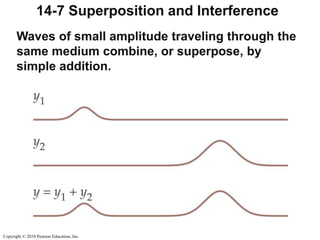
Waves of small amplitude traveling through the
same medium combine, or superpose, by
simple addition.
Copyright © 2010 Pearson Education, Inc.
14-7 Superposition and Interference
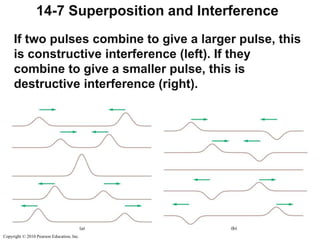
If two pulses combine to give a larger pulse, this
is constructive interference (left). If they
combine to give a smaller pulse, this is
destructive interference (right).
Copyright © 2010 Pearson Education, Inc.
14-7 Superposition and Interference
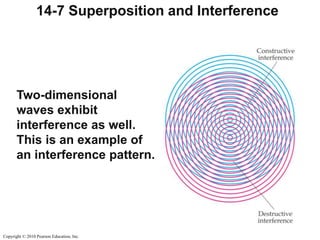
Two-dimensional
waves exhibit
interference as well.
This is an example of
an interference pattern.
Copyright © 2010 Pearson Education, Inc.
14-7 Superposition and Interference
Here is another example of an interference
pattern, this one from two sources. If the
sources are in phase, points where the distance
to the sources differs by an equal number of
wavelengths will interfere constructively; in
between the interference will be destructive.
Copyright © 2010 Pearson Education, Inc.
14-8 Standing Waves
A standing wave is fixed
in location, but oscillates
with time. These waves
are found on strings with
both ends fixed, such as
in a musical instrument,
and also in vibrating
columns of air.
Copyright © 2010 Pearson Education, Inc.
14-8 Standing Waves
The fundamental, or lowest, frequency on a fixed
string has a wavelength twice the length of the
string. Higher frequencies are called harmonics.
Copyright © 2010 Pearson Education, Inc.
14-8 Standing Waves
There must be an integral number of half-
wavelengths on the string; this means that only
certain frequencies are possible.
Points on the string which never move are called
nodes; those which have the maximum
movement are called antinodes.
Copyright © 2010 Pearson Education, Inc.
In order for different
strings to have different
fundamental
frequencies, they must
differ in length and/or
linear density.
A guitar has strings that
are all the same length,
but the density varies.
14-8 Standing Waves
Copyright © 2010 Pearson Education, Inc.
14-8 Standing Waves
In a piano, the strings vary in both length and
density. This gives the sound box of a grand
piano its characteristic shape.
Once the length and material of the string is
decided, individual strings may be tuned to the
exact desired frequencies by changing the
tension.
Musical instruments are usually designed so
that the variation in tension between the
different strings is small; this helps prevent
warping and other damage.
Copyright © 2010 Pearson Education, Inc.
14-8 Standing Waves
Standing waves can also be
excited in columns of air,
such as soda bottles,
woodwind instruments, or
organ pipes.
As indicated in the drawing,
one end is a node (N), and
the other is an antinode (A).
Copyright © 2010 Pearson Education, Inc.
14-8 Standing Waves
In this case, the fundamental wavelength is four
times the length of the pipe, and only odd-
numbered harmonics appear.
Copyright © 2010 Pearson Education, Inc.
14-8 Standing Waves
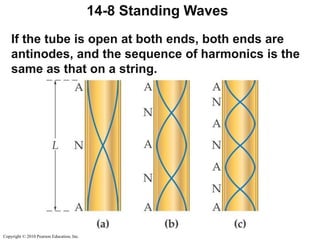
If the tube is open at both ends, both ends are
antinodes, and the sequence of harmonics is the
same as that on a string.
Copyright © 2010 Pearson Education, Inc.
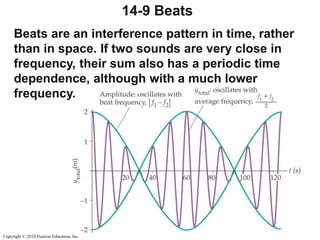
14-9 Beats
Beats are an interference pattern in time, rather
than in space. If two sounds are very close in
frequency, their sum also has a periodic time
dependence, although with a much lower
frequency.
Copyright © 2010 Pearson Education, Inc.
Summary of Chapter 14
• A wave is a propagating disturbance.
• Transverse wave: particles move at right angles
to propagation direction
• Longitudinal wave: particles move along
propagation direction
• Wave speed:
• Speed of a wave on a string:
Copyright © 2010 Pearson Education, Inc.
Summary of Chapter 14
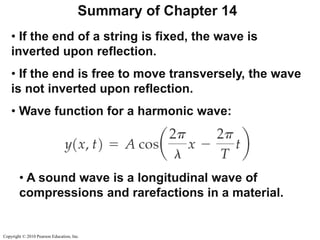
• If the end of a string is fixed, the wave is
inverted upon reflection.
• If the end is free to move transversely, the wave
is not inverted upon reflection.
• Wave function for a harmonic wave:
• A sound wave is a longitudinal wave of
compressions and rarefactions in a material.
Copyright © 2010 Pearson Education, Inc.
Summary of Chapter 14
• High-pitched sounds have high frequencies;
low-pitched sounds have low frequencies.
• Human hearing ranges from 20 Hz to 20,000 Hz.
• Intensity of sound:
• Intensity a distance r from a point source of
sound:
Copyright © 2010 Pearson Education, Inc.
Summary of Chapter 14
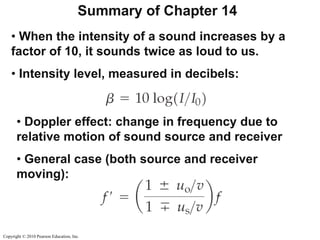
• When the intensity of a sound increases by a
factor of 10, it sounds twice as loud to us.
• Intensity level, measured in decibels:
• Doppler effect: change in frequency due to
relative motion of sound source and receiver
• General case (both source and receiver
moving):
Copyright © 2010 Pearson Education, Inc.
Summary of Chapter 14
• When two or more waves occupy the same
location at the same time, their displacements
add at each point.
• If they add to give a larger amplitude,
interference is constructive.
• If they add to give a smaller amplitude,
interference is destructive.
• An interference pattern consists of constructive
and destructive interference areas.
• Two sources are in phase if their crests are
emitted at the same time.
Copyright © 2010 Pearson Education, Inc.
Summary of Chapter 14
• Two sources are out of phase if the crest of one
is emitted at the same time as the trough of the
other.
• Standing waves on a string:
• Standing waves in a half-closed
column of air:
Copyright © 2010 Pearson Education, Inc.
Summary of Chapter 14
• Standing waves in a fully open column of air:
• Beats occur when waves of slightly different
frequencies interfere.
• Beat frequency:

16457258.ppt

  • 1.
    Copyright © 2010Pearson Education, Inc.
  • 2.
    Copyright © 2010Pearson Education, Inc. 14-7 Superposition and Interference Waves of small amplitude traveling through the same medium combine, or superpose, by simple addition.
  • 3.
    Copyright © 2010Pearson Education, Inc. 14-7 Superposition and Interference If two pulses combine to give a larger pulse, this is constructive interference (left). If they combine to give a smaller pulse, this is destructive interference (right).
  • 4.
    Copyright © 2010Pearson Education, Inc. 14-7 Superposition and Interference Two-dimensional waves exhibit interference as well. This is an example of an interference pattern.
  • 5.
    Copyright © 2010Pearson Education, Inc. 14-7 Superposition and Interference Here is another example of an interference pattern, this one from two sources. If the sources are in phase, points where the distance to the sources differs by an equal number of wavelengths will interfere constructively; in between the interference will be destructive.
  • 6.
    Copyright © 2010Pearson Education, Inc. 14-8 Standing Waves A standing wave is fixed in location, but oscillates with time. These waves are found on strings with both ends fixed, such as in a musical instrument, and also in vibrating columns of air.
  • 7.
    Copyright © 2010Pearson Education, Inc. 14-8 Standing Waves The fundamental, or lowest, frequency on a fixed string has a wavelength twice the length of the string. Higher frequencies are called harmonics.
  • 8.
    Copyright © 2010Pearson Education, Inc. 14-8 Standing Waves There must be an integral number of half- wavelengths on the string; this means that only certain frequencies are possible. Points on the string which never move are called nodes; those which have the maximum movement are called antinodes.
  • 9.
    Copyright © 2010Pearson Education, Inc. In order for different strings to have different fundamental frequencies, they must differ in length and/or linear density. A guitar has strings that are all the same length, but the density varies. 14-8 Standing Waves
  • 10.
    Copyright © 2010Pearson Education, Inc. 14-8 Standing Waves In a piano, the strings vary in both length and density. This gives the sound box of a grand piano its characteristic shape. Once the length and material of the string is decided, individual strings may be tuned to the exact desired frequencies by changing the tension. Musical instruments are usually designed so that the variation in tension between the different strings is small; this helps prevent warping and other damage.
  • 11.
    Copyright © 2010Pearson Education, Inc. 14-8 Standing Waves Standing waves can also be excited in columns of air, such as soda bottles, woodwind instruments, or organ pipes. As indicated in the drawing, one end is a node (N), and the other is an antinode (A).
  • 12.
    Copyright © 2010Pearson Education, Inc. 14-8 Standing Waves In this case, the fundamental wavelength is four times the length of the pipe, and only odd- numbered harmonics appear.
  • 13.
    Copyright © 2010Pearson Education, Inc. 14-8 Standing Waves If the tube is open at both ends, both ends are antinodes, and the sequence of harmonics is the same as that on a string.
  • 14.
    Copyright © 2010Pearson Education, Inc. 14-9 Beats Beats are an interference pattern in time, rather than in space. If two sounds are very close in frequency, their sum also has a periodic time dependence, although with a much lower frequency.
  • 15.
    Copyright © 2010Pearson Education, Inc. Summary of Chapter 14 • A wave is a propagating disturbance. • Transverse wave: particles move at right angles to propagation direction • Longitudinal wave: particles move along propagation direction • Wave speed: • Speed of a wave on a string:
  • 16.
    Copyright © 2010Pearson Education, Inc. Summary of Chapter 14 • If the end of a string is fixed, the wave is inverted upon reflection. • If the end is free to move transversely, the wave is not inverted upon reflection. • Wave function for a harmonic wave: • A sound wave is a longitudinal wave of compressions and rarefactions in a material.
  • 17.
    Copyright © 2010Pearson Education, Inc. Summary of Chapter 14 • High-pitched sounds have high frequencies; low-pitched sounds have low frequencies. • Human hearing ranges from 20 Hz to 20,000 Hz. • Intensity of sound: • Intensity a distance r from a point source of sound:
  • 18.
    Copyright © 2010Pearson Education, Inc. Summary of Chapter 14 • When the intensity of a sound increases by a factor of 10, it sounds twice as loud to us. • Intensity level, measured in decibels: • Doppler effect: change in frequency due to relative motion of sound source and receiver • General case (both source and receiver moving):
  • 19.
    Copyright © 2010Pearson Education, Inc. Summary of Chapter 14 • When two or more waves occupy the same location at the same time, their displacements add at each point. • If they add to give a larger amplitude, interference is constructive. • If they add to give a smaller amplitude, interference is destructive. • An interference pattern consists of constructive and destructive interference areas. • Two sources are in phase if their crests are emitted at the same time.
  • 20.
    Copyright © 2010Pearson Education, Inc. Summary of Chapter 14 • Two sources are out of phase if the crest of one is emitted at the same time as the trough of the other. • Standing waves on a string: • Standing waves in a half-closed column of air:
  • 21.
    Copyright © 2010Pearson Education, Inc. Summary of Chapter 14 • Standing waves in a fully open column of air: • Beats occur when waves of slightly different frequencies interfere. • Beat frequency: