Presented at Biz & Legis
(as a part of Internship)
by
Soundararajan.R
Symbiosis Law School-NOIDA
SIU, Pune
www.bizandlegis.com
Universally Accepted
 Article 26 of 1948 Universal declaration of human
rights - “Everyone has the right to education”
 Directive principles of State policy under Article 45
(by then)
 Not enforceable and justifiable.
 Is there any justification for the right to education?
 Are there minimum guidelines for the right to
education?
08-06-2013 2
www.bizandlegis.com
Stepping Stone
 Dadabhai Naoroji and Jyothiba Phule were
pioneers who demanded free education in India.
 Education is a fundamental human right and
essential for the exercise of all other human rights. It
promotes individual freedom and empowerment
and yields important development benefits.
 The first regulation on compulsory education -
introduced by the State of Baroda (now Gujarat) in
1906. 08-06-2013 3
www.bizandlegis.com
Transformation..
 Free and Compulsory Education made its way
into the Constitution as a Directive Principle
of State Policy under former Article 45.
 States were required to ensure the provision
of Free and Compulsory Education to all
children till the age of fourteen years within a
period of ten years of the commencement of
the Constitution.
08-06-2013 4
www.bizandlegis.com
Amendments made…
 Article 21–A (education for children in the age
group of six to fourteen years)
 {Former} Article 45
 Article 51–A (k) (fundamental duty on parents)
08-06-2013 5
www.bizandlegis.com
After amendments
 Article 21-A : The State shall provide free and
Compulsory education to all children of the age of
six to fourteen years in such a manner as the State
may, by Law, determine.
 Art. 45: The State shall endeavour to provide early
childhood care and education for all children until
they complete the age of six years
 Art. 51 A (k): who is a parent or guardian to provide
opportunities for education to his child or, as the
case may be, ward between the age of six and
fourteen years.".
08-06-2013 6
www.bizandlegis.com
Constitutional Validity
 Came into force on April 1, 2010
 The Supreme Court in Society for Un-aided Private
Schools of Rajasthan v. U.O.I. & Anr. upheld the
constitutional validity of the Right to Education
Act, 2009, which mandates 25% free seats to the
poor in government and private unaided schools
uniformly across the country. Chief Justice S.H.
Kapadia said the act will apply uniformly to
government and unaided private schools except
unaided private minority schools.
08-06-2013 7
www.bizandlegis.com
Highlights
 Section 3(2) inter alia provides that no child shall
be liable to pay any kind of fee or charges or
expenses which may prevent him or her from
pursuing and completing the elementary
education.
 The other purpose of enacting Section 3(2) is to
prevent educational institutions charging
capitation fees resulting in creation of a financial
barrier which prevents a child from accessing or
exercising its right to education which is now
provided for vide Article 21A
08-06-2013 8
www.bizandlegis.com
 25% of seats in private schools for weaker
sections.
 A fixed student-teacher ratio should be
maintained.
 Commissions' to keep a check on schools
 The Schedule – provides basic norms and
forms for effective implementation of the
Act.
08-06-2013 9
www.bizandlegis.com
Judicial pronouncements
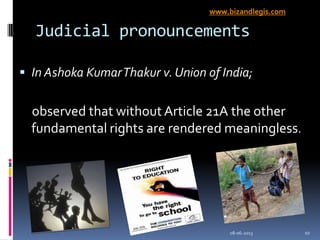
 In Ashoka KumarThakur v. Union of India;
observed that without Article 21A the other
fundamental rights are rendered meaningless.
08-06-2013 10
www.bizandlegis.com
 In Miss. Mohini Jain v. State of Karnataka and
Ors,
"right to education" u/art. 45 of the
Constitution a reality, the fundamental rights
under Chapter III shall remain beyond the
reach of the large majorities which are
illiterate. The State is under an obligation to
make an endeavor to provide educational
facilities at all levels to its citizens”.
08-06-2013 11
www.bizandlegis.com
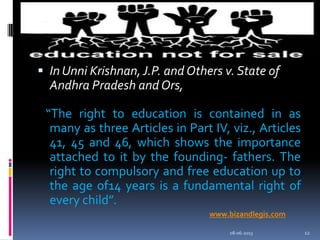
 In Unni Krishnan, J.P. and Others v. State of
Andhra Pradesh and Ors,
“The right to education is contained in as
many as three Articles in Part IV, viz., Articles
41, 45 and 46, which shows the importance
attached to it by the founding- fathers. The
right to compulsory and free education up to
the age of14 years is a fundamental right of
every child”.
08-06-2013 12
www.bizandlegis.com
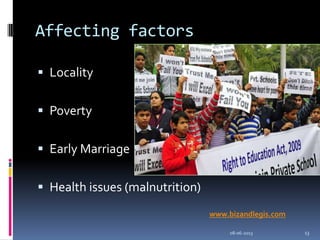
Affecting factors
 Locality
 Poverty
 Early Marriage
 Health issues (malnutrition)
08-06-2013 13
www.bizandlegis.com
Obligation
 Social face of India is poor and dark. A healthy;
happy and educated population is the basic
components and indicators of development and
progress of a nation.
The State is under obligation to provide
education facilities at affordable cost to all
citizens of the country. Private institutes (then)
are not under any such obligation and they are
running the education institutes purely as
commercial monetary profit earning activity.
08-06-2013 14
www.bizandlegis.com
Conclusion
 Every generation looks up to the next generation
with the hope that they will build up a nation
better than the present.
 Therefore, education which empowers the future
generation should always be the main concern
for any nation.
 It is the Sign of freedom, a controlling grace, and
basis of successful life. Education is not a
preparation for life; education is life in itself.
08-06-2013 15
www.bizandlegis.com
Writer can be reached at : nellai94@gmail.com
08-06-2013 16
www.bizandlegis.com

Right to Education

  • 1.
    Presented at Biz& Legis (as a part of Internship) by Soundararajan.R Symbiosis Law School-NOIDA SIU, Pune www.bizandlegis.com
  • 2.
    Universally Accepted  Article26 of 1948 Universal declaration of human rights - “Everyone has the right to education”  Directive principles of State policy under Article 45 (by then)  Not enforceable and justifiable.  Is there any justification for the right to education?  Are there minimum guidelines for the right to education? 08-06-2013 2 www.bizandlegis.com
  • 3.
    Stepping Stone  DadabhaiNaoroji and Jyothiba Phule were pioneers who demanded free education in India.  Education is a fundamental human right and essential for the exercise of all other human rights. It promotes individual freedom and empowerment and yields important development benefits.  The first regulation on compulsory education - introduced by the State of Baroda (now Gujarat) in 1906. 08-06-2013 3 www.bizandlegis.com
  • 4.
    Transformation..  Free andCompulsory Education made its way into the Constitution as a Directive Principle of State Policy under former Article 45.  States were required to ensure the provision of Free and Compulsory Education to all children till the age of fourteen years within a period of ten years of the commencement of the Constitution. 08-06-2013 4 www.bizandlegis.com
  • 5.
    Amendments made…  Article21–A (education for children in the age group of six to fourteen years)  {Former} Article 45  Article 51–A (k) (fundamental duty on parents) 08-06-2013 5 www.bizandlegis.com
  • 6.
    After amendments  Article21-A : The State shall provide free and Compulsory education to all children of the age of six to fourteen years in such a manner as the State may, by Law, determine.  Art. 45: The State shall endeavour to provide early childhood care and education for all children until they complete the age of six years  Art. 51 A (k): who is a parent or guardian to provide opportunities for education to his child or, as the case may be, ward between the age of six and fourteen years.". 08-06-2013 6 www.bizandlegis.com
  • 7.
    Constitutional Validity  Cameinto force on April 1, 2010  The Supreme Court in Society for Un-aided Private Schools of Rajasthan v. U.O.I. & Anr. upheld the constitutional validity of the Right to Education Act, 2009, which mandates 25% free seats to the poor in government and private unaided schools uniformly across the country. Chief Justice S.H. Kapadia said the act will apply uniformly to government and unaided private schools except unaided private minority schools. 08-06-2013 7 www.bizandlegis.com
  • 8.
    Highlights  Section 3(2)inter alia provides that no child shall be liable to pay any kind of fee or charges or expenses which may prevent him or her from pursuing and completing the elementary education.  The other purpose of enacting Section 3(2) is to prevent educational institutions charging capitation fees resulting in creation of a financial barrier which prevents a child from accessing or exercising its right to education which is now provided for vide Article 21A 08-06-2013 8 www.bizandlegis.com
  • 9.
     25% ofseats in private schools for weaker sections.  A fixed student-teacher ratio should be maintained.  Commissions' to keep a check on schools  The Schedule – provides basic norms and forms for effective implementation of the Act. 08-06-2013 9 www.bizandlegis.com
  • 10.
    Judicial pronouncements  InAshoka KumarThakur v. Union of India; observed that without Article 21A the other fundamental rights are rendered meaningless. 08-06-2013 10 www.bizandlegis.com
  • 11.
     In Miss.Mohini Jain v. State of Karnataka and Ors, "right to education" u/art. 45 of the Constitution a reality, the fundamental rights under Chapter III shall remain beyond the reach of the large majorities which are illiterate. The State is under an obligation to make an endeavor to provide educational facilities at all levels to its citizens”. 08-06-2013 11 www.bizandlegis.com
  • 12.
     In UnniKrishnan, J.P. and Others v. State of Andhra Pradesh and Ors, “The right to education is contained in as many as three Articles in Part IV, viz., Articles 41, 45 and 46, which shows the importance attached to it by the founding- fathers. The right to compulsory and free education up to the age of14 years is a fundamental right of every child”. 08-06-2013 12 www.bizandlegis.com
  • 13.
    Affecting factors  Locality Poverty  Early Marriage  Health issues (malnutrition) 08-06-2013 13 www.bizandlegis.com
  • 14.
    Obligation  Social faceof India is poor and dark. A healthy; happy and educated population is the basic components and indicators of development and progress of a nation. The State is under obligation to provide education facilities at affordable cost to all citizens of the country. Private institutes (then) are not under any such obligation and they are running the education institutes purely as commercial monetary profit earning activity. 08-06-2013 14 www.bizandlegis.com
  • 15.
    Conclusion  Every generationlooks up to the next generation with the hope that they will build up a nation better than the present.  Therefore, education which empowers the future generation should always be the main concern for any nation.  It is the Sign of freedom, a controlling grace, and basis of successful life. Education is not a preparation for life; education is life in itself. 08-06-2013 15 www.bizandlegis.com
  • 16.
    Writer can bereached at : nellai94@gmail.com 08-06-2013 16 www.bizandlegis.com