ATTITUDE OF YOUGSTERS TOWARDS DOWRY- A STUDY CONDUCTED IN
KOTTAYAM TOWN
ABSTRACT
Dowry system is one of the longest standing evils associated with marriage from a woman’s point of view in
the Indian society. There has been a dramatic change in the social structure sand thoughts, action and behavior of
people. But unfortunately the basic attitude still remains the same. This study is an attempt to find out the attitude
of youngsters towards dowry.
INTRODUCTON
Marriage is an integral part of society, a source of joy and festivities as well as of new beginnings. Yet, one of the
longest standing evils associated with marriage from a woman’s point of view in the Indian society is the Dowry
system. Despite a lot being said and done against the custom, it is still prevalent in the 21st century, in both subtle
and obvious ways. The root of a host of social atrocities against women, the custom of presenting dowry is the crudest
expression of the male-dominance in the society. It is most often the mandatory custom of a girl’s parents having to
provide a considerable amount of cash, gold in the form of jewelry, electronic equipment, movable or immovable
properties, to the groom and his family, at the time of marriage. Although the origin of the custom lies with parents
trying to assure financial stability for their daughters, in current perspective it has translated into parents paying up
for the assurance of well-being of their daughters. The jewelry and cash that a bride brings with her from her parents’
house is often referred to as “Streedhan” and in theory is the property of the girl, but in reality it is often treated as
their rightful due by the groom’s family. The sum to be paid as dowry has no set standard, the yardstick greatly
depends on the groom’s profession/social standing and is often perceived as the groom’s family as the compensation
of efforts they have made to educate their boy. In a more subtle perspective, one may define this custom as the
unquestioned idea that the girl’s family is inferior in standing with the boy’s family, no matter what her qualities are.
Thus they need to be on their best behavior and offer lavish “gifts” to please the boy’s family. This ideal is so
ingrained in the psyche of a large number of Indians, they either practically ruin themselves financially in order to
pay for the appropriate price of the chosen groom, or make a bid to eradicate the prospect of this financial burden by
selective gender-based abortion or female infanticide. This exploitative system that has turned the custom of giving
gifts and well wishes into a compulsory demand for money, respect and subjugation, is the one of the major
contributing factors hindering the growth of the Indian society where being a woman is still viewed synonymous to
being a burden
It is surprising that even in these days of the 21th century; we are still drowned in the dark depth of these evils. One
of the worst evils of Indian Society is the dowry system. The word ‘dowry’ means the property and money that a
bride brings to her husband’s house at the time of her marriage. It is a custom that is prevalent in all the sections of
our society in one form or the other. At the beginning it was voluntary, but later on the social pressure was such that
very few could escape from it.
The dowry at present is a source of both joy and curse in the society. It is also a joy to the husband and his relatives
who get cash, costly dress and utensils, furniture, bedding materials, etc. But, it is a curse to the bride’s parents who
have to bear enormous cost to satisfy the unreasonable demands of the bridegroom’s party. A demand of dowry does
not diminish even after marriage. The in-laws of the bride are very much ready in Indian homes to inflict harassment,
insults and tortures-both mental and physical. When more pressure is put on the bride’s parents, their dear daughter
has no other option but to commit suicide to avoid more insult and torture at the hands of the members of her
husband’s family.
This curse of Dowry System must be eradicated forth with at any cost. Women from every walk of life, literate or
illiterate, poor or rich, young or old must unite together and come forward to protect their own honour and interest.
Though the Government has promulgated certain anti-dowry laws, these have not produced the desired results.
People’s efforts are also necessary if this evil is to be removed once for all. The high expenditure of the marriage
ceremony must be cut down. Women must be empowered. Gender-based inequality should be completely abolished
and the position of women in the society should be raised. Women must be taught since girlhood that their life is not
useless without marriage. Girls should get the opportunity to get education at schools. After completion of school
education, they should be encouraged to have higher education. Proper education of girls would be helpful in
educating girls and women of their rights. Their age of marriage should be raised. They should be encouraged to
enter into various fields of paid jobs, as their higher economic status also discourages demands for dowry. The
practice of mass marriage should be encouraged for the sake of economy.
Causes of Dowry System
1. Greed Factor – dowry demands often is exemplary of the collective greed of the society. Extortion in the name of
social standing, compensation for the cost of groom’s education, his financial stability is a key feature of Indian
marriages. Demands are put forward shamelessly and are expected to be met with silence. Threats of withdrawing
the proposal loom on the bride’s
Family’s head at the cost of losing face in the community, and portions of the agreed upon sum is often demanded
before the actual ceremony.
2. Society Structure – the dowry system is largely the manifestation of the patriarchal nature of the Indian society
where men are considered superior to women in aspects of physical and mental capabilities. With the backdrop of
such societal structure, women are often considered second-tier citizens, fit to assume only domesticated roles. Such
perceptions are often associated of them being treated as a burden in economic terms first by the father and then by
the husband. This feeling is further compounded by the dowry system which fuels the belief that girl child is a
potential cause of drain of family finances.
3. Religious Dictates – Religious constraints imposed by the society on marriage customs, mainly suitability of groom
have a contributing factor towards the dowry problem. These constraints do not condone inter-religious marriages or
even between different religious sects and a suitable groom has to be found from the same religious backgrounds.
These restrictions limit the number of suitable matches. Boys of marriageable age with desirable qualifications
become a prize and this in turn encourages the practice of the catch being caught by the highest bidder.
4. Social Constraints – Aside from similar religious backgrounds, further constrains are imposed based on caste
system and social status. Practices like caste endogamy and clan exogamy, has to be kept in mind while arranging a
match. Preferred matches have to belong to the same caste, different clan and same or higher social standings. These
limitations again severely deplete the pool of marriageable men leading to similar consequences for demanding
dowry.
5. Social Status of Women – the inferior social standing of women in Indian society is so deep-rooted in the psyche
of the nation, that this treatment of them as mere commodities is accepted without question, not only by the family
but by the women themselves. When marriage is viewed as the ultimate achievement for women, evil practices like
dowry takes its roots deeper in the society.
6. Illiteracy – lack of formal education is another cause for the prevalence of the dowry system. A large number of
women are deliberately kept from schools either due to certain superstitions or from the belief that educating girls
will take away from their eligibility as good wives.
7.Propulsion Towards Adhering to Customs – Indians value traditions a lot and they tend not to question customs.
They follow traditions blindly and provide dowry because it is the norm handed down through generations.
Effects of Dowry System
1. Short Term Effects of Dowry System
These effects of the dowry system are immediate and are a permanent fixture in the daily news.
a). Injustice towards girls – dowry bears a huge financial obligation for the bride’s family. As a consequence, a girl
child is viewed a possible source of drain on the family’s finances, ultimately an onus.
b). Violence against women – contrary to hopeful parents, dowry is often not a one-time pay up. Demands are
continuously made by the husband’s family who consider the girl’s family as a never ending source of finance.
Inability by the girl’s family often leads to verbal abuse, domestic violence and even deaths.
c.) Economic burden – getting a girl married is associated with a hefty amount of money by Indian parents due to
direct or subtle demands for dowry by the groom’s family. Families often borrow heavily, mortgage properties
leading to major decline in economic health.
d.) Gender inequality – the idea of paying dowry in order to get a girl married generates an increased sense of
inequality among the genders, placing men superior to women. Young girls are kept from schools while their brothers
are given access to education.
2. Long Term Effects of Dowry System
The short term effects lead to the following long-term consequences
a). Gender imbalance – the much abhorred practices like abortion of female fetuses and killing of girl babies have
resulted into an unnaturally skewed child sex ratio (CSR) in India.
b.) Loss of self-esteem in women – in a country which has experienced centuries of inferior attitude towards women,
it is very hard to maintain a high level of self-regard if you are a woman. c.)Status of women –practices like dowry
are social evils and a huge deterrent towards improvement of social status of women in India. Inferiority of women
has been impressed upon the minds of the nation time and again by the demands of dowry.
LAW AGAINST DOWRY
The first all-India legislative enactment relating to dowry to be put on the statute book was The Dowry Prohibition
Act, 1961 and this legislation came into force from July 1, 1961. It marked the beginning of a new legal framework
of dowry harassment laws effectively prohibiting the demanding, giving and taking of dowry. Although providing
dowry is illegal, it is still common in many parts of India for a husband to seek a dowry from the wife's family and
in some cases, this result in a form of extortion and violence against the wife.
To further strengthen the anti-dowry law and to stop offences of cruelty by the husband or his relatives against the
wife, new provisions were added to the Indian criminal law - section 498A to Indian Penal Code and section 198A
to the Criminal Procedure Code in 1983. In 2005, the Protection of Women from Domestic Violence Act was passed,
which added an additional layer of protection from dowry harassment. Although the changes in Indian criminal law
reflect a serious effort by legislators to put an end to dowry-related crimes, and although they have been in effect for
many years now, they have been largely criticized as being ineffective.
NEED AND SIGNIFICANCE OF THE STUDY
Dowry is a custom turned as a social evil. The concept of equality among marital relationship is toppled by the
custom. Moreover human dignity of women is questioning through the custom. Women who have not enough money
or property are the worst sufferers Justice is denied to the females and the custom is beneficial to male. Dowry
System is so widespread that it has become a common problem to all families who have marriageable daughters. No
caste or system of family is free from. It was unfortunately become a mark of status and social prestige. Perhaps
dowry was meant or a kind of help for the new couple to set up house, but it has now become the norm by which the
social standing of the family is judged.
The size of dowry differs from person to person, family to family. Some time it decreases or increases according to
the rate in the marriage market. It is regulated by a number of traditional prescriptions, one among which is that a
girl must be married at the earliest. In their feverish anxiety to marry off their daughters, the parents reluctantly
submit to give a dowry and ruin themselves economically, and demean themselves while they play the waiting game
with respect to their sons in the hope of exacting maximum profit in the form of dowries. Money lost in giving a
dowry is regained in taking a dowry. The situation of Indian society is convenient ground for the development of the
dowry system. We follow Arranged marriage. It is considered as one of the respected and prestigious forms of
marriage. According to Indian parents, it is their obligation to arrange for the marriage of their daughters and sons.
Due to the caste system there is very limited area for the selection of life partners. This leads to high dowries.
OBJECTIVES OF THE STUDY
1. To find out the awareness of the respondents regarding dowry.
2. To study the attitude of youngsters toward the practice of dowry.
RESEARCH DESIGN
The research design is the master plan of a study that connects the empirical data to the research questions and
objectives. The nature of the present study is descriptive cum analysis based. Both the primary and secondary data
are used for the study; the primary data was collected through a sample survey. The study is based on primary as
well as secondary data. Secondary data are collected from books, journals, websites etc.
TOOLS USED FOR DATA COLLECTION
A structured questionnaire has been used for collecting data from sample. The first part of the questionnaire deals
with personal information of respondents and second part contains specific questions needed for the achievement of
objectives of the study.
UNIVERSE AND SAMPLE
Youngsters in the Kottayam town constitute the universe of the study. The respondents are selected randomly.
ANALYSIS OF DATA
In this chapter the researcher dealt with the analysis of collected data. Analysis of data held with the help of statistical
table. This chapter shows the socio-economic background of the respondents includes types of family, place of
residence, religion, educational qualification, income etc. This chapter also dealt with the awareness of the
respondents towards dowry. And the present chapter also aims at finding attitude of respondents towards dowry on
respondents.
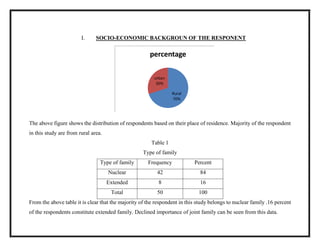
I. SOCIO-ECONOMIC BACKGROUN OF THE RESPONENT
Rural
70%
urban
30%
percentage
The above figure shows the distribution of respondents based on their place of residence. Majority of the respondent
in this study are from rural area.
Table 1
Type of family
Type of family Frequency Percent
Nuclear 42 84
Extended 8 16
Total 50 100
From the above table it is clear that the majority of the respondent in this study belongs to nuclear family .16 percent
of the respondents constitute extended family. Declined importance of joint family can be seen from this data.
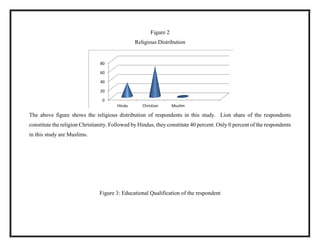
Figure 2
Religious Distribution
0
20
40
60
80
Hindu Christian Muslim
The above figure shows the religious distribution of respondents in this study. Lion share of the respondents
constitute the religion Christianity. Followed by Hindus, they constitute 40 percent. Only 0 percent of the respondents
in this study are Muslims.
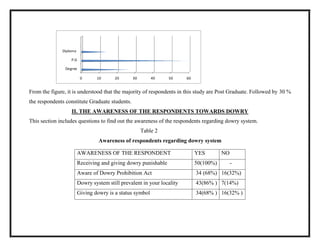
Figure 3: Educational Qualification of the respondent
0 10 20 30 40 50 60
Degree
P.G
Diploma
From the figure, it is understood that the majority of respondents in this study are Post Graduate. Followed by 30 %
the respondents constitute Graduate students.
II. THE AWARENESS OF THE RESPONDENTS TOWARDS DOWRY
This section includes questions to find out the awareness of the respondents regarding dowry system.
Table 2
Awareness of respondents regarding dowry system
AWARENESS OF THE RESPONDENT YES NO
Receiving and giving dowry punishable 50(100%) -
Aware of Dowry Prohibition Act 34 (68%) 16(32%)
Dowry system still prevalent in your locality 43(86% ) 7(14%)
Giving dowry is a status symbol 34(68% ) 16(32% )
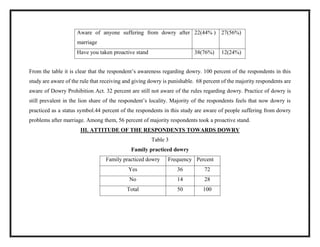
From the table it is clear that the respondent’s awareness regarding dowry. 100 percent of the respondents in this
study are aware of the rule that receiving and giving dowry is punishable. 68 percent of the majority respondents are
aware of Dowry Prohibition Act. 32 percent are still not aware of the rules regarding dowry. Practice of dowry is
still prevalent in the lion share of the respondent’s locality. Majority of the respondents feels that now dowry is
practiced as a status symbol.44 percent of the respondents in this study are aware of people suffering from dowry
problems after marriage. Among them, 56 percent of majority respondents took a proactive stand.
III. ATTITUDE OF THE RESPONDENTS TOWARDS DOWRY
Table 3
Family practiced dowry
Family practiced dowry Frequency Percent
Yes 36 72
No 14 28
Total 50 100
Aware of anyone suffering from dowry after
marriage
22(44% ) 27(56%)
Have you taken proactive stand 38(76%) 12(24%)
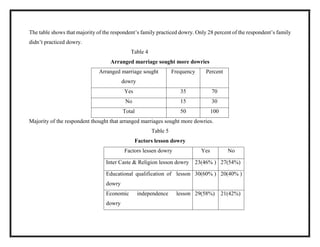
The table shows that majority of the respondent’s family practiced dowry. Only 28 percent of the respondent’s family
didn’t practiced dowry.
Table 4
Arranged marriage sought more dowries
Arranged marriage sought
dowry
Frequency Percent
Yes 35 70
No 15 30
Total 50 100
Majority of the respondent thought that arranged marriages sought more dowries.
Table 5
Factors lesson dowry
Factors lessen dowry Yes No
Inter Caste & Religion lesson dowry 23(46% ) 27(54%)
Educational qualification of lesson
dowry
30(60% ) 20(40% )
Economic independence lesson
dowry
29(58%) 21(42%)
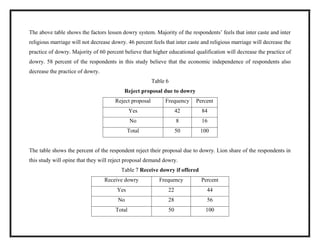
The above table shows the factors lessen dowry system. Majority of the respondents’ feels that inter caste and inter
religious marriage will not decrease dowry. 46 percent feels that inter caste and religious marriage will decrease the
practice of dowry. Majority of 60 percent believe that higher educational qualification will decrease the practice of
dowry. 58 percent of the respondents in this study believe that the economic independence of respondents also
decrease the practice of dowry.
Table 6
Reject proposal due to dowry
Reject proposal Frequency Percent
Yes 42 84
No 8 16
Total 50 100
The table shows the percent of the respondent reject their proposal due to dowry. Lion share of the respondents in
this study will opine that they will reject proposal demand dowry.
Table 7 Receive dowry if offered
Receive dowry Frequency Percent
Yes 22 44
No 28 56
Total 50 100
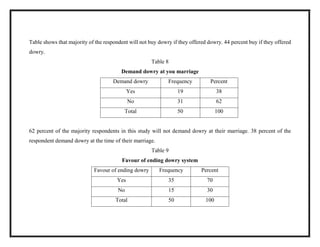
Table shows that majority of the respondent will not buy dowry if they offered dowry. 44 percent buy if they offered
dowry.
Table 8
Demand dowry at you marriage
Demand dowry Frequency Percent
Yes 19 38
No 31 62
Total 50 100
62 percent of the majority respondents in this study will not demand dowry at their marriage. 38 percent of the
respondent demand dowry at the time of their marriage.
Table 9
Favour of ending dowry system
Favour of ending dowry Frequency Percent
Yes 35 70
No 15 30
Total 50 100
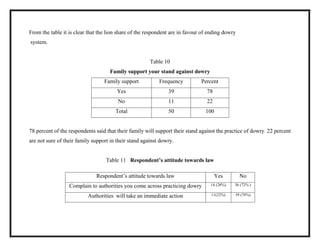
From the table it is clear that the lion share of the respondent are in favour of ending dowry
system.
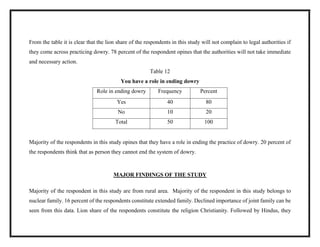
Table 10
Family support your stand against dowry
Family support Frequency Percent
Yes 39 78
No 11 22
Total 50 100
78 percent of the respondents said that their family will support their stand against the practice of dowry. 22 percent
are not sure of their family support in their stand against dowry.
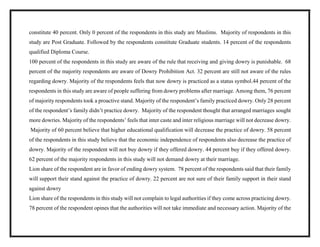
Table 11 Respondent’s attitude towards law
Respondent’s attitude towards law Yes No
Complain to authorities you come across practicing dowry 14 (28%) 36 (72% )
Authorities will take an immediate action 11(22%) 39 (78%)
From the table it is clear that the lion share of the respondents in this study will not complain to legal authorities if
they come across practicing dowry. 78 percent of the respondent opines that the authorities will not take immediate
and necessary action.
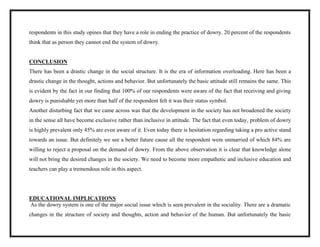
Table 12
You have a role in ending dowry
Role in ending dowry Frequency Percent
Yes 40 80
No 10 20
Total 50 100
Majority of the respondents in this study opines that they have a role in ending the practice of dowry. 20 percent of
the respondents think that as person they cannot end the system of dowry.
MAJOR FINDINGS OF THE STUDY
Majority of the respondent in this study are from rural area. Majority of the respondent in this study belongs to
nuclear family. 16 percent of the respondents constitute extended family. Declined importance of joint family can be
seen from this data. Lion share of the respondents constitute the religion Christianity. Followed by Hindus, they
constitute 40 percent. Only 0 percent of the respondents in this study are Muslims. Majority of respondents in this
study are Post Graduate. Followed by the respondents constitute Graduate students. 14 percent of the respondents
qualified Diploma Course.
100 percent of the respondents in this study are aware of the rule that receiving and giving dowry is punishable. 68
percent of the majority respondents are aware of Dowry Prohibition Act. 32 percent are still not aware of the rules
regarding dowry. Majority of the respondents feels that now dowry is practiced as a status symbol.44 percent of the
respondents in this study are aware of people suffering from dowry problems after marriage. Among them, 76 percent
of majority respondents took a proactive stand. Majority of the respondent’s family practiced dowry. Only 28 percent
of the respondent’s family didn’t practice dowry. Majority of the respondent thought that arranged marriages sought
more dowries. Majority of the respondents’ feels that inter caste and inter religious marriage will not decrease dowry.
Majority of 60 percent believe that higher educational qualification will decrease the practice of dowry. 58 percent
of the respondents in this study believe that the economic independence of respondents also decrease the practice of
dowry. Majority of the respondent will not buy dowry if they offered dowry. 44 percent buy if they offered dowry.
62 percent of the majority respondents in this study will not demand dowry at their marriage.
Lion share of the respondent are in favor of ending dowry system. 78 percent of the respondents said that their family
will support their stand against the practice of dowry. 22 percent are not sure of their family support in their stand
against dowry
Lion share of the respondents in this study will not complain to legal authorities if they come across practicing dowry.
78 percent of the respondent opines that the authorities will not take immediate and necessary action. Majority of the
respondents in this study opines that they have a role in ending the practice of dowry. 20 percent of the respondents
think that as person they cannot end the system of dowry.
CONCLUSION
There has been a drastic change in the social structure. It is the era of information overloading. Here has been a
drastic change in the thought, actions and behavior. But unfortunately the basic attitude still remains the same. This
is evident by the fact in our finding that 100% of our respondents were aware of the fact that receiving and giving
dowry is punishable yet more than half of the respondent felt it was their status symbol.
Another disturbing fact that we came across was that the development in the society has not broadened the society
in the sense all have become exclusive rather than inclusive in attitude. The fact that even today, problem of dowry
is highly prevalent only 45% are even aware of it. Even today there is hesitation regarding taking a pro active stand
towards an issue. But definitely we see a better future cause all the respondent were unmarried of which 84% are
willing to reject a proposal on the demand of dowry. From the above observation it is clear that knowledge alone
will not bring the desired changes in the society. We need to become more empathetic and inclusive education and
teachers can play a tremendous role in this aspect.
EDUCATIONAL IMPLICATIONS
As the dowry system is one of the major social issue which is seen prevalent in the sociality. There are a dramatic
changes in the structure of society and thoughts, action and behavior of the human. But unfortunately the basic
attitude of the human towards dowry remains the same. There should be a change in this attitude. Its can only happens
through education. We have to focus such social issues and make the students aware about it. So we can save our
nation from such social issues.
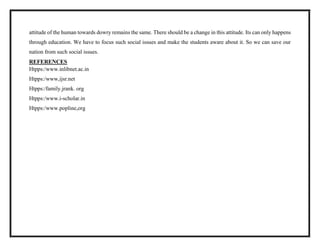
REFERENCES
Htpps:/www.inlibnet.ac.in
Htpps:/www,ijsr.net
Htpps:/family.jrank. org
Htpps:/www.i-scholar.in
Htpps:/www.popline,org
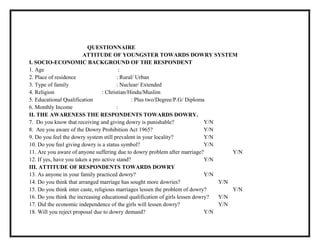
QUESTIONNAIRE
ATTITUDE OF YOUNGSTER TOWARDS DOWRY SYSTEM
I. SOCIO-ECONOMIC BACKGROUND OF THE RESPONDENT
1. Age :
2. Place of residence : Rural/ Urban
3. Type of family : Nuclear/ Extended
4. Religion : Christian/Hindu/Muslim
5. Educational Qualification : Plus two/Degree/P.G/ Diploma
6. Monthly Income :
II. THE AWARENESS THE RESPONDENTS TOWARDS DOWRY.
7. Do you know that receiving and giving dowry is punishable? Y/N
8. Are you aware of the Dowry Prohibition Act 1965? Y/N
9. Do you feel the dowry system still prevalent in your locality? Y/N
10. Do you feel giving dowry is a status symbol? Y/N
11. Are you aware of anyone suffering due to dowry problem after marriage? Y/N
12. If yes, have you taken a pro active stand? Y/N
III. ATTITUDE OF RESPONDENTS TOWARDS DOWRY
13. As anyone in your family practiced dowry? Y/N
14. Do you think that arranged marriage has sought more dowries? Y/N
15. Do you think inter caste, religious marriages lessen the problem of dowry? Y/N
16. Do you think the increasing educational qualification of girls lessen dowry? Y/N
17. Did the economic independence of the girls will lessen dowry? Y/N
18. Will you reject proposal due to dowry demand? Y/N
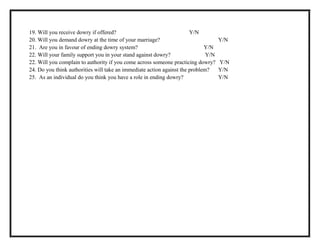
19. Will you receive dowry if offered? Y/N
20. Will you demand dowry at the time of your marriage? Y/N
21. Are you in favour of ending dowry system? Y/N
22. Will your family support you in your stand against dowry? Y/N
22. Will you complain to authority if you come across someone practicing dowry? Y/N
24. Do you think authorities will take an immediate action against the problem? Y/N
25. As an individual do you think you have a role in ending dowry? Y/N

1587200

  • 1.
    ATTITUDE OF YOUGSTERSTOWARDS DOWRY- A STUDY CONDUCTED IN KOTTAYAM TOWN ABSTRACT Dowry system is one of the longest standing evils associated with marriage from a woman’s point of view in the Indian society. There has been a dramatic change in the social structure sand thoughts, action and behavior of people. But unfortunately the basic attitude still remains the same. This study is an attempt to find out the attitude of youngsters towards dowry. INTRODUCTON Marriage is an integral part of society, a source of joy and festivities as well as of new beginnings. Yet, one of the longest standing evils associated with marriage from a woman’s point of view in the Indian society is the Dowry system. Despite a lot being said and done against the custom, it is still prevalent in the 21st century, in both subtle and obvious ways. The root of a host of social atrocities against women, the custom of presenting dowry is the crudest expression of the male-dominance in the society. It is most often the mandatory custom of a girl’s parents having to provide a considerable amount of cash, gold in the form of jewelry, electronic equipment, movable or immovable properties, to the groom and his family, at the time of marriage. Although the origin of the custom lies with parents trying to assure financial stability for their daughters, in current perspective it has translated into parents paying up for the assurance of well-being of their daughters. The jewelry and cash that a bride brings with her from her parents’
  • 2.
    house is oftenreferred to as “Streedhan” and in theory is the property of the girl, but in reality it is often treated as their rightful due by the groom’s family. The sum to be paid as dowry has no set standard, the yardstick greatly depends on the groom’s profession/social standing and is often perceived as the groom’s family as the compensation of efforts they have made to educate their boy. In a more subtle perspective, one may define this custom as the unquestioned idea that the girl’s family is inferior in standing with the boy’s family, no matter what her qualities are. Thus they need to be on their best behavior and offer lavish “gifts” to please the boy’s family. This ideal is so ingrained in the psyche of a large number of Indians, they either practically ruin themselves financially in order to pay for the appropriate price of the chosen groom, or make a bid to eradicate the prospect of this financial burden by selective gender-based abortion or female infanticide. This exploitative system that has turned the custom of giving gifts and well wishes into a compulsory demand for money, respect and subjugation, is the one of the major contributing factors hindering the growth of the Indian society where being a woman is still viewed synonymous to being a burden It is surprising that even in these days of the 21th century; we are still drowned in the dark depth of these evils. One of the worst evils of Indian Society is the dowry system. The word ‘dowry’ means the property and money that a bride brings to her husband’s house at the time of her marriage. It is a custom that is prevalent in all the sections of our society in one form or the other. At the beginning it was voluntary, but later on the social pressure was such that very few could escape from it. The dowry at present is a source of both joy and curse in the society. It is also a joy to the husband and his relatives who get cash, costly dress and utensils, furniture, bedding materials, etc. But, it is a curse to the bride’s parents who
  • 3.
    have to bearenormous cost to satisfy the unreasonable demands of the bridegroom’s party. A demand of dowry does not diminish even after marriage. The in-laws of the bride are very much ready in Indian homes to inflict harassment, insults and tortures-both mental and physical. When more pressure is put on the bride’s parents, their dear daughter has no other option but to commit suicide to avoid more insult and torture at the hands of the members of her husband’s family. This curse of Dowry System must be eradicated forth with at any cost. Women from every walk of life, literate or illiterate, poor or rich, young or old must unite together and come forward to protect their own honour and interest. Though the Government has promulgated certain anti-dowry laws, these have not produced the desired results. People’s efforts are also necessary if this evil is to be removed once for all. The high expenditure of the marriage ceremony must be cut down. Women must be empowered. Gender-based inequality should be completely abolished and the position of women in the society should be raised. Women must be taught since girlhood that their life is not useless without marriage. Girls should get the opportunity to get education at schools. After completion of school education, they should be encouraged to have higher education. Proper education of girls would be helpful in educating girls and women of their rights. Their age of marriage should be raised. They should be encouraged to enter into various fields of paid jobs, as their higher economic status also discourages demands for dowry. The practice of mass marriage should be encouraged for the sake of economy. Causes of Dowry System 1. Greed Factor – dowry demands often is exemplary of the collective greed of the society. Extortion in the name of social standing, compensation for the cost of groom’s education, his financial stability is a key feature of Indian
  • 4.
    marriages. Demands areput forward shamelessly and are expected to be met with silence. Threats of withdrawing the proposal loom on the bride’s Family’s head at the cost of losing face in the community, and portions of the agreed upon sum is often demanded before the actual ceremony. 2. Society Structure – the dowry system is largely the manifestation of the patriarchal nature of the Indian society where men are considered superior to women in aspects of physical and mental capabilities. With the backdrop of such societal structure, women are often considered second-tier citizens, fit to assume only domesticated roles. Such perceptions are often associated of them being treated as a burden in economic terms first by the father and then by the husband. This feeling is further compounded by the dowry system which fuels the belief that girl child is a potential cause of drain of family finances. 3. Religious Dictates – Religious constraints imposed by the society on marriage customs, mainly suitability of groom have a contributing factor towards the dowry problem. These constraints do not condone inter-religious marriages or even between different religious sects and a suitable groom has to be found from the same religious backgrounds. These restrictions limit the number of suitable matches. Boys of marriageable age with desirable qualifications become a prize and this in turn encourages the practice of the catch being caught by the highest bidder. 4. Social Constraints – Aside from similar religious backgrounds, further constrains are imposed based on caste system and social status. Practices like caste endogamy and clan exogamy, has to be kept in mind while arranging a match. Preferred matches have to belong to the same caste, different clan and same or higher social standings. These
  • 5.
    limitations again severelydeplete the pool of marriageable men leading to similar consequences for demanding dowry. 5. Social Status of Women – the inferior social standing of women in Indian society is so deep-rooted in the psyche of the nation, that this treatment of them as mere commodities is accepted without question, not only by the family but by the women themselves. When marriage is viewed as the ultimate achievement for women, evil practices like dowry takes its roots deeper in the society. 6. Illiteracy – lack of formal education is another cause for the prevalence of the dowry system. A large number of women are deliberately kept from schools either due to certain superstitions or from the belief that educating girls will take away from their eligibility as good wives. 7.Propulsion Towards Adhering to Customs – Indians value traditions a lot and they tend not to question customs. They follow traditions blindly and provide dowry because it is the norm handed down through generations. Effects of Dowry System 1. Short Term Effects of Dowry System These effects of the dowry system are immediate and are a permanent fixture in the daily news. a). Injustice towards girls – dowry bears a huge financial obligation for the bride’s family. As a consequence, a girl child is viewed a possible source of drain on the family’s finances, ultimately an onus. b). Violence against women – contrary to hopeful parents, dowry is often not a one-time pay up. Demands are continuously made by the husband’s family who consider the girl’s family as a never ending source of finance. Inability by the girl’s family often leads to verbal abuse, domestic violence and even deaths.
  • 6.
    c.) Economic burden– getting a girl married is associated with a hefty amount of money by Indian parents due to direct or subtle demands for dowry by the groom’s family. Families often borrow heavily, mortgage properties leading to major decline in economic health. d.) Gender inequality – the idea of paying dowry in order to get a girl married generates an increased sense of inequality among the genders, placing men superior to women. Young girls are kept from schools while their brothers are given access to education. 2. Long Term Effects of Dowry System The short term effects lead to the following long-term consequences a). Gender imbalance – the much abhorred practices like abortion of female fetuses and killing of girl babies have resulted into an unnaturally skewed child sex ratio (CSR) in India. b.) Loss of self-esteem in women – in a country which has experienced centuries of inferior attitude towards women, it is very hard to maintain a high level of self-regard if you are a woman. c.)Status of women –practices like dowry are social evils and a huge deterrent towards improvement of social status of women in India. Inferiority of women has been impressed upon the minds of the nation time and again by the demands of dowry. LAW AGAINST DOWRY The first all-India legislative enactment relating to dowry to be put on the statute book was The Dowry Prohibition Act, 1961 and this legislation came into force from July 1, 1961. It marked the beginning of a new legal framework of dowry harassment laws effectively prohibiting the demanding, giving and taking of dowry. Although providing
  • 7.
    dowry is illegal,it is still common in many parts of India for a husband to seek a dowry from the wife's family and in some cases, this result in a form of extortion and violence against the wife. To further strengthen the anti-dowry law and to stop offences of cruelty by the husband or his relatives against the wife, new provisions were added to the Indian criminal law - section 498A to Indian Penal Code and section 198A to the Criminal Procedure Code in 1983. In 2005, the Protection of Women from Domestic Violence Act was passed, which added an additional layer of protection from dowry harassment. Although the changes in Indian criminal law reflect a serious effort by legislators to put an end to dowry-related crimes, and although they have been in effect for many years now, they have been largely criticized as being ineffective. NEED AND SIGNIFICANCE OF THE STUDY Dowry is a custom turned as a social evil. The concept of equality among marital relationship is toppled by the custom. Moreover human dignity of women is questioning through the custom. Women who have not enough money or property are the worst sufferers Justice is denied to the females and the custom is beneficial to male. Dowry System is so widespread that it has become a common problem to all families who have marriageable daughters. No caste or system of family is free from. It was unfortunately become a mark of status and social prestige. Perhaps dowry was meant or a kind of help for the new couple to set up house, but it has now become the norm by which the social standing of the family is judged. The size of dowry differs from person to person, family to family. Some time it decreases or increases according to the rate in the marriage market. It is regulated by a number of traditional prescriptions, one among which is that a
  • 8.
    girl must bemarried at the earliest. In their feverish anxiety to marry off their daughters, the parents reluctantly submit to give a dowry and ruin themselves economically, and demean themselves while they play the waiting game with respect to their sons in the hope of exacting maximum profit in the form of dowries. Money lost in giving a dowry is regained in taking a dowry. The situation of Indian society is convenient ground for the development of the dowry system. We follow Arranged marriage. It is considered as one of the respected and prestigious forms of marriage. According to Indian parents, it is their obligation to arrange for the marriage of their daughters and sons. Due to the caste system there is very limited area for the selection of life partners. This leads to high dowries. OBJECTIVES OF THE STUDY 1. To find out the awareness of the respondents regarding dowry. 2. To study the attitude of youngsters toward the practice of dowry. RESEARCH DESIGN The research design is the master plan of a study that connects the empirical data to the research questions and objectives. The nature of the present study is descriptive cum analysis based. Both the primary and secondary data are used for the study; the primary data was collected through a sample survey. The study is based on primary as well as secondary data. Secondary data are collected from books, journals, websites etc. TOOLS USED FOR DATA COLLECTION
  • 9.
    A structured questionnairehas been used for collecting data from sample. The first part of the questionnaire deals with personal information of respondents and second part contains specific questions needed for the achievement of objectives of the study. UNIVERSE AND SAMPLE Youngsters in the Kottayam town constitute the universe of the study. The respondents are selected randomly. ANALYSIS OF DATA In this chapter the researcher dealt with the analysis of collected data. Analysis of data held with the help of statistical table. This chapter shows the socio-economic background of the respondents includes types of family, place of residence, religion, educational qualification, income etc. This chapter also dealt with the awareness of the respondents towards dowry. And the present chapter also aims at finding attitude of respondents towards dowry on respondents.
  • 10.
    I. SOCIO-ECONOMIC BACKGROUNOF THE RESPONENT Rural 70% urban 30% percentage The above figure shows the distribution of respondents based on their place of residence. Majority of the respondent in this study are from rural area. Table 1 Type of family Type of family Frequency Percent Nuclear 42 84 Extended 8 16 Total 50 100 From the above table it is clear that the majority of the respondent in this study belongs to nuclear family .16 percent of the respondents constitute extended family. Declined importance of joint family can be seen from this data.
  • 11.
    Figure 2 Religious Distribution 0 20 40 60 80 HinduChristian Muslim The above figure shows the religious distribution of respondents in this study. Lion share of the respondents constitute the religion Christianity. Followed by Hindus, they constitute 40 percent. Only 0 percent of the respondents in this study are Muslims. Figure 3: Educational Qualification of the respondent
  • 12.
    0 10 2030 40 50 60 Degree P.G Diploma From the figure, it is understood that the majority of respondents in this study are Post Graduate. Followed by 30 % the respondents constitute Graduate students. II. THE AWARENESS OF THE RESPONDENTS TOWARDS DOWRY This section includes questions to find out the awareness of the respondents regarding dowry system. Table 2 Awareness of respondents regarding dowry system AWARENESS OF THE RESPONDENT YES NO Receiving and giving dowry punishable 50(100%) - Aware of Dowry Prohibition Act 34 (68%) 16(32%) Dowry system still prevalent in your locality 43(86% ) 7(14%) Giving dowry is a status symbol 34(68% ) 16(32% )
  • 13.
    From the tableit is clear that the respondent’s awareness regarding dowry. 100 percent of the respondents in this study are aware of the rule that receiving and giving dowry is punishable. 68 percent of the majority respondents are aware of Dowry Prohibition Act. 32 percent are still not aware of the rules regarding dowry. Practice of dowry is still prevalent in the lion share of the respondent’s locality. Majority of the respondents feels that now dowry is practiced as a status symbol.44 percent of the respondents in this study are aware of people suffering from dowry problems after marriage. Among them, 56 percent of majority respondents took a proactive stand. III. ATTITUDE OF THE RESPONDENTS TOWARDS DOWRY Table 3 Family practiced dowry Family practiced dowry Frequency Percent Yes 36 72 No 14 28 Total 50 100 Aware of anyone suffering from dowry after marriage 22(44% ) 27(56%) Have you taken proactive stand 38(76%) 12(24%)
  • 14.
    The table showsthat majority of the respondent’s family practiced dowry. Only 28 percent of the respondent’s family didn’t practiced dowry. Table 4 Arranged marriage sought more dowries Arranged marriage sought dowry Frequency Percent Yes 35 70 No 15 30 Total 50 100 Majority of the respondent thought that arranged marriages sought more dowries. Table 5 Factors lesson dowry Factors lessen dowry Yes No Inter Caste & Religion lesson dowry 23(46% ) 27(54%) Educational qualification of lesson dowry 30(60% ) 20(40% ) Economic independence lesson dowry 29(58%) 21(42%)
  • 15.
    The above tableshows the factors lessen dowry system. Majority of the respondents’ feels that inter caste and inter religious marriage will not decrease dowry. 46 percent feels that inter caste and religious marriage will decrease the practice of dowry. Majority of 60 percent believe that higher educational qualification will decrease the practice of dowry. 58 percent of the respondents in this study believe that the economic independence of respondents also decrease the practice of dowry. Table 6 Reject proposal due to dowry Reject proposal Frequency Percent Yes 42 84 No 8 16 Total 50 100 The table shows the percent of the respondent reject their proposal due to dowry. Lion share of the respondents in this study will opine that they will reject proposal demand dowry. Table 7 Receive dowry if offered Receive dowry Frequency Percent Yes 22 44 No 28 56 Total 50 100
  • 16.
    Table shows thatmajority of the respondent will not buy dowry if they offered dowry. 44 percent buy if they offered dowry. Table 8 Demand dowry at you marriage Demand dowry Frequency Percent Yes 19 38 No 31 62 Total 50 100 62 percent of the majority respondents in this study will not demand dowry at their marriage. 38 percent of the respondent demand dowry at the time of their marriage. Table 9 Favour of ending dowry system Favour of ending dowry Frequency Percent Yes 35 70 No 15 30 Total 50 100
  • 17.
    From the tableit is clear that the lion share of the respondent are in favour of ending dowry system. Table 10 Family support your stand against dowry Family support Frequency Percent Yes 39 78 No 11 22 Total 50 100 78 percent of the respondents said that their family will support their stand against the practice of dowry. 22 percent are not sure of their family support in their stand against dowry. Table 11 Respondent’s attitude towards law Respondent’s attitude towards law Yes No Complain to authorities you come across practicing dowry 14 (28%) 36 (72% ) Authorities will take an immediate action 11(22%) 39 (78%)
  • 18.
    From the tableit is clear that the lion share of the respondents in this study will not complain to legal authorities if they come across practicing dowry. 78 percent of the respondent opines that the authorities will not take immediate and necessary action. Table 12 You have a role in ending dowry Role in ending dowry Frequency Percent Yes 40 80 No 10 20 Total 50 100 Majority of the respondents in this study opines that they have a role in ending the practice of dowry. 20 percent of the respondents think that as person they cannot end the system of dowry. MAJOR FINDINGS OF THE STUDY Majority of the respondent in this study are from rural area. Majority of the respondent in this study belongs to nuclear family. 16 percent of the respondents constitute extended family. Declined importance of joint family can be seen from this data. Lion share of the respondents constitute the religion Christianity. Followed by Hindus, they
  • 19.
    constitute 40 percent.Only 0 percent of the respondents in this study are Muslims. Majority of respondents in this study are Post Graduate. Followed by the respondents constitute Graduate students. 14 percent of the respondents qualified Diploma Course. 100 percent of the respondents in this study are aware of the rule that receiving and giving dowry is punishable. 68 percent of the majority respondents are aware of Dowry Prohibition Act. 32 percent are still not aware of the rules regarding dowry. Majority of the respondents feels that now dowry is practiced as a status symbol.44 percent of the respondents in this study are aware of people suffering from dowry problems after marriage. Among them, 76 percent of majority respondents took a proactive stand. Majority of the respondent’s family practiced dowry. Only 28 percent of the respondent’s family didn’t practice dowry. Majority of the respondent thought that arranged marriages sought more dowries. Majority of the respondents’ feels that inter caste and inter religious marriage will not decrease dowry. Majority of 60 percent believe that higher educational qualification will decrease the practice of dowry. 58 percent of the respondents in this study believe that the economic independence of respondents also decrease the practice of dowry. Majority of the respondent will not buy dowry if they offered dowry. 44 percent buy if they offered dowry. 62 percent of the majority respondents in this study will not demand dowry at their marriage. Lion share of the respondent are in favor of ending dowry system. 78 percent of the respondents said that their family will support their stand against the practice of dowry. 22 percent are not sure of their family support in their stand against dowry Lion share of the respondents in this study will not complain to legal authorities if they come across practicing dowry. 78 percent of the respondent opines that the authorities will not take immediate and necessary action. Majority of the
  • 20.
    respondents in thisstudy opines that they have a role in ending the practice of dowry. 20 percent of the respondents think that as person they cannot end the system of dowry. CONCLUSION There has been a drastic change in the social structure. It is the era of information overloading. Here has been a drastic change in the thought, actions and behavior. But unfortunately the basic attitude still remains the same. This is evident by the fact in our finding that 100% of our respondents were aware of the fact that receiving and giving dowry is punishable yet more than half of the respondent felt it was their status symbol. Another disturbing fact that we came across was that the development in the society has not broadened the society in the sense all have become exclusive rather than inclusive in attitude. The fact that even today, problem of dowry is highly prevalent only 45% are even aware of it. Even today there is hesitation regarding taking a pro active stand towards an issue. But definitely we see a better future cause all the respondent were unmarried of which 84% are willing to reject a proposal on the demand of dowry. From the above observation it is clear that knowledge alone will not bring the desired changes in the society. We need to become more empathetic and inclusive education and teachers can play a tremendous role in this aspect. EDUCATIONAL IMPLICATIONS As the dowry system is one of the major social issue which is seen prevalent in the sociality. There are a dramatic changes in the structure of society and thoughts, action and behavior of the human. But unfortunately the basic
  • 21.
    attitude of thehuman towards dowry remains the same. There should be a change in this attitude. Its can only happens through education. We have to focus such social issues and make the students aware about it. So we can save our nation from such social issues. REFERENCES Htpps:/www.inlibnet.ac.in Htpps:/www,ijsr.net Htpps:/family.jrank. org Htpps:/www.i-scholar.in Htpps:/www.popline,org
  • 22.
    QUESTIONNAIRE ATTITUDE OF YOUNGSTERTOWARDS DOWRY SYSTEM I. SOCIO-ECONOMIC BACKGROUND OF THE RESPONDENT 1. Age : 2. Place of residence : Rural/ Urban 3. Type of family : Nuclear/ Extended 4. Religion : Christian/Hindu/Muslim 5. Educational Qualification : Plus two/Degree/P.G/ Diploma 6. Monthly Income : II. THE AWARENESS THE RESPONDENTS TOWARDS DOWRY. 7. Do you know that receiving and giving dowry is punishable? Y/N 8. Are you aware of the Dowry Prohibition Act 1965? Y/N 9. Do you feel the dowry system still prevalent in your locality? Y/N 10. Do you feel giving dowry is a status symbol? Y/N 11. Are you aware of anyone suffering due to dowry problem after marriage? Y/N 12. If yes, have you taken a pro active stand? Y/N III. ATTITUDE OF RESPONDENTS TOWARDS DOWRY 13. As anyone in your family practiced dowry? Y/N 14. Do you think that arranged marriage has sought more dowries? Y/N 15. Do you think inter caste, religious marriages lessen the problem of dowry? Y/N 16. Do you think the increasing educational qualification of girls lessen dowry? Y/N 17. Did the economic independence of the girls will lessen dowry? Y/N 18. Will you reject proposal due to dowry demand? Y/N
  • 23.
    19. Will youreceive dowry if offered? Y/N 20. Will you demand dowry at the time of your marriage? Y/N 21. Are you in favour of ending dowry system? Y/N 22. Will your family support you in your stand against dowry? Y/N 22. Will you complain to authority if you come across someone practicing dowry? Y/N 24. Do you think authorities will take an immediate action against the problem? Y/N 25. As an individual do you think you have a role in ending dowry? Y/N