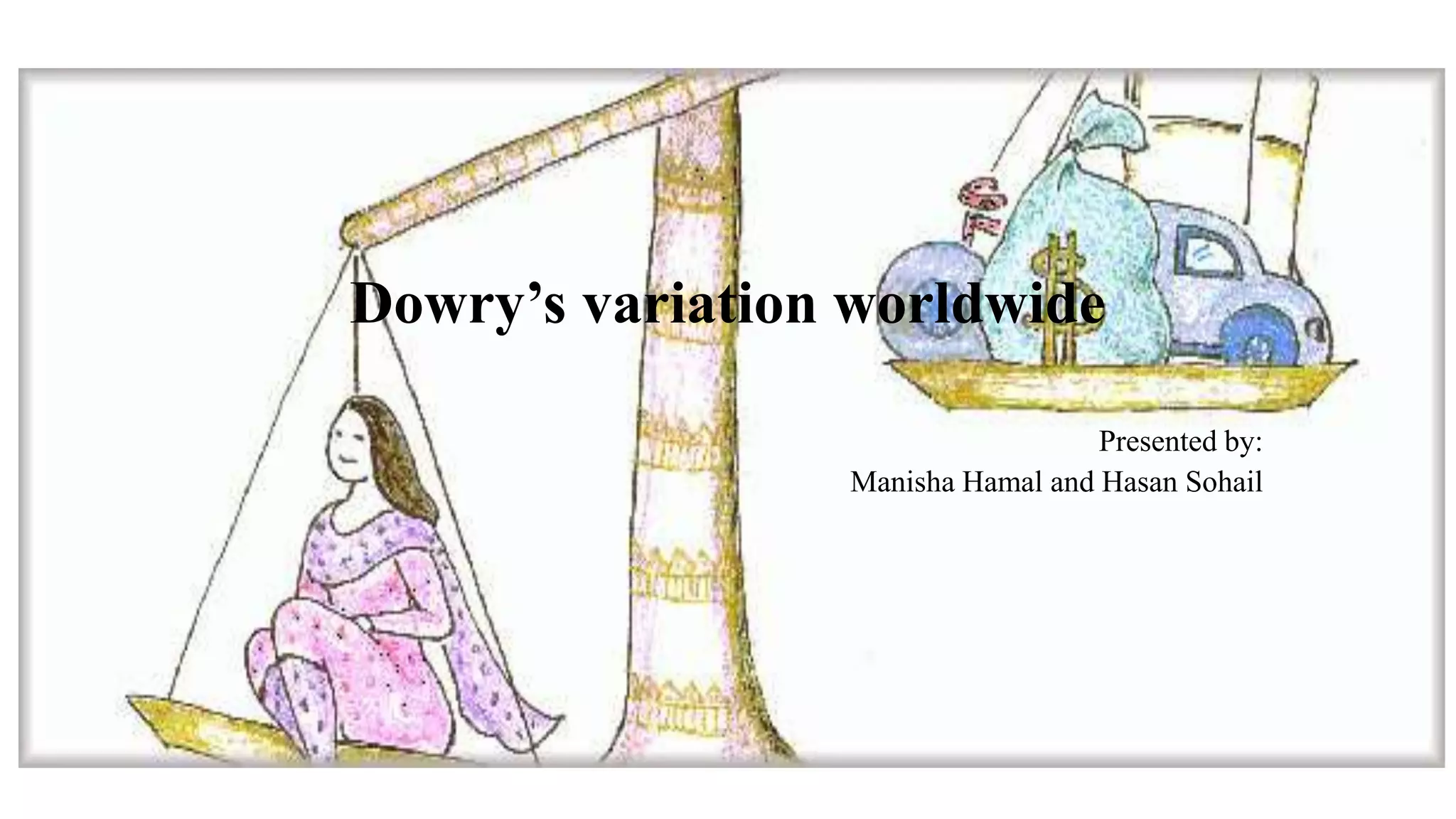
Dowry’s variation worldwide
Presented by:
Manisha Hamal and Hasan Sohail
What is dowry?
• Includes gifts, money, good or property given from the bride’s family to the groom
in-law's before or anytime during or after marriage, which occurs mostly in the
countries of Southeast Asia (Burn, 2011; Dowry Related Violence’)
• Other terms associated with the exchange of wealth during a marriage are bride
price and dower
• Bride price refers to money that a groom would pay to his bride's father in exchange
for her hand in marriage
• Dower is a provision accorded by law, but traditionally by a husband or his family, to
a wife for her support in the event that she should survive if she is a widow
Origin of dowry
• In ancient times, a dowry was given to the groom and his family in
exchange for the bride as a way of ensuring that she is properly taken care
of
• For financial security in the case of widowhood, and was thought to
eventually provide for the couple's future children as well
AND
• If a woman died without having any sons, her husband would have to return
the dowry to the bride's family, deducting the value of the bride price
Global Variation of Dowry
India
• ‘Dahej’
• Dowry has been a prevalent practice in India with variations on dowry’s
practice
• Although Indian laws against dowries have been in effect for decades, they
have been largely criticized as being ineffective. The practice of dowry deaths
and murders continues to take place unchecked in many parts of India and this
has further added to the concerns of enforcement
However,
• The Dowry Prohibition Act, 1961 article 3 specifies that the penalty for giving
or taking dowry does not apply to presents which are given at the time of a
marriage to the bride or bridegroom, when no demand for them have been
made
Pakistan
‘Jahez’
At over 2000 dowry-related deaths per year, and annual rates
exceeding 2.45 deaths per 100,000 women from dowry-related
violence
A 2014 Gallup survey in Pakistan found that 84% of Pakistanis
believe that dowry plays either very important or somewhat important
role in marriage, while 69% believed it is not possible for a girl to get
married without a dowry
Bangladesh
“Pawn or Joutuk”
• Like other South Asian countries, a serious growing problem in Bangladesh as
well.
• Laws prohibiting dowry in Bangladesh include Dowry Prohibition Act,
1980; Dowry Prohibition (Amendment) Ordinance, 1982; and Dowry Prohibition
(Amendment) Ordinance, 1986.)
Nepal
• ‘Daijo’
• Dowry-related violence is increasingly becoming a problem
• In Nepal, the practice of dowry is closely related to social prestige;
and dowry violence is especially prevalent in the Terai belt
• In 2009, Nepal enacted the Social Customs and Practices Act
outlawing dowry; however, there have been no known cases of
enforcement
China
In China women had no legal rights for property inheritance
 Whatever women owned was gifts or wages. This made dowry a
customarily part of marriage
Bride prices vary from CN¥ 1,000,000 in famously money-centric[
Shanghai to as little as CN¥ 10,00
In medieval and Renaissance Europe
Dowry frequently served not only to enhance the desirability of a
woman for marriage but also to build the power and wealth of great
families and even to determine the frontiers and policies of states
The use of dowries more or less disappeared in Europe in the 19th and
20th centuries (K. Subekshya, 2014)
Religious perspective of dowry
Islam
• The mahr (dowry) is something that is paid by the man to his wife
• It is paid to the wife and to her only as an honor and a respect given to
her and to show that he has a serious desire to marry her.
• It is must thing to agree upon at the time of the marriage contract.
• Taking money or gifts from the bride´s family is strictly prohibited.
Christianity
• Dowry is widely practiced by Christians, though among the Christians
of some regions it is not so widespread
• It is a fine method of setting up an establishment for the newlyweds
• Since the bride’s parents are quite choosy about the groom, he should
get a price
• A girl who brings a respectable dowry feels confident while a girl
without dowry feels uneasy
• Dowry is nothing but the share due to their daughter
Hinduism
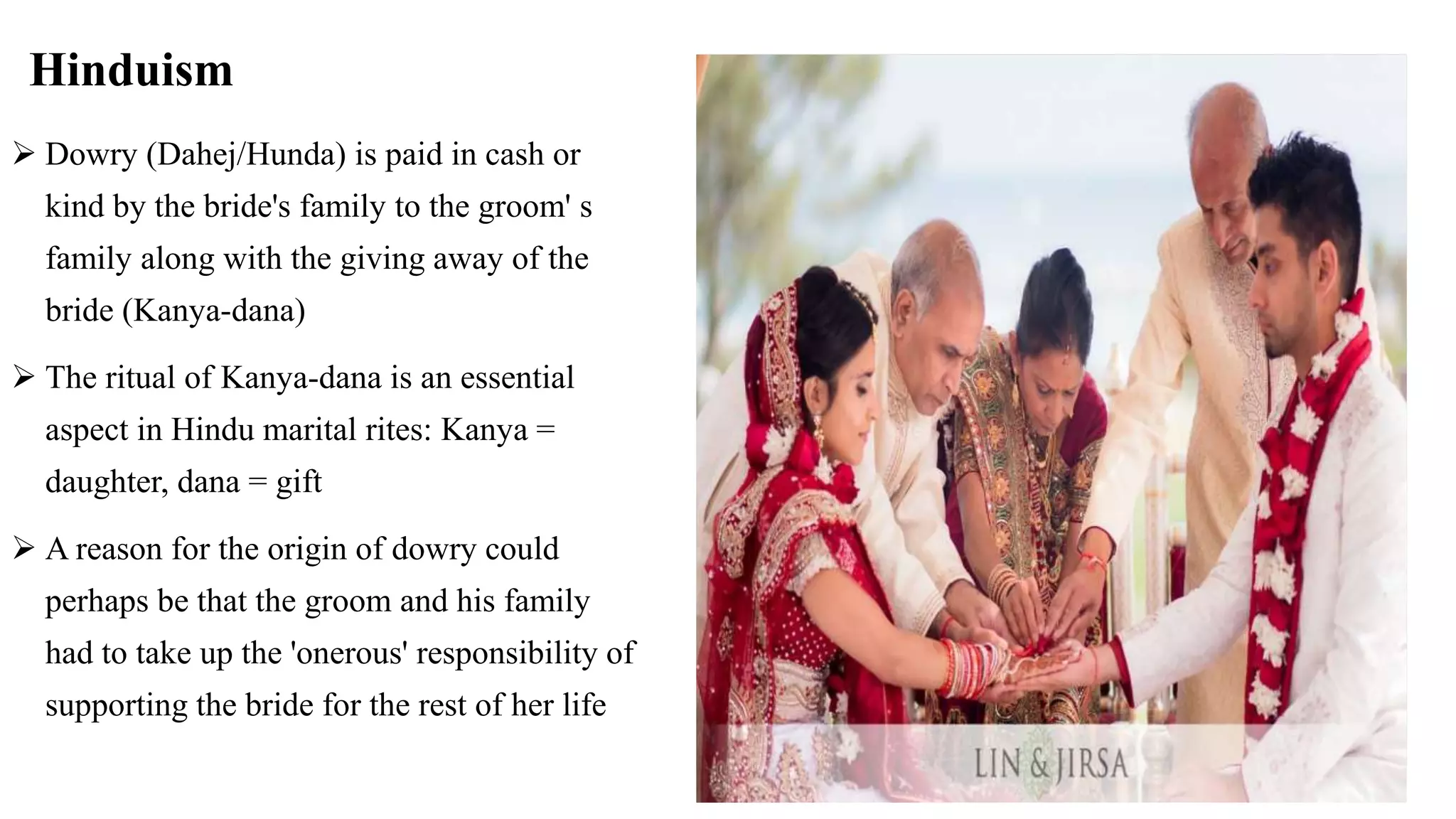
 Dowry (Dahej/Hunda) is paid in cash or
kind by the bride's family to the groom' s
family along with the giving away of the
bride (Kanya-dana)
 The ritual of Kanya-dana is an essential
aspect in Hindu marital rites: Kanya =
daughter, dana = gift
 A reason for the origin of dowry could
perhaps be that the groom and his family
had to take up the 'onerous' responsibility of
supporting the bride for the rest of her life
Dowry’s consequences
Domestic violence- physical torture, battering, marital rape, acid throwing (Burn,
2011)
Abetment to Suicide- Continuing abuse by the husband and his family with threats
of harm could lead to a woman committing suicide
Dowry murder-(wife burning or dowry death) murder committed by her husband
and his family soon after the marriage because of their dissatisfaction with the
dowry, mostly happens in India, Pakistan and Bangladesh (‘Dowry related
Violence’)
Female feticide- killing innocent baby girls
Magnitude of dowry problem
India
• One woman dies every hour in India because of dowry-related crimes
• Official figures from India's National Crime Records Bureau reveal
that 8,233 young women, many of them new brides, were killed in so-
called 'dowry deaths' in 2012
Pakistan
Over 2000 dowry-related deaths per year, and annual rates exceeding 2.45 deaths
per 100,000 women from dowry-related violence
Pakistan has the one of the highest reported number of dowry death rates per
100,000 women in the world (source; Operational Note: Pakistan Refworld, A
United Nations initiative (August 2011), see pages 16-21)
Bangladesh
• In 2014 dowry-related violence claimed 325 lives and resulted in 7,079 incidents
of dowry-harassment.
• This reflects only a fraction of crimes, many go unreported
Nepal
• The practice of dowry being pained to grooms with commitment risk
of extortion and dowry death, it is made spread in India, Pakistan and
Bangladesh and has begun in Nepal (UNICEF, 1999)
• A study conducted by Informal Sector Service Centre, 2014 reported
domestic violence and dowry deaths in Nepal
Control of dowry system
Pledging ourselves not to take dowry
Spread the words of awareness in society
Discourage the dowry infected marriages
Be proud of your daughter
Stop your greediness
Aware people through education and training
Use of media
Say no to Dowry- Be a Man source (http://www.howflux.com/can-we-stop-dowry-system/)
Dowry’s advantage??
Helps newly married couple establish their family
An ugly girl will get husband easily
Supports the higher education of poor groom
Raises the status of women in family
Promotes the inter caste, inter religion and inter state marriage
Acts as provident fund
• https://www.youtube.com/watch?v=4Uoy7f7R6_w
Open for Discussion
• Dowry makes daughter safe in In law´s house? If someone can afford, then
why it is not good?
• Both Bride and Groom are partners for life, right? So what if bride
contributes a little as gifts or money to Groom? It should not be obligatory,
but what if just ethically?
• Is there a need for Uniform Civil Code ( same law for every citizen
irrespective of religion)?
References
1. http://www.yourarticlelibrary.com/society/dowry/dowry-system-in-india-advantages-and-
disadvantages/47642/
2. http://www.hindunet.org/hindu_history/sudheer_history/practices1.html
3. K. Subekshya. 2014. A study on Dowry related Violence in Nepal. INSEC.
http://www.inseconline.org/pics/1409727203.pdf
4. (source: http://bdlaws.minlaw.gov.bd/print_sections_all.php?id=607
5. Operational Note: Pakistan Refworld, A United Nations initiative (August 2011)
6. https://www.ncbi.nlm.nih.gov/pmc/articles/PMC3705690/
7. http://ro.uow.edu.au/cgi/viewcontent.cgi?article=2532&context=lhapapers
8. (http://www.telegraph.co.uk/news/worldnews/asia/india/10280802/Woman-killed-over-
dowry-every-hour-in-India.html)
9. http://www.jstor.org/stable/3773327?seq=1#page_scan_tab_contents

Dowry's variation worldwide

  • 1.
    Dowry’s variation worldwide Presentedby: Manisha Hamal and Hasan Sohail
  • 2.
    What is dowry? •Includes gifts, money, good or property given from the bride’s family to the groom in-law's before or anytime during or after marriage, which occurs mostly in the countries of Southeast Asia (Burn, 2011; Dowry Related Violence’) • Other terms associated with the exchange of wealth during a marriage are bride price and dower • Bride price refers to money that a groom would pay to his bride's father in exchange for her hand in marriage • Dower is a provision accorded by law, but traditionally by a husband or his family, to a wife for her support in the event that she should survive if she is a widow
  • 3.
    Origin of dowry •In ancient times, a dowry was given to the groom and his family in exchange for the bride as a way of ensuring that she is properly taken care of • For financial security in the case of widowhood, and was thought to eventually provide for the couple's future children as well AND • If a woman died without having any sons, her husband would have to return the dowry to the bride's family, deducting the value of the bride price
  • 4.
  • 5.
    India • ‘Dahej’ • Dowryhas been a prevalent practice in India with variations on dowry’s practice • Although Indian laws against dowries have been in effect for decades, they have been largely criticized as being ineffective. The practice of dowry deaths and murders continues to take place unchecked in many parts of India and this has further added to the concerns of enforcement However, • The Dowry Prohibition Act, 1961 article 3 specifies that the penalty for giving or taking dowry does not apply to presents which are given at the time of a marriage to the bride or bridegroom, when no demand for them have been made
  • 6.
    Pakistan ‘Jahez’ At over 2000dowry-related deaths per year, and annual rates exceeding 2.45 deaths per 100,000 women from dowry-related violence A 2014 Gallup survey in Pakistan found that 84% of Pakistanis believe that dowry plays either very important or somewhat important role in marriage, while 69% believed it is not possible for a girl to get married without a dowry
  • 7.
    Bangladesh “Pawn or Joutuk” •Like other South Asian countries, a serious growing problem in Bangladesh as well. • Laws prohibiting dowry in Bangladesh include Dowry Prohibition Act, 1980; Dowry Prohibition (Amendment) Ordinance, 1982; and Dowry Prohibition (Amendment) Ordinance, 1986.)
  • 8.
    Nepal • ‘Daijo’ • Dowry-relatedviolence is increasingly becoming a problem • In Nepal, the practice of dowry is closely related to social prestige; and dowry violence is especially prevalent in the Terai belt • In 2009, Nepal enacted the Social Customs and Practices Act outlawing dowry; however, there have been no known cases of enforcement
  • 9.
    China In China womenhad no legal rights for property inheritance  Whatever women owned was gifts or wages. This made dowry a customarily part of marriage Bride prices vary from CN¥ 1,000,000 in famously money-centric[ Shanghai to as little as CN¥ 10,00
  • 10.
    In medieval andRenaissance Europe Dowry frequently served not only to enhance the desirability of a woman for marriage but also to build the power and wealth of great families and even to determine the frontiers and policies of states The use of dowries more or less disappeared in Europe in the 19th and 20th centuries (K. Subekshya, 2014)
  • 11.
  • 12.
    Islam • The mahr(dowry) is something that is paid by the man to his wife • It is paid to the wife and to her only as an honor and a respect given to her and to show that he has a serious desire to marry her. • It is must thing to agree upon at the time of the marriage contract. • Taking money or gifts from the bride´s family is strictly prohibited.
  • 13.
    Christianity • Dowry iswidely practiced by Christians, though among the Christians of some regions it is not so widespread • It is a fine method of setting up an establishment for the newlyweds • Since the bride’s parents are quite choosy about the groom, he should get a price • A girl who brings a respectable dowry feels confident while a girl without dowry feels uneasy • Dowry is nothing but the share due to their daughter
  • 14.
    Hinduism  Dowry (Dahej/Hunda)is paid in cash or kind by the bride's family to the groom' s family along with the giving away of the bride (Kanya-dana)  The ritual of Kanya-dana is an essential aspect in Hindu marital rites: Kanya = daughter, dana = gift  A reason for the origin of dowry could perhaps be that the groom and his family had to take up the 'onerous' responsibility of supporting the bride for the rest of her life
  • 15.
    Dowry’s consequences Domestic violence-physical torture, battering, marital rape, acid throwing (Burn, 2011) Abetment to Suicide- Continuing abuse by the husband and his family with threats of harm could lead to a woman committing suicide Dowry murder-(wife burning or dowry death) murder committed by her husband and his family soon after the marriage because of their dissatisfaction with the dowry, mostly happens in India, Pakistan and Bangladesh (‘Dowry related Violence’) Female feticide- killing innocent baby girls
  • 16.
    Magnitude of dowryproblem India • One woman dies every hour in India because of dowry-related crimes • Official figures from India's National Crime Records Bureau reveal that 8,233 young women, many of them new brides, were killed in so- called 'dowry deaths' in 2012
  • 17.
    Pakistan Over 2000 dowry-relateddeaths per year, and annual rates exceeding 2.45 deaths per 100,000 women from dowry-related violence Pakistan has the one of the highest reported number of dowry death rates per 100,000 women in the world (source; Operational Note: Pakistan Refworld, A United Nations initiative (August 2011), see pages 16-21) Bangladesh • In 2014 dowry-related violence claimed 325 lives and resulted in 7,079 incidents of dowry-harassment. • This reflects only a fraction of crimes, many go unreported
  • 18.
    Nepal • The practiceof dowry being pained to grooms with commitment risk of extortion and dowry death, it is made spread in India, Pakistan and Bangladesh and has begun in Nepal (UNICEF, 1999) • A study conducted by Informal Sector Service Centre, 2014 reported domestic violence and dowry deaths in Nepal
  • 20.
    Control of dowrysystem Pledging ourselves not to take dowry Spread the words of awareness in society Discourage the dowry infected marriages Be proud of your daughter Stop your greediness Aware people through education and training Use of media Say no to Dowry- Be a Man source (http://www.howflux.com/can-we-stop-dowry-system/)
  • 21.
    Dowry’s advantage?? Helps newlymarried couple establish their family An ugly girl will get husband easily Supports the higher education of poor groom Raises the status of women in family Promotes the inter caste, inter religion and inter state marriage Acts as provident fund
  • 22.
  • 23.
    Open for Discussion •Dowry makes daughter safe in In law´s house? If someone can afford, then why it is not good? • Both Bride and Groom are partners for life, right? So what if bride contributes a little as gifts or money to Groom? It should not be obligatory, but what if just ethically? • Is there a need for Uniform Civil Code ( same law for every citizen irrespective of religion)?
  • 25.
    References 1. http://www.yourarticlelibrary.com/society/dowry/dowry-system-in-india-advantages-and- disadvantages/47642/ 2. http://www.hindunet.org/hindu_history/sudheer_history/practices1.html 3.K. Subekshya. 2014. A study on Dowry related Violence in Nepal. INSEC. http://www.inseconline.org/pics/1409727203.pdf 4. (source: http://bdlaws.minlaw.gov.bd/print_sections_all.php?id=607 5. Operational Note: Pakistan Refworld, A United Nations initiative (August 2011) 6. https://www.ncbi.nlm.nih.gov/pmc/articles/PMC3705690/ 7. http://ro.uow.edu.au/cgi/viewcontent.cgi?article=2532&context=lhapapers 8. (http://www.telegraph.co.uk/news/worldnews/asia/india/10280802/Woman-killed-over- dowry-every-hour-in-India.html) 9. http://www.jstor.org/stable/3773327?seq=1#page_scan_tab_contents