Multidisciplinary pairing: a win-win
employability enhancing teaching
experience.
Claire Howell 2nd April 2014
Employability: definition one.
A set of:
• achievements
• skills
• understandings and
• personal attributes
that makes graduates more likely to gain employment and be
successful in their chosen occupations,
which benefits themselves, the workforce, the community and
the economy.
• (ESECT based on Yorke 2006)
Employability: definition two
Employability is more than about developing attributes,
techniques or experience just to enable a student to get a
job, or to progress within a current career.
It is about learning and the emphasis is less on ‘employ’ and
more on ‘ability’.
In essence, the emphasis is on developing critical, reflective
abilities, with a view to empowering and enhancing the
learner.
• (Harvey 2003)
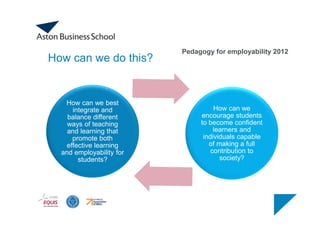
How can we do this?
How can we best
integrate and
balance different
ways of teaching
and learning that
promote both
effective learning
and employability for
students?
How can we
encourage students
to become confident
learners and
individuals capable
of making a full
contribution to
society?
Pedagogy for employability 2012
Real world activities
I am
educating my
students for
jobs that do
not yet exist
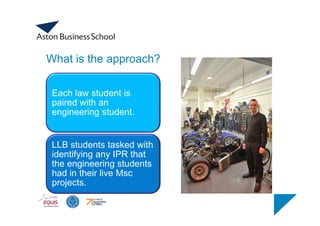
What is the approach?
Each law student is
paired with an
engineering student.
LLB students tasked with
identifying any IPR that
the engineering students
had in their live Msc
projects.
LLB Coursework
50% of the marks
for the module
a) submit an
individual advice
letter [800 words ]
addressed to their
engineering student
based on interviews
conducted
concerning their
project work .
b) a legally argued
analysis of the IP
issues of the project.
1,700 words.
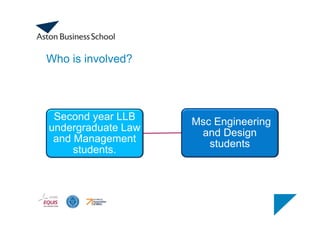
Who is involved?
Second year LLB
undergraduate Law
and Management
students.
Msc Engineering
and Design
students
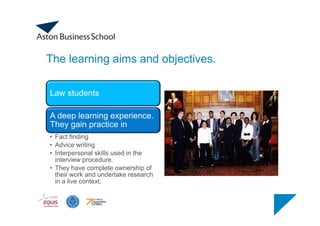
The learning aims and objectives.
Law students
A deep learning experience.
They gain practice in
• Fact finding
• Advice writing
• Interpersonal skills used in the
interview procedure.
• They have complete ownership of
their work and undertake research
in a live context.
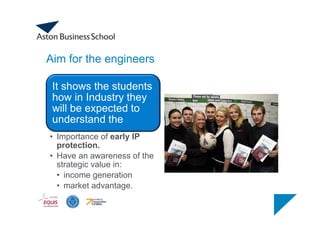
Aim for the engineers
It shows the students
how in Industry they
will be expected to
understand the
• Importance of early IP
protection.
• Have an awareness of the
strategic value in:
• income generation
• market advantage.
Objectives
For the academic
• Both sides win.
• It cost little in the
academics time.
• No preparation of an
innovative case study.
• Little need to motivate
the students as they
motivate themselves.
How we do it at Aston
First term
• Law students learn about the different IP rights.
Second
term
• Masterclass
• Meet with a Patent Attorney and member of the BPU
• the function of the BPU
• what they should do if a registrable idea was discovered.
• the procedures the office would undertake with any innovation.
This was serious
Confidentiality
agreement.
There might be a
REAL invention!
The pairing
The students
swap e-mail
addresses
At that point
I loose
control
My role
Tutorial slot
every week
I was
available via
e-mail
Virtual
leaning
resource
[Blackboard,]
Outcome for engineers
In some cases IP
knowledge has changed
the direction of the
project of the engineer.
With IP knowledge they
recognised a slightly
different approach could
result in something new.
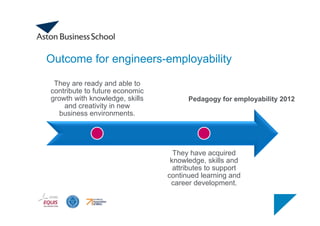
Outcome for engineers-employability
They are ready and able to
contribute to future economic
growth with knowledge, skills
and creativity in new
business environments.
They have acquired
knowledge, skills and
attributes to support
continued learning and
career development.
Pedagogy for employability 2012
Outcome for law students-employability
Self -management
Communication and literacy
application of literacy, ability to produce clear, structured
written work and oral literacy – including listening and
questioning.
Business and customer awareness
the need to provide customer satisfaction and build customer
loyalty.
Problem solving
analysing facts and situations and applying creative thinking
to develop appropriate solutions.
Preparation-the right academic
Enthusiastic
engineering
lecturer
Understands the
importance of
• obtaining IP
• retaining IP
• exploiting IP
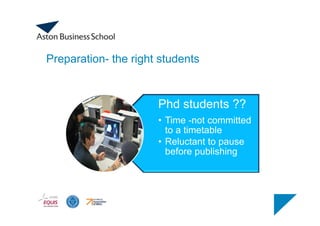
Preparation- the right students
Phd students ??
• Time -not committed
to a timetable
• Reluctant to pause
before publishing
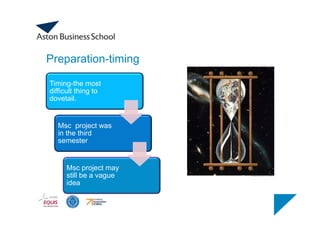
Preparation-timing
Timing-the most
difficult thing to
dovetail.
Msc project was
in the third
semester
Msc project may
still be a vague
idea
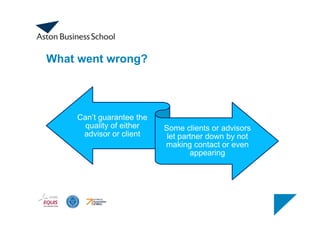
What went wrong?
Can’t guarantee the
quality of either
advisor or client
Some clients or advisors
let partner down by not
making contact or even
appearing
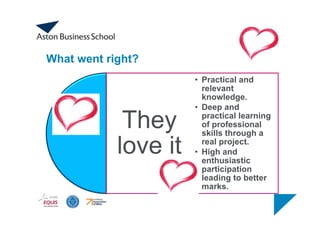
What went right?
They
love it
• Practical and
relevant
knowledge.
• Deep and
practical learning
of professional
skills through a
real project.
• High and
enthusiastic
participation
leading to better
marks.
Learning by doing
Most studies suggest that ‘active learning by doing’ is
what works in relation to many employability skills,
particularly for communication, working with others,
time and personal management and problem solving.
This method allows students to work in
interdisciplinary teams and to integrate their learning
experiences across levels and subjects of study.
Pedagogy for employability 2012
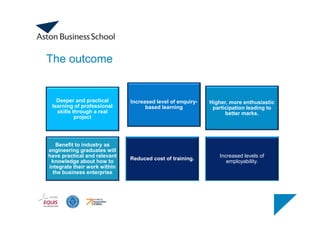
The outcome
Deeper and practical
learning of professional
skills through a real
project
Increased level of enquiry-
based learning
Higher, more enthusiastic
participation leading to
better marks.
Benefit to industry as
engineering graduates will
have practical and relevant
knowledge about how to
integrate their work within
the business enterprise
Reduced cost of training.
Increased levels of
employability.
Conclusion
Experience of working in multi-disciplinary
teams on realistic projects. The lawyers are
learning to talk to engineers and the
engineers are learning to talk to lawyers.
Any course must stimulate and motivate the
students and I think this method of live
teaching does.

Multidisciplinary pairing: a win-win employability enhancing teaching experience - Claire Howell

  • 1.
    Multidisciplinary pairing: awin-win employability enhancing teaching experience. Claire Howell 2nd April 2014
  • 2.
    Employability: definition one. Aset of: • achievements • skills • understandings and • personal attributes that makes graduates more likely to gain employment and be successful in their chosen occupations, which benefits themselves, the workforce, the community and the economy. • (ESECT based on Yorke 2006)
  • 3.
    Employability: definition two Employabilityis more than about developing attributes, techniques or experience just to enable a student to get a job, or to progress within a current career. It is about learning and the emphasis is less on ‘employ’ and more on ‘ability’. In essence, the emphasis is on developing critical, reflective abilities, with a view to empowering and enhancing the learner. • (Harvey 2003)
  • 4.
    How can wedo this? How can we best integrate and balance different ways of teaching and learning that promote both effective learning and employability for students? How can we encourage students to become confident learners and individuals capable of making a full contribution to society? Pedagogy for employability 2012
  • 5.
    Real world activities Iam educating my students for jobs that do not yet exist
  • 6.
    What is theapproach? Each law student is paired with an engineering student. LLB students tasked with identifying any IPR that the engineering students had in their live Msc projects.
  • 7.
    LLB Coursework 50% ofthe marks for the module a) submit an individual advice letter [800 words ] addressed to their engineering student based on interviews conducted concerning their project work . b) a legally argued analysis of the IP issues of the project. 1,700 words.
  • 8.
    Who is involved? Secondyear LLB undergraduate Law and Management students. Msc Engineering and Design students
  • 9.
    The learning aimsand objectives. Law students A deep learning experience. They gain practice in • Fact finding • Advice writing • Interpersonal skills used in the interview procedure. • They have complete ownership of their work and undertake research in a live context.
  • 10.
    Aim for theengineers It shows the students how in Industry they will be expected to understand the • Importance of early IP protection. • Have an awareness of the strategic value in: • income generation • market advantage.
  • 11.
    Objectives For the academic •Both sides win. • It cost little in the academics time. • No preparation of an innovative case study. • Little need to motivate the students as they motivate themselves.
  • 12.
    How we doit at Aston First term • Law students learn about the different IP rights. Second term • Masterclass • Meet with a Patent Attorney and member of the BPU • the function of the BPU • what they should do if a registrable idea was discovered. • the procedures the office would undertake with any innovation.
  • 13.
  • 14.
    The pairing The students swape-mail addresses At that point I loose control
  • 15.
    My role Tutorial slot everyweek I was available via e-mail Virtual leaning resource [Blackboard,]
  • 16.
    Outcome for engineers Insome cases IP knowledge has changed the direction of the project of the engineer. With IP knowledge they recognised a slightly different approach could result in something new.
  • 17.
    Outcome for engineers-employability Theyare ready and able to contribute to future economic growth with knowledge, skills and creativity in new business environments. They have acquired knowledge, skills and attributes to support continued learning and career development. Pedagogy for employability 2012
  • 18.
    Outcome for lawstudents-employability Self -management Communication and literacy application of literacy, ability to produce clear, structured written work and oral literacy – including listening and questioning. Business and customer awareness the need to provide customer satisfaction and build customer loyalty. Problem solving analysing facts and situations and applying creative thinking to develop appropriate solutions.
  • 19.
    Preparation-the right academic Enthusiastic engineering lecturer Understandsthe importance of • obtaining IP • retaining IP • exploiting IP
  • 20.
    Preparation- the rightstudents Phd students ?? • Time -not committed to a timetable • Reluctant to pause before publishing
  • 21.
    Preparation-timing Timing-the most difficult thingto dovetail. Msc project was in the third semester Msc project may still be a vague idea
  • 22.
    What went wrong? Can’tguarantee the quality of either advisor or client Some clients or advisors let partner down by not making contact or even appearing
  • 23.
    What went right? They loveit • Practical and relevant knowledge. • Deep and practical learning of professional skills through a real project. • High and enthusiastic participation leading to better marks.
  • 24.
    Learning by doing Moststudies suggest that ‘active learning by doing’ is what works in relation to many employability skills, particularly for communication, working with others, time and personal management and problem solving. This method allows students to work in interdisciplinary teams and to integrate their learning experiences across levels and subjects of study. Pedagogy for employability 2012
  • 25.
    The outcome Deeper andpractical learning of professional skills through a real project Increased level of enquiry- based learning Higher, more enthusiastic participation leading to better marks. Benefit to industry as engineering graduates will have practical and relevant knowledge about how to integrate their work within the business enterprise Reduced cost of training. Increased levels of employability.
  • 26.
    Conclusion Experience of workingin multi-disciplinary teams on realistic projects. The lawyers are learning to talk to engineers and the engineers are learning to talk to lawyers. Any course must stimulate and motivate the students and I think this method of live teaching does.