Self-Esteem
Outline The importance of self-esteem What self-esteem is… and is not The paradox of self-esteem Toward a new understanding Dependent self-esteem Independent self-esteem Unconditional self-esteem Enhancing self-esteem
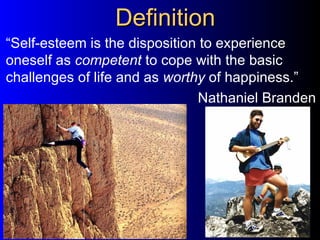
Definition “ Self-esteem is the disposition to experience oneself as  competent  to cope with the basic challenges of life and as  worthy  of happiness.” Nathaniel Branden
Of all the judgments we pass in our lives, none is as important as the one we pass on ourselves. Nathaniel Branden The greatest evil that can befall man is that he should come to think ill of himself. Goethe The Importance of Self-Esteem
High Self-Esteem Mental Health Quality of relationships Success Social effectiveness Happiness
Low Self-Esteem Anxiety Depression Psychosomatic symptoms Underachievement
Nathaniel Branden —  The immune system of consciousness Bednar and Peterson — Underlying cause of most emotional and behavioral  problems California Task Force —  Social vaccine
Criticism Narcissism  ( arrogance and conceit) “ The person who feels weak becomes a bully, the inferior person a braggart; a flexing of muscles, much talk, cockiness, an endeavor to brazen it out, are symptoms of covert anxiety in a person or a group.”   Rollo May
Criticism Narcissism  ( arrogance and conceit) Unrealistic evaluation (harms performance)
Salvaging Self-Esteem’s Self-Esteem What self-esteem is not — A product of empty reinforcement Pseudo self-esteem What self-esteem is —  Founded in reality Product of hard work
More Criticisms of Self-Esteem Anti-social behavior —  Aggressive, uncooperative Paradox of self-esteem
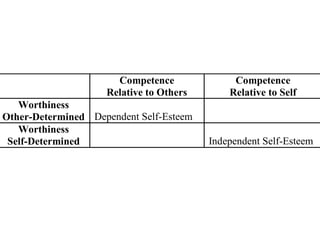
A New Formulation Dependent self-esteem Independent self-esteem Unconditional self-esteem
Dependent Self-Esteem Worthiness —  Other-determined Competence — Other-comparison
Independent Self-Esteem Worthiness —  Self-determined Competence — Self-Comparison
 
Unconditional Self-Esteem Worthiness —  Not contingent Competence — Interdependent
 
The Importance of Being Independent Moral Behavior True to principles Empathy Better cognitive performance Creative thinking Commitment to continuous learning   Increased Happiness Calmness The joy of self-expression
Research Results Self-Esteem Stability Kernis (1995) Ben-Shahar (2000) Happiness and Flow Christino (2002) Narcissism, Generosity, Hostility Ben-Shahar (2004) Perfectionism Ignaczyk and Richey (2003)
The Case of Relationships “ Differentiation is your ability to maintain your sense of self when you are emotionally and/or physically close to others—especially as they become increasingly important to you.  Differentiation permits you to maintain your own course when lovers, friends, and family pressure you to agree and conform.  Well-differentiated people can agree without feeling like they’re ‘losing themselves,’ and can disagree without feeling alienated and embittered.” David Schnarch (1997)
Cultivating Independent and Unconditional Self-Esteem
Change Attitude Behavior
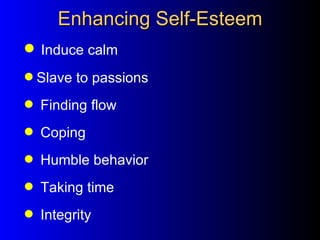
Enhancing Self-Esteem Induce calm Slave to passions Finding flow Coping Humble behavior Taking time
Stage Model Stage 1 Automatic reaction Conformity Dependent self Stage 2 Deliberate reflAction Self reliance Independent core self
Enhancing Self-Esteem Induce calm Slave to passions Finding flow Coping Humble behavior Taking time Integrity
Integrity Treatment Being known versus validated (Schnarch, 1997) Express not impress Assert yourself Gradually expanding integrity From journaling to loved-one to world From day to week to life-long Truth sets us free
Your true potential lies way, way down in the depths of your soul… in the pit of your stomach, past your knowledge, beyond your nervousness, and buried under your fears and anxieties.  As hidden as it may be, it is still there.  I know it’s there because I’ve felt it before, and I know it’s there in others too because I’ve seen others perform miracles.  There is a faint glow of unparalleled potential in all of us, and when we find it — it shines. Melissa Christino
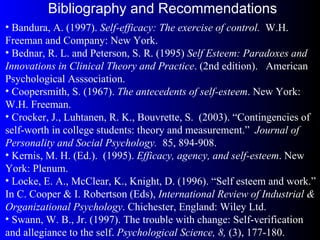
Bandura, A. (1997).  Self-efficacy: The exercise of control.   W.H. Freeman and Company: New York. Bednar, R. L. and Peterson, S. R. (1995)  Self Esteem: Paradoxes and Innovations in Clinical Theory and Practice . (2nd edition).  American Psychological Asssociation. Coopersmith, S. (1967).  The antecedents of self-esteem . New York: W.H. Freeman. Crocker, J., Luhtanen, R. K., Bouvrette, S.  (2003). “Contingencies of self-worth in college students: theory and measurement.”   Journal of Personality and Social Psychology.  85, 894-908. Kernis, M. H. (Ed.).  (1995).  Efficacy, agency, and self-esteem . New York: Plenum. Locke, E. A., McClear, K., Knight, D. (1996). “Self esteem and work.” In C. Cooper & I. Robertson (Eds),  International Review of Industrial & Organizational Psychology . Chichester, England: Wiley Ltd. Swann, W. B., Jr. (1997). The trouble with change: Self-verification and allegiance to the self.  Psychological Science, 8,  (3), 177-180. Bibliography and Recommendations

1504 10-self-esteem

  • 1.
  • 2.
    Outline The importanceof self-esteem What self-esteem is… and is not The paradox of self-esteem Toward a new understanding Dependent self-esteem Independent self-esteem Unconditional self-esteem Enhancing self-esteem
  • 3.
    Definition “ Self-esteemis the disposition to experience oneself as competent to cope with the basic challenges of life and as worthy of happiness.” Nathaniel Branden
  • 4.
    Of all thejudgments we pass in our lives, none is as important as the one we pass on ourselves. Nathaniel Branden The greatest evil that can befall man is that he should come to think ill of himself. Goethe The Importance of Self-Esteem
  • 5.
    High Self-Esteem MentalHealth Quality of relationships Success Social effectiveness Happiness
  • 6.
    Low Self-Esteem AnxietyDepression Psychosomatic symptoms Underachievement
  • 7.
    Nathaniel Branden — The immune system of consciousness Bednar and Peterson — Underlying cause of most emotional and behavioral problems California Task Force — Social vaccine
  • 8.
    Criticism Narcissism ( arrogance and conceit) “ The person who feels weak becomes a bully, the inferior person a braggart; a flexing of muscles, much talk, cockiness, an endeavor to brazen it out, are symptoms of covert anxiety in a person or a group.” Rollo May
  • 9.
    Criticism Narcissism ( arrogance and conceit) Unrealistic evaluation (harms performance)
  • 10.
    Salvaging Self-Esteem’s Self-EsteemWhat self-esteem is not — A product of empty reinforcement Pseudo self-esteem What self-esteem is — Founded in reality Product of hard work
  • 11.
    More Criticisms ofSelf-Esteem Anti-social behavior — Aggressive, uncooperative Paradox of self-esteem
  • 12.
    A New FormulationDependent self-esteem Independent self-esteem Unconditional self-esteem
  • 13.
    Dependent Self-Esteem Worthiness— Other-determined Competence — Other-comparison
  • 14.
    Independent Self-Esteem Worthiness— Self-determined Competence — Self-Comparison
  • 15.
  • 16.
    Unconditional Self-Esteem Worthiness— Not contingent Competence — Interdependent
  • 17.
  • 18.
    The Importance ofBeing Independent Moral Behavior True to principles Empathy Better cognitive performance Creative thinking Commitment to continuous learning Increased Happiness Calmness The joy of self-expression
  • 19.
    Research Results Self-EsteemStability Kernis (1995) Ben-Shahar (2000) Happiness and Flow Christino (2002) Narcissism, Generosity, Hostility Ben-Shahar (2004) Perfectionism Ignaczyk and Richey (2003)
  • 20.
    The Case ofRelationships “ Differentiation is your ability to maintain your sense of self when you are emotionally and/or physically close to others—especially as they become increasingly important to you. Differentiation permits you to maintain your own course when lovers, friends, and family pressure you to agree and conform. Well-differentiated people can agree without feeling like they’re ‘losing themselves,’ and can disagree without feeling alienated and embittered.” David Schnarch (1997)
  • 21.
    Cultivating Independent andUnconditional Self-Esteem
  • 22.
  • 23.
    Enhancing Self-Esteem Inducecalm Slave to passions Finding flow Coping Humble behavior Taking time
  • 24.
    Stage Model Stage1 Automatic reaction Conformity Dependent self Stage 2 Deliberate reflAction Self reliance Independent core self
  • 25.
    Enhancing Self-Esteem Inducecalm Slave to passions Finding flow Coping Humble behavior Taking time Integrity
  • 26.
    Integrity Treatment Beingknown versus validated (Schnarch, 1997) Express not impress Assert yourself Gradually expanding integrity From journaling to loved-one to world From day to week to life-long Truth sets us free
  • 27.
    Your true potentiallies way, way down in the depths of your soul… in the pit of your stomach, past your knowledge, beyond your nervousness, and buried under your fears and anxieties. As hidden as it may be, it is still there. I know it’s there because I’ve felt it before, and I know it’s there in others too because I’ve seen others perform miracles. There is a faint glow of unparalleled potential in all of us, and when we find it — it shines. Melissa Christino
  • 28.
    Bandura, A. (1997). Self-efficacy: The exercise of control. W.H. Freeman and Company: New York. Bednar, R. L. and Peterson, S. R. (1995) Self Esteem: Paradoxes and Innovations in Clinical Theory and Practice . (2nd edition). American Psychological Asssociation. Coopersmith, S. (1967). The antecedents of self-esteem . New York: W.H. Freeman. Crocker, J., Luhtanen, R. K., Bouvrette, S.  (2003). “Contingencies of self-worth in college students: theory and measurement.”  Journal of Personality and Social Psychology. 85, 894-908. Kernis, M. H. (Ed.). (1995). Efficacy, agency, and self-esteem . New York: Plenum. Locke, E. A., McClear, K., Knight, D. (1996). “Self esteem and work.” In C. Cooper & I. Robertson (Eds), International Review of Industrial & Organizational Psychology . Chichester, England: Wiley Ltd. Swann, W. B., Jr. (1997). The trouble with change: Self-verification and allegiance to the self. Psychological Science, 8, (3), 177-180. Bibliography and Recommendations