Comparing mining and manufacturing
supply chain
processes: challenges and requirements
• Published in : Production Planning & Control:
The Management of Operations.
• Published on : 10 Dec 2013
• Page no : 81–96 Vol no :2
• Presented by : Nikunj Rana
• Authors : Raul Zuñigaa, Thorsten Wuesta and
Klaus-Dieter Thobena
Comparing mining industry and
manufacturing
industry from a supply chain perspective
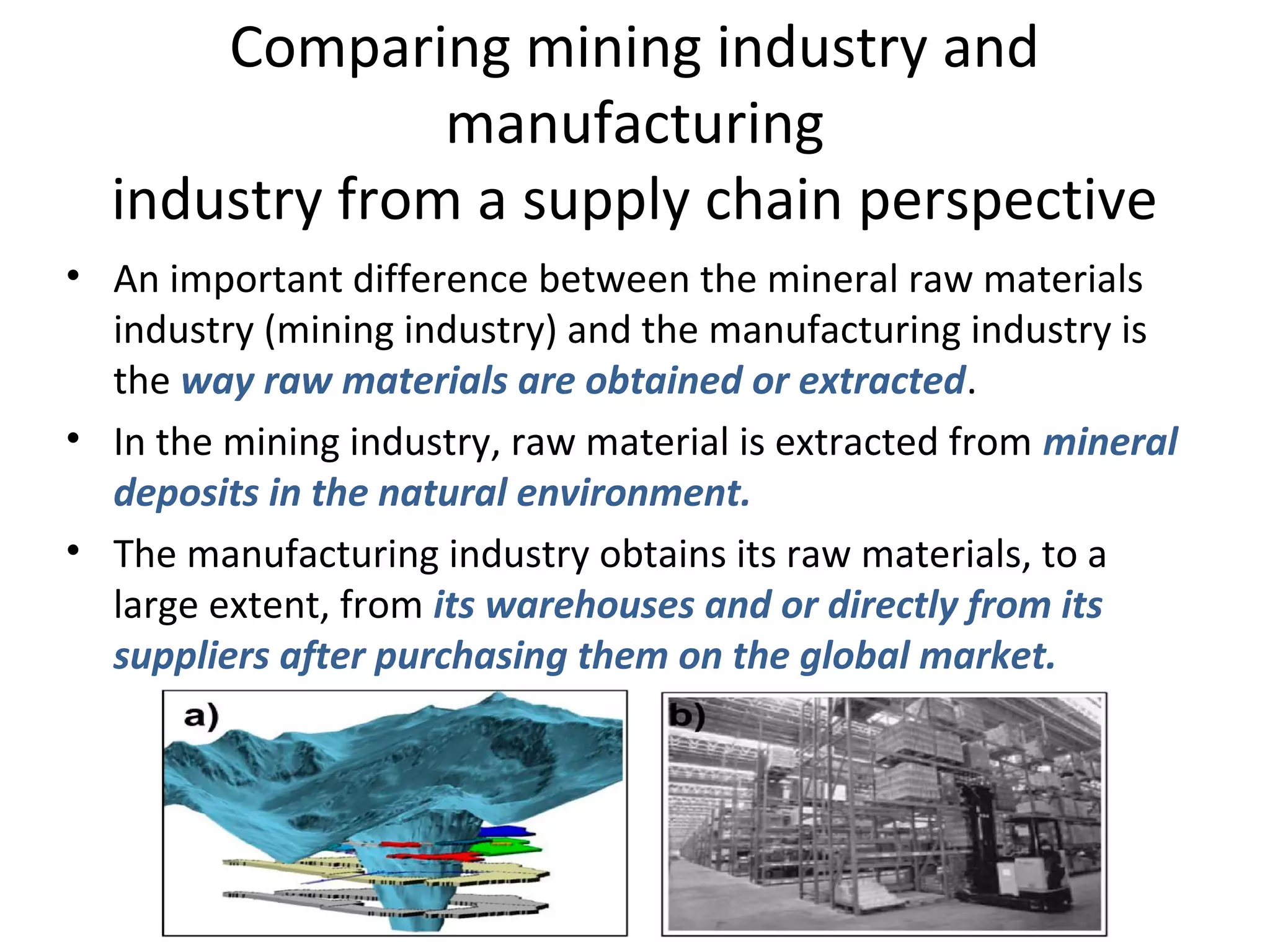
• An important difference between the mineral raw materials
industry (mining industry) and the manufacturing industry is
the way raw materials are obtained or extracted.
• In the mining industry, raw material is extracted from mineral
deposits in the natural environment.
• The manufacturing industry obtains its raw materials, to a
large extent, from its warehouses and or directly from its
suppliers after purchasing them on the global market.
Comparing characteristics of sourcing
in mining and manufacturing
EM MODEL
• The EM model is an industry business process model that
provides a categorization of all activities that are applicable to
the mineral raw materials industry (EMMMV 2010).
• This model has a specific structure where processes are
categorized into three different levels of processes.
SCOR MODEL (supply chain operation
reference)
• SCOR has grown into what many consider the standard
supply-chain framework , widely established within the
manufacturing industry. The version 10.0 of SCOR model
includes a framework for business processes, metrics, high-
quality practices, and people (SCC 2010).
• SCOR describes supply chain as consisting of five primary
management processes : Plan, Source, Make, Deliver and
Return.
Gap between the EM model and
the SCOR Level model
• A large difference between the ‘source’ process of the SCOR
model and the ‘sourcing’ process of the EM Model exists.
• This 'sourcing’ process includes the exploration, development,
and extraction processes of the EM model.
• The ‘source’ process of the SCOR model focuses on
purchasing/procurement, which is different to the ‘sourcing
'process in the mineral raw materials industry.
• The SCOR model does not address sales and marketing, product
development, research and development, and some elements
of post delivery customer support.
• The exploration and development processes are more similar to
product development processes or research and development
processes and are best suitable to the Design Chain Operation
Reference model (SCC 2006).
SCOR level 2 model
SCOR level 3 model
Conclusion and outlook
• In order to understand the requirements of the industry specific
models, the dedicated EM model and the generic SCOR model
(manufacturing), are presented and compared before the
identified gap is elaborated on.
• This paper demonstrates that the modeling of extraction processes
in the mineral raw materials industry using the SCOR model is
possible and provides benefits to both sides.
• It is necessary to continue the research in order to model the
exploration and development processes, so that an integrated,
overarching model describing the whole sourcing process within
this industry can be obtained.
• To model these processes, there is a need to understand the
concepts related to product definition, product classification,
product life, mineral commodity life, product life cycle, mine life
cycle, new-product development, and new mine project
development.
What I have learned
• Facts about the SCM in the Different industry .
• EM Model for SCM (mining industry)
• SCOR model For SCM (Manufacturing
industry) .
• Gap between both model .
• Different levels of SCOR model
• Implementation of SCOR model in copper
mine industry in Chile .

150110746014 1

  • 1.
    Comparing mining andmanufacturing supply chain processes: challenges and requirements • Published in : Production Planning & Control: The Management of Operations. • Published on : 10 Dec 2013 • Page no : 81–96 Vol no :2 • Presented by : Nikunj Rana • Authors : Raul Zuñigaa, Thorsten Wuesta and Klaus-Dieter Thobena
  • 2.
    Comparing mining industryand manufacturing industry from a supply chain perspective • An important difference between the mineral raw materials industry (mining industry) and the manufacturing industry is the way raw materials are obtained or extracted. • In the mining industry, raw material is extracted from mineral deposits in the natural environment. • The manufacturing industry obtains its raw materials, to a large extent, from its warehouses and or directly from its suppliers after purchasing them on the global market.
  • 3.
    Comparing characteristics ofsourcing in mining and manufacturing
  • 4.
    EM MODEL • TheEM model is an industry business process model that provides a categorization of all activities that are applicable to the mineral raw materials industry (EMMMV 2010). • This model has a specific structure where processes are categorized into three different levels of processes.
  • 5.
    SCOR MODEL (supplychain operation reference) • SCOR has grown into what many consider the standard supply-chain framework , widely established within the manufacturing industry. The version 10.0 of SCOR model includes a framework for business processes, metrics, high- quality practices, and people (SCC 2010). • SCOR describes supply chain as consisting of five primary management processes : Plan, Source, Make, Deliver and Return.
  • 6.
    Gap between theEM model and the SCOR Level model • A large difference between the ‘source’ process of the SCOR model and the ‘sourcing’ process of the EM Model exists. • This 'sourcing’ process includes the exploration, development, and extraction processes of the EM model. • The ‘source’ process of the SCOR model focuses on purchasing/procurement, which is different to the ‘sourcing 'process in the mineral raw materials industry. • The SCOR model does not address sales and marketing, product development, research and development, and some elements of post delivery customer support. • The exploration and development processes are more similar to product development processes or research and development processes and are best suitable to the Design Chain Operation Reference model (SCC 2006).
  • 7.
  • 8.
  • 9.
    Conclusion and outlook •In order to understand the requirements of the industry specific models, the dedicated EM model and the generic SCOR model (manufacturing), are presented and compared before the identified gap is elaborated on. • This paper demonstrates that the modeling of extraction processes in the mineral raw materials industry using the SCOR model is possible and provides benefits to both sides. • It is necessary to continue the research in order to model the exploration and development processes, so that an integrated, overarching model describing the whole sourcing process within this industry can be obtained. • To model these processes, there is a need to understand the concepts related to product definition, product classification, product life, mineral commodity life, product life cycle, mine life cycle, new-product development, and new mine project development.
  • 10.
    What I havelearned • Facts about the SCM in the Different industry . • EM Model for SCM (mining industry) • SCOR model For SCM (Manufacturing industry) . • Gap between both model . • Different levels of SCOR model • Implementation of SCOR model in copper mine industry in Chile .