Managing Production
Operations
PRE.BY HAILE DEMASH.
D.B.P.T.C
6/ 2/ 2015 1
pr.by H. D
pr.by H. D 2
After finish this chapter…
Explain what is “process”
Describe OM as function
TO make or Develop operational plan
How to Plan and manage resource acquisition
Identify some decisions make by operation manager
6/ 2/ 2015
pr.by H. D 3
Learning Outcomes
Develop operational plan
Plan and manage resource acquisition
Monitor and review operational performance
6/ 2/ 2015
pr.by H. D 4
LO1: Develop operational plan
Production/manufacturing is the process of
converting raw materials or semi-finished
products into finished products that have value
in the market place. This process involves the
contribution of labor, equipment, energy, and
information.
6/ 2/ 2015
pr.by H. D 5
production as ‘a process by which goods and
services are created’. Some examples of
production are: manufacturing custom-made
products like, boilers with a specific capacity,
constructing flats, some structural fabrication
works for selected customers, etc., and
manufacturing standardized products like, car,
bus, motor cycle, radio, television, etc
6/ 2/ 2015
OPERATIONS MANAGEMENT
CONCEPTS
1.1 INTRODUCTION
Operation is that part of as organization, which is concerned with
the transformation of a range of inputs into the required output
(services) having the requisite quality level.
The set of interrelated management activities, which are involved
in manufacturing certain products, is called as production
management. If the same concept is extended to services
management, then the corresponding set of management
activities is called as operations management.
6/ 2/ 2015 pr.by H. D 6
pr.by H. D 7
Operation Management as Process
 Operation Management deal with PROCESS that produce
“Goods” & “Service”
?
ADD VALUE ?
OUT PUT
IN
PUT
6/ 2/ 2015
pr.by H. D 8
CON.
6/ 2/ 2015
pr.by H. D 9
Concept of Operations
Operations in an organization can be categorizedInto
manufacturing operations and service operations.
Manufacturing operations is a conversion Process that includes
manufacturing yields a tangible output: a product, whereas,
service operation a conversion process that includes service
yields an intangible output: a deed, a performance, an effort.
6/ 2/ 2015
pr.by H. D 10
Objectives of Production Management
The objective of the production management is ‘to produce goods services of
right quality and quantity at the right time and right manufacturing cost’
6/ 2/ 2015
pr.by H. D 11
Operation Management as Process
 PROCESS should be design with according to customer
“Needs” and “Wants”
 Customer
Internal
External
6/ 2/ 2015
pr.by H. D 12
Operation Management as Process
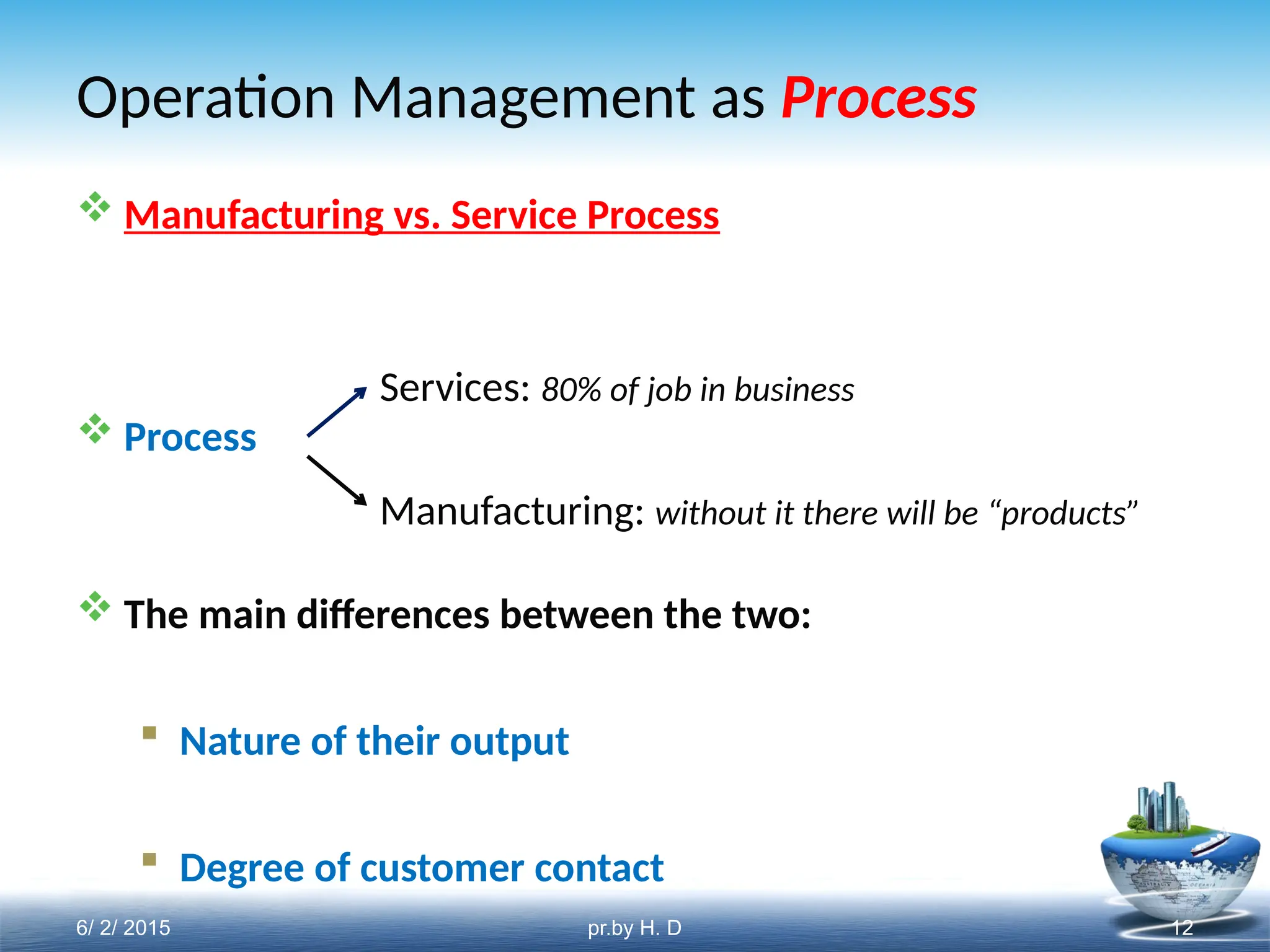
 Manufacturing vs. Service Process
 Process
 The main differences between the two:
 Nature of their output
 Degree of customer contact
Manufacturing: without it there will be “products”
Services: 80% of job in business
6/ 2/ 2015
pr.by H. D 13
Operation Management as Process
 Manufacturing and Service is difficult to distinguish
Total Customer Offering
 Automobile is not just manufacture a car but also provide after sale
service like arrange finance, offering warranties and guarantees.
 Computer industry, customer is paying both hardware and software
but after sale service is very important like help-line for
troubleshooting.
 Therefore, operation management should not see as
manufacturing vs. service BUT as joint effort in the whole
supply chain to provide total customer satisfaction.
6/ 2/ 2015
pr.by H. D 14
Operation Management as Process
 Manufacturing and Service some other example:
1. The product is intangible for service operation
 Is this still true?
 Service companies speak a lot about their “products”
“intangible” become “tangible”
2. Service can not be kept in the stock? Let’s examine the cases
 In “tangible” services business such as the Pizza Company, KFC, Lucky
Burger, the supporting elements of the service (supplies) is clear and
will be kept in stock.
 Pachem dental clinic must have their doctors ready to provide service
to customers, therefore “kept stock”
 Some products can not be stock that long i.e. perishable foods BUT
even CD music can last for years, it is not advised to keep it that long.
6/ 2/ 2015
pr.by H. D 15
Operation Management as Process
 Manufacturing and Service some other example:
3. Service vary and can not be mass-produce
 Depend on where and how we view the service. KFC is consider
service but still can produce large volume and diverse types
4. There is high customer contact
 It is estimated that there is less than 5 min contact between
passengers and flight attendances from Phnom Penh to Singapore
 Crown (Cambodia) spend a lot of time visiting their customers
 The introduction of ATM machines by ANZ and other banks has
reduce tremendous amount of contact between customer and
bankers.
6/ 2/ 2015
pr.by H. D 16
Operation Management as Process
 Manufacturing and Service some other example:
5. Customers participate in the service
 Not really necessary and always the case! With IT system customer
could check in without having to see the counter staffs, therefore
reduce check in time process for air transport companies.
6. Facilities are located near to customers
 That was really in the past! Still true for some cases…
 With modernization of IT, Angkor Home Hotel in Siem Reap can be
book from Tokyo, Operation Management books can be bought from
Amazon.com and have it ship straight to office door in Phnom Penh.
6/ 2/ 2015
pr.by H. D 17
Operation Management as Process
 Manufacturing and Service some other example:
7. Quality is difficult to measure and depends on the server
 In services industry, time is an important dimension in measure
quality – speed and reliability of response are measurable and
quantifiable…
 Gone in 60 seconds! By McDonald fast food chain… vs. long line up of
Lucky Burger, KFC, Pizza Company… during peak time!
6/ 2/ 2015
pr.by H. D 18
Operation Management as Process
 The service management system
1. Culture
&
Philosophy
5. Service
Delivery
System
4. Service
Concept
2. Market
Segment
3. Service
Image
Service Management System (Norman, 2000)
Who we target for?
Where we choose to be
and not to be?
External environment
Internal environment
Specification that
describe the benefit
offered by service.
The way service concept
is delivered.
6/ 2/ 2015
pr.by H. D 19
Operation Management as Process
 Manufacturing and Service – the key points
Ü It is not always helpful when trying to manage operation by
making a total distinction between service and
manufacturing
Ü Manufacturing and service is about the collaboration
activities in providing customers the goods or services
Ü The effort should use to distinction between input that
manufacturing & service process (materials & customers)
Ü Remember: materials do not think or act for themselves
while customers can and do. Service companies that forget
this would die soon…
6/ 2/ 2015
pr.by H. D 20
The production system
 The production system The production system is a
system whose function is to transform an input into a
desired output by means of a process (the production
process) and of resources. Of an organization is that
part, which produces products of an organization.
 The definition of a production system is thus based on
four main elements: the input, the resources, the
production process and the output. It is that activity
whereby resources, flowing within a defined system, are
combined and transformedin a controlled manner to add
value in accordance with the policies communicated by
management.
6/ 2/ 2015
pr.by H. D 21
 The production system has the following characteristics:
1. Production is an organized activity, so every production system has
an objective.
2. The system transforms the various inputs to useful outputs.
3. It does not operate in isolation from the other organization system.
4. There exists a feedback about the activities, which is essential to
control and improve System performance.
6/ 2/ 2015
pr.by H. D 22
Types of Production Systems
 A production system can be defined as a transformation system in
which a saleable product or service is created by working upon a
set of inputs. Inputs are usually in the form of men, machine, money,
materials etc. Production systems are usually classified on the basis
of the following:
• Type of product,
• Type of production line,
• Rate of production,
• Equipment used etc.
Production systems can be classified as Job Shop, Batch, Mass and
Continuous ProductionSystems.
6/ 2/ 2015
pr.by H. D 23
6/ 2/ 2015
pr.by H. D 24
JOB SHOP PRODUCTION
 Job shop production are characterized by manufacturing of one or
few quantity of products designed and produced as per the
specification of customers within prefixed time and cost. The
distinguishing feature of this is low volume and high variety of
products. A job shop comprises of general purpose machines
arranged into different departments. Each job demands unique
technological requirements, demands processing on machines in a
certain sequence
6/ 2/ 2015
pr.by H. D 25
Characteristics
 The Job-shop production system is followed when there is:
1. High variety of products and low volume.
2. Use of general purpose machines and facilities.
3. Highly skilled operators who can take up each job as a challenge
because of uniqueness.
4. Large inventory of materials, tools, parts.
6/ 2/ 2015
pr.by H. D 26
Advantages
Following are the advantages of job shop production:
1. Because of general purpose machines and facilities variety of
products can be produced.
2. Operators will become more skilled and competent, as each job
gives them learning opportunities.
3. Full potential of operators can be utilized.
4. Opportunity exists for creative methods and innovative ideas
6/ 2/ 2015
pr.by H. D 27
6/ 2/ 2015
pr.by H. D 28
BATCH PRODUCTION
Batch production is defined by American Production and
Inventory Control Society (APICS) “as a form of
manufacturing in which the job passes through the
functional departments in lots or batches and each lot may
have a different routing.” It is characterized by the
manufacture of limited number of products produced at
regular intervals and stocked awaiting sales.
6/ 2/ 2015
pr.by H. D 29
Characteristics
Batch production system is used under the following
circumstances:
1. When there is shorter production runs.
2. When plant and machinery are flexible.
3. When plant and machinery set up is used for the
production of item in a batch and change of set up is
required for processing the next batch.
4. When manufacturing lead time and cost are lower as
compared to job order production.
6/ 2/ 2015
pr.by H. D 30
Advantages
 Following are the advantages of batch production:
 1. Better utilization of plant and machinery.
 2. Promotes functional specialization.
 3. Cost per unit is lower as compared to job order
production.
 4. Lower investment in plant and machinery.
 5. Flexibility to accommodate and process number of
products.
 6. Job satisfaction exists for operators.
6/ 2/ 2015
pr.by H. D 31
Limitations
 Following are the limitations of batch production:
1. Material handling is complex because of irregular and
longer flows.
2. Production planning and control is complex.
6/ 2/ 2015
pr.by H. D 32
MASS PRODUCTION
 Manufacture of discrete parts or assemblies using a
continuous process are called mass production. This
production system is justified by very large volume of
production. The machines are arranged in a line or
product layout. Product and process standardization
exists and all outputs follow the same path.
6/ 2/ 2015
pr.by H. D 33
Characteristics
 Mass production is used under the following circumstances:
1. Standardization of product and process sequence.
2. Dedicated special purpose machines having higher production
capacities and output rates.
3. Large volume of products.
4. Shorter cycle time of production.
5. Lower in process inventory.
6. Perfectly balanced production lines.
6/ 2/ 2015
pr.by H. D 34
Advantages
 Following are the advantages of mass production:
1. Higher rate of production with reduced cycle time.
2. Higher capacity utilization due to line balancing.
3. Less skilled operators are required.
4. Low process inventory.
5. Manufacturing cost per unit is low.
6/ 2/ 2015
pr.by H. D 35
Limitations
 Following are the limitations of mass production:
1. Breakdown of one machine will stop an entire production line.
2. Line layout needs major change with the changes in the product
design.
3. High investment in production facilities.
4. The cycle time is determined by the slowest operation.
6/ 2/ 2015
pr.by H. D 36
CONTINUOUS PRODUCTION
Production facilities are arranged as per the sequence of production
operations from the first operations to the finished product. The items
are made to flow through the sequence of operations through material
handling devices such as conveyors, transfer devices, etc.
Characteristics
Continuous production is used under the following circumstances:
1. Dedicated plant and equipment with zero flexibility.
2. Material handling is fully automated.
3. Process follows a predetermined sequence of operations.
4. Component materials cannot be readily identified with final
product..
6/ 2/ 2015
pr.by H. D 37
Advantages
Following are the advantages of continuous production:
1. Standardization of product and process sequence.
2. Higher rate of production with reduced cycle time.
3. Higher capacity utilization due to line balancing.
4. Manpower is not required for material handling as it is completely
automatic.
Limitations
Following are the limitations of continuous production:
1. Flexibility to accommodate and process number of products
does not exist.
2. Very high investment for setting flow lines.
6/ 2/ 2015
pr.by H. D 38
Objectives of Production Management
The objective of the production management is ‘to produce goods services
of right quality and quantity at the right time and right manufacturing cost’.
1. RIGHT QUALITY
The quality of product is established based upon the customers’ needs. The
right quality is not necessarily best quality. It is determined by the cost of
the product and the technical characteristics
as suited to the specific requirements.
2. RIGHT QUANTITY
The manufacturing organization should produce the products in right
number. If they are produced
in excess of demand the capital will block up in the form of inventory and if
the quantity is produced in short of demand, leads to shortage of products.
6/ 2/ 2015
pr.by H. D 39
 3. RIGHT TIME
Timeliness of delivery is one of the important parameter to judge the
effectiveness of production
Department. So, the production department has to make the optimal utilization
of input resourcesto achieve its objective.
4. RIGHT MANUFACTURING COST
 Manufacturing costs are established before the product is actually
manufactured. Hence, all attempts should be made to produce the products
at pre-established cost, so as to reduce the variation between actual and
the standard (pre-established) cost.
6/ 2/ 2015
pr.by H. D 40
Distinction between Manufacturing Operations and Service
Operations
1. Tangible/Intangible nature of output
2. Consumption of output
3. Nature of work (job)
4. Degree of customer contact
5. Customer participation in conversion
6, Measurement of performance.
6/ 2/ 2015
pr.by H. D 41
Objectives of Production Management
 The objective of the production management is ‘to produce goods services
of right quality and quantity at the right time and right manufacturing cost’.
1. RIGHT QUALITY
The quality of product is established based upon the customers’ needs. The right
quality is not necessarily best quality. It is determined by the cost of the product and
the technical characteristicsas suited to the specific requirements.
6/ 2/ 2015
pr.by H. D 42
2. RIGHT QUANTITY
The manufacturing organization should
produce the products in right number. If
they are produced
in excess of demand the capital will block
up in the form of inventory and if the
quantity is produced in short of demand,
leads to shortage of products
6/ 2/ 2015
pr.by H. D 43
3. RIGHT TIME
Timeliness of delivery is one of the
important parameter to judge the
effectiveness of production
Department. So, the production
department has to make the optimal
utilization of input resources
to achieve its objective.
6/ 2/ 2015
pr.by H. D 44
4. RIGHT MANUFACTURING COST
Manufacturing costs are established
before the product is actually
manufactured. Hence, all attempts should
be made to produce the products at pre-
established cost, so as to reduce the
variation between actual and the standard
(pre-established) cost.
6/ 2/ 2015
pr.by H. D 45
Distinction between Manufacturing
Operations and Service Operations
Following characteristics can be considered
for distinguishing manufacturing operations with
service operations:
1. Tangible/Intangible nature of output
2. Consumption of output
3. Nature of work (job)
4. Degree of customer contact
5. Customer participation in conversion
6. Measurement of performance.
6/ 2/ 2015
pr.by H. D 46
 Manufacturing is characterized by tangible outputs (products),
outputs that customers consumeOvertime, jobs that use less labor
and more equipment, little customer contact, no customer
participation in the conversion process (in production), and
sophisticated methods for measuringProduction activities and
resource consumption as product are made.
 Service is characterized by intangible outputs, outputs that
customers consumes immediately, jobs that use more labor and
less equipment, direct consumer contact, frequent customer
participation in the conversion process, and elementary methods for
measuring conversion activities and resource consumption. Some
services are equipment based namely rail-road services, telephone
services and some are people based namely tax consultant
services, hair styling.
6/ 2/ 2015
pr.by H. D 47
6/ 2/ 2015
pr.by H. D 48
6/ 2/ 2015
pr.by H. D 49
6/ 2/ 2015
pr.by H. D 50
6/ 2/ 2015
pr.by H. D 51
A Framework for Managing Operations
 PLANNING
Activities that establishes a course of action and guide future decision-making is
planning.
ORGANIZING
Activities that establishes a structure of tasks and authority
CONTROLLING
Activities that assure the actual performance in accordance with planned performance
. BEHAVIOUR
Operation managers are concerned with how their efforts to plan, organize, and control affect
human behavior.
MODELS
As operation managers plan, organize, and control the conversion process, they encounter many
problems and must make many decisions
6/ 2/ 2015
pr.by H. D 52
SCOPE OF PRODUCTION AND OPERATIONS
MANAGEMENT
 Operations management functions:
1. Location of facilities
2. Plant layouts and material handling
3. Product design
4. Process design
5. Production and planning control
6. Quality control
7. Materials management
8. Maintenance management.
6/ 2/ 2015
pr.by H. D 53
LOCATION OF FACILITIES
Location of facilities for operations is a long-term capacity decision which involves a long term
commitment about the geographically static factors that affect a business organization. It is an
important strategic level decision-making for an organization.
PLANT LAYOUT AND MATERIAL HANDLING
Plant layout refers to the physical arrangement of facilities.
PRODUCT DESIGN
Product design deals with conversion of ideas into reality
PROCESS DESIGN
Process design is a macroscopic decision-making of an overall process route for converting the raw
material into finished goods
6/ 2/ 2015
pr.by H. D 54
PRODUCTION PLANNING AND CONTROL
Main functions of production planning and control includes planning,
routing, scheduling, dispatching and follow-up.
Planning is deciding in advance what to do, how to do it, when to do it and who is to do it.
Planning bridges the gap from where we are, to where we want to go. It makes it possible for
things to occur which would not otherwise happen.
Routing may be defined as the selection of path which each part of the product will follow,
which being transformed from raw material to finished products. Routing determines the most
advantageous path to be followed from department to department and machine to machine till
raw material gets its final shape.
Scheduling determines the programme for the operations. Scheduling may be defined as ‘the
fixation of time and date for each operation’ as well as it determines the sequence of operations
to be followed.
6/ 2/ 2015
pr.by H. D 55
con
6/ 2/ 2015
pr.by H. D 56
QUALITY CONTROL
Quality Control (QC) may be defined as ‘a system that is used to maintain a
desired level of quality in a product or service’
The main objectives of quality control are:
 To improve the companies income by making the production more acceptable to the
customers i.e., by providing long life, greater usefulness, maintainability, etc.
 To reduce companies cost through reduction of losses due to defects.
 To achieve interchangeability of manufacture in large scale production.
 To produce optimal quality at reduced price.
 To ensure satisfaction of customers with productions or services or high quality level, tobuild
customer goodwill, confidence and reputation of manufacturer.
 To make inspection prompt to ensure quality control.
 To check the variation during manufacturing.
6/ 2/ 2015
pr.by H. D 57
MATERIALS MANAGEMENT
Materials management is that aspect of
management function which is primarily
concerned with the acquisition, control and
use of materials needed and flow of goods
and services connected with the production
process having some predetermined
objectives in view
6/ 2/ 2015
pr.by H. D 58
con
 The main objectives of materials management are:
To minimize material cost.
To purchase, receive, transport and store materials efficiently and to reduce the related
cost.
 To cut down costs through simplification, standardization, value analysis, import
substitution, etc.
 To trace new sources of supply and to develop cordial relations with them in order to
ensure continuous supply at reasonable rates.
 To reduce investment tied in the inventories for use in other productive purposes and
to develop high inventory turnover ratios.
6/ 2/ 2015
pr.by H. D 59
MAINTENANCE MANAGEMENT
 In modern industry, equipment and machinery are a very important part of the total
productive effort. Therefore, their idleness or downtime becomes are very expensive.
Hence, it is very important that the plant machinery should be properly maintained.
 The main objectives of maintenance management are:
1. To achieve minimum breakdown and to keep the plant in good working condition at the
lowest possible cost.
2. To keep the machines and other facilities in such a condition that permits them to be
usedat their optimal capacity without interruption.
3. To ensure the availability of the machines, buildings and services required by other
section of the factory for the performance of their functions at optimal return on
investment.
6/ 2/ 2015
pr.by H. D 60
Factory Level Production management
1. Planning
2. Production Management
3. Manufacturing production scheduling (MPS)
4. Material requirement planning (MRP)
5. Just in time (JIT)
6. Bill of Materials
7. Capacity Planning
8. Inventory Control
6/ 2/ 2015
pr.by H. D 61
Operational Plans
Specify the details of how the overall goals
are to be achieved.
Cover short time period.
  Planning is not just forecasting – it should aim to change the future
  Planning is an art not a science - there is no one right way to plan
  Plans should not be set in stone
  Plans are not just the paper they are written on – they must influence peoples’
behavior
6/ 2/ 2015
pr.by H. D 62
There are three types of plan used at different levels within an
organization:
1. Thestrategic plan; is developed for long-term planning and covers a period of aboutfive
years. The strategic plan specifies the missions and goals of the organization including
decisions on how resources, both capital and human, will be allocated to meetorganizational
goals.
2. Business plans; sit between the highest-level plan (the strategic plan) and the operationa
lplan. A business plan is a formal statement of a set of business goals and objectives thatare
to be achieved to meet the strategic objectives of the organization. The business
planincludes the reasons why the goals and objectives are believed to be attainable, the
planfor reaching those goals inclusive of relevant information about the organization.
3 An operational plan; focuses on the short-term objectives: what needs to be accomplishedin
the near future in order that the company can progress towards achieving its strategic objectives.
Operational plans generally have a focus of less than one year and are quitedetailed in terms of
what needs to be implemented and how
6/ 2/ 2015
pr.by H. D 63
LO2: Plan and manage resource acquisition
The Look up pattern can be used with
both reusable and non-reusable resources
 Resource Acquisition (gaining)
•Specify the plan for acquiring the resources and assets, in addition to
personnel, needed to successfully complete the project.
• Describe the resource acquisition process.
• Specify the assignment of responsibility for all aspects of resource
acquisition.
• Specify acquisition plans for equipment, computer hardware and
software, training, service contracts, transportation, facilities, and
administrative and janitorial services.
• Specify when in the project schedule the various acquisition activities
will be required.
•Specify any constraints on acquiring the necessary resources.
6/ 2/ 2015
pr.by H. D 64
The Look up pattern describes how to find
and access resources, whether local or
distributed
6/ 2/ 2015
pr.by H. D 65
 Resource Acquisition (gaining)
• Specify the plan for acquiring the resources and assets, in addition to
personnel, needed to successfully complete the project.
• Describe the resource acquisition process.
• Specify the assignment of responsibility for all aspects of resource acquisition.
• Specify acquisition plans for equipment, computer hardware and software,
training, service contracts, transportation, facilities, and administrative and
janitorial services.
• Specify when in the project schedule the various acquisition activities will be
required.
• Specify any constraints on acquiring the necessary resources.
6/ 2/ 2015
pr.by H. D 66
 Resource Acquisition (gaining)
 • Specify the plan for acquiring the resources and assets, in
addition to personnel, needed to successfully complete the project.
 • Describe the resource acquisition process.
 • Specify the assignment of responsibility for all aspects of
resource acquisition.
 • Specify acquisition plans for equipment, computer hardware
and software, training, service contracts, transportation, facilities,
and administrative and janitorial services.
 • Specify when in the project schedule the various acquisition
activities will be required.
 • Specify any constraints on acquiring the necessary
resources.
6/ 2/ 2015
pr.by H. D 67
 The following participants form the structure of the Lookup pattern:
 A resource user uses a resource.
 A resource is an entity such as a service that provides some
type of functionality.
 A resource provider offers resources and advertises them via
the lookup service.
 A lookup service provides the capability for resource providers
to advertise resources via references to themselves, and for resource
users to find these references
6/ 2/ 2015
pr.by H. D 68
 The following class diagram illustrates the structure of the Look up
pattern.
6/ 2/ 2015
pr.by H. D 69
Strategic HRM is developed through three
steps:
1. Decide on the strategic goals
2. Identify employee skills and behaviors
necessary for success
3. Formulate HR management policies and
practices that will produce these required
skills
6/ 2/ 2015
pr.by H. D 70
6/ 2/ 2015
pr.by H. D 71
Step 1: Define the current business
Begin by asking these questions:
 – What products do we sell?
 – Where do we sell these products?
 – How do our products or services differ from our
competitors?
Step 2: Perform External and Internal Situational Audits
 • The key to success is adaptation
 • Situational audits require SWOT (strengths, weaknesses,
opportunities, and threats) analysis
6/ 2/ 2015
pr.by H. D 72
Step 3: Formulate a New Business Direction
• What should our new business be in terms of product, placement and
competitive advantage?
• The vision statement describes the following:
What do we want to become?
• The mission statement explains the following:
Where are we now?
Step 4: Translate the Mission into Strategic Goals
• Operationalize the mission for managers
• What does the mission mean to each department?
• What goals follow implementation?
6/ 2/ 2015
pr.by H. D 73
Step 5: Formulate Strategies to Achieve the Strategic Goals
• What is the game plan?
• Decide on a course of action
– Best strategies are concise
–Easily communicated
Step 6: Implement the Strategies
• Get the game plan going
• Do what needs to be done
– Hire or fire people
– Build or close plants
–Adding or eliminating products and product lines
Step 7: Evaluate Performance
• Evaluate, evaluate, evaluate
• Ongoing process vis-à-vis strategic control
•Addresses the following questions:
–Are resources being utilized as planned?
–Are inconsistency explained?
 – Do changes in our situation suggest change?
6/ 2/ 2015
pr.by H. D 74
Contents Map
Operation Management as Process
Value Chain Management
What is operation management?
Scope of responsibility of operation manager
Trends and challenges in OM
6/ 2/ 2015
pr.by H. D 75
Value Chain Management
 What is value chain?
 Process must add value to their customers
 Activities that are necessary for adding values
 Therefore, It is about value chain management!!! See: Value Innovation
6/ 2/ 2015
pr.by H. D 76
Value Chain Management
 It is about management of “value added activities” in the
whole supply chain (supply chain management)
 Processes are resource consumer , therefore its activities of
converting input to output must be examine carefully. They
should value added!
 A business is profitable if the value it creates exceeds the cost of performing the value activities (Porter,
2001)
Process
1
Process
2
Process
3
Process
4
Process
5
Process
6
Core processes
6/ 2/ 2015
pr.by H. D 77
The Value Chain (Porter, M. 2001)
 A company’s value chain is a system of interdependent activities which are connected by
linkages.
 Linkages exist when the way in which one activity is performed affects the cost or
effectiveness of other activities. Therefore need to be trade-off & coordination!
6/ 2/ 2015
pr.by H. D 78
Contents Map
Operation Management as Process
Value Chain Management
What is operation management?
Scope of responsibility of operation manager
Trends and challenges in OM
6/ 2/ 2015
pr.by H. D 79
Definition of Operation Management
 Systematic design, direction, and control of process that
transforming input into product/service for external & internal
customers
 In large organization, operation is usually responsible for the actual
transformation of input into services & products.
 Therefore, it is consisted of series of small operation which work as
function.
 Some firms do not own the function but “contracting”
 Most of senior level executive have their work experience in operation
i.e. VP Operation or Production, Chief Operation Officer (COO)
 Typical report function to COO include Customer Service, Production,
Logistic, QA, Inventory, Maintenance & Reliability etc.
6/ 2/ 2015
pr.by H. D 80
Contents Map
Operation Management as Process
Value Chain Management
What is operation management?
Scope of responsibility of operation manager
Trends and challenges in OM
6/ 2/ 2015
pr.by H. D 81
Scope of responsibility of OM
 Decision COO makes both Strategic and Tactics
 Decision making process:
1 •Recognize & Clearly define the problems
2 •Collect information to be analyzed
3 •Choose the most attractive solutions
4 •Implement chosen alternatives
6/ 2/ 2015
pr.by H. D 82
Scope of responsibility of OM
 Strategic vs. Tactics decision
 Strategic decision include:
• Development of new capabilities
• Maintaining of existing ones
• Process design
• Value chain linkage development
• KPIs development (finance and non finance matrices)
 Tactics decision include:
• Process improvement
• Performance measurement & management (see: Kaplan & Norton, Davenport-
analytical performance management)
• Managing projects
• Planning
• Inventory
 Supplement docs: The three level of decision making
6/ 2/ 2015
pr.by H. D 83
Scope of responsibility of OM
 2 Principles must be kept in mind as COO:
1. Must design and operate processes deal with Quality, Technologies,
and staffing issues
2. Each part of organization has its own identity
6/ 2/ 2015
pr.by H. D 84
Contents Map
Operation Management as Process
Value Chain Management
What is operation management?
Scope of responsibility of operation manager
Trends and challenges in OM
6/ 2/ 2015
pr.by H. D 85
Trends & Challenges in managing operation
Productivity
Global competition
Technologies changes
Environmental issues
Ethical
Diversity
6/ 2/ 2015
pr.by H. D 86
Trends & Challenges in managing operation
Productivity
Four strategies to consider:
Value of output
(services or
products)
Value of input (wage,
cost of equipment,
materials etc.)
6/ 2/ 2015
pr.by H. D 87
Trends & Challenges in managing operation
Global competition
It is agreed that to “prosper & survive” business have to view
customers, suppliers, facilities location, and competitor in global terms
Feature articles:
“What it take to compete in flat world”
“Global competition for resources”
6/ 2/ 2015
pr.by H. D 88
Trends & Challenges in managing operation
Technological changes:
Thus, the first and critical point about why we fail to see the need for
change stems from the fact that we stand blinded by the light of
successful past mental maps (Black & Gregerson,2008).
Feature articles:
“strategy & the internet”
“It is all start with ones”
“How information gives you competitive advantages”
LFC vs KFC
6/ 2/ 2015
pr.by H. D 89
Trends & Challenges in managing operation
Environmental issues:
Companies that persist in treating climate change solely as a corporate
social responsibility issue, rather than a business problem, will risk the
greatest consequences (Porter & Reinhardt, 2007).
Feature articles:
“business climate and climate business”
“Impact of Climate Changes on future business strategy adoption”
“Virtual Matrix of Corporate Social Responsibility”
6/ 2/ 2015
pr.by H. D 90
Trends & Challenges in managing operation
Business ethic:
Raising the bar of rules or standards governing the conduct of doing
business
Feature articles:
http://en.wikipedia.org/wiki/Business_ethics
http://www.scu.edu/ethics/
6/ 2/ 2015
pr.by H. D 91
Trends & Challenges in managing operation
Workplace diversity:
Managing diversity is comprehensive process for creating work
environment that includes everyone
There is single recipe for success!
Feature articles:
Harvard Business Review on “Managing Diversity”
Harvard Business Review on “Culture Changes”
Diversity as strategy – Harvard Business Review
Diversity at workplace: benefits , challenges, and required material too
ls
6/ 2/ 2015
pr.by H. D 92
Trends & Challenges in managing operation
Feature articles: “5 Competitive Forces that Shape Strategy”
6/ 2/ 2015
pr.by H. D 93
Question…
?
6/ 2/ 2015
pr.by H. D 94
Class activities
Objectives:
To get deeper understand of business present & future trends & challenges
Increase level of competences in business research
Team work in practices
Business presentation skill
Topics:
1. Productivity improvement challenges
2. Globalization – The competition for resources. Try to answer “why companies
are competing with everyone from everywhere for everything?
3. Climate changes – threats and opportunities for business in the future (to
include case studies)
4. Management of workplace diversity
5. Using Service Management Model developed by Norman, compare service
offer by The Pizza Company, Lucky Burger, KFC, Pizza World, and Soksabby.
6/ 2/ 2015
pr.by H. D 95
Class activities
Team
A – Lead by:
Member:
B – Lead by:
Member:
C – Lead by:
Member:
D – Lead by:
Member:
E – Lead by:
Member:
Requirements:
Paper works > 14 pages
Presentation 20 – 30 min
Q&A < 15 min
Each team member must present
TO BE EFFECTIVE
DEADLINE MUST BE SET
Ba
ck
6/ 2/ 2015

introduction to operation management.pptx

  • 1.
    Managing Production Operations PRE.BY HAILEDEMASH. D.B.P.T.C 6/ 2/ 2015 1 pr.by H. D
  • 2.
    pr.by H. D2 After finish this chapter… Explain what is “process” Describe OM as function TO make or Develop operational plan How to Plan and manage resource acquisition Identify some decisions make by operation manager 6/ 2/ 2015
  • 3.
    pr.by H. D3 Learning Outcomes Develop operational plan Plan and manage resource acquisition Monitor and review operational performance 6/ 2/ 2015
  • 4.
    pr.by H. D4 LO1: Develop operational plan Production/manufacturing is the process of converting raw materials or semi-finished products into finished products that have value in the market place. This process involves the contribution of labor, equipment, energy, and information. 6/ 2/ 2015
  • 5.
    pr.by H. D5 production as ‘a process by which goods and services are created’. Some examples of production are: manufacturing custom-made products like, boilers with a specific capacity, constructing flats, some structural fabrication works for selected customers, etc., and manufacturing standardized products like, car, bus, motor cycle, radio, television, etc 6/ 2/ 2015
  • 6.
    OPERATIONS MANAGEMENT CONCEPTS 1.1 INTRODUCTION Operationis that part of as organization, which is concerned with the transformation of a range of inputs into the required output (services) having the requisite quality level. The set of interrelated management activities, which are involved in manufacturing certain products, is called as production management. If the same concept is extended to services management, then the corresponding set of management activities is called as operations management. 6/ 2/ 2015 pr.by H. D 6
  • 7.
    pr.by H. D7 Operation Management as Process  Operation Management deal with PROCESS that produce “Goods” & “Service” ? ADD VALUE ? OUT PUT IN PUT 6/ 2/ 2015
  • 8.
    pr.by H. D8 CON. 6/ 2/ 2015
  • 9.
    pr.by H. D9 Concept of Operations Operations in an organization can be categorizedInto manufacturing operations and service operations. Manufacturing operations is a conversion Process that includes manufacturing yields a tangible output: a product, whereas, service operation a conversion process that includes service yields an intangible output: a deed, a performance, an effort. 6/ 2/ 2015
  • 10.
    pr.by H. D10 Objectives of Production Management The objective of the production management is ‘to produce goods services of right quality and quantity at the right time and right manufacturing cost’ 6/ 2/ 2015
  • 11.
    pr.by H. D11 Operation Management as Process  PROCESS should be design with according to customer “Needs” and “Wants”  Customer Internal External 6/ 2/ 2015
  • 12.
    pr.by H. D12 Operation Management as Process  Manufacturing vs. Service Process  Process  The main differences between the two:  Nature of their output  Degree of customer contact Manufacturing: without it there will be “products” Services: 80% of job in business 6/ 2/ 2015
  • 13.
    pr.by H. D13 Operation Management as Process  Manufacturing and Service is difficult to distinguish Total Customer Offering  Automobile is not just manufacture a car but also provide after sale service like arrange finance, offering warranties and guarantees.  Computer industry, customer is paying both hardware and software but after sale service is very important like help-line for troubleshooting.  Therefore, operation management should not see as manufacturing vs. service BUT as joint effort in the whole supply chain to provide total customer satisfaction. 6/ 2/ 2015
  • 14.
    pr.by H. D14 Operation Management as Process  Manufacturing and Service some other example: 1. The product is intangible for service operation  Is this still true?  Service companies speak a lot about their “products” “intangible” become “tangible” 2. Service can not be kept in the stock? Let’s examine the cases  In “tangible” services business such as the Pizza Company, KFC, Lucky Burger, the supporting elements of the service (supplies) is clear and will be kept in stock.  Pachem dental clinic must have their doctors ready to provide service to customers, therefore “kept stock”  Some products can not be stock that long i.e. perishable foods BUT even CD music can last for years, it is not advised to keep it that long. 6/ 2/ 2015
  • 15.
    pr.by H. D15 Operation Management as Process  Manufacturing and Service some other example: 3. Service vary and can not be mass-produce  Depend on where and how we view the service. KFC is consider service but still can produce large volume and diverse types 4. There is high customer contact  It is estimated that there is less than 5 min contact between passengers and flight attendances from Phnom Penh to Singapore  Crown (Cambodia) spend a lot of time visiting their customers  The introduction of ATM machines by ANZ and other banks has reduce tremendous amount of contact between customer and bankers. 6/ 2/ 2015
  • 16.
    pr.by H. D16 Operation Management as Process  Manufacturing and Service some other example: 5. Customers participate in the service  Not really necessary and always the case! With IT system customer could check in without having to see the counter staffs, therefore reduce check in time process for air transport companies. 6. Facilities are located near to customers  That was really in the past! Still true for some cases…  With modernization of IT, Angkor Home Hotel in Siem Reap can be book from Tokyo, Operation Management books can be bought from Amazon.com and have it ship straight to office door in Phnom Penh. 6/ 2/ 2015
  • 17.
    pr.by H. D17 Operation Management as Process  Manufacturing and Service some other example: 7. Quality is difficult to measure and depends on the server  In services industry, time is an important dimension in measure quality – speed and reliability of response are measurable and quantifiable…  Gone in 60 seconds! By McDonald fast food chain… vs. long line up of Lucky Burger, KFC, Pizza Company… during peak time! 6/ 2/ 2015
  • 18.
    pr.by H. D18 Operation Management as Process  The service management system 1. Culture & Philosophy 5. Service Delivery System 4. Service Concept 2. Market Segment 3. Service Image Service Management System (Norman, 2000) Who we target for? Where we choose to be and not to be? External environment Internal environment Specification that describe the benefit offered by service. The way service concept is delivered. 6/ 2/ 2015
  • 19.
    pr.by H. D19 Operation Management as Process  Manufacturing and Service – the key points Ü It is not always helpful when trying to manage operation by making a total distinction between service and manufacturing Ü Manufacturing and service is about the collaboration activities in providing customers the goods or services Ü The effort should use to distinction between input that manufacturing & service process (materials & customers) Ü Remember: materials do not think or act for themselves while customers can and do. Service companies that forget this would die soon… 6/ 2/ 2015
  • 20.
    pr.by H. D20 The production system  The production system The production system is a system whose function is to transform an input into a desired output by means of a process (the production process) and of resources. Of an organization is that part, which produces products of an organization.  The definition of a production system is thus based on four main elements: the input, the resources, the production process and the output. It is that activity whereby resources, flowing within a defined system, are combined and transformedin a controlled manner to add value in accordance with the policies communicated by management. 6/ 2/ 2015
  • 21.
    pr.by H. D21  The production system has the following characteristics: 1. Production is an organized activity, so every production system has an objective. 2. The system transforms the various inputs to useful outputs. 3. It does not operate in isolation from the other organization system. 4. There exists a feedback about the activities, which is essential to control and improve System performance. 6/ 2/ 2015
  • 22.
    pr.by H. D22 Types of Production Systems  A production system can be defined as a transformation system in which a saleable product or service is created by working upon a set of inputs. Inputs are usually in the form of men, machine, money, materials etc. Production systems are usually classified on the basis of the following: • Type of product, • Type of production line, • Rate of production, • Equipment used etc. Production systems can be classified as Job Shop, Batch, Mass and Continuous ProductionSystems. 6/ 2/ 2015
  • 23.
    pr.by H. D23 6/ 2/ 2015
  • 24.
    pr.by H. D24 JOB SHOP PRODUCTION  Job shop production are characterized by manufacturing of one or few quantity of products designed and produced as per the specification of customers within prefixed time and cost. The distinguishing feature of this is low volume and high variety of products. A job shop comprises of general purpose machines arranged into different departments. Each job demands unique technological requirements, demands processing on machines in a certain sequence 6/ 2/ 2015
  • 25.
    pr.by H. D25 Characteristics  The Job-shop production system is followed when there is: 1. High variety of products and low volume. 2. Use of general purpose machines and facilities. 3. Highly skilled operators who can take up each job as a challenge because of uniqueness. 4. Large inventory of materials, tools, parts. 6/ 2/ 2015
  • 26.
    pr.by H. D26 Advantages Following are the advantages of job shop production: 1. Because of general purpose machines and facilities variety of products can be produced. 2. Operators will become more skilled and competent, as each job gives them learning opportunities. 3. Full potential of operators can be utilized. 4. Opportunity exists for creative methods and innovative ideas 6/ 2/ 2015
  • 27.
    pr.by H. D27 6/ 2/ 2015
  • 28.
    pr.by H. D28 BATCH PRODUCTION Batch production is defined by American Production and Inventory Control Society (APICS) “as a form of manufacturing in which the job passes through the functional departments in lots or batches and each lot may have a different routing.” It is characterized by the manufacture of limited number of products produced at regular intervals and stocked awaiting sales. 6/ 2/ 2015
  • 29.
    pr.by H. D29 Characteristics Batch production system is used under the following circumstances: 1. When there is shorter production runs. 2. When plant and machinery are flexible. 3. When plant and machinery set up is used for the production of item in a batch and change of set up is required for processing the next batch. 4. When manufacturing lead time and cost are lower as compared to job order production. 6/ 2/ 2015
  • 30.
    pr.by H. D30 Advantages  Following are the advantages of batch production:  1. Better utilization of plant and machinery.  2. Promotes functional specialization.  3. Cost per unit is lower as compared to job order production.  4. Lower investment in plant and machinery.  5. Flexibility to accommodate and process number of products.  6. Job satisfaction exists for operators. 6/ 2/ 2015
  • 31.
    pr.by H. D31 Limitations  Following are the limitations of batch production: 1. Material handling is complex because of irregular and longer flows. 2. Production planning and control is complex. 6/ 2/ 2015
  • 32.
    pr.by H. D32 MASS PRODUCTION  Manufacture of discrete parts or assemblies using a continuous process are called mass production. This production system is justified by very large volume of production. The machines are arranged in a line or product layout. Product and process standardization exists and all outputs follow the same path. 6/ 2/ 2015
  • 33.
    pr.by H. D33 Characteristics  Mass production is used under the following circumstances: 1. Standardization of product and process sequence. 2. Dedicated special purpose machines having higher production capacities and output rates. 3. Large volume of products. 4. Shorter cycle time of production. 5. Lower in process inventory. 6. Perfectly balanced production lines. 6/ 2/ 2015
  • 34.
    pr.by H. D34 Advantages  Following are the advantages of mass production: 1. Higher rate of production with reduced cycle time. 2. Higher capacity utilization due to line balancing. 3. Less skilled operators are required. 4. Low process inventory. 5. Manufacturing cost per unit is low. 6/ 2/ 2015
  • 35.
    pr.by H. D35 Limitations  Following are the limitations of mass production: 1. Breakdown of one machine will stop an entire production line. 2. Line layout needs major change with the changes in the product design. 3. High investment in production facilities. 4. The cycle time is determined by the slowest operation. 6/ 2/ 2015
  • 36.
    pr.by H. D36 CONTINUOUS PRODUCTION Production facilities are arranged as per the sequence of production operations from the first operations to the finished product. The items are made to flow through the sequence of operations through material handling devices such as conveyors, transfer devices, etc. Characteristics Continuous production is used under the following circumstances: 1. Dedicated plant and equipment with zero flexibility. 2. Material handling is fully automated. 3. Process follows a predetermined sequence of operations. 4. Component materials cannot be readily identified with final product.. 6/ 2/ 2015
  • 37.
    pr.by H. D37 Advantages Following are the advantages of continuous production: 1. Standardization of product and process sequence. 2. Higher rate of production with reduced cycle time. 3. Higher capacity utilization due to line balancing. 4. Manpower is not required for material handling as it is completely automatic. Limitations Following are the limitations of continuous production: 1. Flexibility to accommodate and process number of products does not exist. 2. Very high investment for setting flow lines. 6/ 2/ 2015
  • 38.
    pr.by H. D38 Objectives of Production Management The objective of the production management is ‘to produce goods services of right quality and quantity at the right time and right manufacturing cost’. 1. RIGHT QUALITY The quality of product is established based upon the customers’ needs. The right quality is not necessarily best quality. It is determined by the cost of the product and the technical characteristics as suited to the specific requirements. 2. RIGHT QUANTITY The manufacturing organization should produce the products in right number. If they are produced in excess of demand the capital will block up in the form of inventory and if the quantity is produced in short of demand, leads to shortage of products. 6/ 2/ 2015
  • 39.
    pr.by H. D39  3. RIGHT TIME Timeliness of delivery is one of the important parameter to judge the effectiveness of production Department. So, the production department has to make the optimal utilization of input resourcesto achieve its objective. 4. RIGHT MANUFACTURING COST  Manufacturing costs are established before the product is actually manufactured. Hence, all attempts should be made to produce the products at pre-established cost, so as to reduce the variation between actual and the standard (pre-established) cost. 6/ 2/ 2015
  • 40.
    pr.by H. D40 Distinction between Manufacturing Operations and Service Operations 1. Tangible/Intangible nature of output 2. Consumption of output 3. Nature of work (job) 4. Degree of customer contact 5. Customer participation in conversion 6, Measurement of performance. 6/ 2/ 2015
  • 41.
    pr.by H. D41 Objectives of Production Management  The objective of the production management is ‘to produce goods services of right quality and quantity at the right time and right manufacturing cost’. 1. RIGHT QUALITY The quality of product is established based upon the customers’ needs. The right quality is not necessarily best quality. It is determined by the cost of the product and the technical characteristicsas suited to the specific requirements. 6/ 2/ 2015
  • 42.
    pr.by H. D42 2. RIGHT QUANTITY The manufacturing organization should produce the products in right number. If they are produced in excess of demand the capital will block up in the form of inventory and if the quantity is produced in short of demand, leads to shortage of products 6/ 2/ 2015
  • 43.
    pr.by H. D43 3. RIGHT TIME Timeliness of delivery is one of the important parameter to judge the effectiveness of production Department. So, the production department has to make the optimal utilization of input resources to achieve its objective. 6/ 2/ 2015
  • 44.
    pr.by H. D44 4. RIGHT MANUFACTURING COST Manufacturing costs are established before the product is actually manufactured. Hence, all attempts should be made to produce the products at pre- established cost, so as to reduce the variation between actual and the standard (pre-established) cost. 6/ 2/ 2015
  • 45.
    pr.by H. D45 Distinction between Manufacturing Operations and Service Operations Following characteristics can be considered for distinguishing manufacturing operations with service operations: 1. Tangible/Intangible nature of output 2. Consumption of output 3. Nature of work (job) 4. Degree of customer contact 5. Customer participation in conversion 6. Measurement of performance. 6/ 2/ 2015
  • 46.
    pr.by H. D46  Manufacturing is characterized by tangible outputs (products), outputs that customers consumeOvertime, jobs that use less labor and more equipment, little customer contact, no customer participation in the conversion process (in production), and sophisticated methods for measuringProduction activities and resource consumption as product are made.  Service is characterized by intangible outputs, outputs that customers consumes immediately, jobs that use more labor and less equipment, direct consumer contact, frequent customer participation in the conversion process, and elementary methods for measuring conversion activities and resource consumption. Some services are equipment based namely rail-road services, telephone services and some are people based namely tax consultant services, hair styling. 6/ 2/ 2015
  • 47.
    pr.by H. D47 6/ 2/ 2015
  • 48.
    pr.by H. D48 6/ 2/ 2015
  • 49.
    pr.by H. D49 6/ 2/ 2015
  • 50.
    pr.by H. D50 6/ 2/ 2015
  • 51.
    pr.by H. D51 A Framework for Managing Operations  PLANNING Activities that establishes a course of action and guide future decision-making is planning. ORGANIZING Activities that establishes a structure of tasks and authority CONTROLLING Activities that assure the actual performance in accordance with planned performance . BEHAVIOUR Operation managers are concerned with how their efforts to plan, organize, and control affect human behavior. MODELS As operation managers plan, organize, and control the conversion process, they encounter many problems and must make many decisions 6/ 2/ 2015
  • 52.
    pr.by H. D52 SCOPE OF PRODUCTION AND OPERATIONS MANAGEMENT  Operations management functions: 1. Location of facilities 2. Plant layouts and material handling 3. Product design 4. Process design 5. Production and planning control 6. Quality control 7. Materials management 8. Maintenance management. 6/ 2/ 2015
  • 53.
    pr.by H. D53 LOCATION OF FACILITIES Location of facilities for operations is a long-term capacity decision which involves a long term commitment about the geographically static factors that affect a business organization. It is an important strategic level decision-making for an organization. PLANT LAYOUT AND MATERIAL HANDLING Plant layout refers to the physical arrangement of facilities. PRODUCT DESIGN Product design deals with conversion of ideas into reality PROCESS DESIGN Process design is a macroscopic decision-making of an overall process route for converting the raw material into finished goods 6/ 2/ 2015
  • 54.
    pr.by H. D54 PRODUCTION PLANNING AND CONTROL Main functions of production planning and control includes planning, routing, scheduling, dispatching and follow-up. Planning is deciding in advance what to do, how to do it, when to do it and who is to do it. Planning bridges the gap from where we are, to where we want to go. It makes it possible for things to occur which would not otherwise happen. Routing may be defined as the selection of path which each part of the product will follow, which being transformed from raw material to finished products. Routing determines the most advantageous path to be followed from department to department and machine to machine till raw material gets its final shape. Scheduling determines the programme for the operations. Scheduling may be defined as ‘the fixation of time and date for each operation’ as well as it determines the sequence of operations to be followed. 6/ 2/ 2015
  • 55.
    pr.by H. D55 con 6/ 2/ 2015
  • 56.
    pr.by H. D56 QUALITY CONTROL Quality Control (QC) may be defined as ‘a system that is used to maintain a desired level of quality in a product or service’ The main objectives of quality control are:  To improve the companies income by making the production more acceptable to the customers i.e., by providing long life, greater usefulness, maintainability, etc.  To reduce companies cost through reduction of losses due to defects.  To achieve interchangeability of manufacture in large scale production.  To produce optimal quality at reduced price.  To ensure satisfaction of customers with productions or services or high quality level, tobuild customer goodwill, confidence and reputation of manufacturer.  To make inspection prompt to ensure quality control.  To check the variation during manufacturing. 6/ 2/ 2015
  • 57.
    pr.by H. D57 MATERIALS MANAGEMENT Materials management is that aspect of management function which is primarily concerned with the acquisition, control and use of materials needed and flow of goods and services connected with the production process having some predetermined objectives in view 6/ 2/ 2015
  • 58.
    pr.by H. D58 con  The main objectives of materials management are: To minimize material cost. To purchase, receive, transport and store materials efficiently and to reduce the related cost.  To cut down costs through simplification, standardization, value analysis, import substitution, etc.  To trace new sources of supply and to develop cordial relations with them in order to ensure continuous supply at reasonable rates.  To reduce investment tied in the inventories for use in other productive purposes and to develop high inventory turnover ratios. 6/ 2/ 2015
  • 59.
    pr.by H. D59 MAINTENANCE MANAGEMENT  In modern industry, equipment and machinery are a very important part of the total productive effort. Therefore, their idleness or downtime becomes are very expensive. Hence, it is very important that the plant machinery should be properly maintained.  The main objectives of maintenance management are: 1. To achieve minimum breakdown and to keep the plant in good working condition at the lowest possible cost. 2. To keep the machines and other facilities in such a condition that permits them to be usedat their optimal capacity without interruption. 3. To ensure the availability of the machines, buildings and services required by other section of the factory for the performance of their functions at optimal return on investment. 6/ 2/ 2015
  • 60.
    pr.by H. D60 Factory Level Production management 1. Planning 2. Production Management 3. Manufacturing production scheduling (MPS) 4. Material requirement planning (MRP) 5. Just in time (JIT) 6. Bill of Materials 7. Capacity Planning 8. Inventory Control 6/ 2/ 2015
  • 61.
    pr.by H. D61 Operational Plans Specify the details of how the overall goals are to be achieved. Cover short time period.   Planning is not just forecasting – it should aim to change the future   Planning is an art not a science - there is no one right way to plan   Plans should not be set in stone   Plans are not just the paper they are written on – they must influence peoples’ behavior 6/ 2/ 2015
  • 62.
    pr.by H. D62 There are three types of plan used at different levels within an organization: 1. Thestrategic plan; is developed for long-term planning and covers a period of aboutfive years. The strategic plan specifies the missions and goals of the organization including decisions on how resources, both capital and human, will be allocated to meetorganizational goals. 2. Business plans; sit between the highest-level plan (the strategic plan) and the operationa lplan. A business plan is a formal statement of a set of business goals and objectives thatare to be achieved to meet the strategic objectives of the organization. The business planincludes the reasons why the goals and objectives are believed to be attainable, the planfor reaching those goals inclusive of relevant information about the organization. 3 An operational plan; focuses on the short-term objectives: what needs to be accomplishedin the near future in order that the company can progress towards achieving its strategic objectives. Operational plans generally have a focus of less than one year and are quitedetailed in terms of what needs to be implemented and how 6/ 2/ 2015
  • 63.
    pr.by H. D63 LO2: Plan and manage resource acquisition The Look up pattern can be used with both reusable and non-reusable resources  Resource Acquisition (gaining) •Specify the plan for acquiring the resources and assets, in addition to personnel, needed to successfully complete the project. • Describe the resource acquisition process. • Specify the assignment of responsibility for all aspects of resource acquisition. • Specify acquisition plans for equipment, computer hardware and software, training, service contracts, transportation, facilities, and administrative and janitorial services. • Specify when in the project schedule the various acquisition activities will be required. •Specify any constraints on acquiring the necessary resources. 6/ 2/ 2015
  • 64.
    pr.by H. D64 The Look up pattern describes how to find and access resources, whether local or distributed 6/ 2/ 2015
  • 65.
    pr.by H. D65  Resource Acquisition (gaining) • Specify the plan for acquiring the resources and assets, in addition to personnel, needed to successfully complete the project. • Describe the resource acquisition process. • Specify the assignment of responsibility for all aspects of resource acquisition. • Specify acquisition plans for equipment, computer hardware and software, training, service contracts, transportation, facilities, and administrative and janitorial services. • Specify when in the project schedule the various acquisition activities will be required. • Specify any constraints on acquiring the necessary resources. 6/ 2/ 2015
  • 66.
    pr.by H. D66  Resource Acquisition (gaining)  • Specify the plan for acquiring the resources and assets, in addition to personnel, needed to successfully complete the project.  • Describe the resource acquisition process.  • Specify the assignment of responsibility for all aspects of resource acquisition.  • Specify acquisition plans for equipment, computer hardware and software, training, service contracts, transportation, facilities, and administrative and janitorial services.  • Specify when in the project schedule the various acquisition activities will be required.  • Specify any constraints on acquiring the necessary resources. 6/ 2/ 2015
  • 67.
    pr.by H. D67  The following participants form the structure of the Lookup pattern:  A resource user uses a resource.  A resource is an entity such as a service that provides some type of functionality.  A resource provider offers resources and advertises them via the lookup service.  A lookup service provides the capability for resource providers to advertise resources via references to themselves, and for resource users to find these references 6/ 2/ 2015
  • 68.
    pr.by H. D68  The following class diagram illustrates the structure of the Look up pattern. 6/ 2/ 2015
  • 69.
    pr.by H. D69 Strategic HRM is developed through three steps: 1. Decide on the strategic goals 2. Identify employee skills and behaviors necessary for success 3. Formulate HR management policies and practices that will produce these required skills 6/ 2/ 2015
  • 70.
    pr.by H. D70 6/ 2/ 2015
  • 71.
    pr.by H. D71 Step 1: Define the current business Begin by asking these questions:  – What products do we sell?  – Where do we sell these products?  – How do our products or services differ from our competitors? Step 2: Perform External and Internal Situational Audits  • The key to success is adaptation  • Situational audits require SWOT (strengths, weaknesses, opportunities, and threats) analysis 6/ 2/ 2015
  • 72.
    pr.by H. D72 Step 3: Formulate a New Business Direction • What should our new business be in terms of product, placement and competitive advantage? • The vision statement describes the following: What do we want to become? • The mission statement explains the following: Where are we now? Step 4: Translate the Mission into Strategic Goals • Operationalize the mission for managers • What does the mission mean to each department? • What goals follow implementation? 6/ 2/ 2015
  • 73.
    pr.by H. D73 Step 5: Formulate Strategies to Achieve the Strategic Goals • What is the game plan? • Decide on a course of action – Best strategies are concise –Easily communicated Step 6: Implement the Strategies • Get the game plan going • Do what needs to be done – Hire or fire people – Build or close plants –Adding or eliminating products and product lines Step 7: Evaluate Performance • Evaluate, evaluate, evaluate • Ongoing process vis-à-vis strategic control •Addresses the following questions: –Are resources being utilized as planned? –Are inconsistency explained?  – Do changes in our situation suggest change? 6/ 2/ 2015
  • 74.
    pr.by H. D74 Contents Map Operation Management as Process Value Chain Management What is operation management? Scope of responsibility of operation manager Trends and challenges in OM 6/ 2/ 2015
  • 75.
    pr.by H. D75 Value Chain Management  What is value chain?  Process must add value to their customers  Activities that are necessary for adding values  Therefore, It is about value chain management!!! See: Value Innovation 6/ 2/ 2015
  • 76.
    pr.by H. D76 Value Chain Management  It is about management of “value added activities” in the whole supply chain (supply chain management)  Processes are resource consumer , therefore its activities of converting input to output must be examine carefully. They should value added!  A business is profitable if the value it creates exceeds the cost of performing the value activities (Porter, 2001) Process 1 Process 2 Process 3 Process 4 Process 5 Process 6 Core processes 6/ 2/ 2015
  • 77.
    pr.by H. D77 The Value Chain (Porter, M. 2001)  A company’s value chain is a system of interdependent activities which are connected by linkages.  Linkages exist when the way in which one activity is performed affects the cost or effectiveness of other activities. Therefore need to be trade-off & coordination! 6/ 2/ 2015
  • 78.
    pr.by H. D78 Contents Map Operation Management as Process Value Chain Management What is operation management? Scope of responsibility of operation manager Trends and challenges in OM 6/ 2/ 2015
  • 79.
    pr.by H. D79 Definition of Operation Management  Systematic design, direction, and control of process that transforming input into product/service for external & internal customers  In large organization, operation is usually responsible for the actual transformation of input into services & products.  Therefore, it is consisted of series of small operation which work as function.  Some firms do not own the function but “contracting”  Most of senior level executive have their work experience in operation i.e. VP Operation or Production, Chief Operation Officer (COO)  Typical report function to COO include Customer Service, Production, Logistic, QA, Inventory, Maintenance & Reliability etc. 6/ 2/ 2015
  • 80.
    pr.by H. D80 Contents Map Operation Management as Process Value Chain Management What is operation management? Scope of responsibility of operation manager Trends and challenges in OM 6/ 2/ 2015
  • 81.
    pr.by H. D81 Scope of responsibility of OM  Decision COO makes both Strategic and Tactics  Decision making process: 1 •Recognize & Clearly define the problems 2 •Collect information to be analyzed 3 •Choose the most attractive solutions 4 •Implement chosen alternatives 6/ 2/ 2015
  • 82.
    pr.by H. D82 Scope of responsibility of OM  Strategic vs. Tactics decision  Strategic decision include: • Development of new capabilities • Maintaining of existing ones • Process design • Value chain linkage development • KPIs development (finance and non finance matrices)  Tactics decision include: • Process improvement • Performance measurement & management (see: Kaplan & Norton, Davenport- analytical performance management) • Managing projects • Planning • Inventory  Supplement docs: The three level of decision making 6/ 2/ 2015
  • 83.
    pr.by H. D83 Scope of responsibility of OM  2 Principles must be kept in mind as COO: 1. Must design and operate processes deal with Quality, Technologies, and staffing issues 2. Each part of organization has its own identity 6/ 2/ 2015
  • 84.
    pr.by H. D84 Contents Map Operation Management as Process Value Chain Management What is operation management? Scope of responsibility of operation manager Trends and challenges in OM 6/ 2/ 2015
  • 85.
    pr.by H. D85 Trends & Challenges in managing operation Productivity Global competition Technologies changes Environmental issues Ethical Diversity 6/ 2/ 2015
  • 86.
    pr.by H. D86 Trends & Challenges in managing operation Productivity Four strategies to consider: Value of output (services or products) Value of input (wage, cost of equipment, materials etc.) 6/ 2/ 2015
  • 87.
    pr.by H. D87 Trends & Challenges in managing operation Global competition It is agreed that to “prosper & survive” business have to view customers, suppliers, facilities location, and competitor in global terms Feature articles: “What it take to compete in flat world” “Global competition for resources” 6/ 2/ 2015
  • 88.
    pr.by H. D88 Trends & Challenges in managing operation Technological changes: Thus, the first and critical point about why we fail to see the need for change stems from the fact that we stand blinded by the light of successful past mental maps (Black & Gregerson,2008). Feature articles: “strategy & the internet” “It is all start with ones” “How information gives you competitive advantages” LFC vs KFC 6/ 2/ 2015
  • 89.
    pr.by H. D89 Trends & Challenges in managing operation Environmental issues: Companies that persist in treating climate change solely as a corporate social responsibility issue, rather than a business problem, will risk the greatest consequences (Porter & Reinhardt, 2007). Feature articles: “business climate and climate business” “Impact of Climate Changes on future business strategy adoption” “Virtual Matrix of Corporate Social Responsibility” 6/ 2/ 2015
  • 90.
    pr.by H. D90 Trends & Challenges in managing operation Business ethic: Raising the bar of rules or standards governing the conduct of doing business Feature articles: http://en.wikipedia.org/wiki/Business_ethics http://www.scu.edu/ethics/ 6/ 2/ 2015
  • 91.
    pr.by H. D91 Trends & Challenges in managing operation Workplace diversity: Managing diversity is comprehensive process for creating work environment that includes everyone There is single recipe for success! Feature articles: Harvard Business Review on “Managing Diversity” Harvard Business Review on “Culture Changes” Diversity as strategy – Harvard Business Review Diversity at workplace: benefits , challenges, and required material too ls 6/ 2/ 2015
  • 92.
    pr.by H. D92 Trends & Challenges in managing operation Feature articles: “5 Competitive Forces that Shape Strategy” 6/ 2/ 2015
  • 93.
    pr.by H. D93 Question… ? 6/ 2/ 2015
  • 94.
    pr.by H. D94 Class activities Objectives: To get deeper understand of business present & future trends & challenges Increase level of competences in business research Team work in practices Business presentation skill Topics: 1. Productivity improvement challenges 2. Globalization – The competition for resources. Try to answer “why companies are competing with everyone from everywhere for everything? 3. Climate changes – threats and opportunities for business in the future (to include case studies) 4. Management of workplace diversity 5. Using Service Management Model developed by Norman, compare service offer by The Pizza Company, Lucky Burger, KFC, Pizza World, and Soksabby. 6/ 2/ 2015
  • 95.
    pr.by H. D95 Class activities Team A – Lead by: Member: B – Lead by: Member: C – Lead by: Member: D – Lead by: Member: E – Lead by: Member: Requirements: Paper works > 14 pages Presentation 20 – 30 min Q&A < 15 min Each team member must present TO BE EFFECTIVE DEADLINE MUST BE SET Ba ck 6/ 2/ 2015