Διαχείριση Επιχειρηματικών Διαδικασιών BPMI Standards - BPMN Ελένη Πανοπούλου
BPMI Standards BPMN
BPMI   The Business Process Management Initiative (BPMI – www.bpmi.org) has been established to promote and develop the use of Business Process Management (BPM) through the use of standards for process design, deployment, execution, maintenance, and optimization of processes.  BPMI has developed, or is in the process of developing, three standards to facilitate BPM:  Business Process Modeling Notation (BPMN), as a standard for modeling business processes,  Business Process Modeling Language (BPML), as the standard business execution language, and  Business Process Query Language (BPQL), a standard management interface for the deployment and execution of e-Business processes.  All  standards  have been developed using a solid mathematical foundation, which enables a BPMN to map directly to BPML ,  and any other rival business execution languages that are introduced
BPMN The Business Process Modeling Notation (BPMN) is  a  standard  for  model ing  business process flows and web services.  It has 2 goals: to provide a notation that is readily understandable by all business users.  business analysts that create the initial drafts of the processes  technical developers responsible for implementing the technology that will perform th e se processes.  to ensure that XML languages designed for the execution of business processes   can be visually expressed with a common notation BPML (Business Process Modeling Language)  BPEL4WS (Business Process Execution Language for Web Services) ,  created in a joint venture by BEA, IBM, Microsoft, and others
Business Process Diagram  (BPD) BPMN  consists of  one diagram , called  Business Process Diagram (BPD)  BPD  has been designed to :   be easy to use and understand  provide the ability to model complex business processes
Core Set of Notations The core set of modeling elements enable the easy development of simple BPDs that will look familiar to most Business Analysts (like a flowchart diagram) Events Activities Gateways (used for business  decisions and branching of flows) Pools and swim lanes
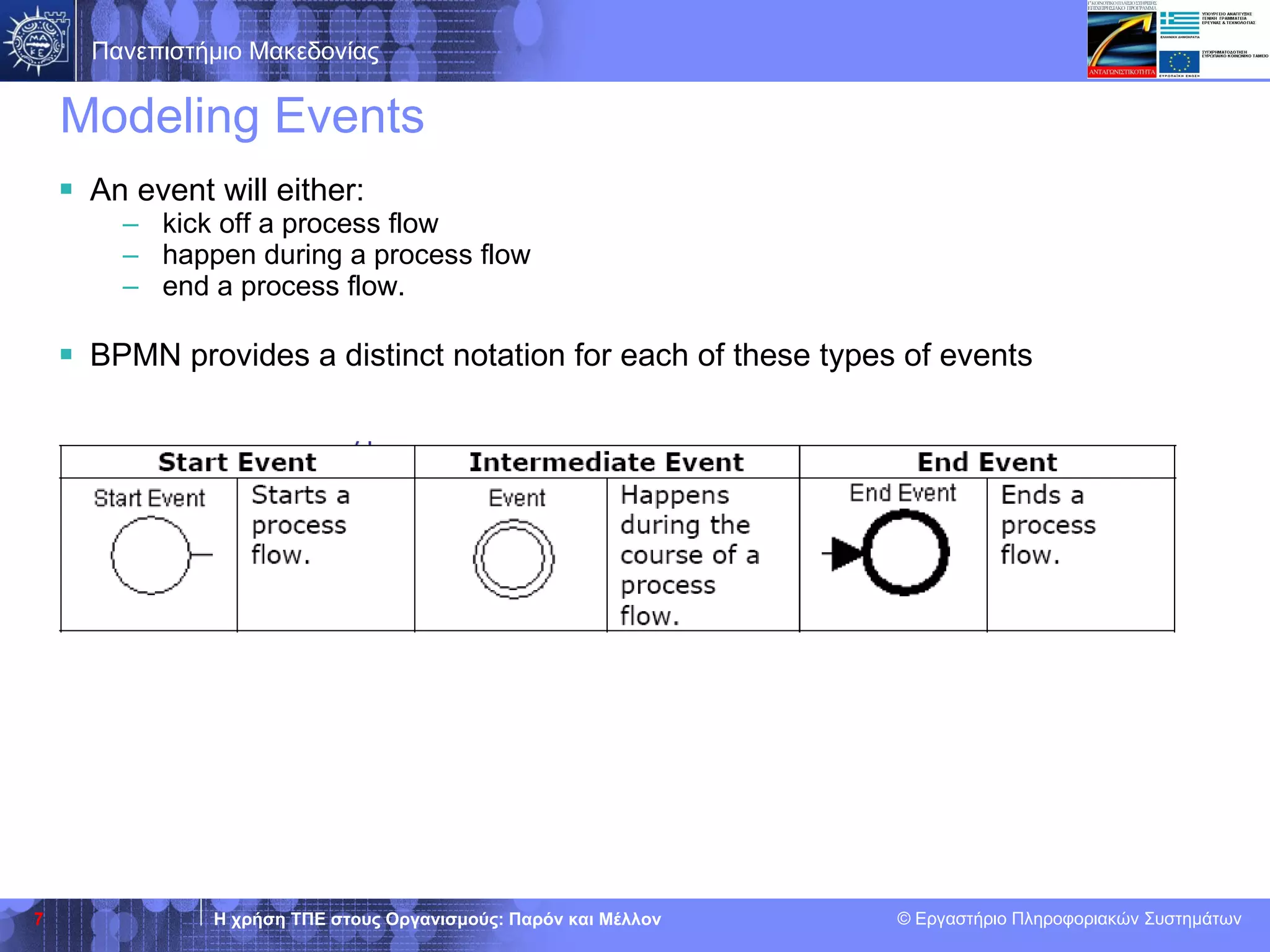
Modeling Events An event  will  either : kick off a process flow happen during a process flow end a process flow.  BPMN provides a distinct notation for each of these types of events
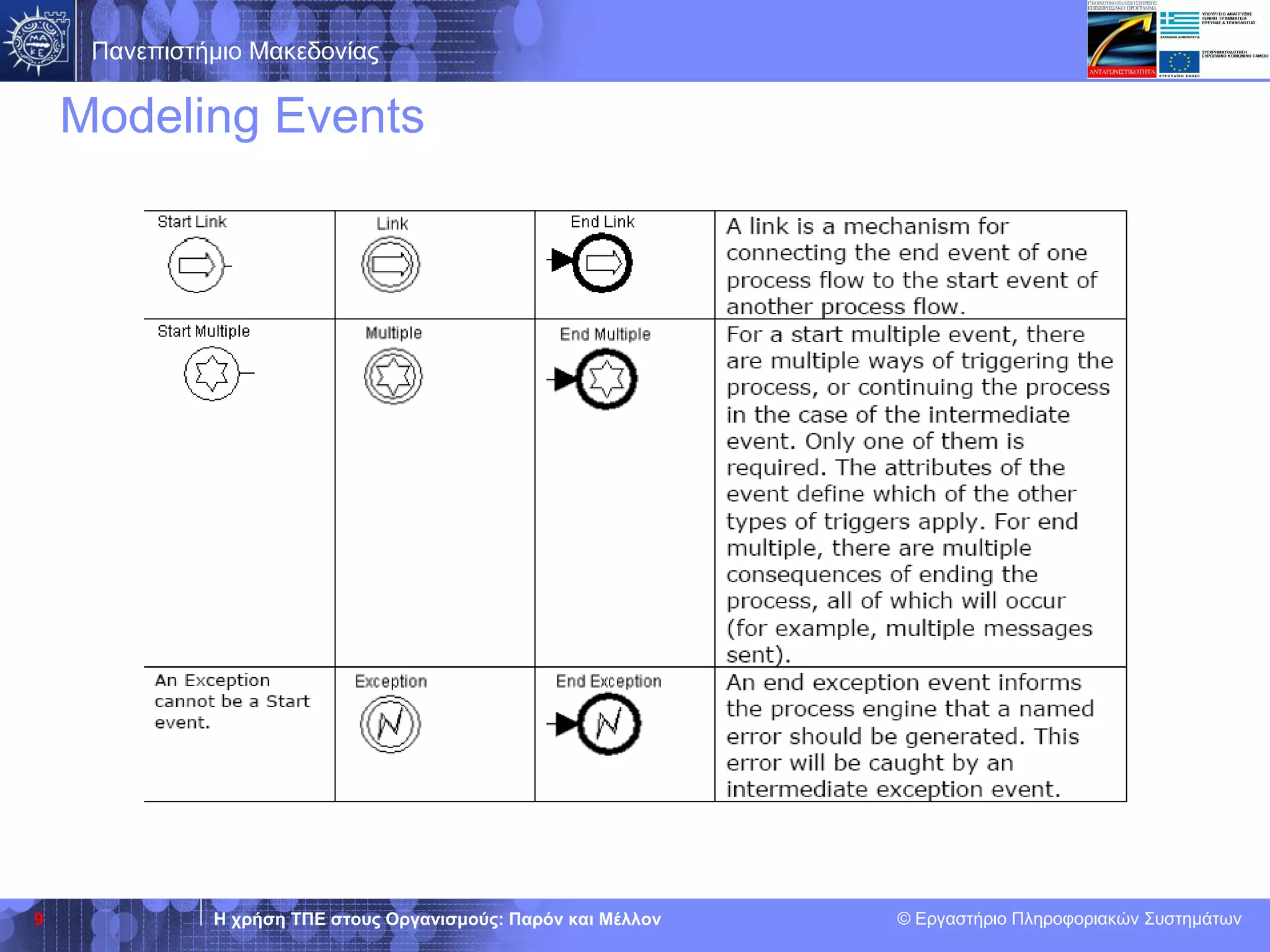
Modeling Events BPMN enables you to specify the trigger type of the event, and denote it with a representative icon  Specifying a trigger type to an event puts certain constraints on the process flow that you are modeling, which are explained in the table. For example, a timer cannot end a process flow. You can only draw message flows from and to message events These types of modeling rules, which are actually kinds of business rules, should be enforced automatically by the modeling tool providing support for BPMN
Modeling Events
Modeling Events
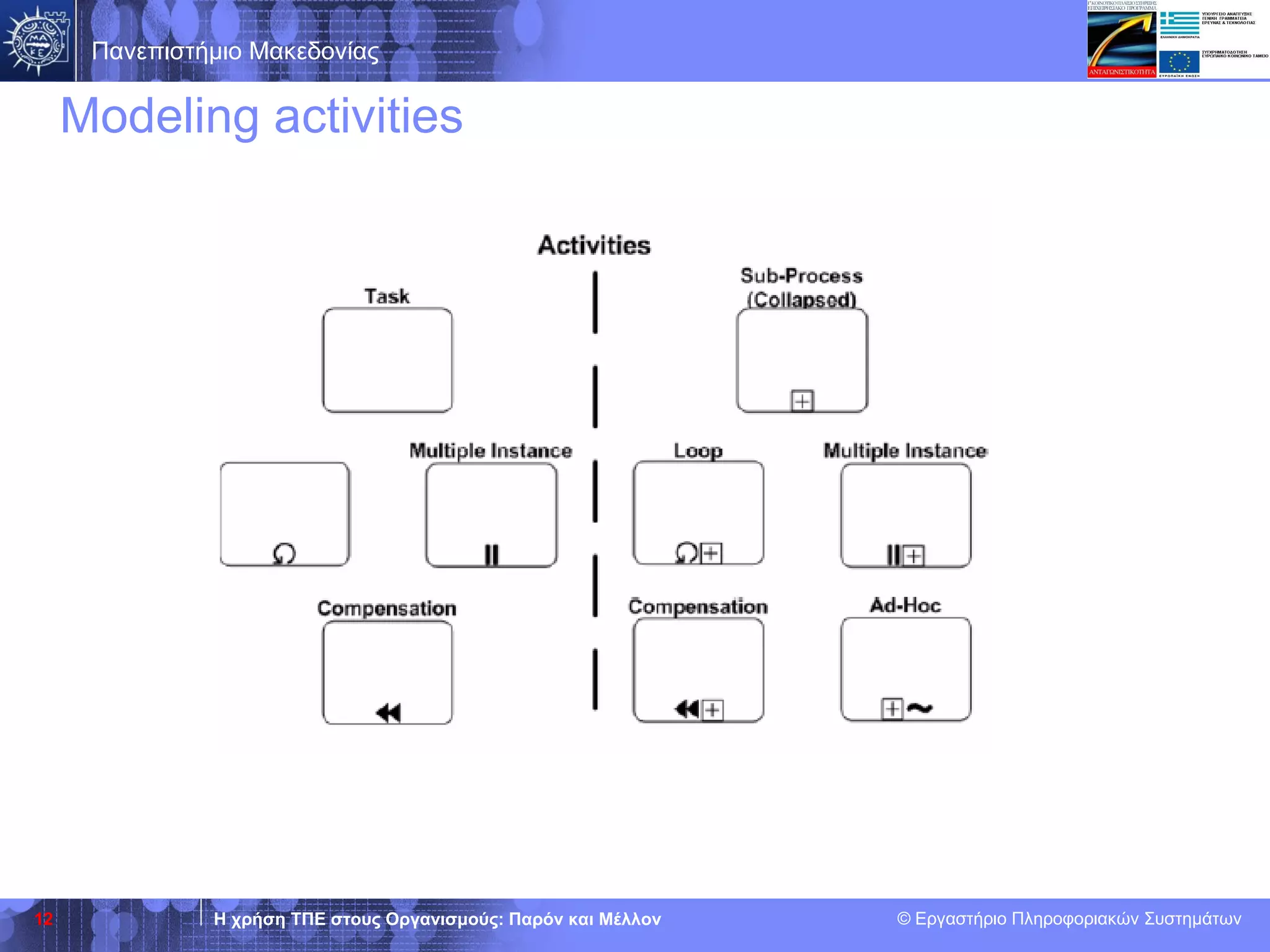
Modeling Activities An activity is work performed within a business process 3 types of activity: process    sub-process    task A  process in the flow can contain sub-processes, which can be graphically shown by another Business Process Diagram connected via a hyperlink to a process symbol.  If a process is not  decomposed by sub-   processes, it is considered  a task – the lowest-level  process. A ‘+’ mark in the process  symbol denotes that the  process is decomposed;  if   it   doesn’t have a ‘+’ mark,  it is a task.
Modeling activities
Modeling Connections A sequence flow is used to show the order that activities will be preformed in a process Associations are used to associate information and artifacts with flow objects
Modeling Gateways Gateways are modeling elements that are used to control the sequence flow in a process Decisions, merges, forks, and joins in the process flow are modeled with a  gateway  symbol
Modeling Gateways
Modeling Gateways
Modeling Gateways
Παράδειγμα
Modeling with Pools and (Swim) Lanes By taking processes and placing them in pools or lanes, you are specifying  who  does  what , for events you specify  where  they occur, and for gateways you specify  where decisions  are made, or  who  makes them.  Typically, a pool represents an organization, and a lane represents a department within that organization But also other things, such as:   a  function  (something that the organization performs, like Marketing or Sales or Training) an  application  (or computer software program) a  location  (a physical location in the company) a  class  (a software module in an object-oriented computer software program) or an  entity  (representing a logical table in a database)
Παράδειγμα
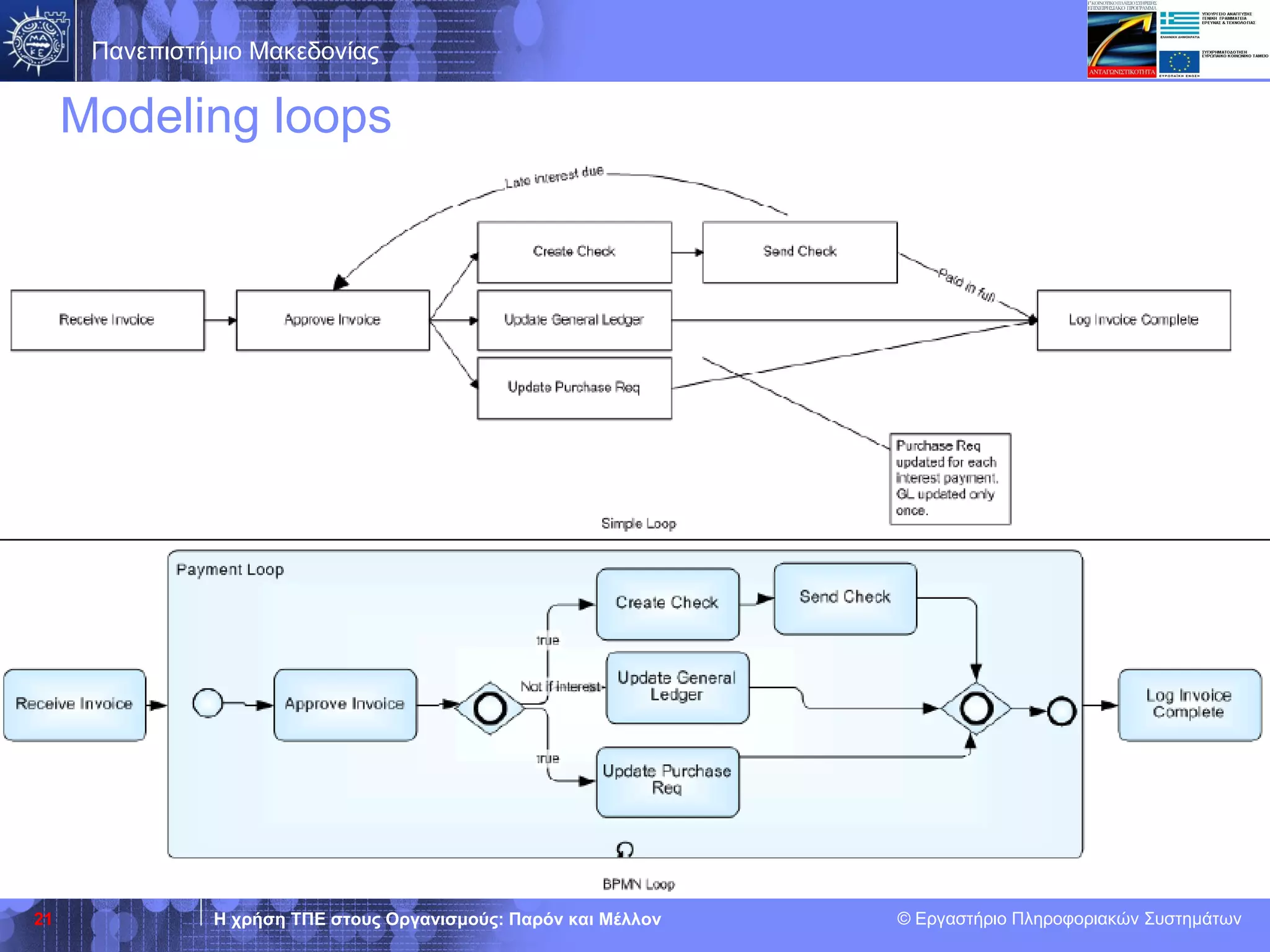
Modeling loops
Παράδειγμα  BPD
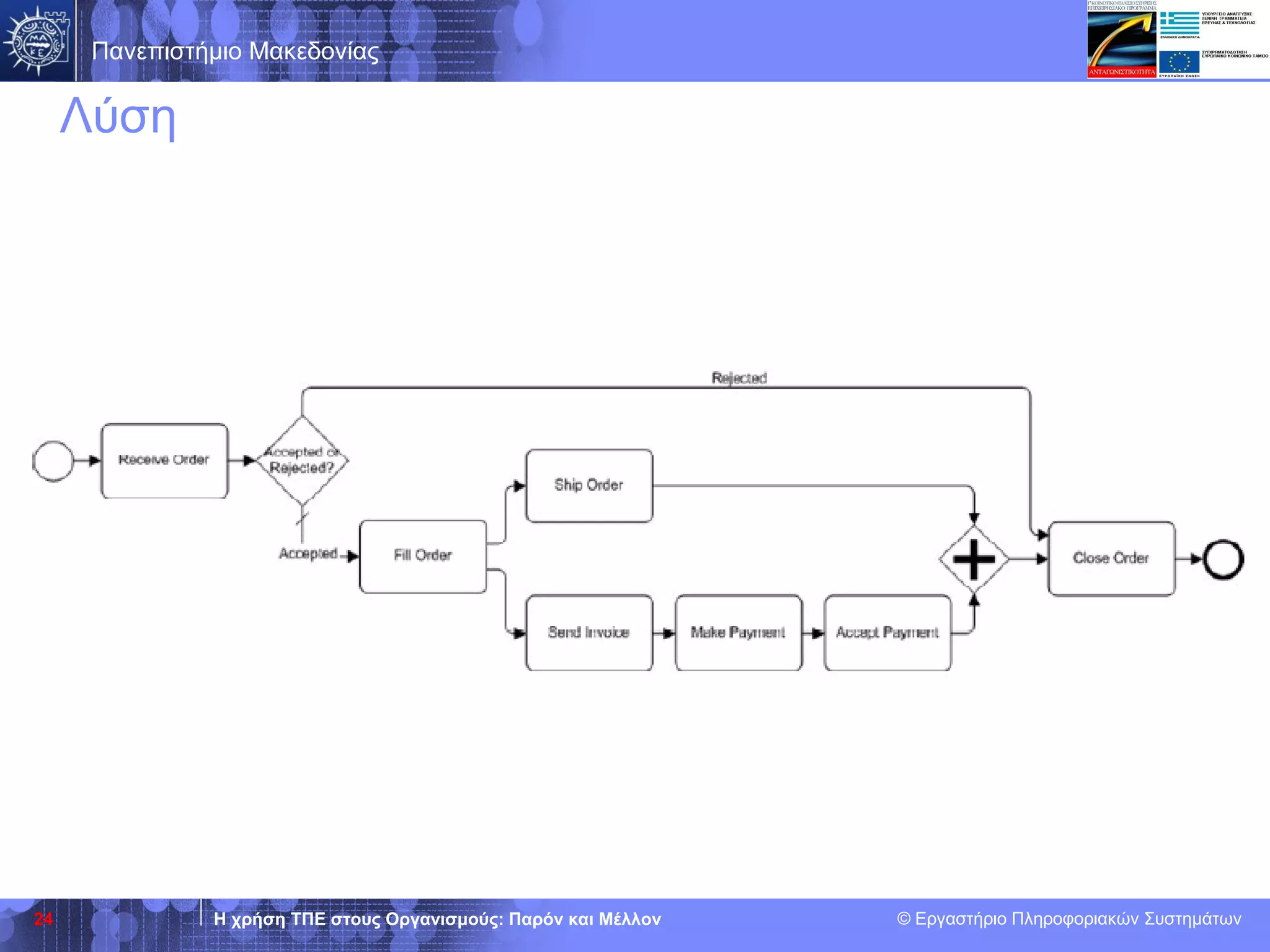
Άσκηση Χωριζόμαστε σε ομάδες ανά 2 Κάθε ομάδα προσπαθεί να σχεδιάσει την διαδικασία που περιγράφεται παρακάτω: Αρχικά παραλαμβάνεται μία παραγγελία. Στην συνέχεια γίνεται έλεγχος αν η παραγγελία είναι αποδεκτή ή όχι. Αν η παραγγελία απορριφθεί, κλείνει η πραγγελία. Αν γίνει αποδεκτή, συμπληρώνεται η φόρμα παραγγελίας, και ταυτόχρονα, γίνεται η αποστολή της παραγγελίας και η αποστολή του τιμολόγιου. Αφού αποσταλλεί το τιμολόγιο, κάποια στιγμή γίνεται η πληρωμή του ποσού και στην συνέχεια επιβεβαιώνεται αυτή η πληρωμή. Αφού ολοκληρωθούν τα βήματα αυτά κλείνει η παραγγελία.  Κάποιος εθελοντής σχεδιάζει την διαδικασία που ετοίμασε στον πίνακα
Λύση
Πηγές και βιβλιογραφία Martin Owen, Jog Raj (2003) BPMN and Business Process Management, Popkin Software Jeanne Baker (BPMI) & Keith Swenson (WfMC) (2005) Smart Process Modeling Using BPM Standards Balbir Barn (2007) Business Process Modeling, e-Framework Workshop Michael Havey (2006)  Keeping BPM Simple for Business Users:   Power Users Beware , BP Trends, January 2006 SoftEng, Notations for Business Process Modeling

15 2 Eleni Pm Lesson 5b

  • 1.
    Διαχείριση Επιχειρηματικών ΔιαδικασιώνBPMI Standards - BPMN Ελένη Πανοπούλου
  • 2.
  • 3.
    BPMI The Business Process Management Initiative (BPMI – www.bpmi.org) has been established to promote and develop the use of Business Process Management (BPM) through the use of standards for process design, deployment, execution, maintenance, and optimization of processes. BPMI has developed, or is in the process of developing, three standards to facilitate BPM: Business Process Modeling Notation (BPMN), as a standard for modeling business processes, Business Process Modeling Language (BPML), as the standard business execution language, and Business Process Query Language (BPQL), a standard management interface for the deployment and execution of e-Business processes. All standards have been developed using a solid mathematical foundation, which enables a BPMN to map directly to BPML , and any other rival business execution languages that are introduced
  • 4.
    BPMN The BusinessProcess Modeling Notation (BPMN) is a standard for model ing business process flows and web services. It has 2 goals: to provide a notation that is readily understandable by all business users. business analysts that create the initial drafts of the processes technical developers responsible for implementing the technology that will perform th e se processes. to ensure that XML languages designed for the execution of business processes can be visually expressed with a common notation BPML (Business Process Modeling Language) BPEL4WS (Business Process Execution Language for Web Services) , created in a joint venture by BEA, IBM, Microsoft, and others
  • 5.
    Business Process Diagram (BPD) BPMN consists of one diagram , called Business Process Diagram (BPD) BPD has been designed to : be easy to use and understand provide the ability to model complex business processes
  • 6.
    Core Set ofNotations The core set of modeling elements enable the easy development of simple BPDs that will look familiar to most Business Analysts (like a flowchart diagram) Events Activities Gateways (used for business decisions and branching of flows) Pools and swim lanes
  • 7.
    Modeling Events Anevent will either : kick off a process flow happen during a process flow end a process flow. BPMN provides a distinct notation for each of these types of events
  • 8.
    Modeling Events BPMNenables you to specify the trigger type of the event, and denote it with a representative icon Specifying a trigger type to an event puts certain constraints on the process flow that you are modeling, which are explained in the table. For example, a timer cannot end a process flow. You can only draw message flows from and to message events These types of modeling rules, which are actually kinds of business rules, should be enforced automatically by the modeling tool providing support for BPMN
  • 9.
  • 10.
  • 11.
    Modeling Activities Anactivity is work performed within a business process 3 types of activity: process  sub-process  task A process in the flow can contain sub-processes, which can be graphically shown by another Business Process Diagram connected via a hyperlink to a process symbol. If a process is not decomposed by sub- processes, it is considered a task – the lowest-level process. A ‘+’ mark in the process symbol denotes that the process is decomposed; if it doesn’t have a ‘+’ mark, it is a task.
  • 12.
  • 13.
    Modeling Connections Asequence flow is used to show the order that activities will be preformed in a process Associations are used to associate information and artifacts with flow objects
  • 14.
    Modeling Gateways Gatewaysare modeling elements that are used to control the sequence flow in a process Decisions, merges, forks, and joins in the process flow are modeled with a gateway symbol
  • 15.
  • 16.
  • 17.
  • 18.
  • 19.
    Modeling with Poolsand (Swim) Lanes By taking processes and placing them in pools or lanes, you are specifying who does what , for events you specify where they occur, and for gateways you specify where decisions are made, or who makes them. Typically, a pool represents an organization, and a lane represents a department within that organization But also other things, such as: a function (something that the organization performs, like Marketing or Sales or Training) an application (or computer software program) a location (a physical location in the company) a class (a software module in an object-oriented computer software program) or an entity (representing a logical table in a database)
  • 20.
  • 21.
  • 22.
  • 23.
    Άσκηση Χωριζόμαστε σεομάδες ανά 2 Κάθε ομάδα προσπαθεί να σχεδιάσει την διαδικασία που περιγράφεται παρακάτω: Αρχικά παραλαμβάνεται μία παραγγελία. Στην συνέχεια γίνεται έλεγχος αν η παραγγελία είναι αποδεκτή ή όχι. Αν η παραγγελία απορριφθεί, κλείνει η πραγγελία. Αν γίνει αποδεκτή, συμπληρώνεται η φόρμα παραγγελίας, και ταυτόχρονα, γίνεται η αποστολή της παραγγελίας και η αποστολή του τιμολόγιου. Αφού αποσταλλεί το τιμολόγιο, κάποια στιγμή γίνεται η πληρωμή του ποσού και στην συνέχεια επιβεβαιώνεται αυτή η πληρωμή. Αφού ολοκληρωθούν τα βήματα αυτά κλείνει η παραγγελία. Κάποιος εθελοντής σχεδιάζει την διαδικασία που ετοίμασε στον πίνακα
  • 24.
  • 25.
    Πηγές και βιβλιογραφίαMartin Owen, Jog Raj (2003) BPMN and Business Process Management, Popkin Software Jeanne Baker (BPMI) & Keith Swenson (WfMC) (2005) Smart Process Modeling Using BPM Standards Balbir Barn (2007) Business Process Modeling, e-Framework Workshop Michael Havey (2006) Keeping BPM Simple for Business Users: Power Users Beware , BP Trends, January 2006 SoftEng, Notations for Business Process Modeling