Download to read offline
![Journal of Advanced Computing and Communication Technologies (ISSN: 2347 - 2804)
Volume No.1 Issue No. 1, August 2013
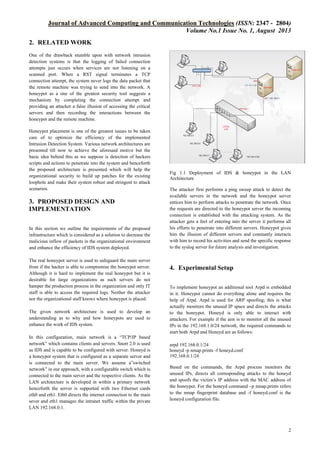
Once the installation is honeypot server is completed the
traffic directed to honeypot server is dumped o other system
using packet analyzing tool tcpdump with the help of
following command:
tcpdump -nn -x -s 1500 host 192.168.0.145 -w store.cap
The tcpdump command will dump all the malicious packets
directed to the honeypot and hence will help in writing the
snort rule set by analyzing the payload.
4.1 Writing of Snort Rules:
Penetrating in the network to gain access by getting the
etc/passwd file in the Linux environment or the password
shadow file i.e. etc/shadow which contains the username and
password of all users. No such rule is defined in the latest
snort rule set. Suppose you get the following log generated in
honeypot:
# cat 44F75D6380122.shell
::::::::::::::
GET/unauthenticated/..%01/..%01/..%01/..%01/..%01/..%01/..
%
01/..%01/..%01/..%01/..%01/..%01/..%01/..%01/..%01/..%01/.
.
%01/..%01/..%01/..%01/..%01/..%01/..%01/..%01/..%01/..%0
1/.
.%01/..%01/..%01/..%01/..%01/..%01/..%01/..%01/..%01/..%
01/
..%01/..%01/..%01/..%01/..%01/..%01/..%01/..%01/..%01/..%
01
/..%01/..%01/..%01/..%01/..%01/..%01/..%01/..%01/..%01/..
%0
1/..%01/..%01/..%01/..%01/..%01//etc/shadow HTTP/1.1
Host: 202.174.22.145:10000
It is visible that the attacking port is 10000 thus port 10000 is
of interest. The various ip addresses from where such request
came can be filtered using tcpdump analysis.
alert tcp any any -> any 10000
(content:"GET /unauthenticated/..%01/..%01/"; msg:"Get
unauthenticated";)
The point of concern here is that adding too much of payload
may result in false negatives which will overall lower down
the implementation of snort in organizational network.
5. Conclusion
The Intrusion detection system can only give the optimum
benefit if it is also able to detect those attacks for which
signatures are not defined in its database. The area of work
will be to give attention to this Snort limitation and thus
increasing the scalability and responsiveness of the system
towards the various types of attacks so as to achieve the motto
of building a smart agile and secure system to face the new
challenges of technological arena. Though honeypot
deployment is a cost-effective solution for the security of
large organization but in future refinement is required to
elimination false alarm generations.
6. REFERENCES
[1] Vidar Ajaxon Grønland: Building IDS signatures by
means of a honeypot Norwegian Information system
Laboratory.
[2] Chi-Hung Chi , Ming Li Dongxi Liu : A method to
obtain Signatures From Honeypots Data, School of
Computing National University of Singapore
[3] Babak Khosravifar, Jamal Bentahar: An Experience
Improving Intrusion Detection Systems False Alarm
Ratio by Using Honeypot.
[4] Department of Electrical and Computer Engineering,
Concordia University
[5] Greg M. Bednarski and Jake Branson: Understanding
Network Threats through Honeypot Deployment,
Carnegie Mellon University March 2004.
4.2 Results and Discussion
[6] Richard Hammer : Enhancing IDS using, Tiny Honeypot
SANS Institute InfoSec Reading Room
Once the analysis is done now it is the time to write the snort
rule. By the analysis of the payload it is visible that the string
started with “GET/unauthenticated/” thus following snort rule
can be set:
[7] Solution Base: What you need to know about honeypots
http://articles.techrepublic.com.com/5100-22_115758218.html
alert tcp $EXTERNAL_NET any ->
$192.168.0.1 10000 (content:"GET /unauthenticated/";
msg:"Get unauthenticated";)
Now any attack coming from the specified port will generate
the alert to the administrator of penetration for unauthorized
access in the network environment by the attacker.
If the set rule has to be further customized then the following
payload can be added:
3](https://image.slidesharecdn.com/137684170917879811-140119025245-phpapp02/85/1376841709-17879811-3-320.jpg)

This paper proposes using a honeypot to improve the efficiency of intrusion detection systems (IDS) in detecting zero-day attacks. It presents a network architecture that deploys a honeypot and uses packet analysis tools to generate IDS signatures for new attacks. The honeypot records an attacker's activities without their knowledge. The recorded data is analyzed to write custom IDS rules matching payloads to detect similar future attacks. This allows the IDS to identify threats even without prior signatures.


