ELEMENTS OF DESIGN
Elements of design are “tools”. Just like the carpenter has a
hammer and saw, the designer has the elements.
There are 4 elements of design: Line, Form, COLOR, & Texture.
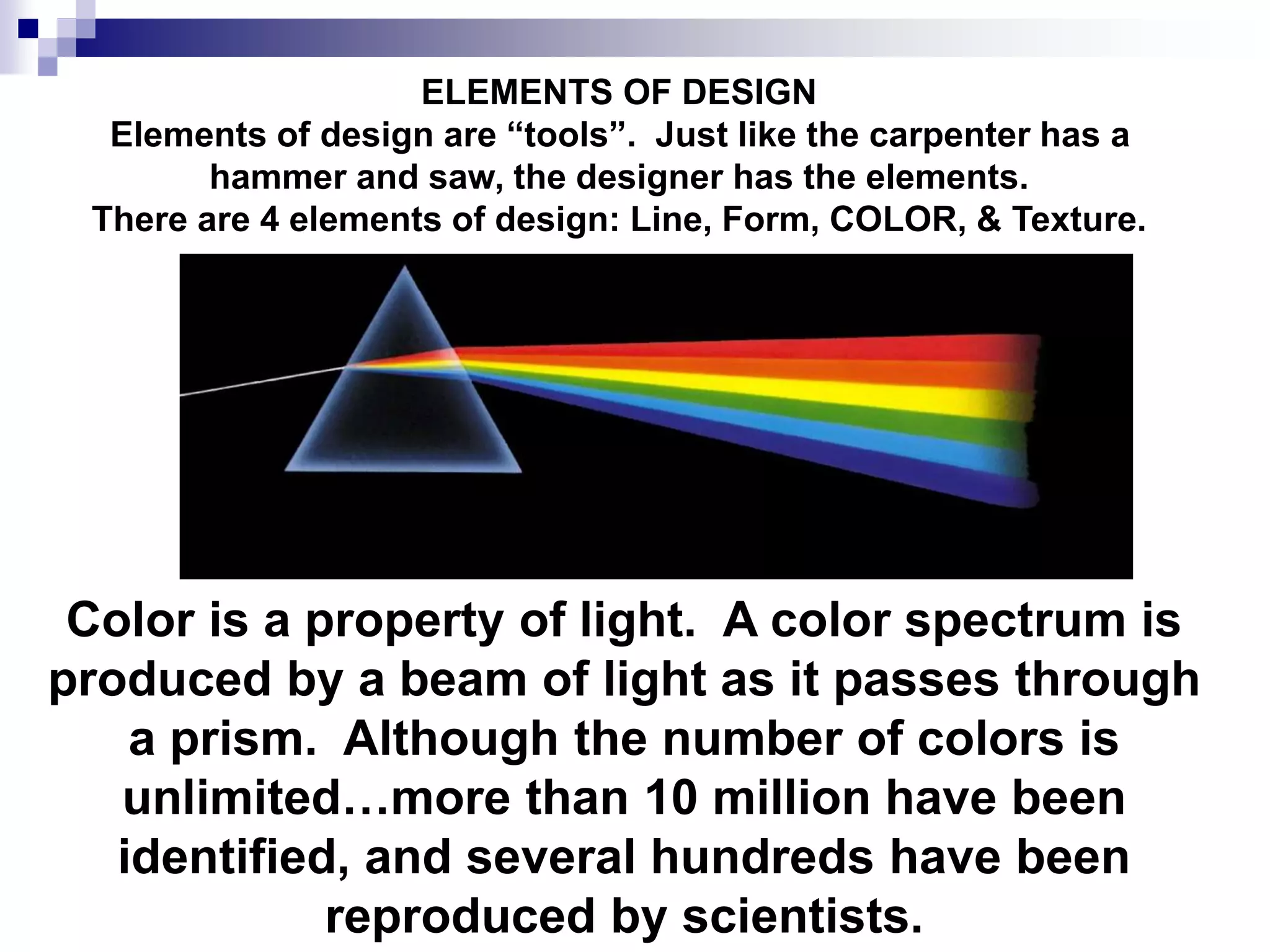
Color is a property of light. A color spectrum is
produced by a beam of light as it passes through
a prism. Although the number of colors is
unlimited…more than 10 million have been
identified, and several hundreds have been
reproduced by scientists.
Red-violet
Violet
Blue-violet
Blue
Blue-green
Green
Yellow-green
Yellow
Yellow-orange Orange
Red-orange
Red
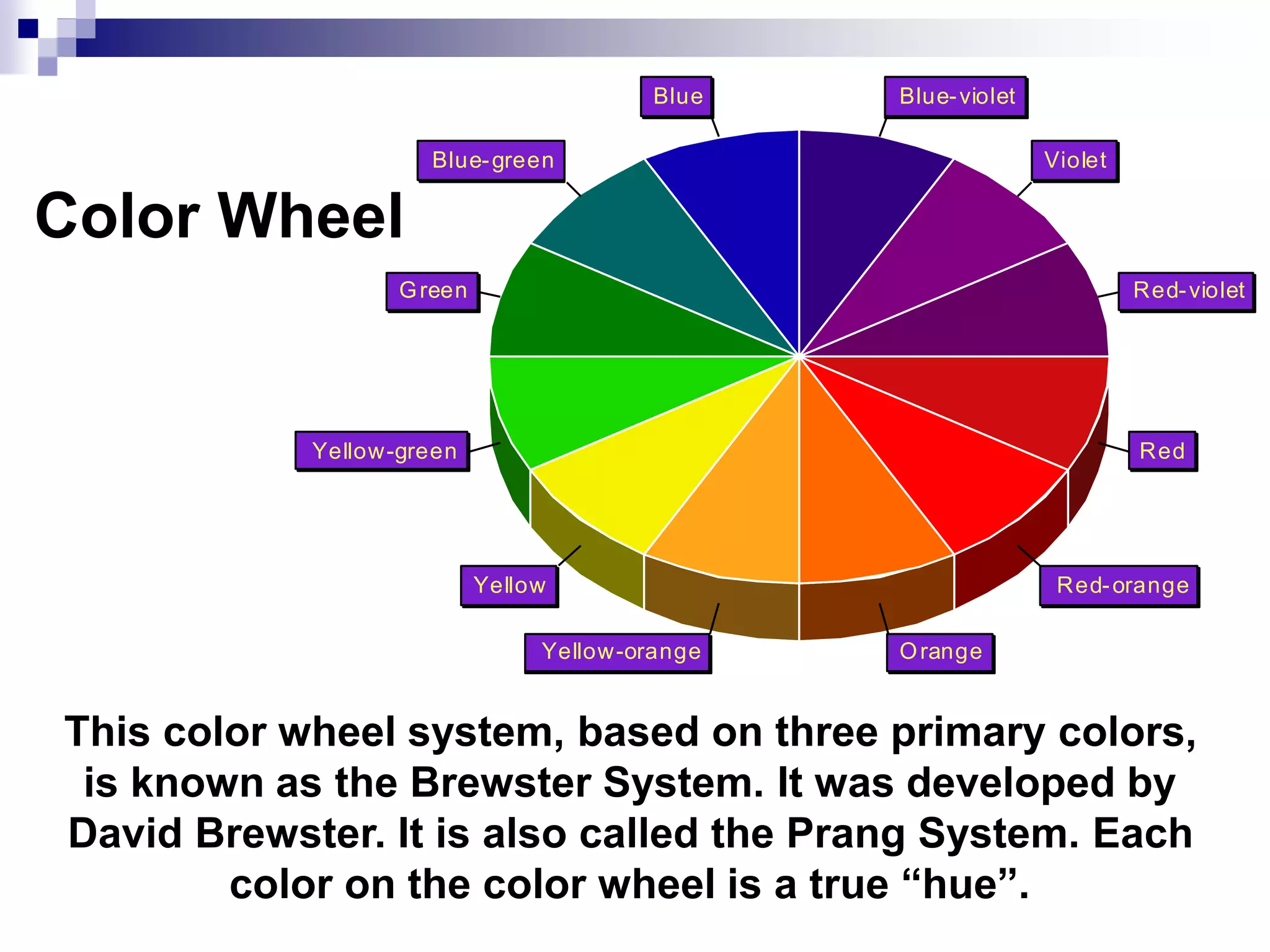
Color Wheel
This color wheel system, based on three primary colors,
is known as the Brewster System. It was developed by
David Brewster. It is also called the Prang System. Each
color on the color wheel is a true “hue”.
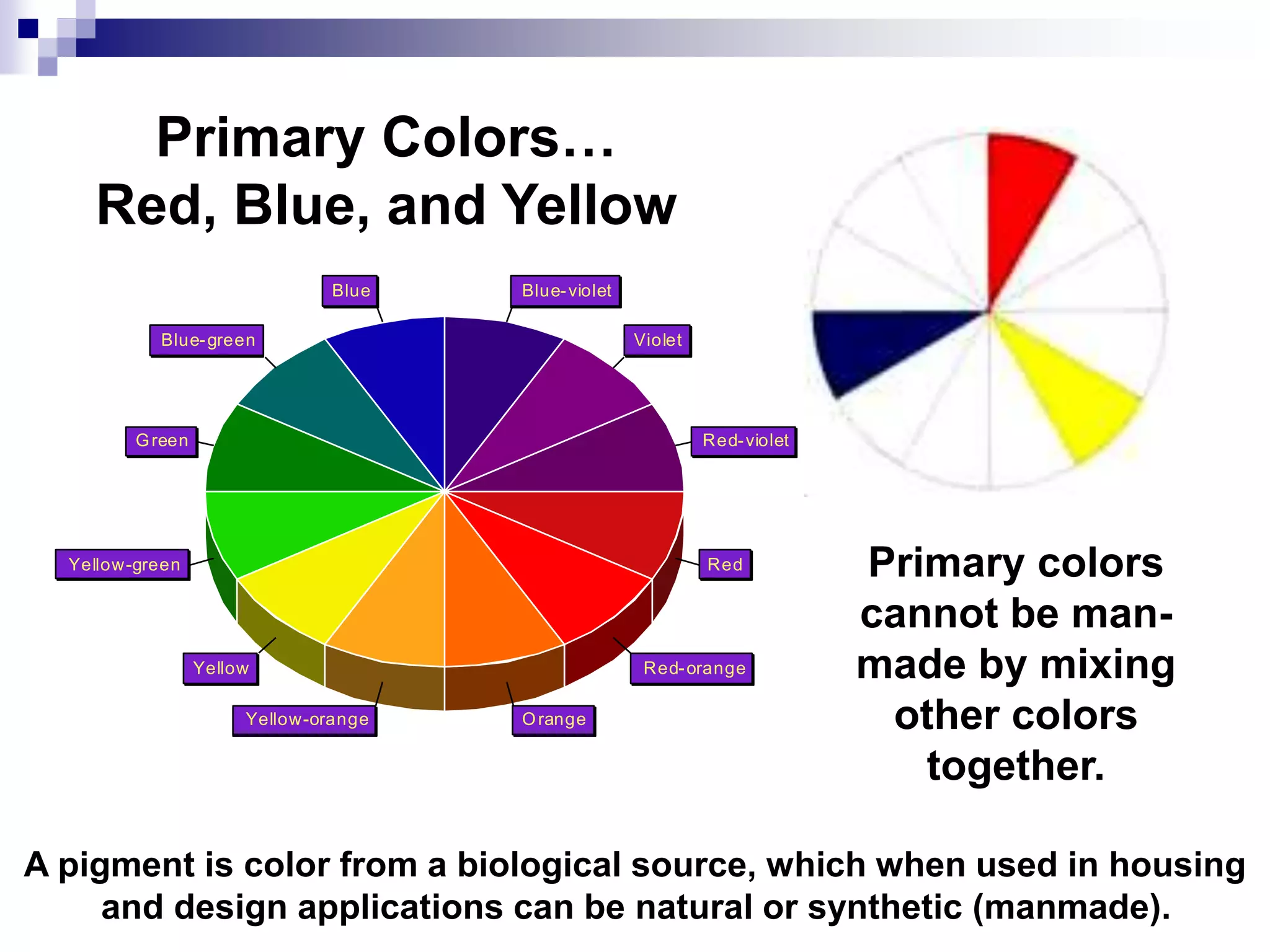
Primary Colors…
Red, Blue, and Yellow
Red-violet
Violet
Blue-violet
Blue
Blue-green
Green
Yellow-green
Yellow
Yellow-orange Orange
Red-orange
Red Primary colors
cannot be man-
made by mixing
other colors
together.
A pigment is color from a biological source, which when used in housing
and design applications can be natural or synthetic (manmade).
Red-violet
Violet
Blue-violet
Blue
Blue-green
Green
Yellow-green
Yellow
Yellow-orange Orange
Red-orange
Red
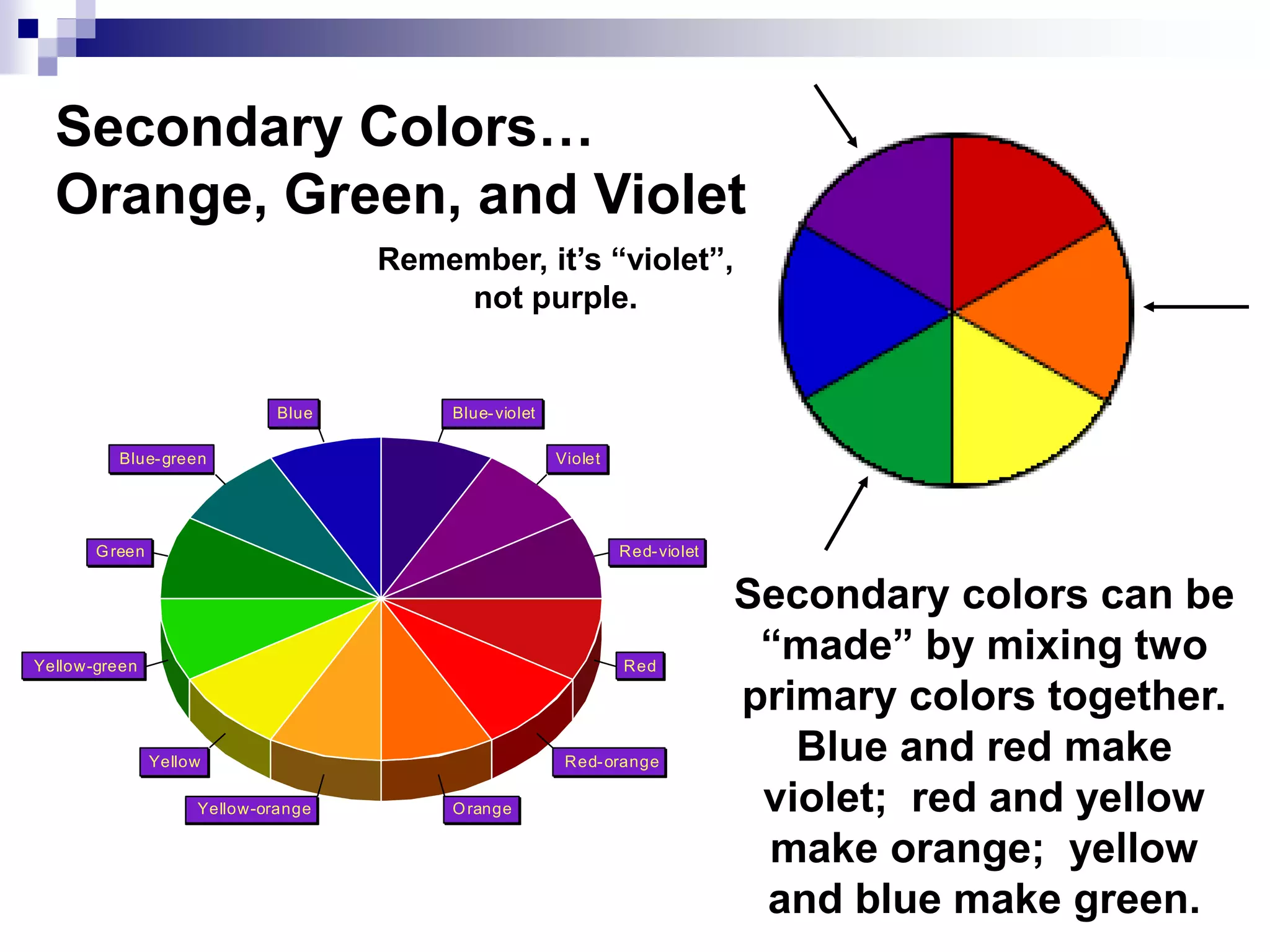
Secondary Colors…
Orange, Green, and Violet
Remember, it’s “violet”,
not purple.
Secondary colors can be
“made” by mixing two
primary colors together.
Blue and red make
violet; red and yellow
make orange; yellow
and blue make green.
Red-violet
Violet
Blue-violet
Blue
Blue-green
Green
Yellow-green
Yellow
Yellow-orange Orange
Red-orange
Red
Tertiary Colors… Yellow-green,
Blue-green, Blue-Violet, Red-Violet,
Red-orange, Yellow-orange
The tertiary colors are also
referred to as the intermediate
colors. Tertiary colors are made
by mixing a primary with a
secondary color… the primary
color is always listed first. For
example, when the primary
color of yellow is mixed with
the secondary color named
green, the new tertiary color is
called yellow-green.
Tertiary colors can be expanded further, such as mixing blue and blue-
green together. The result would be the color blue-blue-green. Perhaps
we would name that color “teal” to be less confusing.
Neutral Colors…
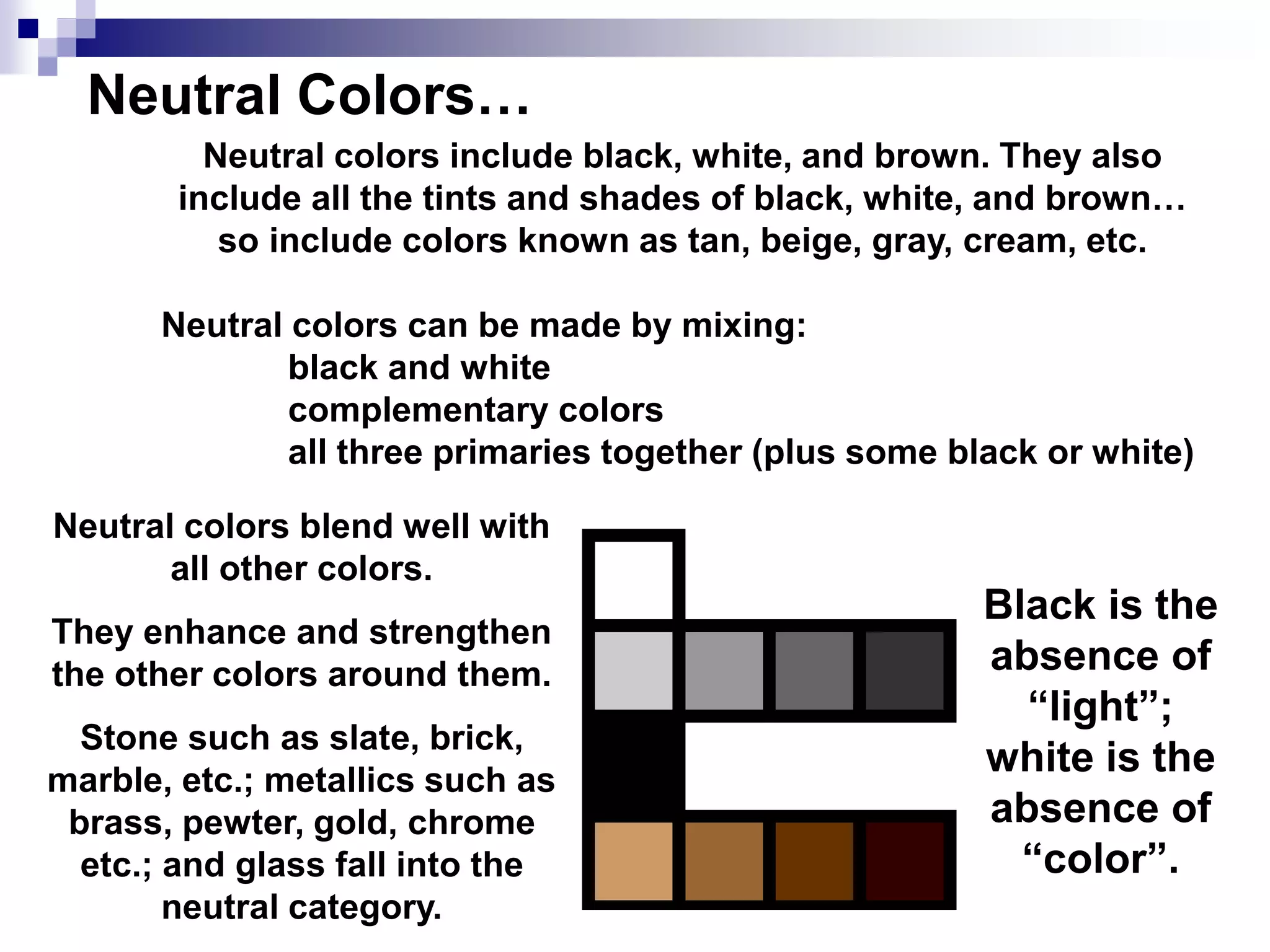
Neutral colors include black, white, and brown. They also
include all the tints and shades of black, white, and brown…
so include colors known as tan, beige, gray, cream, etc.
Neutral colors can be made by mixing:
black and white
complementary colors
all three primaries together (plus some black or white)
Neutral colors blend well with
all other colors.
They enhance and strengthen
the other colors around them.
Stone such as slate, brick,
marble, etc.; metallics such as
brass, pewter, gold, chrome
etc.; and glass fall into the
neutral category.
Black is the
absence of
“light”;
white is the
absence of
“color”.
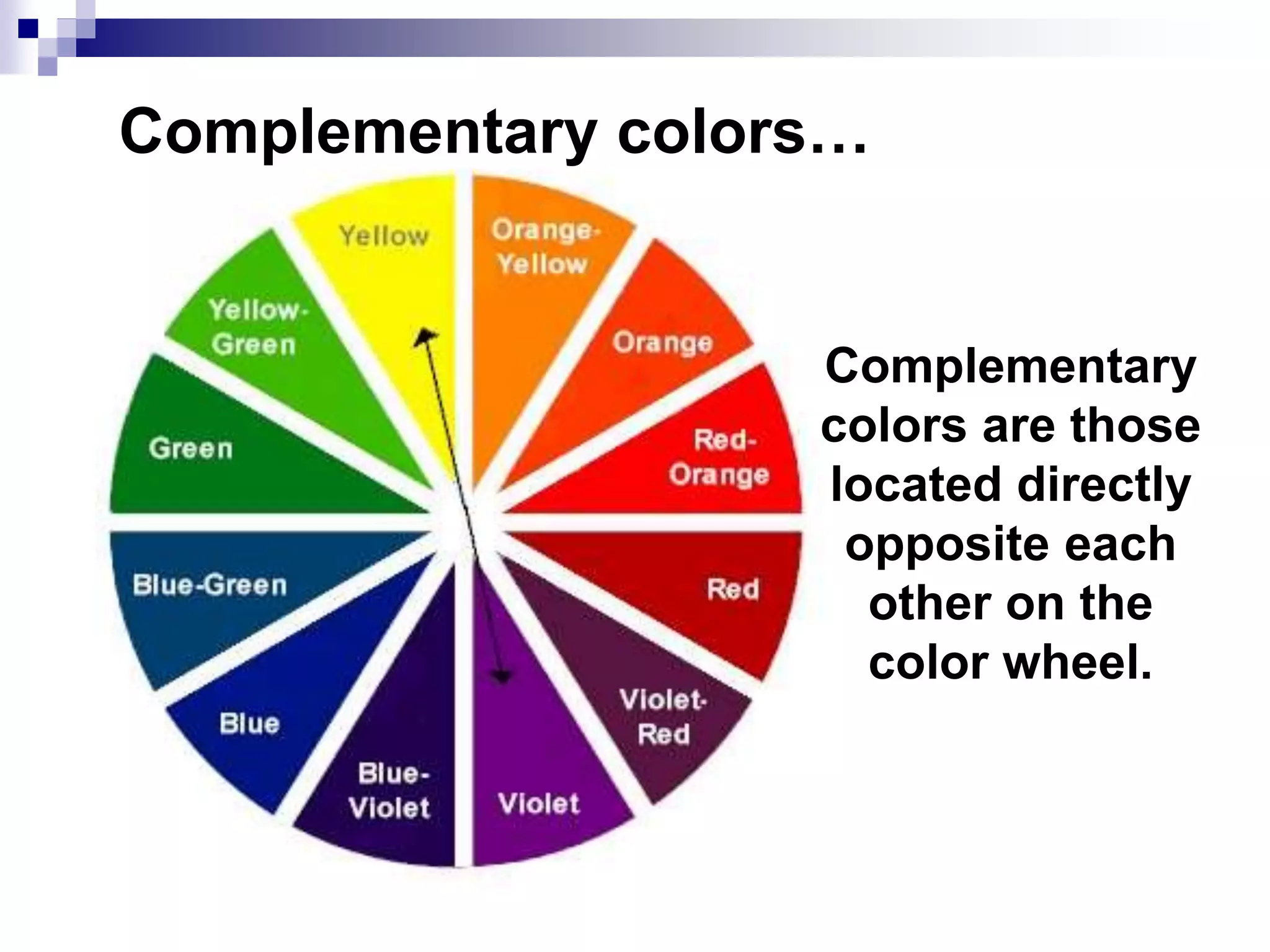
Complementary colors…
Complementary
colors are those
located directly
opposite each
other on the
color wheel.
“INTENSITY” OF COLORS
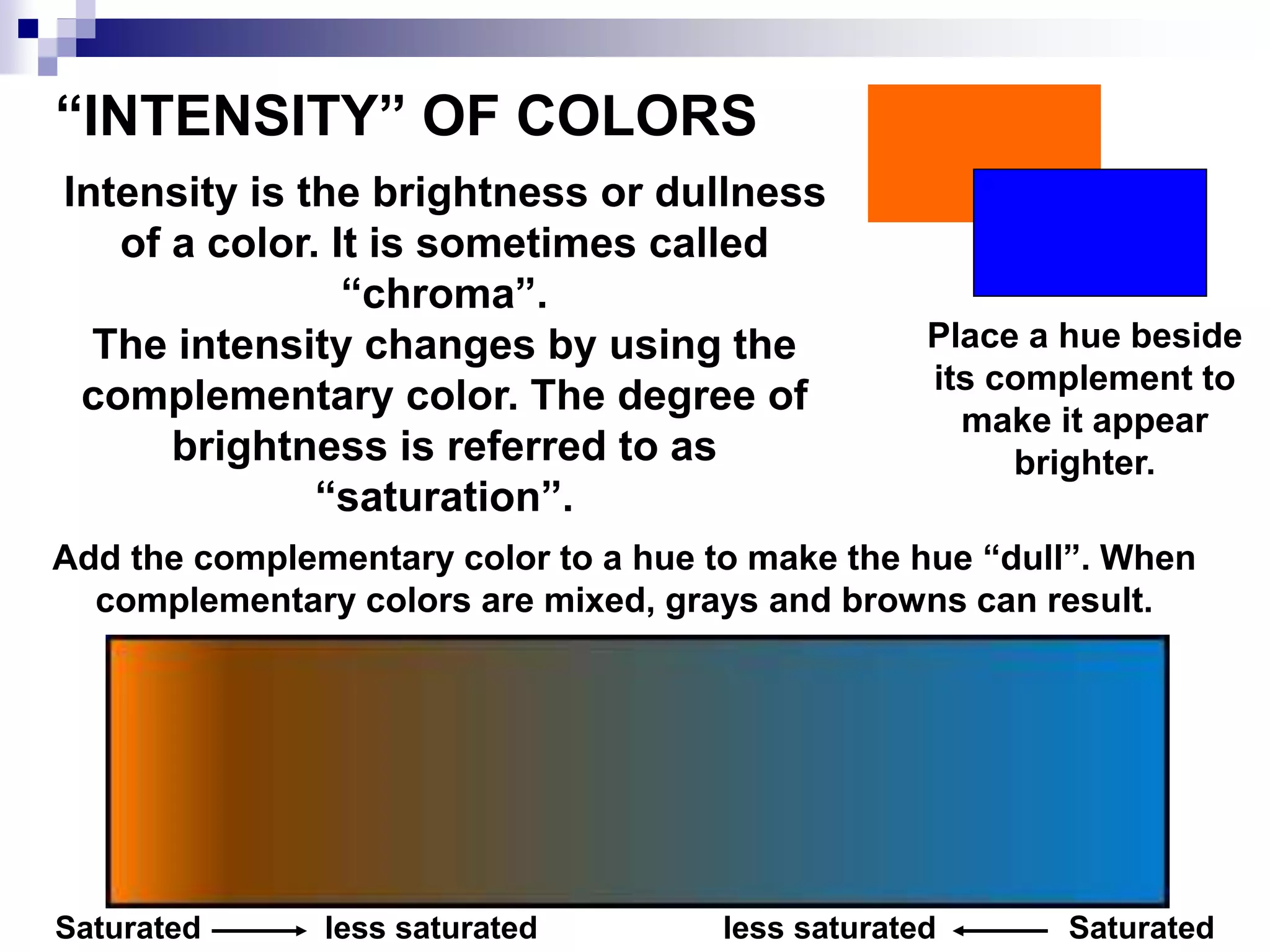
Intensity is the brightness or dullness
of a color. It is sometimes called
“chroma”.
The intensity changes by using the
complementary color. The degree of
brightness is referred to as
“saturation”.
Place a hue beside
its complement to
make it appear
brighter.
Add the complementary color to a hue to make the hue “dull”. When
complementary colors are mixed, grays and browns can result.
Saturated less saturated less saturated Saturated
“VALUE” OF COLORS
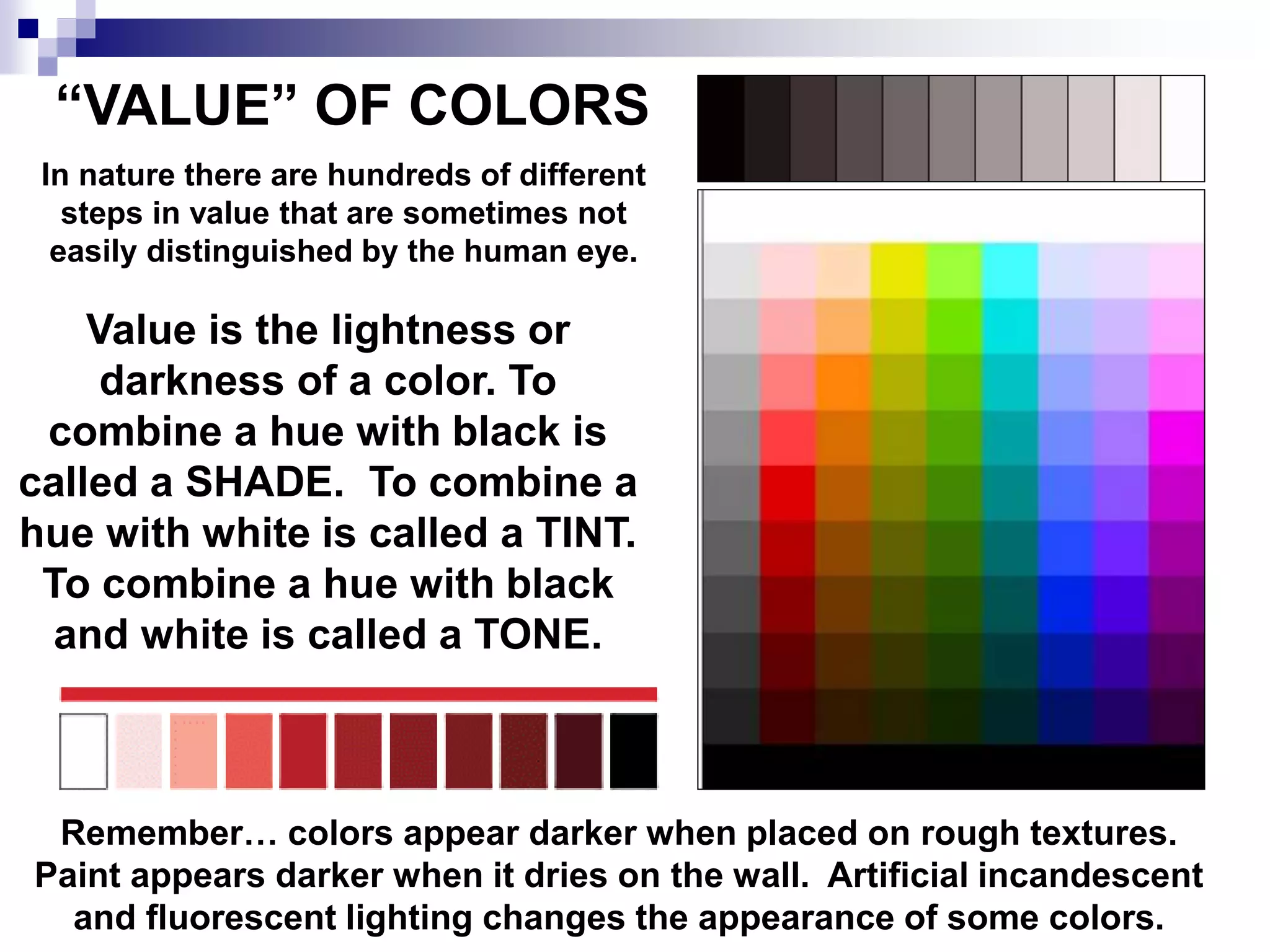
In nature there are hundreds of different
steps in value that are sometimes not
easily distinguished by the human eye.
Value is the lightness or
darkness of a color. To
combine a hue with black is
called a SHADE. To combine a
hue with white is called a TINT.
To combine a hue with black
and white is called a TONE.
Remember… colors appear darker when placed on rough textures.
Paint appears darker when it dries on the wall. Artificial incandescent
and fluorescent lighting changes the appearance of some colors.
Color Schemes
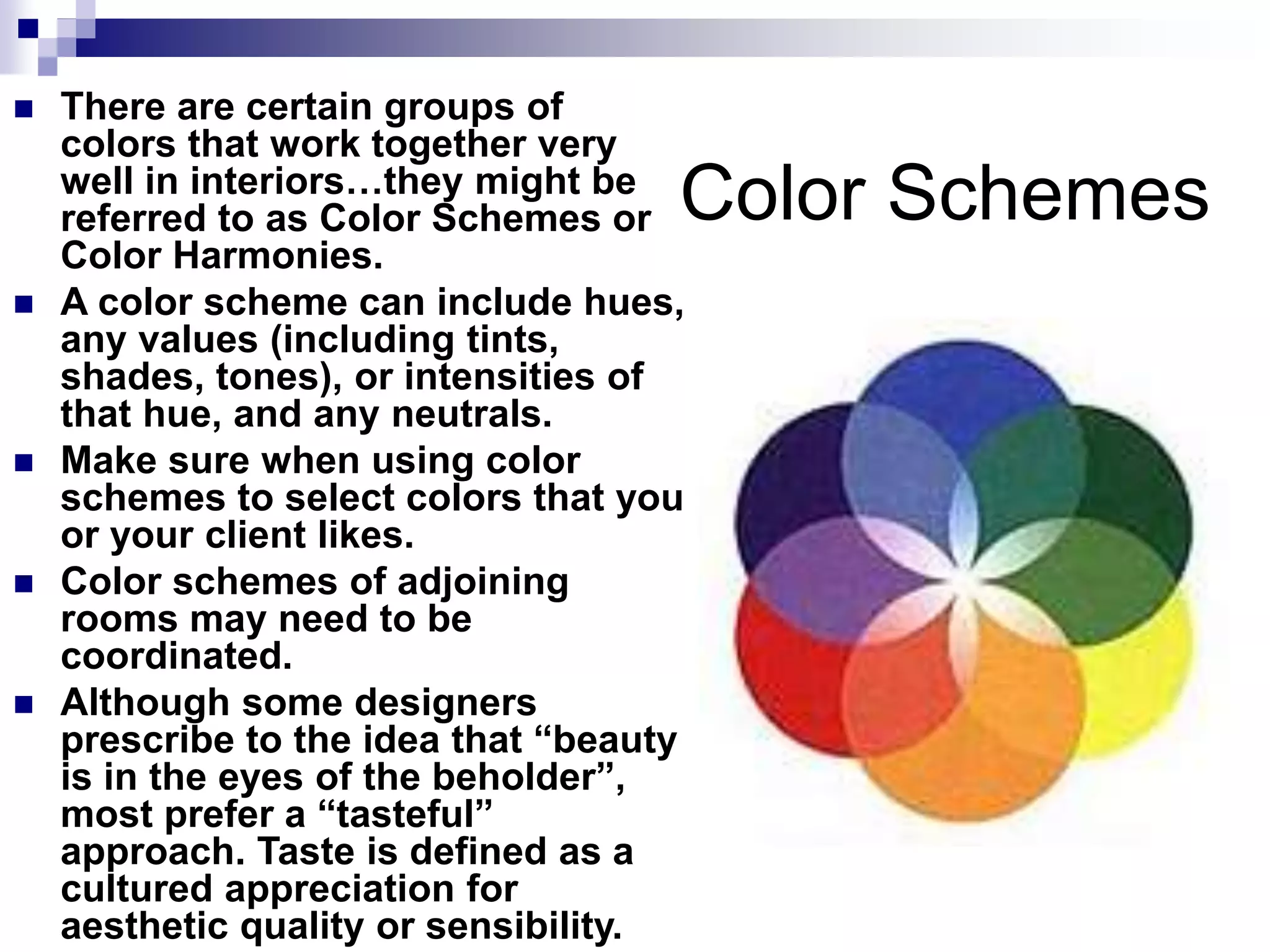
 There are certain groups of
colors that work together very
well in interiors…they might be
referred to as Color Schemes or
Color Harmonies.
 A color scheme can include hues,
any values (including tints,
shades, tones), or intensities of
that hue, and any neutrals.
 Make sure when using color
schemes to select colors that you
or your client likes.
 Color schemes of adjoining
rooms may need to be
coordinated.
 Although some designers
prescribe to the idea that “beauty
is in the eyes of the beholder”,
most prefer a “tasteful”
approach. Taste is defined as a
cultured appreciation for
aesthetic quality or sensibility.
Monochromatic
 A color scheme using one
color, and tints, tones and
shades of that color.
Red-violet
Violet
Blue-violet
Blue
Blue-green
Green
Yellow-green
Yellow
Yellow-orange Orange
Red-orange
Red
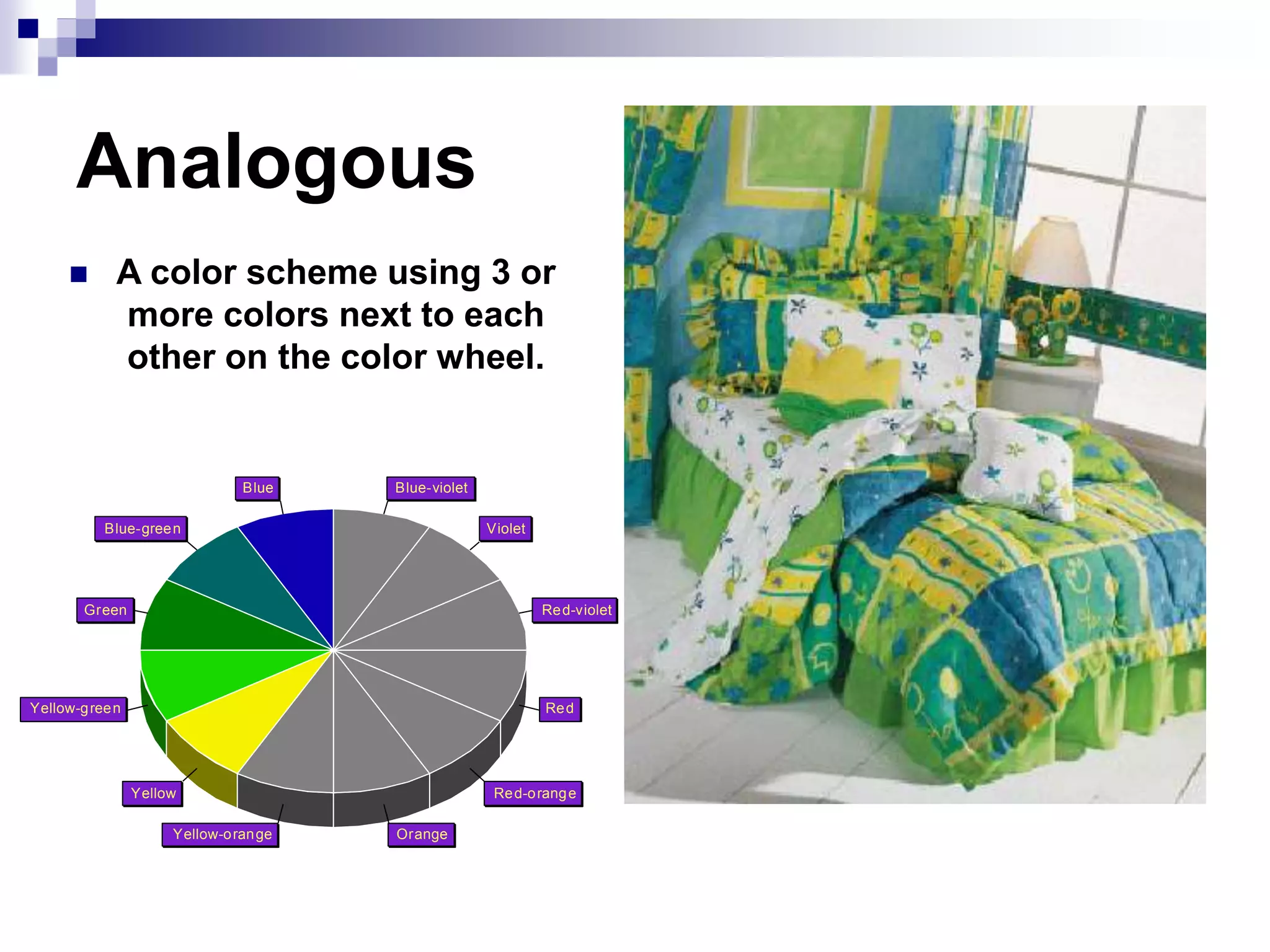
Analogous
 A color scheme using 3 or
more colors next to each
other on the color wheel.
Red-violet
Violet
Blue-violet
Blue
Blue-green
Green
Yellow-green
Yellow
Yellow-orange Orange
Red-orange
Red
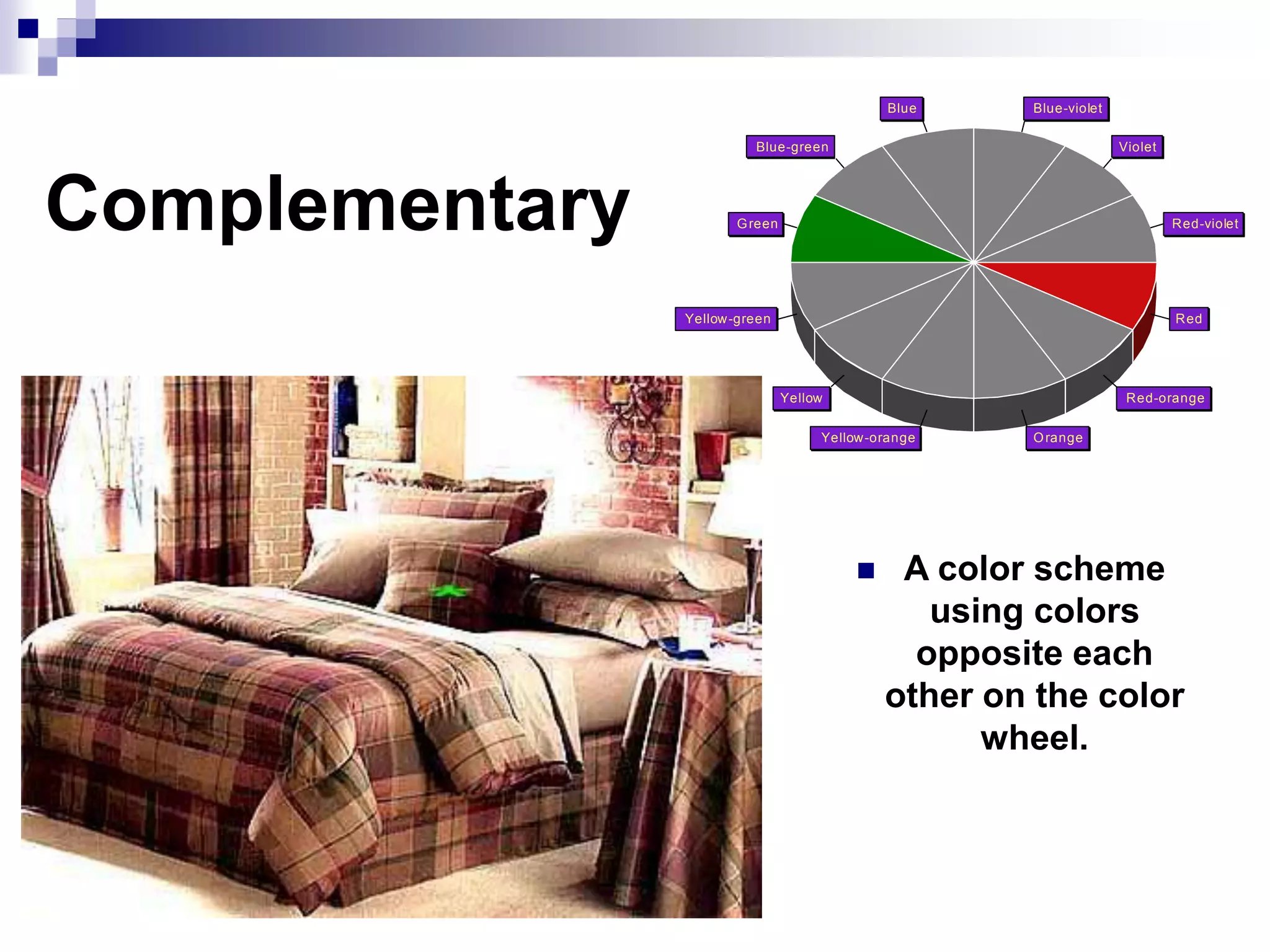
Complementary
 A color scheme
using colors
opposite each
other on the color
wheel.
Red-violet
Violet
Blue-violet
Blue
Blue-green
Green
Yellow-green
Yellow
Yellow-orange Orange
Red-orange
Red
Double Complementary
 A Color scheme using two
sets of complementary
colors.
Red-violet
Violet
Blue-violet
Blue
Blue-green
Green
Yellow-green
Yellow
Yellow-orange Orange
Red-orange
Red
Split Complementary
 A color scheme using one
color, and the colors on either
side of it’s complement. This
color scheme, along with the
double complementary are
more difficult to achieve in a
tasteful fashion.
Red-violet
Violet
Blue-violet
Blue
Blue-green
Green
Yellow-green
Yellow
Yellow-orange Orange
Red-orange
Red
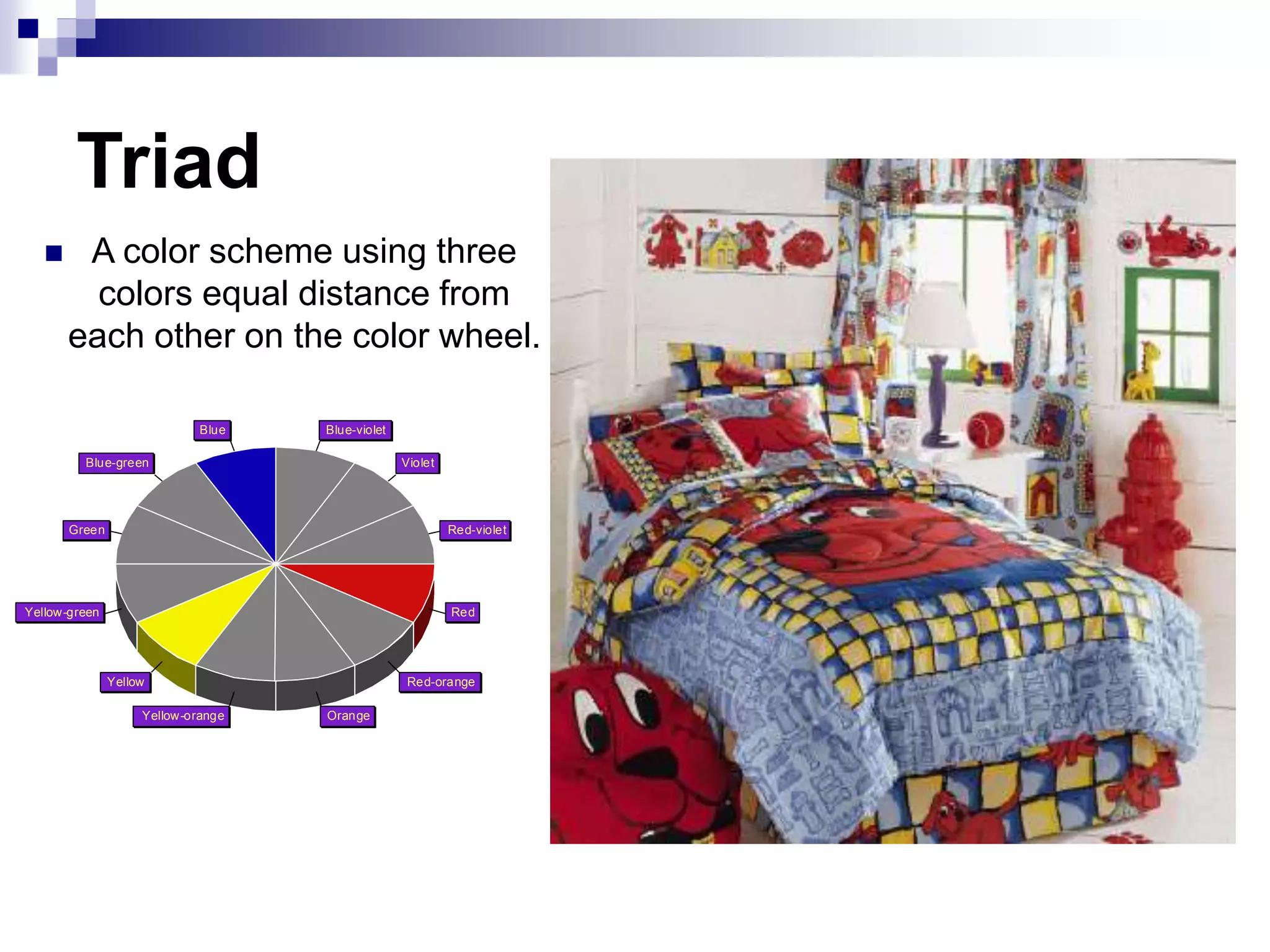
Triad
 A color scheme using three
colors equal distance from
each other on the color wheel.
Red-violet
Violet
Blue-violet
Blue
Blue-green
Green
Yellow-green
Yellow
Yellow-orange Orange
Red-orange
Red
Neutral
 A color scheme using whites,
blacks, browns, grays and
beiges, etc.
Red-violet
Violet
Blue-violet
Blue
Blue-green
Green
Yellow-green
Yellow
Yellow-orange Orange
Red-orange
Red
This scheme is often “accented” with a
small amount of another hue, and called
the ACCENTED NEUTRAL.
Fad
 Some designers base a room decor on a
popular “theme” instead of a prescribed color
scheme. It should only be used if it reflects the
personality and preferences of the client.
The bedroom above is decorated
around a nautical “theme”,
disregarding any specific color
harmony.
This red, white, and blue color
combination is only acceptable for
those who prefer the patriotic “theme”.
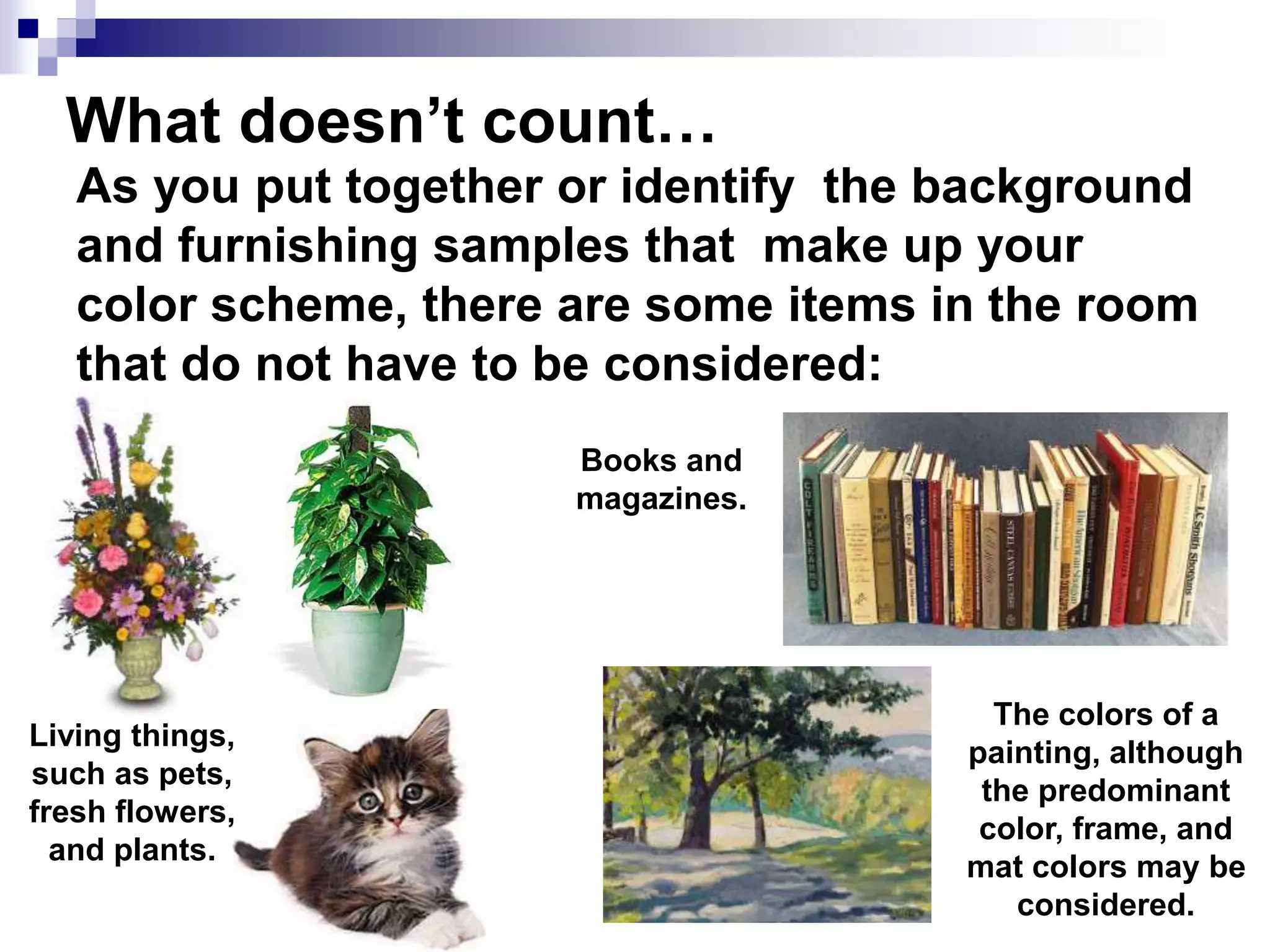
What doesn’t count…
As you put together or identify the background
and furnishing samples that make up your
color scheme, there are some items in the room
that do not have to be considered:
Living things,
such as pets,
fresh flowers,
and plants.
Books and
magazines.
The colors of a
painting, although
the predominant
color, frame, and
mat colors may be
considered.
Warm Colors
 Colors on the warm side of the
spectrum…red, yellow, orange.
They usually also include the
neutral black and brown tones.
Red-violet
Violet
Blue-violet
Blue
Blue-green
Green
Yellow-green
Yellow
Yellow-orange Orange
Red-orange
Red
Warm colors are especially good in rooms with northern exposures.
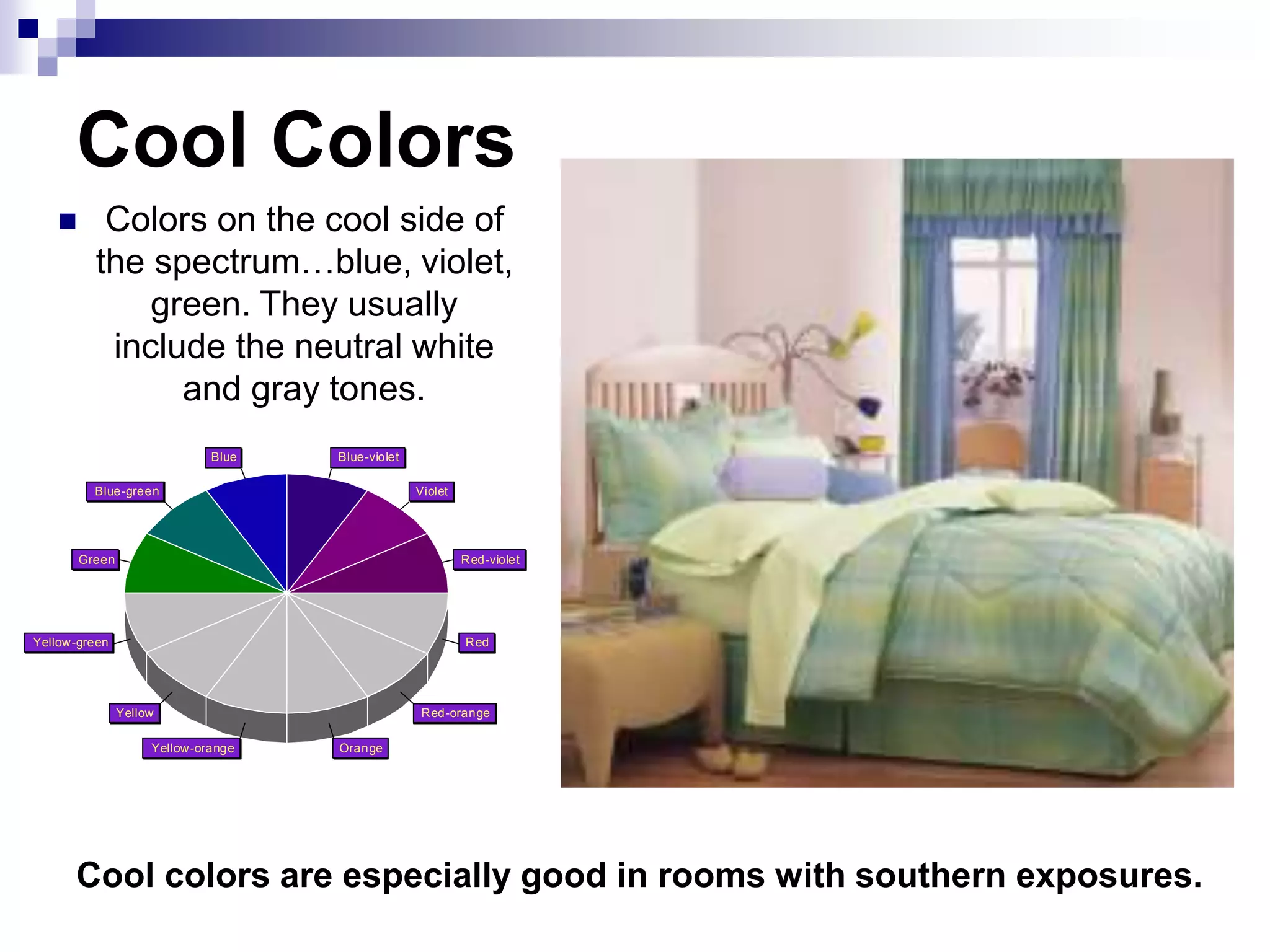
Cool Colors
 Colors on the cool side of
the spectrum…blue, violet,
green. They usually
include the neutral white
and gray tones.
Red-violet
Violet
Blue-violet
Blue
Blue-green
Green
Yellow-green
Yellow
Yellow-orange Orange
Red-orange
Red
Cool colors are especially good in rooms with southern exposures.
Light Colors
“RECEDE”
Dark Colors “ADVANCE”
When rooms are painted pastel
or light colors/neutrals, they
seem bigger. The colors
“recede” or appear to move
away from you. Remember when
selecting paint… the paint dries
darker on the wall.
When rooms are painted
dark colors/neutrals,
they seem smaller. The
colors “advance” or
appear to move in closer
to you.
Large prints or very
“busy” prints may also
make a room appear
smaller.
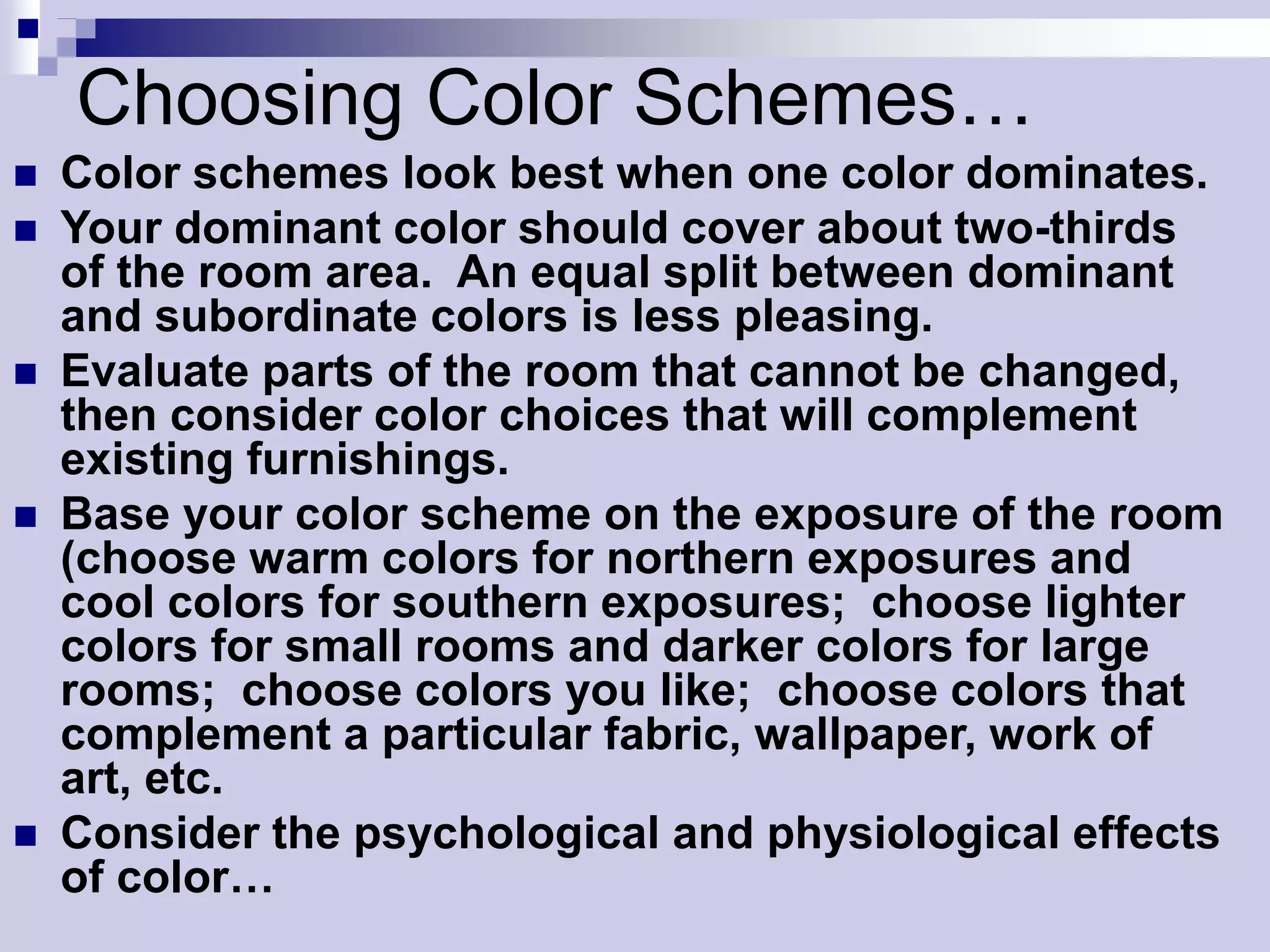
Choosing Color Schemes…
 Color schemes look best when one color dominates.
 Your dominant color should cover about two-thirds
of the room area. An equal split between dominant
and subordinate colors is less pleasing.
 Evaluate parts of the room that cannot be changed,
then consider color choices that will complement
existing furnishings.
 Base your color scheme on the exposure of the room
(choose warm colors for northern exposures and
cool colors for southern exposures; choose lighter
colors for small rooms and darker colors for large
rooms; choose colors you like; choose colors that
complement a particular fabric, wallpaper, work of
art, etc.
 Consider the psychological and physiological effects
of color…
Physiological Effects of Individual Colors
Color creates powerful psychological and physiological effects.
Psychological effects are sensed in the mind; physiological effects actually
cause a change in the body. It is important to note that people may react
differently to the same color, based on their previous experiences or learned
behavior. Research studies have shown that:
Color affects eye's perception of weight and size. Dark and bright colors seem
heavier than light and cool colors. (However, it is interesting that the opposite effect is
true in fashion design. Dark colors tend to slim the figure, whereas light colors are usually thought
to make one look heavier.)
Color affects a person's perception of temperature. Studies have indicated
that body temperature actually fluctuates in response to various colors. For
example, red, orange, and yellow can raise one's temperature; cool colors
have the opposite reaction.
Color can cause feelings of boredom and calmness, or stimulation and
liveliness. Colors may cause the nervous system to become agitated, and the
body reacts in negative ways to this stimulus.
Colors can affect one's reaction to sounds, taste, odors, and time perception.
Colors can improve the rate of recovery of sick patients.
Psychological Associations with Color:
Gray Elegance, humility, respect, reverence, stability, subtlety, timelessness, wisdom OR
boredom, decay, decrepitude, dullness, dust, pollution, urban sprawl
White Reverence, purity, snow, peace, innocence, cleanliness, simplicity, security,
humility, marriage, sterility, winter OR coldness, sterility, surrender, cowardice,
fearfulness, winter, unimaginative
Black Modernity, power, sophistication, formality, elegance, wealth, mystery, style OR
evil, death, fear, anonymity, anger, sadness, remorse, mourning, unhappiness, mystery
Red Passion, strength, energy, fire, love, sex, excitement, speed, heat, leadership,
masculinity, power OR danger, fire, gaudiness, blood, war, anger, revolution, radicalism,
aggression, stop
Blue Seas, skies, peace, unity, harmony, tranquility, calmness, coolness, confidence,
water, ice, loyalty, conservatism, dependability, cleanliness, technology, winter OR
depression, coldness, idealism, obscenity, ice, tackiness, winter
Green Nature, spring, fertility, youth, environment, wealth, money (US), good luck, vigor,
generosity, go, grass OR aggression, inexperience, envy, misfortune, jealousy, money,
illness, greed
Yellow Sunlight, joy, happiness, optimism, idealism, wealth (gold), summer, hope, air OR
cowardice, illness (quarantine), hazards, dishonesty, avarice, sissification, weakness
Violet Sensuality, spirituality, creativity, wealth, royalty, nobility, ceremony, mystery,
wisdom, enlightenment OR arrogance, flamboyance, gaudiness, mourning, profanity,
exaggeration
Orange Buddhism, energy, balance, heat, fire, enthusiasm, flamboyance, playfulness OR
Aggression, arrogance, flamboyance, gaudiness, over-emotion, warning, danger, fire
Brown Calm, depth, natural organisms, nature, richness, rusticism, stability, tradition OR
boorishness, dirt, dullness, filth, heaviness, poverty, roughness
Color Projects
White 5 Tints True Hue 4 Shades Black
Red Value Scale
Dull Hue Dull Complement
Hue Brown Complement
Intensity Scale
You will be completing a total of 8 pages for these two projects.
The first 6 pages will each be set up to illustrate a neutral,
monochromatic, complementary, analogous, triad, and fad color
scheme according to the sample given. Include the title, your
name, and a color wheel that is suitably colored and labeled for
each page. You must find your pictures in catalogs or
magazines… not the internet. You may use a computer or your
templates for printing.
The 7th page will include a hand-painted value and intensity
scale, using the tempera paint colors of your choice.
On the 8th page, use colored pencils to color each picture in a manner that
illustrates the psychological associations of color.
This monochromatic
color scheme is based on
a single hue… red orange.
By mixing a small amount
of red-orange and white, a
peachy tone is achieved.
COLOR SCHEME: MONOCHROMATIC
BY YOUR NAME
White 5 Tints True Hue 4 Shades Black
VALUE & INTENSITY
OF COLOR
By__________
Value scale for the color:______________
Intensity Scale for the color: ___________
Dull Hue Dull Complement
Hue Brown Complement
The psychological
associations of color…
A rose for your
sick relative in
the hospital.
A hat, perfect for the king’s
coronation or the college graduate.
The blanket of your
favorite race horse.
Name: ____________________
The sofa in the dentist’s waiting room.
A rose for your
true love!
Teen boys car.

135-Color.ppt

  • 2.
    ELEMENTS OF DESIGN Elementsof design are “tools”. Just like the carpenter has a hammer and saw, the designer has the elements. There are 4 elements of design: Line, Form, COLOR, & Texture. Color is a property of light. A color spectrum is produced by a beam of light as it passes through a prism. Although the number of colors is unlimited…more than 10 million have been identified, and several hundreds have been reproduced by scientists.
  • 3.
    Red-violet Violet Blue-violet Blue Blue-green Green Yellow-green Yellow Yellow-orange Orange Red-orange Red Color Wheel Thiscolor wheel system, based on three primary colors, is known as the Brewster System. It was developed by David Brewster. It is also called the Prang System. Each color on the color wheel is a true “hue”.
  • 4.
    Primary Colors… Red, Blue,and Yellow Red-violet Violet Blue-violet Blue Blue-green Green Yellow-green Yellow Yellow-orange Orange Red-orange Red Primary colors cannot be man- made by mixing other colors together. A pigment is color from a biological source, which when used in housing and design applications can be natural or synthetic (manmade).
  • 5.
    Red-violet Violet Blue-violet Blue Blue-green Green Yellow-green Yellow Yellow-orange Orange Red-orange Red Secondary Colors… Orange,Green, and Violet Remember, it’s “violet”, not purple. Secondary colors can be “made” by mixing two primary colors together. Blue and red make violet; red and yellow make orange; yellow and blue make green.
  • 6.
    Red-violet Violet Blue-violet Blue Blue-green Green Yellow-green Yellow Yellow-orange Orange Red-orange Red Tertiary Colors…Yellow-green, Blue-green, Blue-Violet, Red-Violet, Red-orange, Yellow-orange The tertiary colors are also referred to as the intermediate colors. Tertiary colors are made by mixing a primary with a secondary color… the primary color is always listed first. For example, when the primary color of yellow is mixed with the secondary color named green, the new tertiary color is called yellow-green. Tertiary colors can be expanded further, such as mixing blue and blue- green together. The result would be the color blue-blue-green. Perhaps we would name that color “teal” to be less confusing.
  • 7.
    Neutral Colors… Neutral colorsinclude black, white, and brown. They also include all the tints and shades of black, white, and brown… so include colors known as tan, beige, gray, cream, etc. Neutral colors can be made by mixing: black and white complementary colors all three primaries together (plus some black or white) Neutral colors blend well with all other colors. They enhance and strengthen the other colors around them. Stone such as slate, brick, marble, etc.; metallics such as brass, pewter, gold, chrome etc.; and glass fall into the neutral category. Black is the absence of “light”; white is the absence of “color”.
  • 8.
    Complementary colors… Complementary colors arethose located directly opposite each other on the color wheel.
  • 9.
    “INTENSITY” OF COLORS Intensityis the brightness or dullness of a color. It is sometimes called “chroma”. The intensity changes by using the complementary color. The degree of brightness is referred to as “saturation”. Place a hue beside its complement to make it appear brighter. Add the complementary color to a hue to make the hue “dull”. When complementary colors are mixed, grays and browns can result. Saturated less saturated less saturated Saturated
  • 10.
    “VALUE” OF COLORS Innature there are hundreds of different steps in value that are sometimes not easily distinguished by the human eye. Value is the lightness or darkness of a color. To combine a hue with black is called a SHADE. To combine a hue with white is called a TINT. To combine a hue with black and white is called a TONE. Remember… colors appear darker when placed on rough textures. Paint appears darker when it dries on the wall. Artificial incandescent and fluorescent lighting changes the appearance of some colors.
  • 11.
    Color Schemes  Thereare certain groups of colors that work together very well in interiors…they might be referred to as Color Schemes or Color Harmonies.  A color scheme can include hues, any values (including tints, shades, tones), or intensities of that hue, and any neutrals.  Make sure when using color schemes to select colors that you or your client likes.  Color schemes of adjoining rooms may need to be coordinated.  Although some designers prescribe to the idea that “beauty is in the eyes of the beholder”, most prefer a “tasteful” approach. Taste is defined as a cultured appreciation for aesthetic quality or sensibility.
  • 12.
    Monochromatic  A colorscheme using one color, and tints, tones and shades of that color. Red-violet Violet Blue-violet Blue Blue-green Green Yellow-green Yellow Yellow-orange Orange Red-orange Red
  • 13.
    Analogous  A colorscheme using 3 or more colors next to each other on the color wheel. Red-violet Violet Blue-violet Blue Blue-green Green Yellow-green Yellow Yellow-orange Orange Red-orange Red
  • 14.
    Complementary  A colorscheme using colors opposite each other on the color wheel. Red-violet Violet Blue-violet Blue Blue-green Green Yellow-green Yellow Yellow-orange Orange Red-orange Red
  • 15.
    Double Complementary  AColor scheme using two sets of complementary colors. Red-violet Violet Blue-violet Blue Blue-green Green Yellow-green Yellow Yellow-orange Orange Red-orange Red
  • 16.
    Split Complementary  Acolor scheme using one color, and the colors on either side of it’s complement. This color scheme, along with the double complementary are more difficult to achieve in a tasteful fashion. Red-violet Violet Blue-violet Blue Blue-green Green Yellow-green Yellow Yellow-orange Orange Red-orange Red
  • 17.
    Triad  A colorscheme using three colors equal distance from each other on the color wheel. Red-violet Violet Blue-violet Blue Blue-green Green Yellow-green Yellow Yellow-orange Orange Red-orange Red
  • 18.
    Neutral  A colorscheme using whites, blacks, browns, grays and beiges, etc. Red-violet Violet Blue-violet Blue Blue-green Green Yellow-green Yellow Yellow-orange Orange Red-orange Red This scheme is often “accented” with a small amount of another hue, and called the ACCENTED NEUTRAL.
  • 19.
    Fad  Some designersbase a room decor on a popular “theme” instead of a prescribed color scheme. It should only be used if it reflects the personality and preferences of the client. The bedroom above is decorated around a nautical “theme”, disregarding any specific color harmony. This red, white, and blue color combination is only acceptable for those who prefer the patriotic “theme”.
  • 20.
    What doesn’t count… Asyou put together or identify the background and furnishing samples that make up your color scheme, there are some items in the room that do not have to be considered: Living things, such as pets, fresh flowers, and plants. Books and magazines. The colors of a painting, although the predominant color, frame, and mat colors may be considered.
  • 21.
    Warm Colors  Colorson the warm side of the spectrum…red, yellow, orange. They usually also include the neutral black and brown tones. Red-violet Violet Blue-violet Blue Blue-green Green Yellow-green Yellow Yellow-orange Orange Red-orange Red Warm colors are especially good in rooms with northern exposures.
  • 22.
    Cool Colors  Colorson the cool side of the spectrum…blue, violet, green. They usually include the neutral white and gray tones. Red-violet Violet Blue-violet Blue Blue-green Green Yellow-green Yellow Yellow-orange Orange Red-orange Red Cool colors are especially good in rooms with southern exposures.
  • 23.
    Light Colors “RECEDE” Dark Colors“ADVANCE” When rooms are painted pastel or light colors/neutrals, they seem bigger. The colors “recede” or appear to move away from you. Remember when selecting paint… the paint dries darker on the wall. When rooms are painted dark colors/neutrals, they seem smaller. The colors “advance” or appear to move in closer to you. Large prints or very “busy” prints may also make a room appear smaller.
  • 24.
    Choosing Color Schemes… Color schemes look best when one color dominates.  Your dominant color should cover about two-thirds of the room area. An equal split between dominant and subordinate colors is less pleasing.  Evaluate parts of the room that cannot be changed, then consider color choices that will complement existing furnishings.  Base your color scheme on the exposure of the room (choose warm colors for northern exposures and cool colors for southern exposures; choose lighter colors for small rooms and darker colors for large rooms; choose colors you like; choose colors that complement a particular fabric, wallpaper, work of art, etc.  Consider the psychological and physiological effects of color…
  • 25.
    Physiological Effects ofIndividual Colors Color creates powerful psychological and physiological effects. Psychological effects are sensed in the mind; physiological effects actually cause a change in the body. It is important to note that people may react differently to the same color, based on their previous experiences or learned behavior. Research studies have shown that: Color affects eye's perception of weight and size. Dark and bright colors seem heavier than light and cool colors. (However, it is interesting that the opposite effect is true in fashion design. Dark colors tend to slim the figure, whereas light colors are usually thought to make one look heavier.) Color affects a person's perception of temperature. Studies have indicated that body temperature actually fluctuates in response to various colors. For example, red, orange, and yellow can raise one's temperature; cool colors have the opposite reaction. Color can cause feelings of boredom and calmness, or stimulation and liveliness. Colors may cause the nervous system to become agitated, and the body reacts in negative ways to this stimulus. Colors can affect one's reaction to sounds, taste, odors, and time perception. Colors can improve the rate of recovery of sick patients.
  • 26.
    Psychological Associations withColor: Gray Elegance, humility, respect, reverence, stability, subtlety, timelessness, wisdom OR boredom, decay, decrepitude, dullness, dust, pollution, urban sprawl White Reverence, purity, snow, peace, innocence, cleanliness, simplicity, security, humility, marriage, sterility, winter OR coldness, sterility, surrender, cowardice, fearfulness, winter, unimaginative Black Modernity, power, sophistication, formality, elegance, wealth, mystery, style OR evil, death, fear, anonymity, anger, sadness, remorse, mourning, unhappiness, mystery Red Passion, strength, energy, fire, love, sex, excitement, speed, heat, leadership, masculinity, power OR danger, fire, gaudiness, blood, war, anger, revolution, radicalism, aggression, stop Blue Seas, skies, peace, unity, harmony, tranquility, calmness, coolness, confidence, water, ice, loyalty, conservatism, dependability, cleanliness, technology, winter OR depression, coldness, idealism, obscenity, ice, tackiness, winter Green Nature, spring, fertility, youth, environment, wealth, money (US), good luck, vigor, generosity, go, grass OR aggression, inexperience, envy, misfortune, jealousy, money, illness, greed Yellow Sunlight, joy, happiness, optimism, idealism, wealth (gold), summer, hope, air OR cowardice, illness (quarantine), hazards, dishonesty, avarice, sissification, weakness Violet Sensuality, spirituality, creativity, wealth, royalty, nobility, ceremony, mystery, wisdom, enlightenment OR arrogance, flamboyance, gaudiness, mourning, profanity, exaggeration Orange Buddhism, energy, balance, heat, fire, enthusiasm, flamboyance, playfulness OR Aggression, arrogance, flamboyance, gaudiness, over-emotion, warning, danger, fire Brown Calm, depth, natural organisms, nature, richness, rusticism, stability, tradition OR boorishness, dirt, dullness, filth, heaviness, poverty, roughness
  • 28.
    Color Projects White 5Tints True Hue 4 Shades Black Red Value Scale Dull Hue Dull Complement Hue Brown Complement Intensity Scale You will be completing a total of 8 pages for these two projects. The first 6 pages will each be set up to illustrate a neutral, monochromatic, complementary, analogous, triad, and fad color scheme according to the sample given. Include the title, your name, and a color wheel that is suitably colored and labeled for each page. You must find your pictures in catalogs or magazines… not the internet. You may use a computer or your templates for printing. The 7th page will include a hand-painted value and intensity scale, using the tempera paint colors of your choice. On the 8th page, use colored pencils to color each picture in a manner that illustrates the psychological associations of color.
  • 29.
    This monochromatic color schemeis based on a single hue… red orange. By mixing a small amount of red-orange and white, a peachy tone is achieved. COLOR SCHEME: MONOCHROMATIC BY YOUR NAME
  • 30.
    White 5 TintsTrue Hue 4 Shades Black VALUE & INTENSITY OF COLOR By__________ Value scale for the color:______________ Intensity Scale for the color: ___________ Dull Hue Dull Complement Hue Brown Complement
  • 31.
    The psychological associations ofcolor… A rose for your sick relative in the hospital. A hat, perfect for the king’s coronation or the college graduate. The blanket of your favorite race horse. Name: ____________________ The sofa in the dentist’s waiting room. A rose for your true love! Teen boys car.