MEANING
Monetary policy is an instrument which effect
the credit flow in an economy.
The variation effect the demand & supply of
credit in an economy, and the level or nature
of economic activities.
Objective
Stability in price level
Economic development
Arrangement of full employment
Expansion of credit facility
Equality & Justice
Stability in exchange rate
INSTRUMENTS
GENERAL (QUANTITATIVE) Methods
SELECTIVE (QUALITATIVE) Methods
GENERAL (QUANTITATIVE) Methods
Meaning:-
These methods help in credit control in the
economy.
Affect total quantity of the credit.
Types
A. Bank rate policy
B. Open market policy
C. Cash reserve ratio
D. Statuary reserve ratio
Bank Rate policy
Traditional approach:- Bank rate means on
which central bank discounts and rediscount
the eligible bills.
Today’s approach:- Bank rate means the
minimum rate on which central bank provides
financial accommodation to commercial bank
in the discharge of its function as the lender of
the last resort.
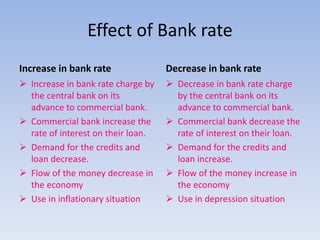
Effect of Bank rate
Increase in bank rate
 Increase in bank rate charge by
the central bank on its
advance to commercial bank.
 Commercial bank increase the
rate of interest on their loan.
 Demand for the credits and
loan decrease.
 Flow of the money decrease in
the economy
 Use in inflationary situation
Decrease in bank rate
 Decrease in bank rate charge
by the central bank on its
advance to commercial bank.
 Commercial bank decrease the
rate of interest on their loan.
 Demand for the credits and
loan increase.
 Flow of the money increase in
the economy
 Use in depression situation
Open Market operation
Its include the sales and purchase by the central
bank of ….
Assets
Foreign exchange
Gold
Government securities
Company securities
Use of Open Market operation
In the inflationary situation
 Central bank sell out the
securities to commercial
bank and control money
supply.
 Central bank decrease the
money supply.
In the depressionary situation
 Central bank purchase the
securities from the
commercial bank.
 Central bank increase the
money supply.
Cash Reserve Ratio
Commercial bank has to keep a certain
percentage of its total deposits with central
bank.
It control the cash flow in economy.
 It keeps changing in monetary policy framed
by central bank of a country.
STATUARY LIQUIDITY RATIO
Commercial bank is to keep a certain
percentage of its total deposits as liquid asset.
It control the cash flow in economy.
 It keeps changing in monetary policy framed
by central bank of a country.
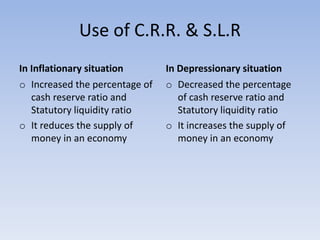
Use of C.R.R. & S.L.R
In Inflationary situation
o Increased the percentage of
cash reserve ratio and
Statutory liquidity ratio
o It reduces the supply of
money in an economy
In Depressionary situation
o Decreased the percentage
of cash reserve ratio and
Statutory liquidity ratio
o It increases the supply of
money in an economy
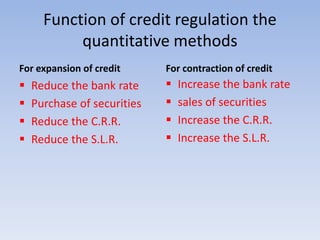
Function of credit regulation the
quantitative methods
For expansion of credit
 Reduce the bank rate
 Purchase of securities
 Reduce the C.R.R.
 Reduce the S.L.R.
For contraction of credit
 Increase the bank rate
 sales of securities
 Increase the C.R.R.
 Increase the S.L.R.
Specific or qualitative Credit Control
 Adopt for expansion and contraction of credit
to attain specific objective.
Methods of qualitative credit control
• Credit rationing
• Change in margin
• Direct action
MEANING
• Measures related to taxation & public
expenditure are normally called fiscal
measures and the policy concerning them as
known as FISCAL POLICY.
• In short, fiscal policy or budgetary policy
consists of steps & measures which the
government in order to fulfill the aims of
economic policy.
Objective of fiscal policy
To achieve and maintain the full employment
in the economy.
Attain Economic growth in long term.
Achieve economic stability.
To guide the allocation of existing resources
into socially necessary lines of development.
INSTRUMENTS
 PUBLIC EXPENDITURE
 TAXATION
 PUBLIC DEBT
PUBLIC EXPENDITURE
Meaning:-
 Government spending
 Productive
 Non-Productive
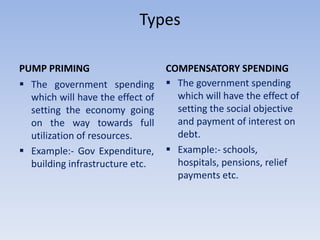
Types
PUMP PRIMING
 The government spending
which will have the effect of
setting the economy going
on the way towards full
utilization of resources.
 Example:- Gov Expenditure,
building infrastructure etc.
COMPENSATORY SPENDING
 The government spending
which will have the effect of
setting the social objective
and payment of interest on
debt.
 Example:- schools,
hospitals, pensions, relief
payments etc.
EFFECT
• Gov. exp should be reduced in inflation and
increased during depressions in case of a
deflationary situation in an economy.
Therefore it act as a balancing factor between
saving & investment
TAXATION
Meaning:-
Source of Revenue
Helps Gov. to do there exp.
Generated from public
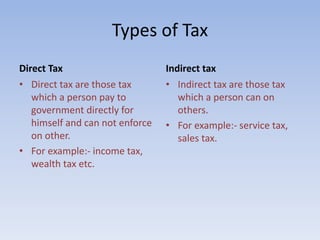
Types of Tax
Direct Tax
• Direct tax are those tax
which a person pay to
government directly for
himself and can not enforce
on other.
• For example:- income tax,
wealth tax etc.
Indirect tax
• Indirect tax are those tax
which a person can on
others.
• For example:- service tax,
sales tax.
Effect of Taxation
Reduction in taxation
 Increase the disposable
income.
 Increase the consumption
power.
 Use for offsetting the
deflation forces
Increase in Taxation
 Decrease the disposable
income.
 Decrease the consumption
power.
 Use for offsetting the
inflation forces.
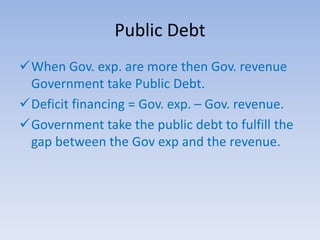
Public Debt
When Gov. exp. are more then Gov. revenue
Government take Public Debt.
Deficit financing = Gov. exp. – Gov. revenue.
Government take the public debt to fulfill the
gap between the Gov exp and the revenue.
Types of public debt
Borrowing from public
Borrowing from commercial bank
Issue of new currency
Effect
• Public Debt effect the inflation and deflation
• If government take the borrowing from public
and banks it will decrease the cash flow in the
market and increase the deflation.
• If there is depression in economy government
repay the debt the public which increase the
cash flow of the money in market.
Some facts and figures
Monetary policy is been framed by……………
Fiscal policy is been framed by………………
Present governor of R.B.I……………………
Present Finance minister of India……………….
Current S.L.R…………………….
Current C.R.R…………………..
Monetary policy in India framed under which
act……………………….
13247355.ppt

13247355.ppt

  • 2.
    MEANING Monetary policy isan instrument which effect the credit flow in an economy. The variation effect the demand & supply of credit in an economy, and the level or nature of economic activities.
  • 3.
    Objective Stability in pricelevel Economic development Arrangement of full employment Expansion of credit facility Equality & Justice Stability in exchange rate
  • 4.
  • 5.
    GENERAL (QUANTITATIVE) Methods Meaning:- Thesemethods help in credit control in the economy. Affect total quantity of the credit.
  • 6.
    Types A. Bank ratepolicy B. Open market policy C. Cash reserve ratio D. Statuary reserve ratio
  • 7.
    Bank Rate policy Traditionalapproach:- Bank rate means on which central bank discounts and rediscount the eligible bills. Today’s approach:- Bank rate means the minimum rate on which central bank provides financial accommodation to commercial bank in the discharge of its function as the lender of the last resort.
  • 8.
    Effect of Bankrate Increase in bank rate  Increase in bank rate charge by the central bank on its advance to commercial bank.  Commercial bank increase the rate of interest on their loan.  Demand for the credits and loan decrease.  Flow of the money decrease in the economy  Use in inflationary situation Decrease in bank rate  Decrease in bank rate charge by the central bank on its advance to commercial bank.  Commercial bank decrease the rate of interest on their loan.  Demand for the credits and loan increase.  Flow of the money increase in the economy  Use in depression situation
  • 9.
    Open Market operation Itsinclude the sales and purchase by the central bank of …. Assets Foreign exchange Gold Government securities Company securities
  • 10.
    Use of OpenMarket operation In the inflationary situation  Central bank sell out the securities to commercial bank and control money supply.  Central bank decrease the money supply. In the depressionary situation  Central bank purchase the securities from the commercial bank.  Central bank increase the money supply.
  • 11.
    Cash Reserve Ratio Commercialbank has to keep a certain percentage of its total deposits with central bank. It control the cash flow in economy.  It keeps changing in monetary policy framed by central bank of a country.
  • 12.
    STATUARY LIQUIDITY RATIO Commercialbank is to keep a certain percentage of its total deposits as liquid asset. It control the cash flow in economy.  It keeps changing in monetary policy framed by central bank of a country.
  • 13.
    Use of C.R.R.& S.L.R In Inflationary situation o Increased the percentage of cash reserve ratio and Statutory liquidity ratio o It reduces the supply of money in an economy In Depressionary situation o Decreased the percentage of cash reserve ratio and Statutory liquidity ratio o It increases the supply of money in an economy
  • 14.
    Function of creditregulation the quantitative methods For expansion of credit  Reduce the bank rate  Purchase of securities  Reduce the C.R.R.  Reduce the S.L.R. For contraction of credit  Increase the bank rate  sales of securities  Increase the C.R.R.  Increase the S.L.R.
  • 15.
    Specific or qualitativeCredit Control  Adopt for expansion and contraction of credit to attain specific objective.
  • 16.
    Methods of qualitativecredit control • Credit rationing • Change in margin • Direct action
  • 18.
    MEANING • Measures relatedto taxation & public expenditure are normally called fiscal measures and the policy concerning them as known as FISCAL POLICY. • In short, fiscal policy or budgetary policy consists of steps & measures which the government in order to fulfill the aims of economic policy.
  • 19.
    Objective of fiscalpolicy To achieve and maintain the full employment in the economy. Attain Economic growth in long term. Achieve economic stability. To guide the allocation of existing resources into socially necessary lines of development.
  • 20.
  • 21.
    PUBLIC EXPENDITURE Meaning:-  Governmentspending  Productive  Non-Productive
  • 22.
    Types PUMP PRIMING  Thegovernment spending which will have the effect of setting the economy going on the way towards full utilization of resources.  Example:- Gov Expenditure, building infrastructure etc. COMPENSATORY SPENDING  The government spending which will have the effect of setting the social objective and payment of interest on debt.  Example:- schools, hospitals, pensions, relief payments etc.
  • 23.
    EFFECT • Gov. expshould be reduced in inflation and increased during depressions in case of a deflationary situation in an economy. Therefore it act as a balancing factor between saving & investment
  • 24.
    TAXATION Meaning:- Source of Revenue HelpsGov. to do there exp. Generated from public
  • 25.
    Types of Tax DirectTax • Direct tax are those tax which a person pay to government directly for himself and can not enforce on other. • For example:- income tax, wealth tax etc. Indirect tax • Indirect tax are those tax which a person can on others. • For example:- service tax, sales tax.
  • 26.
    Effect of Taxation Reductionin taxation  Increase the disposable income.  Increase the consumption power.  Use for offsetting the deflation forces Increase in Taxation  Decrease the disposable income.  Decrease the consumption power.  Use for offsetting the inflation forces.
  • 27.
    Public Debt When Gov.exp. are more then Gov. revenue Government take Public Debt. Deficit financing = Gov. exp. – Gov. revenue. Government take the public debt to fulfill the gap between the Gov exp and the revenue.
  • 28.
    Types of publicdebt Borrowing from public Borrowing from commercial bank Issue of new currency
  • 29.
    Effect • Public Debteffect the inflation and deflation • If government take the borrowing from public and banks it will decrease the cash flow in the market and increase the deflation. • If there is depression in economy government repay the debt the public which increase the cash flow of the money in market.
  • 30.
    Some facts andfigures Monetary policy is been framed by…………… Fiscal policy is been framed by……………… Present governor of R.B.I…………………… Present Finance minister of India………………. Current S.L.R……………………. Current C.R.R………………….. Monetary policy in India framed under which act……………………….