Double Taxation and Tax Treaties
IFM - FACULTY OF ECONOMICS AND
MANAGEMENT SCIENCES (FEMS)
Lecture Two
Double Taxation
This refers to:
– Imposition of income tax or corporate tax on the
same income or capital for identical or same
period or tax year in respect of the same taxpayer.
– It may be domestic
• i.e. where taxes are imposed within a sovereign state by
different taxing authorities, e.g. different members of
federation.
– It may be international
• Where taxes are imposed by different sovereign states.
International Double taxation
“…Tax sovereignty may entail conflicting claims
from two or more jurisdictions over the same
taxable amount, which may lead to juridical
double taxation, which is the imposition of
comparable taxes in two (or more) states on
the same taxpayer in respect of the same
income…”
Double Taxation
• Kinds of double taxation:
– Juridical double taxation
i.e. imposition of comparable taxes by two (or
more) tax jurisdictions on the same taxpayer in
respect of the same taxable income or capital
– Economic double taxation
i.e. imposition of comparable taxes by two (or
more) tax jurisdictions on different taxpayers in
respect of the same taxable income
Approaches to determine tax residents
Art. 4 of OECD/UN Models
For individuals
• Facts and circumstances
– Having regard to all facts and
circumstances decision is made as
to whether a taxpayer has a
sufficiently strong personal
connection (nexus) to the
jurisdiction to be regarded as fiscal
resident
• Number of day present in a tax
jurisdiction
– An individual is a resident if is
physically present in the
jurisdiction for a specific number of
days (usually 183) in the tax year,
alternatively in any 12 months
beginning or ending during the tax
year
For Companies
• Place of incorporation
– A company is a resident of
the country in which it is
incorporated
• Central of management or
control
– A company is a resident of a
country in which its central
management and control is
located
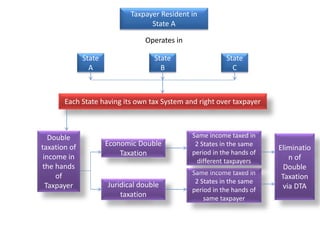
Taxpayer Resident in
State A
State
C
State
A
Same income taxed in
2 States in the same
period in the hands of
same taxpayer
Operates in
State
B
Each State having its own tax System and right over taxpayer
Economic Double
Taxation
Same income taxed in
2 States in the same
period in the hands of
different taxpayers
Double
taxation of
income in
the hands
of
Taxpayer
Eliminatio
n of
Double
Taxation
via DTA
Juridical double
taxation
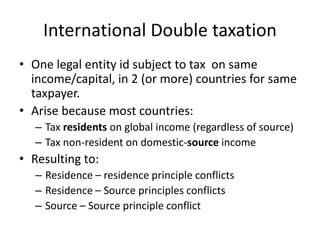
International Double taxation
• One legal entity id subject to tax on same
income/capital, in 2 (or more) countries for same
taxpayer.
• Arise because most countries:
– Tax residents on global income (regardless of source)
– Tax non-resident on domestic-source income
• Resulting to:
– Residence – residence principle conflicts
– Residence – Source principles conflicts
– Source – Source principle conflict
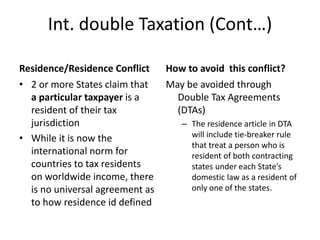
Int. double Taxation (Cont…)
Residence/Residence Conflict
• 2 or more States claim that
a particular taxpayer is a
resident of their tax
jurisdiction
• While it is now the
international norm for
countries to tax residents
on worldwide income, there
is no universal agreement as
to how residence id defined
How to avoid this conflict?
May be avoided through
Double Tax Agreements
(DTAs)
– The residence article in DTA
will include tie-breaker rule
that treat a person who is
resident of both contracting
states under each State’s
domestic law as a resident of
only one of the states.
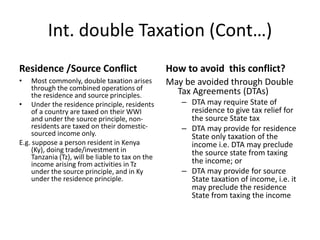
Int. double Taxation (Cont…)
Residence /Source Conflict
• Most commonly, double taxation arises
through the combined operations of
the residence and source principles.
• Under the residence principle, residents
of a country are taxed on their WWI
and under the source principle, non-
residents are taxed on their domestic-
sourced income only.
E.g. suppose a person resident in Kenya
(Ky), doing trade/investment in
Tanzania (Tz), will be liable to tax on the
income arising from activities in Tz
under the source principle, and in Ky
under the residence principle.
How to avoid this conflict?
May be avoided through Double
Tax Agreements (DTAs)
– DTA may require State of
residence to give tax relief for
the source State tax
– DTA may provide for residence
State only taxation of the
income i.e. DTA may preclude
the source state from taxing
the income; or
– DTA may provide for source
State taxation of income, i.e. it
may preclude the residence
State from taxing the income
Int. double Taxation (Cont…)
Source /Source Conflict
• Similar, while it is internationally common practice
that States can tax non-residents on income
sourced within their State jurisdictions, there is no
internationally agreed set of rules for this purpose.
Instance of source/source conflicts can be found for
all most all classes of income.
• When more than one country claim that revenue
was sourced from its territory
E.g. 1. Some countries may regard business profits as
sourced within the jurisdiction if the profits are
attributable to PE in the jurisdiction, while other
countries may regard business profits as sourced in
the jurisdiction if place of contract is in the
jurisdiction.
E.g. 2. Royalties: some countries may regard royalties as
sourced in the jurisdiction if the underlying
property giving raise to royalty is used in the
jurisdiction, while other countries may regard it as
sourced in the jurisdiction if royalty is paid by
resident of the jurisdiction
How to avoid this conflict?
May be avoided through
Double Tax Agreements
(DTAs)
– The taxing right specified in a
DTA effectively sets out a
uniform set of source rules
that are then applied by both
countries overriding any
conflicting domestic rules
Double tax treaties
• Bilateral/Multilateral Agreements
• Countries decide how their tax systems interact
• Prevention of double taxation
– E.g. Tanzania – Canada (1995) “AGREEMENT BETWEEN
CANADA AND THE URT FOR THE AVOIDANCE OF DOUBLE
TAXATION AND THE PREVENTION OF FISCAL EVASION
WITH RESPECT TO TAXES ON INCOME AND ON CAPITAL”
– E.g. EAC Multilateral Agreement (1997) “AGREEMENT
BETWEEN THE GOVERNMENTS OF THE REPUBLIC OF
KENYA, THE URT AND THE REPUBLIC OF UGANDA FOR THE
AVOIDANCE OF DOUBLE TAXATION AND THE PREVENTION
OF FISCAL EVASION WITH RESPECT TO TAXES ON INCOME”
Tax treaties and domestic (tax) law
• Treaty overrides domestic law
– Sect.128 of the Income Tax Act 2004
• Incorporated into domestic law (‘ratified’)
– Direct effect
– Indirect effect
– What is the practice in Tanzania?
Tax treaties and domestic (tax) law
• Governed by Vienna Convention on the Law of
Treaties (1980)
• Territorial scope
• General rules of interpretation
• Breach of treaties
• Changes in Circumstances of the State
Why Tax Treaties are
important/needed
• If two countries (both) recognize the concept
of taxation by residence and taxation by
source:
– Discrepancies in definitions
– Discrepancies in domestic (tax) law
Development of tax treaties
• League of Nations Financial Committee (1923)
• Which country has priority in taxing:
– Country of source?
– Country of residence?
– Should this differ depending on the type of
income
Three central Principles
• Profits of a Permanent establishment (PE)
could be taxed by the host (source) country
• Residence depend on the place of central
management
• Subsidiaries to be treated as separate (legal)
entity
The Inter-War Period
• Emergence of the transfer price problem –
Carroll Report to the League of Nations, 1933
• Rules for attribution of profits to foreign
branches: - the “separate entity” principle
The OECD Model Treaty of 1963 (Last
revised 2017)
• Amended the 1935 model to take account of
developments since plethora of treaties..
• Aims of OECD – to promote trade between its
member countries
The UN Model Treaty
• 1st Published 1980
• Source based principle
• Model for TTs between developed and
developing countries
Main Articles of the Models
• Definitions
– Residence
– Permanent Establishment
• How certain items of income are to be taxed
– Business profits
– Interest, dividends and royalties
– Capital gains
• Articles for special types of taxpayers
– Artists
– Students
– Athletes
Thank You

Lecture 2 - Double Taxation.ppt

  • 1.
    Double Taxation andTax Treaties IFM - FACULTY OF ECONOMICS AND MANAGEMENT SCIENCES (FEMS) Lecture Two
  • 2.
    Double Taxation This refersto: – Imposition of income tax or corporate tax on the same income or capital for identical or same period or tax year in respect of the same taxpayer. – It may be domestic • i.e. where taxes are imposed within a sovereign state by different taxing authorities, e.g. different members of federation. – It may be international • Where taxes are imposed by different sovereign states.
  • 3.
    International Double taxation “…Taxsovereignty may entail conflicting claims from two or more jurisdictions over the same taxable amount, which may lead to juridical double taxation, which is the imposition of comparable taxes in two (or more) states on the same taxpayer in respect of the same income…”
  • 4.
    Double Taxation • Kindsof double taxation: – Juridical double taxation i.e. imposition of comparable taxes by two (or more) tax jurisdictions on the same taxpayer in respect of the same taxable income or capital – Economic double taxation i.e. imposition of comparable taxes by two (or more) tax jurisdictions on different taxpayers in respect of the same taxable income
  • 5.
    Approaches to determinetax residents Art. 4 of OECD/UN Models For individuals • Facts and circumstances – Having regard to all facts and circumstances decision is made as to whether a taxpayer has a sufficiently strong personal connection (nexus) to the jurisdiction to be regarded as fiscal resident • Number of day present in a tax jurisdiction – An individual is a resident if is physically present in the jurisdiction for a specific number of days (usually 183) in the tax year, alternatively in any 12 months beginning or ending during the tax year For Companies • Place of incorporation – A company is a resident of the country in which it is incorporated • Central of management or control – A company is a resident of a country in which its central management and control is located
  • 6.
    Taxpayer Resident in StateA State C State A Same income taxed in 2 States in the same period in the hands of same taxpayer Operates in State B Each State having its own tax System and right over taxpayer Economic Double Taxation Same income taxed in 2 States in the same period in the hands of different taxpayers Double taxation of income in the hands of Taxpayer Eliminatio n of Double Taxation via DTA Juridical double taxation
  • 7.
    International Double taxation •One legal entity id subject to tax on same income/capital, in 2 (or more) countries for same taxpayer. • Arise because most countries: – Tax residents on global income (regardless of source) – Tax non-resident on domestic-source income • Resulting to: – Residence – residence principle conflicts – Residence – Source principles conflicts – Source – Source principle conflict
  • 8.
    Int. double Taxation(Cont…) Residence/Residence Conflict • 2 or more States claim that a particular taxpayer is a resident of their tax jurisdiction • While it is now the international norm for countries to tax residents on worldwide income, there is no universal agreement as to how residence id defined How to avoid this conflict? May be avoided through Double Tax Agreements (DTAs) – The residence article in DTA will include tie-breaker rule that treat a person who is resident of both contracting states under each State’s domestic law as a resident of only one of the states.
  • 9.
    Int. double Taxation(Cont…) Residence /Source Conflict • Most commonly, double taxation arises through the combined operations of the residence and source principles. • Under the residence principle, residents of a country are taxed on their WWI and under the source principle, non- residents are taxed on their domestic- sourced income only. E.g. suppose a person resident in Kenya (Ky), doing trade/investment in Tanzania (Tz), will be liable to tax on the income arising from activities in Tz under the source principle, and in Ky under the residence principle. How to avoid this conflict? May be avoided through Double Tax Agreements (DTAs) – DTA may require State of residence to give tax relief for the source State tax – DTA may provide for residence State only taxation of the income i.e. DTA may preclude the source state from taxing the income; or – DTA may provide for source State taxation of income, i.e. it may preclude the residence State from taxing the income
  • 10.
    Int. double Taxation(Cont…) Source /Source Conflict • Similar, while it is internationally common practice that States can tax non-residents on income sourced within their State jurisdictions, there is no internationally agreed set of rules for this purpose. Instance of source/source conflicts can be found for all most all classes of income. • When more than one country claim that revenue was sourced from its territory E.g. 1. Some countries may regard business profits as sourced within the jurisdiction if the profits are attributable to PE in the jurisdiction, while other countries may regard business profits as sourced in the jurisdiction if place of contract is in the jurisdiction. E.g. 2. Royalties: some countries may regard royalties as sourced in the jurisdiction if the underlying property giving raise to royalty is used in the jurisdiction, while other countries may regard it as sourced in the jurisdiction if royalty is paid by resident of the jurisdiction How to avoid this conflict? May be avoided through Double Tax Agreements (DTAs) – The taxing right specified in a DTA effectively sets out a uniform set of source rules that are then applied by both countries overriding any conflicting domestic rules
  • 11.
    Double tax treaties •Bilateral/Multilateral Agreements • Countries decide how their tax systems interact • Prevention of double taxation – E.g. Tanzania – Canada (1995) “AGREEMENT BETWEEN CANADA AND THE URT FOR THE AVOIDANCE OF DOUBLE TAXATION AND THE PREVENTION OF FISCAL EVASION WITH RESPECT TO TAXES ON INCOME AND ON CAPITAL” – E.g. EAC Multilateral Agreement (1997) “AGREEMENT BETWEEN THE GOVERNMENTS OF THE REPUBLIC OF KENYA, THE URT AND THE REPUBLIC OF UGANDA FOR THE AVOIDANCE OF DOUBLE TAXATION AND THE PREVENTION OF FISCAL EVASION WITH RESPECT TO TAXES ON INCOME”
  • 12.
    Tax treaties anddomestic (tax) law • Treaty overrides domestic law – Sect.128 of the Income Tax Act 2004 • Incorporated into domestic law (‘ratified’) – Direct effect – Indirect effect – What is the practice in Tanzania?
  • 13.
    Tax treaties anddomestic (tax) law • Governed by Vienna Convention on the Law of Treaties (1980) • Territorial scope • General rules of interpretation • Breach of treaties • Changes in Circumstances of the State
  • 14.
    Why Tax Treatiesare important/needed • If two countries (both) recognize the concept of taxation by residence and taxation by source: – Discrepancies in definitions – Discrepancies in domestic (tax) law
  • 15.
    Development of taxtreaties • League of Nations Financial Committee (1923) • Which country has priority in taxing: – Country of source? – Country of residence? – Should this differ depending on the type of income
  • 16.
    Three central Principles •Profits of a Permanent establishment (PE) could be taxed by the host (source) country • Residence depend on the place of central management • Subsidiaries to be treated as separate (legal) entity
  • 17.
    The Inter-War Period •Emergence of the transfer price problem – Carroll Report to the League of Nations, 1933 • Rules for attribution of profits to foreign branches: - the “separate entity” principle
  • 18.
    The OECD ModelTreaty of 1963 (Last revised 2017) • Amended the 1935 model to take account of developments since plethora of treaties.. • Aims of OECD – to promote trade between its member countries
  • 19.
    The UN ModelTreaty • 1st Published 1980 • Source based principle • Model for TTs between developed and developing countries
  • 20.
    Main Articles ofthe Models • Definitions – Residence – Permanent Establishment • How certain items of income are to be taxed – Business profits – Interest, dividends and royalties – Capital gains • Articles for special types of taxpayers – Artists – Students – Athletes
  • 21.