eMedToday
TeleHealth & TeleMedicine
in the U.S.
1

HOW TELEHEALTH IS DEALT WITH BY THE
HEALTH INSURERS
Simply a series of tools, facilities and procedures
that enables and enhances the delivery of
healthcare
November 2013
Copyright © eMedToday 2013
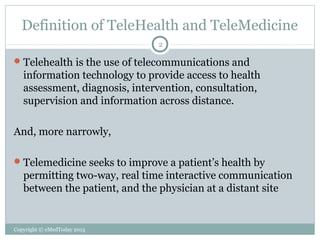
Definition of TeleHealth and TeleMedicine
2

 Telehealth is the use of telecommunications and

information technology to provide access to health
assessment, diagnosis, intervention, consultation,
supervision and information across distance.
And, more narrowly,
 Telemedicine seeks to improve a patient’s health by

permitting two-way, real time interactive communication
between the patient, and the physician at a distant site

Copyright © eMedToday 2013
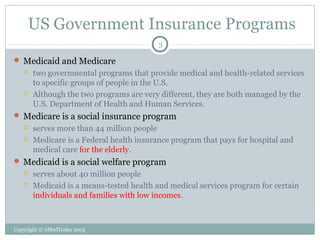
US Government Insurance Programs
3

 Medicaid and Medicare




two governmental programs that provide medical and health-related services
to specific groups of people in the U.S.
Although the two programs are very different, they are both managed by the
U.S. Department of Health and Human Services.

 Medicare is a social insurance program



serves more than 44 million people
Medicare is a Federal health insurance program that pays for hospital and
medical care for the elderly.

 Medicaid is a social welfare program



serves about 40 million people
Medicaid is a means-tested health and medical services program for certain
individuals and families with low incomes.

Copyright © eMedToday 2013
US Government Insurance Programs and
Telehealth
4

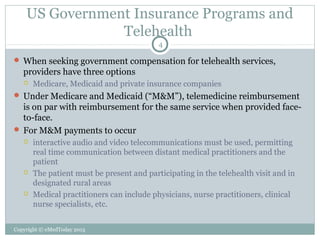
 When seeking government compensation for telehealth services,

providers have three options


Medicare, Medicaid and private insurance companies

 Under Medicare and Medicaid (“M&M”), telemedicine reimbursement

is on par with reimbursement for the same service when provided faceto-face.
 For M&M payments to occur






interactive audio and video telecommunications must be used, permitting
real time communication between distant medical practitioners and the
patient
The patient must be present and participating in the telehealth visit and in
designated rural areas
Medical practitioners can include physicians, nurse practitioners, clinical
nurse specialists, etc.

Copyright © eMedToday 2013
Insurance Cover of Telehealth Services
5

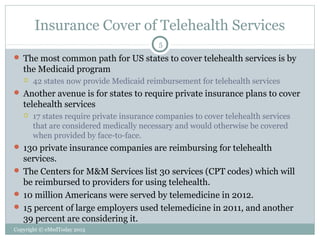
 The most common path for US states to cover telehealth services is by

the Medicaid program


42 states now provide Medicaid reimbursement for telehealth services

 Another avenue is for states to require private insurance plans to cover

telehealth services


17 states require private insurance companies to cover telehealth services
that are considered medically necessary and would otherwise be covered
when provided by face-to-face.

 130 private insurance companies are reimbursing for telehealth

services.
 The Centers for M&M Services list 30 services (CPT codes) which will
be reimbursed to providers for using telehealth.
 10 million Americans were served by telemedicine in 2012.
 15 percent of large employers used telemedicine in 2011, and another
39 percent are considering it.
Copyright © eMedToday 2013
Patients Perspective of Telehealth
6

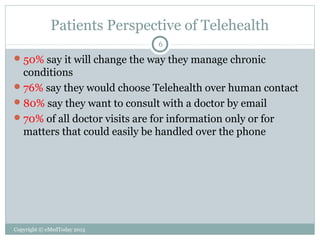
 50% say it will change the way they manage chronic

conditions
 76% say they would choose Telehealth over human contact
 80% say they want to consult with a doctor by email
 70% of all doctor visits are for information only or for
matters that could easily be handled over the phone

Copyright © eMedToday 2013
4 Case Studies
7

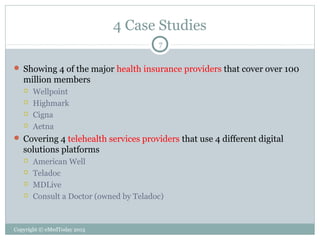
 Showing 4 of the major health insurance providers that cover over 100

million members





Wellpoint
Highmark
Cigna
Aetna

 Covering 4 telehealth services providers that use 4 different digital

solutions platforms





American Well
Teladoc
MDLive
Consult a Doctor (owned by Teladoc)

Copyright © eMedToday 2013
Case Study #1
WellPoint
8

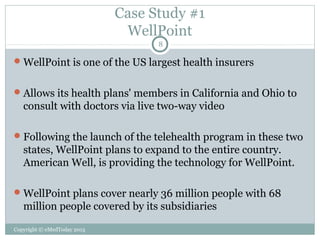
 WellPoint is one of the US largest health insurers
 Allows its health plans' members in California and Ohio to

consult with doctors via live two-way video
 Following the launch of the telehealth program in these two

states, WellPoint plans to expand to the entire country.
American Well, is providing the technology for WellPoint.
 WellPoint plans cover nearly 36 million people with 68

million people covered by its subsidiaries
Copyright © eMedToday 2013
Case Study #1
WellPoint (Cont’d)
9

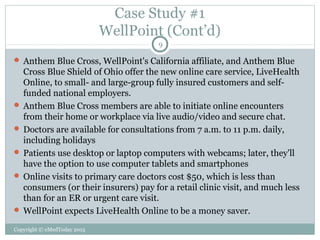
 Anthem Blue Cross, WellPoint's California affiliate, and Anthem Blue

Cross Blue Shield of Ohio offer the new online care service, LiveHealth
Online, to small- and large-group fully insured customers and selffunded national employers.
 Anthem Blue Cross members are able to initiate online encounters
from their home or workplace via live audio/video and secure chat.
 Doctors are available for consultations from 7 a.m. to 11 p.m. daily,
including holidays
 Patients use desktop or laptop computers with webcams; later, they'll
have the option to use computer tablets and smartphones
 Online visits to primary care doctors cost $50, which is less than
consumers (or their insurers) pay for a retail clinic visit, and much less
than for an ER or urgent care visit.
 WellPoint expects LiveHealth Online to be a money saver.
Copyright © eMedToday 2013
Case Study #1
WellPoint (Cont’d)
10

 Patients are asking for more anytime, anywhere access to physicians
 More people are comfortable interacting with physicians’ online.
 Within the secure LiveHealth Online application, policyholders can

share medical information with the attending physician
 Well Point reimburses for online visits after patients pays for co-pay;
patients can file claims on line
 WellPoint pays doctors for each consult, with the claim automatically
generated through LiveHealth Online.
 The patient fee is based on an office visit. But since WellPoint assumes
that physicians are accessing the system from home, fees are
discounted to reflect no office-related costs on the physician’s part.

Copyright © eMedToday 2013
Case Study #2
Highmark
11

Highmark Inc., one of the largest Blue health insurers in the US, has
launched a telehealth service for its members allowing them to conduct
long-distance virtual visits over the Internet with a physician using
telehealth provider, Teladoc.
 Highmark Inc. is a national diversified health and wellness company
based in Pittsburgh that serves 33.5 million people across the US
through its businesses in health insurance, dental insurance, and vision
care and information technology.
 Highmark members call a U.S.-based, board-certified physician via
phone or arrange for a video consultation online through the Teladoc
website.
 Upon requesting a consultation, members receive a call back from a
doctor licensed in their state within an average of 22 minutes. There is
no time limit for the consultation which costs $38.


Copyright © eMedToday 2013
Case Study #2
Highmark (Cont’d)
12

 In order to use the service, members register online and create a







Teladoc account. They then complete a medical history disclosure
form in order to populate an electronic health record (EHR) to store
their information. Patients can update their EHR at their convenience.
Teladoc's physicians have access to the member's EHR at the time of
their consultation.
During the visit, the physician reviews a member's medical history and
any prior consultations, as well as update the EHR with details of the
current consultation.
If medically appropriate, physicians prescribe medication that can be
sent to the member's pharmacy via phone, fax, or electronically.
With patient approval, the Teladoc system also can send a record of
the consultation to the patient's primary care physician.

Copyright © eMedToday 2013
Case Study #2
Highmark (Cont’d)
13

 Access to these doctors online after hours prevents unnecessary visits

to the emergency room or urgent care facilities, thus reducing
healthcare costs.
 Convenience is also a benefit for members, who would normally have
to take time off from work to visit a physician's practice.
 Teladoc platform is a proprietary, encrypted point-to-point video
connection between the member and a Teladoc physician.
 Patients pay a charge or co-pay similar to visiting a doctor's office -insurers would save by not paying out claims for more costly
treatment in urgent care centers and hospitals.

Copyright © eMedToday 2013
Case Study #3
Cigna
14

 Cigna is largest US national insurer to sell telehealth to employers.
 Cigna offers MDLive’s telehealth services to its self-insured customers

nationwide.
 Cigna operates in 30 countries, has approximately 35,800 employees
and manages around US$53 billion in assets.
 Cigna members in these self-insured plans request online video,
telephone or e-mail consultations with primary care physicians for nonurgent care needs such as cold and flu, rashes, and headaches.
 MDLive doctors are available 24/7 and respond to requests within an
average of 11 minutes.
 MDLive's telehealth services enable increasingly mobile and timeconstrained customers to schedule a virtual consult with a boardcertified physician and resolve a non-emergency medical issue in less
than one hour.
Copyright © eMedToday 2013
Case Study #3
Cigna (Cont’d)
15

 MDLive integrates directly into the insurer's consumer platform,

MyCigna.com, and also features Cigna's new mobile app, which helps
members locate and select physicians and urgent care centers.
 MDLive offers its customers -- mainly self-insured employers -- the
ability to send summaries of telehealth encounters to their employees'
primary care doctors.
 If a self-insured business offers the MDLive service to its employees,
the consults will be part of Cigna’s regular negotiated rates and co-pays.
 If a patient doesn't have a primary care physician and needs a follow-up
visit, MDLive recommends one from Cigna's directory.
 Cigna sees this large-scale application of telehealth as a validation that
"telehealth is now accepted for population health management."

Copyright © eMedToday 2013
Case Study #4
Aetna
16

 Aetna provides health care, dental, pharmacy, group life, disability, and

long-term care insurance and employee benefits, primarily through
employer-paid insurance and benefit programs.
 Membership includes 22 million medical members, 13 million group
insurance members, 1 million health care professional and 5,300
hospitals.
 Aetna and telehealth provider, Consult a Doctor are teaming to provide
a 24/7 Telemedicine.


This partnership has been designed to help employees get better access to
resources that help improve their health.

 The Consult a Doctor Plus is a program that allows employers the

ability to drive health care costs down by providing these companies’
employees with help and support for their health care needs at any time
they would like.
Copyright © eMedToday 2013
Case Study #4
Aetna (Cont’d)
17

 The Consult a Doctor program allows users to contact a certified

physician, either through phone or email whenever they need.
 Consult a Doctor meets the need of Aetna members for primary care by
providing high quality care at an affordable $38 per visit.
 The Consult a Doctor program is powered by Telecare 3.0 which offers
several customized versions to their customers.
 In late 2013, Consult A Doctor was purchased by Teladoc.


Teladoc is the largest provider to telemedicine services with 9 million
members

Copyright © eMedToday 2013

131107 telehealth us

  • 1.
    eMedToday TeleHealth & TeleMedicine inthe U.S. 1 HOW TELEHEALTH IS DEALT WITH BY THE HEALTH INSURERS Simply a series of tools, facilities and procedures that enables and enhances the delivery of healthcare November 2013 Copyright © eMedToday 2013
  • 2.
    Definition of TeleHealthand TeleMedicine 2  Telehealth is the use of telecommunications and information technology to provide access to health assessment, diagnosis, intervention, consultation, supervision and information across distance. And, more narrowly,  Telemedicine seeks to improve a patient’s health by permitting two-way, real time interactive communication between the patient, and the physician at a distant site Copyright © eMedToday 2013
  • 3.
    US Government InsurancePrograms 3  Medicaid and Medicare   two governmental programs that provide medical and health-related services to specific groups of people in the U.S. Although the two programs are very different, they are both managed by the U.S. Department of Health and Human Services.  Medicare is a social insurance program   serves more than 44 million people Medicare is a Federal health insurance program that pays for hospital and medical care for the elderly.  Medicaid is a social welfare program   serves about 40 million people Medicaid is a means-tested health and medical services program for certain individuals and families with low incomes. Copyright © eMedToday 2013
  • 4.
    US Government InsurancePrograms and Telehealth 4  When seeking government compensation for telehealth services, providers have three options  Medicare, Medicaid and private insurance companies  Under Medicare and Medicaid (“M&M”), telemedicine reimbursement is on par with reimbursement for the same service when provided faceto-face.  For M&M payments to occur    interactive audio and video telecommunications must be used, permitting real time communication between distant medical practitioners and the patient The patient must be present and participating in the telehealth visit and in designated rural areas Medical practitioners can include physicians, nurse practitioners, clinical nurse specialists, etc. Copyright © eMedToday 2013
  • 5.
    Insurance Cover ofTelehealth Services 5  The most common path for US states to cover telehealth services is by the Medicaid program  42 states now provide Medicaid reimbursement for telehealth services  Another avenue is for states to require private insurance plans to cover telehealth services  17 states require private insurance companies to cover telehealth services that are considered medically necessary and would otherwise be covered when provided by face-to-face.  130 private insurance companies are reimbursing for telehealth services.  The Centers for M&M Services list 30 services (CPT codes) which will be reimbursed to providers for using telehealth.  10 million Americans were served by telemedicine in 2012.  15 percent of large employers used telemedicine in 2011, and another 39 percent are considering it. Copyright © eMedToday 2013
  • 6.
    Patients Perspective ofTelehealth 6  50% say it will change the way they manage chronic conditions  76% say they would choose Telehealth over human contact  80% say they want to consult with a doctor by email  70% of all doctor visits are for information only or for matters that could easily be handled over the phone Copyright © eMedToday 2013
  • 7.
    4 Case Studies 7 Showing 4 of the major health insurance providers that cover over 100 million members     Wellpoint Highmark Cigna Aetna  Covering 4 telehealth services providers that use 4 different digital solutions platforms     American Well Teladoc MDLive Consult a Doctor (owned by Teladoc) Copyright © eMedToday 2013
  • 8.
    Case Study #1 WellPoint 8 WellPoint is one of the US largest health insurers  Allows its health plans' members in California and Ohio to consult with doctors via live two-way video  Following the launch of the telehealth program in these two states, WellPoint plans to expand to the entire country. American Well, is providing the technology for WellPoint.  WellPoint plans cover nearly 36 million people with 68 million people covered by its subsidiaries Copyright © eMedToday 2013
  • 9.
    Case Study #1 WellPoint(Cont’d) 9  Anthem Blue Cross, WellPoint's California affiliate, and Anthem Blue Cross Blue Shield of Ohio offer the new online care service, LiveHealth Online, to small- and large-group fully insured customers and selffunded national employers.  Anthem Blue Cross members are able to initiate online encounters from their home or workplace via live audio/video and secure chat.  Doctors are available for consultations from 7 a.m. to 11 p.m. daily, including holidays  Patients use desktop or laptop computers with webcams; later, they'll have the option to use computer tablets and smartphones  Online visits to primary care doctors cost $50, which is less than consumers (or their insurers) pay for a retail clinic visit, and much less than for an ER or urgent care visit.  WellPoint expects LiveHealth Online to be a money saver. Copyright © eMedToday 2013
  • 10.
    Case Study #1 WellPoint(Cont’d) 10  Patients are asking for more anytime, anywhere access to physicians  More people are comfortable interacting with physicians’ online.  Within the secure LiveHealth Online application, policyholders can share medical information with the attending physician  Well Point reimburses for online visits after patients pays for co-pay; patients can file claims on line  WellPoint pays doctors for each consult, with the claim automatically generated through LiveHealth Online.  The patient fee is based on an office visit. But since WellPoint assumes that physicians are accessing the system from home, fees are discounted to reflect no office-related costs on the physician’s part. Copyright © eMedToday 2013
  • 11.
    Case Study #2 Highmark 11 HighmarkInc., one of the largest Blue health insurers in the US, has launched a telehealth service for its members allowing them to conduct long-distance virtual visits over the Internet with a physician using telehealth provider, Teladoc.  Highmark Inc. is a national diversified health and wellness company based in Pittsburgh that serves 33.5 million people across the US through its businesses in health insurance, dental insurance, and vision care and information technology.  Highmark members call a U.S.-based, board-certified physician via phone or arrange for a video consultation online through the Teladoc website.  Upon requesting a consultation, members receive a call back from a doctor licensed in their state within an average of 22 minutes. There is no time limit for the consultation which costs $38.  Copyright © eMedToday 2013
  • 12.
    Case Study #2 Highmark(Cont’d) 12  In order to use the service, members register online and create a     Teladoc account. They then complete a medical history disclosure form in order to populate an electronic health record (EHR) to store their information. Patients can update their EHR at their convenience. Teladoc's physicians have access to the member's EHR at the time of their consultation. During the visit, the physician reviews a member's medical history and any prior consultations, as well as update the EHR with details of the current consultation. If medically appropriate, physicians prescribe medication that can be sent to the member's pharmacy via phone, fax, or electronically. With patient approval, the Teladoc system also can send a record of the consultation to the patient's primary care physician. Copyright © eMedToday 2013
  • 13.
    Case Study #2 Highmark(Cont’d) 13  Access to these doctors online after hours prevents unnecessary visits to the emergency room or urgent care facilities, thus reducing healthcare costs.  Convenience is also a benefit for members, who would normally have to take time off from work to visit a physician's practice.  Teladoc platform is a proprietary, encrypted point-to-point video connection between the member and a Teladoc physician.  Patients pay a charge or co-pay similar to visiting a doctor's office -insurers would save by not paying out claims for more costly treatment in urgent care centers and hospitals. Copyright © eMedToday 2013
  • 14.
    Case Study #3 Cigna 14 Cigna is largest US national insurer to sell telehealth to employers.  Cigna offers MDLive’s telehealth services to its self-insured customers nationwide.  Cigna operates in 30 countries, has approximately 35,800 employees and manages around US$53 billion in assets.  Cigna members in these self-insured plans request online video, telephone or e-mail consultations with primary care physicians for nonurgent care needs such as cold and flu, rashes, and headaches.  MDLive doctors are available 24/7 and respond to requests within an average of 11 minutes.  MDLive's telehealth services enable increasingly mobile and timeconstrained customers to schedule a virtual consult with a boardcertified physician and resolve a non-emergency medical issue in less than one hour. Copyright © eMedToday 2013
  • 15.
    Case Study #3 Cigna(Cont’d) 15  MDLive integrates directly into the insurer's consumer platform, MyCigna.com, and also features Cigna's new mobile app, which helps members locate and select physicians and urgent care centers.  MDLive offers its customers -- mainly self-insured employers -- the ability to send summaries of telehealth encounters to their employees' primary care doctors.  If a self-insured business offers the MDLive service to its employees, the consults will be part of Cigna’s regular negotiated rates and co-pays.  If a patient doesn't have a primary care physician and needs a follow-up visit, MDLive recommends one from Cigna's directory.  Cigna sees this large-scale application of telehealth as a validation that "telehealth is now accepted for population health management." Copyright © eMedToday 2013
  • 16.
    Case Study #4 Aetna 16 Aetna provides health care, dental, pharmacy, group life, disability, and long-term care insurance and employee benefits, primarily through employer-paid insurance and benefit programs.  Membership includes 22 million medical members, 13 million group insurance members, 1 million health care professional and 5,300 hospitals.  Aetna and telehealth provider, Consult a Doctor are teaming to provide a 24/7 Telemedicine.  This partnership has been designed to help employees get better access to resources that help improve their health.  The Consult a Doctor Plus is a program that allows employers the ability to drive health care costs down by providing these companies’ employees with help and support for their health care needs at any time they would like. Copyright © eMedToday 2013
  • 17.
    Case Study #4 Aetna(Cont’d) 17  The Consult a Doctor program allows users to contact a certified physician, either through phone or email whenever they need.  Consult a Doctor meets the need of Aetna members for primary care by providing high quality care at an affordable $38 per visit.  The Consult a Doctor program is powered by Telecare 3.0 which offers several customized versions to their customers.  In late 2013, Consult A Doctor was purchased by Teladoc.  Teladoc is the largest provider to telemedicine services with 9 million members Copyright © eMedToday 2013