1
Telemedicine in India
The World Health Partners (WHP) Model
Deployment of Large Scale Telemedicine in A
Developing Country
An Overview by eMedToday
June 2013
2
This is a brief introduction on how one
organization, World Health Partners (WHP), has
successfully achieved deployment of large scale
telemedicine in the developing country of India
Information and graphics is from available media reports and from the website of World
Health Partners (worldhealthpartners.org)
3
India’s Health Care Challenges
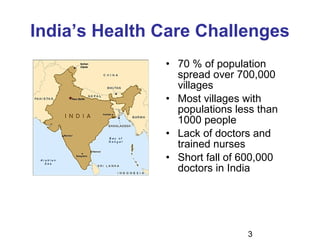
• 70 % of population
spread over 700,000
villages
• Most villages with
populations less than
1000 people
• Lack of doctors and
trained nurses
• Short fall of 600,000
doctors in India
4
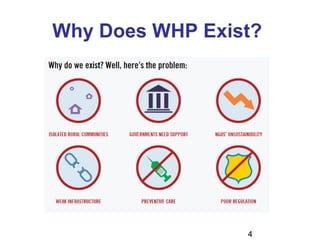
Why Does WHP Exist?
5
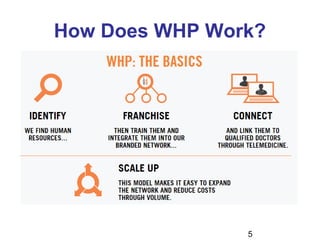
How Does WHP Work?
6
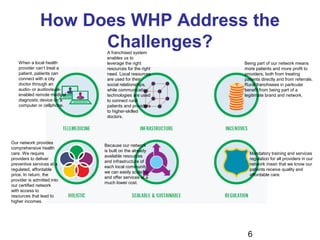
How Does WHP Address the
Challenges?
When a local health
provider can’t treat a
patient, patients can
connect with a city
doctor through an
audio- or audiovisual-
enabled remote medical
diagnostic device on a
computer or cellphone.
A franchised system
enables us to
leverage the right
resources for the right
need. Local resources
are used for their
social relationships,
while communication
technologies are used
to connect rural
patients and providers
to higher-skilled
doctors.
Being part of our network means
more patients and more profit to
providers, both from treating
patients directly and from referrals.
Rural franchisees in particular
benefit from being part of a
legitimate brand and network.
Our network provides
comprehensive health
care. We require
providers to deliver
preventive services at a
regulated, affordable
price. In return, the
provider is admitted into
our certified network
with access to
resources that lead to
higher incomes.
Because our network
is built on the already
available resources
and infrastructure of
each local community,
we can easily scale up
and offer services at a
much lower cost.
Mandatory training and services
regulation for all providers in our
network mean that we know our
patients receive quality and
affordable care.
7
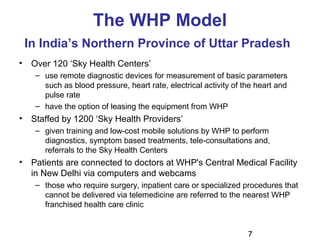
The WHP Model
In India’s Northern Province of Uttar Pradesh
• Over 120 ‘Sky Health Centers’
– use remote diagnostic devices for measurement of basic parameters
such as blood pressure, heart rate, electrical activity of the heart and
pulse rate
– have the option of leasing the equipment from WHP
• Staffed by 1200 ‘Sky Health Providers’
– given training and low-cost mobile solutions by WHP to perform
diagnostics, symptom based treatments, tele-consultations and,
referrals to the Sky Health Centers
• Patients are connected to doctors at WHP's Central Medical Facility
in New Delhi via computers and webcams
– those who require surgery, inpatient care or specialized procedures that
cannot be delivered via telemedicine are referred to the nearest WHP
franchised health care clinic
8
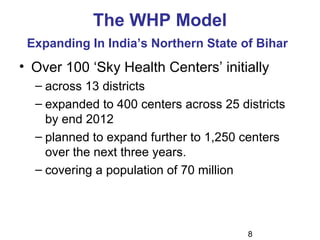
The WHP Model
Expanding In India’s Northern State of Bihar
• Over 100 ‘Sky Health Centers’ initially
– across 13 districts
– expanded to 400 centers across 25 districts
by end 2012
– planned to expand further to 1,250 centers
over the next three years.
– covering a population of 70 million
9
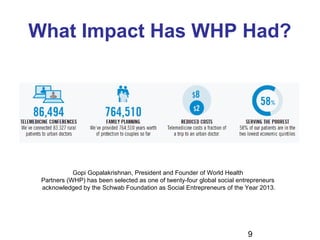
What Impact Has WHP Had?
Gopi Gopalakrishnan, President and Founder of World Health
Partners (WHP) has been selected as one of twenty-four global social entrepreneurs
acknowledged by the Schwab Foundation as Social Entrepreneurs of the Year 2013.
9
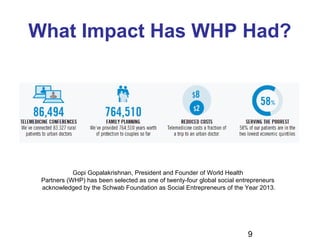
What Impact Has WHP Had?
Gopi Gopalakrishnan, President and Founder of World Health
Partners (WHP) has been selected as one of twenty-four global social entrepreneurs
acknowledged by the Schwab Foundation as Social Entrepreneurs of the Year 2013.

130628

  • 1.
    1 Telemedicine in India TheWorld Health Partners (WHP) Model Deployment of Large Scale Telemedicine in A Developing Country An Overview by eMedToday June 2013
  • 2.
    2 This is abrief introduction on how one organization, World Health Partners (WHP), has successfully achieved deployment of large scale telemedicine in the developing country of India Information and graphics is from available media reports and from the website of World Health Partners (worldhealthpartners.org)
  • 3.
    3 India’s Health CareChallenges • 70 % of population spread over 700,000 villages • Most villages with populations less than 1000 people • Lack of doctors and trained nurses • Short fall of 600,000 doctors in India
  • 4.
  • 5.
  • 6.
    6 How Does WHPAddress the Challenges? When a local health provider can’t treat a patient, patients can connect with a city doctor through an audio- or audiovisual- enabled remote medical diagnostic device on a computer or cellphone. A franchised system enables us to leverage the right resources for the right need. Local resources are used for their social relationships, while communication technologies are used to connect rural patients and providers to higher-skilled doctors. Being part of our network means more patients and more profit to providers, both from treating patients directly and from referrals. Rural franchisees in particular benefit from being part of a legitimate brand and network. Our network provides comprehensive health care. We require providers to deliver preventive services at a regulated, affordable price. In return, the provider is admitted into our certified network with access to resources that lead to higher incomes. Because our network is built on the already available resources and infrastructure of each local community, we can easily scale up and offer services at a much lower cost. Mandatory training and services regulation for all providers in our network mean that we know our patients receive quality and affordable care.
  • 7.
    7 The WHP Model InIndia’s Northern Province of Uttar Pradesh • Over 120 ‘Sky Health Centers’ – use remote diagnostic devices for measurement of basic parameters such as blood pressure, heart rate, electrical activity of the heart and pulse rate – have the option of leasing the equipment from WHP • Staffed by 1200 ‘Sky Health Providers’ – given training and low-cost mobile solutions by WHP to perform diagnostics, symptom based treatments, tele-consultations and, referrals to the Sky Health Centers • Patients are connected to doctors at WHP's Central Medical Facility in New Delhi via computers and webcams – those who require surgery, inpatient care or specialized procedures that cannot be delivered via telemedicine are referred to the nearest WHP franchised health care clinic
  • 8.
    8 The WHP Model ExpandingIn India’s Northern State of Bihar • Over 100 ‘Sky Health Centers’ initially – across 13 districts – expanded to 400 centers across 25 districts by end 2012 – planned to expand further to 1,250 centers over the next three years. – covering a population of 70 million
  • 9.
    9 What Impact HasWHP Had? Gopi Gopalakrishnan, President and Founder of World Health Partners (WHP) has been selected as one of twenty-four global social entrepreneurs acknowledged by the Schwab Foundation as Social Entrepreneurs of the Year 2013.
  • 10.
    9 What Impact HasWHP Had? Gopi Gopalakrishnan, President and Founder of World Health Partners (WHP) has been selected as one of twenty-four global social entrepreneurs acknowledged by the Schwab Foundation as Social Entrepreneurs of the Year 2013.