Migration to
Enterprise Cloud Computing
Bob Marcus
One Definition of Cloud Computing
 Cloud Computing describes information
technology (IT) resources with these properties:
 Hosted on a remote virtualized infrastructure
 Scalable deployment possible
 Accessed as services
 Support Internet protocols and interfaces
 Payments based on actual use of resources
 Enterprise Cloud Computing is the incorporation
of Cloud Computing resources into Enterprise IT
2
Enterprise Cloud Computing Challenge
 Cloud Computing has the potential to provide
major benefits to enterprises
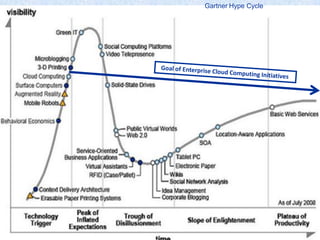
 Cloud deployments are now following the
traditional life cycle for emerging technologies
e.g. over-hyped, push-back, ultimate use
 In the past, this life-cycle has produced mixed
results (e.g. SOA)
 In the current economic climate, it will be very
valuable to speed up successful deployments
 Challenge: Develop a new process for
migration to Enterprise Cloud Computing
Gartner Hype Cycle
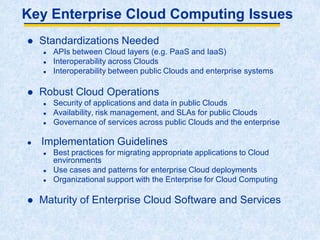
Key Enterprise Cloud Computing Issues
 Standardizations Needed
 APIs between Cloud layers (e.g. PaaS and IaaS)
 Interoperability across Clouds
 Interoperability between public Clouds and enterprise systems
 Robust Cloud Operations
 Security of applications and data in public Clouds
 Availability, risk management, and SLAs for public Clouds
 Governance of services across public Clouds and the enterprise
 Implementation Guidelines
 Best practices for migrating appropriate applications to Cloud
environments
 Use cases and patterns for enterprise Cloud deployments
 Organizational support with the Enterprise for Cloud Computing
 Maturity of Enterprise Cloud Software and Services
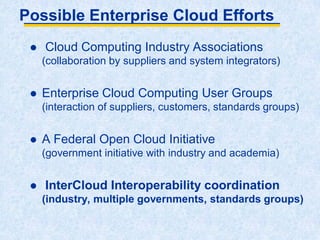
Possible Enterprise Cloud Efforts
 Cloud Computing Industry Associations
(collaboration by suppliers and system integrators)
 Enterprise Cloud Computing User Groups
(interaction of suppliers, customers, standards groups)
 A Federal Open Cloud Initiative
(government initiative with industry and academia)
 InterCloud Interoperability coordination
(industry, multiple governments, standards groups)
Standardizations
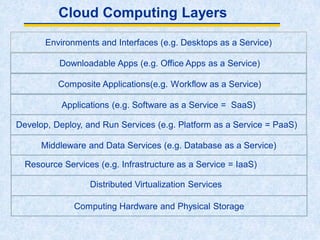
Cloud Computing Layers
Downloadable Apps (e.g. Office Apps as a Service)
Environments and Interfaces (e.g. Desktops as a Service)
Applications (e.g. Software as a Service = SaaS)
Middleware and Data Services (e.g. Database as a Service)
Computing Hardware and Physical Storage
Resource Services (e.g. Infrastructure as a Service = IaaS)
Distributed Virtualization Services
Composite Applications(e.g. Workflow as a Service)
Develop, Deploy, and Run Services (e.g. Platform as a Service = PaaS)
APIs Between Cloud Layers
 What API standardizations are really needed
for portability in the near future e.g. API for
IaaS (CPUs, storage)?
 Are there existing deployed APIs that should
be the starting point of future standardization
activities?
 What should be the industry process for
defining and implementing these standards?
Interoperability across Clouds
 What are the requirements for Cloud to Cloud
interoperability at each level (e.g IaaS, PaaS,
and SaaS) in the next few years?
 What are the technical and non-technical (e.g.
business, legal) standardizations needed to
provide the required interoperability?
 What should be the process for defining and
implementing international InterCloud standards?
 Reference: new Cloud Interoperability Magazine
http://cloudinterop.ulitzer.com/
Interoperability across Clouds and Enterprise
 How can public Clouds be used to extend
enterprise systems (e.g. to handle spikes in
resource requirements)?
 How can enterprise applications be
incrementally migrated to Cloud platforms?
 How can enterprise policies and governance
be extended to include Cloud deployments?
Robust Cloud Operations
Security of Applications and Data
 How can the security of application and data
be guaranteed in Cloud deployments?
 Which current enterprise applications and data
can be safely deployed on public Clouds?
 Can virtual private Clouds become an equally
secure alternative to internal Clouds?
Availability, Risk, and SLAs
 What are the past problems with public Clouds
and how can customers be sure that these
problems won’t occur in the future?
 What sort of SLAs should user expect for
Cloud deployments?
 Are there documented ways to mitigate the risk
of Cloud deployments?
Governance and Management for Clouds
 How can enterprises provide policy
enforcement on Cloud deployments?
 Are there system management tools that work
across Clouds and enterprise systems?
 How are costs allocated for shared resources
across enterprise organizations?
Implementation Guidelines
Best Practices for Migration
 How can an enterprise determine which
applications should remain internal?
 How should an enterprise decide whether to
use SaaS leasing, PaaS tools, or IaaS
foundation to deploy applications?
 Are there documented methods for SaaS,
PaaS, and IaaS deployments?
Use Cases and Patterns
 Which enterprise applications and processes
are most suitable for Cloud deployments?
 What are the success stories for Cloud
deployments by enterprises?
 Are there documented design patterns for
PaaS and IaaS deployments?
Organizational Support for Cloud Computing
 What new enterprise organizational structure
and roles (if any) are needed to handle Cloud
Computing?
 What is the relationship to SOA organizations
(e.g. Centers of Excellence?
 What should be the role of an Enterprise
Cloud Computing Group with members from
multiple enterprises, industry, government, and
standards groups?
Cloud Software and Services
Enterprise Cloud Software and Services
 What software and/or services are available for
enterprise Cloud Computing?
 What are the benefits of these software/services
to enterprises?
 Are there referencible examples of successful
deployments using these software/services?
 What are the key lessons learned from past
efforts that can improve future deployments?
 What are the goals and direction for Cloud
software/services providers in the future?
21
Topics from an Enterprise RFI
 Financial aspects of the cloud computing model
 Relative maturity, projected trends and risks
 Typical suite of hardware and software necessary
 Core Requirements
 Virtualization
 API and User Interface
 Application Layer Interoperability (IaaS)
 Data Layer Interoperability
 Basic or Core Services (PaaS)
 Security
 Scalability Requirements (Distributed Virtualization)
 Storage Requirements
 Identity Access Management
 Chargeback and Billing

2008 Migration to Enterprise Cloud Computing

  • 1.
    Migration to Enterprise CloudComputing Bob Marcus
  • 2.
    One Definition ofCloud Computing  Cloud Computing describes information technology (IT) resources with these properties:  Hosted on a remote virtualized infrastructure  Scalable deployment possible  Accessed as services  Support Internet protocols and interfaces  Payments based on actual use of resources  Enterprise Cloud Computing is the incorporation of Cloud Computing resources into Enterprise IT 2
  • 3.
    Enterprise Cloud ComputingChallenge  Cloud Computing has the potential to provide major benefits to enterprises  Cloud deployments are now following the traditional life cycle for emerging technologies e.g. over-hyped, push-back, ultimate use  In the past, this life-cycle has produced mixed results (e.g. SOA)  In the current economic climate, it will be very valuable to speed up successful deployments  Challenge: Develop a new process for migration to Enterprise Cloud Computing
  • 4.
  • 5.
    Key Enterprise CloudComputing Issues  Standardizations Needed  APIs between Cloud layers (e.g. PaaS and IaaS)  Interoperability across Clouds  Interoperability between public Clouds and enterprise systems  Robust Cloud Operations  Security of applications and data in public Clouds  Availability, risk management, and SLAs for public Clouds  Governance of services across public Clouds and the enterprise  Implementation Guidelines  Best practices for migrating appropriate applications to Cloud environments  Use cases and patterns for enterprise Cloud deployments  Organizational support with the Enterprise for Cloud Computing  Maturity of Enterprise Cloud Software and Services
  • 6.
    Possible Enterprise CloudEfforts  Cloud Computing Industry Associations (collaboration by suppliers and system integrators)  Enterprise Cloud Computing User Groups (interaction of suppliers, customers, standards groups)  A Federal Open Cloud Initiative (government initiative with industry and academia)  InterCloud Interoperability coordination (industry, multiple governments, standards groups)
  • 7.
  • 8.
    Cloud Computing Layers DownloadableApps (e.g. Office Apps as a Service) Environments and Interfaces (e.g. Desktops as a Service) Applications (e.g. Software as a Service = SaaS) Middleware and Data Services (e.g. Database as a Service) Computing Hardware and Physical Storage Resource Services (e.g. Infrastructure as a Service = IaaS) Distributed Virtualization Services Composite Applications(e.g. Workflow as a Service) Develop, Deploy, and Run Services (e.g. Platform as a Service = PaaS)
  • 9.
    APIs Between CloudLayers  What API standardizations are really needed for portability in the near future e.g. API for IaaS (CPUs, storage)?  Are there existing deployed APIs that should be the starting point of future standardization activities?  What should be the industry process for defining and implementing these standards?
  • 10.
    Interoperability across Clouds What are the requirements for Cloud to Cloud interoperability at each level (e.g IaaS, PaaS, and SaaS) in the next few years?  What are the technical and non-technical (e.g. business, legal) standardizations needed to provide the required interoperability?  What should be the process for defining and implementing international InterCloud standards?  Reference: new Cloud Interoperability Magazine http://cloudinterop.ulitzer.com/
  • 11.
    Interoperability across Cloudsand Enterprise  How can public Clouds be used to extend enterprise systems (e.g. to handle spikes in resource requirements)?  How can enterprise applications be incrementally migrated to Cloud platforms?  How can enterprise policies and governance be extended to include Cloud deployments?
  • 12.
  • 13.
    Security of Applicationsand Data  How can the security of application and data be guaranteed in Cloud deployments?  Which current enterprise applications and data can be safely deployed on public Clouds?  Can virtual private Clouds become an equally secure alternative to internal Clouds?
  • 14.
    Availability, Risk, andSLAs  What are the past problems with public Clouds and how can customers be sure that these problems won’t occur in the future?  What sort of SLAs should user expect for Cloud deployments?  Are there documented ways to mitigate the risk of Cloud deployments?
  • 15.
    Governance and Managementfor Clouds  How can enterprises provide policy enforcement on Cloud deployments?  Are there system management tools that work across Clouds and enterprise systems?  How are costs allocated for shared resources across enterprise organizations?
  • 16.
  • 17.
    Best Practices forMigration  How can an enterprise determine which applications should remain internal?  How should an enterprise decide whether to use SaaS leasing, PaaS tools, or IaaS foundation to deploy applications?  Are there documented methods for SaaS, PaaS, and IaaS deployments?
  • 18.
    Use Cases andPatterns  Which enterprise applications and processes are most suitable for Cloud deployments?  What are the success stories for Cloud deployments by enterprises?  Are there documented design patterns for PaaS and IaaS deployments?
  • 19.
    Organizational Support forCloud Computing  What new enterprise organizational structure and roles (if any) are needed to handle Cloud Computing?  What is the relationship to SOA organizations (e.g. Centers of Excellence?  What should be the role of an Enterprise Cloud Computing Group with members from multiple enterprises, industry, government, and standards groups?
  • 20.
  • 21.
    Enterprise Cloud Softwareand Services  What software and/or services are available for enterprise Cloud Computing?  What are the benefits of these software/services to enterprises?  Are there referencible examples of successful deployments using these software/services?  What are the key lessons learned from past efforts that can improve future deployments?  What are the goals and direction for Cloud software/services providers in the future? 21
  • 22.
    Topics from anEnterprise RFI  Financial aspects of the cloud computing model  Relative maturity, projected trends and risks  Typical suite of hardware and software necessary  Core Requirements  Virtualization  API and User Interface  Application Layer Interoperability (IaaS)  Data Layer Interoperability  Basic or Core Services (PaaS)  Security  Scalability Requirements (Distributed Virtualization)  Storage Requirements  Identity Access Management  Chargeback and Billing