INTERNATIONAL JOURNAL OF RENEWABLE ENERGY RESEARCH
Corresponding Author et al. ,Vol. XX, No. XX
1
Coordinated IPFC and SMES Strategy for Stability
Analysis of Renewable Energy Based
Contemporary Interconnected Power System with
FOPID Controller
Ch. Naga sai kalyan1
, G. Swapna2
S. Rajasekaran3
, A. N. Venkateswarlu4
,
B. Srikanth Goud5
, Ch. Rami Reddy6
1
Department of Electrical and Electronics Engineering, Vasireddy Venkatadri Institute of
Technology Guntur, India-522 508
2
Department of Electrical and Electronics Engineering, Koneru Lakshmaiah Education
Foundation, Guntur, India-522302
3
Department of Electrical and Electronics Engineering, Vignana Bharathi Institute of
Technology, Hyderabad, Ghatkesar, Telangana, India
4
Department of Electrical and Electronics Engineering, Vignan’s Lara Insititute of Technology
and Science, Vadlamudi, Guntur, India. 522213
5
Department of Electrical and Electronics Engineering, Anurag College of Engineering
Ghatkesar, Telangana, India-501301
6
Department of Electrical and Electronics Engineering, Malla Reddy Engineering College,
Maisammaguda, Secunderabad, Telangana, India 500100
(kalyanchallapalli@gmail.com, swapna@kluniversity.in, drsekar.ee@gmail.com, atyam2000@gmail.com,
srikanth.b@anuraghyd.ac.in, crreddy229@gmail.com)
‡
Corresponding B. Srikanth Goud, Anurag College of Engineering Ghatkesar, Telangana, India-
501301,
Tel: +91-9030937167, srikanth.b@anuraghyd.ac.in
Received: xx.xx.xxxx Accepted:xx.xx.xxxx
Abstract- In this paper, an amalgamation of fractional calculus theory with integral order (IO) controller
that is fractional order PID (FOPID) fine-tuned with water cycle algorithm (WCA) a natured inspired
optimization technique is proposed as a secondary regulator for renewable-based contemporary
interconnected power system (IPS). Investigation performed on IPS subjected to the perturbations of
10% step load on area-1 (10%SLP). System nonlinearity features of communication time delays (CTDs)
are considered to conduct a more realistic analysis. Simulation results reveal the predominance of CTDs
on IPS performance. The sovereignty of presented FOPID has been demonstrated with traditional IO
ARTICLE TEMPLATE CONTAINING AUTHOR GUIDELINES FOR PEER-REVIEW
type regulators like PI, and PID under unique perturbed conditions. Further, the device superconducting
magnetic energy storage (SMES) is incorporated in each area and the interline power flow controller
(IPFC) is operated in conjunction with the tie-line is operated. Responses of IPS reveal the enhancement
in the dynamic performance of the system under the coordination of IPFC-SMES with the WCA tuned
FOPID regulator.
Keywords- FOPID regulator, water cycle algorithm, SMES-IPFC strategy, CTDs, 10%SLP.
1. Introduction
Today’s world is more focusing on reducing carbon emissions to control global warming. Moreover, the
fossil fuels which constitute the carbon emissions in the environment are rapidly depleting. With the
motto of handover of fossil fuels to future generations and minimizing their effect of emissions on the
modern-day environment, renewable power generation units are gaining momentum in the electrical
sector. With the rapid growth of industrialization, the demand for electrical energy is increasing
continuously. To meet the load demands, renewable power-generating sources (RPGS) are extensively
integrated with the existing grid. The IPS network is becoming complex with RPGS integration and
requires more sophisticated control techniques to ensure IPS stability and reliability.
The entire IPS is segregated into various control areas and each area is integrated with different power
generation sources. The control areas are together interlinked with a transmission line called a tie-line to
facilitate power exchange. Control area frequency and tie-line power deviations are power full indicators
in assessing the stability, reliability and security of large scale IPS networks. The deviation in control
area frequency arises with the lapse between the generation of real power and existing load demand.
Thus the lapse between power generation and demand must be monitored and regulated continuously
and automatically. The automatic action is filled by employing the load frequency controller (LFC) in
each control area. A bulk quantity of literature is reported on LFC study and researchers are proposed
INTERNATIONAL JOURNAL OF RENEWABLE ENERGY RESEARCH
Corresponding Author et al. ,Vol. XX, No. XX
3
numerous control technics and their efficacy is tested by considering various power system models as
test systems [1].
Owing to the advantage of conventional controllers like PI and PID [2] in design simplicity, researchers
are widely implemented as secondary regulators to LFC study. Moreover to make the controller
performance more effective, researchers are adopted various meta-heuristic optimizations like Salp
swarm technique (SST), fruit fly algorithm (FFA) [3], imperialist competitive algorithm (ICA), flower
pollination algorithm (FPA) [4], modified bat algorithm (MBA), multi verse optimizer (MVO), ant lion
optimizer (ALO) [5], chemical reaction optimizer (CRO), genetic algorithm (GA) [6], seagull
optimization algorithm (SOA) [7], simulated annealing (SA), firefly algorithm (FA) [8], marine
predictive approach (MPA) [9], teaching learning based (TLBO) [10], optimizer, water cycle algorithm
(WCA) [11-12], elephant heard technique (EHT) [13], artificial field algorithm (AEFA) [14], fractal
search-pattern search (FSPS) [15], gravitation search technique (GST), backtracking search algorithm
(BSA) [16], particle swarm optimizer (PSO) [17], squirrel search algorithm (SSA), cuckoo search
technique (CST) [18], grey wolf optimizer (GWO) [19], biogeography optimizer (BGO), moth flame
optimizer (MFO) [20], mine blast technique (MBT), bacterial foraging algorithm (BFA) [21],
differential evolution (DE) [22] etc. are reported. But the PI and PID regulators are best suitable for only
linearized models.
In realistic practice, no power system network is linear and has deliberated with generation rate
constraints (GRC), a practical non-linearity feature to regulate the generation lowering and rising. Thus,
researchers are focused on implementing fuzzy logic control (FLC) techniques for LFC in association
with PI and PID. Different FLC controllers such as WCA based fuzzy (F) PID [23], big bang-big crunch
(BBBC) [24] tuned FPID, and SA based FPI [25], ICA [26] tuned FOFPI-FOPD are available in past
studies. The design of FLC is more complex and requires skilled technicians. Moreover, the framing of
fuzzy rules and selection of membership functions greatly influences FLC performance.
ARTICLE TEMPLATE CONTAINING AUTHOR GUIDELINES FOR PEER-REVIEW
Further, researchers are focused on the design of sliding mode controllers (SMC) and robust
control techniques. However, the robust control technique involves more mathematical modelling and its
application to complex IPS are time taking. Thus, FO controllers are gaining momentum and are more
efficacious compared to traditional regulators. FOPI, FOPI-FOPD and FOPID are based on optimization
algorithms like the sine cosine approach (SCA) [27], CRO, Falcon optimizer (FO) [28], Volleyball
algorithm (VBA) [29], lion algorithmic approach (LAA) [30], lightning search algorithm (LSA), crow
search technique (CST) etc. are reported.
A literature survey discloses that FOPID based on SOA is not available in the literature. SOA is
the latest technique and is widely grabbing the attention of researchers as a solution to engineering
problems. Apart from the secondary control techniques, territorial strategy is necessitated for the
contemporary IPS with RPGS as the power generation from renewable units is very intermittent.
Implementation of high voltage DC transmission line with AC tie-line is rigorously implemented by the
researchers [31]. Contrary to AC-DC lines, coordinated flexible AC transmission system devices and
energy storage devices (ESDs) are newly implemented by researchers [32]. Thus, in this paper IPFC
Considering the above literature this paper contributes the following
a) Contemporary renewable-based IPS is designed in MATLAB/SIMULINK.
b) WCA based FOPID is implemented as a secondary regulator in each control area.
c) Efficacy of FOPID is deliberated with PI, PID performances.
d) Contemporary IPS are investigated with and without CTDs considerations.
e) The impact of CTDs on contemporary IPS performance is visualized and justified.
f) SMES-IPFC coordinated control is implemented for performance enhancement.
g) The sensitivity test is conducted to demonstrate secondary and territorial strategy robustness.
INTERNATIONAL JOURNAL OF RENEWABLE ENERGY RESEARCH
Corresponding Author et al. ,Vol. XX, No. XX
5
Fig.1. Model of contemporary IPS considered for investigation
2. Proposed Test System
Contemporary IPS considered for investigation in this paper comprises two areas with 5:3
generation capacity. Area-1 consists of traditional power generation sources of thermal, hydro and gas
units with a total capacity of 1250MW. In contrast to area-1, area-2 with 750MW total capacity
incorporates renewable sources like solar photovoltaic penetration and wind unit along with a diesel
plant. The contemporary IPS model comprised of RPGS is depicted in Fig.1, and is developed in the
domain of MATLAB/SIMULINK and the necessary parameters are chosen from [31-32]. The realistic
constraint of limiting the real power generation raising and lowering that is GRC is perceived in this
paper for both hydro and thermal units. Apart from that, the CTDs are perceived with the IPS model to
ARTICLE TEMPLATE CONTAINING AUTHOR GUIDELINES FOR PEER-REVIEW
establish the investigation nearer to realistic practice. The practical contemporary IPS is resided to a
wide extent and employs many measuring devices located at remote points. The data from the device at
a remote point is transmitted to the control centre to generate an error signal. The generated error signal
is received by the controller in the plant location. The transmitting and receiving of signals among
various devices at different points will only take place with communication peripherals. Thus,
communication peripherals inherit the time delay nature and these delays are playing their part in the
performance of IPS. Due to the delay in signal transmitting and receiving there exists a delay in
changing the power system operating point. The operating point of the power system is altered regularly
to keep the difference between real power demand and generation minimum. The real power mismatch
is a direct analogy to the control area frequency and hence the stability. Thus, CTDs are needed to be
confiscated at the time of regulator design. Transport type of CTDs are perceived in this paper and is
modelled as [33]
s
2
τ
1
s
2
τ
1
e
d
d
sτd
+
−
=
−
(1)
3. Controller and objective function
The formulated problem in this paper is related to the control literature, thus the design of the
FOPID regulator should follow the Caputo definition. Normally, the FO integral and derivative
parameters are derived from FO differential equations subjected to initial conditions at zero. The FO
integral-differential parameters for FOPID [34] regulator in this work are obtained from derivative αth
of
function f(t) is provided in (2).
 −
−
−
= −
+
t
o
m
1
α
m
α
t m
α
1
m
dT,
T)
(t
f(T)
D
α)
Γ(m
1
f(t)
D 
 (2)
The modelling of FOPID is given in (3)
INTERNATIONAL JOURNAL OF RENEWABLE ENERGY RESEARCH
Corresponding Author et al. ,Vol. XX, No. XX
7
( )
μ
D
λ
I
P
i s
K
s
K
K
(s)
U +






+
= (3)
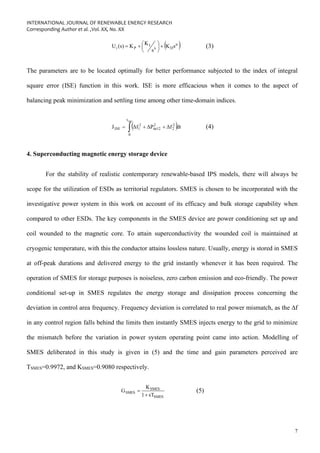
The parameters are to be located optimally for better performance subjected to the index of integral
square error (ISE) function in this work. ISE is more efficacious when it comes to the aspect of
balancing peak minimization and settling time among other time-domain indices.
( )
 +
+
=
sim
t
0
2
2
2
tie12
2
1
ISE dt
Δf
ΔP
Δf
J (4)
4. Superconducting magnetic energy storage device
For the stability of realistic contemporary renewable-based IPS models, there will always be
scope for the utilization of ESDs as territorial regulators. SMES is chosen to be incorporated with the
investigative power system in this work on account of its efficacy and bulk storage capability when
compared to other ESDs. The key components in the SMES device are power conditioning set up and
coil wounded to the magnetic core. To attain superconductivity the wounded coil is maintained at
cryogenic temperature, with this the conductor attains lossless nature. Usually, energy is stored in SMES
at off-peak durations and delivered energy to the grid instantly whenever it has been required. The
operation of SMES for storage purposes is noiseless, zero carbon emission and eco-friendly. The power
conditional set-up in SMES regulates the energy storage and dissipation process concerning the
deviation in control area frequency. Frequency deviation is correlated to real power mismatch, as the ∆f
in any control region falls behind the limits then instantly SMES injects energy to the grid to minimize
the mismatch before the variation in power system operating point came into action. Modelling of
SMES deliberated in this study is given in (5) and the time and gain parameters perceived are
TSMES=0.9972, and KSMES=0.9080 respectively.
SMES
SMES
SMES
sT
1
K
G
+
= (5)
ARTICLE TEMPLATE CONTAINING AUTHOR GUIDELINES FOR PEER-REVIEW
4.1 Interline power flow controller
IPFC is one of the most dominant devices among all the available FACTs controllers. It employs several
voltage source control units and is coupled to a common dc link. It can compensate for the flow of
power in multiple transmission lines. Thus, to damp out the oscillations in tie-line power flow and to
compensate for the line flow IPFC is integrated into conjunction with the line in this paper for LFC of
the contemporary renewable-based IPS model. The architecture of IPFC deliberated in this paper is
shown in Fig.2 [35].
Fig.2. Architecture of IPFC
Upon laying IPFC in conjunction with the line, the variation in tie-line flow is modelled as
(s)
ΔP
(s)
ΔP
(s)
ΔP 0
tie12
IPFC
tie12 +
= (6)
The effect of IPFC on power flow in tie-line is given by
( ) 







+
+
=
IPFC
0
tie12
2
1
1
IPFC
sT
1
1
*
(s)
ΔP
K
(s)
Δf
K
(s)
ΔP (7)
4.2 Water cycle algorithm
WCA is the modern optimization approach inspired by the process of the water cycle in nature and how
streams and rivers finally fly into the sea in the practical world. The optimization process in this
INTERNATIONAL JOURNAL OF RENEWABLE ENERGY RESEARCH
Corresponding Author et al. ,Vol. XX, No. XX
9
approach initiates with raindrops or snowdrops as initial particles. The emergence of snowdrops and
raindrops in the mountain regions will flow downhill and forms streams or rivers. The formed stream or
rivers flow downwards continuously and at last, merged with the sea. Here, the raindrops act as
populations and the sea is the best solution. Here, in this paper, the WCA mechanism is implemented to
find the gains of the FOPID regulator optimally. Hence, the raindrops are nothing but the parameters of
the FOPID controller that are to be initiated randomly in an array as follows [36]:
μ]
λ,
,
K
K
,
[K
Y
RD D
I,
P
i
i =
= (8)
















−
−
−
−
−
−
=
POP
N
i
1
RD
RD
RD
Population
RD (9)
Later, the ISE index for every RD has to be evaluated using the equation provided in (10-11) and the
positions of streams/rivers are initiated subjected to the consideration of merging with the sea finally.
)
Position
(Position
*
C
*
()
rand
Position
Position Stream
River
Stream
Stream
New −
+
= (10)
)
Position
(Position
*
C
*
()
rand
Position
Position River
Sea
River
River
New −
+
= (11)
The parameter ‘C’ value is assigned randomly from the range [0-2]. The process of evaporation and rain
in WCA is modelled in equations (12-14) to avoid the solution getting trapped into local minima.
max
river
sea d
P
P 
− (12)
tion)
/max.itera
(d
d
d max/
max
new
max −
= (13)
)
N
rand(1,
X
U
P
P var
sea
new
stream +
= (14)
ARTICLE TEMPLATE CONTAINING AUTHOR GUIDELINES FOR PEER-REVIEW
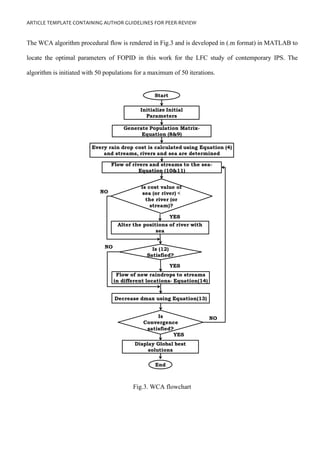
The WCA algorithm procedural flow is rendered in Fig.3 and is developed in (.m format) in MATLAB to
locate the optimal parameters of FOPID in this work for the LFC study of contemporary IPS. The
algorithm is initiated with 50 populations for a maximum of 50 iterations.
Fig.3. WCA flowchart
INTERNATIONAL JOURNAL OF RENEWABLE ENERGY RESEARCH
Corresponding Author et al. ,Vol. XX, No. XX
11
5. Results and Discussion
Case-1: Analysis of contemporary IPS without considering CTDs
Considered renewable energy sources based on contemporary IPS are investigated for 10%SLP
disturbance on area-1 and the constraint of CTDs is not taken into account. Regulators of FOPID, PID
and PI are placed in each control area one by one and are rendered optimally using the nature-inspired
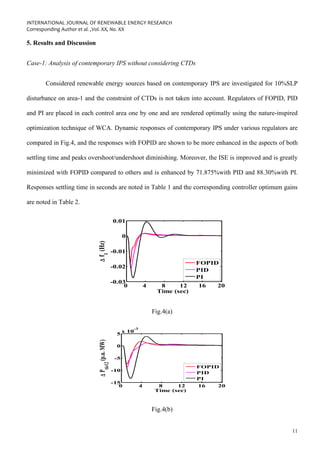
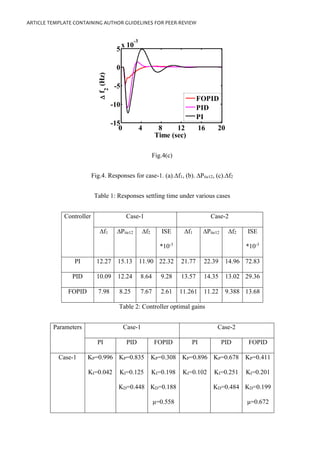
optimization technique of WCA. Dynamic responses of contemporary IPS under various regulators are
compared in Fig.4, and the responses with FOPID are shown to be more enhanced in the aspects of both
settling time and peaks overshoot/undershoot diminishing. Moreover, the ISE is improved and is greatly
minimized with FOPID compared to others and is enhanced by 71.875%with PID and 88.30%with PI.
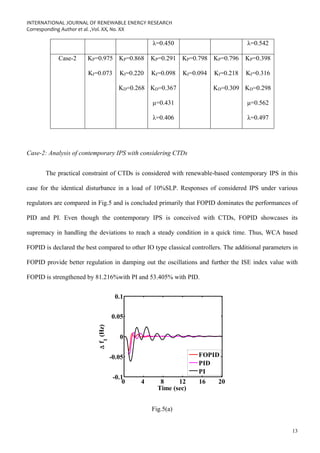
Responses settling time in seconds are noted in Table 1 and the corresponding controller optimum gains
are noted in Table 2.
0 4 8 12 16 20
-0.03
-0.02
-0.01
0
0.01
Time (sec)

f
1
(Hz)
FOPID
PID
PI
Fig.4(a)
0 4 8 12 16 20
-15
-10
-5
0
5
x 10
-3
Time (sec)

P
tie12
(p.u.
MW)
FOPID
PID
PI
Fig.4(b)
ARTICLE TEMPLATE CONTAINING AUTHOR GUIDELINES FOR PEER-REVIEW
0 4 8 12 16 20
-15
-10
-5
0
5
x 10
-3
Time (sec)

f
2
(Hz)
FOPID
PID
PI
Fig.4(c)
Fig.4. Responses for case-1. (a).∆f1, (b). ∆Ptie12, (c).∆f2
Table 1: Responses settling time under various cases
Controller Case-1 Case-2
∆f1 ∆Ptie12 ∆f2 ISE
*10-3
∆f1 ∆Ptie12 ∆f2 ISE
*10-3
PI 12.27 15.13 11.90 22.32 21.77 22.39 14.96 72.83
PID 10.09 12.24 8.64 9.28 13.57 14.35 13.02 29.36
FOPID 7.98 8.25 7.67 2.61 11.261 11.22 9.388 13.68
Table 2: Controller optimal gains
Parameters Case-1 Case-2
PI PID FOPID PI PID FOPID
Case-1 KP=0.996
KI=0.042
KP=0.835
KI=0.125
KD=0.448
KP=0.308
KI=0.198
KD=0.188
μ=0.558
KP=0.896
KI=0.102
KP=0.678
KI=0.251
KD=0.484
KP=0.411
KI=0.201
KD=0.199
μ=0.672
INTERNATIONAL JOURNAL OF RENEWABLE ENERGY RESEARCH
Corresponding Author et al. ,Vol. XX, No. XX
13
λ=0.450 λ=0.542
Case-2 KP=0.975
KI=0.073
KP=0.868
KI=0.220
KD=0.268
KP=0.291
KI=0.098
KD=0.367
μ=0.431
λ=0.406
KP=0.798
KI=0.094
KP=0.796
KI=0.218
KD=0.309
KP=0.398
KI=0.316
KD=0.298
μ=0.562
λ=0.497
Case-2: Analysis of contemporary IPS with considering CTDs
The practical constraint of CTDs is considered with renewable-based contemporary IPS in this
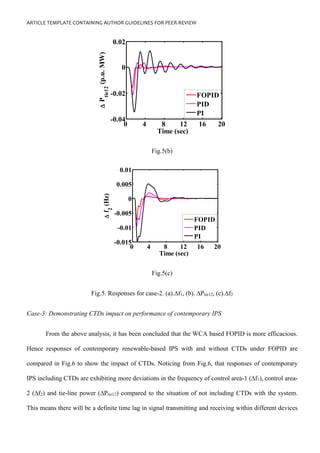
case for the identical disturbance in a load of 10%SLP. Responses of considered IPS under various
regulators are compared in Fig.5 and is concluded primarily that FOPID dominates the performances of
PID and PI. Even though the contemporary IPS is conceived with CTDs, FOPID showcases its
supremacy in handling the deviations to reach a steady condition in a quick time. Thus, WCA based
FOPID is declared the best compared to other IO type classical controllers. The additional parameters in
FOPID provide better regulation in damping out the oscillations and further the ISE index value with
FOPID is strengthened by 81.216%with PI and 53.405% with PID.
0 4 8 12 16 20
-0.1
-0.05
0
0.05
0.1
Time (sec)

f
1
(Hz)
FOPID
PID
PI
Fig.5(a)
ARTICLE TEMPLATE CONTAINING AUTHOR GUIDELINES FOR PEER-REVIEW
0 4 8 12 16 20
-0.04
-0.02
0
0.02
Time (sec)

P
tie12
(p.u.
MW)
FOPID
PID
PI
Fig.5(b)
0 4 8 12 16 20
-0.015
-0.01
-0.005
0
0.005
0.01
Time (sec)

f
2
(Hz)
FOPID
PID
PI
Fig.5(c)
Fig.5. Responses for case-2. (a).∆f1, (b). ∆Ptie12, (c).∆f2
Case-3: Demonstrating CTDs impact on performance of contemporary IPS
From the above analysis, it has been concluded that the WCA based FOPID is more efficacious.
Hence responses of contemporary renewable-based IPS with and without CTDs under FOPID are
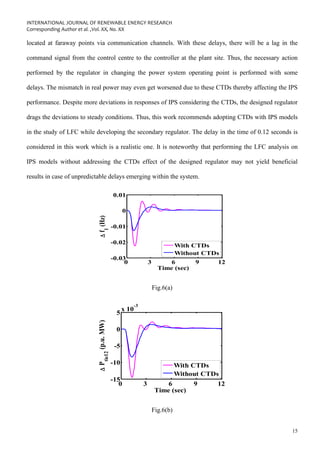
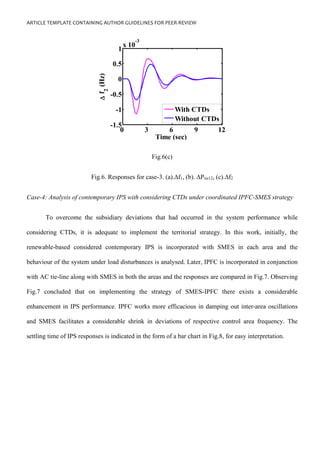
compared in Fig.6 to show the impact of CTDs. Noticing from Fig.6, that responses of contemporary
IPS including CTDs are exhibiting more deviations in the frequency of control area-1 (∆f1), control area-
2 (∆f2) and tie-line power (∆Ptie12) compared to the situation of not including CTDs with the system.
This means there will be a definite time lag in signal transmitting and receiving within different devices
INTERNATIONAL JOURNAL OF RENEWABLE ENERGY RESEARCH
Corresponding Author et al. ,Vol. XX, No. XX
15
located at faraway points via communication channels. With these delays, there will be a lag in the
command signal from the control centre to the controller at the plant site. Thus, the necessary action
performed by the regulator in changing the power system operating point is performed with some
delays. The mismatch in real power may even get worsened due to these CTDs thereby affecting the IPS
performance. Despite more deviations in responses of IPS considering the CTDs, the designed regulator
drags the deviations to steady conditions. Thus, this work recommends adopting CTDs with IPS models
in the study of LFC while developing the secondary regulator. The delay in the time of 0.12 seconds is
considered in this work which is a realistic one. It is noteworthy that performing the LFC analysis on
IPS models without addressing the CTDs effect of the designed regulator may not yield beneficial
results in case of unpredictable delays emerging within the system.
0 3 6 9 12
-0.03
-0.02
-0.01
0
0.01
Time (sec)

f
1
(Hz)
With CTDs
Without CTDs
Fig.6(a)
0 3 6 9 12
-15
-10
-5
0
5
x 10
-3
Time (sec)

P
tie12
(p.u.
MW)
With CTDs
Without CTDs
Fig.6(b)
ARTICLE TEMPLATE CONTAINING AUTHOR GUIDELINES FOR PEER-REVIEW
0 3 6 9 12
-1.5
-1
-0.5
0
0.5
1
x 10
-3
Time (sec)

f
2
(Hz)
With CTDs
Without CTDs
Fig.6(c)
Fig.6. Responses for case-3. (a).∆f1, (b). ∆Ptie12, (c).∆f2
Case-4: Analysis of contemporary IPS with considering CTDs under coordinated IPFC-SMES strategy
To overcome the subsidiary deviations that had occurred in the system performance while
considering CTDs, it is adequate to implement the territorial strategy. In this work, initially, the
renewable-based considered contemporary IPS is incorporated with SMES in each area and the
behaviour of the system under load disturbances is analysed. Later, IPFC is incorporated in conjunction
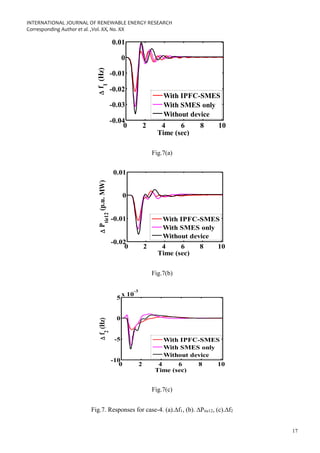
with AC tie-line along with SMES in both the areas and the responses are compared in Fig.7. Observing
Fig.7 concluded that on implementing the strategy of SMES-IPFC there exists a considerable
enhancement in IPS performance. IPFC works more efficacious in damping out inter-area oscillations
and SMES facilitates a considerable shrink in deviations of respective control area frequency. The
settling time of IPS responses is indicated in the form of a bar chart in Fig.8, for easy interpretation.
INTERNATIONAL JOURNAL OF RENEWABLE ENERGY RESEARCH
Corresponding Author et al. ,Vol. XX, No. XX
17
0 2 4 6 8 10
-0.04
-0.03
-0.02
-0.01
0
0.01
Time (sec)

f
1
(Hz)
With IPFC-SMES
With SMES only
Without device
Fig.7(a)
0 2 4 6 8 10
-0.02
-0.01
0
0.01
Time (sec)

P
tie12
(p.u.
MW)
With IPFC-SMES
With SMES only
Without device
Fig.7(b)
0 2 4 6 8 10
-10
-5
0
5
x 10
-3
Time (sec)

f
2
(Hz)
With IPFC-SMES
With SMES only
Without device
Fig.7(c)
Fig.7. Responses for case-4. (a).∆f1, (b). ∆Ptie12, (c).∆f2
ARTICLE TEMPLATE CONTAINING AUTHOR GUIDELINES FOR PEER-REVIEW
Fig.8. The bar chart indicates a comparison of responses settling time in seconds (on the Y-axis) for
case-4.
Case-5: Sensitivity test
The suggested WCA optimized FOPID regulator in coordination with the territorial strategy of
SMES-IPFC in renewable sources based contemporary IPS is targeted with loadings in both the areas
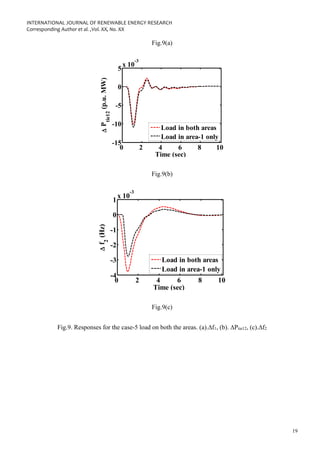
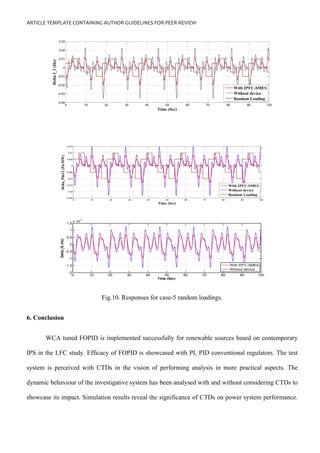
and also with random loading in area-1. The IPS responses for loading in both the areas are rendered in
Fig.9, and random loadings it has been depicted in Fig.10. From sensitivity analysis, it has been
observed that the deviations in IPS responses are not seen much even though the system is loaded in
both areas. Moreover, with the effective strategy of SMES-IPFC, the performance of the IPS looks more
stable even if it is subjected to random loadings. Thus, FOPID based on WCA with SMES-IPFC
territorial strategy presented in this paper is robust.
0 2 4 6 8 10
-0.03
-0.02
-0.01
0
0.01
Time (sec)

f
1
(Hz)
Load in both areas
Load in area-1 only
INTERNATIONAL JOURNAL OF RENEWABLE ENERGY RESEARCH
Corresponding Author et al. ,Vol. XX, No. XX
19
Fig.9(a)
0 2 4 6 8 10
-15
-10
-5
0
5
x 10
-3
Time (sec)

P
tie12
(p.u.
MW)
Load in both areas
Load in area-1 only
Fig.9(b)
0 2 4 6 8 10
-4
-3
-2
-1
0
1
x 10
-3
Time (sec)

f
2
(Hz)
Load in both areas
Load in area-1 only
Fig.9(c)
Fig.9. Responses for the case-5 load on both the areas. (a).∆f1, (b). ∆Ptie12, (c).∆f2
ARTICLE TEMPLATE CONTAINING AUTHOR GUIDELINES FOR PEER-REVIEW
0 10 20 30 40 50 60 70 80 90 100
-0.04
-0.03
-0.02
-0.01
0
0.01
0.02
0.03
Time (Sec)
Delta
f_1
(Hz)
With IPFC-SMES
Without device
Random Loading
0 10 20 30 40 50 60 70 80 90 100
-0.025
-0.02
-0.015
-0.01
-0.005
0
0.005
0.01
0.015
Time (Sec)
Delta_Ptie12
(Pu.MW)
With IPFC-SMES
Without device
Random Loading
0 10 20 30 40 50 60 70 80 90 100
-2
-1.5
-1
-0.5
0
0.5
1
1.5
x 10
-3
Time (Sec)
Delta_f2
(Hz)
With IPFC-SMES
Without device
Fig.10. Responses for case-5 random loadings.
6. Conclusion
WCA tuned FOPID is implemented successfully for renewable sources based on contemporary
IPS in the LFC study. Efficacy of FOPID is showcased with PI, PID conventional regulators. The test
system is perceived with CTDs in the vision of performing analysis in more practical aspects. The
dynamic behaviour of the investigative system has been analysed with and without considering CTDs to
showcase its impact. Simulation results reveal the significance of CTDs on power system performance.
INTERNATIONAL JOURNAL OF RENEWABLE ENERGY RESEARCH
Corresponding Author et al. ,Vol. XX, No. XX
21
With CTDs the system responses are slightly deviated more and also concede more time to settle down
because of the delay in delivering the control signal to the generators to alter the operating point. This
paper suggests considering test system models with CTDs to avoid the chances of instability due to
unexpected time delays. Later, SMES-IPFC coordinated strategy is implemented in the contemporary
IPS under WCA based FOPID regulator. Test system responses reveal the enhancement in dynamic
behaviour with SMES-IPFC devices under the same perturbed conditions. Robustness of FOPID along
with SMES-IPFC coordinated regulation is revealed with random loadings of sensitivity analysis.
References
1. D.H.Tungadio, and Y.Sun, “Load frequency controllers considering renewable energy
integration in power system”, Energy Reports, 2019, Vol. 05, PP.436-454.
2. C. N. S. Kalyan, and G. S. Rao, “Coordinated SMES and TCSC damping controller for load
frequency control of multi area power system with diverse sources”, International Journal on
Electrical Engineering and Informatics, Vol.12 (04), pp.747-769, 2020.
3. Mohanty B, Hota PK. Comparative performance analysis of fruit fly optimisation algorithm for
multi-area multisource automatic generation control under deregulated environment. IET Gener
Transm Distrib 2015;9(14):1845–55.
4. Hussain I, Ranjan S, Das DC, Sinha N. Performance analysis of flower pollination algorithm
optimized PID controller for Wind-PV-SMES-BESS-diesel autonomous hybrid power system.
Int J Renew Energy Res 2017;7(2):643–51.
5. A.Fathy, A.M.Kassem, “Antlion optimizer-ANFIS load frequency control for multi-
interconnected plants comprising photovoltaic and wind turbine”, ISA Transactions, Vol.87,
pp.282-296, 2019.
6. Cam E, Gorel G, Mamur H. Use of the genetic algorithm-based fuzzy logic controller for load-
frequency control in a two area interconnected power system. Appl Sci 2017;7(3):308.
ARTICLE TEMPLATE CONTAINING AUTHOR GUIDELINES FOR PEER-REVIEW
7. C. N. S. Kalyan and C. V. Suresh, “Higher order degree of freedom controller for load frequency
control of multi area interconnected power system with time delays”, Global Transitions
Proceedings, https://doi.org/10.1016/j.gltp.2022.03.020, 2022
8. Jagatheesan K, Anand B, Samanta S, Dey N, Ashour AS, Balas VE. Design of a proportional-
integral-derivative controller for an automatic generation control of multi-area power thermal
systems using firefly algorithm. IEEE/CAA J Autom Sin 2019;6(2):503–15.
9. A.H.Yakout, M.A.Attia, H.Kotb, “Marine predator algorithm based cascaded PIDA load
frequency controller for electric power systems with wave energy conversion systems”,
Alexandria Engineering Journal, Vol.60, pp.4213-4222, 2021.
10. Sahu BK, Pati TK, Nayak JR, Panda S, Kar SK. A novel hybrid LUS–TLBO optimized fuzzy-
PID controller for load frequency control of multi-source power system. Int J Electr Power
Energy Syst 2016;74 (Jan.):58–69.
11. C. N. S. Kalyan, “Determination of appropriate GRC modelling for optimal LFC of multi area
thermal system”, 2021 IEEE International Power and Renewable Energy Conference
(IPRECON), 2021, pp.1-6, 10.1109/IPRECON52453.2021.9640892
12. C. N. S. Kalyan, B. S. Goud, C. R. Reddy, M. Bajaj, G. S. Rao, “SMES and TCSC coordinated
strategy for multi-area multi-source system with water cycle algorithm based 3DOF-PID
controller”, Smart Science, 2022, https://doi.org/10.1080/23080477.2022.2054199
13. S.Dewangan, T.Prakash, V.P.Singh, “Design and performance analysis of elephant herding
optimization based controller for load frequency control in thermal interconnected power
system”, Optimal Control Applications and Methods, Vol.42, pp.144-159, 2021.
14. C. N. S. Kalyan, B. S. Goud, C. R. Reddy, M. Bajaj, N. K. Sharma, H. H. Alhelou, P.Siano and
S. Kamel, “Comparative performance assessment of different energy storage devices in
combined LFC and AVR analysis of multi-area power system”, Energies, Vol.15, No.2, 629,
2022.
INTERNATIONAL JOURNAL OF RENEWABLE ENERGY RESEARCH
Corresponding Author et al. ,Vol. XX, No. XX
23
15. Saha D, Saikia LC. Automatic generation control of an interconnected CCGT thermal system
using stochastic fractal search optimized classical controllers. Int Trans Electr Energy Syst
2018;28(5):1–25.
16. D.Guha, P.K.Roy and S.Banerjee, “Application of backtracking search algorithm in load
frequency control of multi-area interconnected power system”, Ain Shams Engineering Journal,
Vol.9, No.2, pp.257-276, 2018.
17. Naga sai kalyan, C., Sambasiva rao, G. (2021) Performance index based coordinated control
strategy for simultaneous frequency and voltage stabilization of multi-area interconnected
system. In: Singh A.K., Tripathy M. (eds) Control Applications in Modern Power System.
Lecture Notes in Electrical Engineering, Vol 710. Springer, Singapore.
https://doi.org/10.1007/978-981-15-8815-0_4
18. Abdelaziz AY, Ali ES. Cuckoo Search algorithm based load frequency controller design for
nonlinear interconnected power system. Int J Electr Power Energy Syst 2015;73(Dec.):632–43.
19. C. N. S. Kalyan, UPFC and SMES based coordinated control strategy for simultaneous
frequency and voltage stability of an interconnected power system”, 2021 1st
International
Conference on Power Electronics and Energy (ICPEE), 2021, pp.1-6,
10.1109/ICPEE50452.2021.9358576
20. B.Mohanty, B.V.S.Acharyulu, and P.K.Hota, “Moth-flame optimization algorithm optimized
dual-mode controller for multiarea hybrid sources AGC system”, Optimal control applications
and methods, Vol.39, No.02, pp.720-734, 2018.
21. Panwar A, Sharma G, Nasiruddin I, Bansal RC. Frequency stabilization of hydro– hydropower
system using hybrid bacteria foraging PSO with UPFC and HAE. Electr Power Syst Res
2018;161(Aug.):74–85.
22. C.N.S.Kalyan, and C V Suresh, “Differential Evolution based Intelligent Control approach for
LFC of Multiarea Power System with Communication Time Delays”, 2021 International
ARTICLE TEMPLATE CONTAINING AUTHOR GUIDELINES FOR PEER-REVIEW
Conference on Computing, Communication, and Intelligent Systems, 2021, PP.868-873, doi:
10.1109/ICCCIS51004.2021.9397112.
23. C. N. S. Kalyan, B. S. Goud, C. R. Reddy, H.S.Ramadan, M. Bajaj, Z.M.Ali, “Water cycle
algorithm optimized type II fuzzy controller for load frequency control of a multi-area multi-fuel
system with communication time delays”, Energies, Vol.14, No.17, 5387, 2021.
24. S.Jain, Y.V.Hote, “Design of fractional PID for load frequency control via internal model control
and big bang big crunch optimization”, IFAC Papers Online, Vol.51, pp.610-615, 2018.
25. K.R.M.V.Chandrakala and S.Balamurugan, “Simulated annealing based optimal frequency and
terminal voltage control of multi source multi area system”, International Journal of Electrical
Power and Energy Systems, Vol.78, pp.823-829, 2016.
26. Y.Arya, “A new optimized fuzzy FOPI-FOPD controller for automatic generation control of
electric power systems”, Journal of Franklin Institute, Vol.36, pp.5611-5629, 2019.
27. W.Tasnin, and L.C.Saikia, “Comparative performance of different energy storage devices in
AGC of multi-source system including geothermal power plant”, Journal of Renewable and
Sustainable Energy, 10, 024101 (2018).
28. C. N. S. Kalyan, B. S. Goud, C. R. Reddy, B. N. Reddy, M. Bajaj, A.V.Sudhakar, “Falcon
optimizer based PIDD controller for AGC of dual area realistic system with AC-DC links”, 2021
International Conference on Technology and Policy in Energy and Electric Power (ICT-PEP),
2021, pp.6-10, 10.1109/ICT-PEP53949.2021.9600946
29. A.Prakash, S.Murali, R.Shankar, R.Bhushan, “HVDC tie-link modelling for restructured AGC
using a novel fractional order cascade controller”, Electric Power Systems Research, Vol.170,
pp.244-258, 2019.
30. Sharma D, Yadav NK. Lion Algorithm with Levy Update: Load frequency controlling scheme
for two-area interconnected multi-source power system. Trans Inst Meas Control
2019;41(14):4084–99.
INTERNATIONAL JOURNAL OF RENEWABLE ENERGY RESEARCH
Corresponding Author et al. ,Vol. XX, No. XX
25
31. C.N.S.Kalyan and G.S.Rao, “Frequency and voltage stabilization in combined load frequency
control and automatic voltage regulation of multi area system with hybrid generation utilities by
AC/DC links”, International Journal of sustainable energy, 2020, Vol.39, No.10, pp.1009-1029.
32. C.N.S.Kalyan and G.S.Rao, “Combined frequency and voltage stabilization of multi-area
multisource system by DE-AEFA optimized PID controller with coordinated performance of
IPFC and RFBs”, International Journal of Ambient Energy, 2020,
https://doi.org/10.1080/01430750.2020.1860130.
33. C.N.S.Kalyan and G.S.Rao, “Demonstrating the effect of excitation cross coupling and
communication time delays on automatic generation control”, 2021 4th
Biennial International
Conference on Nascent Technologies in Engineering (ICNTE), 2021, pp.1-6,
10.1109/ICNTE51185.2021.9487779
34. S.Sondhi, Y.V.Hote, “Fractional order PID controller for load frequency control”, Energy
Conversion and Management, Vol.85, pp.343-353, 2014.
35. C.N.S.Kalyan and G.S.Rao, “Impact of communication time delays on combined LFC and AVR
of a multi-area hybrid system with IPFC-RFBs coordinated control strategy”, Prot Control Mod
Power Syst, Vol.6, No.7, 2021, https://doi.org/10.1186/s41601-021-00185-z
36. H.Eskandar, A.Sadollah, A.Bahreininejad, M.Hamdi, “Water cycle algorithm-A novel meta-
heuristic optimization method for solving constrained engineering optimization problems”,
Computers & Structures, Vol.110, pp.151-166, 2012.

13012-41797-1-RV.pdf

  • 1.
    INTERNATIONAL JOURNAL OFRENEWABLE ENERGY RESEARCH Corresponding Author et al. ,Vol. XX, No. XX 1 Coordinated IPFC and SMES Strategy for Stability Analysis of Renewable Energy Based Contemporary Interconnected Power System with FOPID Controller Ch. Naga sai kalyan1 , G. Swapna2 S. Rajasekaran3 , A. N. Venkateswarlu4 , B. Srikanth Goud5 , Ch. Rami Reddy6 1 Department of Electrical and Electronics Engineering, Vasireddy Venkatadri Institute of Technology Guntur, India-522 508 2 Department of Electrical and Electronics Engineering, Koneru Lakshmaiah Education Foundation, Guntur, India-522302 3 Department of Electrical and Electronics Engineering, Vignana Bharathi Institute of Technology, Hyderabad, Ghatkesar, Telangana, India 4 Department of Electrical and Electronics Engineering, Vignan’s Lara Insititute of Technology and Science, Vadlamudi, Guntur, India. 522213 5 Department of Electrical and Electronics Engineering, Anurag College of Engineering Ghatkesar, Telangana, India-501301 6 Department of Electrical and Electronics Engineering, Malla Reddy Engineering College, Maisammaguda, Secunderabad, Telangana, India 500100 (kalyanchallapalli@gmail.com, swapna@kluniversity.in, drsekar.ee@gmail.com, atyam2000@gmail.com, srikanth.b@anuraghyd.ac.in, crreddy229@gmail.com) ‡ Corresponding B. Srikanth Goud, Anurag College of Engineering Ghatkesar, Telangana, India- 501301, Tel: +91-9030937167, srikanth.b@anuraghyd.ac.in Received: xx.xx.xxxx Accepted:xx.xx.xxxx Abstract- In this paper, an amalgamation of fractional calculus theory with integral order (IO) controller that is fractional order PID (FOPID) fine-tuned with water cycle algorithm (WCA) a natured inspired optimization technique is proposed as a secondary regulator for renewable-based contemporary interconnected power system (IPS). Investigation performed on IPS subjected to the perturbations of 10% step load on area-1 (10%SLP). System nonlinearity features of communication time delays (CTDs) are considered to conduct a more realistic analysis. Simulation results reveal the predominance of CTDs on IPS performance. The sovereignty of presented FOPID has been demonstrated with traditional IO
  • 2.
    ARTICLE TEMPLATE CONTAININGAUTHOR GUIDELINES FOR PEER-REVIEW type regulators like PI, and PID under unique perturbed conditions. Further, the device superconducting magnetic energy storage (SMES) is incorporated in each area and the interline power flow controller (IPFC) is operated in conjunction with the tie-line is operated. Responses of IPS reveal the enhancement in the dynamic performance of the system under the coordination of IPFC-SMES with the WCA tuned FOPID regulator. Keywords- FOPID regulator, water cycle algorithm, SMES-IPFC strategy, CTDs, 10%SLP. 1. Introduction Today’s world is more focusing on reducing carbon emissions to control global warming. Moreover, the fossil fuels which constitute the carbon emissions in the environment are rapidly depleting. With the motto of handover of fossil fuels to future generations and minimizing their effect of emissions on the modern-day environment, renewable power generation units are gaining momentum in the electrical sector. With the rapid growth of industrialization, the demand for electrical energy is increasing continuously. To meet the load demands, renewable power-generating sources (RPGS) are extensively integrated with the existing grid. The IPS network is becoming complex with RPGS integration and requires more sophisticated control techniques to ensure IPS stability and reliability. The entire IPS is segregated into various control areas and each area is integrated with different power generation sources. The control areas are together interlinked with a transmission line called a tie-line to facilitate power exchange. Control area frequency and tie-line power deviations are power full indicators in assessing the stability, reliability and security of large scale IPS networks. The deviation in control area frequency arises with the lapse between the generation of real power and existing load demand. Thus the lapse between power generation and demand must be monitored and regulated continuously and automatically. The automatic action is filled by employing the load frequency controller (LFC) in each control area. A bulk quantity of literature is reported on LFC study and researchers are proposed
  • 3.
    INTERNATIONAL JOURNAL OFRENEWABLE ENERGY RESEARCH Corresponding Author et al. ,Vol. XX, No. XX 3 numerous control technics and their efficacy is tested by considering various power system models as test systems [1]. Owing to the advantage of conventional controllers like PI and PID [2] in design simplicity, researchers are widely implemented as secondary regulators to LFC study. Moreover to make the controller performance more effective, researchers are adopted various meta-heuristic optimizations like Salp swarm technique (SST), fruit fly algorithm (FFA) [3], imperialist competitive algorithm (ICA), flower pollination algorithm (FPA) [4], modified bat algorithm (MBA), multi verse optimizer (MVO), ant lion optimizer (ALO) [5], chemical reaction optimizer (CRO), genetic algorithm (GA) [6], seagull optimization algorithm (SOA) [7], simulated annealing (SA), firefly algorithm (FA) [8], marine predictive approach (MPA) [9], teaching learning based (TLBO) [10], optimizer, water cycle algorithm (WCA) [11-12], elephant heard technique (EHT) [13], artificial field algorithm (AEFA) [14], fractal search-pattern search (FSPS) [15], gravitation search technique (GST), backtracking search algorithm (BSA) [16], particle swarm optimizer (PSO) [17], squirrel search algorithm (SSA), cuckoo search technique (CST) [18], grey wolf optimizer (GWO) [19], biogeography optimizer (BGO), moth flame optimizer (MFO) [20], mine blast technique (MBT), bacterial foraging algorithm (BFA) [21], differential evolution (DE) [22] etc. are reported. But the PI and PID regulators are best suitable for only linearized models. In realistic practice, no power system network is linear and has deliberated with generation rate constraints (GRC), a practical non-linearity feature to regulate the generation lowering and rising. Thus, researchers are focused on implementing fuzzy logic control (FLC) techniques for LFC in association with PI and PID. Different FLC controllers such as WCA based fuzzy (F) PID [23], big bang-big crunch (BBBC) [24] tuned FPID, and SA based FPI [25], ICA [26] tuned FOFPI-FOPD are available in past studies. The design of FLC is more complex and requires skilled technicians. Moreover, the framing of fuzzy rules and selection of membership functions greatly influences FLC performance.
  • 4.
    ARTICLE TEMPLATE CONTAININGAUTHOR GUIDELINES FOR PEER-REVIEW Further, researchers are focused on the design of sliding mode controllers (SMC) and robust control techniques. However, the robust control technique involves more mathematical modelling and its application to complex IPS are time taking. Thus, FO controllers are gaining momentum and are more efficacious compared to traditional regulators. FOPI, FOPI-FOPD and FOPID are based on optimization algorithms like the sine cosine approach (SCA) [27], CRO, Falcon optimizer (FO) [28], Volleyball algorithm (VBA) [29], lion algorithmic approach (LAA) [30], lightning search algorithm (LSA), crow search technique (CST) etc. are reported. A literature survey discloses that FOPID based on SOA is not available in the literature. SOA is the latest technique and is widely grabbing the attention of researchers as a solution to engineering problems. Apart from the secondary control techniques, territorial strategy is necessitated for the contemporary IPS with RPGS as the power generation from renewable units is very intermittent. Implementation of high voltage DC transmission line with AC tie-line is rigorously implemented by the researchers [31]. Contrary to AC-DC lines, coordinated flexible AC transmission system devices and energy storage devices (ESDs) are newly implemented by researchers [32]. Thus, in this paper IPFC Considering the above literature this paper contributes the following a) Contemporary renewable-based IPS is designed in MATLAB/SIMULINK. b) WCA based FOPID is implemented as a secondary regulator in each control area. c) Efficacy of FOPID is deliberated with PI, PID performances. d) Contemporary IPS are investigated with and without CTDs considerations. e) The impact of CTDs on contemporary IPS performance is visualized and justified. f) SMES-IPFC coordinated control is implemented for performance enhancement. g) The sensitivity test is conducted to demonstrate secondary and territorial strategy robustness.
  • 5.
    INTERNATIONAL JOURNAL OFRENEWABLE ENERGY RESEARCH Corresponding Author et al. ,Vol. XX, No. XX 5 Fig.1. Model of contemporary IPS considered for investigation 2. Proposed Test System Contemporary IPS considered for investigation in this paper comprises two areas with 5:3 generation capacity. Area-1 consists of traditional power generation sources of thermal, hydro and gas units with a total capacity of 1250MW. In contrast to area-1, area-2 with 750MW total capacity incorporates renewable sources like solar photovoltaic penetration and wind unit along with a diesel plant. The contemporary IPS model comprised of RPGS is depicted in Fig.1, and is developed in the domain of MATLAB/SIMULINK and the necessary parameters are chosen from [31-32]. The realistic constraint of limiting the real power generation raising and lowering that is GRC is perceived in this paper for both hydro and thermal units. Apart from that, the CTDs are perceived with the IPS model to
  • 6.
    ARTICLE TEMPLATE CONTAININGAUTHOR GUIDELINES FOR PEER-REVIEW establish the investigation nearer to realistic practice. The practical contemporary IPS is resided to a wide extent and employs many measuring devices located at remote points. The data from the device at a remote point is transmitted to the control centre to generate an error signal. The generated error signal is received by the controller in the plant location. The transmitting and receiving of signals among various devices at different points will only take place with communication peripherals. Thus, communication peripherals inherit the time delay nature and these delays are playing their part in the performance of IPS. Due to the delay in signal transmitting and receiving there exists a delay in changing the power system operating point. The operating point of the power system is altered regularly to keep the difference between real power demand and generation minimum. The real power mismatch is a direct analogy to the control area frequency and hence the stability. Thus, CTDs are needed to be confiscated at the time of regulator design. Transport type of CTDs are perceived in this paper and is modelled as [33] s 2 τ 1 s 2 τ 1 e d d sτd + − = − (1) 3. Controller and objective function The formulated problem in this paper is related to the control literature, thus the design of the FOPID regulator should follow the Caputo definition. Normally, the FO integral and derivative parameters are derived from FO differential equations subjected to initial conditions at zero. The FO integral-differential parameters for FOPID [34] regulator in this work are obtained from derivative αth of function f(t) is provided in (2).  − − − = − + t o m 1 α m α t m α 1 m dT, T) (t f(T) D α) Γ(m 1 f(t) D   (2) The modelling of FOPID is given in (3)
  • 7.
    INTERNATIONAL JOURNAL OFRENEWABLE ENERGY RESEARCH Corresponding Author et al. ,Vol. XX, No. XX 7 ( ) μ D λ I P i s K s K K (s) U +       + = (3) The parameters are to be located optimally for better performance subjected to the index of integral square error (ISE) function in this work. ISE is more efficacious when it comes to the aspect of balancing peak minimization and settling time among other time-domain indices. ( )  + + = sim t 0 2 2 2 tie12 2 1 ISE dt Δf ΔP Δf J (4) 4. Superconducting magnetic energy storage device For the stability of realistic contemporary renewable-based IPS models, there will always be scope for the utilization of ESDs as territorial regulators. SMES is chosen to be incorporated with the investigative power system in this work on account of its efficacy and bulk storage capability when compared to other ESDs. The key components in the SMES device are power conditioning set up and coil wounded to the magnetic core. To attain superconductivity the wounded coil is maintained at cryogenic temperature, with this the conductor attains lossless nature. Usually, energy is stored in SMES at off-peak durations and delivered energy to the grid instantly whenever it has been required. The operation of SMES for storage purposes is noiseless, zero carbon emission and eco-friendly. The power conditional set-up in SMES regulates the energy storage and dissipation process concerning the deviation in control area frequency. Frequency deviation is correlated to real power mismatch, as the ∆f in any control region falls behind the limits then instantly SMES injects energy to the grid to minimize the mismatch before the variation in power system operating point came into action. Modelling of SMES deliberated in this study is given in (5) and the time and gain parameters perceived are TSMES=0.9972, and KSMES=0.9080 respectively. SMES SMES SMES sT 1 K G + = (5)
  • 8.
    ARTICLE TEMPLATE CONTAININGAUTHOR GUIDELINES FOR PEER-REVIEW 4.1 Interline power flow controller IPFC is one of the most dominant devices among all the available FACTs controllers. It employs several voltage source control units and is coupled to a common dc link. It can compensate for the flow of power in multiple transmission lines. Thus, to damp out the oscillations in tie-line power flow and to compensate for the line flow IPFC is integrated into conjunction with the line in this paper for LFC of the contemporary renewable-based IPS model. The architecture of IPFC deliberated in this paper is shown in Fig.2 [35]. Fig.2. Architecture of IPFC Upon laying IPFC in conjunction with the line, the variation in tie-line flow is modelled as (s) ΔP (s) ΔP (s) ΔP 0 tie12 IPFC tie12 + = (6) The effect of IPFC on power flow in tie-line is given by ( )         + + = IPFC 0 tie12 2 1 1 IPFC sT 1 1 * (s) ΔP K (s) Δf K (s) ΔP (7) 4.2 Water cycle algorithm WCA is the modern optimization approach inspired by the process of the water cycle in nature and how streams and rivers finally fly into the sea in the practical world. The optimization process in this
  • 9.
    INTERNATIONAL JOURNAL OFRENEWABLE ENERGY RESEARCH Corresponding Author et al. ,Vol. XX, No. XX 9 approach initiates with raindrops or snowdrops as initial particles. The emergence of snowdrops and raindrops in the mountain regions will flow downhill and forms streams or rivers. The formed stream or rivers flow downwards continuously and at last, merged with the sea. Here, the raindrops act as populations and the sea is the best solution. Here, in this paper, the WCA mechanism is implemented to find the gains of the FOPID regulator optimally. Hence, the raindrops are nothing but the parameters of the FOPID controller that are to be initiated randomly in an array as follows [36]: μ] λ, , K K , [K Y RD D I, P i i = = (8)                 − − − − − − = POP N i 1 RD RD RD Population RD (9) Later, the ISE index for every RD has to be evaluated using the equation provided in (10-11) and the positions of streams/rivers are initiated subjected to the consideration of merging with the sea finally. ) Position (Position * C * () rand Position Position Stream River Stream Stream New − + = (10) ) Position (Position * C * () rand Position Position River Sea River River New − + = (11) The parameter ‘C’ value is assigned randomly from the range [0-2]. The process of evaporation and rain in WCA is modelled in equations (12-14) to avoid the solution getting trapped into local minima. max river sea d P P  − (12) tion) /max.itera (d d d max/ max new max − = (13) ) N rand(1, X U P P var sea new stream + = (14)
  • 10.
    ARTICLE TEMPLATE CONTAININGAUTHOR GUIDELINES FOR PEER-REVIEW The WCA algorithm procedural flow is rendered in Fig.3 and is developed in (.m format) in MATLAB to locate the optimal parameters of FOPID in this work for the LFC study of contemporary IPS. The algorithm is initiated with 50 populations for a maximum of 50 iterations. Fig.3. WCA flowchart
  • 11.
    INTERNATIONAL JOURNAL OFRENEWABLE ENERGY RESEARCH Corresponding Author et al. ,Vol. XX, No. XX 11 5. Results and Discussion Case-1: Analysis of contemporary IPS without considering CTDs Considered renewable energy sources based on contemporary IPS are investigated for 10%SLP disturbance on area-1 and the constraint of CTDs is not taken into account. Regulators of FOPID, PID and PI are placed in each control area one by one and are rendered optimally using the nature-inspired optimization technique of WCA. Dynamic responses of contemporary IPS under various regulators are compared in Fig.4, and the responses with FOPID are shown to be more enhanced in the aspects of both settling time and peaks overshoot/undershoot diminishing. Moreover, the ISE is improved and is greatly minimized with FOPID compared to others and is enhanced by 71.875%with PID and 88.30%with PI. Responses settling time in seconds are noted in Table 1 and the corresponding controller optimum gains are noted in Table 2. 0 4 8 12 16 20 -0.03 -0.02 -0.01 0 0.01 Time (sec)  f 1 (Hz) FOPID PID PI Fig.4(a) 0 4 8 12 16 20 -15 -10 -5 0 5 x 10 -3 Time (sec)  P tie12 (p.u. MW) FOPID PID PI Fig.4(b)
  • 12.
    ARTICLE TEMPLATE CONTAININGAUTHOR GUIDELINES FOR PEER-REVIEW 0 4 8 12 16 20 -15 -10 -5 0 5 x 10 -3 Time (sec)  f 2 (Hz) FOPID PID PI Fig.4(c) Fig.4. Responses for case-1. (a).∆f1, (b). ∆Ptie12, (c).∆f2 Table 1: Responses settling time under various cases Controller Case-1 Case-2 ∆f1 ∆Ptie12 ∆f2 ISE *10-3 ∆f1 ∆Ptie12 ∆f2 ISE *10-3 PI 12.27 15.13 11.90 22.32 21.77 22.39 14.96 72.83 PID 10.09 12.24 8.64 9.28 13.57 14.35 13.02 29.36 FOPID 7.98 8.25 7.67 2.61 11.261 11.22 9.388 13.68 Table 2: Controller optimal gains Parameters Case-1 Case-2 PI PID FOPID PI PID FOPID Case-1 KP=0.996 KI=0.042 KP=0.835 KI=0.125 KD=0.448 KP=0.308 KI=0.198 KD=0.188 μ=0.558 KP=0.896 KI=0.102 KP=0.678 KI=0.251 KD=0.484 KP=0.411 KI=0.201 KD=0.199 μ=0.672
  • 13.
    INTERNATIONAL JOURNAL OFRENEWABLE ENERGY RESEARCH Corresponding Author et al. ,Vol. XX, No. XX 13 λ=0.450 λ=0.542 Case-2 KP=0.975 KI=0.073 KP=0.868 KI=0.220 KD=0.268 KP=0.291 KI=0.098 KD=0.367 μ=0.431 λ=0.406 KP=0.798 KI=0.094 KP=0.796 KI=0.218 KD=0.309 KP=0.398 KI=0.316 KD=0.298 μ=0.562 λ=0.497 Case-2: Analysis of contemporary IPS with considering CTDs The practical constraint of CTDs is considered with renewable-based contemporary IPS in this case for the identical disturbance in a load of 10%SLP. Responses of considered IPS under various regulators are compared in Fig.5 and is concluded primarily that FOPID dominates the performances of PID and PI. Even though the contemporary IPS is conceived with CTDs, FOPID showcases its supremacy in handling the deviations to reach a steady condition in a quick time. Thus, WCA based FOPID is declared the best compared to other IO type classical controllers. The additional parameters in FOPID provide better regulation in damping out the oscillations and further the ISE index value with FOPID is strengthened by 81.216%with PI and 53.405% with PID. 0 4 8 12 16 20 -0.1 -0.05 0 0.05 0.1 Time (sec)  f 1 (Hz) FOPID PID PI Fig.5(a)
  • 14.
    ARTICLE TEMPLATE CONTAININGAUTHOR GUIDELINES FOR PEER-REVIEW 0 4 8 12 16 20 -0.04 -0.02 0 0.02 Time (sec)  P tie12 (p.u. MW) FOPID PID PI Fig.5(b) 0 4 8 12 16 20 -0.015 -0.01 -0.005 0 0.005 0.01 Time (sec)  f 2 (Hz) FOPID PID PI Fig.5(c) Fig.5. Responses for case-2. (a).∆f1, (b). ∆Ptie12, (c).∆f2 Case-3: Demonstrating CTDs impact on performance of contemporary IPS From the above analysis, it has been concluded that the WCA based FOPID is more efficacious. Hence responses of contemporary renewable-based IPS with and without CTDs under FOPID are compared in Fig.6 to show the impact of CTDs. Noticing from Fig.6, that responses of contemporary IPS including CTDs are exhibiting more deviations in the frequency of control area-1 (∆f1), control area- 2 (∆f2) and tie-line power (∆Ptie12) compared to the situation of not including CTDs with the system. This means there will be a definite time lag in signal transmitting and receiving within different devices
  • 15.
    INTERNATIONAL JOURNAL OFRENEWABLE ENERGY RESEARCH Corresponding Author et al. ,Vol. XX, No. XX 15 located at faraway points via communication channels. With these delays, there will be a lag in the command signal from the control centre to the controller at the plant site. Thus, the necessary action performed by the regulator in changing the power system operating point is performed with some delays. The mismatch in real power may even get worsened due to these CTDs thereby affecting the IPS performance. Despite more deviations in responses of IPS considering the CTDs, the designed regulator drags the deviations to steady conditions. Thus, this work recommends adopting CTDs with IPS models in the study of LFC while developing the secondary regulator. The delay in the time of 0.12 seconds is considered in this work which is a realistic one. It is noteworthy that performing the LFC analysis on IPS models without addressing the CTDs effect of the designed regulator may not yield beneficial results in case of unpredictable delays emerging within the system. 0 3 6 9 12 -0.03 -0.02 -0.01 0 0.01 Time (sec)  f 1 (Hz) With CTDs Without CTDs Fig.6(a) 0 3 6 9 12 -15 -10 -5 0 5 x 10 -3 Time (sec)  P tie12 (p.u. MW) With CTDs Without CTDs Fig.6(b)
  • 16.
    ARTICLE TEMPLATE CONTAININGAUTHOR GUIDELINES FOR PEER-REVIEW 0 3 6 9 12 -1.5 -1 -0.5 0 0.5 1 x 10 -3 Time (sec)  f 2 (Hz) With CTDs Without CTDs Fig.6(c) Fig.6. Responses for case-3. (a).∆f1, (b). ∆Ptie12, (c).∆f2 Case-4: Analysis of contemporary IPS with considering CTDs under coordinated IPFC-SMES strategy To overcome the subsidiary deviations that had occurred in the system performance while considering CTDs, it is adequate to implement the territorial strategy. In this work, initially, the renewable-based considered contemporary IPS is incorporated with SMES in each area and the behaviour of the system under load disturbances is analysed. Later, IPFC is incorporated in conjunction with AC tie-line along with SMES in both the areas and the responses are compared in Fig.7. Observing Fig.7 concluded that on implementing the strategy of SMES-IPFC there exists a considerable enhancement in IPS performance. IPFC works more efficacious in damping out inter-area oscillations and SMES facilitates a considerable shrink in deviations of respective control area frequency. The settling time of IPS responses is indicated in the form of a bar chart in Fig.8, for easy interpretation.
  • 17.
    INTERNATIONAL JOURNAL OFRENEWABLE ENERGY RESEARCH Corresponding Author et al. ,Vol. XX, No. XX 17 0 2 4 6 8 10 -0.04 -0.03 -0.02 -0.01 0 0.01 Time (sec)  f 1 (Hz) With IPFC-SMES With SMES only Without device Fig.7(a) 0 2 4 6 8 10 -0.02 -0.01 0 0.01 Time (sec)  P tie12 (p.u. MW) With IPFC-SMES With SMES only Without device Fig.7(b) 0 2 4 6 8 10 -10 -5 0 5 x 10 -3 Time (sec)  f 2 (Hz) With IPFC-SMES With SMES only Without device Fig.7(c) Fig.7. Responses for case-4. (a).∆f1, (b). ∆Ptie12, (c).∆f2
  • 18.
    ARTICLE TEMPLATE CONTAININGAUTHOR GUIDELINES FOR PEER-REVIEW Fig.8. The bar chart indicates a comparison of responses settling time in seconds (on the Y-axis) for case-4. Case-5: Sensitivity test The suggested WCA optimized FOPID regulator in coordination with the territorial strategy of SMES-IPFC in renewable sources based contemporary IPS is targeted with loadings in both the areas and also with random loading in area-1. The IPS responses for loading in both the areas are rendered in Fig.9, and random loadings it has been depicted in Fig.10. From sensitivity analysis, it has been observed that the deviations in IPS responses are not seen much even though the system is loaded in both areas. Moreover, with the effective strategy of SMES-IPFC, the performance of the IPS looks more stable even if it is subjected to random loadings. Thus, FOPID based on WCA with SMES-IPFC territorial strategy presented in this paper is robust. 0 2 4 6 8 10 -0.03 -0.02 -0.01 0 0.01 Time (sec)  f 1 (Hz) Load in both areas Load in area-1 only
  • 19.
    INTERNATIONAL JOURNAL OFRENEWABLE ENERGY RESEARCH Corresponding Author et al. ,Vol. XX, No. XX 19 Fig.9(a) 0 2 4 6 8 10 -15 -10 -5 0 5 x 10 -3 Time (sec)  P tie12 (p.u. MW) Load in both areas Load in area-1 only Fig.9(b) 0 2 4 6 8 10 -4 -3 -2 -1 0 1 x 10 -3 Time (sec)  f 2 (Hz) Load in both areas Load in area-1 only Fig.9(c) Fig.9. Responses for the case-5 load on both the areas. (a).∆f1, (b). ∆Ptie12, (c).∆f2
  • 20.
    ARTICLE TEMPLATE CONTAININGAUTHOR GUIDELINES FOR PEER-REVIEW 0 10 20 30 40 50 60 70 80 90 100 -0.04 -0.03 -0.02 -0.01 0 0.01 0.02 0.03 Time (Sec) Delta f_1 (Hz) With IPFC-SMES Without device Random Loading 0 10 20 30 40 50 60 70 80 90 100 -0.025 -0.02 -0.015 -0.01 -0.005 0 0.005 0.01 0.015 Time (Sec) Delta_Ptie12 (Pu.MW) With IPFC-SMES Without device Random Loading 0 10 20 30 40 50 60 70 80 90 100 -2 -1.5 -1 -0.5 0 0.5 1 1.5 x 10 -3 Time (Sec) Delta_f2 (Hz) With IPFC-SMES Without device Fig.10. Responses for case-5 random loadings. 6. Conclusion WCA tuned FOPID is implemented successfully for renewable sources based on contemporary IPS in the LFC study. Efficacy of FOPID is showcased with PI, PID conventional regulators. The test system is perceived with CTDs in the vision of performing analysis in more practical aspects. The dynamic behaviour of the investigative system has been analysed with and without considering CTDs to showcase its impact. Simulation results reveal the significance of CTDs on power system performance.
  • 21.
    INTERNATIONAL JOURNAL OFRENEWABLE ENERGY RESEARCH Corresponding Author et al. ,Vol. XX, No. XX 21 With CTDs the system responses are slightly deviated more and also concede more time to settle down because of the delay in delivering the control signal to the generators to alter the operating point. This paper suggests considering test system models with CTDs to avoid the chances of instability due to unexpected time delays. Later, SMES-IPFC coordinated strategy is implemented in the contemporary IPS under WCA based FOPID regulator. Test system responses reveal the enhancement in dynamic behaviour with SMES-IPFC devices under the same perturbed conditions. Robustness of FOPID along with SMES-IPFC coordinated regulation is revealed with random loadings of sensitivity analysis. References 1. D.H.Tungadio, and Y.Sun, “Load frequency controllers considering renewable energy integration in power system”, Energy Reports, 2019, Vol. 05, PP.436-454. 2. C. N. S. Kalyan, and G. S. Rao, “Coordinated SMES and TCSC damping controller for load frequency control of multi area power system with diverse sources”, International Journal on Electrical Engineering and Informatics, Vol.12 (04), pp.747-769, 2020. 3. Mohanty B, Hota PK. Comparative performance analysis of fruit fly optimisation algorithm for multi-area multisource automatic generation control under deregulated environment. IET Gener Transm Distrib 2015;9(14):1845–55. 4. Hussain I, Ranjan S, Das DC, Sinha N. Performance analysis of flower pollination algorithm optimized PID controller for Wind-PV-SMES-BESS-diesel autonomous hybrid power system. Int J Renew Energy Res 2017;7(2):643–51. 5. A.Fathy, A.M.Kassem, “Antlion optimizer-ANFIS load frequency control for multi- interconnected plants comprising photovoltaic and wind turbine”, ISA Transactions, Vol.87, pp.282-296, 2019. 6. Cam E, Gorel G, Mamur H. Use of the genetic algorithm-based fuzzy logic controller for load- frequency control in a two area interconnected power system. Appl Sci 2017;7(3):308.
  • 22.
    ARTICLE TEMPLATE CONTAININGAUTHOR GUIDELINES FOR PEER-REVIEW 7. C. N. S. Kalyan and C. V. Suresh, “Higher order degree of freedom controller for load frequency control of multi area interconnected power system with time delays”, Global Transitions Proceedings, https://doi.org/10.1016/j.gltp.2022.03.020, 2022 8. Jagatheesan K, Anand B, Samanta S, Dey N, Ashour AS, Balas VE. Design of a proportional- integral-derivative controller for an automatic generation control of multi-area power thermal systems using firefly algorithm. IEEE/CAA J Autom Sin 2019;6(2):503–15. 9. A.H.Yakout, M.A.Attia, H.Kotb, “Marine predator algorithm based cascaded PIDA load frequency controller for electric power systems with wave energy conversion systems”, Alexandria Engineering Journal, Vol.60, pp.4213-4222, 2021. 10. Sahu BK, Pati TK, Nayak JR, Panda S, Kar SK. A novel hybrid LUS–TLBO optimized fuzzy- PID controller for load frequency control of multi-source power system. Int J Electr Power Energy Syst 2016;74 (Jan.):58–69. 11. C. N. S. Kalyan, “Determination of appropriate GRC modelling for optimal LFC of multi area thermal system”, 2021 IEEE International Power and Renewable Energy Conference (IPRECON), 2021, pp.1-6, 10.1109/IPRECON52453.2021.9640892 12. C. N. S. Kalyan, B. S. Goud, C. R. Reddy, M. Bajaj, G. S. Rao, “SMES and TCSC coordinated strategy for multi-area multi-source system with water cycle algorithm based 3DOF-PID controller”, Smart Science, 2022, https://doi.org/10.1080/23080477.2022.2054199 13. S.Dewangan, T.Prakash, V.P.Singh, “Design and performance analysis of elephant herding optimization based controller for load frequency control in thermal interconnected power system”, Optimal Control Applications and Methods, Vol.42, pp.144-159, 2021. 14. C. N. S. Kalyan, B. S. Goud, C. R. Reddy, M. Bajaj, N. K. Sharma, H. H. Alhelou, P.Siano and S. Kamel, “Comparative performance assessment of different energy storage devices in combined LFC and AVR analysis of multi-area power system”, Energies, Vol.15, No.2, 629, 2022.
  • 23.
    INTERNATIONAL JOURNAL OFRENEWABLE ENERGY RESEARCH Corresponding Author et al. ,Vol. XX, No. XX 23 15. Saha D, Saikia LC. Automatic generation control of an interconnected CCGT thermal system using stochastic fractal search optimized classical controllers. Int Trans Electr Energy Syst 2018;28(5):1–25. 16. D.Guha, P.K.Roy and S.Banerjee, “Application of backtracking search algorithm in load frequency control of multi-area interconnected power system”, Ain Shams Engineering Journal, Vol.9, No.2, pp.257-276, 2018. 17. Naga sai kalyan, C., Sambasiva rao, G. (2021) Performance index based coordinated control strategy for simultaneous frequency and voltage stabilization of multi-area interconnected system. In: Singh A.K., Tripathy M. (eds) Control Applications in Modern Power System. Lecture Notes in Electrical Engineering, Vol 710. Springer, Singapore. https://doi.org/10.1007/978-981-15-8815-0_4 18. Abdelaziz AY, Ali ES. Cuckoo Search algorithm based load frequency controller design for nonlinear interconnected power system. Int J Electr Power Energy Syst 2015;73(Dec.):632–43. 19. C. N. S. Kalyan, UPFC and SMES based coordinated control strategy for simultaneous frequency and voltage stability of an interconnected power system”, 2021 1st International Conference on Power Electronics and Energy (ICPEE), 2021, pp.1-6, 10.1109/ICPEE50452.2021.9358576 20. B.Mohanty, B.V.S.Acharyulu, and P.K.Hota, “Moth-flame optimization algorithm optimized dual-mode controller for multiarea hybrid sources AGC system”, Optimal control applications and methods, Vol.39, No.02, pp.720-734, 2018. 21. Panwar A, Sharma G, Nasiruddin I, Bansal RC. Frequency stabilization of hydro– hydropower system using hybrid bacteria foraging PSO with UPFC and HAE. Electr Power Syst Res 2018;161(Aug.):74–85. 22. C.N.S.Kalyan, and C V Suresh, “Differential Evolution based Intelligent Control approach for LFC of Multiarea Power System with Communication Time Delays”, 2021 International
  • 24.
    ARTICLE TEMPLATE CONTAININGAUTHOR GUIDELINES FOR PEER-REVIEW Conference on Computing, Communication, and Intelligent Systems, 2021, PP.868-873, doi: 10.1109/ICCCIS51004.2021.9397112. 23. C. N. S. Kalyan, B. S. Goud, C. R. Reddy, H.S.Ramadan, M. Bajaj, Z.M.Ali, “Water cycle algorithm optimized type II fuzzy controller for load frequency control of a multi-area multi-fuel system with communication time delays”, Energies, Vol.14, No.17, 5387, 2021. 24. S.Jain, Y.V.Hote, “Design of fractional PID for load frequency control via internal model control and big bang big crunch optimization”, IFAC Papers Online, Vol.51, pp.610-615, 2018. 25. K.R.M.V.Chandrakala and S.Balamurugan, “Simulated annealing based optimal frequency and terminal voltage control of multi source multi area system”, International Journal of Electrical Power and Energy Systems, Vol.78, pp.823-829, 2016. 26. Y.Arya, “A new optimized fuzzy FOPI-FOPD controller for automatic generation control of electric power systems”, Journal of Franklin Institute, Vol.36, pp.5611-5629, 2019. 27. W.Tasnin, and L.C.Saikia, “Comparative performance of different energy storage devices in AGC of multi-source system including geothermal power plant”, Journal of Renewable and Sustainable Energy, 10, 024101 (2018). 28. C. N. S. Kalyan, B. S. Goud, C. R. Reddy, B. N. Reddy, M. Bajaj, A.V.Sudhakar, “Falcon optimizer based PIDD controller for AGC of dual area realistic system with AC-DC links”, 2021 International Conference on Technology and Policy in Energy and Electric Power (ICT-PEP), 2021, pp.6-10, 10.1109/ICT-PEP53949.2021.9600946 29. A.Prakash, S.Murali, R.Shankar, R.Bhushan, “HVDC tie-link modelling for restructured AGC using a novel fractional order cascade controller”, Electric Power Systems Research, Vol.170, pp.244-258, 2019. 30. Sharma D, Yadav NK. Lion Algorithm with Levy Update: Load frequency controlling scheme for two-area interconnected multi-source power system. Trans Inst Meas Control 2019;41(14):4084–99.
  • 25.
    INTERNATIONAL JOURNAL OFRENEWABLE ENERGY RESEARCH Corresponding Author et al. ,Vol. XX, No. XX 25 31. C.N.S.Kalyan and G.S.Rao, “Frequency and voltage stabilization in combined load frequency control and automatic voltage regulation of multi area system with hybrid generation utilities by AC/DC links”, International Journal of sustainable energy, 2020, Vol.39, No.10, pp.1009-1029. 32. C.N.S.Kalyan and G.S.Rao, “Combined frequency and voltage stabilization of multi-area multisource system by DE-AEFA optimized PID controller with coordinated performance of IPFC and RFBs”, International Journal of Ambient Energy, 2020, https://doi.org/10.1080/01430750.2020.1860130. 33. C.N.S.Kalyan and G.S.Rao, “Demonstrating the effect of excitation cross coupling and communication time delays on automatic generation control”, 2021 4th Biennial International Conference on Nascent Technologies in Engineering (ICNTE), 2021, pp.1-6, 10.1109/ICNTE51185.2021.9487779 34. S.Sondhi, Y.V.Hote, “Fractional order PID controller for load frequency control”, Energy Conversion and Management, Vol.85, pp.343-353, 2014. 35. C.N.S.Kalyan and G.S.Rao, “Impact of communication time delays on combined LFC and AVR of a multi-area hybrid system with IPFC-RFBs coordinated control strategy”, Prot Control Mod Power Syst, Vol.6, No.7, 2021, https://doi.org/10.1186/s41601-021-00185-z 36. H.Eskandar, A.Sadollah, A.Bahreininejad, M.Hamdi, “Water cycle algorithm-A novel meta- heuristic optimization method for solving constrained engineering optimization problems”, Computers & Structures, Vol.110, pp.151-166, 2012.