Basics of Rapid Re-Housing   Jamey Burden National Alliance to End Homelessness Conference July 13, 2011
Basics of Rapid Re-Housing The Community and the Agency Developing a Rapid Re-Housing Program Results So Far Observations and Ongoing Questions Some Guiding Principles
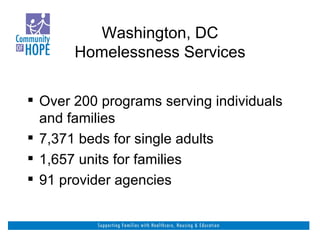
Washington, DC Homelessness Services Over 200 programs serving individuals and families 7,371 beds for single adults 1,657 units for families 91 provider agencies
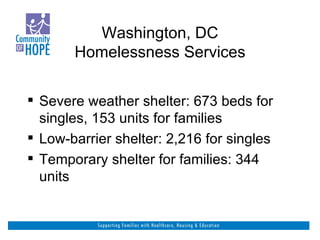
Washington, DC Homelessness Services Severe weather shelter: 673 beds for singles, 153 units for families Low-barrier shelter: 2,216 for singles Temporary shelter for families: 344 units
Washington, DC Homelessness Services Transitional housing: 1,138 beds for singles, 617 units for families Permanent supportive housing: 3,344 beds for singles, 696 units for families
Washington, DC Point in Time 2011 850 families were homeless 3,800 individuals were homeless
What We Do Community of Hope Mission: “ Improving health and quality of life for low-income, homeless, and underserved families and individuals in the District of Columbia by providing healthcare, housing with supportive services, educational opportunities, and spiritual support.”
What We Do Provide healthcare to individuals with little or no insurance Provide housing and supportive services to families that are near-homeless, homeless, or were previously homeless
Developing a Program The three-legged stool: Activities (i.e., assistance, services) System design/collaboration Research & evaluation
Developing a Program Define goals Who will you serve (and for how long)? What  won’t  you do? Plan partnerships (no matter how painful) Nuts and bolts Messaging
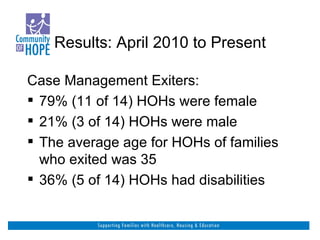
Results: April 2010 to Present Case Management Exiters: 79% (11 of 14) HOHs were female 21% (3 of 14) HOHs were male The average age for HOHs of families who exited was 35 36% (5 of 14) HOHs had disabilities
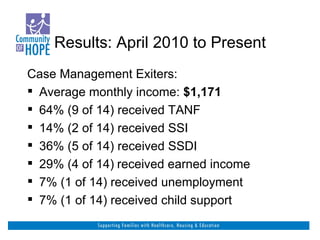
Results: April 2010 to Present Case Management Exiters: Average monthly income:  $1,171 64% (9 of 14) received TANF 14% (2 of 14) received SSI 36% (5 of 14) received SSDI 29% (4 of 14)   received earned income 7% (1 of 14) received unemployment 7% (1 of 14) received child support
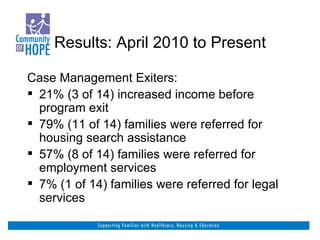
Results: April 2010 to Present Case Management Exiters: 21% (3 of 14) increased income before program exit 79% (11 of 14) families were referred for housing search assistance 57% (8 of 14) families were referred for employment services 7% (1 of 14) families were referred for legal services
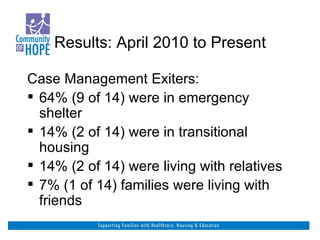
Results: April 2010 to Present Case Management Exiters: 64% (9 of 14) were in emergency shelter 14% (2 of 14) were in transitional housing 14% (2 of 14) were living with relatives 7% (1 of 14) families were living with friends
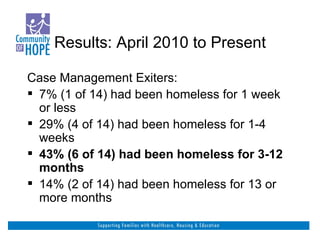
Results: April 2010 to Present Case Management Exiters: 7% (1 of 14) had been homeless for 1 week or less 29% (4 of 14) had been homeless for 1-4 weeks 43% (6 of 14) had been homeless for 3-12 months 14% (2 of 14) had been homeless for 13 or more months
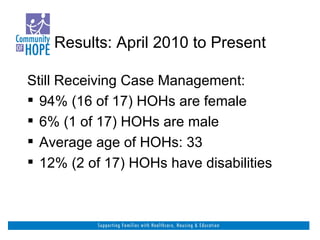
Results: April 2010 to Present Still Receiving Case Management: 94% (16 of 17) HOHs are female 6% (1 of 17) HOHs are male Average age of HOHs: 33 12% (2 of 17) HOHs have disabilities
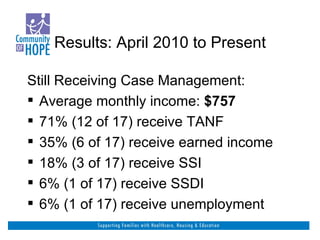
Results: April 2010 to Present Still Receiving Case Management: Average monthly income:  $757 71% (12 of 17) receive TANF 35% (6 of 17) receive earned income 18% (3 of 17) receive SSI 6% (1 of 17) receive SSDI 6% (1 of 17) receive unemployment
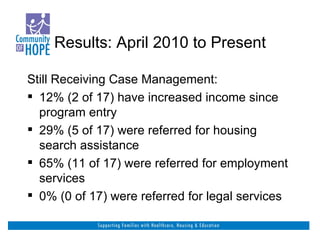
Results: April 2010 to Present Still Receiving Case Management: 12% (2 of 17) have increased income since program entry 29% (5 of 17) were referred for housing search assistance 65% (11 of 17) were referred for employment services 0% (0 of 17) were referred for legal services
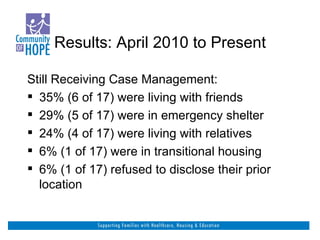
Results: April 2010 to Present Still Receiving Case Management: 35% (6 of 17) were living with friends 29% (5 of 17) were in emergency shelter 24% (4 of 17) were living with relatives 6% (1 of 17) were in transitional housing 6% (1 of 17) refused to disclose their prior location
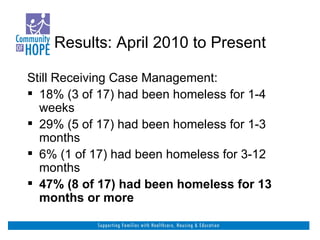
Results: April 2010 to Present Still Receiving Case Management: 18% (3 of 17) had been homeless for 1-4 weeks 29% (5 of 17) had been homeless for 1-3 months 6% (1 of 17) had been homeless for 3-12 months 47% (8 of 17) had been homeless for 13 months or more
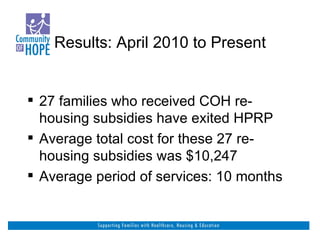
Results: April 2010 to Present 27 families who received COH re-housing subsidies have exited HPRP Average total cost for these 27 re-housing subsidies was $10,247 Average period of services: 10 months
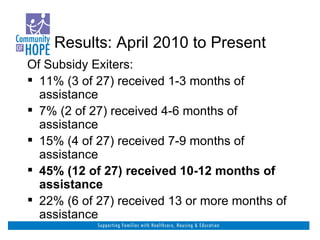
Results: April 2010 to Present Of Subsidy Exiters: 11% (3 of 27) received 1-3 months of assistance 7% (2 of 27) received 4-6 months of assistance 15% (4 of 27) received 7-9 months of assistance 45% (12 of 27) received 10-12 months of assistance 22% (6 of 27) received 13 or more months of assistance
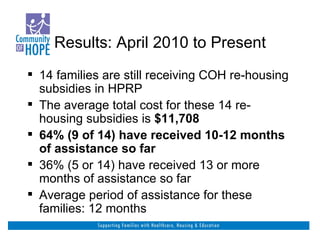
Results: April 2010 to Present 14 families are still receiving COH re-housing subsidies in HPRP The average total cost for these 14 re-housing subsidies is  $11,708 64% (9 of 14) have received 10-12 months of assistance so far 36% (5 or 14) have received 13 or more months of assistance so far Average period of assistance for these families: 12 months
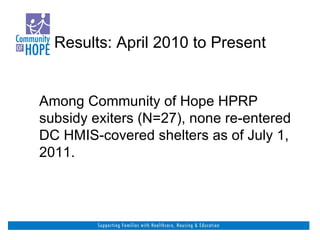
Results: April 2010 to Present Among Community of Hope HPRP subsidy exiters (N=27), none re-entered DC HMIS-covered shelters as of July 1, 2011.
Observations/Questions Targeting Risk Don’t make decisions with clients that have long-term impact – use progressive engagement
Observations/Questions Don’t do mainstream services providers’ jobs Use Barriers to Housing Stability Assessments Don’t overextend families by placing them with high rent burdens Overcoming myths
Some Guiding Principles Housing stability is main goal Targeting: must target those with highest risk factors, best indicator is historical housing instability Intensity of services: minimum amount to solve problem, increase with degree of risk
Some Guiding Principles Collaboration, create integrated system, leadership Consumer choice and flexibility is critical Research must be embedded in all the work, ongoing
Contact Info Jamey Burden Director of Housing Programs Community of Hope Washington, DC (202) 407-7766 [email_address]

1.3 Jamey Burden

  • 1.
    Basics of RapidRe-Housing Jamey Burden National Alliance to End Homelessness Conference July 13, 2011
  • 2.
    Basics of RapidRe-Housing The Community and the Agency Developing a Rapid Re-Housing Program Results So Far Observations and Ongoing Questions Some Guiding Principles
  • 3.
    Washington, DC HomelessnessServices Over 200 programs serving individuals and families 7,371 beds for single adults 1,657 units for families 91 provider agencies
  • 4.
    Washington, DC HomelessnessServices Severe weather shelter: 673 beds for singles, 153 units for families Low-barrier shelter: 2,216 for singles Temporary shelter for families: 344 units
  • 5.
    Washington, DC HomelessnessServices Transitional housing: 1,138 beds for singles, 617 units for families Permanent supportive housing: 3,344 beds for singles, 696 units for families
  • 6.
    Washington, DC Pointin Time 2011 850 families were homeless 3,800 individuals were homeless
  • 7.
    What We DoCommunity of Hope Mission: “ Improving health and quality of life for low-income, homeless, and underserved families and individuals in the District of Columbia by providing healthcare, housing with supportive services, educational opportunities, and spiritual support.”
  • 8.
    What We DoProvide healthcare to individuals with little or no insurance Provide housing and supportive services to families that are near-homeless, homeless, or were previously homeless
  • 9.
    Developing a ProgramThe three-legged stool: Activities (i.e., assistance, services) System design/collaboration Research & evaluation
  • 10.
    Developing a ProgramDefine goals Who will you serve (and for how long)? What won’t you do? Plan partnerships (no matter how painful) Nuts and bolts Messaging
  • 11.
    Results: April 2010to Present Case Management Exiters: 79% (11 of 14) HOHs were female 21% (3 of 14) HOHs were male The average age for HOHs of families who exited was 35 36% (5 of 14) HOHs had disabilities
  • 12.
    Results: April 2010to Present Case Management Exiters: Average monthly income: $1,171 64% (9 of 14) received TANF 14% (2 of 14) received SSI 36% (5 of 14) received SSDI 29% (4 of 14) received earned income 7% (1 of 14) received unemployment 7% (1 of 14) received child support
  • 13.
    Results: April 2010to Present Case Management Exiters: 21% (3 of 14) increased income before program exit 79% (11 of 14) families were referred for housing search assistance 57% (8 of 14) families were referred for employment services 7% (1 of 14) families were referred for legal services
  • 14.
    Results: April 2010to Present Case Management Exiters: 64% (9 of 14) were in emergency shelter 14% (2 of 14) were in transitional housing 14% (2 of 14) were living with relatives 7% (1 of 14) families were living with friends
  • 15.
    Results: April 2010to Present Case Management Exiters: 7% (1 of 14) had been homeless for 1 week or less 29% (4 of 14) had been homeless for 1-4 weeks 43% (6 of 14) had been homeless for 3-12 months 14% (2 of 14) had been homeless for 13 or more months
  • 16.
    Results: April 2010to Present Still Receiving Case Management: 94% (16 of 17) HOHs are female 6% (1 of 17) HOHs are male Average age of HOHs: 33 12% (2 of 17) HOHs have disabilities
  • 17.
    Results: April 2010to Present Still Receiving Case Management: Average monthly income: $757 71% (12 of 17) receive TANF 35% (6 of 17) receive earned income 18% (3 of 17) receive SSI 6% (1 of 17) receive SSDI 6% (1 of 17) receive unemployment
  • 18.
    Results: April 2010to Present Still Receiving Case Management: 12% (2 of 17) have increased income since program entry 29% (5 of 17) were referred for housing search assistance 65% (11 of 17) were referred for employment services 0% (0 of 17) were referred for legal services
  • 19.
    Results: April 2010to Present Still Receiving Case Management: 35% (6 of 17) were living with friends 29% (5 of 17) were in emergency shelter 24% (4 of 17) were living with relatives 6% (1 of 17) were in transitional housing 6% (1 of 17) refused to disclose their prior location
  • 20.
    Results: April 2010to Present Still Receiving Case Management: 18% (3 of 17) had been homeless for 1-4 weeks 29% (5 of 17) had been homeless for 1-3 months 6% (1 of 17) had been homeless for 3-12 months 47% (8 of 17) had been homeless for 13 months or more
  • 21.
    Results: April 2010to Present 27 families who received COH re-housing subsidies have exited HPRP Average total cost for these 27 re-housing subsidies was $10,247 Average period of services: 10 months
  • 22.
    Results: April 2010to Present Of Subsidy Exiters: 11% (3 of 27) received 1-3 months of assistance 7% (2 of 27) received 4-6 months of assistance 15% (4 of 27) received 7-9 months of assistance 45% (12 of 27) received 10-12 months of assistance 22% (6 of 27) received 13 or more months of assistance
  • 23.
    Results: April 2010to Present 14 families are still receiving COH re-housing subsidies in HPRP The average total cost for these 14 re-housing subsidies is $11,708 64% (9 of 14) have received 10-12 months of assistance so far 36% (5 or 14) have received 13 or more months of assistance so far Average period of assistance for these families: 12 months
  • 24.
    Results: April 2010to Present Among Community of Hope HPRP subsidy exiters (N=27), none re-entered DC HMIS-covered shelters as of July 1, 2011.
  • 25.
    Observations/Questions Targeting RiskDon’t make decisions with clients that have long-term impact – use progressive engagement
  • 26.
    Observations/Questions Don’t domainstream services providers’ jobs Use Barriers to Housing Stability Assessments Don’t overextend families by placing them with high rent burdens Overcoming myths
  • 27.
    Some Guiding PrinciplesHousing stability is main goal Targeting: must target those with highest risk factors, best indicator is historical housing instability Intensity of services: minimum amount to solve problem, increase with degree of risk
  • 28.
    Some Guiding PrinciplesCollaboration, create integrated system, leadership Consumer choice and flexibility is critical Research must be embedded in all the work, ongoing
  • 29.
    Contact Info JameyBurden Director of Housing Programs Community of Hope Washington, DC (202) 407-7766 [email_address]

Editor's Notes

  • #22 33% (9 of 27) of these heads of household have a high school diploma or GED
  • #24 64% (9 of 14) of these heads of household have a high school diploma or GED