Report  April 2013

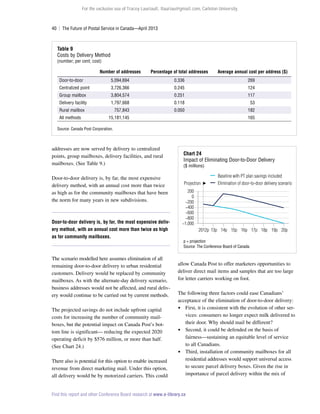
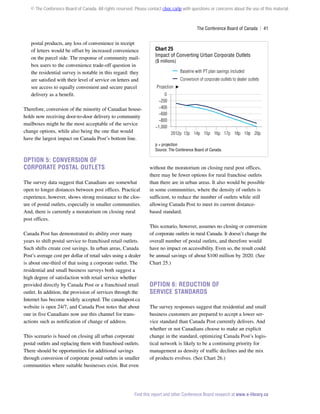
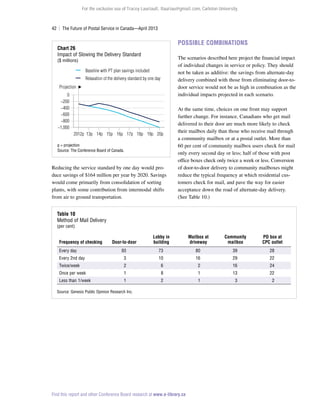
The Future of Postal
Service in Canada

Technology and innovation
For the exclusive use of Tracey Lauriault, tlauriau@gmail.com, Carleton University.

The Future of Postal Service in Canada
by David Stewart-Patterson, Vijay Gill, and Crystal Hoganson

About The Conference
Board of Canada
We are:
 The foremost independent, not-for-profit, applied

research organization in Canada.
 Objective and non-partisan. We do not lobby

for specific interests.
 Funded exclusively through the fees we charge

for services to the private and public sectors.
 Experts in running conferences but also at con-

ducting, publishing, and disseminating research;
helping people network; developing individual
leadership skills; and building organizational
capacity.
 Specialists in economic trends, as well
as organizational performance and public
policy issues.
 Not a government department or agency,
although we are often hired to provide
services for all levels of government.
 Independent from, but affiliated with, The
Conference Board, Inc. of New York, which
serves nearly 2,000 companies in 60 nations
and has offices in Brussels and Hong Kong.

©2013 The Conference Board of Canada*
Published in Canada  •  All rights reserved
Agreement No. 40063028
*Incorporated as AERIC Inc.
Forecasts and research often involve numerous assumptions and data
sources, and are subject to inherent risks and uncertainties. This information
is not intended as specific investment, accounting, legal, or tax advice.

Preface
The spread of electronic communications has seriously affected the use of postal services by Canadians.
Canada Post was able to cope with the impact of falling
mail volumes through incremental efficiencies and price
increases, but fell into deficit in 2011 after 16 profitable
years. Canadians must consider more fundamental changes if they wish to prevent Canada Post’s losses from
expanding dramatically in the years ahead. The report
explores possible paths forward through a combination
of econometric analysis, competitor risk assessment, and
interviews; focus groups; and polling of residential and
business customers. It offers a framework for constructive discussion of how Canadians would prefer to shape
a sustainable postal service for their future.
© The Conference Board of Canada. All rights reserved. Please contact cboc.ca/ip with questions or concerns about the use of this material.

Contents
Executive Summary .  .  .  .  .  .  .  .  .  .  .  .  .  .  .  .  .  .  .  .  .  .  .  .  .  .  .  .  .  .  .  .  .  .  .  .  .  .  .  .  .  .  .  .  .  .  .  .  .  .  .  .  .  .  .  .  .  .  .  .  .  .  .  . i
Chapter 1—Introduction  . . . . . . . . . . . . . . . . . . . . . . . . . . . . . . . . . . . . . . . . . . . . . . . . . . . . . . . . . . . . . . . . . . . . . . 1
Methodology . . . . . . . . . . . . . . . . . . . . . . . . . . . . . . . . . . . . . . . . . . . . . . . . . . . . . . . . . . . . . . . . . . . . . . . . . . . . . . . . 2
Chapter 2—Global Trends in Postal Service . . . . . . . . . . . . . . . . . . . . . . . . . . . . . . . . . . . . . . . . . . . . . . . . . . . . . . . . 4
Liberalization and Privatization . . . . . . . . . . . . . . . . . . . . . . . . . . . . . . . . . . . . . . . . . . . . . . . . . . . . . . . . . . . . . . . . . 5
Expansion Into Financial Services . . . . . . . . . . . . . . . . . . . . . . . . . . . . . . . . . . . . . . . . . . . . . . . . . . . . . . . . . . . . . . . 6
Development of Digital Products . . . . . . . . . . . . . . . . . . . . . . . . . . . . . . . . . . . . . . . . . . . . . . . . . . . . . . . . . . . . . . . . 7
E-Commerce and Parcels . . . . . . . . . . . . . . . . . . . . . . . . . . . . . . . . . . . . . . . . . . . . . . . . . . . . . . . . . . . . . . . . . . . . . . 8
Changes to Service Standards . . . . . . . . . . . . . . . . . . . . . . . . . . . . . . . . . . . . . . . . . . . . . . . . . . . . . . . . . . . . . . . . . . . 9
Conclusion  . . . . . . . . . . . . . . . . . . . . . . . . . . . . . . . . . . . . . . . . . . . . . . . . . . . . . . . . . . . . . . . . . . . . . . . . . . . . . . . . 10
Chapter 3—The Competitive Environment in Canada . . . . . . . . . . . . . . . . . . . . . . . . . . . . . . . . . . . . . . . . . . . . . . . .
Transaction Mail . . . . . . . . . . . . . . . . . . . . . . . . . . . . . . . . . . . . . . . . . . . . . . . . . . . . . . . . . . . . . . . . . . . . . . . . . . . .
Advertising Mail . . . . . . . . . . . . . . . . . . . . . . . . . . . . . . . . . . . . . . . . . . . . . . . . . . . . . . . . . . . . . . . . . . . . . . . . . . . .
Publications . . . . . . . . . . . . . . . . . . . . . . . . . . . . . . . . . . . . . . . . . . . . . . . . . . . . . . . . . . . . . . . . . . . . . . . . . . . . . . . .
Parcels . . . . . . . . . . . . . . . . . . . . . . . . . . . . . . . . . . . . . . . . . . . . . . . . . . . . . . . . . . . . . . . . . . . . . . . . . . . . . . . . . . . .
Other Trends Affecting the Competitive Outlook  . . . . . . . . . . . . . . . . . . . . . . . . . . . . . . . . . . . . . . . . . . . . . . . . . .

11
11
13
15
16
17

Chapter 4—The Outlook for Canada Post . . . . . . . . . . . . . . . . . . . . . . . . . . . . . . . . . . . . . . . . . . . . . . . . . . . . . . . . . 19
Volume and Revenue Projections . . . . . . . . . . . . . . . . . . . . . . . . . . . . . . . . . . . . . . . . . . . . . . . . . . . . . . . . . . . . . . . 20
Chapter 5—Expectations and Use of Postal Service . . . . . . . . . . . . . . . . . . . . . . . . . . . . . . . . . . . . . . . . . . . . . . . . .
How the Use of Postal Services Is Changing  . . . . . . . . . . . . . . . . . . . . . . . . . . . . . . . . . . . . . . . . . . . . . . . . . . . . .
What Canadians Expect and Value . . . . . . . . . . . . . . . . . . . . . . . . . . . . . . . . . . . . . . . . . . . . . . . . . . . . . . . . . . . . . .
The Business Case for Change . . . . . . . . . . . . . . . . . . . . . . . . . . . . . . . . . . . . . . . . . . . . . . . . . . . . . . . . . . . . . . . . .
Ability to Replace Canada Post . . . . . . . . . . . . . . . . . . . . . . . . . . . . . . . . . . . . . . . . . . . . . . . . . . . . . . . . . . . . . . . .

24
24
27
33
35

Chapter 6—Sustaining the Postal Service That Canadians Need  . . . . . . . . . . . . . . . . . . . . . . . . . . . . . . . . . . . . . . .
Option 1: Large Price Increases . . . . . . . . . . . . . . . . . . . . . . . . . . . . . . . . . . . . . . . . . . . . . . . . . . . . . . . . . . . . . . . .
Option 2: Wage Restraint  . . . . . . . . . . . . . . . . . . . . . . . . . . . . . . . . . . . . . . . . . . . . . . . . . . . . . . . . . . . . . . . . . . . . .
Option 3: Alternate-Day Delivery . . . . . . . . . . . . . . . . . . . . . . . . . . . . . . . . . . . . . . . . . . . . . . . . . . . . . . . . . . . . . .
Option 4: Elimination of Door-To-Door Service . . . . . . . . . . . . . . . . . . . . . . . . . . . . . . . . . . . . . . . . . . . . . . . . . . .
Option 5: Conversion of Corporate Postal Outlets  . . . . . . . . . . . . . . . . . . . . . . . . . . . . . . . . . . . . . . . . . . . . . . . . .
Option 6: Reduction of Service Standards . . . . . . . . . . . . . . . . . . . . . . . . . . . . . . . . . . . . . . . . . . . . . . . . . . . . . . . .
Possible Combinations . . . . . . . . . . . . . . . . . . . . . . . . . . . . . . . . . . . . . . . . . . . . . . . . . . . . . . . . . . . . . . . . . . . . . . .

37
38
39
40
40
42
42
43

Chapter 7—Conclusion . . . . . . . . . . . . . . . . . . . . . . . . . . . . . . . . . . . . . . . . . . . . . . . . . . . . . . . . . . . . . . . . . . . . . . . 44
Appendix A—Bibliography  . . . . . . . . . . . . . . . . . . . . . . . . . . . . . . . . . . . . . . . . . . . . . . . . . . . . . . . . . . . . . . . . . . . . 46
For the exclusive use of Tracey Lauriault, tlauriau@gmail.com, Carleton University.

Acknowledgements
This report was written and researched by David Stewart-Patterson, Vijay Gill, and Crystal Hoganson. It was made
possible with funding from Canada Post Corporation.
Special thanks go to Dave Crapper of Genesis Public Opinion Research Inc., who conducted the focus groups and the
residential and small business polling that provided the basis for Chapter 5.
We also thank our internal Conference Board contributors, Ross Prusakowski and Decky Kabongi, for their work on
the econometric analysis; and Dan Muzyka and Glen Hodgson for reviewing the report.
We extend our thanks to the three external reviewers of this report: Michael Trebilcock of the University of Toronto,
and Frank Graves and Derek Jansen of EKOS Research Associates.
The findings and conclusions of this report are entirely those of The Conference Board of Canada. Any errors and
omissions in fact or interpretation remain the sole responsibility of The Conference Board of Canada.
© The Conference Board of Canada. All rights reserved. Please contact cboc.ca/ip with questions or concerns about the use of this material.

Executive Summary

The Future of Postal
Service in Canada
At a Glance
 Canadians face a fundamental challenge: they
still rely on postal service but are steadily shifting communications from physical to digital.
This is driving down the volume of mail even
as the number of addresses to be served continues to rise.
 Although Canada Post operated profitably for
16 consecutive years, these current trends are
projected to lead to annual operating deficits
of close to $1 billion by 2020.
 The postal needs of Canadians are evolving,
and Canada Post currently delivers a higher
standard of service than Canadians expect
or use.
 No single change will suffice to prevent significant and growing losses on postal operations.
But a series of measures that would align service standards with the actual and future needs
of Canadians could enable Canada Post to
return to financial self-sustainability.

T

he spread of advanced communications technologies is changing the face of postal services
worldwide. Across industrialized economies, mail
volume is declining relentlessly. Postal services in other

countries are pursuing a range of strategies in response
to this trend. The strategies include privatization and
liberalization; growth into new lines of business,
such as financial services; development of digital
products; expansion of parcel delivery; and reduction
of service standards.
Until 2011, Canada Post succeeded in remaining profitable for 16 years through steady improvements in efficiency and regular price increases. Canada Post also has
pursued some of the strategies seen internationally—
notably the development of digital products such as
epost and Vault, and improvements in parcel delivery
service to compete within the rapidly growing market
created by e-commerce.
But traditional forms of mail such as bills, statements, and
payments are falling steadily in volume. Major mailers in
Canada, including governments, are making concerted
efforts to reduce their use of postal services by encouraging consumers to switch to electronic alternatives.
Advertising mail, like other traditional advertising media,
faces intense pressure from the explosive growth of online
advertising as well as e-mail and mobile options. As
Canadians seek more information online, demand for
hard-copy publications is declining and publishers are
moving toward digital replicas aimed primarily at tablets
and mobile devices. The one area of growth is in parcel
delivery, where e-commerce is driving demand for delivery of packages from online retailers and distributors to
homes and businesses.

Find this report and other Conference Board research at www.e-library.ca
For the exclusive use of Tracey Lauriault, tlauriau@gmail.com, Carleton University.

ii  |  The Future of Postal Service in Canada—April 2013

Our projection suggests that Canada Post’s transaction
mail, addressed and unaddressed advertising mail, and
publication volumes will decline by about 26 to 27 per
cent by 2020. Parcel volume is projected to buck the
trend and see a 26 per cent increase over the same period,
but this will remain small as a share of total mail traffic.
While the Crown corporation’s Postal Transformation
initiative will have a significant impact on its bottom
line by boosting productivity and improving efficiency,
its annual operating loss is nonetheless projected to
reach about $1 billion by 2020.

By presenting a portfolio of potential responses to the
challenge of sustaining postal service, this report offers
a framework for discussion of options by Canadians.

Polling of small business and residential customers confirmed that their habits are changing, with almost half
of households saying they now send two pieces of mail
or less per month. While small businesses, as a group,
also are using mail less frequently, they remain relatively dependent on mail for invoicing and payments.
Both groups of customers confirmed that their demand
for parcel service will continue to rise with the spread
of e-commerce. But residential customers noted growing frustration over the need to travel to pick up parcels
when no one is home to accept delivery during the day.
Residential and small business customers recognize that
the price of a stamp represents good value, and both
appear willing to accept slower service than they currently receive. What matters most to these customers is
not speed but certainty of delivery and, on this score,
they express a high degree of confidence in the mail.
Their responses suggest that Canada Post, like postal
services in other developed countries, is now providing
a higher level of service than necessary.
Canadians believe that despite the spread of electronic
communications, they always will need postal service.
They have a high degree of trust in Canada Post; one that
carries over from physical delivery to digital products.
However, neither residential nor small business customers have fully made the connection between the changes
in their own behaviour and the impact of these changes

on Canada Post’s business model. They recognize that
the status quo is no longer viable, but are not yet fully
convinced of the scale and speed of change that may be
required. Nonetheless, 80 per cent of the household and
small business customers surveyed for our report agreed
with the statement that “Canada Post has to make fundamental changes to the way it has operated in the past
in order to be relevant in the future.”
The quantitative analysis done for this report suggests
that Canada Post could reduce its projected losses significantly by raising prices faster than inflation, but that it
cannot realistically return to self-sustainability through
price increases alone. Therefore, the report examined five
options for cutting costs: wage restraint; alternate-day
delivery for mail (but not parcels); converting Canadian
households’ receiving door-to-door delivery to community mailboxes; further replacement of corporate post
offices with franchised postal outlets; and reduced speed
of delivery. Eliminating delivery to the door for urban
residential customers would be the option with the largest financial impact, saving a projected $576 million
a year by 2020.
No single change to prices or service standards will be
sufficient to enable self-sustainability as mail volumes
continue to decline. While there will probably be a relatively stable and residual level of demand for mail services, it is impossible to determine when and where that
level might be reached. Any given change in service is
likely to have a one-time positive impact on the bottom
line, but cannot change the relentless downward slope
of the mail volume curve. Thus, sustaining a postal service that will meet the evolving needs of Canadians will
require a combination of measures, but not necessarily
all at once.
The purpose of this report is not to recommend any one
or particular combination of options. Rather, its goal is to
illustrate both the potential financial impact of a range
of choices and how such changes would be seen by
Canada Post’s business and residential customers. By
presenting a portfolio of potential responses to the challenge of sustaining postal service, this report offers a
framework for discussion of options by Canadians in
their roles as customers and, through the Government
of Canada, as shareholders and taxpayers.

Find this report and other Conference Board research at www.e-library.ca
© The Conference Board of Canada. All rights reserved. Please contact cboc.ca/ip with questions or concerns about the use of this material.

Chapter 1

Introduction
vast land. In 1981, responsibility for delivering the mail
was moved to a Crown corporation as a means of encouraging greater efficiency, but both the monopoly power
and corresponding service obligations remained.

Chapter Summary
 Canadians are changing the ways in which
they communicate, and this is having a dramatic impact on their use of postal service.
 Canada Post engaged The Conference Board
of Canada to conduct an independent assessment of the future of postal service in Canada,
and to consider potential paths forward.
 The research explored the attitudes and
behaviour of Canada Post residential and
business customers through a combination
of interviews, focus groups, and polling.
 To quantify the impact of economic, technological, and demographic trends on Canada
Post’s business, the Conference Board employed
econometric analysis and a competitor risk
assessment to project future mail volumes,
revenues, and operating income.

C

anada set up its postal service in an era in
which physical delivery of letters was the primary means of communication among its farflung communities. Given Canada’s geography, postal
service was seen as a public service essential to both the
political unity and economic efficiency of the country.
Postal service, therefore, was set up as a department of
the federal government, with monopoly power to offset
the high cost of delivering letters and goods across a

The spread of electronic communications has dramatically affected the use of postal services by Canadians.
The telephone for voice communication arrived first,
followed by the use of phone lines to transmit documents via fax. Then the Internet became widespread,
offering easier, cheaper, and faster substitutes for many
forms of communication—from bills and payments to
advertising and publications, personal letters, and even
greeting cards. In this digital age, Canada Post’s monopoly over lettermail has clearly declined in economic
value even though Canada’s growing population and the
demographic trend to smaller households continues to
increase the number of addresses that the post office is
required to serve.
This combination—the rising number of addresses and
the falling volume of mail—presents Canadians with
a fundamental challenge, one that is becoming acute
across advanced economies. (See Chart 1.)
Until recently, Canada Post has been able to cope with
the impact through incremental strategies to improve
efficiency, but it fell into deficit in 2011 after 16 years
of consistent profit. Canadians now must consider more
strategic choices if they wish to prevent Canada Post’s
losses from expanding dramatically in the years ahead.
Therefore, Canada Post engaged The Conference Board

Find this report and other Conference Board research at www.e-library.ca
For the exclusive use of Tracey Lauriault, tlauriau@gmail.com, Carleton University.

2  |  The Future of Postal Service in Canada—April 2013

Chart 1
Mail Volume and Number of Addresses

(billions of pieces; millions of addresses)

Mail volume (left)

Number of addresses (right)

Forecast
18
17
16
15
14
13
12

12
11
10
9
8
7
6
2003 04 05 06 07 08 09 10 11 12f 13f 14f 15f 16f 17f 18f 19f 20f

The econometric analysis was used primarily to provide
price and GDP elasticities, and was augmented with a risk
matrix in order to complete the projection of volumes
by line of business. Data from ZenithOptimedia were
leveraged to estimate the impacts of expected advertising expenditures on alternate sources such as Internet
search/display, mobile advertising, and digital replicas
of publications. Although demographic factors (such
as the share of population by decade of birth) were
correlated with transaction mail volumes, they were
not statistically significant in terms of providing
explanatory power.

Source: Canada Post; The Conference Board of Canada.

of Canada to conduct an independent assessment of
the future of postal service in Canada, and to consider
potential paths forward.
The first step was to assess how technological change is
affecting the expectations of Canadians and the extent
to which they actually use and depend on its services.
To this end, the Conference Board interviewed a range
of Canada Post’s major customers and engaged Genesis
Public Opinion Research Inc. to conduct focus groups
and a telephone poll of small business customers and
a parallel telephone poll of residential customers.

Methodology
To quantify the impact of economic, technological,
and demographic trends on Canada Post’s business, the
Conference Board employed econometric analysis and
a competitor risk assessment to project future mail volumes, revenues, and operating income. This framework,
in turn, was used to test the financial impact of a variety
of potential actions aimed at improving the sustainability
of the postal business.
While Canada Post supplied some of the historical
data used in the analysis, the analytical framework was
developed independently. The resulting observations
and conclusions are those of The Conference Board
of Canada alone.

To quantify the impact of economic, technological, and
demographic trends, the Conference Board employed
econometric analysis and a competitor risk assessment.

The research explored the attitudes and behaviour of
Canada Post customers through a combination of interviews, focus groups, and polling. The Conference Board
conducted individual interviews with a selection of
Canada Post’s major customers to add qualitative
insight to the quantitative analysis.
Genesis Public Opinion Research Inc. explored the
attitudes of residential customers through a telephone
survey of households across the country. The objectives
of the survey were to:
 understand customers’ current use of both lettermail
and courier/package services;
 determine their service expectations and related
attitudes to those lines of business;
 assess their use and evaluations of corporate and
private retail outlets;
 determine their understanding of the business
challenges Canada Post faces.
The residential survey selected and interviewed correspondents based on the way in which they receive mail.
The target sample included approximately 500 customers
who get mail delivered to their door (DTD), 300 who
use group mailboxes (CMB), 250 who receive mail in
their lobby or common area (LBA), 100 who have mail

Find this report and other Conference Board research at www.e-library.ca
© The Conference Board of Canada. All rights reserved. Please contact cboc.ca/ip with questions or concerns about the use of this material.

The Conference Board of Canada  | 3

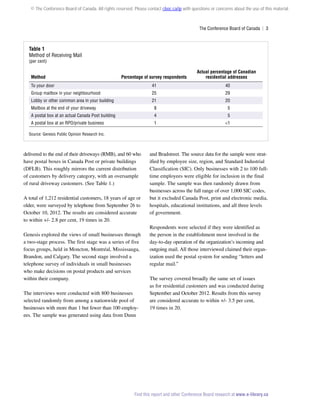
Table 1
Method of Receiving Mail

(per cent)

Percentage of survey respondents

Actual percentage of Canadian
residential addresses

To your door

41

40

Group mailbox in your neighbourhood

25

29

Lobby or other common area in your building

21

20

Mailbox at the end of your driveway

8

5

A postal box at an actual Canada Post building

4

5

A postal box at an RPO/private business

1

1

Method

Source: Genesis Public Opinion Research Inc.

delivered to the end of their driveways (RMB), and 60 who
have postal boxes in Canada Post or private buildings
(DFLB). This roughly mirrors the current distribution
of customers by delivery category, with an oversample
of rural driveway customers. (See Table 1.)
A total of 1,212 residential customers, 18 years of age or
older, were surveyed by telephone from September 26 to
October 10, 2012. The results are considered accurate
to within +/- 2.8 per cent, 19 times in 20.
Genesis explored the views of small businesses through
a two-stage process. The first stage was a series of five
focus groups, held in Moncton, Montréal, Mississauga,
Brandon, and Calgary. The second stage involved a
telephone survey of individuals in small businesses
who make decisions on postal products and services
within their company.
The interviews were conducted with 800 businesses
selected randomly from among a nationwide pool of
businesses with more than 1 but fewer than 100 employees. The sample was generated using data from Dunn

and Bradstreet. The source data for the sample were stratified by employee size, region, and Standard Industrial
Classification (SIC). Only businesses with 2 to 100 fulltime employees were eligible for inclusion in the final
sample. The sample was then randomly drawn from
businesses across the full range of over 1,000 SIC codes,
but it excluded Canada Post, print and electronic media,
hospitals, educational institutions, and all three levels
of government.
Respondents were selected if they were identified as
the person in the establishment most involved in the
day-to-day operation of the organization’s incoming and
outgoing mail. All those interviewed claimed their organization used the postal system for sending “letters and
regular mail.”
The survey covered broadly the same set of issues
as for residential customers and was conducted during
September and October 2012. Results from this survey
are considered accurate to within +/- 3.5 per cent,
19 times in 20.

Find this report and other Conference Board research at www.e-library.ca
For the exclusive use of Tracey Lauriault, tlauriau@gmail.com, Carleton University.

Chapter 2

Global Trends in Postal Service
Chapter Summary
 Electronic alternatives are changing the face
of postal service around the world.
 Other countries are pursuing the following five
major approaches to enable postal services to
reduce costs or enhance revenue:
–	 liberalization and privatization;
–	 expansion into new lines of business;
–	 development of digital products;
–	 expansion of parcel delivery;
–	 reduction of service standards.
 Canada Post already is pursuing two of
these approaches by developing new digital
products—including epost and Vault—and
by increasing its efficiency, capacity, and
service offerings in the parcel business.

T

he digital revolution has changed the face of
postal service as we know it. No longer is the
post office viewed as the primary means of
connecting people and businesses wherever they are
located. Widespread access to broadband and mobile
technologies is having a fundamental impact on how
people and businesses communicate. People increasingly are communicating by phone, e-mail, text, and

other web-enabled tools. Growing numbers are accessing information for work and for pleasure on websites,
e-readers, and tablets. Customers and providers alike
are handling statements, invoices, and payments online.
E-commerce has moved quickly from an add-on means
of browsing for products to a primary sales channel.
Generally, survival in the core business of lettermail has
required taking out costs faster than volume-driven revenue declines. This has meant either additional investment
in technologies such as high-speed sorting equipment
or reductions in service standards. However, there is a
growing recognition around the world that postal services
must develop new strategies to survive. A 2012 study by
the International Post Corporation and Boston Consulting
Group concluded that, by 2020, moving the mail will
no longer be the core business of postal operators.1
Despite differences in the economic and social environments across countries, it is clear that postal operators
around the world are facing declining lettermail volumes.
The Universal Postal Union reported that between 2006
and 2010, domestic lettermail traffic decreased by 3.5 per
cent, while international mail decreased 13 per cent.2

1	

International Post Corporation and The Boston Consulting Group,
Focus on the Future, 22.

2	

Universal Postal Union, The Global Postal Network—Key Figures.

Find this report and other Conference Board research at www.e-library.ca
© The Conference Board of Canada. All rights reserved. Please contact cboc.ca/ip with questions or concerns about the use of this material.

The Conference Board of Canada  | 5

To deal with this decline, postal services are continuing
efforts to reduce costs through greater efficiency and
pursuing alternatives that could enhance revenue beyond
lettermail. This chapter discusses some of the most
notable approaches that other countries have taken
to date. These include:
 liberalization and privatization—as a means of
encouraging efficiency through competition
and market discipline;
 expansion into new lines of business—notably financial services, to generate profits that can offset the
declining mail business;
 development of digital mail products—to retain postal
customers through improved and value-added postal
services that go beyond physical delivery;
 expansion of parcel delivery services—to make better
use of the mail delivery infrastructure by generating
volume and revenue from the growth of e-commerce;
 reduction of mail service standards—to cut costs through
changes such as reduced frequency of delivery.

Liberalization and Privatization
In many countries, especially in Europe and Australasia,
governments have strengthened the pressure for efficiency
by exposing postal services to increased competition
through liberalization of markets, elimination of mail
monopolies, or privatization of postal operations. Since
1997, Europe’s postal industry, under the direction of
the European Commission (EC), has slowly become
liberalized in response to a wider economic agenda with
a focus on either modernization or commercialization
by the state.3 By January 2013, all 27 members of the
European Union had eliminated postal monopolies.
Some critics may argue that liberalizing or privatizing
postal services could result in a decrease in the quality
of service. But research has indicated that moving to a
liberalized or privatized postal service can create more
benefits than harm. To illustrate, a 2007 study reviewed
the performance impacts of postal deregulation in a
number of countries, including Germany, Australia,
New Zealand, and the United Kingdom. The research

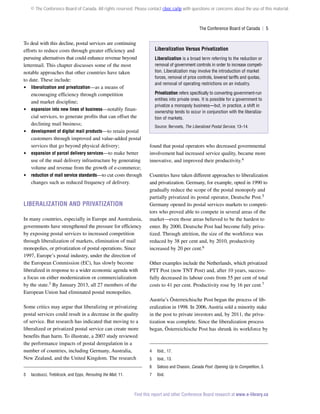
Liberalization Versus Privatization
Liberalization is a broad term referring to the reduction or
removal of government controls in order to increase competition. Liberalization may involve the introduction of market
forces, removal of price controls, lowered tariffs and quotas,
and removal of operating restrictions on an industry.
Privatization refers specifically to converting government-run
entities into private ones. It is possible for a government to
privatize a monopoly business—but, in practice, a shift in
ownership tends to occur in conjunction with the liberalization of markets.
Source: Bervoets, The Liberalized Postal Service, 13–14.

found that postal operators who decreased governmental
involvement had increased service quality, became more
innovative, and improved their productivity.4
Countries have taken different approaches to liberalization
and privatization. Germany, for example, opted in 1990 to
gradually reduce the scope of the postal monopoly and
partially privatized its postal operator, Deutsche Post.5
Germany opened its postal services markets to competitors who proved able to compete in several areas of the
market—even those areas believed to be the hardest to
enter. By 2000, Deutsche Post had become fully privatized. Through attrition, the size of the workforce was
reduced by 38 per cent and, by 2010, productivity
increased by 20 per cent.6
Other examples include the Netherlands, which privatized
PTT Post (now TNT Post) and, after 10 years, successfully decreased its labour costs from 55 per cent of total
costs to 41 per cent. Productivity rose by 16 per cent.7
Austria’s Österreichische Post began the process of liberalization in 1998. In 2006, Austria sold a minority stake
in the post to private investors and, by 2011, the privatization was complete. Since the liberalization process
began, Österreichische Post has shrunk its workforce by

Iacobucci, Trebilcock, and Epps, Rerouting the Mail, 11.

Ibid., 17.

5	

Ibid., 13.

6	
3	

4	

Geloso and Chassin, Canada Post: Opening Up to Competition, 3.

7	Ibid.

Find this report and other Conference Board research at www.e-library.ca
For the exclusive use of Tracey Lauriault, tlauriau@gmail.com, Carleton University.

6  |  The Future of Postal Service in Canada—April 2013

25 per cent, invested in new equipment, decreased
its labour costs by 14 per cent, and nearly doubled
its productivity.8
In New Zealand, postal reform was driven by a “broad
economic policy of commercialization of the state enterprise sector.”9 The New Zealand government owns NZ
Post, but the organization is directed to act like a private
sector firm—it needs to generate a profit, repay loans,
self-fund through its earnings, and pay taxes and dividends.10 NZ Post moved from generating a loss to creating a profit by cutting costs by 30 per cent, speeding
up mail delivery, increasing “on time” delivery by 15 per
cent, and nearly doubling its overall productivity.11,12

As a Crown corporation, Canada Post has both a public
service mandate and an obligation to act like a private
sector firm—at least to the extent of being self-sufficient.

Neither privatization nor liberalization of markets is,
by itself, a strategy for sustaining postal services in an
environment of decline. They are policies intended to
drive more rapid response to that environment by encouraging or enabling postal services to make decisions that
might be more difficult or politically impossible to pursue
as an arm of government.
In 1981, Canada turned its postal service into a Crown
corporation. As such, Canada Post has both a public
service mandate and an obligation to act like a private
sector firm—at least to the extent of being self-sufficient.
Until fiscal year 2011, Canada Post operated consistently
at a profit. And, it had been doing so while its monopoly
lettermail privilege declined in value due to a growing
number of cost-effective substitutes. Put another way,
the proliferation of digital alternatives to mail has, in
effect, liberalized the postal market to a great degree.
8	

Ibid., 4.

9	

Iacobucci, Trebilcock, and Epps, Rerouting the Mail, 11.

The key decisions with respect to the future of postal
service in Canada are about public policy; that is, about
how postal services could change in order to meet the
evolving needs of Canadians in the digital era. Privatization
has been a means to that end in some other jurisdictions,
but this report focuses on desired outcomes rather than
mechanisms for achieving those outcomes.

Expansion Into Financial Services
For international postal operators, the primary new business line being entered is financial services. In some
countries, such as Japan and Great Britain, financial
services have been a core element of the post office for
many years. In other countries, financial services have
been gradually introduced to postal services over time.
The addition of financial services through postal outlets
offers many potential benefits. For instance, it can facilitate financial inclusion in rural areas while also mitigating
the decline in postal revenues.13 Postal banks serve large
markets, but can be low in incremental cost because they
make shared use of the postal retail network. According
to a discussion paper of the United Nations Department
of Economic and Social Affairs, banking revenues in
many countries are actually essential to generate profits
from their postal networks.14
Postal services are generally accepted as safe, trusted, reliable institutions. As such, the public tends to view postal
financial services as a “safe haven.”15 The Universal
Postal Union (UPU) estimates that more than 1 billion
people worldwide conduct banking through postal services and, in 2010, 51 postal operators worldwide held
1.6 billion in savings and deposit accounts.16

13	 Berthaud and Davico, Global Panorama on Postal Financial
Inclusion, 3.

10	Ibid.

14	Scher, Postal Savings and the Provision of Financial Services, 15.

11	 Geloso and Chassin, Canada Post, 3.

15	 Berthaud and Davico, Global Panorama on Postal Financial
Inclusion, 3.

12	 Lammam and Karabegovic, “Recent Mail Disruption Strengthens
Case to Privatize Canada Post.”

16	Ibid.

Find this report and other Conference Board research at www.e-library.ca
© The Conference Board of Canada. All rights reserved. Please contact cboc.ca/ip with questions or concerns about the use of this material.

The Conference Board of Canada  | 7

Financial services have also been lucrative for postal
operators. For instance, Germany’s Deutsche Postbank
increased its total volume of savings by 21 per cent in the
first half of 2009 alone, and its market share increased
by 10.3 per cent.17
For PostFinance, the financial branch of Swiss Post,
financial services were the main driver of growth, leading to an 11.5 per cent increase in net profit in 2009. In
the first three quarters of 2009, PostFinance saw a 4 per
cent increase in the number of new customers; a 5 per cent
increase in the number of new accounts; and an exceptional year with the first three quarters of 2009 outperforming 2008 by 75 per cent.18 This was also true for
Poste Italiane, which recorded a 5.5 per cent drop in its
postal services’ segment revenue. But due to its growth
in the financial and insurance services, Poste Italiane
saw overall revenues increase by 13 per cent.19
Other countries seeking to leverage their extensive
retail presence and customer trust have also moved
into the financial services business. In New Zealand,
the government-owned postal service set up Kiwibank
as a subsidiary in 2002. This action was a means of
competing with the large Australian banks that controlled 80 per cent of the retail banking sector in New
Zealand.20 Within the first five years of its creation,
500,000 customers (or approximately 13 per cent of
New Zealand’s population) transferred their deposits
to Kiwibank. In the second half of 2011, Kiwibank
had a return on equity of 11.7 per cent.21
Canada has a highly developed financial services sector that extends from large banks to small credit unions.
While there is clearly room for Canada Post to explore
digital products involving financial transactions such as
invoicing and bill payments, the conditions that allowed
17	 Universal Postal Union, The Global Economic and Financial Crisis, 17.
18	Ibid.
19	 Moran and others, Achieving High Performance in the Postal
Industry, 6.

other postal administrations to succeed in banking do
not exist in Canada. Therefore, this report does not
explore financial services as an option in Canada.

Development of Digital Products
As lettermail volumes decline, postal operators have
turned to diversifying their products and services in
order to generate additional revenue streams. By integrating digital and physical mail services, international
postal operators have been able to capitalize on their
existing assets and sustain their competitive advantage
in the market.

Canada has a highly developed financial services sector,
so this report does not explore expansion into financial
services as an option for Canada Post.

As the decline in physical lettermail continues, there
appears to be potential for the development of electronic products. Success in the development of digital
mail products relies heavily on the degree of trust that
customers have in their postal service.
In 2012, Deutsche Post published a report laying out five
scenarios for the potential development of the logistics
industry to 2050. One of the key issues the report identified was the extent to which advanced logistics could
encompass the safe transfer of information, as well as the
reliable delivery of goods. Jürgen Gerdes, a member of
the Deutsche Post DHL Board of Management responsible for mail, notes in the report that ensuring its customers’ trust has always been at the core of the company’s
business model. “Guaranteeing the identity of the sender
and recipient and the inviolability of the contents of the
message is also the rationale behind its E-Postbrief
secure electronic post product. This and other efforts
the company is making to help safeguard the Internet
will likely transform the company by 2050.”22

20	 Brown, “Saving the Post Office and Postal Banking.”
21	Ibid.

22	 Deutsche Post AG, Delivering Tomorrow.

Find this report and other Conference Board research at www.e-library.ca
For the exclusive use of Tracey Lauriault, tlauriau@gmail.com, Carleton University.

8  |  The Future of Postal Service in Canada—April 2013

Within a rapidly changing global communications market,
postal operators around the world have to adapt quickly
to changes in consumer and business demand. Therefore,
business plans must be modified in order to build parcel
traffic generated by e-commerce and move into digital
services. Postal services generally do not view digital
communications as a separate initiative, but rather as a
means of transforming their business models to incorporate e-commerce and e-substitution.
Finland, for instance, is experimenting with the concept
of secure digital mailboxes. This system, called Netposti,
is an alternative to a physical mailbox. Physical mail
is opened, scanned, and sent as a PDF file to a secure
digital mailbox. Citizens are provided with accounts tied
to their social security numbers and e-mail addresses.23
Consumers receive an e-mail or a text message when
their mail is ready to be viewed. Envelopes are analyzed,
and items such as credit cards are filtered out for physical
delivery. Scanned mail is also delivered to physical
addresses, but residential mail services have been
reduced to twice a week.24

Digital products are evolving within a highly competitive
marketplace, and their potential contribution to the sustainability of postal service is uncertain.

Finns are significant users of electronic services, and
once the use of e-commerce began to take off, so too
did concerns about credit card safety. By signing a
cooperation agreement with the leading Finnish online
payment provider, Netposti allows consumers to click
an invoice button and receive a receipt of their online
purchase directly to their secure Netposti account.25
Then there is Polish Post, which recently released a
new line of digital products. Poland’s postal market has
been opened up to full competition and the NeoKartka

service was developed in response to customer demand
for more digital mail services.26 This hybrid service
allows customers to send greeting cards and postcards
electronically for conversion to the physical form prior
to delivery.27
In the past 10 years, Italy’s Poste Italiane has invested
heavily in technology to bridge the physical and electronic worlds. Poste Italiane developed an advanced
technological infrastructure where over 80 per cent of
correspondence is sorted using automated systems.28
In addition, Poste Italiane has been able to expand its
services and offer new products while utilizing various
channels: electronic invoicing for government contractors,
scanning and electronic archiving, and mobile virtual
network operators (e.g., using mobile devices to pay
bills and send mail).29
Canada Post is actively developing digital products. In
2011, it set up a distinct Digital Delivery Network in
parallel with its Physical Delivery Network. Its digital
product line now includes its epost system for the secure
delivery of statements and payment of bills, the Canada
Post Vault service for secure storage of personal and
sensitive information, and Data and Integrated Market
Solutions to support precision target marketing by
Canadian businesses.30
Digital products, however, are evolving within a highly
competitive marketplace. The international experience
suggests that such products cannot replace lost lettermail business. But they do have the potential to generate some revenue for Canada Post that could contribute
to offsetting the costs of maintaining the physical mail
delivery system. Their potential degree of contribution
is uncertain, so future digital revenues are not addressed
within the revenue projections of this report.
26	 Post  Parcel, “Polish Post Launches Hybrid Postcard
Delivery Service.”
27	Ibid.

23	 United States Postal Service, Office of the Inspector General,
The Postal Service Role in the Digital Age, 28.

28	 United States Postal Service, Office of the Inspector General,
The Postal Service Role in the Digital Age, 29.

24	Ibid.

29	 Ibid., 30.

25	 Ibid., 4.

30	 Canada Post Corporation, Transformation, 6–11.

Find this report and other Conference Board research at www.e-library.ca
© The Conference Board of Canada. All rights reserved. Please contact cboc.ca/ip with questions or concerns about the use of this material.

The Conference Board of Canada  | 9

E-Commerce and Parcels
Parcels are the one postal product that is seeing growth
driven by the digital revolution. People have become
enthusiastic online shoppers. In Europe, e-commerce
sales have doubled since 2005 and are expected to
grow a further 65 per cent by 2015.31 But everything
consumers buy needs to move physically from the producer, distributor, or retailer to homes and businesses.
And consumers have developed high expectations in
terms of the speed of delivery of the goods they have
ordered online.
The parcel business, unlike lettermail, is highly competitive, but parcel volumes have been rising worldwide. Postal services have been aggressively using their
extensive sorting and delivery infrastructure to expand
in this sector. In some cases, they are expanding beyond
their national borders: Spain’s Correos, for instance, is
using a partnership model to enter Asian markets; the
Netherlands is expanding its parcel services into new
geographies through acquisitions; and Poland’s InPost
is installing 100 self-service parcel terminals in
Brazil.32,33
To accommodate the rise in parcel volume, numerous
international postal services are expanding their parcel
centres and investing in new technologies to help with
the rise in parcel demand. Germany plans to build a
new parcel centre that will be 140,000 square metres—
the largest parcel centre in the country. The United
Kingdom’s Royal Mail has announced two new
parcel depots by fall 2013.34
Canada Post has implemented measures to expand its
parcel volume, both through its postal operations and
through its Purolator courier service. It has made concerted efforts to enhance parcel services to shippers.

In 2011, it offered on-demand parcel pickup for small
businesses and, in 2012, provided enhanced web services
for online retailers—including seamless management of
returns. With approximately 40 per cent of parcel deliveries to Canadians originating internationally, Canada
Post has negotiated bilateral agreements, notably with
the United States and China, to increase its share of this
inbound traffic. Canada Post also has made extensive
investments in improved sorting equipment for packages; built new facilities, including a 700,000 squarefoot plant at Vancouver International Airport; increased
real-time tracking through portable scanners for employees; and added to its capacity for motorized delivery
to handle growing package volumes.35 The potential
growth in parcel business and its impact on overall volume and revenue is addressed within the quantitative
framework developed for this report.

Changes to Service Standards
As lettermail continues to decline, postal operators are
looking for ways to reduce costs by changing their delivery standards. The most frequently considered option is
to reduce the frequency of delivery. One study suggests
that approximately 20 to 30 per cent of operational costs
can be reduced simply by determining the requirements
of receivers and aligning these requirements with the
business model.36 In particular, the study found that
if delivery was reduced from six days a week to three
days, the resulting labour cost savings could cut their
total costs by between 5 and 10 per cent.37
Several postal operators have moved in this direction.
The U.S. Postal Service announced in February 2013
that plans to stop delivering letters on Saturdays, starting
in August 2013, could cut costs by about US$2 billion
a year. (Parcels would continue to be delivered on
Saturdays and post offices would remain open.)38
Singapore and Italy have already migrated from

31	 Wilson, “Click Thinking,” 20.
32	 Barton and Narang, Achieving High Performance in the Postal
Industry, 6.

35	 Canada Post Corporation, Transformation, 7–9.

33	 Post  Parcel, “InPost Alliance to Bring 24-Hour Parcel Terminals
to Brazil.”
34	 Barton and Narang, Achieving High Performance in the Postal
Industry, 6.

36	 van Heel, Airoldi, and Bos, The Postman Always Brings Twice, 6.
37	Ibid.
38	 Nixon, “Trying to Stem Losses, Post Office Seeks to End Saturday
Letter Delivery.”

Find this report and other Conference Board research at www.e-library.ca
For the exclusive use of Tracey Lauriault, tlauriau@gmail.com, Carleton University.

10  |  The Future of Postal Service in Canada—April 2013

six to five delivery days a week.39 Post Danmark has
chosen to deliver bulk mail three days a week and alternate
between areas. Meanwhile, Finland has taken a hybrid
approach on a trial basis, reducing delivery frequency
in certain regions to twice a week while also delivering
mail electronically.40 When customers were asked if
this service was meeting their needs, responses indicated a high degree of satisfaction.41
Potential changes to service standards in Canada,
including reduced days of delivery, are examined
in detail later in this report.

Conclusion
Canada’s experience is not unique. The situation in the
United States is far more severe: the U.S. Postal Service
reported a loss of US$15.9 billion in the fiscal year ended

September 30, 2012, more than triple its US$5.1 billion
loss in the previous year.42 Postal operators around the
world are being forced to deal with the same pressures
on traditional mail volumes. Some have dramatically
reshaped their business models, moving their core operations into new lines of business or new markets. Others
have focused on adding revenue through complementary
digital products and growth sectors such as parcels, while
also exploring ways to sustain their postal networks
through investment in technology and changes in
service standards.
The clear message from the international experience
is that dealing with the technology-driven decline of
lettermail requires significant changes to the traditional
postal business model. In addition, while management
initiatives can drive significant innovation and efficiencies,
the scale of the challenge ultimately requires policy decisions by governments to shape the future course of
postal service within their jurisdictions.

39	 Singapore Post, SingPost Implements 5-Day Mail Collection and
Delivery Service.
40	 van Heel, Airoldi, and Bos, The Postman Always Brings Twice, 7.
41	Ibid.

42	 United States Postal Service, Postal Service $15.9 Billion Loss
Highlights Urgent Need for Legislative Reform.

Find this report and other Conference Board research at www.e-library.ca
© The Conference Board of Canada. All rights reserved. Please contact cboc.ca/ip with questions or concerns about the use of this material.

Chapter 3

The Competitive Environment
in Canada
Canada Post maintains regular contact with its largevolume customers, and the views of this sector are well
understood by management. However, because many of
these businesses are heavily focused on particular products, their strategic decisions will have a disproportionate
impact on the sustainability of postal service. Therefore,
the research for this report included interviews with a
representative sample of major customers across Canada
Post’s business lines as well as a review of relevant literature. Both the experience and the intentions of major
customers offer insights into the viability of future
options for postal service.

Chapter Summary
 Major mailers in Canada, including governments, are making concerted efforts to reduce
their use of postal services by encouraging
consumers to switch to electronic alternatives
for receiving bills, statements, and payments.
 Advertising mail faces intense pressure from
the explosive growth of online advertising
as well as e-mail and mobile alternatives.
 As Canadians seek more information
online, demand for hard-copy publications
is declining, and publishers are moving
toward digital replicas aimed primarily
at tablets and mobile devices.

The overall decline in mail volume is driven by a variety of
factors related to the ways that Canadians use the mail.

 E-commerce is creating a rapidly growing
demand for parcel delivery services, and
while Canada Post must compete in this
business, it is seen as having a significant
convenience advantage.

T

Transaction Mail

he overall decline in mail volume is driven by a
variety of factors related to the different ways
that Canadians use the mail. This chapter looks
at the competitive environment for each of the major
segments of mail volume: transactions, advertising,
publications, and parcels.

Transaction mail is the product that is experiencing
the most rapid decline in use by major mailers. While
Canada Post holds a monopoly on lettermail, this monopoly product is nonetheless subject to growing competition, primarily in the form of digital substitutes. Specific
threats to transaction mail volumes include transmission
of statements, bills, payments and other documents to
customers; payments by customers; business-to-business
invoicing and payments; and e-mail and instant messaging.

Find this report and other Conference Board research at www.e-library.ca
For the exclusive use of Tracey Lauriault, tlauriau@gmail.com, Carleton University.

12  |  The Future of Postal Service in Canada—April 2013

Transmission of Bills and
Statements to Customers
Many Canadians still receive paper bills by mail. From
the customer’s point of view, receiving bills has no cost
and is convenient. For companies sending statements
and bills, however, postal service is a major expense
and digital alternatives offer large cost savings.
An executive at a major bank said the bank began
encouraging customers to convert to electronic delivery
five years ago, and intensified its efforts two years ago.
Customers are currently converting at about 1 per cent
per month, and more than half now receive their statements electronically. A major publishing firm said that
its web-based transactions in the first three quarters of
2012 were up 20 per cent from the same period in 2011.
The firm also said that the electronic share of the company’s transactions has grown more than tenfold in the
past five years—from 2 per cent to more than 25 per cent.

Conversion to electronic delivery is being positioned as
offering greater convenience to the customer, as well as
cost savings to the mailer.

A growing number of major mailers have begun charging
customers who want to continue receiving paper bills. This
has prompted an advocacy campaign by the Canadian
Association of Retired Persons, which has focused on
the $2 per month fees now being levied by companies
that include Bell Media, Rogers, TELUS, and TD Bank.1
It is becoming common for newer entrants into the telecom sector to default to online bills and charge a fee for
paper bill service, adding pressure for incumbent providers to do the same. 2 Imposing a cost on customers
for paper delivery can only accelerate the conversion
to electronic transmission.
Not all major customers are cutting transaction mail to
the same extent. But conversion to electronic delivery is
being positioned as offering greater convenience to the
1	

Canadian Association of Retired Persons (CARP), Paper Bill
Surcharge Advocacy Update.

2	Roseman, Bell Wants to Charge Web Clients $2 for Paper Bills.

customer, as well as cost savings to the mailer. The
2011 postal labour disruption provided a huge incentive
for both sender and receiver to convert. Those who made
the change at that time generally have not reverted.
Mailers still find physical mail more effective for certain kinds of transactions such as subscription renewals,
but they will continue to encourage conversion to electronic transactions for cost reasons. As one mailer we
interviewed put it, “We would love to do all electronic,
but that’s certainly not realistic.”
The current pace of conversions may level off, but the
ultimate share of customers who will refuse conversion
is not clear. Mailers who are still heavily dependent on
physical mail confirmed that this is linked to the older
demographics of their customer base. One publisher said
subscribers to titles geared to older, rural, and female
readers show little interest in electronic transactions—
but for those aimed at younger male readers, web
transactions are “off the charts.”
Government Mail
The Government of Canada is both Canada Post’s owner
and one of its biggest customers. Like other major mailers,
the federal government is seeking to cut costs by reducing
its use of postal services. In April 2012, for instance, the
government announced that it would phase out the use
of paper cheques by April 2016 and instead make payments to Canadians by direct deposit. Public Works and
Government Services Canada (PWGSC) has set the cost
of producing a cheque at $0.82, compared with only
$0.13 for making the same payment by direct deposit.
This initiative is expected to save the government about
$17.4 million a year, starting in fiscal 2014–15.
Once the process is complete, PWGSC said that “cheques
will only be issued under exceptional circumstances; for
example, when Canadians do not have access to a financial institution because they live in a remote location.” 3
This means that by 2016, the federal government, as a
Canada Post customer, will use its wholly owned postal
service to deliver only a tiny fraction of its 300 million
3	

Public Works and Government Services Canada, Government
of Canada Increasing the Use of Direct Deposit.

Find this report and other Conference Board research at www.e-library.ca
© The Conference Board of Canada. All rights reserved. Please contact cboc.ca/ip with questions or concerns about the use of this material.

The Conference Board of Canada  | 13

annual payments: the recipients will be those people
living in the most remote and therefore costliest locations for Canada Post to serve.
Similarly, the Canada Revenue Agency (CRA) has
decided to stop mailing out the traditional printed income
tax package in 2013, telling taxpayers who want to do
their taxes on paper either to download the forms from
the CRA website or pick them up at their nearest post
office. The CRA said that only 35 per cent of taxpayers
still use paper forms and that, in 2011, 1.3 million printed
packages went unused. The agency estimates that processing paper returns also costs about four times more
than an electronic return.4
Payments by Residential Customers
Financial institutions have steadily increased the number
of options for consumers to pay their bills. Automated
teller machines created more locations that consumers
could access to pay their bills at any time. And then
telephone and online banking enabled the convenience
of payment from home or office. Canadian consumers
appear to have been enthusiastic adopters of electronic
bill payment, moving even more quickly than their
counterparts in the United States.5
One positive source of demand for transaction mail
has been “evidence mail” such as credit cards, driver’s
licenses, and loyalty cards. However, some retailers are
beginning to allow the printing of loyalty cards—at least
for temporary means (prior to receiving the official card
in the mail). This suggests that a shift toward a complete
replacement is possible. In the slightly longer term, efforts
by Google, PayPal, and others to replace the physical
wallet with a “digital wallet” using a smartphone could
further undermine the mail volume that is generated by
evidence mail.
So far, take-up has been slow to take advantage of the
digital wallet—partly due to relatively few smartphones
housing the required near field communication (NFC).
4	

Dubinski, “The Canada Revenue Agency’s Move Angers
Seniors’ Advocates.”

5	

However, many popular recently released smartphone
models do include NFC chips. On the other hand, it is
not entirely clear if these technologies ultimately will
lead to the replacement of physical cards altogether or
just dispense with the need to carry them (which is the
initial objective).
Business-to-Business Invoicing and Payments
Many businesses still prefer paper invoices and payments
in order to maintain records for tax and audit purposes,
which generates demand for lettermail. Data from our
mailer interviews have suggested that some businesses
will continue to shift away from this practice, although
the shift may not occur as quickly as it will for residential customers. Business use of the mail for invoicing
and payments was explored in more detail through the
focus groups and polling conducted for this report and
is discussed in a later chapter.
E-Mail/Instant Messaging for
Two-Way Communications
While there are still nearly one-fifth of households
without Internet access in Canada, the use of e-mail
or other electronic means as a substitute for two-way
lettermail communications has largely taken its course.

Advertising Mail
Addressed and unaddressed Admail offer different levels
of service at different price points. Addressed Admail
can be considered a premium service that allows for
better targeting of individuals and greater certainty of
being read. Unaddressed Admail allows less targeting,
but at a lower price point. Both types of Admail face
competition from the same broad range of advertising
alternatives, albeit to different degrees.
Advertising is an intensely competitive business, with
customers constantly looking at alternatives that either
can deliver better responses at the same cost or similar
outcomes at lower cost. Organizations also are seeking
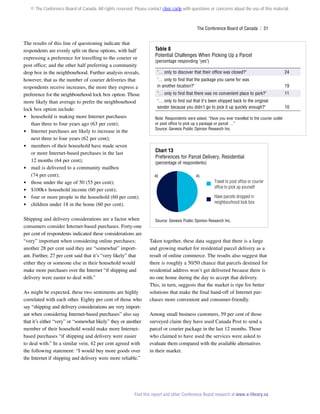
to reduce some of their environmental impact by using
less paper. Scotiabank, for instance, reported that its use

The Canadian Press, “Mobile Banking.”

Find this report and other Conference Board research at www.e-library.ca
For the exclusive use of Tracey Lauriault, tlauriau@gmail.com, Carleton University.

14  |  The Future of Postal Service in Canada—April 2013

of paper for marketing direct mail plummeted from
165 tonnes in 2010 to 92 tonnes in 2011—a drop of
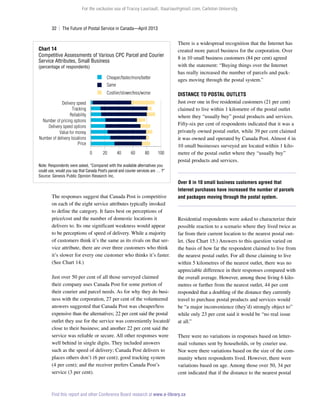
44 per cent in a single year.6
In the advertising business, Canada Post has some
unique attributes that enable it to charge premium rates
for specific markets. One major retailer, for example,
said in an interview that it heavily uses flyers, but chooses
Canada Post for only about 10 per cent of its total volume.
Canada Post’s universal delivery network enables the
retailer to connect with certain customers that it would
otherwise be unable to reach or target, but Canada
Post’s costs are more than triple that of distribution
via newspaper.
Another mailer we interviewed cited Canada Post’s
ability to target customers down to the route level as key,
but noted that newspapers are beginning to improve service in this area. Another praised Canada Post’s unique
degree of access to customers in apartment buildings
and condominiums. For large firms, mail is but one
channel among many marketing options, and cost is
critical. One mailer told us: “If I can find a distributor
who can do 80 per cent of what we can do with Canada
Post, I’ll move.”
As sources of competition for Admail in the future,
magazines, TV, radio, and newspapers (for ad placement) are not considered to be increasing threats. In
fact, the difficulties that magazine and newspapers have
had in terms of their own physical distribution may present
a mild opportunity. Meanwhile, the decline in newspaper
distribution also provides a particular opportunity for
unaddressed Admail, which competes almost directly
with newspapers in distribution.
The total amount of advertising spending in Canada (on
sources other than Admail) is forecast to grow from just
under $11 billion in 2011 to over $12 billion in 2014.7
What is striking is the rise of Internet advertising spending as a share of the total, which is forecast to increase
from 25 to 35 per cent over the same period, overtaking
TV for the top spot. (See Chart 2.)

Chart 2
Canadian Advertising Expenditure Share of Total
(per cent)

Newspapers

Radio

Magazines

Outdoor

TV

Internet
Forecast

40
30
20
10
0
2000

02

04

06

08

10

12f

Source: ZenithOptimedia.

Like all forms of traditional advertising, Admail (both
addressed and unaddressed) faces competition from the
various forms of Internet advertising, more specifically:
 Online display. Advertising spending on online display (such as web banners) reached $800 million in
2011 and is expected to exceed $1.1 billion in 2014.
Online display advertising has grown significantly
more sophisticated in its ability to target individuals
according to demographics, location, search history,
etc.—contributing to its ongoing growth. And while
display ads may not have the “staying power” of
physical flyers (which can sit on a coffee table as a
reminder), they are increasingly able to perform this
role by appearing on websites that are visited by
individuals multiple times per day. Moreover, the
lower visibility is offset by low cost per ad relative to
Admail (roughly $20 to $50 per thousand visitors).8
 Online video. The ad spend on online video is relatively small, sitting at $80 million in 2011. But this
is expected to quadruple by 2014 due to increasing
use of streaming video. This is considered to be a
direct threat for TV advertising spending.
 Internet classified. One of the “oldest” forms of
Internet advertising spending, Internet classified hit
$600 million in 2011. But as a result of its maturity,

6	Scotiabank, Paper—Measuring and Reducing Paper Consumption.
7	Barnard, ZenithOptimedia Releases September 2012 Advertising
Expenditure Forecasts, 47.

14f

8	ZenithOptimedia, Americas Market  MediaFact, 62.

Find this report and other Conference Board research at www.e-library.ca
© The Conference Board of Canada. All rights reserved. Please contact cboc.ca/ip with questions or concerns about the use of this material.

The Conference Board of Canada  | 15

it is considered to have more or less peaked as it
has captured most of the market from newspapers
and other traditional sources.
 Online search. The largest share of Internet ad spend
goes to online search, reaching $1.1 billion in 2011.
The spending is expected to grow at an accelerating
pace, eventually exceeding $1.8 billion in 2014. This
is partly due to the growing sophistication of online
search as a tool to target individuals according to a
range of characteristics. (See Chart 3.)
 E-mail. Spending on e-mail advertising has declined
from its modest peak of $20 million in 2006. Despite
its superficial similarities to addressed Admail, e-mail
is, for the most part, not an effective substitute due
to spam filters and generally low open rates. It is
much cheaper, but also seen as less reliable because
of the risk of fake or mistaken addresses. As well,
there is uncertainty over whether a customer has
received a message and when, if ever, the e-mail
gets opened and read. One marketing executive we
interviewed said that experiments showed that the
optimal approach involved a combination of
physical and electronic messages.
 Mobile. Mobile advertising spending (targeting smartphones and tablets largely through applications that
users install) is currently small. But it is expected to
become the fastest-growing segment of advertising
spending (both within Internet spending and otherwise). This is due to the rapid adoption of mobile
devices, the increasing amount of time that consumers spend using the devices, and the growing number
of applications that consumers install for “free.” In
many ways, mobile advertising is a direct competitor
for both addressed and unaddressed Admail. That’s
because consumers can be targeted not only by residential location but also by their physical location
at a particular time of day for alerts regarding coupons, special promotions, entertainment events, etc.
Moreover, like addressed Admail, mobile advertising
can target individuals within a household better than
most other forms of Internet advertising spending (due
to the usually exclusive use of mobile devices).

Chart 3
Canadian Internet Advertising Expenditure
($ millions)

Display

Search

Video

E−mail

Classified

Mobile
Forecast

2,000
1,500
1,000
500
0

04 05 06 07 08 09 10 11 12f 13f 14f
f = forecast
Source: ZenithOptimedia.

Publications
Canada Post generates revenue through the distribution of
publications such as magazines, newspapers, and newsletters. All are facing intense pressure from electronic
alternatives, which will affect the expected revenue
associated with their physical distribution. Growing
competitive threats to the physical distribution of publications can be categorized in two general categories:
 General electronic content. As individuals spend more
time consuming information online, their appetite for
traditional physical periodicals has waned. The decline
in physical newspaper and magazine circulation is a
direct result of this. Canada Post has already felt the
effects of this decline as its publication distribution
volumes have fallen from a peak of 536 million in
2006 to 431 million in 2011.This trend is expected
to continue.
 Digital replicas. To combat the decline in physical
distribution, publishers have attempted to steer readers
to corporate websites offering the same or similar
content. More recently, the trend has been toward
“digital replicas,” which offer not only the same
content but the exact look and layout of the physical

Find this report and other Conference Board research at www.e-library.ca
For the exclusive use of Tracey Lauriault, tlauriau@gmail.com, Carleton University.

16  |  The Future of Postal Service in Canada—April 2013

rate structure. Another was blunter: “The way the rates
are structured in Canada motivates me to do everything
in my power not to use Canada Post.”

Table 2
Canada Post Segment and Purolator Parcel Volumes
and Revenues
Canada Post
2003

2010

Purolator
2003

2010

Volume (millions)

162

143

129

143

Revenue ($ millions)

991

1,275

1,079

1,493

Yield ($/parcel)

6.12

8.92

8.36

10.44

Source: Canada Post Corporation.

periodicals. These replicas are mainly intended for
tablets, but can also be read on smartphones and personal computers. Digital replicas (as well as general
electronic content consumed through tablets, e-readers,
and smartphones) add potential for an even more rapid
shift away from physical distribution of periodicals.
While data for Canadian digital replica distribution are
not available, the trend in the U.S. is indicative of what is
to come. For example, 7 of the top 25 consumer magazines (rated by circulation) in the U.S. had digital replicas
as of June 2012. Of the seven, two—Game Informer
magazine and Maxim— have seen their digital replica
distribution exceed 10 per cent of their total circulation.9 Other magazines, such as Reader’s Digest and
O (the Oprah magazine), that do not necessarily target
younger demographics have also released digital replicas, suggesting that this will likely be more than a
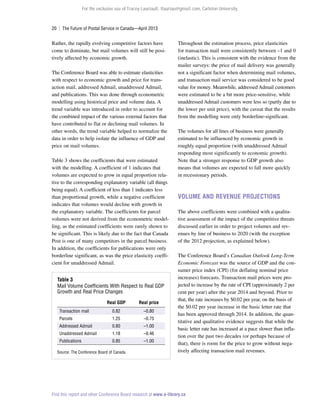
niche phenomenon.
Canada Post’s publication volume also is being affected by
a shift in federal policy. The government used to subsidize postal rates for publications. Instead, it now offers a
general subsidy to magazines. This has given publishers
a strong incentive to encourage newsstand sales rather
than mailed subscriptions—especially for magazines
using high-quality glossy paper and inserts. On this
subject, one publisher we interviewed pointed to what
he called a “penalty box” (much higher rates for publications that weigh more than 200 grams) in Canada Post’s

9	Lulofs, The Top 25 U.S. Consumer Magazines.

Parcels
In Canada, as elsewhere, the parcel business is the
exception to the downward trend. E-commerce is having
a major upward impact on parcel volume. One e-commerce
firm said its parcel volume is doubling every year, and
it expects that growth trend to continue for at least the
next five years. For e-commerce fulfillment, both the
speed and frequency of delivery are important for customer satisfaction. That said, customers have shown little interest in paying extra for faster delivery options.
Despite the fact that Canada Post’s monopoly does not
cover parcel service, it has been sharing in this rising
overall market. The Canada Post group actually competes
for parcels through two vehicles, its postal segment and
its Purolator courier business. On this score, Purolator
has, to date, been more successful. (See Table 2.)

In Canada, as elsewhere, the parcel business is the
exception to the downward trend—e-commerce is having
a major upward impact on parcel volume.

One major shipper mentioned having moved from
exclusive reliance on Canada Post to heavy reliance on
a private sector competitor and then back to the Canada
Post group. The factors in returning to Canada Post were
its stronger on-time performance, reduction in the proportion of damaged shipments, and initiation of improvements such as signature service and the ability to track
and trace shipments.
As with other major mailers, the 2011 labour disruption
was highly damaging, leading to lost sales as well as
delayed shipments. Shippers, however, do have both
short- and long-term alternatives and can factor the risk of
labour disruption into their choice of delivery company.
One Canada Post customer mentioned hedging its bets
by signing a combination agreement with both Canada
Post and Purolator.

Find this report and other Conference Board research at www.e-library.ca
© The Conference Board of Canada. All rights reserved. Please contact cboc.ca/ip with questions or concerns about the use of this material.

The Conference Board of Canada  | 17

Canada Post is seen as having an important convenience
advantage in parcel delivery. There is a strong desire for
even better delivery options, including weekend delivery,
more secure lockboxes, and a “guaranteed leave at door”
option for low-value shipments. But shippers see Canada
Post as providing much more convenient pickup locations than other parcel or courier companies for recipients who are not at home when a parcel is delivered.

Other Trends Affecting
the Competitive Outlook
The rapid change in adoption of new technologies highlights the difficulty in projecting the change in mail volumes in even the near term. For example, global tablet
sales are expected to have nearly doubled in 2012 to a
total of 119 million units.10 In Canada, the trend is similar, with tablet sales up by 79 per cent in 2012.11 And
most or all of this growth has come in addition to (not
at the expense of) PC sales,12 indicating that tablets are
substitutes for other consumer goods (such as newspapers and magazines) more than they are for PCs.
Meanwhile, smartphones are becoming ubiquitous, and
Canadians are changing the way in which they use their
smartphones. Smartphone penetration in Canada reached
54 per cent of the mobile market in May 2012, up from
36 per cent in 2011.13 And among those smartphone
owners, the average user is accessing mobile content
more often.14 In other words, more people are buying
smartphones and those who own them are using them
more intensively.
Despite the rapid rise in tablet and smartphone penetration,
Canada is actually behind the curve in terms of wireless
adoption and smartphone penetration. For example, the
overall wireless penetration rate (the number of wireless

10	 ITBusiness Staff, Global Tablet Sales Will Double to 119M.
11	 NPD Group, Tablet Makers Climbing Apple’s Tree.

subscribers, including smartphones and “dumbphones,”
relative to the total population) is expected to hit 100 per
cent in Canada within the next three years. However,
this rate was already achieved in the United States in
2010. And the rate of smartphone penetration is significantly higher in countries such as Sweden, Hong Kong,
and Singapore.15
What does this all mean for other forms of communication? These new technologies will inevitably attract
a greater share of the total advertising spending as
Canadians adopt and spend more of their time using
them. Furthermore, they open the door for more sophisticated and targeted forms of advertising. For example,
display advertising (both on traditional PCs and tablets/
smartphones) are becoming more “social” in that they
are able to cater directly to users’ interests and current
situations. This has, in part, allowed coupon sites to
make big gains, as they are able to target their intended
audience more precisely.

Mobile technologies will inevitably attract a greater share
of the total advertising spending as Canadians adopt and
spend more of their time using them.

Other highlights of the disruptive impact of mobile
technology on all forms of print and other advertising
include16 the following:
 Canadians aged 55+ are the largest growth segment
of online users by age.
 The hours per visitor on social networking sites is
up across the board (diverting attention from traditional media).
 YouTube videos per viewer were up 170 per cent in
2011, which is significant given the relative infancy
of online video advertising.
 About 1.4 million Canadians scanned QR codes
(a type of bar code) with mobile devices at least
once a month in 2012, primarily for product info,
but also for “clipping” coupons.

12	 NPD Group, Optimistic Start to 2012 for Canadian PC Market.
13	 J.D. Power and Associates, 2012 Canadian Wireless Total
Ownership Experience Study.

15	Knowlton, Canada to Surpass 100 Per Cent Wireless
Penetration Rate.

14	Hardy, comScore; “Smartphone Penetration Has Reached
45 Per Cent of the Canadian Mobile Market.”

16	comScore, comScore Releases the “2012 Canada Digital Future
in Focus” Report.

Find this report and other Conference Board research at www.e-library.ca
For the exclusive use of Tracey Lauriault, tlauriau@gmail.com, Carleton University.

18  |  The Future of Postal Service in Canada—April 2013

Traditional print media and retailers are attempting to
make use of these technologies to avoid being left behind.
The trend of subsidizing digital devices in exchange
for an ongoing subscription commitment is an example.
Barnes and Noble now discounts its Nook e-readers and
tablets when the customer commits to a digital New

York Times subscription.17 The Times (U.K.) is making
a similar offer to customers who purchase Google’s
Nexus 7 tablet.18
17	Melanson, Barnes  Noble Offers Discounted Nooks.
18	Smith, The Times UK Offers Digital Newspaper Subscriptions.

Find this report and other Conference Board research at www.e-library.ca
© The Conference Board of Canada. All rights reserved. Please contact cboc.ca/ip with questions or concerns about the use of this material.

Chapter 4

The Outlook for Canada Post
variables. This was, in large part, due to the rapid
change in technologies and market dynamics—the
overwhelming factors that have contributed to the change
in mail volumes. However, the impact of changing prices
and overall economic activity (that is, GDP) were determined to be significant. As such, our projections make
use of price projections and GDP in order to project
mail volumes. The rest are explained by our analysis
of competitive threats (as well as opportunities). This
is similar to the approach that was taken by the Boston
Consulting Group for the purpose of projecting U.S.
Postal Service mail volumes.

Chapter Summary
 Our projection suggests that Canada Post’s
advertising mail and publication volumes will
decline 26 per cent, and transaction mail
27 per cent, between 2012 and 2020.
 Parcel volume will buck the downward trend
and is projected to increase by 26 per cent
by 2020.
 While the Crown corporation’s Postal
Transformation initiative will have a significant
positive impact, the annual operating loss for
its Canada Post segment is projected to reach
about $1 billion by 2020.

T

he Conference Board has combined competitive threat assessment with an econometric
approach to project mail volumes and revenues
by line of business. The econometric approach used
time series data and tested a range of socio-economic
indicators as explanatory variables. In addition, a panel
set of international data was also tested.
While there were correlations between demographic
data (such as population shares by date of birth) and
mail volumes, they were not significant as explanatory

The Conference Board has a long-term forecast for
NAICS industry classifications 491 and 492 from its
national macroeconomic model. This forecast combines
postal and courier GDP, so is of limited use for the purpose of projecting mail volumes by line of business.
However, it is worth noting that the overall outlook for
the combined industry is mildly positive, with real GDP
expected to grow by approximately 1 per cent per year
through 2017. This is primarily the result of the growing courier segment, which is expected to more than
offset the overall decline in transaction and Admail.
Although it became clear from the econometric analysis
that growth in mail volumes has been decoupled from
general economic growth, this is not to say that mail
demand no longer depends on economic growth.

Find this report and other Conference Board research at www.e-library.ca
For the exclusive use of Tracey Lauriault, tlauriau@gmail.com, Carleton University.

20  |  The Future of Postal Service in Canada—April 2013

Rather, the rapidly evolving competitive factors have
come to dominate, but mail volumes will still be positively affected by economic growth.
The Conference Board was able to estimate elasticities
with respect to economic growth and price for transaction mail, addressed Admail, unaddressed Admail,
and publications. This was done through econometric
modelling using historical price and volume data. A
trend variable was introduced in order to account for
the combined impact of the various external factors that
have contributed to flat or declining mail volumes. In
other words, the trend variable helped to normalize the
data in order to help isolate the influence of GDP and
price on mail volumes.
Table 3 shows the coefficients that were estimated
with the modelling. A coefficient of 1 indicates that
volumes are expected to grow in equal proportion relative to the corresponding explanatory variable (all things
being equal). A coefficient of less than 1 indicates less
than proportional growth, while a negative coefficient
indicates that volumes would decline with growth in
the explanatory variable. The coefficients for parcel
volumes were not derived from the econometric modelling, as the estimated coefficients were rarely shown to
be significant. This is likely due to the fact that Canada
Post is one of many competitors in the parcel business.
In addition, the coefficients for publications were only
borderline significant, as was the price elasticity coefficient for unaddressed Admail.
Table 3
Mail Volume Coefficients With Respect to Real GDP
Growth and Real Price Changes
Real GDP

Real price

Transaction mail

0.82

–0.80

Parcels

1.25

–0.75

Addressed Admail

0.80

–1.00

Unaddressed Admail

1.18

–0.46

Publications

0.85

–1.00

Source: The Conference Board of Canada.

Throughout the estimation process, price elasticities
for transaction mail were consistently between –1 and 0
(inelastic). This is consistent with the evidence from the
mailer surveys: the price of mail delivery was generally
not a significant factor when determining mail volumes,
and transaction mail service was considered to be good
value for money. Meanwhile, addressed Admail customers
were estimated to be a bit more price-sensitive, while
unaddressed Admail customers were less so (partly due to
the lower per unit price), with the caveat that the results
from the modelling were only borderline-significant.
The volumes for all lines of business were generally
estimated to be influenced by economic growth in
roughly equal proportion (with unaddressed Admail
responding most significantly to economic growth).
Note that a stronger response to GDP growth also
means that volumes are expected to fall more quickly
in recessionary periods.

Volume and Revenue Projections
The above coefficients were combined with a qualitative assessment of the impact of the competitive threats
discussed earlier in order to project volumes and revenues by line of business to 2020 (with the exception
of the 2012 projection, as explained below).
The Conference Board’s Canadian Outlook Long-Term
Economic Forecast was the source of GDP and the consumer price index (CPI) (for deflating nominal price
increases) forecasts. Transaction mail prices were projected to increase by the rate of CPI (approximately 2 per
cent per year) after the year 2014 and beyond. Prior to
that, the rate increases by $0.02 per year, on the basis of
the $0.02 per year increase in the basic letter rate that
has been approved through 2014. In addition, the quantitative and qualitative evidence suggests that while the
basic letter rate has increased at a pace slower than inflation over the past two decades (or perhaps because of
that), there is room for the price to grow without negatively affecting transaction mail revenues.

Find this report and other Conference Board research at www.e-library.ca
© The Conference Board of Canada. All rights reserved. Please contact cboc.ca/ip with questions or concerns about the use of this material.

The Conference Board of Canada  | 21

Table 4
Projected Mail Volume to 2020, by Product

(millions of pieces)	

2012

2013

2014

2015

2016

2017

2018

2019

2020

4,070

3,888

3,725

3,596

3,460

3,324

3,204

3,082

2,966

110

113

117

121

124

128

131

134

139

Addressed Admail

1,229

1,186

1,148

1,108

1,065

1,023

986

948

912

Unaddressed Admail

3,320

3,202

3,094

2,984

2,870

2,756

2,654

2,552

2,455

414

400

387

374

359

345

332

320

307

Domestic transaction mail
Domestic parcels

Publications

Source: The Conference Board of Canada.

Other lines of business were projected to see price
increases of approximately 2 per cent per year in nominal terms, roughly in line with the long-term outlook
for CPI growth.
The projection for 2012 was based solely on the volume
and price trends through 2012 Q3. Through the first three
quarters in 2012, domestic transaction mail volumes had
declined by 6.3 per cent relative to the same period in
2011. However, the rate of decline worsened in Q3, with
year-on-year volumes declining by 9.5 per cent relative
to Q3 of 2011. In order to complete the projection for
2012, 2012 Q4 volumes were projected to change at the
same rate as 2012 Q3 volumes had over the same quarter
the previous year. This approach was taken in order to
control for the fact that 2011 Q2 volumes were negatively
affected by the strike. The same approach was taken for
projecting volumes for the other lines of business.
Transaction mail is projected to decline by 27 per cent
between 2012 and 2020. Addressed and unaddressed
Admail and publications are projected to decline by a
similar 26 per cent. Only parcel volume bucks the trend,
with projected volume up by 26 per cent over the same
period. Given the low base of parcel volume relative to
other products, this is not enough to change the overall
downward trend in volume. (See Table 4.)
The most recent volume figures in 2012 indicate an
even more rapid decline than in previous years. There
are too few data points to determine if this represents
an acceleration of the trend. But this does suggest that
some of the newer technological factors may be taking

Chart 4
Projected Mail Volume to 2020
(millions of pieces)

Domestic transaction mail

Unaddressed Admail

Domestic parcels

Publications

Addressed Admail
Projection
5,000
4,000
3,000
2,000
1,000
0
2012p 13p 14p 15p 16p 17p 18p 19p 20p
p = projection
Source: The Conference Board of Canada.

hold even more quickly than anticipated. Therefore,
the rate of decline projected here may be conservative.
(See Chart 4.)
The Canada Post Group includes businesses such as
Purolator that compete in an open market. The Canada
Post segment includes transaction mail, Admail, publications, and the Canada Post parcel business. As shown
in Table 5, the Canada Post segment accounted in 2011
for 78 per cent of the group’s total revenue and 80 per
cent of its costs.
One-time factors, including a labour disruption that
shut down the postal system for 25 days and a pay
equity decision from the Supreme Court of Canada,

Find this report and other Conference Board research at www.e-library.ca
For the exclusive use of Tracey Lauriault, tlauriau@gmail.com, Carleton University.

22  |  The Future of Postal Service in Canada—April 2013

Chart 5
Projected Net Loss From Operations to 2020

Table 5
2011 Operating Results

($ millions)

($ millions)

Canada Post segment
Revenue

5,861

7,484

Costs

6,189

7,710

Operating income

–328

Baseline with PT plan savings included

Total

–226

Source: The Conference Board of Canada; Canada Post Corporation.

Projection
0

Baseline without PT plan savings

−500
−1,000
−1,500

contributed heavily to the operating loss in 2011.1
Operating income includes the expense portion of pension and other employee future benefits, but excludes the
longer-term impact of the significant deficit in Canada
Post’s pension plan. This report and its scenarios focus
exclusively on the Canada Post segment, because this is
the business that is constrained by public policy.
This projection of mail volumes leads to a very negative
outlook for Canada Post revenues and for its bottom line.
The start of our projection period includes the anticipated
negative impact of a planned change in the accounting for
current costs associated with providing future employee
benefits. From this base, the Conference Board projected
two scenarios.
The first is a “business as usual” outlook that does not
include the impact of the Postal Transformation initiative, either in terms of savings realized through 2012 or
those that are expected through 2017. This first scenario
effectively maintains the labour force at its current level,
meaning that retirees and other leavers are replaced on
an ongoing basis.
The second scenario includes both the realized and
expected impact of the Postal Transformation (PT)
initiative. This recognizes the impact of the actions that
Canada Post management already has launched, with
the objective of significantly improving efficiency and
reducing costs through the application of leading-edge
technologies. This scenario is the one used as the baseline against which all additional options are measured.
(See Chart 5.)
1	

Canada Post Corporation, Transformation, 5.

2012p 13p 14p 15p 16p 17p 18p 19p 20p
p = projection
Source: The Conference Board of Canada.

The Postal Transformation initiative will have a significant impact in improving financial performance, but the
Conference Board projects that the annual operating
loss still will reach about $1 billion by 2020.
It is possible that Canada Post could offset some of
these losses in its current core business lines through
increased profits in other activities. These activities
include growth of its existing Purolator courier service,
development of electronic postal products, or entry into
new lines of business that could leverage its expertise
and physical assets.

Despite its major investments in technology to cut costs
and improve efficiency, Canada Post’s annual operating
loss is projected to reach $1 billion by 2020.

However, Canadians should be careful not to rely on
competitive, profit-oriented activities within the broader
Canada Post group as a means of financially sustaining
postal services. First, there is no way to guarantee sustained profitability in rapidly evolving markets. Second,
any Canada Post-owned businesses participating in open
markets must generate competitive financial returns. If
these operations are required to siphon capital into subsidies for postal services, they are more likely to underinvest and fall behind. Third, there is no public policy
rationale for a government-owned business to engage

Find this report and other Conference Board research at www.e-library.ca
© The Conference Board of Canada. All rights reserved. Please contact cboc.ca/ip with questions or concerns about the use of this material.

The Conference Board of Canada  | 23

in a competitive sector solely to generate profits to subsidize public services. Whether subsidies are delivered
by having governments forego dividends on investments
or by handing over cash from general tax revenues, the
net effect on the public purse is the same.

efficiency. The projections developed by the Conference
Board suggest that incremental improvements are no
longer sufficient to sustain the existing postal network
and level of service in the face of growing competitive
pressures from electronic technologies.

Until 2011, Canada Post was able to deliver on its service
obligations to Canadian residential and business customers while also meeting its legislated mandate to operate
at a profit. This financial performance has required steady
increases in stamp prices and relentless efforts to improve

Instead, addressing the looming financial shortfall
requires a fundamental examination of which kind of
postal services Canadians still need, and which changes
to the postal business model could enable those services
to sustain themselves over time.

Find this report and other Conference Board research at www.e-library.ca
For the exclusive use of Tracey Lauriault, tlauriau@gmail.com, Carleton University.

Chapter 5

Expectations and Use
of Postal Service
Chapter Summary
 Household and small business customers
are using mail less frequently. Almost half of
households send two pieces of mail or less
each month.
 Both groups of customers see the current price
of a stamp as good value, and are willing to
tolerate slower service than they now receive.
What matters most is the certainty that mail
will be delivered to its intended destination.
 E-commerce is increasing the demand for
parcel delivery. However, having to travel to
pick up parcels when no one is home to accept
delivery is a growing source of frustration.
 Many customers, especially in rural areas,
would be significantly inconvenienced if the
distance to the nearest postal outlet was
doubled. But most are highly satisfied with
the retail service they receive, whether from
a corporate or franchised outlet.
 Most Canadians believe that despite the
spread of electronic communications, they
always will need postal service and recognize
the need for some degree of change.

T

his chapter describes the responses of Canadian
residential and small business customers to questions about their expectations and actual use of
postal service, about their perceptions of the challenges
facing Canada Post, and about how they might react to
various potential avenues for addressing those challenges.

How the Use of Postal Services
Is Changing
The surveys confirm that traditional forms of paperbased communications are increasingly being overtaken
by electronic forms of communication. Almost half of
households surveyed (47 per cent) said they are sending
less mail today than three to four years ago. Slightly
more (49 per cent) said they are sending about the
same amount of mail. Only 3 per cent claimed to
be sending more mail.
As for incoming mail, just over half of those surveyed
(51 per cent) said that their household currently receives
about the same amount of lettermail that it used to “three
to four years ago.” However, one-third claimed that their
household receives less mail than it used to, while half
that number (17 per cent) said they receive more.

Find this report and other Conference Board research at www.e-library.ca
© The Conference Board of Canada. All rights reserved. Please contact cboc.ca/ip with questions or concerns about the use of this material.

The Conference Board of Canada  | 25

When asked to estimate how many letters, cards, bill
payments, or other regular mail their household would
send out in an average month, 17 per cent of respondents
said “none”; and 30 per cent said their household sent
an average of either 1 piece (16 per cent of respondents)
or 2 pieces (14 per cent) through the system. Taken
together, these results suggest that almost half of all
Canadian households send no more than two pieces of
mail through the postal system each month, with close
to one in five households claiming they don’t send any.
At the other extreme, 9 per cent indicated they sent
more than 10 pieces each month, and 4 per cent said
they sent 20 or more pieces. (See Chart 6.)
Not surprisingly, businesses on average send considerably more mail than households, and the larger the
company, the more mail it sends. (See Table 6.)
Chart 6
Estimated Monthly Lettermail Volume, Residential

20
15
10
5
0
1

2

3

4

5

Declining use is also evident in terms of the amount of
mail received by small businesses. Forty-six per cent
claimed they were receiving the same amount of mail
today as they had in the last three to four years. However,
40 per cent said they were receiving less, and only 13 per
cent said they were receiving more.
Financial Transactions
Patterns of mail use are connected with how businesses
and households handle financial transactions. The residential segment’s relatively low and declining use of the
postal system for Canada Post’s traditional lettermail
product is evidenced by answers to questions asking
respondents how they typically pay for monthly household expenses, such as credit card and utility bills. This
was followed up by a question asking how many of those
kinds of monthly household expenses they pay online.
Fully three-quarters of those surveyed claimed they
don’t pay any of those monthly household expenses
using the mail system. (See Chart 7.)

(number of pieces per household; percentage
of respondents)

None

Like households, businesses’ use of the system seems to
be declining. Just over one-third of businesses surveyed
claimed their business was sending out less mail than
they were three to four years ago. Almost half (46 per
cent) claimed their business was sending the same amount,
while 14 per cent claimed they were sending more mail.
Looking ahead over the next three to five years, a majority (73 per cent) expect their business to use Canada
Post’s regular mail service “about the same” as they do
now. However, the number that expects use of the system
to decline is double the number of those who believe
their use of regular mail is likely to increase.

6−10 11−19 20

Note: Respondents were asked “Approximately how many
letters, cards, bill payments, or other regular mail do you think
your household would send out through the postal system in
an average month?”
Source: Genesis Public Opinion Research Inc.

Table 6
Business Lettermail Volume

(number of pieces; number of employees; per cent)

Number of full-time employees
Number of Pieces

2–5

6–10

11–24

25–50

51–100

25

47

29

20

12

10

25–50

30

25

27

16

9

51–100

12

22

15

23

14

100+

11

24

38

50

67

Source: Genesis Public Opinion Research Inc.

Find this report and other Conference Board research at www.e-library.ca
For the exclusive use of Tracey Lauriault, tlauriau@gmail.com, Carleton University.

26  |  The Future of Postal Service in Canada—April 2013

Chart 7
Method of Paying Monthly Household Bills

(percentage of respondents)

Payment by Mail

Payment Online

80

50

60

20

40
30
20
10

0

0

40

All

Most

Only some

None

All

Only some

None

Note: In the chart on the left, respondents were asked, “How many of your monthly household bills (e.g., credit cards, phone, electricity) do
you pay by mail?” In the chart on the right, respondents were asked, “How many of those monthly household bills do you pay online?”
Source: Genesis Public Opinion Research Inc.

For small businesses, lettermail is used primarily for
communicating with clients or customers. Over 40 per
cent of the small businesses surveyed said that “all” of
the letters they send in a given month are sent to their
customers or clients.
As for what they are sending to their customers and
clients, the results make it clear that the postal system
remains an integral part of how small businesses send
invoices and collect payments. Fully 70 per cent of the
small businesses interviewed claimed to use the mail
for the purposes of billing clients. Of that number, 29 per
cent said they send “all” their invoices through the mail.
At the other extreme, just over one-quarter (26 per cent)
claim to send no more than half of their invoices through
the mail. (See Chart 8.)
Chart 8
Estimated Customer Invoices Sent Via Lettermail
(number of invoices; percentage of respondents)
4

1−24

18

25−49

29

8

50−74
75−99

13
28

While 70 per cent say they use the postal system to send
client invoices, more than that claim that the postal system delivers client payments to their business. Eightytwo per cent of respondents said they received client
payments through the mail, suggesting that even though
some clients may get an invoice by another means, they
nonetheless pay it by mail. Almost two-thirds of small
businesses surveyed indicated that a minimum of half
of all their client and customer payments come through
the mail, including almost 1 in 10 respondents who
indicated that “all” their company receivables come via
the mail.
More important than the volume of payments received by
businesses is the value of those payments. Respondents
were asked to estimate the percentage of their company’s
total monthly income that comes via the mail, and 40 per
cent estimated that their company receives at least half of
its total monthly income through the mail. This includes
22 per cent of companies that claim they receive at least
three-quarters of their income via the mail and another
4 per cent that claim all their monthly income is received
via the postal system. One-quarter of those surveyed
didn’t know what percentage of monthly income came
that way.

100
Don’t know

Note: Respondents were asked “Approximately what percentage of
all your customer invoices would be sent out through the mail?”
Source: Genesis Public Opinion Research Inc.

Over 80 per cent of those surveyed claim to receive
payment through the mail from clients and customers.
Almost two-thirds claimed that a minimum of half or
more of their total number of payments are received

Find this report and other Conference Board research at www.e-library.ca
© The Conference Board of Canada. All rights reserved. Please contact cboc.ca/ip with questions or concerns about the use of this material.

The Conference Board of Canada  | 27

through the mail, and 40 per cent claimed that a minimum of half their firm’s monthly income comes to them
via the mail. These findings suggest that the postal system remains an important aspect of the commercial
operations of small business.

Small businesses were more likely to have an accurate
sense of stamp prices, but only 38 per cent of those surveyed correctly volunteered $0.61 when asked to identify
the cost of a 2012 stamp. That number was only slightly
above the number who said they “don’t know” what a
stamp costs.

What Canadians Expect and Value

Among business customers, the ability to correctly identify
the cost of a stamp is related to the number of letters sent
in an average month. Among those respondents whose
company sends 100 or more letters a month, 59 per cent
correctly identified the cost of a stamp. Among those
whose company sends less than 25 letters per month, only
14 per cent correctly identified the cost. The same pattern
was observed based on the employee size of the company.
Almost two-thirds (63 per cent) of those from companies
employing between 51–100 people correctly identified
the price of a stamp, almost three times the number
whose company employed 2–5 full-time employees.

Both the residential and small business surveys probed
what Canadians expect from their postal service and
how satisfied they are with the quality and value of the
services they now receive.
Stamp Prices
Only 5 per cent of residential customers surveyed correctly identified the 2012 price of a stamp as $0.61. Almost
half of those surveyed (47 per cent) guessed the price
was $0.60 or less; 15 per cent guessed a stamp was
$0.62 or more, while fully one-third of all those surveyed said they didn’t know the present day cost of
a stamp.

The results suggest that for many Canadians, the value
derived from what a stamp enables its purchaser to do is
comparatively well understood and widely endorsed.

These guesses did not vary in any meaningful way
based on how many pieces of lettermail respondents
claimed their household sent. Nor did they vary much
based on how many monthly household bills are paid
using the mail or paid online. However, there was almost
universal agreement with the following statement: “When
you think about it, being able to send a piece of mail
across the country for $0.61 is an incredible bargain.”
Twenty-three per cent said they “strongly agree” with
that statement; another 64 per cent claimed to “agree.”
These results suggest that for many Canadians, the cost
or price of a stamp is not top-of-mind, but the value
derived from what a stamp enables its purchaser to do
is comparatively well understood and widely endorsed.

Regardless of the variability in estimates of the cost of a
stamp, business respondents overwhelmingly conceded
the value associated with lettermail. Just over 80 per cent
of those interviewed agreed with the proposition, “When
you think about it, being able to send a piece of mail
across the country for $0.61 is an incredible bargain.”
Delivery Standards
Respondents to both the household and small business
surveys were asked what they believed would be “an
acceptable length of time” for Canada Post to deliver
lettermail across town, across the province, and across
the country. They were then asked, “How long would
you be prepared to give Canada Post to deliver a letter”
across each of those three distances “before you would
seriously consider sending it another way?” In each
case, the results suggest that Canadians are prepared to
give Canada Post more time than they think it currently
takes to deliver a letter.
Only 17 per cent of residential respondents volunteered
“one day” or “next day” when asked what they considered
to be “an acceptable length of time for Canada Post to
deliver a regular letter from one side of a large city to
the other side.” A further 43 per cent volunteered “two
days.” The average response was 2.4 days. (See Chart 9.)

Find this report and other Conference Board research at www.e-library.ca
For the exclusive use of Tracey Lauriault, tlauriau@gmail.com, Carleton University.

28  |  The Future of Postal Service in Canada—April 2013

response was 3.7 days, more than a day longer than
answers to the original question probing the length of
time considered to be acceptable in the first place.

Chart 9
Lettermail Performance vs. Expectations: Cross-Town
Delivery, Residential

(number of days; percentage of respondents)

Percentage of residential respondents who consider the
length of time acceptable for CPC to deliver lettermail
across a large city
Percentage of residential respondents who consider the
length of time acceptable for CPC to deliver lettermail
across a large city before considering other alternatives
50
40
30
20
10
0
Next day

2 days

3 days

4−5 days

6+ days

DK/NO

Source: Genesis Public Opinion Research Inc.

Chart 10
Lettermail Performance vs. Expectations: Cross-Country Delivery,
Residential
(number of days; percentage of respondents)

Percentage of residential respondents who consider the
length of time acceptable for CPC to deliver lettermail
across the country
Percentage of residential respondents who consider the
length of time acceptable for CPC to deliver lettermail
across the country before considering other alternatives
35
30
25
20
15
10
5
0
2 days

3 days

4 days

5 days

6−7 days

8 days
or more

DK

Source: Genesis Public Opinion Research Inc.

When asked how long they would be prepared to give
Canada Post to deliver before looking for an alternative,
fully 56 per cent of residential customers claimed they
would be prepared to give Canada Post three days or
more to deliver a letter across a large city. The average

Respondents were asked similar questions for lettermail
delivery across the province, and from one end of the
country to the other. The pattern observed from “crosstown” delivery repeated itself for “cross-country” delivery. (See Chart 10.)
There were no appreciable behavioural variations in
response to these questions. It didn’t matter how many
letters respondents sent, or whether or not they paid
their household expenses online. There were, however,
demographic differences. The biggest difference related
to age. Generally, the younger the respondents, the more
generous they were prepared to be with their timeline
expectations. Conversely, the older the respondents, the
more likely they were to say that longer time frames
were less acceptable.
Similarly, there is considerable evidence that small
business customers may be willing to see the time it
takes to deliver lettermail extended, particularly for
delivery over longer distances. Some 87 per cent of
those surveyed believe Canada Post should be able to
deliver a standard letter “across a large city” within
three days or less. The average number of days considered to be “acceptable” to deliver a letter across a
large city was 2.2 days.
When asked what delivery time they are prepared to
tolerate, small businesses said, on average, that they
could live with a cross-town delivery time of 3.4 days.
As for households, this is more than a full day longer
than answers to the original question probing the length
of time considered to be “acceptable” in the first place.
Again, the pattern was similar for both cross-province
and cross-country delivery. (See Chart 11.)
The results from the series of questions about the speed
of lettermail delivery suggest that there is a gap between
what small business and residential customers consider
to be an “acceptable” delivery time and what they are
nonetheless prepared to accept before they look elsewhere for alternatives.

Find this report and other Conference Board research at www.e-library.ca
© The Conference Board of Canada. All rights reserved. Please contact cboc.ca/ip with questions or concerns about the use of this material.

The Conference Board of Canada  | 29

Cost, Speed, and Reliability
Nine in ten residential respondents agreed with the
proposition, “I’m confident that the things I put in the
mail are going to arrive at their destination,” including
just over one-quarter (27 per cent) who “strongly agreed.”
Quebecers, residents of small town/rural areas, francophones, and those between the ages of 50–64 were more
likely than average to strongly agree with that statement. Those who send more letters than average on a
monthly basis are also more inclined to strongly agree
with that statement.
Just over half those surveyed (53 per cent) agreed with
the proposition, “If something is time sensitive, I don’t
put it in the mail.” Younger Canadians are more likely
to agree with this sentiment than older Canadians, and
those mailing the most letters are more likely to disagree with it. Given that older Canadians report mailing
more letters and paying more household bills via the
mail, this difference is not surprising.
Responses from small businesses were similar. Nine in
ten respondents agreed with the following statement: “I’m
confident that the things I put in the mail are going to
arrive at their destination,” and two-thirds agreed with
the statement, “If something is time sensitive, I don’t
put it in the mail.”
In the context of responses that suggest residential customers are prepared to be relatively generous in terms
of their expectations for speed of lettermail delivery,
these results suggest that certainty of delivery—faith
and confidence that a mailed letter will actually arrive
at its destination—is a significant consideration at play
in determining use of the system.
For business customers, the cost, speed, and reliability
of lettermail delivery are important and interrelated. To
see which of those three service features small business
respondents valued most, a series of questions pitted each
pair of these three features against one another and
asked respondents to pick which of them they considered
to be most important. When the cost of the stamp was
pitted against either the letter’s speed of delivery, or confidence that the letter mailed would reach its intended
destination, cost was far and away the lesser of the concerns. And when speed of delivery was pitted against

Chart 11
Lettermail Performance vs. Expectations:
Cross-Town Delivery, Small Business

(percentage of respondents)

Percentage of small business customers who consider the
length of time acceptable for CPC to deliver lettermail
across a large city

50
40
30

Percentage of small business customers who consider the
length of time acceptable for CPC to deliver lettermail across
a large city before considering other alternatives

20
10
0
Same day Next day

2 days

3 days

4−5 days

6 days DK/NO
or more

Source: Genesis Public Opinion Research Inc.

Table 7	
Factors Influencing the Mailing of a Letter: Small Business Respondents
(percentage of responses)

The cost of the stamp OR

17

How quickly it reaches its destination

76

The cost of the stamp OR

10

How confident you are that it will actually reach its destination

87

How quickly it reaches its destination OR

25

How confident you are that it will actually reach its destination

69

Note: Respondents were asked, “I’d like you to think about mailing a letter….which one
of the following things is most important to you when you mail that letter?”
Source: Genesis Public Opinion Research Inc.

confidence that the letter would reach its destination,
confidence was picked almost three times for every one
instance that speed was chosen. (See Table 7.)
Parcel Service
In contrast to lettermail, Canadians report making
increasing numbers of Internet-based purchases that
need to be shipped to their home. More than one in
four respondents claim that members of their household
made seven or more Internet purchases in the 12 months
prior to the survey. (See Chart 12.)

Find this report and other Conference Board research at www.e-library.ca
For the exclusive use of Tracey Lauriault, tlauriau@gmail.com, Carleton University.

30  |  The Future of Postal Service in Canada—April 2013

Chart 12
Estimated Number of Internet Purchases Shipped
to Purchaser’s Home

(number of purchases; percentage of respondents)

40
30
20
10
0
None

1−6

7−12

13+

Note: Respondents were asked, “Thinking back over the last 12
months, which would include the lead-up to last Christmas, how
many items did members of your household purchase over the
Internet that had to be shipped to your home?”
Source: Genesis Public Opinion Research Inc.

As might be expected, geography, age/life stage, and
socio-economics are demographic factors that influence
Internet purchasing. Those more likely to report that
members of their household have made over six purchases in the last 12 months include:
 household income of $100k+ (46 per cent);
 those with university education (39 per cent);
 children under the age of 6 in the home (38 per cent);
 three or more people in the household (38 per cent);
 those under 50 years of age (36 per cent).
In addition to a significant amount of Internet-based purchasing in the last 12 months, 39 per cent of respondents
indicated that their household Internet purchases have been
“increasing” over the last three to four years. Looking
ahead, 35 per cent of respondents said their household
is likely to “increase” its Internet-based purchasing in
the next three to four years with another 45 per cent
saying it’s likely to “stay the same.”
Those more likely to say Internet-based purchases
are likely to increase include:
 households with children under 6 years old
(55 per cent);
 household income of $100k+ (53 per cent);
 three or more people in household (52 per cent );

 18–34 year olds (51 per cent);
 35–49 year olds (47 per cent );
 college educated (44 per cent).
 those living in cities of 1 million+ people (40 per cent).

Worth noting is the fact that among those who claim
their household’s Internet-based purchases are likely to
increase in the years ahead are many of the same people
who claim to be making more of those purchases now.
Taken at face value, this means that that their estimates
of future behaviour are reasonably dependable, given
that they at least appear to be consistent with reported
current practice.
When packages are delivered to a residential address,
it is common practice for the receiver to be required to
sign a receipt for it. With two-income households now the
norm, a home delivery often goes undelivered because
no one was home to sign for it. Several questions in the
study were designed to examine the issues and potential
for consumer frustration around the successful delivery
of Internet purchases.
When asked how often courier packages were undelivered because no one was home to sign for them, 10 per
cent of respondents said that it happened “all the time.”
Another 14 per cent said it happened “most of the time,”
while 17 per cent said it happened “about half the time.”
Only 22 per cent said it has “never” happened.
Respondents who indicated packages were not delivered
to their home because no one was there to sign for them
were subsequently asked if they had ever travelled to
the courier offices or post office to pick up an undelivered parcel. Eighty-four per cent of them indicated that
they had. Those answering “yes” were asked a series of
follow-up questions in an attempt to quantify the anecdotes of “hit and miss” aggravation that often accompany such episodes. (See Table 8.)
As a possible remedy for the inconvenience associated
with missed home deliveries, respondents were asked to
choose between two options. (See Chart 13.)

Find this report and other Conference Board research at www.e-library.ca
© The Conference Board of Canada. All rights reserved. Please contact cboc.ca/ip with questions or concerns about the use of this material.

The Conference Board of Canada  | 31

The results of this line of questioning indicate that
respondents are evenly split on these options, with half
expressing a preference for travelling to the courier or
post office; and the other half preferring a community
drop box in the neighbourhood. Further analysis reveals,
however, that as the number of courier deliveries that
respondents receive increases, the more they express a
preference for the neighbourhood lock box option. Those
more likely than average to prefer the neighbourhood
lock box option include:
 household is making more Internet purchases
than three to four years ago (63 per cent);
 Internet purchases are likely to increase in the
next three to four years (62 per cent);
 members of their household have made seven
or more Internet-based purchases in the last
12 months (64 per cent);
 mail is delivered to a community mailbox
(74 per cent);
 those under the age of 50 (55 per cent);
 $100k+ household income (60 per cent);
 four or more people in the household (60 per cent);
 children under 18 in the home (60 per cent).
Shipping and delivery considerations are a factor when
consumers consider Internet-based purchases. Forty-one
per cent of respondents indicated these considerations are
“very” important when considering online purchases;
another 28 per cent said they are “somewhat” important. Further, 27 per cent said that it’s “very likely” that
either they or someone else in their household would
make more purchases over the Internet “if shipping and
delivery were easier to deal with.”
As might be expected, these two sentiments are highly
correlated with each other. Eighty per cent of those who
say “shipping and delivery considerations are very important when considering Internet-based purchases” also say
that it’s either “very” or “somewhat likely” they or another
member of their household would make more Internetbased purchases “if shipping and delivery were easier
to deal with.” In a similar vein, 42 per cent agreed with
the following statement: “I would buy more goods over
the Internet if shipping and delivery were more reliable.”

Table 8	
Potential Challenges When Picking Up a Parcel
(percentage responding yes)

… only to discover that their office was closed?

24

… only to find that the package you came for was
in another location?

19

… only to find that there was no convenient place to park?

11

… only to find out that it's been shipped back to the original
sender because you didn't go to pick it up quickly enough?

10

Note: Respondents were asked, “Have you ever travelled to the courier outlet
or post office to pick up a package or parcel …”
Source: Genesis Public Opinion Research Inc.

Chart 13
Preferences for Parcel Delivery, Residential
(percentage of respondents)
48

46

Travel to post office or courier
office to pick up yourself
Have parcels dropped in
neighbourhood lock box

Source: Genesis Public Opinion Research Inc.

Taken together, these data suggest that there is a large
and growing market for residential parcel delivery as a
result of online commerce. The results also suggest that
there is roughly a 50/50 chance that parcels destined for
residential address won’t get delivered because there is
no one home during the day to accept that delivery.
This, in turn, suggests that the market is ripe for better
solutions that make the final hand-off of Internet purchases more convenient and consumer-friendly.
Among small business customers, 59 per cent of those
surveyed claim they have used Canada Post to send a
parcel or courier package in the last 12 months. Those
who claimed to have used the services were asked to
evaluate them compared with the available alternatives
in their market.

Find this report and other Conference Board research at www.e-library.ca
For the exclusive use of Tracey Lauriault, tlauriau@gmail.com, Carleton University.

32  |  The Future of Postal Service in Canada—April 2013

Chart 14
Competitive Assessments of Various CPC Parcel and Courier
Service Attributes, Small Business

(percentage of respondents)

Cheaper/faster/more/better
Same
Costlier/slower/less/worse
Delivery speed
Tracking
Reliability
Number of pricing options
Delivery speed options
Value for money
Number of delivery locations
Price
0

20

40

60

80

100

Note: Respondents were asked, “Compared with the available alternatives you
could use, would you say that Canada Post’s parcel and courier services are … ?”
Source: Genesis Public Opinion Research Inc.

The responses suggest that Canada Post is competitive
on each of the eight service attributes typically invoked
to define the category. It fares best on perceptions of
price/cost and the number of domestic locations it
delivers to. Its one significant weakness would appear
to be perceptions of speed of delivery. While a majority
of customers think it’s the same as its rivals on that service attribute, there are over three customers who think
it’s slower for every one customer who thinks it’s faster.
(See Chart 14.)
Just over 50 per cent of all those surveyed claimed
their company uses Canada Post for some portion of
their courier and parcel needs. As for why they do business with the corporation, 27 per cent of the volunteered
answers suggested that Canada Post was cheaper/less
expensive than the alternatives; 22 per cent said the postal
outlet they use for the service was conveniently located/
close to their business; and another 22 per cent said the
service was reliable or secure. All other responses were
well behind in single digits. They included answers
such as the speed of delivery; Canada Post delivers to
places others don’t (6 per cent); good tracking system
(4 per cent); and the receiver prefers Canada Post’s
service (3 per cent).

There is a widespread recognition that the Internet has
created more parcel business for the corporation. Over
8 in 10 small business customers (84 per cent) agreed
with the statement: “Buying things over the Internet
has really increased the number of parcels and packages moving through the postal system.”
Distance to Postal Outlets
Just over one in five residential customers (21 per cent)
claimed to live within 1 kilometre of the postal outlet
where they “usually buy” postal products and services.
Fifty-six per cent of respondents indicated that it was a
privately owned postal outlet, while 39 per cent claimed
it was owned and operated by Canada Post. Almost 4 in
10 small businesses surveyed are located within 1 kilometre of the postal outlet where they “usually buy”
postal products and services.

Over 8 in 10 small business customers agreed that
Internet purchases have increased the number of parcels
and packages moving through the postal system.

Residential respondents were asked to characterize their
possible reaction to a scenario where they lived twice as
far from their current location to the nearest postal outlet. (See Chart 15.) Answers to this question varied on
the basis of how far the respondent claimed to live from
the nearest postal outlet. For all those claiming to live
within 5 kilometres of the nearest outlet, there was no
appreciable difference in their responses compared with
the overall average. However, among those living 6 kilometres or further from the nearest outlet, 44 per cent
responded that a doubling of the distance they currently
travel to purchase postal products and services would
be “a major inconvenience (they’d) strongly object to”
while only 23 per cent said it would be “no real issue
at all.”
There were no variations in responses based on lettermail volumes sent by households, or by courier use.
Nor were there variations based on the size of the community where respondents lived. However, there were
variations based on age. Among those over 50, 34 per
cent indicated that if the distance to the nearest postal

Find this report and other Conference Board research at www.e-library.ca
© The Conference Board of Canada. All rights reserved. Please contact cboc.ca/ip with questions or concerns about the use of this material.

The Conference Board of Canada  | 33

outlet doubled, it would be a “major inconvenience”
and they’d “strongly object.” The comparable number
for those younger than 50 was only 23 per cent.
Small business respondents also were asked to characterize their possible reaction to a scenario where their
business was located twice as far from its current location to the nearest postal outlet. The respondents were
equally split on the three options. However, two-thirds
indicated they’d either quickly adjust or considered the
prospect “no real issue.” (See Chart 16.)
Questions about distance to nearest post office did not
distinguish between corporate or franchised retail outlets,
but the survey also probed relative rates of satisfaction. In
terms of overall residential customer satisfaction, 83 per
cent of respondents gave the corporate and private outlets
a score of 8 or better on a 0–10 scale. Similarly, 85 per
cent of small business customers gave both corporate
and private outlets a score of 8 or better.

Chart 15
Reaction to Potential Changes in Distance to Nearest
Postal Outlet, Residential

(percentage of respondents)
28
36

A major inconvenience you’d strongly object to
An inconvenience compared with now,
but you would quickly adjust
No real issue at all
35

Note: Respondents were asked, “If the nearest place where you could buy postal products
and services was twice as far away, would that be …”
Source: Genesis Public Opinion Research Inc.

Chart 16
Reaction to Potential Changes in Distance to Nearest
Postal Outlet, Small Business
(percentage of respondents)
32

The Business Case for Change
Responses to a series of questions about the broad
business environment in which Canada Post currently
operates suggest that Canadians have a reasonable understanding of the challenges—though not necessarily their
magnitude—that the corporation currently faces.
By way of example, virtually half (49 per cent) of those
surveyed in the residential study thought there was “less”
mail moving through the postal system today compared
with three to four years ago. One-quarter (24 per cent)
said they thought the amount of mail moving through the
system was about the same, while one in five thought
there was more today compared with three to four
years ago.
As for addresses served, 47 per cent of respondents
believed there were more compared with the number
the corporation served three to four years ago. Twenty
per cent believed there were “less,” and 24 per cent
believed there were the same number.

33

A major inconvenience you’d strongly object to
An inconvenience compared with now,
but you would quickly adjust
No real issue at all

32
Note: Respondents were asked, “If the nearest place where you could buy postal products
and services was twice as far away, would that be …”
Source: Genesis Public Opinion Research Inc.

In short, about half of Canadians understand that less
mail is moving through the system. Half also understand
that the number of addresses is growing. But only one
in five household respondents recognized both parts of
Canada’s postal challenge: less mail and more addresses.
Results were similar in the business survey. Over half
(55 per cent) of those surveyed thought there was “less”
mail moving through the postal system today compared
with three to four years ago. One in five (20 per cent)
said they thought the amount of mail moving through
the system was about the same, while only 16 per cent
said they thought there was more mail moving through
the system.

Find this report and other Conference Board research at www.e-library.ca
For the exclusive use of Tracey Lauriault, tlauriau@gmail.com, Carleton University.

34  |  The Future of Postal Service in Canada—April 2013

Chart 17
Characterizations of CPC Business Challenges, Residential

(percentage of respondents)
9

9

Is healthy; its future is bright
Has issues, but nothing it can’t easily fix

41

35

Has significant challenges requiring
some operational changes
Has serious problems requiring fundamental
reorganization of its business

Note: Respondents were asked, “Looking ahead over the next number of years, would you
say that CPC … ?”
Source: Genesis Public Opinion Research Inc.

However, only 43 per cent of business respondents
believed that Canada Post is serving more addresses
than three to four years ago; 20 per cent believed there
are “less,” and 24 per cent believed there are the “same”
number as before. Only 15 per cent of business respondents
accurately identified both the decline in mail volume and
the growth in the number of addresses as challenges.
Knowledge of Canada Post’s financial performance is
equally vague. When asked about Canada Post’s financial
performance in the last three to four years, residential
customers surveyed broke into near-perfect quartiles:
23 per cent believed they “made a profit”; 26 per cent
said they “broke even”; 28 per cent said they operated
at “a loss”; and 24 per cent didn’t know what to think.
Among business respondents, only 25 per cent believed
they “made a profit”; 16 per cent said they “broke even”;
and 20 per cent said they operated at “a loss.” The largest answer category was “don’t know” at 39 per cent.
These tentative and uncertain assessments of the current state of the business partly explain how respondents
characterize the current challenges the corporation faces.
Only 9 per cent of residential customers think the corporation “is healthy and its future is bright.” At the
other extreme, the same number believes it has “serious
problems that require a fundamental reorganization of
the business.” (See Chart 17.)

Among business respondents, only 11 per cent think the
corporation “is healthy and its future is bright.” At the
other extreme, only 6 per cent believe it has “serious
problems that require a fundamental reorganization
of the business.” (See Chart 18.)
These results indicate that Canadians understand it is
not business as usual at Canada Post. But in roughly
equal numbers, they’re split between thinking those
issues can be “easily fixed” and thinking Canada Post
has “significant challenges that will require some changes
to the way it operates.”

Canadians are almost evenly split between thinking Canada
Post’s issues can be “easily fixed” and thinking there are
“significant challenges requiring operational changes.”

The way respondents characterize the corporation’s
challenge is influenced by their understanding of the
business trends and corporate finances. The residential
and business respondents who think volumes are down
are also more likely than average to believe Canada
Post has “significant challenges” that will require
“changes to the way it operates.” And those who
believe the corporation has been losing money are
more likely than average to believe that Canada
Post has both “significant challenges” and “serious
problems that require a fundamental reorganization
of the business.”
Notwithstanding these differences in understanding related
to the precise nature of the challenges, there is a broadbased consensus on the need for change. Eighty per cent
of residential and 67 per cent of small business customers agreed with the statement that “Canada Post has to
make fundamental changes to the way it has operated in
the past in order to be relevant in the future.”

Find this report and other Conference Board research at www.e-library.ca
© The Conference Board of Canada. All rights reserved. Please contact cboc.ca/ip with questions or concerns about the use of this material.

The Conference Board of Canada  | 35

Ability to Replace Canada Post
As discussed earlier in this report, Canadians see a role for
Canada Post in the future, notwithstanding their declining
use of some of its traditional services. That said, there
is a significant minority who believe they would be able
to replace most, if not all, of the services Canada Post
currently provides. (See Chart 19.)
The data suggest that respondents make a distinction
between the prospect of replacing the services they currently receive from Canada Post and the ability to do so
in a cost-effective manner. Seventy-two per cent of all
those who thought they could replace at least “some”
of the services they currently receive from Canada Post
also believe it would cost them more than they pay now
to do so. Only 5 per cent of those who thought Canada
Post’s services could be replaced believed that could
happen for less money than they currently spend on
Canada Post.
Small business respondents appear somewhat more bullish on the idea of being able to cope without Canada Post
in the future. Fully one-quarter thought that if the corporation no longer existed, they could replace “all” of
the services they currently count on the corporation to
provide, while a slightly larger number believed they
would be able to replace “most” of those services. (See
Chart 20.)
Not surprisingly, companies that send fewer letters,
those that report declining use of the system, and firms
with five or fewer full-time employees were most likely
to believe they could replace “all” of the services they
currently receive from Canada Post.
Businesses, like households, recognized that replacing
the services currently received from Canada Post likely
would cost them more money. Fully 27 per cent estimated
it would cost their business “much more” than what they
currently spend on Canada Post’s services. Another 42 per
cent estimated it would cost “more” than what they currently spend. Only 5 per cent thought the cost of replacing
Canada Post’s services would be less than what they
currently spend.

Chart 18
Characterizations of CPC Business Challenges, Small Business

(percentage of respondents)
6

8

Is healthy; its future is bright

11

Has issues, but nothing it can’t easily fix
Has significant challenges requiring
some operational changes
39

37

Has serious problems requiring fundamental
reorganization of its business
Don’t know

Note: Respondents were asked, “Looking ahead over the next number of years, would you
say that CPC … ?”
Source: Genesis Public Opinion Research Inc.

Chart 19
Perceived Ability to Replace CPC Services, Residential
(percentage of respondents)
12

19

All
Most
Only some
23

43

None

Note: Respondents were asked, “Suppose Canada Post no longer
existed. Do you think you’d be able to replace all/most/only some/
or none of the services you currently receive from Canada Post?”
Source: Genesis Public Opinion Research Inc.

Chart 20
Perceived Ability to Replace CPC Services,
Small Business
(percentage of respondents)
5
25

All
Most

39

Only some
None
29

Note: Respondents were asked, “Suppose Canada Post no longer
existed. Do you think you’d be able to replace all/most/only some/
or none of the services you currently receive from Canada Post?”
Source: Genesis Public Opinion Research Inc.

Find this report and other Conference Board research at www.e-library.ca
For the exclusive use of Tracey Lauriault, tlauriau@gmail.com, Carleton University.

Chapter 6

Sustaining the Postal Service
That Canadians Need
Chapter Summary
 Canada Post could significantly reduce its
projected loss by raising prices, but cannot
realistically return to self-sustainability
through price increases alone.
 Five options for cutting costs—wage restraint,
alternate-day delivery, elimination of door-todoor delivery, a further shift of corporate post
offices to franchised retail outlets, and reduced
speed of delivery—could reduce projected
operating losses.
 Eliminating delivery to the door for urban
residential customers would be the option
with the largest financial impact, saving
$576 million a year by 2020.

O

ur projection of mail volume and revenue
makes it clear that in the absence of significant changes to its business model, Canadians
face large and growing operating losses at Canada Post.
The surveys of residential and business customers show
that Canada Post is actually delivering a higher level of
service than Canadians expect or need. Therefore, there
is room to explore significant changes in the corporation’s business model that could contribute to longterm sustainability.

Canadians can aim to close the financial gap at Canada
Post by enabling it either to increase revenue or to cut
costs. On the revenue side, Canada Post historically has
raised its prices at an average rate lower than inflation.
Given the relentless pressure on mail volume, the question is whether price increases that significantly exceed
inflation could raise enough incremental revenue to
reduce or eliminate the looming operating deficits.
There is a wider range of options when it comes to
cutting costs. Canada Post already has launched major
efforts to improve efficiency and cut costs through investment in new technologies—substituting capital for labour.
As discussed, these investments will have a significant
impact in reducing the operating deficit, but will fall
well short of the savings that would be needed to return
to self-sustainability.
The Conference Board has modelled the impact of five
potential approaches to cost reduction. The first considers
what degree of wage restraint would be needed to reach
break-even without reducing the size of the labour force.
The remainder would require labour force reductions
greater than expected attrition and include:
 alternate-day delivery;
 elimination of door-to-door delivery;
 conversion of corporate post offices to
franchised retail outlets;
 reduced standards for speed of delivery.

Find this report and other Conference Board research at www.e-library.ca
© The Conference Board of Canada. All rights reserved. Please contact cboc.ca/ip with questions or concerns about the use of this material.

The Conference Board of Canada  | 37

The Postal Transformation initiative already being
implemented will take advantage of expected attrition
to reduce the number of full-time employees. Since
labour accounts for roughly 70 per cent of Canada
Post’s costs, any significant change in the delivery
model likely will reduce the requirement for labour
by more than could be achieved through attrition.

Chart 21
Impact of a Major Increase in Postal Pricing

($ millions)

Baseline with PT plan savings included
5 per cent price increase scenario
Projection

Our financial projections assume that Canada Post will
be able to reduce its labour force as required, and the
following scenarios show the full resulting savings
being achieved very quickly. The practical reality is
that, barring successful collective bargaining or legislated terms, the costs savings projected in the scenarios
probably would be reduced or delayed. In addition, the
operational complexity of some changes means that
implementing them across the system might take several
years rather than a single year as suggested in our charts.
The scenarios presented here were developed and selected
by The Conference Board of Canada to test the possible
impact of a wide range of potential approaches to the
challenges facing postal service. These scenarios do not
reflect the views of either Canada Post or the Government
of Canada. Similarly, the financial impacts projected here
flow solely from the econometric and risk assessment
framework developed by the Conference Board for
this project.

Option 1: Large Price Increases
The Conference Board modelled two approaches to
increasing prices faster than the rate of inflation.
1.	 The first price scenario sees prices for transaction
mail rise by 5 per cent a year after 2014. Admail
and publications prices would rise by 5 per cent a
year after 2013. Parcel prices increase by 2 per cent
a year after 2013. This would reduce the projected
operating loss in 2020 by just $110 million.
2.	 The second price scenario has transaction mail
prices increasing by 10 per cent per year after 2014.
Unaddressed Admail would rise by 10 per cent and
addressed Admail, publications, and parcel prices by
5 per cent after 2013. The 2020 reduction in operating loss would be $318 million. (See Chart 21.)

10 per cent price increase scenario

0
−200
−400
−600
−800
−1,000
2012p 13p 14p 15p 16p 17p 18p 19p 20p
p = projection
Source: The Conference Board of Canada.

Customer attitudes from the focus groups and polling
suggest that Canadians recognize the current price of a
stamp as providing good value, and that residential and
small business customers would be prepared to accept
some degree of higher pricing.
The projection reflects the price elasticity observed
for each product category and assumes a uniform price
increase across each category. In reality, Canada Post
likely would take a more nuanced approach to raising
prices. Some products likely would see price increases
greater than the benchmark; others would rise more
slowly. In particular, Canada Post could be expected to
work with its major customers to reduce the pricing
impact in return for greater customer efforts to reduce
sorting and delivery costs. Interviews with major mailers made it clear that these customers would welcome
such efforts, even if overall prices do not rise faster
than inflation.
However, while the desire to cut costs is the primary
driver of mail-reduction strategies being pursued by
major mailers, the cost issues for these customers go
well beyond the price of a stamp. Sending hard-copy
statements to customers costs much more than the postage, as demonstrated by the companies that have started
charging customers $2 a month or more for mail service.
Such developments suggest that major mailers already are
doing as much as they can to reduce their mail volumes.

Find this report and other Conference Board research at www.e-library.ca
For the exclusive use of Tracey Lauriault, tlauriau@gmail.com, Carleton University.

38  |  The Future of Postal Service in Canada—April 2013

Price increases by Canada Post, even on the scale suggested here, likely would have little incremental impact
in accelerating the trend.
The net impact of price increases on the bottom line
would be positive, and a more aggressive pricing policy
could contribute significantly to sustainability. However,
no realistic scenario for increasing prices could bring
Canada Post anywhere close to self-sustainability by 2020.

Option 2: Wage Restraint
When organizations face a budget crunch and wish to
avoid layoffs, they often consider wage restraint as an
alternative. Canadians can see this approach playing out
in the public sector as provincial governments do their
best to deal with large deficits by reining in their biggest costs: education and health care.
In considering this option for Canada Post, two observations are important. The first is that wage restraint typically is suitable only as a response to relatively short-term
pressures; for instance, as a means of enabling a company to get through a recession without resorting to layoffs. Freezing or reducing wages generally is not a policy
that can be applied indefinitely. The second is that even
temporary wage restraint has significant risks. It can be
damaging to morale within an organization, and may
lead to public protests when applied broadly. Given
Canada Post’s visibility in Canadian communities and
its labour relations history, wage restraint in the post
office could lead to major labour disruptions, even if
pursued as an alternative to an equivalent cut in the
number of workers.
The Conference Board, nonetheless, used its model to
consider what degree of wage restraint would be necessary to sustain postal operations without labour force
reduction in light of the relentless downward trend in
mail volumes. (See Chart 22.)
The first wage restraint scenario freezes wages for
seven years starting in 2013. This would stabilize the
annual operating loss at around $300 million. The second

Chart 22
Impact of Severe Wage Restraint

($ millions)

Baseline with PT plan savings included
Wage freeze scenario
1 per cent wage decrease scenario
Projection
0
−200
−400
−600
−800
−1,000
2012p 13p 14p 15p 16p 17p 18p 19p 20p
p = projection
Source: The Conference Board of Canada.

scenario assumes a nominal wage decrease of 1 per cent
per year over the same period—in effect, a real wage cut
of 3 per cent a year. This would bring operating results
close to break-even without any other changes in Canada
Post’s business model. While wage restraint on this
scale is consistent with the impact of Canada Post’s
declining volume, it cannot be considered realistic.
The broad issue of compensation cannot be excluded
from any discussion about Canada Post’s future. But,
the most critical issue regarding compensation is likely
to be Canada Post’s pension plan. Like all employers
offering defined-benefit plans, Canada Post has been
severely affected by a combination of two factors: the
way that steadily falling interest rates have affected the
returns on financial assets; and the fact that Canadians
are living longer and healthier lives, and therefore collecting pensions for many more years than expected
when the plans were designed.
The size of Canada Post’s pension plan has more than
doubled since 2000, reaching more than $15 billion.
However, by the end of fiscal 2011, it had a going concern
deficit of $423 million and a solvency deficit of $4.7 billion. This required current and special contributions during
2011—totalling $510 million—despite relief provided
by the Government of Canada in the form of a letter of
credit facility.

Find this report and other Conference Board research at www.e-library.ca
© The Conference Board of Canada. All rights reserved. Please contact cboc.ca/ip with questions or concerns about the use of this material.

The Conference Board of Canada  | 39

Canada Post has, like other corporations in similar circumstances, taken a range of steps to address its pension
challenge. These include introducing a new defined contribution plan for new management employees, moving
to a 50/50 cost sharing of contributions with employees,
and negotiating new pension plan provisions for new
unionized employees. However, management does not
expect these steps to be sufficient to cover ongoing pension plan deficits if today’s historically low discount rates
continue. Without further relief from the government,
Canada Post will need to fund additional billions of
dollars in contributions starting in 2014. This would
have an impact on the future compensation of employees beyond any degree of wage restraint that might be
considered as a response to declining mail volumes.

Option 3: Alternate-Day Delivery
One of the most common approaches to reducing the
cost of postal service internationally is to cut the number of days each week on which mail is delivered.
Savings from moving to alternate-day delivery would
flow primarily from a reduction in the number of letter
carriers. As the remaining delivery days would result in
more addresses receiving one or more pieces of mail on
a given delivery day, savings would not be directly proportional to the number of delivery days eliminated. Every
route would be affected, making this option complex to
implement. There also would be additional warehousing
requirements for mail being stored prior to delivery. The
Conference Board’s projection assumes that cutting the
number of delivery days in half results in approximately
44 per cent cost savings. This approach would have a
major impact on the bottom line, eliminating about half
of the projected 2020 operating loss. (See Chart 23.)
Survey responses suggest that there would be only
modest resistance from residential customers, and this
scenario assumes that business addresses would continue to receive mail on a daily basis. Canada Post
could mitigate customer resistance to reduced physical
delivery through the addition of digital service, such as
the scan/e-mail approach used in Finland. The incremental cost of such digital service would, of course,
reduce the potential savings.

Chart 23
Impact of Alternate-Day Delivery

($ millions)

Baseline with PT plan savings included
Projection
Alternate-day service scenario
200
0
−200
−400
−600
−800
−1,000
2012p 13p 14p 15p 16p 17p 18p 19p 20p
p = projection
Source: The Conference Board of Canada.

However, there likely would be serious pushback from
major mailers. A high-profile change in service would
give an additional incentive to transaction mailers to push
their customers to convert to electronic alternatives.
Marketing mail business could be severely affected,
especially in segments such as retail where customers
count on delivery on different specific days of the week.
As one mailer put it, “There is no good day to cut.” For
these major customers, Canada Post already faces competition from lower-cost alternatives such as Publisac in
Quebec and newspapers that would continue to offer
daily delivery.
At the same time, Canada Post will face competitive
pressure to maintain daily delivery in the growing parcel business. In this context, a switch to alternate-day
delivery for lettermail would add to operational complexity and could create confusion among residential
and business customers.

Option 4: Elimination of
Door-To-Door Service
The image of the mail carrier bringing letters to the
door is enduring, but this actually reflects reality for
only one-third of the addresses now served by Canada
Post. Door-to-door delivery is still the largest single
category of delivery method, but more than 10 million

Find this report and other Conference Board research at www.e-library.ca
For the exclusive use of Tracey Lauriault, tlauriau@gmail.com, Carleton University.

40  |  The Future of Postal Service in Canada—April 2013

Table 9
Costs by Delivery Method

(number; per cent; cost)

Number of addresses

Percentage of total addresses

Average annual cost per address ($)

Door-to-door

5,094,694

0.336

269

Centralized point

3,726,366

0.245

124

Group mailbox

3,804,574

0.251

117

Delivery facility

1,797,668

0.118

53

757,843

0.050

182

Rural mailbox
All methods

15,181,145

165

Source: Canada Post Corporation.

addresses are now served by delivery to centralized
points, group mailboxes, delivery facilities, and rural
mailboxes. (See Table 9.)
Door-to-door delivery is, by far, the most expensive
delivery method, with an annual cost more than twice
as high as for the community mailboxes that have been
the norm for many years in new subdivisions.

Door-to-door delivery is, by far, the most expensive delivery method, with an annual cost more than twice as high
as for community mailboxes.

The scenario modelled here assumes elimination of all
remaining door-to-door delivery to urban residential
customers. Delivery would be replaced by community
mailboxes. As with the alternate-day delivery scenario,
business addresses would not be affected, and rural delivery would continue to be carried out by current methods.
The projected savings do not include upfront capital
costs for increasing the number of community mailboxes, but the potential impact on Canada Post’s bottom line is significant— reducing the expected 2020
operating deficit by $576 million, or more than half.
(See Chart 24.)
There also is potential for this option to enable increased
revenue from direct marketing mail. Under this option,
all delivery would be by motorized carriers. This could

Chart 24
Impact of Eliminating Door-to-Door Delivery
($ millions)

Baseline with PT plan savings included
Projection

Elimination of door-to-door delivery scenario

200
0
−200
−400
−600
−800
−1,000
2012p 13p 14p 15p 16p 17p 18p 19p 20p
p = projection
Source: The Conference Board of Canada.

allow Canada Post to offer marketers opportunities to
deliver direct mail items and samples that are too large
for letter carriers working on foot.
The following three factors could ease Canadians’
acceptance of the elimination of door-to-door delivery:
 First, it is consistent with the evolution of other services: consumers no longer expect milk delivered to
their door. Why should mail be different?
 Second, it could be defended on the basis of
fairness—sustaining an equitable level of service
to all Canadians.
 Third, installation of community mailboxes for all
residential addresses would support universal access
to secure parcel delivery boxes. Given the rise in
importance of parcel delivery within the mix of

Find this report and other Conference Board research at www.e-library.ca
© The Conference Board of Canada. All rights reserved. Please contact cboc.ca/ip with questions or concerns about the use of this material.

The Conference Board of Canada  | 41

postal products, any loss of convenience in receipt
of letters would be offset by increased convenience
on the parcel side. The response of community mailbox users to the convenience trade-off question in
the residential survey is notable in this regard: they
are satisfied with their level of service on letters and
see access to equally convenient and secure parcel
delivery as a benefit.
Therefore, conversion of the minority of Canadian households now receiving door-to-door delivery to community
mailboxes might be the most acceptable of the service
change options, while also being the one that would
have the largest impact on Canada Post’s bottom line.

Chart 25
Impact of Converting Urban Corporate Outlets

($ millions)

Baseline with PT plan savings included
Conversion of corporate outlets to dealer outlets
Projection
0
−200
−400
−600
−800
−1,000
2012p 13p 14p 15p 16p 17p 18p 19p 20p
p = projection
Source: The Conference Board of Canada.

Option 5: Conversion of
Corporate Postal Outlets
The survey data suggest that Canadians are somewhat
open to longer distances between post offices. Practical
experience, however, shows strong resistance to the closure of postal outlets, especially in smaller communities.
And, there is currently a moratorium on closing rural
post offices.
Canada Post has demonstrated its ability over many
years to shift postal service to franchised retail outlets.
Such shifts create cost savings. In urban areas, Canada
Post’s average cost per dollar of retail sales using a dealer
is about one-third of that using a corporate outlet. The
residential and small business surveys both suggest a
high degree of satisfaction with retail service whether
provided directly by Canada Post or a franchised retail
outlet. In addition, the provision of services through the
Internet has become widely accepted. The canadapost.ca
website is open 24/7, and Canada Post notes that about
one in five Canadians now use this channel for transactions such as notification of change of address.
This scenario is based on closing all urban corporate
postal outlets and replacing them with franchised outlets.
There should be opportunities for additional savings
through conversion of corporate postal outlets in smaller
communities where suitable businesses exist. But even

without the moratorium on closing rural post offices,
there may be fewer options for rural franchise outlets
than there are in urban areas. It also would be possible
in some communities, where the density of outlets is
sufficient, to reduce the number of outlets while still
allowing Canada Post to meet its current distancebased standard.
This scenario, however, assumes no closing or conversion
of corporate outlets in rural Canada. It doesn’t change the
overall number of postal outlets, and therefore would
have no impact on accessibility. Even so, the result could
be annual savings of about $100 million by 2020. (See
Chart 25.)

Option 6: Reduction of
Service Standards
The survey responses suggest that residential and small
business customers are prepared to accept a lower service standard than Canada Post currently delivers. And
whether or not Canadians choose to make an explicit
change in the standard, optimizing Canada Post’s logistical network is likely to be a continuing priority for
management as density of traffic declines and the mix
of products evolves. (See Chart 26.)

Find this report and other Conference Board research at www.e-library.ca
For the exclusive use of Tracey Lauriault, tlauriau@gmail.com, Carleton University.

42  |  The Future of Postal Service in Canada—April 2013

Possible Combinations

Chart 26
Impact of Slowing the Delivery Standard

The scenarios described here project the financial impact
of individual changes in service or policy. They should
not be taken as additive: the savings from alternate-day
delivery combined with those from eliminating door-todoor service would not be as high in combination as the
individual impacts projected in each scenario.

($ millions)

Baseline with PT plan savings included
Relaxation of the delivery standard by one day
Projection
0
−200
−400
−600
−800
−1,000
2012p 13p 14p 15p 16p 17p 18p 19p 20p
p = projection
Source: The Conference Board of Canada.

Reducing the service standard by one day would produce savings of $164 million per year by 2020. Savings
would come primarily from consolidation of sorting
plants, with some contribution from intermodal shifts
from air to ground transportation.

At the same time, choices on one front may support
further change. For instance, Canadians who get mail
delivered to their door are much more likely to check
their mailbox daily than those who receive mail through
a community mailbox or at a postal outlet. More than
60 per cent of community mailbox users check for mail
only every second day or less; half of those with post
office boxes check only twice a week or less. Conversion
of door-to-door delivery to community mailboxes might
reduce the typical frequency at which residential customers check for mail, and pave the way for easier
acceptance down the road of alternate-day delivery.
(See Table 10.)

Table 10
Method of Mail Delivery
(per cent)

Door-to-door

Lobby in
building

Mailbox at
driveway

Community
mailbox

PO box at
CPC outlet

93

73

80

39

28

Every 2nd day

3

10

16

29

22

Twice/week

2

6

2

16

24

Once per week

1

8

1

13

22

Less than 1/week

1

2

1

3

2

Frequency of checking
Every day

Source: Genesis Public Opinion Research Inc.

Find this report and other Conference Board research at www.e-library.ca
© The Conference Board of Canada. All rights reserved. Please contact cboc.ca/ip with questions or concerns about the use of this material.

Chapter 7

Conclusion
less comfortable with new technologies and prefer the
familiarity and reliability of communications on paper.
Many small businesses, especially those that operate
primarily within a community, continue to deal with
customers and suppliers primarily through the mail.
And the rapid expansion of e-commerce is creating a
growing demand for physically moving purchased goods
from retailers and distributors to homes and businesses.

Chapter Summary
 Canadians still need a postal service, but what
they expect and use continues to change.
 Canadians understand how technology is
changing their own use of the mail system,
but don’t yet fully appreciate the impact of
these changes on Canada Post.
 Sustaining a postal service that will meet
the evolving needs of Canadians will require
a combination of measures, but not necessarily all at once.

T

he steady and perhaps accelerating decline in
the volume of mail in Canada speaks for itself.
Canadians no longer depend on their postal service to the extent they once did. Broadband and mobile
communications technologies have given most Canadians
alternatives to mail that are faster, cheaper, and more
convenient for many traditional uses. Households and
businesses alike are changing their habits at a rapid pace.
The need for a postal service, however, has not disappeared. Some communities are still poorly served by
telecommunications infrastructure by reason of size and
distance. Some Canadians, especially older ones, are

The result is that Canadians still need a postal service.
What has changed is how and why they need it. The post
office was once an essential sinew of nation-building,
the primary means of enabling Canadians to communicate with one another from coast to coast to coast. The
core demand for postal service now flows from its ability to move physical goods rather than information. And
this has important implications for the universal service
obligations embedded in Canada Post’s mandate.
The residential and small business polling conducted
for this report suggests that Canadians understand that
their own behaviour is changing, but have not yet fully
made the connection to the impact of these changes on
Canada Post’s business model. At the same time, their
responses on issues such as speed, frequency of delivery,
convenience, and price, suggest that Canada Post—like
postal services in other developed countries—is now
providing a higher level of service than necessary.

Find this report and other Conference Board research at www.e-library.ca
For the exclusive use of Tracey Lauriault, tlauriau@gmail.com, Carleton University.

44  |  The Future of Postal Service in Canada—April 2013

When speed matters, Canadians will send information
electronically and packages by courier. When using mail,
speed has become less important, suggesting that options
such as alternate-day delivery or reduced time standards
could be used to cut costs while still meeting customer
needs. Similarly, when half of households send two pieces
of mail or less each month, even a major increase in the
price of a stamp would impose a monthly cost increase
worth less than a cup of coffee. And when two-thirds of
Canadians already do without delivery to their door, is it
either cost-effective or fair to maintain, for the remaining third, a degree of service that long ago disappeared
for products like milk? Shifting delivery from the door
to a more consistent use of community mailboxes also
could lead to a net improvement in meeting the evolving needs of customers by making parcel delivery easier
and more convenient.
The analysis done for this report indicates that no single
change in policy will be sufficient to bring Canada Post
back to break-even by 2020 and beyond. While there
will probably be some relatively stable, residual level of
demand for mail services, it is impossible to determine
when and where that level might be reached. Any given
change in service is likely to have a one-time positive
impact on the bottom line, but cannot change the relentless downward slope of the mail volume curve.

Therefore, sustaining a postal service that will meet the
evolving needs of Canadians will require a combination
of measures, but not necessarily all at once. An aggressive
approach to change that would lead to a self-sustaining
result by 2020, if implemented quickly, could produce
a big spike in profitability in the short term. This might
provide resources for investment in new technologies or
competitive profit-earning ventures. But a more phased
approach would have the advantage of reducing the
impact of change on employees and customers while
remaining true to the shareholder’s expectation of
self-sufficiency.
The purpose of this report is not to recommend any
one or particular combination of options. Rather, its
goal is to illustrate both the potential financial impact
of a range of choices and how such changes would be
seen by Canada Post’s business and residential customers. As well, it offers a framework for constructive discussion of how Canadians would prefer to shape a
sustainable postal service for their future.

Tell us how we’re doing—rate this publication.
www.conferenceboard.ca/e-Library/abstract.aspx?did=5443

Find this report and other Conference Board research at www.e-library.ca
© The Conference Board of Canada. All rights reserved. Please contact cboc.ca/ip with questions or concerns about the use of this material.

Appendix A

Bibliography
Barnard, Jonathan. ZenithOptimedia Releases
September 2012 Advertising Expenditure Forecasts. News
release, Toronto: ZenithOptimedia, October 12, 2011.
www.zenithoptimedia.com/zenith/zenithoptimediareleases-september-2012-advertising-expenditureforecasts/.

Canadian Association of Retired Persons (CARP).
Paper Bill Surcharge Advocacy Update. November 16,
2012. www.carp.ca/2012/11/16/paper-bill-surchargesadvocacy-update.

Barton, Susan, and Vineet Narang. Achieving High
Performance in the Postal Industry: Accenture
Research and Insights 2012. Accenture, 2012.

comScore. comScore Releases the “2012 Canada
Digital Future in Focus” Report. Press release, Toronto:
comScore, March 1, 2012. www.comscore.com/
Insights/Press_Releases/2012/3/comScore_Releases_
the_2012_Canada_Digital_Future_in_Focus_Report.

Berthaud, Alexandre, and Gisela Davico. Global
Panorama on Postal Financial Inclusion: Business
Models and Key Issues. Berne: Universal Postal
Union, 2012.

Deutsche Post AG. Delivering Tomorrow: Logistics
2050—A Scenario Study. 2012. www.dp-dhl.com/
content/dam/logistik_populaer/Studie2050/szenariostudy-logistics-2050-en.pdf.

Bervoets, Annemieke. The Liberalized Postal Service.
Master thesis, July 13, 2012. http://oaithesis.eur.nl/ir/
repub/asset/12437/Thesis per cent20Annemieke per
cent20Bervoets.docx.

Dubinski, Kate. “The Canada Revenue Agency’s Move
Angers Seniors’ Advocates.” The London Free Press,
January 22, 2013. www.lfpress.com/2013/01/22/thecanada-revenue-agencys-move-angers-seniors-advocates.

Brown, Ellen. “Saving the Post Office and Postal
Banking: The Models of Kiwibank and Japan Post.”
Huff Post. August 15, 2012. www.huffingtonpost.com/
ellen-brown/saving-the-post-office-le_b_1765156.html
(accessed September 1, 2012).

Geloso, Vincent, and Youri Chassin. Canada Post:
Opening Up to Competition. Montreal Economic
Institute. April 26, 2011. www.iedm.org/35041canada-post-opening-up-to-competition (accessed
August 1, 2012).

Canada Post Corporation. Transformation: 2011
Annual Report. Ottawa: Canada Post Corporation,
2012. www.canadapost.ca/cpo/mc/assets/pdf/aboutus/
annualreport/2011_AR_complete_en.pdf.
Find this report and other Conference Board research at www.e-library.ca
For the exclusive use of Tracey Lauriault, tlauriau@gmail.com, Carleton University.

46  |  The Future of Postal Service in Canada—April 2013

Hardy, Ian. comScore: “Smartphone Penetration Has
Reached 45 Per Cent of the Canadian Mobile Market.”
MobileSyrup, March 1, 2012. http://mobilesyrup.
com/2012/03/01/comscore-smartphone-penetrationhas-reached-45-of-the-canadian-mobile-market/.

Melanson, Donald. Barnes  Noble Offers Discounted
Nooks With One-Year Subscription to The New York
Times. Engadget, January 9, 2012. www.engadget.com/
2012/01/09/barnes-and-noble-offers-discounted-nookswith-one-year-subscriptio/.

Iacobucci, Edward M., Michael J. Trebilcock, and
Tracey D. Epps. Rerouting the Mail: Why Canada Post
Is Due for Reform. Toronto: C.D. Howe Institute, 2007.

Moran, Brian J., Warren Tomlin, Vineet Narang, and
Susan Barton. Achieving High Performance in the
Postal Industry: Accenture Research and Insights
2011. Accenture, 2011.

International Post Corporation and The Boston Consulting
Group. Focus on the Future: Building a New Compelling
Position for Posts. Brussels: International Post Corporation
and The Boston Consulting Group, 2012.
ITBusiness Staff. Global Tablet Sales Will Double to
119M in 2012: Gartner. ITBusiness.ca, April 10, 2012.
www.itbusiness.ca/it/client/en/home/news.asp?id=66928.
J.D. Power and Associates. 2012 Canadian Wireless
Total Ownership Experience Study. Press release,
Toronto: J.D. Power and Associates, May 10, 2012.
www.jdpower.com/content/press-release/Y1JTKwn/
2012-canadian-wireless-total-ownership-experiencestudy.htm.

Nixon, Ron. “Trying to Stem Losses, Post Office
Seeks to End Saturday Letter Delivery.” New York
Times, February 6, 2013. www.nytimes.com/2013/02/07/
us/postal-service-plans-to-end-saturday-delivery.html.
NPD Group. Tablet Makers Climbing Apple’s Tree.
www.npd.com/lps/Canada-Tablet-Report/?utm_
source=CanadaHomePageutm_medium=Tileutm_
campaign=Quarterly-Tablet-Report.
––. Optimistic Start to 2012 for Canadian PC Market.
News release, Toronto: NPD Group, April 23, 2012.
www.npdgroup.ca/wps/portal/npd/ca/news/
prca_120423/.

Knowlton, Thomas. Canada to Surpass 100 Per Cent
Wireless Penetration Rate in Three Years (That Sucks, by
the Way). Techvibes, June 5, 2012. www.techvibes.com/
blog/canada-to-surpass-100-wireless-penetration-ratein-three-years-that-sucks-by-the-way-2012-06-05.

Post  Parcel. “InPost Alliance to Bring 24-Hour Parcel
Terminals to Brazil.” Post  Parcel News. January 14,
2013. http://postandparcel.info/53172/news/companies/
inpost-alliance-to-bring-24-hour-parcel-terminals-tobrazil/ (accessed January 17, 2013).

Lammam, Charles, and Amela Karabegovic. “Recent
Mail Distruption Strengthens Case to Privatize Canada
Post.” Fraser Forum (September/October, 2011): 12.
www.fraserinstitute.org/research-news/research/display.
aspx?id=10843 (accessed September 1, 2012).

—. “Polish Post Launches Hybrid Postcard Delivery
Service.” Post  Parcel: News. January 14, 2013.
http://postandparcel.info/53167/news/companies/polishpost-launches-hybrid-postcard-delivery-service/
(accessed January 17, 2013).

Lulofs, Neal. The Top 25 U.S. Consumer Magazines
for the First Half of 2012. News bulletin, Arlington
Heights, IL: Alliance for Audited Media, August 7,
2012. http://accessabc.wordpress.com/2012/08/07/
the-top-25-u-s-consumer-magazines-for-the-firsthalf-of-2012/.

Postal Technology International. “Deutsche Post DHL
to Build Largest Parcel Centre in Germany.” Postal
Technology International (January 2013): 9–10.

Find this report and other Conference Board research at www.e-library.ca
© The Conference Board of Canada. All rights reserved. Please contact cboc.ca/ip with questions or concerns about the use of this material.

The Conference Board of Canada  | 47

Public Works and Government Services Canada.
Government of Canada Increasing the Use of Direct
Deposit: Security, Reliability and Efficiency. News
release, Ottawa: PWGSC, April 11, 2012. news.gc.ca/
web/article-eng.do?nid=667819.
Roseman, Ellen. Bell Wants to Charge Web
Clients $2 for Paper Bills. March 31, 2012.
www.ellenroseman.com/?p=1299.
Scher, Mark J. Postal Savings and the Provision of
Financial Services: Policy Issues and Asian Experiences
in the Use of the Postal Infrastructure for Savings
Mobilization. Discussion paper, United Nations
Department of Economic and Social Affairs, 2001.
Scotiabank. Paper—Measuring and Reducing Paper
Consumption. 2011. www.scotiabank.com/ca/
en/0,,437,00.html.

United States Postal Service. Postal Service $15.9
Billion Loss Highlights Urgent Need for Legislative
Reform in Congressional Lame Duck Session. News
release, Washington, DC: USPS, November 15, 2012.
http://about.usps.com/news/national-releases/2012/
pr12_131.htm.
United States Postal Service, Office of the Inspector
General. The Postal Service Role in the Digital Age:
Part 1— Facts and Trends. United States Postal Service
Office of the Inspector General, Risk Analysis Research
Center, 2011.
Universal Postal Union. The Global Postal Network—
Key Figures. http://news.upu.int/insight/backgrounders/
key-figures/ (accessed January 8, 2013).
––. The Global Economic and Financial Crisis:
Further Insights Into Its Impact on the Postal Sector.
Switzerland: International Bureau of the Universal
Postal Union Economics and Regulatory Affairs, 2009.

Singapore Post. Singpost Implements 5-Day Mail
Collection and Delivery Service. News release,
Singapore: Singpost, February 10, 2010.
Smith, Mat. The Times UK Offers Digital Newspaper
Subscriptions With Subsidized Nexus 7. Engadget,
December 4, 2012. www.engadget.com/2012/12/04/thetimes-uk-subsidized-tablet-nexus-7-subscription/.
The Canadian Press. “Mobile Banking: Experts See
‘Humongous’ Growth in Canada for 2012.” Huff Post,
March 5, 2013. www.huffingtonpost.ca/2011/12/14/
mobile-banking-canada-online-growth_n_1148571.html.

van Heel, Bas, Marco Airoldi, and Sjoerd Bos.
The Postman Always Brings Twice: Receiver-Driven
Transformation of the Mail Business Model. The
Boston Consulting Group, 2011.
Wilson, Dan. “Click Thinking.” Postal Technology
International (January 2013): 20–26.
ZenithOptimedia. Americas Market  MediaFact: 2011
Edition. Toronto: ZenithOptimedia, December, 2011.

Find this report and other Conference Board research at www.e-library.ca
Publication 13-290
E-copy: Complimentary

For the exclusive use of Tracey Lauriault, tlauriau@gmail.com, Carleton University.

255 Smyth Road, Ottawa ON  K1H 8M7  Canada
Tel.­613-526-3280  •  Fax 613-526-4857  •  Inquiries 1-866-711-2262
The Conference Board, Inc. 845 Third Avenue, New York NY 10022-6679 USA Tel. 212-759-0900  •  Fax 212-980-7014 • www.conference-board.org
The Conference Board Europe  Chaussée de La Hulpe 130, Box 11, B-1000  Brussels, Belgium  Tel. +32 2 675 54 05  •  Fax +32 2 675 03 95
The Conference Board Asia-Pacific  2802 Admiralty Centre, Tower 1, 18 Harcourt Road, Admiralty  Hong Kong  SAR  Tel. +852 2511 1630  •  Fax +852 2869 1403

conferenceboard.ca

The Future of Postal Service in Canada

  • 1.
    Report  April 2013 TheFuture of Postal Service in Canada Technology and innovation
  • 2.
    For the exclusiveuse of Tracey Lauriault, tlauriau@gmail.com, Carleton University. The Future of Postal Service in Canada by David Stewart-Patterson, Vijay Gill, and Crystal Hoganson About The Conference Board of Canada We are: The foremost independent, not-for-profit, applied research organization in Canada. Objective and non-partisan. We do not lobby for specific interests. Funded exclusively through the fees we charge for services to the private and public sectors. Experts in running conferences but also at con- ducting, publishing, and disseminating research; helping people network; developing individual leadership skills; and building organizational capacity. Specialists in economic trends, as well as organizational performance and public policy issues. Not a government department or agency, although we are often hired to provide services for all levels of government. Independent from, but affiliated with, The Conference Board, Inc. of New York, which serves nearly 2,000 companies in 60 nations and has offices in Brussels and Hong Kong. ©2013 The Conference Board of Canada* Published in Canada  •  All rights reserved Agreement No. 40063028 *Incorporated as AERIC Inc. Forecasts and research often involve numerous assumptions and data sources, and are subject to inherent risks and uncertainties. This information is not intended as specific investment, accounting, legal, or tax advice. Preface The spread of electronic communications has seriously affected the use of postal services by Canadians. Canada Post was able to cope with the impact of falling mail volumes through incremental efficiencies and price increases, but fell into deficit in 2011 after 16 profitable years. Canadians must consider more fundamental changes if they wish to prevent Canada Post’s losses from expanding dramatically in the years ahead. The report explores possible paths forward through a combination of econometric analysis, competitor risk assessment, and interviews; focus groups; and polling of residential and business customers. It offers a framework for constructive discussion of how Canadians would prefer to shape a sustainable postal service for their future.
  • 3.
    © The ConferenceBoard of Canada. All rights reserved. Please contact cboc.ca/ip with questions or concerns about the use of this material. Contents Executive Summary . . . . . . . . . . . . . . . . . . . . . . . . . . . . . . . . . . . . . . . . . . . . . . . . . . . . . . . . . . . . . . . . i Chapter 1—Introduction . . . . . . . . . . . . . . . . . . . . . . . . . . . . . . . . . . . . . . . . . . . . . . . . . . . . . . . . . . . . . . . . . . . . . . 1 Methodology . . . . . . . . . . . . . . . . . . . . . . . . . . . . . . . . . . . . . . . . . . . . . . . . . . . . . . . . . . . . . . . . . . . . . . . . . . . . . . . . 2 Chapter 2—Global Trends in Postal Service . . . . . . . . . . . . . . . . . . . . . . . . . . . . . . . . . . . . . . . . . . . . . . . . . . . . . . . . 4 Liberalization and Privatization . . . . . . . . . . . . . . . . . . . . . . . . . . . . . . . . . . . . . . . . . . . . . . . . . . . . . . . . . . . . . . . . . 5 Expansion Into Financial Services . . . . . . . . . . . . . . . . . . . . . . . . . . . . . . . . . . . . . . . . . . . . . . . . . . . . . . . . . . . . . . . 6 Development of Digital Products . . . . . . . . . . . . . . . . . . . . . . . . . . . . . . . . . . . . . . . . . . . . . . . . . . . . . . . . . . . . . . . . 7 E-Commerce and Parcels . . . . . . . . . . . . . . . . . . . . . . . . . . . . . . . . . . . . . . . . . . . . . . . . . . . . . . . . . . . . . . . . . . . . . . 8 Changes to Service Standards . . . . . . . . . . . . . . . . . . . . . . . . . . . . . . . . . . . . . . . . . . . . . . . . . . . . . . . . . . . . . . . . . . . 9 Conclusion . . . . . . . . . . . . . . . . . . . . . . . . . . . . . . . . . . . . . . . . . . . . . . . . . . . . . . . . . . . . . . . . . . . . . . . . . . . . . . . . 10 Chapter 3—The Competitive Environment in Canada . . . . . . . . . . . . . . . . . . . . . . . . . . . . . . . . . . . . . . . . . . . . . . . . Transaction Mail . . . . . . . . . . . . . . . . . . . . . . . . . . . . . . . . . . . . . . . . . . . . . . . . . . . . . . . . . . . . . . . . . . . . . . . . . . . . Advertising Mail . . . . . . . . . . . . . . . . . . . . . . . . . . . . . . . . . . . . . . . . . . . . . . . . . . . . . . . . . . . . . . . . . . . . . . . . . . . . Publications . . . . . . . . . . . . . . . . . . . . . . . . . . . . . . . . . . . . . . . . . . . . . . . . . . . . . . . . . . . . . . . . . . . . . . . . . . . . . . . . Parcels . . . . . . . . . . . . . . . . . . . . . . . . . . . . . . . . . . . . . . . . . . . . . . . . . . . . . . . . . . . . . . . . . . . . . . . . . . . . . . . . . . . . Other Trends Affecting the Competitive Outlook . . . . . . . . . . . . . . . . . . . . . . . . . . . . . . . . . . . . . . . . . . . . . . . . . . 11 11 13 15 16 17 Chapter 4—The Outlook for Canada Post . . . . . . . . . . . . . . . . . . . . . . . . . . . . . . . . . . . . . . . . . . . . . . . . . . . . . . . . . 19 Volume and Revenue Projections . . . . . . . . . . . . . . . . . . . . . . . . . . . . . . . . . . . . . . . . . . . . . . . . . . . . . . . . . . . . . . . 20 Chapter 5—Expectations and Use of Postal Service . . . . . . . . . . . . . . . . . . . . . . . . . . . . . . . . . . . . . . . . . . . . . . . . . How the Use of Postal Services Is Changing . . . . . . . . . . . . . . . . . . . . . . . . . . . . . . . . . . . . . . . . . . . . . . . . . . . . . What Canadians Expect and Value . . . . . . . . . . . . . . . . . . . . . . . . . . . . . . . . . . . . . . . . . . . . . . . . . . . . . . . . . . . . . . The Business Case for Change . . . . . . . . . . . . . . . . . . . . . . . . . . . . . . . . . . . . . . . . . . . . . . . . . . . . . . . . . . . . . . . . . Ability to Replace Canada Post . . . . . . . . . . . . . . . . . . . . . . . . . . . . . . . . . . . . . . . . . . . . . . . . . . . . . . . . . . . . . . . . 24 24 27 33 35 Chapter 6—Sustaining the Postal Service That Canadians Need . . . . . . . . . . . . . . . . . . . . . . . . . . . . . . . . . . . . . . . Option 1: Large Price Increases . . . . . . . . . . . . . . . . . . . . . . . . . . . . . . . . . . . . . . . . . . . . . . . . . . . . . . . . . . . . . . . . Option 2: Wage Restraint . . . . . . . . . . . . . . . . . . . . . . . . . . . . . . . . . . . . . . . . . . . . . . . . . . . . . . . . . . . . . . . . . . . . . Option 3: Alternate-Day Delivery . . . . . . . . . . . . . . . . . . . . . . . . . . . . . . . . . . . . . . . . . . . . . . . . . . . . . . . . . . . . . . Option 4: Elimination of Door-To-Door Service . . . . . . . . . . . . . . . . . . . . . . . . . . . . . . . . . . . . . . . . . . . . . . . . . . . Option 5: Conversion of Corporate Postal Outlets . . . . . . . . . . . . . . . . . . . . . . . . . . . . . . . . . . . . . . . . . . . . . . . . . Option 6: Reduction of Service Standards . . . . . . . . . . . . . . . . . . . . . . . . . . . . . . . . . . . . . . . . . . . . . . . . . . . . . . . . Possible Combinations . . . . . . . . . . . . . . . . . . . . . . . . . . . . . . . . . . . . . . . . . . . . . . . . . . . . . . . . . . . . . . . . . . . . . . . 37 38 39 40 40 42 42 43 Chapter 7—Conclusion . . . . . . . . . . . . . . . . . . . . . . . . . . . . . . . . . . . . . . . . . . . . . . . . . . . . . . . . . . . . . . . . . . . . . . . 44 Appendix A—Bibliography . . . . . . . . . . . . . . . . . . . . . . . . . . . . . . . . . . . . . . . . . . . . . . . . . . . . . . . . . . . . . . . . . . . . 46
  • 4.
    For the exclusiveuse of Tracey Lauriault, tlauriau@gmail.com, Carleton University. Acknowledgements This report was written and researched by David Stewart-Patterson, Vijay Gill, and Crystal Hoganson. It was made possible with funding from Canada Post Corporation. Special thanks go to Dave Crapper of Genesis Public Opinion Research Inc., who conducted the focus groups and the residential and small business polling that provided the basis for Chapter 5. We also thank our internal Conference Board contributors, Ross Prusakowski and Decky Kabongi, for their work on the econometric analysis; and Dan Muzyka and Glen Hodgson for reviewing the report. We extend our thanks to the three external reviewers of this report: Michael Trebilcock of the University of Toronto, and Frank Graves and Derek Jansen of EKOS Research Associates. The findings and conclusions of this report are entirely those of The Conference Board of Canada. Any errors and omissions in fact or interpretation remain the sole responsibility of The Conference Board of Canada.
  • 5.
    © The ConferenceBoard of Canada. All rights reserved. Please contact cboc.ca/ip with questions or concerns about the use of this material. Executive Summary The Future of Postal Service in Canada At a Glance Canadians face a fundamental challenge: they still rely on postal service but are steadily shifting communications from physical to digital. This is driving down the volume of mail even as the number of addresses to be served continues to rise. Although Canada Post operated profitably for 16 consecutive years, these current trends are projected to lead to annual operating deficits of close to $1 billion by 2020. The postal needs of Canadians are evolving, and Canada Post currently delivers a higher standard of service than Canadians expect or use. No single change will suffice to prevent significant and growing losses on postal operations. But a series of measures that would align service standards with the actual and future needs of Canadians could enable Canada Post to return to financial self-sustainability. T he spread of advanced communications technologies is changing the face of postal services worldwide. Across industrialized economies, mail volume is declining relentlessly. Postal services in other countries are pursuing a range of strategies in response to this trend. The strategies include privatization and liberalization; growth into new lines of business, such as financial services; development of digital products; expansion of parcel delivery; and reduction of service standards. Until 2011, Canada Post succeeded in remaining profitable for 16 years through steady improvements in efficiency and regular price increases. Canada Post also has pursued some of the strategies seen internationally— notably the development of digital products such as epost and Vault, and improvements in parcel delivery service to compete within the rapidly growing market created by e-commerce. But traditional forms of mail such as bills, statements, and payments are falling steadily in volume. Major mailers in Canada, including governments, are making concerted efforts to reduce their use of postal services by encouraging consumers to switch to electronic alternatives. Advertising mail, like other traditional advertising media, faces intense pressure from the explosive growth of online advertising as well as e-mail and mobile options. As Canadians seek more information online, demand for hard-copy publications is declining and publishers are moving toward digital replicas aimed primarily at tablets and mobile devices. The one area of growth is in parcel delivery, where e-commerce is driving demand for delivery of packages from online retailers and distributors to homes and businesses. Find this report and other Conference Board research at www.e-library.ca
  • 6.
    For the exclusiveuse of Tracey Lauriault, tlauriau@gmail.com, Carleton University. ii  |  The Future of Postal Service in Canada—April 2013 Our projection suggests that Canada Post’s transaction mail, addressed and unaddressed advertising mail, and publication volumes will decline by about 26 to 27 per cent by 2020. Parcel volume is projected to buck the trend and see a 26 per cent increase over the same period, but this will remain small as a share of total mail traffic. While the Crown corporation’s Postal Transformation initiative will have a significant impact on its bottom line by boosting productivity and improving efficiency, its annual operating loss is nonetheless projected to reach about $1 billion by 2020. By presenting a portfolio of potential responses to the challenge of sustaining postal service, this report offers a framework for discussion of options by Canadians. Polling of small business and residential customers confirmed that their habits are changing, with almost half of households saying they now send two pieces of mail or less per month. While small businesses, as a group, also are using mail less frequently, they remain relatively dependent on mail for invoicing and payments. Both groups of customers confirmed that their demand for parcel service will continue to rise with the spread of e-commerce. But residential customers noted growing frustration over the need to travel to pick up parcels when no one is home to accept delivery during the day. Residential and small business customers recognize that the price of a stamp represents good value, and both appear willing to accept slower service than they currently receive. What matters most to these customers is not speed but certainty of delivery and, on this score, they express a high degree of confidence in the mail. Their responses suggest that Canada Post, like postal services in other developed countries, is now providing a higher level of service than necessary. Canadians believe that despite the spread of electronic communications, they always will need postal service. They have a high degree of trust in Canada Post; one that carries over from physical delivery to digital products. However, neither residential nor small business customers have fully made the connection between the changes in their own behaviour and the impact of these changes on Canada Post’s business model. They recognize that the status quo is no longer viable, but are not yet fully convinced of the scale and speed of change that may be required. Nonetheless, 80 per cent of the household and small business customers surveyed for our report agreed with the statement that “Canada Post has to make fundamental changes to the way it has operated in the past in order to be relevant in the future.” The quantitative analysis done for this report suggests that Canada Post could reduce its projected losses significantly by raising prices faster than inflation, but that it cannot realistically return to self-sustainability through price increases alone. Therefore, the report examined five options for cutting costs: wage restraint; alternate-day delivery for mail (but not parcels); converting Canadian households’ receiving door-to-door delivery to community mailboxes; further replacement of corporate post offices with franchised postal outlets; and reduced speed of delivery. Eliminating delivery to the door for urban residential customers would be the option with the largest financial impact, saving a projected $576 million a year by 2020. No single change to prices or service standards will be sufficient to enable self-sustainability as mail volumes continue to decline. While there will probably be a relatively stable and residual level of demand for mail services, it is impossible to determine when and where that level might be reached. Any given change in service is likely to have a one-time positive impact on the bottom line, but cannot change the relentless downward slope of the mail volume curve. Thus, sustaining a postal service that will meet the evolving needs of Canadians will require a combination of measures, but not necessarily all at once. The purpose of this report is not to recommend any one or particular combination of options. Rather, its goal is to illustrate both the potential financial impact of a range of choices and how such changes would be seen by Canada Post’s business and residential customers. By presenting a portfolio of potential responses to the challenge of sustaining postal service, this report offers a framework for discussion of options by Canadians in their roles as customers and, through the Government of Canada, as shareholders and taxpayers. Find this report and other Conference Board research at www.e-library.ca
  • 7.
    © The ConferenceBoard of Canada. All rights reserved. Please contact cboc.ca/ip with questions or concerns about the use of this material. Chapter 1 Introduction vast land. In 1981, responsibility for delivering the mail was moved to a Crown corporation as a means of encouraging greater efficiency, but both the monopoly power and corresponding service obligations remained. Chapter Summary Canadians are changing the ways in which they communicate, and this is having a dramatic impact on their use of postal service. Canada Post engaged The Conference Board of Canada to conduct an independent assessment of the future of postal service in Canada, and to consider potential paths forward. The research explored the attitudes and behaviour of Canada Post residential and business customers through a combination of interviews, focus groups, and polling. To quantify the impact of economic, technological, and demographic trends on Canada Post’s business, the Conference Board employed econometric analysis and a competitor risk assessment to project future mail volumes, revenues, and operating income. C anada set up its postal service in an era in which physical delivery of letters was the primary means of communication among its farflung communities. Given Canada’s geography, postal service was seen as a public service essential to both the political unity and economic efficiency of the country. Postal service, therefore, was set up as a department of the federal government, with monopoly power to offset the high cost of delivering letters and goods across a The spread of electronic communications has dramatically affected the use of postal services by Canadians. The telephone for voice communication arrived first, followed by the use of phone lines to transmit documents via fax. Then the Internet became widespread, offering easier, cheaper, and faster substitutes for many forms of communication—from bills and payments to advertising and publications, personal letters, and even greeting cards. In this digital age, Canada Post’s monopoly over lettermail has clearly declined in economic value even though Canada’s growing population and the demographic trend to smaller households continues to increase the number of addresses that the post office is required to serve. This combination—the rising number of addresses and the falling volume of mail—presents Canadians with a fundamental challenge, one that is becoming acute across advanced economies. (See Chart 1.) Until recently, Canada Post has been able to cope with the impact through incremental strategies to improve efficiency, but it fell into deficit in 2011 after 16 years of consistent profit. Canadians now must consider more strategic choices if they wish to prevent Canada Post’s losses from expanding dramatically in the years ahead. Therefore, Canada Post engaged The Conference Board Find this report and other Conference Board research at www.e-library.ca
  • 8.
    For the exclusiveuse of Tracey Lauriault, tlauriau@gmail.com, Carleton University. 2  |  The Future of Postal Service in Canada—April 2013 Chart 1 Mail Volume and Number of Addresses (billions of pieces; millions of addresses) Mail volume (left) Number of addresses (right) Forecast 18 17 16 15 14 13 12 12 11 10 9 8 7 6 2003 04 05 06 07 08 09 10 11 12f 13f 14f 15f 16f 17f 18f 19f 20f The econometric analysis was used primarily to provide price and GDP elasticities, and was augmented with a risk matrix in order to complete the projection of volumes by line of business. Data from ZenithOptimedia were leveraged to estimate the impacts of expected advertising expenditures on alternate sources such as Internet search/display, mobile advertising, and digital replicas of publications. Although demographic factors (such as the share of population by decade of birth) were correlated with transaction mail volumes, they were not statistically significant in terms of providing explanatory power. Source: Canada Post; The Conference Board of Canada. of Canada to conduct an independent assessment of the future of postal service in Canada, and to consider potential paths forward. The first step was to assess how technological change is affecting the expectations of Canadians and the extent to which they actually use and depend on its services. To this end, the Conference Board interviewed a range of Canada Post’s major customers and engaged Genesis Public Opinion Research Inc. to conduct focus groups and a telephone poll of small business customers and a parallel telephone poll of residential customers. Methodology To quantify the impact of economic, technological, and demographic trends on Canada Post’s business, the Conference Board employed econometric analysis and a competitor risk assessment to project future mail volumes, revenues, and operating income. This framework, in turn, was used to test the financial impact of a variety of potential actions aimed at improving the sustainability of the postal business. While Canada Post supplied some of the historical data used in the analysis, the analytical framework was developed independently. The resulting observations and conclusions are those of The Conference Board of Canada alone. To quantify the impact of economic, technological, and demographic trends, the Conference Board employed econometric analysis and a competitor risk assessment. The research explored the attitudes and behaviour of Canada Post customers through a combination of interviews, focus groups, and polling. The Conference Board conducted individual interviews with a selection of Canada Post’s major customers to add qualitative insight to the quantitative analysis. Genesis Public Opinion Research Inc. explored the attitudes of residential customers through a telephone survey of households across the country. The objectives of the survey were to: understand customers’ current use of both lettermail and courier/package services; determine their service expectations and related attitudes to those lines of business; assess their use and evaluations of corporate and private retail outlets; determine their understanding of the business challenges Canada Post faces. The residential survey selected and interviewed correspondents based on the way in which they receive mail. The target sample included approximately 500 customers who get mail delivered to their door (DTD), 300 who use group mailboxes (CMB), 250 who receive mail in their lobby or common area (LBA), 100 who have mail Find this report and other Conference Board research at www.e-library.ca
  • 9.
    © The ConferenceBoard of Canada. All rights reserved. Please contact cboc.ca/ip with questions or concerns about the use of this material. The Conference Board of Canada  | 3 Table 1 Method of Receiving Mail (per cent) Percentage of survey respondents Actual percentage of Canadian residential addresses To your door 41 40 Group mailbox in your neighbourhood 25 29 Lobby or other common area in your building 21 20 Mailbox at the end of your driveway 8 5 A postal box at an actual Canada Post building 4 5 A postal box at an RPO/private business 1 1 Method Source: Genesis Public Opinion Research Inc. delivered to the end of their driveways (RMB), and 60 who have postal boxes in Canada Post or private buildings (DFLB). This roughly mirrors the current distribution of customers by delivery category, with an oversample of rural driveway customers. (See Table 1.) A total of 1,212 residential customers, 18 years of age or older, were surveyed by telephone from September 26 to October 10, 2012. The results are considered accurate to within +/- 2.8 per cent, 19 times in 20. Genesis explored the views of small businesses through a two-stage process. The first stage was a series of five focus groups, held in Moncton, Montréal, Mississauga, Brandon, and Calgary. The second stage involved a telephone survey of individuals in small businesses who make decisions on postal products and services within their company. The interviews were conducted with 800 businesses selected randomly from among a nationwide pool of businesses with more than 1 but fewer than 100 employees. The sample was generated using data from Dunn and Bradstreet. The source data for the sample were stratified by employee size, region, and Standard Industrial Classification (SIC). Only businesses with 2 to 100 fulltime employees were eligible for inclusion in the final sample. The sample was then randomly drawn from businesses across the full range of over 1,000 SIC codes, but it excluded Canada Post, print and electronic media, hospitals, educational institutions, and all three levels of government. Respondents were selected if they were identified as the person in the establishment most involved in the day-to-day operation of the organization’s incoming and outgoing mail. All those interviewed claimed their organization used the postal system for sending “letters and regular mail.” The survey covered broadly the same set of issues as for residential customers and was conducted during September and October 2012. Results from this survey are considered accurate to within +/- 3.5 per cent, 19 times in 20. Find this report and other Conference Board research at www.e-library.ca
  • 10.
    For the exclusiveuse of Tracey Lauriault, tlauriau@gmail.com, Carleton University. Chapter 2 Global Trends in Postal Service Chapter Summary Electronic alternatives are changing the face of postal service around the world. Other countries are pursuing the following five major approaches to enable postal services to reduce costs or enhance revenue: – liberalization and privatization; – expansion into new lines of business; – development of digital products; – expansion of parcel delivery; – reduction of service standards. Canada Post already is pursuing two of these approaches by developing new digital products—including epost and Vault—and by increasing its efficiency, capacity, and service offerings in the parcel business. T he digital revolution has changed the face of postal service as we know it. No longer is the post office viewed as the primary means of connecting people and businesses wherever they are located. Widespread access to broadband and mobile technologies is having a fundamental impact on how people and businesses communicate. People increasingly are communicating by phone, e-mail, text, and other web-enabled tools. Growing numbers are accessing information for work and for pleasure on websites, e-readers, and tablets. Customers and providers alike are handling statements, invoices, and payments online. E-commerce has moved quickly from an add-on means of browsing for products to a primary sales channel. Generally, survival in the core business of lettermail has required taking out costs faster than volume-driven revenue declines. This has meant either additional investment in technologies such as high-speed sorting equipment or reductions in service standards. However, there is a growing recognition around the world that postal services must develop new strategies to survive. A 2012 study by the International Post Corporation and Boston Consulting Group concluded that, by 2020, moving the mail will no longer be the core business of postal operators.1 Despite differences in the economic and social environments across countries, it is clear that postal operators around the world are facing declining lettermail volumes. The Universal Postal Union reported that between 2006 and 2010, domestic lettermail traffic decreased by 3.5 per cent, while international mail decreased 13 per cent.2 1 International Post Corporation and The Boston Consulting Group, Focus on the Future, 22. 2 Universal Postal Union, The Global Postal Network—Key Figures. Find this report and other Conference Board research at www.e-library.ca
  • 11.
    © The ConferenceBoard of Canada. All rights reserved. Please contact cboc.ca/ip with questions or concerns about the use of this material. The Conference Board of Canada  | 5 To deal with this decline, postal services are continuing efforts to reduce costs through greater efficiency and pursuing alternatives that could enhance revenue beyond lettermail. This chapter discusses some of the most notable approaches that other countries have taken to date. These include: liberalization and privatization—as a means of encouraging efficiency through competition and market discipline; expansion into new lines of business—notably financial services, to generate profits that can offset the declining mail business; development of digital mail products—to retain postal customers through improved and value-added postal services that go beyond physical delivery; expansion of parcel delivery services—to make better use of the mail delivery infrastructure by generating volume and revenue from the growth of e-commerce; reduction of mail service standards—to cut costs through changes such as reduced frequency of delivery. Liberalization and Privatization In many countries, especially in Europe and Australasia, governments have strengthened the pressure for efficiency by exposing postal services to increased competition through liberalization of markets, elimination of mail monopolies, or privatization of postal operations. Since 1997, Europe’s postal industry, under the direction of the European Commission (EC), has slowly become liberalized in response to a wider economic agenda with a focus on either modernization or commercialization by the state.3 By January 2013, all 27 members of the European Union had eliminated postal monopolies. Some critics may argue that liberalizing or privatizing postal services could result in a decrease in the quality of service. But research has indicated that moving to a liberalized or privatized postal service can create more benefits than harm. To illustrate, a 2007 study reviewed the performance impacts of postal deregulation in a number of countries, including Germany, Australia, New Zealand, and the United Kingdom. The research Liberalization Versus Privatization Liberalization is a broad term referring to the reduction or removal of government controls in order to increase competition. Liberalization may involve the introduction of market forces, removal of price controls, lowered tariffs and quotas, and removal of operating restrictions on an industry. Privatization refers specifically to converting government-run entities into private ones. It is possible for a government to privatize a monopoly business—but, in practice, a shift in ownership tends to occur in conjunction with the liberalization of markets. Source: Bervoets, The Liberalized Postal Service, 13–14. found that postal operators who decreased governmental involvement had increased service quality, became more innovative, and improved their productivity.4 Countries have taken different approaches to liberalization and privatization. Germany, for example, opted in 1990 to gradually reduce the scope of the postal monopoly and partially privatized its postal operator, Deutsche Post.5 Germany opened its postal services markets to competitors who proved able to compete in several areas of the market—even those areas believed to be the hardest to enter. By 2000, Deutsche Post had become fully privatized. Through attrition, the size of the workforce was reduced by 38 per cent and, by 2010, productivity increased by 20 per cent.6 Other examples include the Netherlands, which privatized PTT Post (now TNT Post) and, after 10 years, successfully decreased its labour costs from 55 per cent of total costs to 41 per cent. Productivity rose by 16 per cent.7 Austria’s Österreichische Post began the process of liberalization in 1998. In 2006, Austria sold a minority stake in the post to private investors and, by 2011, the privatization was complete. Since the liberalization process began, Österreichische Post has shrunk its workforce by Iacobucci, Trebilcock, and Epps, Rerouting the Mail, 11. Ibid., 17. 5 Ibid., 13. 6 3 4 Geloso and Chassin, Canada Post: Opening Up to Competition, 3. 7 Ibid. Find this report and other Conference Board research at www.e-library.ca
  • 12.
    For the exclusiveuse of Tracey Lauriault, tlauriau@gmail.com, Carleton University. 6  |  The Future of Postal Service in Canada—April 2013 25 per cent, invested in new equipment, decreased its labour costs by 14 per cent, and nearly doubled its productivity.8 In New Zealand, postal reform was driven by a “broad economic policy of commercialization of the state enterprise sector.”9 The New Zealand government owns NZ Post, but the organization is directed to act like a private sector firm—it needs to generate a profit, repay loans, self-fund through its earnings, and pay taxes and dividends.10 NZ Post moved from generating a loss to creating a profit by cutting costs by 30 per cent, speeding up mail delivery, increasing “on time” delivery by 15 per cent, and nearly doubling its overall productivity.11,12 As a Crown corporation, Canada Post has both a public service mandate and an obligation to act like a private sector firm—at least to the extent of being self-sufficient. Neither privatization nor liberalization of markets is, by itself, a strategy for sustaining postal services in an environment of decline. They are policies intended to drive more rapid response to that environment by encouraging or enabling postal services to make decisions that might be more difficult or politically impossible to pursue as an arm of government. In 1981, Canada turned its postal service into a Crown corporation. As such, Canada Post has both a public service mandate and an obligation to act like a private sector firm—at least to the extent of being self-sufficient. Until fiscal year 2011, Canada Post operated consistently at a profit. And, it had been doing so while its monopoly lettermail privilege declined in value due to a growing number of cost-effective substitutes. Put another way, the proliferation of digital alternatives to mail has, in effect, liberalized the postal market to a great degree. 8 Ibid., 4. 9 Iacobucci, Trebilcock, and Epps, Rerouting the Mail, 11. The key decisions with respect to the future of postal service in Canada are about public policy; that is, about how postal services could change in order to meet the evolving needs of Canadians in the digital era. Privatization has been a means to that end in some other jurisdictions, but this report focuses on desired outcomes rather than mechanisms for achieving those outcomes. Expansion Into Financial Services For international postal operators, the primary new business line being entered is financial services. In some countries, such as Japan and Great Britain, financial services have been a core element of the post office for many years. In other countries, financial services have been gradually introduced to postal services over time. The addition of financial services through postal outlets offers many potential benefits. For instance, it can facilitate financial inclusion in rural areas while also mitigating the decline in postal revenues.13 Postal banks serve large markets, but can be low in incremental cost because they make shared use of the postal retail network. According to a discussion paper of the United Nations Department of Economic and Social Affairs, banking revenues in many countries are actually essential to generate profits from their postal networks.14 Postal services are generally accepted as safe, trusted, reliable institutions. As such, the public tends to view postal financial services as a “safe haven.”15 The Universal Postal Union (UPU) estimates that more than 1 billion people worldwide conduct banking through postal services and, in 2010, 51 postal operators worldwide held 1.6 billion in savings and deposit accounts.16 13 Berthaud and Davico, Global Panorama on Postal Financial Inclusion, 3. 10 Ibid. 14 Scher, Postal Savings and the Provision of Financial Services, 15. 11 Geloso and Chassin, Canada Post, 3. 15 Berthaud and Davico, Global Panorama on Postal Financial Inclusion, 3. 12 Lammam and Karabegovic, “Recent Mail Disruption Strengthens Case to Privatize Canada Post.” 16 Ibid. Find this report and other Conference Board research at www.e-library.ca
  • 13.
    © The ConferenceBoard of Canada. All rights reserved. Please contact cboc.ca/ip with questions or concerns about the use of this material. The Conference Board of Canada  | 7 Financial services have also been lucrative for postal operators. For instance, Germany’s Deutsche Postbank increased its total volume of savings by 21 per cent in the first half of 2009 alone, and its market share increased by 10.3 per cent.17 For PostFinance, the financial branch of Swiss Post, financial services were the main driver of growth, leading to an 11.5 per cent increase in net profit in 2009. In the first three quarters of 2009, PostFinance saw a 4 per cent increase in the number of new customers; a 5 per cent increase in the number of new accounts; and an exceptional year with the first three quarters of 2009 outperforming 2008 by 75 per cent.18 This was also true for Poste Italiane, which recorded a 5.5 per cent drop in its postal services’ segment revenue. But due to its growth in the financial and insurance services, Poste Italiane saw overall revenues increase by 13 per cent.19 Other countries seeking to leverage their extensive retail presence and customer trust have also moved into the financial services business. In New Zealand, the government-owned postal service set up Kiwibank as a subsidiary in 2002. This action was a means of competing with the large Australian banks that controlled 80 per cent of the retail banking sector in New Zealand.20 Within the first five years of its creation, 500,000 customers (or approximately 13 per cent of New Zealand’s population) transferred their deposits to Kiwibank. In the second half of 2011, Kiwibank had a return on equity of 11.7 per cent.21 Canada has a highly developed financial services sector that extends from large banks to small credit unions. While there is clearly room for Canada Post to explore digital products involving financial transactions such as invoicing and bill payments, the conditions that allowed 17 Universal Postal Union, The Global Economic and Financial Crisis, 17. 18 Ibid. 19 Moran and others, Achieving High Performance in the Postal Industry, 6. other postal administrations to succeed in banking do not exist in Canada. Therefore, this report does not explore financial services as an option in Canada. Development of Digital Products As lettermail volumes decline, postal operators have turned to diversifying their products and services in order to generate additional revenue streams. By integrating digital and physical mail services, international postal operators have been able to capitalize on their existing assets and sustain their competitive advantage in the market. Canada has a highly developed financial services sector, so this report does not explore expansion into financial services as an option for Canada Post. As the decline in physical lettermail continues, there appears to be potential for the development of electronic products. Success in the development of digital mail products relies heavily on the degree of trust that customers have in their postal service. In 2012, Deutsche Post published a report laying out five scenarios for the potential development of the logistics industry to 2050. One of the key issues the report identified was the extent to which advanced logistics could encompass the safe transfer of information, as well as the reliable delivery of goods. Jürgen Gerdes, a member of the Deutsche Post DHL Board of Management responsible for mail, notes in the report that ensuring its customers’ trust has always been at the core of the company’s business model. “Guaranteeing the identity of the sender and recipient and the inviolability of the contents of the message is also the rationale behind its E-Postbrief secure electronic post product. This and other efforts the company is making to help safeguard the Internet will likely transform the company by 2050.”22 20 Brown, “Saving the Post Office and Postal Banking.” 21 Ibid. 22 Deutsche Post AG, Delivering Tomorrow. Find this report and other Conference Board research at www.e-library.ca
  • 14.
    For the exclusiveuse of Tracey Lauriault, tlauriau@gmail.com, Carleton University. 8  |  The Future of Postal Service in Canada—April 2013 Within a rapidly changing global communications market, postal operators around the world have to adapt quickly to changes in consumer and business demand. Therefore, business plans must be modified in order to build parcel traffic generated by e-commerce and move into digital services. Postal services generally do not view digital communications as a separate initiative, but rather as a means of transforming their business models to incorporate e-commerce and e-substitution. Finland, for instance, is experimenting with the concept of secure digital mailboxes. This system, called Netposti, is an alternative to a physical mailbox. Physical mail is opened, scanned, and sent as a PDF file to a secure digital mailbox. Citizens are provided with accounts tied to their social security numbers and e-mail addresses.23 Consumers receive an e-mail or a text message when their mail is ready to be viewed. Envelopes are analyzed, and items such as credit cards are filtered out for physical delivery. Scanned mail is also delivered to physical addresses, but residential mail services have been reduced to twice a week.24 Digital products are evolving within a highly competitive marketplace, and their potential contribution to the sustainability of postal service is uncertain. Finns are significant users of electronic services, and once the use of e-commerce began to take off, so too did concerns about credit card safety. By signing a cooperation agreement with the leading Finnish online payment provider, Netposti allows consumers to click an invoice button and receive a receipt of their online purchase directly to their secure Netposti account.25 Then there is Polish Post, which recently released a new line of digital products. Poland’s postal market has been opened up to full competition and the NeoKartka service was developed in response to customer demand for more digital mail services.26 This hybrid service allows customers to send greeting cards and postcards electronically for conversion to the physical form prior to delivery.27 In the past 10 years, Italy’s Poste Italiane has invested heavily in technology to bridge the physical and electronic worlds. Poste Italiane developed an advanced technological infrastructure where over 80 per cent of correspondence is sorted using automated systems.28 In addition, Poste Italiane has been able to expand its services and offer new products while utilizing various channels: electronic invoicing for government contractors, scanning and electronic archiving, and mobile virtual network operators (e.g., using mobile devices to pay bills and send mail).29 Canada Post is actively developing digital products. In 2011, it set up a distinct Digital Delivery Network in parallel with its Physical Delivery Network. Its digital product line now includes its epost system for the secure delivery of statements and payment of bills, the Canada Post Vault service for secure storage of personal and sensitive information, and Data and Integrated Market Solutions to support precision target marketing by Canadian businesses.30 Digital products, however, are evolving within a highly competitive marketplace. The international experience suggests that such products cannot replace lost lettermail business. But they do have the potential to generate some revenue for Canada Post that could contribute to offsetting the costs of maintaining the physical mail delivery system. Their potential degree of contribution is uncertain, so future digital revenues are not addressed within the revenue projections of this report. 26 Post Parcel, “Polish Post Launches Hybrid Postcard Delivery Service.” 27 Ibid. 23 United States Postal Service, Office of the Inspector General, The Postal Service Role in the Digital Age, 28. 28 United States Postal Service, Office of the Inspector General, The Postal Service Role in the Digital Age, 29. 24 Ibid. 29 Ibid., 30. 25 Ibid., 4. 30 Canada Post Corporation, Transformation, 6–11. Find this report and other Conference Board research at www.e-library.ca
  • 15.
    © The ConferenceBoard of Canada. All rights reserved. Please contact cboc.ca/ip with questions or concerns about the use of this material. The Conference Board of Canada  | 9 E-Commerce and Parcels Parcels are the one postal product that is seeing growth driven by the digital revolution. People have become enthusiastic online shoppers. In Europe, e-commerce sales have doubled since 2005 and are expected to grow a further 65 per cent by 2015.31 But everything consumers buy needs to move physically from the producer, distributor, or retailer to homes and businesses. And consumers have developed high expectations in terms of the speed of delivery of the goods they have ordered online. The parcel business, unlike lettermail, is highly competitive, but parcel volumes have been rising worldwide. Postal services have been aggressively using their extensive sorting and delivery infrastructure to expand in this sector. In some cases, they are expanding beyond their national borders: Spain’s Correos, for instance, is using a partnership model to enter Asian markets; the Netherlands is expanding its parcel services into new geographies through acquisitions; and Poland’s InPost is installing 100 self-service parcel terminals in Brazil.32,33 To accommodate the rise in parcel volume, numerous international postal services are expanding their parcel centres and investing in new technologies to help with the rise in parcel demand. Germany plans to build a new parcel centre that will be 140,000 square metres— the largest parcel centre in the country. The United Kingdom’s Royal Mail has announced two new parcel depots by fall 2013.34 Canada Post has implemented measures to expand its parcel volume, both through its postal operations and through its Purolator courier service. It has made concerted efforts to enhance parcel services to shippers. In 2011, it offered on-demand parcel pickup for small businesses and, in 2012, provided enhanced web services for online retailers—including seamless management of returns. With approximately 40 per cent of parcel deliveries to Canadians originating internationally, Canada Post has negotiated bilateral agreements, notably with the United States and China, to increase its share of this inbound traffic. Canada Post also has made extensive investments in improved sorting equipment for packages; built new facilities, including a 700,000 squarefoot plant at Vancouver International Airport; increased real-time tracking through portable scanners for employees; and added to its capacity for motorized delivery to handle growing package volumes.35 The potential growth in parcel business and its impact on overall volume and revenue is addressed within the quantitative framework developed for this report. Changes to Service Standards As lettermail continues to decline, postal operators are looking for ways to reduce costs by changing their delivery standards. The most frequently considered option is to reduce the frequency of delivery. One study suggests that approximately 20 to 30 per cent of operational costs can be reduced simply by determining the requirements of receivers and aligning these requirements with the business model.36 In particular, the study found that if delivery was reduced from six days a week to three days, the resulting labour cost savings could cut their total costs by between 5 and 10 per cent.37 Several postal operators have moved in this direction. The U.S. Postal Service announced in February 2013 that plans to stop delivering letters on Saturdays, starting in August 2013, could cut costs by about US$2 billion a year. (Parcels would continue to be delivered on Saturdays and post offices would remain open.)38 Singapore and Italy have already migrated from 31 Wilson, “Click Thinking,” 20. 32 Barton and Narang, Achieving High Performance in the Postal Industry, 6. 35 Canada Post Corporation, Transformation, 7–9. 33 Post Parcel, “InPost Alliance to Bring 24-Hour Parcel Terminals to Brazil.” 34 Barton and Narang, Achieving High Performance in the Postal Industry, 6. 36 van Heel, Airoldi, and Bos, The Postman Always Brings Twice, 6. 37 Ibid. 38 Nixon, “Trying to Stem Losses, Post Office Seeks to End Saturday Letter Delivery.” Find this report and other Conference Board research at www.e-library.ca
  • 16.
    For the exclusiveuse of Tracey Lauriault, tlauriau@gmail.com, Carleton University. 10  |  The Future of Postal Service in Canada—April 2013 six to five delivery days a week.39 Post Danmark has chosen to deliver bulk mail three days a week and alternate between areas. Meanwhile, Finland has taken a hybrid approach on a trial basis, reducing delivery frequency in certain regions to twice a week while also delivering mail electronically.40 When customers were asked if this service was meeting their needs, responses indicated a high degree of satisfaction.41 Potential changes to service standards in Canada, including reduced days of delivery, are examined in detail later in this report. Conclusion Canada’s experience is not unique. The situation in the United States is far more severe: the U.S. Postal Service reported a loss of US$15.9 billion in the fiscal year ended September 30, 2012, more than triple its US$5.1 billion loss in the previous year.42 Postal operators around the world are being forced to deal with the same pressures on traditional mail volumes. Some have dramatically reshaped their business models, moving their core operations into new lines of business or new markets. Others have focused on adding revenue through complementary digital products and growth sectors such as parcels, while also exploring ways to sustain their postal networks through investment in technology and changes in service standards. The clear message from the international experience is that dealing with the technology-driven decline of lettermail requires significant changes to the traditional postal business model. In addition, while management initiatives can drive significant innovation and efficiencies, the scale of the challenge ultimately requires policy decisions by governments to shape the future course of postal service within their jurisdictions. 39 Singapore Post, SingPost Implements 5-Day Mail Collection and Delivery Service. 40 van Heel, Airoldi, and Bos, The Postman Always Brings Twice, 7. 41 Ibid. 42 United States Postal Service, Postal Service $15.9 Billion Loss Highlights Urgent Need for Legislative Reform. Find this report and other Conference Board research at www.e-library.ca
  • 17.
    © The ConferenceBoard of Canada. All rights reserved. Please contact cboc.ca/ip with questions or concerns about the use of this material. Chapter 3 The Competitive Environment in Canada Canada Post maintains regular contact with its largevolume customers, and the views of this sector are well understood by management. However, because many of these businesses are heavily focused on particular products, their strategic decisions will have a disproportionate impact on the sustainability of postal service. Therefore, the research for this report included interviews with a representative sample of major customers across Canada Post’s business lines as well as a review of relevant literature. Both the experience and the intentions of major customers offer insights into the viability of future options for postal service. Chapter Summary Major mailers in Canada, including governments, are making concerted efforts to reduce their use of postal services by encouraging consumers to switch to electronic alternatives for receiving bills, statements, and payments. Advertising mail faces intense pressure from the explosive growth of online advertising as well as e-mail and mobile alternatives. As Canadians seek more information online, demand for hard-copy publications is declining, and publishers are moving toward digital replicas aimed primarily at tablets and mobile devices. The overall decline in mail volume is driven by a variety of factors related to the ways that Canadians use the mail. E-commerce is creating a rapidly growing demand for parcel delivery services, and while Canada Post must compete in this business, it is seen as having a significant convenience advantage. T Transaction Mail he overall decline in mail volume is driven by a variety of factors related to the different ways that Canadians use the mail. This chapter looks at the competitive environment for each of the major segments of mail volume: transactions, advertising, publications, and parcels. Transaction mail is the product that is experiencing the most rapid decline in use by major mailers. While Canada Post holds a monopoly on lettermail, this monopoly product is nonetheless subject to growing competition, primarily in the form of digital substitutes. Specific threats to transaction mail volumes include transmission of statements, bills, payments and other documents to customers; payments by customers; business-to-business invoicing and payments; and e-mail and instant messaging. Find this report and other Conference Board research at www.e-library.ca
  • 18.
    For the exclusiveuse of Tracey Lauriault, tlauriau@gmail.com, Carleton University. 12  |  The Future of Postal Service in Canada—April 2013 Transmission of Bills and Statements to Customers Many Canadians still receive paper bills by mail. From the customer’s point of view, receiving bills has no cost and is convenient. For companies sending statements and bills, however, postal service is a major expense and digital alternatives offer large cost savings. An executive at a major bank said the bank began encouraging customers to convert to electronic delivery five years ago, and intensified its efforts two years ago. Customers are currently converting at about 1 per cent per month, and more than half now receive their statements electronically. A major publishing firm said that its web-based transactions in the first three quarters of 2012 were up 20 per cent from the same period in 2011. The firm also said that the electronic share of the company’s transactions has grown more than tenfold in the past five years—from 2 per cent to more than 25 per cent. Conversion to electronic delivery is being positioned as offering greater convenience to the customer, as well as cost savings to the mailer. A growing number of major mailers have begun charging customers who want to continue receiving paper bills. This has prompted an advocacy campaign by the Canadian Association of Retired Persons, which has focused on the $2 per month fees now being levied by companies that include Bell Media, Rogers, TELUS, and TD Bank.1 It is becoming common for newer entrants into the telecom sector to default to online bills and charge a fee for paper bill service, adding pressure for incumbent providers to do the same. 2 Imposing a cost on customers for paper delivery can only accelerate the conversion to electronic transmission. Not all major customers are cutting transaction mail to the same extent. But conversion to electronic delivery is being positioned as offering greater convenience to the 1 Canadian Association of Retired Persons (CARP), Paper Bill Surcharge Advocacy Update. 2 Roseman, Bell Wants to Charge Web Clients $2 for Paper Bills. customer, as well as cost savings to the mailer. The 2011 postal labour disruption provided a huge incentive for both sender and receiver to convert. Those who made the change at that time generally have not reverted. Mailers still find physical mail more effective for certain kinds of transactions such as subscription renewals, but they will continue to encourage conversion to electronic transactions for cost reasons. As one mailer we interviewed put it, “We would love to do all electronic, but that’s certainly not realistic.” The current pace of conversions may level off, but the ultimate share of customers who will refuse conversion is not clear. Mailers who are still heavily dependent on physical mail confirmed that this is linked to the older demographics of their customer base. One publisher said subscribers to titles geared to older, rural, and female readers show little interest in electronic transactions— but for those aimed at younger male readers, web transactions are “off the charts.” Government Mail The Government of Canada is both Canada Post’s owner and one of its biggest customers. Like other major mailers, the federal government is seeking to cut costs by reducing its use of postal services. In April 2012, for instance, the government announced that it would phase out the use of paper cheques by April 2016 and instead make payments to Canadians by direct deposit. Public Works and Government Services Canada (PWGSC) has set the cost of producing a cheque at $0.82, compared with only $0.13 for making the same payment by direct deposit. This initiative is expected to save the government about $17.4 million a year, starting in fiscal 2014–15. Once the process is complete, PWGSC said that “cheques will only be issued under exceptional circumstances; for example, when Canadians do not have access to a financial institution because they live in a remote location.” 3 This means that by 2016, the federal government, as a Canada Post customer, will use its wholly owned postal service to deliver only a tiny fraction of its 300 million 3 Public Works and Government Services Canada, Government of Canada Increasing the Use of Direct Deposit. Find this report and other Conference Board research at www.e-library.ca
  • 19.
    © The ConferenceBoard of Canada. All rights reserved. Please contact cboc.ca/ip with questions or concerns about the use of this material. The Conference Board of Canada  | 13 annual payments: the recipients will be those people living in the most remote and therefore costliest locations for Canada Post to serve. Similarly, the Canada Revenue Agency (CRA) has decided to stop mailing out the traditional printed income tax package in 2013, telling taxpayers who want to do their taxes on paper either to download the forms from the CRA website or pick them up at their nearest post office. The CRA said that only 35 per cent of taxpayers still use paper forms and that, in 2011, 1.3 million printed packages went unused. The agency estimates that processing paper returns also costs about four times more than an electronic return.4 Payments by Residential Customers Financial institutions have steadily increased the number of options for consumers to pay their bills. Automated teller machines created more locations that consumers could access to pay their bills at any time. And then telephone and online banking enabled the convenience of payment from home or office. Canadian consumers appear to have been enthusiastic adopters of electronic bill payment, moving even more quickly than their counterparts in the United States.5 One positive source of demand for transaction mail has been “evidence mail” such as credit cards, driver’s licenses, and loyalty cards. However, some retailers are beginning to allow the printing of loyalty cards—at least for temporary means (prior to receiving the official card in the mail). This suggests that a shift toward a complete replacement is possible. In the slightly longer term, efforts by Google, PayPal, and others to replace the physical wallet with a “digital wallet” using a smartphone could further undermine the mail volume that is generated by evidence mail. So far, take-up has been slow to take advantage of the digital wallet—partly due to relatively few smartphones housing the required near field communication (NFC). 4 Dubinski, “The Canada Revenue Agency’s Move Angers Seniors’ Advocates.” 5 However, many popular recently released smartphone models do include NFC chips. On the other hand, it is not entirely clear if these technologies ultimately will lead to the replacement of physical cards altogether or just dispense with the need to carry them (which is the initial objective). Business-to-Business Invoicing and Payments Many businesses still prefer paper invoices and payments in order to maintain records for tax and audit purposes, which generates demand for lettermail. Data from our mailer interviews have suggested that some businesses will continue to shift away from this practice, although the shift may not occur as quickly as it will for residential customers. Business use of the mail for invoicing and payments was explored in more detail through the focus groups and polling conducted for this report and is discussed in a later chapter. E-Mail/Instant Messaging for Two-Way Communications While there are still nearly one-fifth of households without Internet access in Canada, the use of e-mail or other electronic means as a substitute for two-way lettermail communications has largely taken its course. Advertising Mail Addressed and unaddressed Admail offer different levels of service at different price points. Addressed Admail can be considered a premium service that allows for better targeting of individuals and greater certainty of being read. Unaddressed Admail allows less targeting, but at a lower price point. Both types of Admail face competition from the same broad range of advertising alternatives, albeit to different degrees. Advertising is an intensely competitive business, with customers constantly looking at alternatives that either can deliver better responses at the same cost or similar outcomes at lower cost. Organizations also are seeking to reduce some of their environmental impact by using less paper. Scotiabank, for instance, reported that its use The Canadian Press, “Mobile Banking.” Find this report and other Conference Board research at www.e-library.ca
  • 20.
    For the exclusiveuse of Tracey Lauriault, tlauriau@gmail.com, Carleton University. 14  |  The Future of Postal Service in Canada—April 2013 of paper for marketing direct mail plummeted from 165 tonnes in 2010 to 92 tonnes in 2011—a drop of 44 per cent in a single year.6 In the advertising business, Canada Post has some unique attributes that enable it to charge premium rates for specific markets. One major retailer, for example, said in an interview that it heavily uses flyers, but chooses Canada Post for only about 10 per cent of its total volume. Canada Post’s universal delivery network enables the retailer to connect with certain customers that it would otherwise be unable to reach or target, but Canada Post’s costs are more than triple that of distribution via newspaper. Another mailer we interviewed cited Canada Post’s ability to target customers down to the route level as key, but noted that newspapers are beginning to improve service in this area. Another praised Canada Post’s unique degree of access to customers in apartment buildings and condominiums. For large firms, mail is but one channel among many marketing options, and cost is critical. One mailer told us: “If I can find a distributor who can do 80 per cent of what we can do with Canada Post, I’ll move.” As sources of competition for Admail in the future, magazines, TV, radio, and newspapers (for ad placement) are not considered to be increasing threats. In fact, the difficulties that magazine and newspapers have had in terms of their own physical distribution may present a mild opportunity. Meanwhile, the decline in newspaper distribution also provides a particular opportunity for unaddressed Admail, which competes almost directly with newspapers in distribution. The total amount of advertising spending in Canada (on sources other than Admail) is forecast to grow from just under $11 billion in 2011 to over $12 billion in 2014.7 What is striking is the rise of Internet advertising spending as a share of the total, which is forecast to increase from 25 to 35 per cent over the same period, overtaking TV for the top spot. (See Chart 2.) Chart 2 Canadian Advertising Expenditure Share of Total (per cent) Newspapers Radio Magazines Outdoor TV Internet Forecast 40 30 20 10 0 2000 02 04 06 08 10 12f Source: ZenithOptimedia. Like all forms of traditional advertising, Admail (both addressed and unaddressed) faces competition from the various forms of Internet advertising, more specifically: Online display. Advertising spending on online display (such as web banners) reached $800 million in 2011 and is expected to exceed $1.1 billion in 2014. Online display advertising has grown significantly more sophisticated in its ability to target individuals according to demographics, location, search history, etc.—contributing to its ongoing growth. And while display ads may not have the “staying power” of physical flyers (which can sit on a coffee table as a reminder), they are increasingly able to perform this role by appearing on websites that are visited by individuals multiple times per day. Moreover, the lower visibility is offset by low cost per ad relative to Admail (roughly $20 to $50 per thousand visitors).8 Online video. The ad spend on online video is relatively small, sitting at $80 million in 2011. But this is expected to quadruple by 2014 due to increasing use of streaming video. This is considered to be a direct threat for TV advertising spending. Internet classified. One of the “oldest” forms of Internet advertising spending, Internet classified hit $600 million in 2011. But as a result of its maturity, 6 Scotiabank, Paper—Measuring and Reducing Paper Consumption. 7 Barnard, ZenithOptimedia Releases September 2012 Advertising Expenditure Forecasts, 47. 14f 8 ZenithOptimedia, Americas Market MediaFact, 62. Find this report and other Conference Board research at www.e-library.ca
  • 21.
    © The ConferenceBoard of Canada. All rights reserved. Please contact cboc.ca/ip with questions or concerns about the use of this material. The Conference Board of Canada  | 15 it is considered to have more or less peaked as it has captured most of the market from newspapers and other traditional sources. Online search. The largest share of Internet ad spend goes to online search, reaching $1.1 billion in 2011. The spending is expected to grow at an accelerating pace, eventually exceeding $1.8 billion in 2014. This is partly due to the growing sophistication of online search as a tool to target individuals according to a range of characteristics. (See Chart 3.) E-mail. Spending on e-mail advertising has declined from its modest peak of $20 million in 2006. Despite its superficial similarities to addressed Admail, e-mail is, for the most part, not an effective substitute due to spam filters and generally low open rates. It is much cheaper, but also seen as less reliable because of the risk of fake or mistaken addresses. As well, there is uncertainty over whether a customer has received a message and when, if ever, the e-mail gets opened and read. One marketing executive we interviewed said that experiments showed that the optimal approach involved a combination of physical and electronic messages. Mobile. Mobile advertising spending (targeting smartphones and tablets largely through applications that users install) is currently small. But it is expected to become the fastest-growing segment of advertising spending (both within Internet spending and otherwise). This is due to the rapid adoption of mobile devices, the increasing amount of time that consumers spend using the devices, and the growing number of applications that consumers install for “free.” In many ways, mobile advertising is a direct competitor for both addressed and unaddressed Admail. That’s because consumers can be targeted not only by residential location but also by their physical location at a particular time of day for alerts regarding coupons, special promotions, entertainment events, etc. Moreover, like addressed Admail, mobile advertising can target individuals within a household better than most other forms of Internet advertising spending (due to the usually exclusive use of mobile devices). Chart 3 Canadian Internet Advertising Expenditure ($ millions) Display Search Video E−mail Classified Mobile Forecast 2,000 1,500 1,000 500 0 04 05 06 07 08 09 10 11 12f 13f 14f f = forecast Source: ZenithOptimedia. Publications Canada Post generates revenue through the distribution of publications such as magazines, newspapers, and newsletters. All are facing intense pressure from electronic alternatives, which will affect the expected revenue associated with their physical distribution. Growing competitive threats to the physical distribution of publications can be categorized in two general categories: General electronic content. As individuals spend more time consuming information online, their appetite for traditional physical periodicals has waned. The decline in physical newspaper and magazine circulation is a direct result of this. Canada Post has already felt the effects of this decline as its publication distribution volumes have fallen from a peak of 536 million in 2006 to 431 million in 2011.This trend is expected to continue. Digital replicas. To combat the decline in physical distribution, publishers have attempted to steer readers to corporate websites offering the same or similar content. More recently, the trend has been toward “digital replicas,” which offer not only the same content but the exact look and layout of the physical Find this report and other Conference Board research at www.e-library.ca
  • 22.
    For the exclusiveuse of Tracey Lauriault, tlauriau@gmail.com, Carleton University. 16  |  The Future of Postal Service in Canada—April 2013 rate structure. Another was blunter: “The way the rates are structured in Canada motivates me to do everything in my power not to use Canada Post.” Table 2 Canada Post Segment and Purolator Parcel Volumes and Revenues Canada Post 2003 2010 Purolator 2003 2010 Volume (millions) 162 143 129 143 Revenue ($ millions) 991 1,275 1,079 1,493 Yield ($/parcel) 6.12 8.92 8.36 10.44 Source: Canada Post Corporation. periodicals. These replicas are mainly intended for tablets, but can also be read on smartphones and personal computers. Digital replicas (as well as general electronic content consumed through tablets, e-readers, and smartphones) add potential for an even more rapid shift away from physical distribution of periodicals. While data for Canadian digital replica distribution are not available, the trend in the U.S. is indicative of what is to come. For example, 7 of the top 25 consumer magazines (rated by circulation) in the U.S. had digital replicas as of June 2012. Of the seven, two—Game Informer magazine and Maxim— have seen their digital replica distribution exceed 10 per cent of their total circulation.9 Other magazines, such as Reader’s Digest and O (the Oprah magazine), that do not necessarily target younger demographics have also released digital replicas, suggesting that this will likely be more than a niche phenomenon. Canada Post’s publication volume also is being affected by a shift in federal policy. The government used to subsidize postal rates for publications. Instead, it now offers a general subsidy to magazines. This has given publishers a strong incentive to encourage newsstand sales rather than mailed subscriptions—especially for magazines using high-quality glossy paper and inserts. On this subject, one publisher we interviewed pointed to what he called a “penalty box” (much higher rates for publications that weigh more than 200 grams) in Canada Post’s 9 Lulofs, The Top 25 U.S. Consumer Magazines. Parcels In Canada, as elsewhere, the parcel business is the exception to the downward trend. E-commerce is having a major upward impact on parcel volume. One e-commerce firm said its parcel volume is doubling every year, and it expects that growth trend to continue for at least the next five years. For e-commerce fulfillment, both the speed and frequency of delivery are important for customer satisfaction. That said, customers have shown little interest in paying extra for faster delivery options. Despite the fact that Canada Post’s monopoly does not cover parcel service, it has been sharing in this rising overall market. The Canada Post group actually competes for parcels through two vehicles, its postal segment and its Purolator courier business. On this score, Purolator has, to date, been more successful. (See Table 2.) In Canada, as elsewhere, the parcel business is the exception to the downward trend—e-commerce is having a major upward impact on parcel volume. One major shipper mentioned having moved from exclusive reliance on Canada Post to heavy reliance on a private sector competitor and then back to the Canada Post group. The factors in returning to Canada Post were its stronger on-time performance, reduction in the proportion of damaged shipments, and initiation of improvements such as signature service and the ability to track and trace shipments. As with other major mailers, the 2011 labour disruption was highly damaging, leading to lost sales as well as delayed shipments. Shippers, however, do have both short- and long-term alternatives and can factor the risk of labour disruption into their choice of delivery company. One Canada Post customer mentioned hedging its bets by signing a combination agreement with both Canada Post and Purolator. Find this report and other Conference Board research at www.e-library.ca
  • 23.
    © The ConferenceBoard of Canada. All rights reserved. Please contact cboc.ca/ip with questions or concerns about the use of this material. The Conference Board of Canada  | 17 Canada Post is seen as having an important convenience advantage in parcel delivery. There is a strong desire for even better delivery options, including weekend delivery, more secure lockboxes, and a “guaranteed leave at door” option for low-value shipments. But shippers see Canada Post as providing much more convenient pickup locations than other parcel or courier companies for recipients who are not at home when a parcel is delivered. Other Trends Affecting the Competitive Outlook The rapid change in adoption of new technologies highlights the difficulty in projecting the change in mail volumes in even the near term. For example, global tablet sales are expected to have nearly doubled in 2012 to a total of 119 million units.10 In Canada, the trend is similar, with tablet sales up by 79 per cent in 2012.11 And most or all of this growth has come in addition to (not at the expense of) PC sales,12 indicating that tablets are substitutes for other consumer goods (such as newspapers and magazines) more than they are for PCs. Meanwhile, smartphones are becoming ubiquitous, and Canadians are changing the way in which they use their smartphones. Smartphone penetration in Canada reached 54 per cent of the mobile market in May 2012, up from 36 per cent in 2011.13 And among those smartphone owners, the average user is accessing mobile content more often.14 In other words, more people are buying smartphones and those who own them are using them more intensively. Despite the rapid rise in tablet and smartphone penetration, Canada is actually behind the curve in terms of wireless adoption and smartphone penetration. For example, the overall wireless penetration rate (the number of wireless 10 ITBusiness Staff, Global Tablet Sales Will Double to 119M. 11 NPD Group, Tablet Makers Climbing Apple’s Tree. subscribers, including smartphones and “dumbphones,” relative to the total population) is expected to hit 100 per cent in Canada within the next three years. However, this rate was already achieved in the United States in 2010. And the rate of smartphone penetration is significantly higher in countries such as Sweden, Hong Kong, and Singapore.15 What does this all mean for other forms of communication? These new technologies will inevitably attract a greater share of the total advertising spending as Canadians adopt and spend more of their time using them. Furthermore, they open the door for more sophisticated and targeted forms of advertising. For example, display advertising (both on traditional PCs and tablets/ smartphones) are becoming more “social” in that they are able to cater directly to users’ interests and current situations. This has, in part, allowed coupon sites to make big gains, as they are able to target their intended audience more precisely. Mobile technologies will inevitably attract a greater share of the total advertising spending as Canadians adopt and spend more of their time using them. Other highlights of the disruptive impact of mobile technology on all forms of print and other advertising include16 the following: Canadians aged 55+ are the largest growth segment of online users by age. The hours per visitor on social networking sites is up across the board (diverting attention from traditional media). YouTube videos per viewer were up 170 per cent in 2011, which is significant given the relative infancy of online video advertising. About 1.4 million Canadians scanned QR codes (a type of bar code) with mobile devices at least once a month in 2012, primarily for product info, but also for “clipping” coupons. 12 NPD Group, Optimistic Start to 2012 for Canadian PC Market. 13 J.D. Power and Associates, 2012 Canadian Wireless Total Ownership Experience Study. 15 Knowlton, Canada to Surpass 100 Per Cent Wireless Penetration Rate. 14 Hardy, comScore; “Smartphone Penetration Has Reached 45 Per Cent of the Canadian Mobile Market.” 16 comScore, comScore Releases the “2012 Canada Digital Future in Focus” Report. Find this report and other Conference Board research at www.e-library.ca
  • 24.
    For the exclusiveuse of Tracey Lauriault, tlauriau@gmail.com, Carleton University. 18  |  The Future of Postal Service in Canada—April 2013 Traditional print media and retailers are attempting to make use of these technologies to avoid being left behind. The trend of subsidizing digital devices in exchange for an ongoing subscription commitment is an example. Barnes and Noble now discounts its Nook e-readers and tablets when the customer commits to a digital New York Times subscription.17 The Times (U.K.) is making a similar offer to customers who purchase Google’s Nexus 7 tablet.18 17 Melanson, Barnes Noble Offers Discounted Nooks. 18 Smith, The Times UK Offers Digital Newspaper Subscriptions. Find this report and other Conference Board research at www.e-library.ca
  • 25.
    © The ConferenceBoard of Canada. All rights reserved. Please contact cboc.ca/ip with questions or concerns about the use of this material. Chapter 4 The Outlook for Canada Post variables. This was, in large part, due to the rapid change in technologies and market dynamics—the overwhelming factors that have contributed to the change in mail volumes. However, the impact of changing prices and overall economic activity (that is, GDP) were determined to be significant. As such, our projections make use of price projections and GDP in order to project mail volumes. The rest are explained by our analysis of competitive threats (as well as opportunities). This is similar to the approach that was taken by the Boston Consulting Group for the purpose of projecting U.S. Postal Service mail volumes. Chapter Summary Our projection suggests that Canada Post’s advertising mail and publication volumes will decline 26 per cent, and transaction mail 27 per cent, between 2012 and 2020. Parcel volume will buck the downward trend and is projected to increase by 26 per cent by 2020. While the Crown corporation’s Postal Transformation initiative will have a significant positive impact, the annual operating loss for its Canada Post segment is projected to reach about $1 billion by 2020. T he Conference Board has combined competitive threat assessment with an econometric approach to project mail volumes and revenues by line of business. The econometric approach used time series data and tested a range of socio-economic indicators as explanatory variables. In addition, a panel set of international data was also tested. While there were correlations between demographic data (such as population shares by date of birth) and mail volumes, they were not significant as explanatory The Conference Board has a long-term forecast for NAICS industry classifications 491 and 492 from its national macroeconomic model. This forecast combines postal and courier GDP, so is of limited use for the purpose of projecting mail volumes by line of business. However, it is worth noting that the overall outlook for the combined industry is mildly positive, with real GDP expected to grow by approximately 1 per cent per year through 2017. This is primarily the result of the growing courier segment, which is expected to more than offset the overall decline in transaction and Admail. Although it became clear from the econometric analysis that growth in mail volumes has been decoupled from general economic growth, this is not to say that mail demand no longer depends on economic growth. Find this report and other Conference Board research at www.e-library.ca
  • 26.
    For the exclusiveuse of Tracey Lauriault, tlauriau@gmail.com, Carleton University. 20  |  The Future of Postal Service in Canada—April 2013 Rather, the rapidly evolving competitive factors have come to dominate, but mail volumes will still be positively affected by economic growth. The Conference Board was able to estimate elasticities with respect to economic growth and price for transaction mail, addressed Admail, unaddressed Admail, and publications. This was done through econometric modelling using historical price and volume data. A trend variable was introduced in order to account for the combined impact of the various external factors that have contributed to flat or declining mail volumes. In other words, the trend variable helped to normalize the data in order to help isolate the influence of GDP and price on mail volumes. Table 3 shows the coefficients that were estimated with the modelling. A coefficient of 1 indicates that volumes are expected to grow in equal proportion relative to the corresponding explanatory variable (all things being equal). A coefficient of less than 1 indicates less than proportional growth, while a negative coefficient indicates that volumes would decline with growth in the explanatory variable. The coefficients for parcel volumes were not derived from the econometric modelling, as the estimated coefficients were rarely shown to be significant. This is likely due to the fact that Canada Post is one of many competitors in the parcel business. In addition, the coefficients for publications were only borderline significant, as was the price elasticity coefficient for unaddressed Admail. Table 3 Mail Volume Coefficients With Respect to Real GDP Growth and Real Price Changes Real GDP Real price Transaction mail 0.82 –0.80 Parcels 1.25 –0.75 Addressed Admail 0.80 –1.00 Unaddressed Admail 1.18 –0.46 Publications 0.85 –1.00 Source: The Conference Board of Canada. Throughout the estimation process, price elasticities for transaction mail were consistently between –1 and 0 (inelastic). This is consistent with the evidence from the mailer surveys: the price of mail delivery was generally not a significant factor when determining mail volumes, and transaction mail service was considered to be good value for money. Meanwhile, addressed Admail customers were estimated to be a bit more price-sensitive, while unaddressed Admail customers were less so (partly due to the lower per unit price), with the caveat that the results from the modelling were only borderline-significant. The volumes for all lines of business were generally estimated to be influenced by economic growth in roughly equal proportion (with unaddressed Admail responding most significantly to economic growth). Note that a stronger response to GDP growth also means that volumes are expected to fall more quickly in recessionary periods. Volume and Revenue Projections The above coefficients were combined with a qualitative assessment of the impact of the competitive threats discussed earlier in order to project volumes and revenues by line of business to 2020 (with the exception of the 2012 projection, as explained below). The Conference Board’s Canadian Outlook Long-Term Economic Forecast was the source of GDP and the consumer price index (CPI) (for deflating nominal price increases) forecasts. Transaction mail prices were projected to increase by the rate of CPI (approximately 2 per cent per year) after the year 2014 and beyond. Prior to that, the rate increases by $0.02 per year, on the basis of the $0.02 per year increase in the basic letter rate that has been approved through 2014. In addition, the quantitative and qualitative evidence suggests that while the basic letter rate has increased at a pace slower than inflation over the past two decades (or perhaps because of that), there is room for the price to grow without negatively affecting transaction mail revenues. Find this report and other Conference Board research at www.e-library.ca
  • 27.
    © The ConferenceBoard of Canada. All rights reserved. Please contact cboc.ca/ip with questions or concerns about the use of this material. The Conference Board of Canada  | 21 Table 4 Projected Mail Volume to 2020, by Product (millions of pieces) 2012 2013 2014 2015 2016 2017 2018 2019 2020 4,070 3,888 3,725 3,596 3,460 3,324 3,204 3,082 2,966 110 113 117 121 124 128 131 134 139 Addressed Admail 1,229 1,186 1,148 1,108 1,065 1,023 986 948 912 Unaddressed Admail 3,320 3,202 3,094 2,984 2,870 2,756 2,654 2,552 2,455 414 400 387 374 359 345 332 320 307 Domestic transaction mail Domestic parcels Publications Source: The Conference Board of Canada. Other lines of business were projected to see price increases of approximately 2 per cent per year in nominal terms, roughly in line with the long-term outlook for CPI growth. The projection for 2012 was based solely on the volume and price trends through 2012 Q3. Through the first three quarters in 2012, domestic transaction mail volumes had declined by 6.3 per cent relative to the same period in 2011. However, the rate of decline worsened in Q3, with year-on-year volumes declining by 9.5 per cent relative to Q3 of 2011. In order to complete the projection for 2012, 2012 Q4 volumes were projected to change at the same rate as 2012 Q3 volumes had over the same quarter the previous year. This approach was taken in order to control for the fact that 2011 Q2 volumes were negatively affected by the strike. The same approach was taken for projecting volumes for the other lines of business. Transaction mail is projected to decline by 27 per cent between 2012 and 2020. Addressed and unaddressed Admail and publications are projected to decline by a similar 26 per cent. Only parcel volume bucks the trend, with projected volume up by 26 per cent over the same period. Given the low base of parcel volume relative to other products, this is not enough to change the overall downward trend in volume. (See Table 4.) The most recent volume figures in 2012 indicate an even more rapid decline than in previous years. There are too few data points to determine if this represents an acceleration of the trend. But this does suggest that some of the newer technological factors may be taking Chart 4 Projected Mail Volume to 2020 (millions of pieces) Domestic transaction mail Unaddressed Admail Domestic parcels Publications Addressed Admail Projection 5,000 4,000 3,000 2,000 1,000 0 2012p 13p 14p 15p 16p 17p 18p 19p 20p p = projection Source: The Conference Board of Canada. hold even more quickly than anticipated. Therefore, the rate of decline projected here may be conservative. (See Chart 4.) The Canada Post Group includes businesses such as Purolator that compete in an open market. The Canada Post segment includes transaction mail, Admail, publications, and the Canada Post parcel business. As shown in Table 5, the Canada Post segment accounted in 2011 for 78 per cent of the group’s total revenue and 80 per cent of its costs. One-time factors, including a labour disruption that shut down the postal system for 25 days and a pay equity decision from the Supreme Court of Canada, Find this report and other Conference Board research at www.e-library.ca
  • 28.
    For the exclusiveuse of Tracey Lauriault, tlauriau@gmail.com, Carleton University. 22  |  The Future of Postal Service in Canada—April 2013 Chart 5 Projected Net Loss From Operations to 2020 Table 5 2011 Operating Results ($ millions) ($ millions) Canada Post segment Revenue 5,861 7,484 Costs 6,189 7,710 Operating income –328 Baseline with PT plan savings included Total –226 Source: The Conference Board of Canada; Canada Post Corporation. Projection 0 Baseline without PT plan savings −500 −1,000 −1,500 contributed heavily to the operating loss in 2011.1 Operating income includes the expense portion of pension and other employee future benefits, but excludes the longer-term impact of the significant deficit in Canada Post’s pension plan. This report and its scenarios focus exclusively on the Canada Post segment, because this is the business that is constrained by public policy. This projection of mail volumes leads to a very negative outlook for Canada Post revenues and for its bottom line. The start of our projection period includes the anticipated negative impact of a planned change in the accounting for current costs associated with providing future employee benefits. From this base, the Conference Board projected two scenarios. The first is a “business as usual” outlook that does not include the impact of the Postal Transformation initiative, either in terms of savings realized through 2012 or those that are expected through 2017. This first scenario effectively maintains the labour force at its current level, meaning that retirees and other leavers are replaced on an ongoing basis. The second scenario includes both the realized and expected impact of the Postal Transformation (PT) initiative. This recognizes the impact of the actions that Canada Post management already has launched, with the objective of significantly improving efficiency and reducing costs through the application of leading-edge technologies. This scenario is the one used as the baseline against which all additional options are measured. (See Chart 5.) 1 Canada Post Corporation, Transformation, 5. 2012p 13p 14p 15p 16p 17p 18p 19p 20p p = projection Source: The Conference Board of Canada. The Postal Transformation initiative will have a significant impact in improving financial performance, but the Conference Board projects that the annual operating loss still will reach about $1 billion by 2020. It is possible that Canada Post could offset some of these losses in its current core business lines through increased profits in other activities. These activities include growth of its existing Purolator courier service, development of electronic postal products, or entry into new lines of business that could leverage its expertise and physical assets. Despite its major investments in technology to cut costs and improve efficiency, Canada Post’s annual operating loss is projected to reach $1 billion by 2020. However, Canadians should be careful not to rely on competitive, profit-oriented activities within the broader Canada Post group as a means of financially sustaining postal services. First, there is no way to guarantee sustained profitability in rapidly evolving markets. Second, any Canada Post-owned businesses participating in open markets must generate competitive financial returns. If these operations are required to siphon capital into subsidies for postal services, they are more likely to underinvest and fall behind. Third, there is no public policy rationale for a government-owned business to engage Find this report and other Conference Board research at www.e-library.ca
  • 29.
    © The ConferenceBoard of Canada. All rights reserved. Please contact cboc.ca/ip with questions or concerns about the use of this material. The Conference Board of Canada  | 23 in a competitive sector solely to generate profits to subsidize public services. Whether subsidies are delivered by having governments forego dividends on investments or by handing over cash from general tax revenues, the net effect on the public purse is the same. efficiency. The projections developed by the Conference Board suggest that incremental improvements are no longer sufficient to sustain the existing postal network and level of service in the face of growing competitive pressures from electronic technologies. Until 2011, Canada Post was able to deliver on its service obligations to Canadian residential and business customers while also meeting its legislated mandate to operate at a profit. This financial performance has required steady increases in stamp prices and relentless efforts to improve Instead, addressing the looming financial shortfall requires a fundamental examination of which kind of postal services Canadians still need, and which changes to the postal business model could enable those services to sustain themselves over time. Find this report and other Conference Board research at www.e-library.ca
  • 30.
    For the exclusiveuse of Tracey Lauriault, tlauriau@gmail.com, Carleton University. Chapter 5 Expectations and Use of Postal Service Chapter Summary Household and small business customers are using mail less frequently. Almost half of households send two pieces of mail or less each month. Both groups of customers see the current price of a stamp as good value, and are willing to tolerate slower service than they now receive. What matters most is the certainty that mail will be delivered to its intended destination. E-commerce is increasing the demand for parcel delivery. However, having to travel to pick up parcels when no one is home to accept delivery is a growing source of frustration. Many customers, especially in rural areas, would be significantly inconvenienced if the distance to the nearest postal outlet was doubled. But most are highly satisfied with the retail service they receive, whether from a corporate or franchised outlet. Most Canadians believe that despite the spread of electronic communications, they always will need postal service and recognize the need for some degree of change. T his chapter describes the responses of Canadian residential and small business customers to questions about their expectations and actual use of postal service, about their perceptions of the challenges facing Canada Post, and about how they might react to various potential avenues for addressing those challenges. How the Use of Postal Services Is Changing The surveys confirm that traditional forms of paperbased communications are increasingly being overtaken by electronic forms of communication. Almost half of households surveyed (47 per cent) said they are sending less mail today than three to four years ago. Slightly more (49 per cent) said they are sending about the same amount of mail. Only 3 per cent claimed to be sending more mail. As for incoming mail, just over half of those surveyed (51 per cent) said that their household currently receives about the same amount of lettermail that it used to “three to four years ago.” However, one-third claimed that their household receives less mail than it used to, while half that number (17 per cent) said they receive more. Find this report and other Conference Board research at www.e-library.ca
  • 31.
    © The ConferenceBoard of Canada. All rights reserved. Please contact cboc.ca/ip with questions or concerns about the use of this material. The Conference Board of Canada  | 25 When asked to estimate how many letters, cards, bill payments, or other regular mail their household would send out in an average month, 17 per cent of respondents said “none”; and 30 per cent said their household sent an average of either 1 piece (16 per cent of respondents) or 2 pieces (14 per cent) through the system. Taken together, these results suggest that almost half of all Canadian households send no more than two pieces of mail through the postal system each month, with close to one in five households claiming they don’t send any. At the other extreme, 9 per cent indicated they sent more than 10 pieces each month, and 4 per cent said they sent 20 or more pieces. (See Chart 6.) Not surprisingly, businesses on average send considerably more mail than households, and the larger the company, the more mail it sends. (See Table 6.) Chart 6 Estimated Monthly Lettermail Volume, Residential 20 15 10 5 0 1 2 3 4 5 Declining use is also evident in terms of the amount of mail received by small businesses. Forty-six per cent claimed they were receiving the same amount of mail today as they had in the last three to four years. However, 40 per cent said they were receiving less, and only 13 per cent said they were receiving more. Financial Transactions Patterns of mail use are connected with how businesses and households handle financial transactions. The residential segment’s relatively low and declining use of the postal system for Canada Post’s traditional lettermail product is evidenced by answers to questions asking respondents how they typically pay for monthly household expenses, such as credit card and utility bills. This was followed up by a question asking how many of those kinds of monthly household expenses they pay online. Fully three-quarters of those surveyed claimed they don’t pay any of those monthly household expenses using the mail system. (See Chart 7.) (number of pieces per household; percentage of respondents) None Like households, businesses’ use of the system seems to be declining. Just over one-third of businesses surveyed claimed their business was sending out less mail than they were three to four years ago. Almost half (46 per cent) claimed their business was sending the same amount, while 14 per cent claimed they were sending more mail. Looking ahead over the next three to five years, a majority (73 per cent) expect their business to use Canada Post’s regular mail service “about the same” as they do now. However, the number that expects use of the system to decline is double the number of those who believe their use of regular mail is likely to increase. 6−10 11−19 20 Note: Respondents were asked “Approximately how many letters, cards, bill payments, or other regular mail do you think your household would send out through the postal system in an average month?” Source: Genesis Public Opinion Research Inc. Table 6 Business Lettermail Volume (number of pieces; number of employees; per cent) Number of full-time employees Number of Pieces 2–5 6–10 11–24 25–50 51–100 25 47 29 20 12 10 25–50 30 25 27 16 9 51–100 12 22 15 23 14 100+ 11 24 38 50 67 Source: Genesis Public Opinion Research Inc. Find this report and other Conference Board research at www.e-library.ca
  • 32.
    For the exclusiveuse of Tracey Lauriault, tlauriau@gmail.com, Carleton University. 26  |  The Future of Postal Service in Canada—April 2013 Chart 7 Method of Paying Monthly Household Bills (percentage of respondents) Payment by Mail Payment Online 80 50 60 20 40 30 20 10 0 0 40 All Most Only some None All Only some None Note: In the chart on the left, respondents were asked, “How many of your monthly household bills (e.g., credit cards, phone, electricity) do you pay by mail?” In the chart on the right, respondents were asked, “How many of those monthly household bills do you pay online?” Source: Genesis Public Opinion Research Inc. For small businesses, lettermail is used primarily for communicating with clients or customers. Over 40 per cent of the small businesses surveyed said that “all” of the letters they send in a given month are sent to their customers or clients. As for what they are sending to their customers and clients, the results make it clear that the postal system remains an integral part of how small businesses send invoices and collect payments. Fully 70 per cent of the small businesses interviewed claimed to use the mail for the purposes of billing clients. Of that number, 29 per cent said they send “all” their invoices through the mail. At the other extreme, just over one-quarter (26 per cent) claim to send no more than half of their invoices through the mail. (See Chart 8.) Chart 8 Estimated Customer Invoices Sent Via Lettermail (number of invoices; percentage of respondents) 4 1−24 18 25−49 29 8 50−74 75−99 13 28 While 70 per cent say they use the postal system to send client invoices, more than that claim that the postal system delivers client payments to their business. Eightytwo per cent of respondents said they received client payments through the mail, suggesting that even though some clients may get an invoice by another means, they nonetheless pay it by mail. Almost two-thirds of small businesses surveyed indicated that a minimum of half of all their client and customer payments come through the mail, including almost 1 in 10 respondents who indicated that “all” their company receivables come via the mail. More important than the volume of payments received by businesses is the value of those payments. Respondents were asked to estimate the percentage of their company’s total monthly income that comes via the mail, and 40 per cent estimated that their company receives at least half of its total monthly income through the mail. This includes 22 per cent of companies that claim they receive at least three-quarters of their income via the mail and another 4 per cent that claim all their monthly income is received via the postal system. One-quarter of those surveyed didn’t know what percentage of monthly income came that way. 100 Don’t know Note: Respondents were asked “Approximately what percentage of all your customer invoices would be sent out through the mail?” Source: Genesis Public Opinion Research Inc. Over 80 per cent of those surveyed claim to receive payment through the mail from clients and customers. Almost two-thirds claimed that a minimum of half or more of their total number of payments are received Find this report and other Conference Board research at www.e-library.ca
  • 33.
    © The ConferenceBoard of Canada. All rights reserved. Please contact cboc.ca/ip with questions or concerns about the use of this material. The Conference Board of Canada  | 27 through the mail, and 40 per cent claimed that a minimum of half their firm’s monthly income comes to them via the mail. These findings suggest that the postal system remains an important aspect of the commercial operations of small business. Small businesses were more likely to have an accurate sense of stamp prices, but only 38 per cent of those surveyed correctly volunteered $0.61 when asked to identify the cost of a 2012 stamp. That number was only slightly above the number who said they “don’t know” what a stamp costs. What Canadians Expect and Value Among business customers, the ability to correctly identify the cost of a stamp is related to the number of letters sent in an average month. Among those respondents whose company sends 100 or more letters a month, 59 per cent correctly identified the cost of a stamp. Among those whose company sends less than 25 letters per month, only 14 per cent correctly identified the cost. The same pattern was observed based on the employee size of the company. Almost two-thirds (63 per cent) of those from companies employing between 51–100 people correctly identified the price of a stamp, almost three times the number whose company employed 2–5 full-time employees. Both the residential and small business surveys probed what Canadians expect from their postal service and how satisfied they are with the quality and value of the services they now receive. Stamp Prices Only 5 per cent of residential customers surveyed correctly identified the 2012 price of a stamp as $0.61. Almost half of those surveyed (47 per cent) guessed the price was $0.60 or less; 15 per cent guessed a stamp was $0.62 or more, while fully one-third of all those surveyed said they didn’t know the present day cost of a stamp. The results suggest that for many Canadians, the value derived from what a stamp enables its purchaser to do is comparatively well understood and widely endorsed. These guesses did not vary in any meaningful way based on how many pieces of lettermail respondents claimed their household sent. Nor did they vary much based on how many monthly household bills are paid using the mail or paid online. However, there was almost universal agreement with the following statement: “When you think about it, being able to send a piece of mail across the country for $0.61 is an incredible bargain.” Twenty-three per cent said they “strongly agree” with that statement; another 64 per cent claimed to “agree.” These results suggest that for many Canadians, the cost or price of a stamp is not top-of-mind, but the value derived from what a stamp enables its purchaser to do is comparatively well understood and widely endorsed. Regardless of the variability in estimates of the cost of a stamp, business respondents overwhelmingly conceded the value associated with lettermail. Just over 80 per cent of those interviewed agreed with the proposition, “When you think about it, being able to send a piece of mail across the country for $0.61 is an incredible bargain.” Delivery Standards Respondents to both the household and small business surveys were asked what they believed would be “an acceptable length of time” for Canada Post to deliver lettermail across town, across the province, and across the country. They were then asked, “How long would you be prepared to give Canada Post to deliver a letter” across each of those three distances “before you would seriously consider sending it another way?” In each case, the results suggest that Canadians are prepared to give Canada Post more time than they think it currently takes to deliver a letter. Only 17 per cent of residential respondents volunteered “one day” or “next day” when asked what they considered to be “an acceptable length of time for Canada Post to deliver a regular letter from one side of a large city to the other side.” A further 43 per cent volunteered “two days.” The average response was 2.4 days. (See Chart 9.) Find this report and other Conference Board research at www.e-library.ca
  • 34.
    For the exclusiveuse of Tracey Lauriault, tlauriau@gmail.com, Carleton University. 28  |  The Future of Postal Service in Canada—April 2013 response was 3.7 days, more than a day longer than answers to the original question probing the length of time considered to be acceptable in the first place. Chart 9 Lettermail Performance vs. Expectations: Cross-Town Delivery, Residential (number of days; percentage of respondents) Percentage of residential respondents who consider the length of time acceptable for CPC to deliver lettermail across a large city Percentage of residential respondents who consider the length of time acceptable for CPC to deliver lettermail across a large city before considering other alternatives 50 40 30 20 10 0 Next day 2 days 3 days 4−5 days 6+ days DK/NO Source: Genesis Public Opinion Research Inc. Chart 10 Lettermail Performance vs. Expectations: Cross-Country Delivery, Residential (number of days; percentage of respondents) Percentage of residential respondents who consider the length of time acceptable for CPC to deliver lettermail across the country Percentage of residential respondents who consider the length of time acceptable for CPC to deliver lettermail across the country before considering other alternatives 35 30 25 20 15 10 5 0 2 days 3 days 4 days 5 days 6−7 days 8 days or more DK Source: Genesis Public Opinion Research Inc. When asked how long they would be prepared to give Canada Post to deliver before looking for an alternative, fully 56 per cent of residential customers claimed they would be prepared to give Canada Post three days or more to deliver a letter across a large city. The average Respondents were asked similar questions for lettermail delivery across the province, and from one end of the country to the other. The pattern observed from “crosstown” delivery repeated itself for “cross-country” delivery. (See Chart 10.) There were no appreciable behavioural variations in response to these questions. It didn’t matter how many letters respondents sent, or whether or not they paid their household expenses online. There were, however, demographic differences. The biggest difference related to age. Generally, the younger the respondents, the more generous they were prepared to be with their timeline expectations. Conversely, the older the respondents, the more likely they were to say that longer time frames were less acceptable. Similarly, there is considerable evidence that small business customers may be willing to see the time it takes to deliver lettermail extended, particularly for delivery over longer distances. Some 87 per cent of those surveyed believe Canada Post should be able to deliver a standard letter “across a large city” within three days or less. The average number of days considered to be “acceptable” to deliver a letter across a large city was 2.2 days. When asked what delivery time they are prepared to tolerate, small businesses said, on average, that they could live with a cross-town delivery time of 3.4 days. As for households, this is more than a full day longer than answers to the original question probing the length of time considered to be “acceptable” in the first place. Again, the pattern was similar for both cross-province and cross-country delivery. (See Chart 11.) The results from the series of questions about the speed of lettermail delivery suggest that there is a gap between what small business and residential customers consider to be an “acceptable” delivery time and what they are nonetheless prepared to accept before they look elsewhere for alternatives. Find this report and other Conference Board research at www.e-library.ca
  • 35.
    © The ConferenceBoard of Canada. All rights reserved. Please contact cboc.ca/ip with questions or concerns about the use of this material. The Conference Board of Canada  | 29 Cost, Speed, and Reliability Nine in ten residential respondents agreed with the proposition, “I’m confident that the things I put in the mail are going to arrive at their destination,” including just over one-quarter (27 per cent) who “strongly agreed.” Quebecers, residents of small town/rural areas, francophones, and those between the ages of 50–64 were more likely than average to strongly agree with that statement. Those who send more letters than average on a monthly basis are also more inclined to strongly agree with that statement. Just over half those surveyed (53 per cent) agreed with the proposition, “If something is time sensitive, I don’t put it in the mail.” Younger Canadians are more likely to agree with this sentiment than older Canadians, and those mailing the most letters are more likely to disagree with it. Given that older Canadians report mailing more letters and paying more household bills via the mail, this difference is not surprising. Responses from small businesses were similar. Nine in ten respondents agreed with the following statement: “I’m confident that the things I put in the mail are going to arrive at their destination,” and two-thirds agreed with the statement, “If something is time sensitive, I don’t put it in the mail.” In the context of responses that suggest residential customers are prepared to be relatively generous in terms of their expectations for speed of lettermail delivery, these results suggest that certainty of delivery—faith and confidence that a mailed letter will actually arrive at its destination—is a significant consideration at play in determining use of the system. For business customers, the cost, speed, and reliability of lettermail delivery are important and interrelated. To see which of those three service features small business respondents valued most, a series of questions pitted each pair of these three features against one another and asked respondents to pick which of them they considered to be most important. When the cost of the stamp was pitted against either the letter’s speed of delivery, or confidence that the letter mailed would reach its intended destination, cost was far and away the lesser of the concerns. And when speed of delivery was pitted against Chart 11 Lettermail Performance vs. Expectations: Cross-Town Delivery, Small Business (percentage of respondents) Percentage of small business customers who consider the length of time acceptable for CPC to deliver lettermail across a large city 50 40 30 Percentage of small business customers who consider the length of time acceptable for CPC to deliver lettermail across a large city before considering other alternatives 20 10 0 Same day Next day 2 days 3 days 4−5 days 6 days DK/NO or more Source: Genesis Public Opinion Research Inc. Table 7 Factors Influencing the Mailing of a Letter: Small Business Respondents (percentage of responses) The cost of the stamp OR 17 How quickly it reaches its destination 76 The cost of the stamp OR 10 How confident you are that it will actually reach its destination 87 How quickly it reaches its destination OR 25 How confident you are that it will actually reach its destination 69 Note: Respondents were asked, “I’d like you to think about mailing a letter….which one of the following things is most important to you when you mail that letter?” Source: Genesis Public Opinion Research Inc. confidence that the letter would reach its destination, confidence was picked almost three times for every one instance that speed was chosen. (See Table 7.) Parcel Service In contrast to lettermail, Canadians report making increasing numbers of Internet-based purchases that need to be shipped to their home. More than one in four respondents claim that members of their household made seven or more Internet purchases in the 12 months prior to the survey. (See Chart 12.) Find this report and other Conference Board research at www.e-library.ca
  • 36.
    For the exclusiveuse of Tracey Lauriault, tlauriau@gmail.com, Carleton University. 30  |  The Future of Postal Service in Canada—April 2013 Chart 12 Estimated Number of Internet Purchases Shipped to Purchaser’s Home (number of purchases; percentage of respondents) 40 30 20 10 0 None 1−6 7−12 13+ Note: Respondents were asked, “Thinking back over the last 12 months, which would include the lead-up to last Christmas, how many items did members of your household purchase over the Internet that had to be shipped to your home?” Source: Genesis Public Opinion Research Inc. As might be expected, geography, age/life stage, and socio-economics are demographic factors that influence Internet purchasing. Those more likely to report that members of their household have made over six purchases in the last 12 months include: household income of $100k+ (46 per cent); those with university education (39 per cent); children under the age of 6 in the home (38 per cent); three or more people in the household (38 per cent); those under 50 years of age (36 per cent). In addition to a significant amount of Internet-based purchasing in the last 12 months, 39 per cent of respondents indicated that their household Internet purchases have been “increasing” over the last three to four years. Looking ahead, 35 per cent of respondents said their household is likely to “increase” its Internet-based purchasing in the next three to four years with another 45 per cent saying it’s likely to “stay the same.” Those more likely to say Internet-based purchases are likely to increase include: households with children under 6 years old (55 per cent); household income of $100k+ (53 per cent); three or more people in household (52 per cent ); 18–34 year olds (51 per cent); 35–49 year olds (47 per cent ); college educated (44 per cent). those living in cities of 1 million+ people (40 per cent). Worth noting is the fact that among those who claim their household’s Internet-based purchases are likely to increase in the years ahead are many of the same people who claim to be making more of those purchases now. Taken at face value, this means that that their estimates of future behaviour are reasonably dependable, given that they at least appear to be consistent with reported current practice. When packages are delivered to a residential address, it is common practice for the receiver to be required to sign a receipt for it. With two-income households now the norm, a home delivery often goes undelivered because no one was home to sign for it. Several questions in the study were designed to examine the issues and potential for consumer frustration around the successful delivery of Internet purchases. When asked how often courier packages were undelivered because no one was home to sign for them, 10 per cent of respondents said that it happened “all the time.” Another 14 per cent said it happened “most of the time,” while 17 per cent said it happened “about half the time.” Only 22 per cent said it has “never” happened. Respondents who indicated packages were not delivered to their home because no one was there to sign for them were subsequently asked if they had ever travelled to the courier offices or post office to pick up an undelivered parcel. Eighty-four per cent of them indicated that they had. Those answering “yes” were asked a series of follow-up questions in an attempt to quantify the anecdotes of “hit and miss” aggravation that often accompany such episodes. (See Table 8.) As a possible remedy for the inconvenience associated with missed home deliveries, respondents were asked to choose between two options. (See Chart 13.) Find this report and other Conference Board research at www.e-library.ca
  • 37.
    © The ConferenceBoard of Canada. All rights reserved. Please contact cboc.ca/ip with questions or concerns about the use of this material. The Conference Board of Canada  | 31 The results of this line of questioning indicate that respondents are evenly split on these options, with half expressing a preference for travelling to the courier or post office; and the other half preferring a community drop box in the neighbourhood. Further analysis reveals, however, that as the number of courier deliveries that respondents receive increases, the more they express a preference for the neighbourhood lock box option. Those more likely than average to prefer the neighbourhood lock box option include: household is making more Internet purchases than three to four years ago (63 per cent); Internet purchases are likely to increase in the next three to four years (62 per cent); members of their household have made seven or more Internet-based purchases in the last 12 months (64 per cent); mail is delivered to a community mailbox (74 per cent); those under the age of 50 (55 per cent); $100k+ household income (60 per cent); four or more people in the household (60 per cent); children under 18 in the home (60 per cent). Shipping and delivery considerations are a factor when consumers consider Internet-based purchases. Forty-one per cent of respondents indicated these considerations are “very” important when considering online purchases; another 28 per cent said they are “somewhat” important. Further, 27 per cent said that it’s “very likely” that either they or someone else in their household would make more purchases over the Internet “if shipping and delivery were easier to deal with.” As might be expected, these two sentiments are highly correlated with each other. Eighty per cent of those who say “shipping and delivery considerations are very important when considering Internet-based purchases” also say that it’s either “very” or “somewhat likely” they or another member of their household would make more Internetbased purchases “if shipping and delivery were easier to deal with.” In a similar vein, 42 per cent agreed with the following statement: “I would buy more goods over the Internet if shipping and delivery were more reliable.” Table 8 Potential Challenges When Picking Up a Parcel (percentage responding yes) … only to discover that their office was closed? 24 … only to find that the package you came for was in another location? 19 … only to find that there was no convenient place to park? 11 … only to find out that it's been shipped back to the original sender because you didn't go to pick it up quickly enough? 10 Note: Respondents were asked, “Have you ever travelled to the courier outlet or post office to pick up a package or parcel …” Source: Genesis Public Opinion Research Inc. Chart 13 Preferences for Parcel Delivery, Residential (percentage of respondents) 48 46 Travel to post office or courier office to pick up yourself Have parcels dropped in neighbourhood lock box Source: Genesis Public Opinion Research Inc. Taken together, these data suggest that there is a large and growing market for residential parcel delivery as a result of online commerce. The results also suggest that there is roughly a 50/50 chance that parcels destined for residential address won’t get delivered because there is no one home during the day to accept that delivery. This, in turn, suggests that the market is ripe for better solutions that make the final hand-off of Internet purchases more convenient and consumer-friendly. Among small business customers, 59 per cent of those surveyed claim they have used Canada Post to send a parcel or courier package in the last 12 months. Those who claimed to have used the services were asked to evaluate them compared with the available alternatives in their market. Find this report and other Conference Board research at www.e-library.ca
  • 38.
    For the exclusiveuse of Tracey Lauriault, tlauriau@gmail.com, Carleton University. 32  |  The Future of Postal Service in Canada—April 2013 Chart 14 Competitive Assessments of Various CPC Parcel and Courier Service Attributes, Small Business (percentage of respondents) Cheaper/faster/more/better Same Costlier/slower/less/worse Delivery speed Tracking Reliability Number of pricing options Delivery speed options Value for money Number of delivery locations Price 0 20 40 60 80 100 Note: Respondents were asked, “Compared with the available alternatives you could use, would you say that Canada Post’s parcel and courier services are … ?” Source: Genesis Public Opinion Research Inc. The responses suggest that Canada Post is competitive on each of the eight service attributes typically invoked to define the category. It fares best on perceptions of price/cost and the number of domestic locations it delivers to. Its one significant weakness would appear to be perceptions of speed of delivery. While a majority of customers think it’s the same as its rivals on that service attribute, there are over three customers who think it’s slower for every one customer who thinks it’s faster. (See Chart 14.) Just over 50 per cent of all those surveyed claimed their company uses Canada Post for some portion of their courier and parcel needs. As for why they do business with the corporation, 27 per cent of the volunteered answers suggested that Canada Post was cheaper/less expensive than the alternatives; 22 per cent said the postal outlet they use for the service was conveniently located/ close to their business; and another 22 per cent said the service was reliable or secure. All other responses were well behind in single digits. They included answers such as the speed of delivery; Canada Post delivers to places others don’t (6 per cent); good tracking system (4 per cent); and the receiver prefers Canada Post’s service (3 per cent). There is a widespread recognition that the Internet has created more parcel business for the corporation. Over 8 in 10 small business customers (84 per cent) agreed with the statement: “Buying things over the Internet has really increased the number of parcels and packages moving through the postal system.” Distance to Postal Outlets Just over one in five residential customers (21 per cent) claimed to live within 1 kilometre of the postal outlet where they “usually buy” postal products and services. Fifty-six per cent of respondents indicated that it was a privately owned postal outlet, while 39 per cent claimed it was owned and operated by Canada Post. Almost 4 in 10 small businesses surveyed are located within 1 kilometre of the postal outlet where they “usually buy” postal products and services. Over 8 in 10 small business customers agreed that Internet purchases have increased the number of parcels and packages moving through the postal system. Residential respondents were asked to characterize their possible reaction to a scenario where they lived twice as far from their current location to the nearest postal outlet. (See Chart 15.) Answers to this question varied on the basis of how far the respondent claimed to live from the nearest postal outlet. For all those claiming to live within 5 kilometres of the nearest outlet, there was no appreciable difference in their responses compared with the overall average. However, among those living 6 kilometres or further from the nearest outlet, 44 per cent responded that a doubling of the distance they currently travel to purchase postal products and services would be “a major inconvenience (they’d) strongly object to” while only 23 per cent said it would be “no real issue at all.” There were no variations in responses based on lettermail volumes sent by households, or by courier use. Nor were there variations based on the size of the community where respondents lived. However, there were variations based on age. Among those over 50, 34 per cent indicated that if the distance to the nearest postal Find this report and other Conference Board research at www.e-library.ca
  • 39.
    © The ConferenceBoard of Canada. All rights reserved. Please contact cboc.ca/ip with questions or concerns about the use of this material. The Conference Board of Canada  | 33 outlet doubled, it would be a “major inconvenience” and they’d “strongly object.” The comparable number for those younger than 50 was only 23 per cent. Small business respondents also were asked to characterize their possible reaction to a scenario where their business was located twice as far from its current location to the nearest postal outlet. The respondents were equally split on the three options. However, two-thirds indicated they’d either quickly adjust or considered the prospect “no real issue.” (See Chart 16.) Questions about distance to nearest post office did not distinguish between corporate or franchised retail outlets, but the survey also probed relative rates of satisfaction. In terms of overall residential customer satisfaction, 83 per cent of respondents gave the corporate and private outlets a score of 8 or better on a 0–10 scale. Similarly, 85 per cent of small business customers gave both corporate and private outlets a score of 8 or better. Chart 15 Reaction to Potential Changes in Distance to Nearest Postal Outlet, Residential (percentage of respondents) 28 36 A major inconvenience you’d strongly object to An inconvenience compared with now, but you would quickly adjust No real issue at all 35 Note: Respondents were asked, “If the nearest place where you could buy postal products and services was twice as far away, would that be …” Source: Genesis Public Opinion Research Inc. Chart 16 Reaction to Potential Changes in Distance to Nearest Postal Outlet, Small Business (percentage of respondents) 32 The Business Case for Change Responses to a series of questions about the broad business environment in which Canada Post currently operates suggest that Canadians have a reasonable understanding of the challenges—though not necessarily their magnitude—that the corporation currently faces. By way of example, virtually half (49 per cent) of those surveyed in the residential study thought there was “less” mail moving through the postal system today compared with three to four years ago. One-quarter (24 per cent) said they thought the amount of mail moving through the system was about the same, while one in five thought there was more today compared with three to four years ago. As for addresses served, 47 per cent of respondents believed there were more compared with the number the corporation served three to four years ago. Twenty per cent believed there were “less,” and 24 per cent believed there were the same number. 33 A major inconvenience you’d strongly object to An inconvenience compared with now, but you would quickly adjust No real issue at all 32 Note: Respondents were asked, “If the nearest place where you could buy postal products and services was twice as far away, would that be …” Source: Genesis Public Opinion Research Inc. In short, about half of Canadians understand that less mail is moving through the system. Half also understand that the number of addresses is growing. But only one in five household respondents recognized both parts of Canada’s postal challenge: less mail and more addresses. Results were similar in the business survey. Over half (55 per cent) of those surveyed thought there was “less” mail moving through the postal system today compared with three to four years ago. One in five (20 per cent) said they thought the amount of mail moving through the system was about the same, while only 16 per cent said they thought there was more mail moving through the system. Find this report and other Conference Board research at www.e-library.ca
  • 40.
    For the exclusiveuse of Tracey Lauriault, tlauriau@gmail.com, Carleton University. 34  |  The Future of Postal Service in Canada—April 2013 Chart 17 Characterizations of CPC Business Challenges, Residential (percentage of respondents) 9 9 Is healthy; its future is bright Has issues, but nothing it can’t easily fix 41 35 Has significant challenges requiring some operational changes Has serious problems requiring fundamental reorganization of its business Note: Respondents were asked, “Looking ahead over the next number of years, would you say that CPC … ?” Source: Genesis Public Opinion Research Inc. However, only 43 per cent of business respondents believed that Canada Post is serving more addresses than three to four years ago; 20 per cent believed there are “less,” and 24 per cent believed there are the “same” number as before. Only 15 per cent of business respondents accurately identified both the decline in mail volume and the growth in the number of addresses as challenges. Knowledge of Canada Post’s financial performance is equally vague. When asked about Canada Post’s financial performance in the last three to four years, residential customers surveyed broke into near-perfect quartiles: 23 per cent believed they “made a profit”; 26 per cent said they “broke even”; 28 per cent said they operated at “a loss”; and 24 per cent didn’t know what to think. Among business respondents, only 25 per cent believed they “made a profit”; 16 per cent said they “broke even”; and 20 per cent said they operated at “a loss.” The largest answer category was “don’t know” at 39 per cent. These tentative and uncertain assessments of the current state of the business partly explain how respondents characterize the current challenges the corporation faces. Only 9 per cent of residential customers think the corporation “is healthy and its future is bright.” At the other extreme, the same number believes it has “serious problems that require a fundamental reorganization of the business.” (See Chart 17.) Among business respondents, only 11 per cent think the corporation “is healthy and its future is bright.” At the other extreme, only 6 per cent believe it has “serious problems that require a fundamental reorganization of the business.” (See Chart 18.) These results indicate that Canadians understand it is not business as usual at Canada Post. But in roughly equal numbers, they’re split between thinking those issues can be “easily fixed” and thinking Canada Post has “significant challenges that will require some changes to the way it operates.” Canadians are almost evenly split between thinking Canada Post’s issues can be “easily fixed” and thinking there are “significant challenges requiring operational changes.” The way respondents characterize the corporation’s challenge is influenced by their understanding of the business trends and corporate finances. The residential and business respondents who think volumes are down are also more likely than average to believe Canada Post has “significant challenges” that will require “changes to the way it operates.” And those who believe the corporation has been losing money are more likely than average to believe that Canada Post has both “significant challenges” and “serious problems that require a fundamental reorganization of the business.” Notwithstanding these differences in understanding related to the precise nature of the challenges, there is a broadbased consensus on the need for change. Eighty per cent of residential and 67 per cent of small business customers agreed with the statement that “Canada Post has to make fundamental changes to the way it has operated in the past in order to be relevant in the future.” Find this report and other Conference Board research at www.e-library.ca
  • 41.
    © The ConferenceBoard of Canada. All rights reserved. Please contact cboc.ca/ip with questions or concerns about the use of this material. The Conference Board of Canada  | 35 Ability to Replace Canada Post As discussed earlier in this report, Canadians see a role for Canada Post in the future, notwithstanding their declining use of some of its traditional services. That said, there is a significant minority who believe they would be able to replace most, if not all, of the services Canada Post currently provides. (See Chart 19.) The data suggest that respondents make a distinction between the prospect of replacing the services they currently receive from Canada Post and the ability to do so in a cost-effective manner. Seventy-two per cent of all those who thought they could replace at least “some” of the services they currently receive from Canada Post also believe it would cost them more than they pay now to do so. Only 5 per cent of those who thought Canada Post’s services could be replaced believed that could happen for less money than they currently spend on Canada Post. Small business respondents appear somewhat more bullish on the idea of being able to cope without Canada Post in the future. Fully one-quarter thought that if the corporation no longer existed, they could replace “all” of the services they currently count on the corporation to provide, while a slightly larger number believed they would be able to replace “most” of those services. (See Chart 20.) Not surprisingly, companies that send fewer letters, those that report declining use of the system, and firms with five or fewer full-time employees were most likely to believe they could replace “all” of the services they currently receive from Canada Post. Businesses, like households, recognized that replacing the services currently received from Canada Post likely would cost them more money. Fully 27 per cent estimated it would cost their business “much more” than what they currently spend on Canada Post’s services. Another 42 per cent estimated it would cost “more” than what they currently spend. Only 5 per cent thought the cost of replacing Canada Post’s services would be less than what they currently spend. Chart 18 Characterizations of CPC Business Challenges, Small Business (percentage of respondents) 6 8 Is healthy; its future is bright 11 Has issues, but nothing it can’t easily fix Has significant challenges requiring some operational changes 39 37 Has serious problems requiring fundamental reorganization of its business Don’t know Note: Respondents were asked, “Looking ahead over the next number of years, would you say that CPC … ?” Source: Genesis Public Opinion Research Inc. Chart 19 Perceived Ability to Replace CPC Services, Residential (percentage of respondents) 12 19 All Most Only some 23 43 None Note: Respondents were asked, “Suppose Canada Post no longer existed. Do you think you’d be able to replace all/most/only some/ or none of the services you currently receive from Canada Post?” Source: Genesis Public Opinion Research Inc. Chart 20 Perceived Ability to Replace CPC Services, Small Business (percentage of respondents) 5 25 All Most 39 Only some None 29 Note: Respondents were asked, “Suppose Canada Post no longer existed. Do you think you’d be able to replace all/most/only some/ or none of the services you currently receive from Canada Post?” Source: Genesis Public Opinion Research Inc. Find this report and other Conference Board research at www.e-library.ca
  • 42.
    For the exclusiveuse of Tracey Lauriault, tlauriau@gmail.com, Carleton University. Chapter 6 Sustaining the Postal Service That Canadians Need Chapter Summary Canada Post could significantly reduce its projected loss by raising prices, but cannot realistically return to self-sustainability through price increases alone. Five options for cutting costs—wage restraint, alternate-day delivery, elimination of door-todoor delivery, a further shift of corporate post offices to franchised retail outlets, and reduced speed of delivery—could reduce projected operating losses. Eliminating delivery to the door for urban residential customers would be the option with the largest financial impact, saving $576 million a year by 2020. O ur projection of mail volume and revenue makes it clear that in the absence of significant changes to its business model, Canadians face large and growing operating losses at Canada Post. The surveys of residential and business customers show that Canada Post is actually delivering a higher level of service than Canadians expect or need. Therefore, there is room to explore significant changes in the corporation’s business model that could contribute to longterm sustainability. Canadians can aim to close the financial gap at Canada Post by enabling it either to increase revenue or to cut costs. On the revenue side, Canada Post historically has raised its prices at an average rate lower than inflation. Given the relentless pressure on mail volume, the question is whether price increases that significantly exceed inflation could raise enough incremental revenue to reduce or eliminate the looming operating deficits. There is a wider range of options when it comes to cutting costs. Canada Post already has launched major efforts to improve efficiency and cut costs through investment in new technologies—substituting capital for labour. As discussed, these investments will have a significant impact in reducing the operating deficit, but will fall well short of the savings that would be needed to return to self-sustainability. The Conference Board has modelled the impact of five potential approaches to cost reduction. The first considers what degree of wage restraint would be needed to reach break-even without reducing the size of the labour force. The remainder would require labour force reductions greater than expected attrition and include: alternate-day delivery; elimination of door-to-door delivery; conversion of corporate post offices to franchised retail outlets; reduced standards for speed of delivery. Find this report and other Conference Board research at www.e-library.ca
  • 43.
    © The ConferenceBoard of Canada. All rights reserved. Please contact cboc.ca/ip with questions or concerns about the use of this material. The Conference Board of Canada  | 37 The Postal Transformation initiative already being implemented will take advantage of expected attrition to reduce the number of full-time employees. Since labour accounts for roughly 70 per cent of Canada Post’s costs, any significant change in the delivery model likely will reduce the requirement for labour by more than could be achieved through attrition. Chart 21 Impact of a Major Increase in Postal Pricing ($ millions) Baseline with PT plan savings included 5 per cent price increase scenario Projection Our financial projections assume that Canada Post will be able to reduce its labour force as required, and the following scenarios show the full resulting savings being achieved very quickly. The practical reality is that, barring successful collective bargaining or legislated terms, the costs savings projected in the scenarios probably would be reduced or delayed. In addition, the operational complexity of some changes means that implementing them across the system might take several years rather than a single year as suggested in our charts. The scenarios presented here were developed and selected by The Conference Board of Canada to test the possible impact of a wide range of potential approaches to the challenges facing postal service. These scenarios do not reflect the views of either Canada Post or the Government of Canada. Similarly, the financial impacts projected here flow solely from the econometric and risk assessment framework developed by the Conference Board for this project. Option 1: Large Price Increases The Conference Board modelled two approaches to increasing prices faster than the rate of inflation. 1. The first price scenario sees prices for transaction mail rise by 5 per cent a year after 2014. Admail and publications prices would rise by 5 per cent a year after 2013. Parcel prices increase by 2 per cent a year after 2013. This would reduce the projected operating loss in 2020 by just $110 million. 2. The second price scenario has transaction mail prices increasing by 10 per cent per year after 2014. Unaddressed Admail would rise by 10 per cent and addressed Admail, publications, and parcel prices by 5 per cent after 2013. The 2020 reduction in operating loss would be $318 million. (See Chart 21.) 10 per cent price increase scenario 0 −200 −400 −600 −800 −1,000 2012p 13p 14p 15p 16p 17p 18p 19p 20p p = projection Source: The Conference Board of Canada. Customer attitudes from the focus groups and polling suggest that Canadians recognize the current price of a stamp as providing good value, and that residential and small business customers would be prepared to accept some degree of higher pricing. The projection reflects the price elasticity observed for each product category and assumes a uniform price increase across each category. In reality, Canada Post likely would take a more nuanced approach to raising prices. Some products likely would see price increases greater than the benchmark; others would rise more slowly. In particular, Canada Post could be expected to work with its major customers to reduce the pricing impact in return for greater customer efforts to reduce sorting and delivery costs. Interviews with major mailers made it clear that these customers would welcome such efforts, even if overall prices do not rise faster than inflation. However, while the desire to cut costs is the primary driver of mail-reduction strategies being pursued by major mailers, the cost issues for these customers go well beyond the price of a stamp. Sending hard-copy statements to customers costs much more than the postage, as demonstrated by the companies that have started charging customers $2 a month or more for mail service. Such developments suggest that major mailers already are doing as much as they can to reduce their mail volumes. Find this report and other Conference Board research at www.e-library.ca
  • 44.
    For the exclusiveuse of Tracey Lauriault, tlauriau@gmail.com, Carleton University. 38  |  The Future of Postal Service in Canada—April 2013 Price increases by Canada Post, even on the scale suggested here, likely would have little incremental impact in accelerating the trend. The net impact of price increases on the bottom line would be positive, and a more aggressive pricing policy could contribute significantly to sustainability. However, no realistic scenario for increasing prices could bring Canada Post anywhere close to self-sustainability by 2020. Option 2: Wage Restraint When organizations face a budget crunch and wish to avoid layoffs, they often consider wage restraint as an alternative. Canadians can see this approach playing out in the public sector as provincial governments do their best to deal with large deficits by reining in their biggest costs: education and health care. In considering this option for Canada Post, two observations are important. The first is that wage restraint typically is suitable only as a response to relatively short-term pressures; for instance, as a means of enabling a company to get through a recession without resorting to layoffs. Freezing or reducing wages generally is not a policy that can be applied indefinitely. The second is that even temporary wage restraint has significant risks. It can be damaging to morale within an organization, and may lead to public protests when applied broadly. Given Canada Post’s visibility in Canadian communities and its labour relations history, wage restraint in the post office could lead to major labour disruptions, even if pursued as an alternative to an equivalent cut in the number of workers. The Conference Board, nonetheless, used its model to consider what degree of wage restraint would be necessary to sustain postal operations without labour force reduction in light of the relentless downward trend in mail volumes. (See Chart 22.) The first wage restraint scenario freezes wages for seven years starting in 2013. This would stabilize the annual operating loss at around $300 million. The second Chart 22 Impact of Severe Wage Restraint ($ millions) Baseline with PT plan savings included Wage freeze scenario 1 per cent wage decrease scenario Projection 0 −200 −400 −600 −800 −1,000 2012p 13p 14p 15p 16p 17p 18p 19p 20p p = projection Source: The Conference Board of Canada. scenario assumes a nominal wage decrease of 1 per cent per year over the same period—in effect, a real wage cut of 3 per cent a year. This would bring operating results close to break-even without any other changes in Canada Post’s business model. While wage restraint on this scale is consistent with the impact of Canada Post’s declining volume, it cannot be considered realistic. The broad issue of compensation cannot be excluded from any discussion about Canada Post’s future. But, the most critical issue regarding compensation is likely to be Canada Post’s pension plan. Like all employers offering defined-benefit plans, Canada Post has been severely affected by a combination of two factors: the way that steadily falling interest rates have affected the returns on financial assets; and the fact that Canadians are living longer and healthier lives, and therefore collecting pensions for many more years than expected when the plans were designed. The size of Canada Post’s pension plan has more than doubled since 2000, reaching more than $15 billion. However, by the end of fiscal 2011, it had a going concern deficit of $423 million and a solvency deficit of $4.7 billion. This required current and special contributions during 2011—totalling $510 million—despite relief provided by the Government of Canada in the form of a letter of credit facility. Find this report and other Conference Board research at www.e-library.ca
  • 45.
    © The ConferenceBoard of Canada. All rights reserved. Please contact cboc.ca/ip with questions or concerns about the use of this material. The Conference Board of Canada  | 39 Canada Post has, like other corporations in similar circumstances, taken a range of steps to address its pension challenge. These include introducing a new defined contribution plan for new management employees, moving to a 50/50 cost sharing of contributions with employees, and negotiating new pension plan provisions for new unionized employees. However, management does not expect these steps to be sufficient to cover ongoing pension plan deficits if today’s historically low discount rates continue. Without further relief from the government, Canada Post will need to fund additional billions of dollars in contributions starting in 2014. This would have an impact on the future compensation of employees beyond any degree of wage restraint that might be considered as a response to declining mail volumes. Option 3: Alternate-Day Delivery One of the most common approaches to reducing the cost of postal service internationally is to cut the number of days each week on which mail is delivered. Savings from moving to alternate-day delivery would flow primarily from a reduction in the number of letter carriers. As the remaining delivery days would result in more addresses receiving one or more pieces of mail on a given delivery day, savings would not be directly proportional to the number of delivery days eliminated. Every route would be affected, making this option complex to implement. There also would be additional warehousing requirements for mail being stored prior to delivery. The Conference Board’s projection assumes that cutting the number of delivery days in half results in approximately 44 per cent cost savings. This approach would have a major impact on the bottom line, eliminating about half of the projected 2020 operating loss. (See Chart 23.) Survey responses suggest that there would be only modest resistance from residential customers, and this scenario assumes that business addresses would continue to receive mail on a daily basis. Canada Post could mitigate customer resistance to reduced physical delivery through the addition of digital service, such as the scan/e-mail approach used in Finland. The incremental cost of such digital service would, of course, reduce the potential savings. Chart 23 Impact of Alternate-Day Delivery ($ millions) Baseline with PT plan savings included Projection Alternate-day service scenario 200 0 −200 −400 −600 −800 −1,000 2012p 13p 14p 15p 16p 17p 18p 19p 20p p = projection Source: The Conference Board of Canada. However, there likely would be serious pushback from major mailers. A high-profile change in service would give an additional incentive to transaction mailers to push their customers to convert to electronic alternatives. Marketing mail business could be severely affected, especially in segments such as retail where customers count on delivery on different specific days of the week. As one mailer put it, “There is no good day to cut.” For these major customers, Canada Post already faces competition from lower-cost alternatives such as Publisac in Quebec and newspapers that would continue to offer daily delivery. At the same time, Canada Post will face competitive pressure to maintain daily delivery in the growing parcel business. In this context, a switch to alternate-day delivery for lettermail would add to operational complexity and could create confusion among residential and business customers. Option 4: Elimination of Door-To-Door Service The image of the mail carrier bringing letters to the door is enduring, but this actually reflects reality for only one-third of the addresses now served by Canada Post. Door-to-door delivery is still the largest single category of delivery method, but more than 10 million Find this report and other Conference Board research at www.e-library.ca
  • 46.
    For the exclusiveuse of Tracey Lauriault, tlauriau@gmail.com, Carleton University. 40  |  The Future of Postal Service in Canada—April 2013 Table 9 Costs by Delivery Method (number; per cent; cost) Number of addresses Percentage of total addresses Average annual cost per address ($) Door-to-door 5,094,694 0.336 269 Centralized point 3,726,366 0.245 124 Group mailbox 3,804,574 0.251 117 Delivery facility 1,797,668 0.118 53 757,843 0.050 182 Rural mailbox All methods 15,181,145 165 Source: Canada Post Corporation. addresses are now served by delivery to centralized points, group mailboxes, delivery facilities, and rural mailboxes. (See Table 9.) Door-to-door delivery is, by far, the most expensive delivery method, with an annual cost more than twice as high as for the community mailboxes that have been the norm for many years in new subdivisions. Door-to-door delivery is, by far, the most expensive delivery method, with an annual cost more than twice as high as for community mailboxes. The scenario modelled here assumes elimination of all remaining door-to-door delivery to urban residential customers. Delivery would be replaced by community mailboxes. As with the alternate-day delivery scenario, business addresses would not be affected, and rural delivery would continue to be carried out by current methods. The projected savings do not include upfront capital costs for increasing the number of community mailboxes, but the potential impact on Canada Post’s bottom line is significant— reducing the expected 2020 operating deficit by $576 million, or more than half. (See Chart 24.) There also is potential for this option to enable increased revenue from direct marketing mail. Under this option, all delivery would be by motorized carriers. This could Chart 24 Impact of Eliminating Door-to-Door Delivery ($ millions) Baseline with PT plan savings included Projection Elimination of door-to-door delivery scenario 200 0 −200 −400 −600 −800 −1,000 2012p 13p 14p 15p 16p 17p 18p 19p 20p p = projection Source: The Conference Board of Canada. allow Canada Post to offer marketers opportunities to deliver direct mail items and samples that are too large for letter carriers working on foot. The following three factors could ease Canadians’ acceptance of the elimination of door-to-door delivery: First, it is consistent with the evolution of other services: consumers no longer expect milk delivered to their door. Why should mail be different? Second, it could be defended on the basis of fairness—sustaining an equitable level of service to all Canadians. Third, installation of community mailboxes for all residential addresses would support universal access to secure parcel delivery boxes. Given the rise in importance of parcel delivery within the mix of Find this report and other Conference Board research at www.e-library.ca
  • 47.
    © The ConferenceBoard of Canada. All rights reserved. Please contact cboc.ca/ip with questions or concerns about the use of this material. The Conference Board of Canada  | 41 postal products, any loss of convenience in receipt of letters would be offset by increased convenience on the parcel side. The response of community mailbox users to the convenience trade-off question in the residential survey is notable in this regard: they are satisfied with their level of service on letters and see access to equally convenient and secure parcel delivery as a benefit. Therefore, conversion of the minority of Canadian households now receiving door-to-door delivery to community mailboxes might be the most acceptable of the service change options, while also being the one that would have the largest impact on Canada Post’s bottom line. Chart 25 Impact of Converting Urban Corporate Outlets ($ millions) Baseline with PT plan savings included Conversion of corporate outlets to dealer outlets Projection 0 −200 −400 −600 −800 −1,000 2012p 13p 14p 15p 16p 17p 18p 19p 20p p = projection Source: The Conference Board of Canada. Option 5: Conversion of Corporate Postal Outlets The survey data suggest that Canadians are somewhat open to longer distances between post offices. Practical experience, however, shows strong resistance to the closure of postal outlets, especially in smaller communities. And, there is currently a moratorium on closing rural post offices. Canada Post has demonstrated its ability over many years to shift postal service to franchised retail outlets. Such shifts create cost savings. In urban areas, Canada Post’s average cost per dollar of retail sales using a dealer is about one-third of that using a corporate outlet. The residential and small business surveys both suggest a high degree of satisfaction with retail service whether provided directly by Canada Post or a franchised retail outlet. In addition, the provision of services through the Internet has become widely accepted. The canadapost.ca website is open 24/7, and Canada Post notes that about one in five Canadians now use this channel for transactions such as notification of change of address. This scenario is based on closing all urban corporate postal outlets and replacing them with franchised outlets. There should be opportunities for additional savings through conversion of corporate postal outlets in smaller communities where suitable businesses exist. But even without the moratorium on closing rural post offices, there may be fewer options for rural franchise outlets than there are in urban areas. It also would be possible in some communities, where the density of outlets is sufficient, to reduce the number of outlets while still allowing Canada Post to meet its current distancebased standard. This scenario, however, assumes no closing or conversion of corporate outlets in rural Canada. It doesn’t change the overall number of postal outlets, and therefore would have no impact on accessibility. Even so, the result could be annual savings of about $100 million by 2020. (See Chart 25.) Option 6: Reduction of Service Standards The survey responses suggest that residential and small business customers are prepared to accept a lower service standard than Canada Post currently delivers. And whether or not Canadians choose to make an explicit change in the standard, optimizing Canada Post’s logistical network is likely to be a continuing priority for management as density of traffic declines and the mix of products evolves. (See Chart 26.) Find this report and other Conference Board research at www.e-library.ca
  • 48.
    For the exclusiveuse of Tracey Lauriault, tlauriau@gmail.com, Carleton University. 42  |  The Future of Postal Service in Canada—April 2013 Possible Combinations Chart 26 Impact of Slowing the Delivery Standard The scenarios described here project the financial impact of individual changes in service or policy. They should not be taken as additive: the savings from alternate-day delivery combined with those from eliminating door-todoor service would not be as high in combination as the individual impacts projected in each scenario. ($ millions) Baseline with PT plan savings included Relaxation of the delivery standard by one day Projection 0 −200 −400 −600 −800 −1,000 2012p 13p 14p 15p 16p 17p 18p 19p 20p p = projection Source: The Conference Board of Canada. Reducing the service standard by one day would produce savings of $164 million per year by 2020. Savings would come primarily from consolidation of sorting plants, with some contribution from intermodal shifts from air to ground transportation. At the same time, choices on one front may support further change. For instance, Canadians who get mail delivered to their door are much more likely to check their mailbox daily than those who receive mail through a community mailbox or at a postal outlet. More than 60 per cent of community mailbox users check for mail only every second day or less; half of those with post office boxes check only twice a week or less. Conversion of door-to-door delivery to community mailboxes might reduce the typical frequency at which residential customers check for mail, and pave the way for easier acceptance down the road of alternate-day delivery. (See Table 10.) Table 10 Method of Mail Delivery (per cent) Door-to-door Lobby in building Mailbox at driveway Community mailbox PO box at CPC outlet 93 73 80 39 28 Every 2nd day 3 10 16 29 22 Twice/week 2 6 2 16 24 Once per week 1 8 1 13 22 Less than 1/week 1 2 1 3 2 Frequency of checking Every day Source: Genesis Public Opinion Research Inc. Find this report and other Conference Board research at www.e-library.ca
  • 49.
    © The ConferenceBoard of Canada. All rights reserved. Please contact cboc.ca/ip with questions or concerns about the use of this material. Chapter 7 Conclusion less comfortable with new technologies and prefer the familiarity and reliability of communications on paper. Many small businesses, especially those that operate primarily within a community, continue to deal with customers and suppliers primarily through the mail. And the rapid expansion of e-commerce is creating a growing demand for physically moving purchased goods from retailers and distributors to homes and businesses. Chapter Summary Canadians still need a postal service, but what they expect and use continues to change. Canadians understand how technology is changing their own use of the mail system, but don’t yet fully appreciate the impact of these changes on Canada Post. Sustaining a postal service that will meet the evolving needs of Canadians will require a combination of measures, but not necessarily all at once. T he steady and perhaps accelerating decline in the volume of mail in Canada speaks for itself. Canadians no longer depend on their postal service to the extent they once did. Broadband and mobile communications technologies have given most Canadians alternatives to mail that are faster, cheaper, and more convenient for many traditional uses. Households and businesses alike are changing their habits at a rapid pace. The need for a postal service, however, has not disappeared. Some communities are still poorly served by telecommunications infrastructure by reason of size and distance. Some Canadians, especially older ones, are The result is that Canadians still need a postal service. What has changed is how and why they need it. The post office was once an essential sinew of nation-building, the primary means of enabling Canadians to communicate with one another from coast to coast to coast. The core demand for postal service now flows from its ability to move physical goods rather than information. And this has important implications for the universal service obligations embedded in Canada Post’s mandate. The residential and small business polling conducted for this report suggests that Canadians understand that their own behaviour is changing, but have not yet fully made the connection to the impact of these changes on Canada Post’s business model. At the same time, their responses on issues such as speed, frequency of delivery, convenience, and price, suggest that Canada Post—like postal services in other developed countries—is now providing a higher level of service than necessary. Find this report and other Conference Board research at www.e-library.ca
  • 50.
    For the exclusiveuse of Tracey Lauriault, tlauriau@gmail.com, Carleton University. 44  |  The Future of Postal Service in Canada—April 2013 When speed matters, Canadians will send information electronically and packages by courier. When using mail, speed has become less important, suggesting that options such as alternate-day delivery or reduced time standards could be used to cut costs while still meeting customer needs. Similarly, when half of households send two pieces of mail or less each month, even a major increase in the price of a stamp would impose a monthly cost increase worth less than a cup of coffee. And when two-thirds of Canadians already do without delivery to their door, is it either cost-effective or fair to maintain, for the remaining third, a degree of service that long ago disappeared for products like milk? Shifting delivery from the door to a more consistent use of community mailboxes also could lead to a net improvement in meeting the evolving needs of customers by making parcel delivery easier and more convenient. The analysis done for this report indicates that no single change in policy will be sufficient to bring Canada Post back to break-even by 2020 and beyond. While there will probably be some relatively stable, residual level of demand for mail services, it is impossible to determine when and where that level might be reached. Any given change in service is likely to have a one-time positive impact on the bottom line, but cannot change the relentless downward slope of the mail volume curve. Therefore, sustaining a postal service that will meet the evolving needs of Canadians will require a combination of measures, but not necessarily all at once. An aggressive approach to change that would lead to a self-sustaining result by 2020, if implemented quickly, could produce a big spike in profitability in the short term. This might provide resources for investment in new technologies or competitive profit-earning ventures. But a more phased approach would have the advantage of reducing the impact of change on employees and customers while remaining true to the shareholder’s expectation of self-sufficiency. The purpose of this report is not to recommend any one or particular combination of options. Rather, its goal is to illustrate both the potential financial impact of a range of choices and how such changes would be seen by Canada Post’s business and residential customers. As well, it offers a framework for constructive discussion of how Canadians would prefer to shape a sustainable postal service for their future. Tell us how we’re doing—rate this publication. www.conferenceboard.ca/e-Library/abstract.aspx?did=5443 Find this report and other Conference Board research at www.e-library.ca
  • 51.
    © The ConferenceBoard of Canada. All rights reserved. Please contact cboc.ca/ip with questions or concerns about the use of this material. Appendix A Bibliography Barnard, Jonathan. ZenithOptimedia Releases September 2012 Advertising Expenditure Forecasts. News release, Toronto: ZenithOptimedia, October 12, 2011. www.zenithoptimedia.com/zenith/zenithoptimediareleases-september-2012-advertising-expenditureforecasts/. Canadian Association of Retired Persons (CARP). Paper Bill Surcharge Advocacy Update. November 16, 2012. www.carp.ca/2012/11/16/paper-bill-surchargesadvocacy-update. Barton, Susan, and Vineet Narang. Achieving High Performance in the Postal Industry: Accenture Research and Insights 2012. Accenture, 2012. comScore. comScore Releases the “2012 Canada Digital Future in Focus” Report. Press release, Toronto: comScore, March 1, 2012. www.comscore.com/ Insights/Press_Releases/2012/3/comScore_Releases_ the_2012_Canada_Digital_Future_in_Focus_Report. Berthaud, Alexandre, and Gisela Davico. Global Panorama on Postal Financial Inclusion: Business Models and Key Issues. Berne: Universal Postal Union, 2012. Deutsche Post AG. Delivering Tomorrow: Logistics 2050—A Scenario Study. 2012. www.dp-dhl.com/ content/dam/logistik_populaer/Studie2050/szenariostudy-logistics-2050-en.pdf. Bervoets, Annemieke. The Liberalized Postal Service. Master thesis, July 13, 2012. http://oaithesis.eur.nl/ir/ repub/asset/12437/Thesis per cent20Annemieke per cent20Bervoets.docx. Dubinski, Kate. “The Canada Revenue Agency’s Move Angers Seniors’ Advocates.” The London Free Press, January 22, 2013. www.lfpress.com/2013/01/22/thecanada-revenue-agencys-move-angers-seniors-advocates. Brown, Ellen. “Saving the Post Office and Postal Banking: The Models of Kiwibank and Japan Post.” Huff Post. August 15, 2012. www.huffingtonpost.com/ ellen-brown/saving-the-post-office-le_b_1765156.html (accessed September 1, 2012). Geloso, Vincent, and Youri Chassin. Canada Post: Opening Up to Competition. Montreal Economic Institute. April 26, 2011. www.iedm.org/35041canada-post-opening-up-to-competition (accessed August 1, 2012). Canada Post Corporation. Transformation: 2011 Annual Report. Ottawa: Canada Post Corporation, 2012. www.canadapost.ca/cpo/mc/assets/pdf/aboutus/ annualreport/2011_AR_complete_en.pdf. Find this report and other Conference Board research at www.e-library.ca
  • 52.
    For the exclusiveuse of Tracey Lauriault, tlauriau@gmail.com, Carleton University. 46  |  The Future of Postal Service in Canada—April 2013 Hardy, Ian. comScore: “Smartphone Penetration Has Reached 45 Per Cent of the Canadian Mobile Market.” MobileSyrup, March 1, 2012. http://mobilesyrup. com/2012/03/01/comscore-smartphone-penetrationhas-reached-45-of-the-canadian-mobile-market/. Melanson, Donald. Barnes Noble Offers Discounted Nooks With One-Year Subscription to The New York Times. Engadget, January 9, 2012. www.engadget.com/ 2012/01/09/barnes-and-noble-offers-discounted-nookswith-one-year-subscriptio/. Iacobucci, Edward M., Michael J. Trebilcock, and Tracey D. Epps. Rerouting the Mail: Why Canada Post Is Due for Reform. Toronto: C.D. Howe Institute, 2007. Moran, Brian J., Warren Tomlin, Vineet Narang, and Susan Barton. Achieving High Performance in the Postal Industry: Accenture Research and Insights 2011. Accenture, 2011. International Post Corporation and The Boston Consulting Group. Focus on the Future: Building a New Compelling Position for Posts. Brussels: International Post Corporation and The Boston Consulting Group, 2012. ITBusiness Staff. Global Tablet Sales Will Double to 119M in 2012: Gartner. ITBusiness.ca, April 10, 2012. www.itbusiness.ca/it/client/en/home/news.asp?id=66928. J.D. Power and Associates. 2012 Canadian Wireless Total Ownership Experience Study. Press release, Toronto: J.D. Power and Associates, May 10, 2012. www.jdpower.com/content/press-release/Y1JTKwn/ 2012-canadian-wireless-total-ownership-experiencestudy.htm. Nixon, Ron. “Trying to Stem Losses, Post Office Seeks to End Saturday Letter Delivery.” New York Times, February 6, 2013. www.nytimes.com/2013/02/07/ us/postal-service-plans-to-end-saturday-delivery.html. NPD Group. Tablet Makers Climbing Apple’s Tree. www.npd.com/lps/Canada-Tablet-Report/?utm_ source=CanadaHomePageutm_medium=Tileutm_ campaign=Quarterly-Tablet-Report. ––. Optimistic Start to 2012 for Canadian PC Market. News release, Toronto: NPD Group, April 23, 2012. www.npdgroup.ca/wps/portal/npd/ca/news/ prca_120423/. Knowlton, Thomas. Canada to Surpass 100 Per Cent Wireless Penetration Rate in Three Years (That Sucks, by the Way). Techvibes, June 5, 2012. www.techvibes.com/ blog/canada-to-surpass-100-wireless-penetration-ratein-three-years-that-sucks-by-the-way-2012-06-05. Post Parcel. “InPost Alliance to Bring 24-Hour Parcel Terminals to Brazil.” Post Parcel News. January 14, 2013. http://postandparcel.info/53172/news/companies/ inpost-alliance-to-bring-24-hour-parcel-terminals-tobrazil/ (accessed January 17, 2013). Lammam, Charles, and Amela Karabegovic. “Recent Mail Distruption Strengthens Case to Privatize Canada Post.” Fraser Forum (September/October, 2011): 12. www.fraserinstitute.org/research-news/research/display. aspx?id=10843 (accessed September 1, 2012). —. “Polish Post Launches Hybrid Postcard Delivery Service.” Post Parcel: News. January 14, 2013. http://postandparcel.info/53167/news/companies/polishpost-launches-hybrid-postcard-delivery-service/ (accessed January 17, 2013). Lulofs, Neal. The Top 25 U.S. Consumer Magazines for the First Half of 2012. News bulletin, Arlington Heights, IL: Alliance for Audited Media, August 7, 2012. http://accessabc.wordpress.com/2012/08/07/ the-top-25-u-s-consumer-magazines-for-the-firsthalf-of-2012/. Postal Technology International. “Deutsche Post DHL to Build Largest Parcel Centre in Germany.” Postal Technology International (January 2013): 9–10. Find this report and other Conference Board research at www.e-library.ca
  • 53.
    © The ConferenceBoard of Canada. All rights reserved. Please contact cboc.ca/ip with questions or concerns about the use of this material. The Conference Board of Canada  | 47 Public Works and Government Services Canada. Government of Canada Increasing the Use of Direct Deposit: Security, Reliability and Efficiency. News release, Ottawa: PWGSC, April 11, 2012. news.gc.ca/ web/article-eng.do?nid=667819. Roseman, Ellen. Bell Wants to Charge Web Clients $2 for Paper Bills. March 31, 2012. www.ellenroseman.com/?p=1299. Scher, Mark J. Postal Savings and the Provision of Financial Services: Policy Issues and Asian Experiences in the Use of the Postal Infrastructure for Savings Mobilization. Discussion paper, United Nations Department of Economic and Social Affairs, 2001. Scotiabank. Paper—Measuring and Reducing Paper Consumption. 2011. www.scotiabank.com/ca/ en/0,,437,00.html. United States Postal Service. Postal Service $15.9 Billion Loss Highlights Urgent Need for Legislative Reform in Congressional Lame Duck Session. News release, Washington, DC: USPS, November 15, 2012. http://about.usps.com/news/national-releases/2012/ pr12_131.htm. United States Postal Service, Office of the Inspector General. The Postal Service Role in the Digital Age: Part 1— Facts and Trends. United States Postal Service Office of the Inspector General, Risk Analysis Research Center, 2011. Universal Postal Union. The Global Postal Network— Key Figures. http://news.upu.int/insight/backgrounders/ key-figures/ (accessed January 8, 2013). ––. The Global Economic and Financial Crisis: Further Insights Into Its Impact on the Postal Sector. Switzerland: International Bureau of the Universal Postal Union Economics and Regulatory Affairs, 2009. Singapore Post. Singpost Implements 5-Day Mail Collection and Delivery Service. News release, Singapore: Singpost, February 10, 2010. Smith, Mat. The Times UK Offers Digital Newspaper Subscriptions With Subsidized Nexus 7. Engadget, December 4, 2012. www.engadget.com/2012/12/04/thetimes-uk-subsidized-tablet-nexus-7-subscription/. The Canadian Press. “Mobile Banking: Experts See ‘Humongous’ Growth in Canada for 2012.” Huff Post, March 5, 2013. www.huffingtonpost.ca/2011/12/14/ mobile-banking-canada-online-growth_n_1148571.html. van Heel, Bas, Marco Airoldi, and Sjoerd Bos. The Postman Always Brings Twice: Receiver-Driven Transformation of the Mail Business Model. The Boston Consulting Group, 2011. Wilson, Dan. “Click Thinking.” Postal Technology International (January 2013): 20–26. ZenithOptimedia. Americas Market MediaFact: 2011 Edition. Toronto: ZenithOptimedia, December, 2011. Find this report and other Conference Board research at www.e-library.ca
  • 54.
    Publication 13-290 E-copy: Complimentary Forthe exclusive use of Tracey Lauriault, tlauriau@gmail.com, Carleton University. 255 Smyth Road, Ottawa ON  K1H 8M7  Canada Tel.­613-526-3280  •  Fax 613-526-4857  •  Inquiries 1-866-711-2262 The Conference Board, Inc. 845 Third Avenue, New York NY 10022-6679 USA Tel. 212-759-0900  •  Fax 212-980-7014 • www.conference-board.org The Conference Board Europe  Chaussée de La Hulpe 130, Box 11, B-1000  Brussels, Belgium  Tel. +32 2 675 54 05  •  Fax +32 2 675 03 95 The Conference Board Asia-Pacific  2802 Admiralty Centre, Tower 1, 18 Harcourt Road, Admiralty  Hong Kong  SAR  Tel. +852 2511 1630  •  Fax +852 2869 1403 conferenceboard.ca