Open Smart City Guide V1.0
Webinar 3
Open Smart Cities Guide V1.0
(http://www.opennorth.ca/open-smart-cities-guide)
Presented by: Jean-Noe Landry (Open North) & Dr. Tracey P. Lauriault (Carleton University) &
Rachel Bloom (Open North)
Content Contributors: David Fewer CIPPIC, Mark Fox U. of Toronto, Stephen Letts & Carly
Livingstone (RA Carleton U.)
Project Name: Open Smart Cities in Canada
Date: April 17, 2018 at 1230 PM
Project Funder: Natural Resources Canada GeoConnections
Webinar 3 – Open Smart Cities
Introductory remarks
Jean-Noe Landry, Executive Director, Open North
Webinar 3 includes:
1. Summary:
• Webinar 1: E-Scan and Assessment of Smart Cities in Canada (listen at: http://bit.ly/2yp7H8k )
• Webinar 2: (listen at: https://vimeo.com/247378746)
2. Context in Canada
3. Open Smart City Guide V1.0
4. Q & A
Webinar Presenters:
Rachel Bloom, Open North
Dr Tracey P. Lauriault, School of Journalism and Communication, Carleton University
2
Open North
Founded in 2011, OpenNorth is Canada’s leading not-for-profit organization specialized in open
data and civic technology.
Focus: inclusive, innovative, and dynamic open data ecosystems
Expertise:
open smart and resilient cities
data standards and life cycle management
open data policy, licenses, and governance
data user needs identification and stakeholder engagement
strategy and planning
Approach: global/local, multi-stakeholder, inter-jurisdictional, capacity building, maturity
modeling, applied research
Networks: Open Data Charter, Open Government Partnership, International Open Data
Conference, Global Initiative on Fiscal Transparency, Open Contracting Partnership, Canadian
Multi-stakeholder Forum
3
Open Smart Cities in Canada Project
Funded by: GeoConnections
Lead by: OpenNorth
Project core team:
Rachel Bloom & Jean-Noe Landry, Open
North
Dr. Tracey P. Lauriault, Carleton University
David Fewer, LL.M., Canadian Internet
Policy and Public Interest Clinic (CIPPIC)
Dr. Mark Fox, University of Toronto
Research Assistants Carleton University
Carly Livingstone
Stephen Letts
Project collaborators:
Expert Smart City representatives
from the cities of:
1. Edmonton
2. Guelph
3. Montréal
4. Ottawa
Collaborators include experts from
the provinces of:
1. Ontario
2. British Columbia
4
1. Summary of Webinars 1 & 2
Open Smart Cities Guide V1.0 (http://www.opennorth.ca/open-smart-cities-guide)
5
Webinar 1
E-Scan & Assessment of Smart Cities in Canada
E-scan identified
smart city makers
smart city components
Assessment of smart city strategies:
Cities of Edmonton, Guelph, Montreal, and Ottawa
governance structures
practices relate to open data
geospatial data
Procurement
Conclusion
• Listen at: http://bit.ly/2yp7H8k and access the full report here:
https://osf.io/preprints/socarxiv/e4fs8/
6
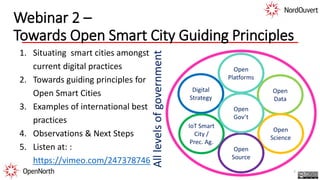
Webinar 2 –
Towards Open Smart City Guiding Principles
1. Situating smart cities amongst
current digital practices
2. Towards guiding principles for
Open Smart Cities
3. Examples of international best
practices
4. Observations & Next Steps
5. Listen at: :
https://vimeo.com/247378746
Open
Data
Digital
Strategy
Open
Science
IoT Smart
City /
Prec. Ag.
Open
Platforms
Open
Source
Open
Gov’t
Alllevelsofgovernment
7
2. Context in Canada
Open Smart Cities Guide V1.0 (http://www.opennorth.ca/open-smart-cities-guide)
8
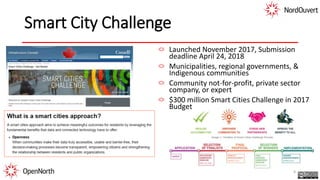
Smart City Challenge
Launched November 2017, Submission
deadline April 24, 2018
Municipalities, regional governments, &
Indigenous communities
Community not-for-profit, private sector
company, or expert
$300 million Smart Cities Challenge in 2017
Budget
9
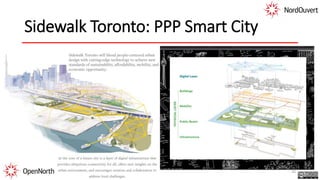
Sidewalk Toronto: PPP Smart City
10
3. Open Smart City Guide V 1.0
Open Smart Cities Guide V1.0 (http://www.opennorth.ca/open-smart-cities-guide)
11
Evidence informed guidelines
1. Open Smart Cities in Canada: Environmental-Scan and Case Studies –
Executive Summary (find here: https://osf.io/preprints/socarxiv/e4fs8/)
2. Open Smart Cities in Canada: Assessment Report for the cities of Edmonton,
Guelph, Montreal, and Ottawa and also the province of Ontario’s Smart Grid
and smart meter data (find here: https://osf.io/preprints/socarxiv/qbyzj/)
3. Open Smart Cities FAQ (find here: https://cippic.ca/en/Open_Smart_Cities)
4. Webinars 1 & 2 (listen at: http://bit.ly/2yp7H8k and
https://vimeo.com/247378746)
12
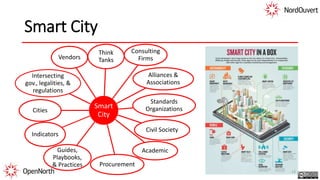
Smart City
Smart
City
Think
Tanks
Consulting
Firms
Alliances &
Associations
Civil Society
Academic
Procurement
Guides,
Playbooks,
& Practices
Indicators
Cities
Intersecting
gov., legalities, &
regulations
Vendors
Standards
Organizations
13
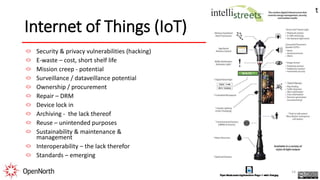
Internet of Things (IoT)
Security & privacy vulnerabilities (hacking)
E-waste – cost, short shelf life
Mission creep - potential
Surveillance / dataveillance potential
Ownership / procurement
Repair – DRM
Device lock in
Archiving - the lack thereof
Reuse – unintended purposes
Sustainability & maintenance &
management
Interoperability – the lack therefor
Standards – emerging
14
Data & Technology
are considered as more than the unique arrangement of objective and
politically neutral facts & things
&
they do not exist independently of ideas, techniques, technologies,
systems, people and contexts regardless of them being presented in
that way.
15
A city is
is a complex and dynamic socio-biological-physical system.
It is a territorially bound human settlement governed by public city
officials who manage the grey (i.e., built form), blue (i.e., water) and
green (i.e., land) environment and the people they serve as per their
legal and jurisdictional responsibilities.
Cities are much more complex than this, however, for the purpose
of this exercise, we have limited ourselves to a functionalist and an
administrative definition.
16
Data and Networked Urbanism
Smart cities in the common sense of the term and as per their
current manifestations are:
“[technologically] instrumented and networked,
[with] systems [that are] interlinked and integrated,
and [where] vast troves of big urban data are being generated [by sensors]
and used to manage and control urban life in real-time”.
Public administrators and elected officials invest in smart city technologies
and data analytical systems to inform how to innovatively, economically,
efficiently and objectively run and manage the cities they govern.
Predominately, a smart city is about quantifying and managing
infrastructure, mobility, business and online government services and a
focus oriented toward technological solutionism.
(Kitchin 2015)
17
Definition of the Open Smart City 1.0
An Open Smart City is where residents, civil society,
academics, and the private sector collaborate with
public officials to mobilize data and technologies when
warranted in an ethical, accountable and transparent
way to govern the city as a fair, viable and liveable
commons and balance economic development, social
progress and environmental responsibility.
18
5 Themes
1.Governance
2.Engagement
3.Data & Technology
4.Data Governance
5.Effective and values based smart cities
19
1. Governance in an Open Smart City is ethical,
accountable, and transparent. These principles
apply to the governance of social and technical
platforms which include data, algorithms, skills,
infrastructure, and knowledge.
20
21
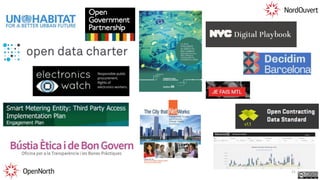
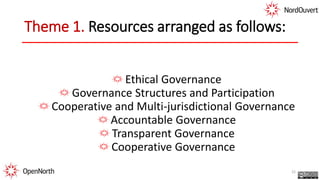
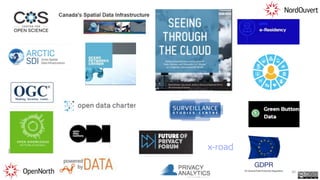
Theme 1. Resources arranged as follows:
22
Ethical Governance
Governance Structures and Participation
Cooperative and Multi-jurisdictional Governance
Accountable Governance
Transparent Governance
Cooperative Governance
2. An Open Smart City is participatory,
collaborative, and responsive. It is a city where
government, civil society, the private sector, the
media, academia and residents meaningfully
participate in the governance of the city and have
shared rights and responsibilities. This entails a
culture of trust and critical thinking and fair, just,
inclusive, and informed approaches.
23
24
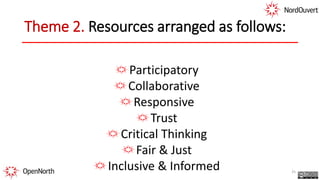
Theme 2. Resources arranged as follows:
25
Participatory
Collaborative
Responsive
Trust
Critical Thinking
Fair & Just
Inclusive & Informed
3. An Open Smart City uses data and technologies that
are fit for purpose, can be repaired and queried, their
source code are open, adhere to open standards, are
interoperable, durable, secure, and where possible
locally procured and scalable. Data and technology are
used and acquired in such a way as to reduce harm and
bias, increase sustainability and enhance flexibility. An
Open Smart City may defer when warranted to
automated decision making and therefore designs these
systems to be legible, responsive, adaptive and
accountable.
26
27
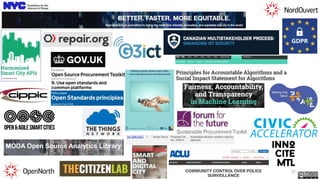
Theme 3. Resources arranged as follows:
28
Fit for Purpose
Repaired and Queried
Open Source
Open Standards
Cybersecurity and Data Security
Reduction of Harm and Bias
Local Procurement
Balancing Sustainability
4. In an Open Smart City, data management is the
norm and custody and control over data generated
by smart technologies is held and exercised in the
public interest. Data governance includes
sovereignty, residency, open by default, security,
individual and social privacy, and grants people
authority over their personal data.
29
30
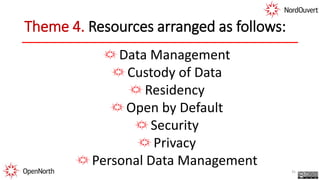
Theme 4. Resources arranged as follows:
31
Data Management
Custody of Data
Residency
Open by Default
Security
Privacy
Personal Data Management
5. In an Open Smart City, it is recognized that data
and technology are not always the solution to many
of the systemic issues cities face, nor are there
always quick fixes. These problems require
innovative, sometimes long term, social,
organizational, economic, and political processes
and solutions.
32
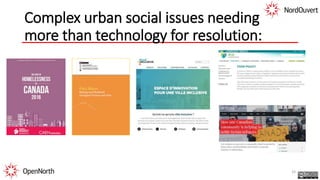
Complex urban social issues needing
more than technology for resolution:
33
An Open Smart City
“not just [about] a ‘right to use
technology’, which is precisely
where many smart city initiatives
stop, but rather the right to shape
the city using human initiative
and technology for social
purposes to make cities better.”
Open Smart City should benefit and
empower people and social movements.
These initiatives are propelled by human
values and principles of accountability,
transparency, ethics, equity, openness,
human rights, and inclusivity.
Thus, we emphasize that efficiency and
progress should not be the key drivers for
the deployment of smart city technology.
Our fifth characteristic of an Open Smart
City would also recognize:
the right to disconnect
the right to be anonymous in a connected city.
34
Hollands (2014)
Critical interventions into the corporate smart city
5. Conclusion
35
Limitations & Strengths
Limitations
We could have organized it by component, specific technologies or software stack
We could have consulted more broadly on each item, especially to experts in law,
cybersecurity, industry associations, etc.
We could also have met with residents, makers, civil liberties organizations, civic
technology groups and more…
We could also have taken a less government centric approach
Strengths
We looked at the literature and at examples and we defined an Open Smart City
The definition captures what is missing in data and networked urbanism
Although and Open Smart City does not yet exist, we were able to find many
examples and resources that lead us to believe that it is possible, and we hope you
find them to be useful.
36
Final Remarks
The Open Smart City Guide V1.0 is a Living Document that will be updated on a
regular basis and we are counting on you for your help. You can access it here
http://www.opennorth.ca/open-smart-cities-guide
Please send feedback, ideas, critiques etc. to info@opennorth.ca
Next Events:
Webinaire 3, 25 avril 12h30:
https://zoom.us/webinar/register/WN_hwnsww3bQtuz3fasyO-qJQ
Open Cities Summit Pre-Event to the International Open Data Conference in
Argentina, Sept. 2018 and the theme is Open Smart Cities
Canadian Open Data Summit, Nov. 2018
37
Project Outputs
1. Open Smart Cities in Canada: Environmental-Scan and Case Studies –
Executive Summary (find here: https://osf.io/preprints/socarxiv/e4fs8/)
2. Open Smart Cities in Canada: Assessment Report (find here:
https://osf.io/preprints/socarxiv/qbyzj/)
3. Open Smart Cities FAQ (find here: https://cippic.ca/en/Open_Smart_Cities)
4. Webinars 1 & 2 (listen at: http://bit.ly/2yp7H8k and
https://vimeo.com/247378746)
5. Open Smart Cities Guide V1.0 (find here: http://www.opennorth.ca/open-
smart-cities-guide)
38
Q&A
39
Discussion Questions
What do you think of this definition?
What concepts do you think are missing from this guide?
How do you envision this guide changing over the long term?
40
Merci | Thank You
rachel@opennorth.ca
Tracey.Lauriault@Carleton.ca
jeannoe@opennorth.ca
Website: www.opennorth.ca
Email: info@opennorth.ca
Twitter | FaceBook | GitHub |
LinkedIn
41