Audit, Audit Committee & Risk
Management
- Manoj Agarwal at Institute of Company Secretaries of India


                                                               TT
Agenda
    •   What is Risk
    •   Risk Management
    •   Classification of Risks
    •   What is Audit
    •   Audit Committee Role
    •   Expectation from Risk Management


2   5-Mar-2011   © ANB Consulting CO. Pvt. Ltd.   T
What is Risk?
    Risk, in traditional terms, is viewed as a „negative‟.
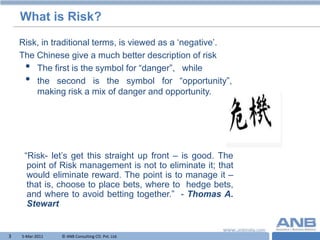
    The Chinese give a much better description of risk
     • The first is the symbol for “danger”, while
     • the second is the symbol for “opportunity”,
        making risk a mix of danger and opportunity.


     “Risk- let‟s get this straight up front – is good. The
      point of Risk management is not to eliminate it; that
      would eliminate reward. The point is to manage it –
      that is, choose to place bets, where to hedge bets,
      and where to avoid betting together.” - Thomas A.
      Stewart


3   5-Mar-2011   © ANB Consulting CO. Pvt. Ltd.               T
Risk & Risk Management

    In economic terms, profit is the reward for entrepreneurship or “Risk
    Taking”


    As a lay investor, our investment planning is based on risk
    perception – bank deposits, life insurance, debentures and GoI
    bonds, Mutual Funds, Shares, Private Equity….


    Risk management is an attempt to identify, measure and
    monitor risks– so as to manage uncertainty.


4    5-Mar-2011   © ANB Consulting CO. Pvt. Ltd.                    T
Risk Management

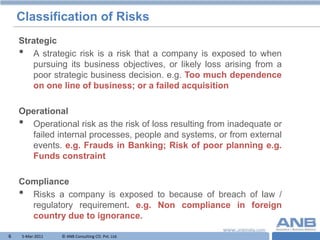
    1    Understand the nature and extent of risks facing the company

    2 Understand the extent and categories of risks which it regards as
      acceptable for a company to bear

    3 Understand the likelihood of risks concerned materializing


    4 Company‟s ability to reduce the incidence and impact              on
      business of risks that do materialize


    5 Costs of operating particular controls relative to benefits


5    5-Mar-2011   © ANB Consulting CO. Pvt. Ltd.                    T
Classification of Risks
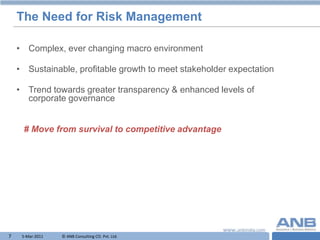
    Strategic
    •  A strategic risk is a risk that a company is exposed to when
       pursuing its business objectives, or likely loss arising from a
       poor strategic business decision. e.g. Too much dependence
       on one line of business; or a failed acquisition

    Operational
    • Operational risk as the risk of loss resulting from inadequate or
      failed internal processes, people and systems, or from external
      events. e.g. Frauds in Banking; Risk of poor planning e.g.
      Funds constraint

    Compliance
    • Risks a company is exposed to because of breach of law /
      regulatory requirement. e.g. Non compliance in foreign
      country due to ignorance.

6   5-Mar-2011   © ANB Consulting CO. Pvt. Ltd.                    T
The Need for Risk Management

    • Complex, ever changing macro environment

    • Sustainable, profitable growth to meet stakeholder expectation

    • Trend towards greater transparency & enhanced levels of
      corporate governance


     # Move from survival to competitive advantage


7    5-Mar-2011   © ANB Consulting CO. Pvt. Ltd.                  T
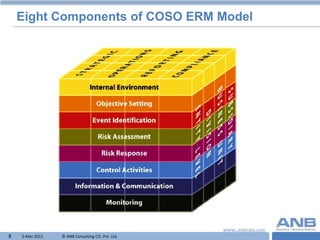
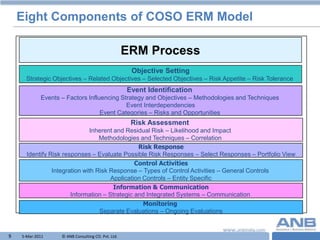
Eight Components of COSO ERM Model


8   5-Mar-2011   © ANB Consulting CO. Pvt. Ltd.   T
Eight Components of COSO ERM Model

                                                    ERM Process
                                                     Objective Setting
      Strategic Objectives – Related Objectives – Selected Objectives – Risk Appetite – Risk Tolerance
                                                    Event Identification
            Events – Factors Influencing Strategy and Objectives – Methodologies and Techniques
                                           Event Interdependencies
                                  Event Categories – Risks and Opportunities
                                                     Risk Assessment
                               Inherent and Residual Risk – Likelihood and Impact
                                  Methodologies and Techniques – Correlation
                                                Risk Response
      Identify Risk responses – Evaluate Possible Risk Responses – Select Responses – Portfolio View
                                               Control Activities
                Integration with Risk Response – Types of Control Activities – General Controls
                                      Application Controls – Entity Specific
                                        Information & Communication
                       Information – Strategic and Integrated Systems – Communication
                                                  Monitoring
                                  Separate Evaluations – Ongoing Evaluations


9   5-Mar-2011     © ANB Consulting CO. Pvt. Ltd.                                           T
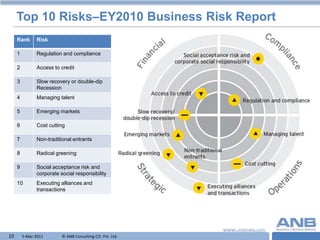
Top 10 Risks–EY2010 Business Risk Report
     Rank      Risk

     1         Regulation and compliance

     2         Access to credit

     3         Slow recovery or double-dip
               Recession
     4         Managing talent

     5         Emerging markets

     6         Cost cutting

     7         Non-traditional entrants

     8         Radical greening

     9         Social acceptance risk and
               corporate social responsibility
     10        Executing alliances and
               transactions


10       5-Mar-2011       © ANB Consulting CO. Pvt. Ltd.   T
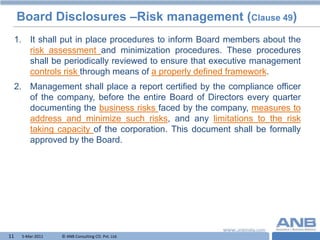
Board Disclosures –Risk management (Clause 49)
     1. It shall put in place procedures to inform Board members about the
        risk assessment and minimization procedures. These procedures
        shall be periodically reviewed to ensure that executive management
        controls risk through means of a properly defined framework.
     2. Management shall place a report certified by the compliance officer
        of the company, before the entire Board of Directors every quarter
        documenting the business risks faced by the company, measures to
        address and minimize such risks, and any limitations to the risk
        taking capacity of the corporation. This document shall be formally
        approved by the Board.


11    5-Mar-2011   © ANB Consulting CO. Pvt. Ltd.                 T
What is Audit
     The general definition of an audit is an evaluation of a person,
     organization, system, process, enterprise, project or product. The
     term most commonly refers to audits in accounting, but similar concepts
     also exist in project management, quality management, and energy
     conservation

     (source Wikipedia)

     Audits are performed to ascertain the validity and reliability of
     information; also to provide an assessment of a system's internal
     control. The goal of an audit is to express an opinion on the person /
     organization / system (etc.) in question, under evaluation based on work
     done on a test basis.


12    5-Mar-2011   © ANB Consulting CO. Pvt. Ltd.                   T
Audit Committee
     1. Company to constitute an audit committee with terms of reference
     2. At least three members- two thirds independent
     3. Chairman to be independent- must attend every AGM to answer
        shareholder queries
     4. All members financially literate & at least 1 member to be
        accounting or related financial management expert
     5. May meet with or without executives – generally CFO & CEO are
        invited
     6. Must meet at least 4 times a year - quorum = greater of 2 members
        or 2/3rd and at least 2 independent


13    5-Mar-2011   © ANB Consulting CO. Pvt. Ltd.                 T
Audit Committee’s role – Clause 49
     1. Oversee financial reporting process
     2. Recommend to the Board the hiring and firing of statutory auditors and
        confirming their remuneration
     3. Review the adequacy of internal control system
     4. Reviewing the adequacy of structures, staffing and examining the scope
        of internal audit department
     5. Discussing significant findings and follow ups with internal auditors
     6. Review of financial and risk management policies
     7. To review working of whistle blower mechanisms
     8. Other functions specified in terms of reference


14     5-Mar-2011   © ANB Consulting CO. Pvt. Ltd.                    T
Review of information by Audit Committee
     The Audit Committee shall mandatorily review the following information:
     1. Financial statements and draft audit report, including quarterly / half-
        yearly financial information;
     2. Management discussion and analysis of financial condition and
        results of operations;
     3. Reports relating to compliance with laws and to risk management;
     4. Management letters / letters of internal control weaknesses issued
        by statutory / internal auditors; and
     5. Records of related party transactions
     6. The appointment, removal and terms of remuneration of the Chief
        internal auditor shall be subject to review by the Audit Committee


15     5-Mar-2011   © ANB Consulting CO. Pvt. Ltd.                     T
Expectation from Risk Management
     • Avoidance of Surprises
     • Effective evaluation of cost of control
     • Protection of the Reputation
     • Proper allocations of resources
     • Higher probability of meeting targets
     • More informed decision making
     • Recognizing opportunities and focusing on areas for
       improvement
     ….Leading to competitive advantage


16   5-Mar-2011   © ANB Consulting CO. Pvt. Ltd.             T
17   5-Mar-2011   © ANB Consulting CO. Pvt. Ltd.   T
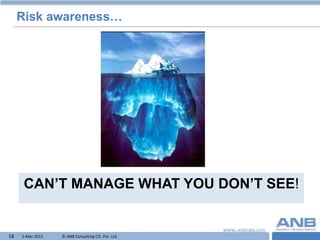
Risk awareness…


      CAN’T MANAGE WHAT YOU DON’T SEE!


18   5-Mar-2011   © ANB Consulting CO. Pvt. Ltd.   T
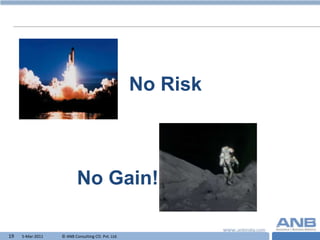
No Risk


                          No Gain!

19   5-Mar-2011   © ANB Consulting CO. Pvt. Ltd.             T
Thank You
                                                   Manoj.Agarwal@anbglobal.com


20   5-Mar-2011   © ANB Consulting CO. Pvt. Ltd.                      T
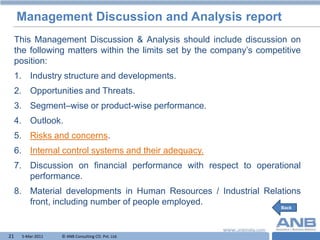
Management Discussion and Analysis report
     This Management Discussion & Analysis should include discussion on
     the following matters within the limits set by the company‟s competitive
     position:
     1. Industry structure and developments.
     2. Opportunities and Threats.
     3. Segment–wise or product-wise performance.
     4. Outlook.
     5. Risks and concerns.
     6. Internal control systems and their adequacy.
     7. Discussion on financial performance with respect to operational
        performance.
     8. Material developments in Human Resources / Industrial Relations
        front, including number of people employed.
                                                                        Back


21    5-Mar-2011   © ANB Consulting CO. Pvt. Ltd.                   T
Training of Board Members
     Company shall train its Board members in the business model of the
     company as well as the risk profile of the business parameters of the
     company, their responsibilities as directors, and the best ways to
     discharge them.
     (Non Mandatory Requirement Clause 49)


                                                                     Back


22    5-Mar-2011   © ANB Consulting CO. Pvt. Ltd.                T
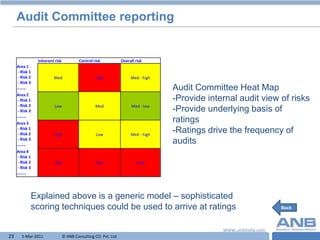
Audit Committee reporting


                Inherent risk            Control risk            Overall risk
     Area 1
     - Risk 1
     - Risk 2           Med                       High                Med - high
     - Risk 3
     ………                                                                           Audit Committee Heat Map
     Area 2
     - Risk 1                                                                      -Provide internal audit view of risks
     - Risk 2            Low                      Med                  Med - low
     - Risk 3                                                                      -Provide underlying basis of
     ………
     Area 3
                                                                                   ratings
     - Risk 1
     - Risk 2           High                      Low                 Med - high
                                                                                   -Ratings drive the frequency of
     - Risk 3
     ………
                                                                                   audits
     Area 4
     - Risk 1
     - Risk 2           High                      High                   High
     - Risk 3
     ………


            Explained above is a generic model – sophisticated
            scoring techniques could be used to arrive at ratings                                               Back


23     5-Mar-2011               © ANB Consulting CO. Pvt. Ltd.                                              T

Audit Audit Commite And Risk Management

  • 1.
    Audit, Audit Committee& Risk Management - Manoj Agarwal at Institute of Company Secretaries of India TT
  • 2.
    Agenda • What is Risk • Risk Management • Classification of Risks • What is Audit • Audit Committee Role • Expectation from Risk Management 2 5-Mar-2011 © ANB Consulting CO. Pvt. Ltd. T
  • 3.
    What is Risk? Risk, in traditional terms, is viewed as a „negative‟. The Chinese give a much better description of risk • The first is the symbol for “danger”, while • the second is the symbol for “opportunity”, making risk a mix of danger and opportunity. “Risk- let‟s get this straight up front – is good. The point of Risk management is not to eliminate it; that would eliminate reward. The point is to manage it – that is, choose to place bets, where to hedge bets, and where to avoid betting together.” - Thomas A. Stewart 3 5-Mar-2011 © ANB Consulting CO. Pvt. Ltd. T
  • 4.
    Risk & RiskManagement In economic terms, profit is the reward for entrepreneurship or “Risk Taking” As a lay investor, our investment planning is based on risk perception – bank deposits, life insurance, debentures and GoI bonds, Mutual Funds, Shares, Private Equity…. Risk management is an attempt to identify, measure and monitor risks– so as to manage uncertainty. 4 5-Mar-2011 © ANB Consulting CO. Pvt. Ltd. T
  • 5.
    Risk Management 1 Understand the nature and extent of risks facing the company 2 Understand the extent and categories of risks which it regards as acceptable for a company to bear 3 Understand the likelihood of risks concerned materializing 4 Company‟s ability to reduce the incidence and impact on business of risks that do materialize 5 Costs of operating particular controls relative to benefits 5 5-Mar-2011 © ANB Consulting CO. Pvt. Ltd. T
  • 6.
    Classification of Risks Strategic • A strategic risk is a risk that a company is exposed to when pursuing its business objectives, or likely loss arising from a poor strategic business decision. e.g. Too much dependence on one line of business; or a failed acquisition Operational • Operational risk as the risk of loss resulting from inadequate or failed internal processes, people and systems, or from external events. e.g. Frauds in Banking; Risk of poor planning e.g. Funds constraint Compliance • Risks a company is exposed to because of breach of law / regulatory requirement. e.g. Non compliance in foreign country due to ignorance. 6 5-Mar-2011 © ANB Consulting CO. Pvt. Ltd. T
  • 7.
    The Need forRisk Management • Complex, ever changing macro environment • Sustainable, profitable growth to meet stakeholder expectation • Trend towards greater transparency & enhanced levels of corporate governance # Move from survival to competitive advantage 7 5-Mar-2011 © ANB Consulting CO. Pvt. Ltd. T
  • 8.
    Eight Components ofCOSO ERM Model 8 5-Mar-2011 © ANB Consulting CO. Pvt. Ltd. T
  • 9.
    Eight Components ofCOSO ERM Model ERM Process Objective Setting Strategic Objectives – Related Objectives – Selected Objectives – Risk Appetite – Risk Tolerance Event Identification Events – Factors Influencing Strategy and Objectives – Methodologies and Techniques Event Interdependencies Event Categories – Risks and Opportunities Risk Assessment Inherent and Residual Risk – Likelihood and Impact Methodologies and Techniques – Correlation Risk Response Identify Risk responses – Evaluate Possible Risk Responses – Select Responses – Portfolio View Control Activities Integration with Risk Response – Types of Control Activities – General Controls Application Controls – Entity Specific Information & Communication Information – Strategic and Integrated Systems – Communication Monitoring Separate Evaluations – Ongoing Evaluations 9 5-Mar-2011 © ANB Consulting CO. Pvt. Ltd. T
  • 10.
    Top 10 Risks–EY2010Business Risk Report Rank Risk 1 Regulation and compliance 2 Access to credit 3 Slow recovery or double-dip Recession 4 Managing talent 5 Emerging markets 6 Cost cutting 7 Non-traditional entrants 8 Radical greening 9 Social acceptance risk and corporate social responsibility 10 Executing alliances and transactions 10 5-Mar-2011 © ANB Consulting CO. Pvt. Ltd. T
  • 11.
    Board Disclosures –Riskmanagement (Clause 49) 1. It shall put in place procedures to inform Board members about the risk assessment and minimization procedures. These procedures shall be periodically reviewed to ensure that executive management controls risk through means of a properly defined framework. 2. Management shall place a report certified by the compliance officer of the company, before the entire Board of Directors every quarter documenting the business risks faced by the company, measures to address and minimize such risks, and any limitations to the risk taking capacity of the corporation. This document shall be formally approved by the Board. 11 5-Mar-2011 © ANB Consulting CO. Pvt. Ltd. T
  • 12.
    What is Audit The general definition of an audit is an evaluation of a person, organization, system, process, enterprise, project or product. The term most commonly refers to audits in accounting, but similar concepts also exist in project management, quality management, and energy conservation (source Wikipedia) Audits are performed to ascertain the validity and reliability of information; also to provide an assessment of a system's internal control. The goal of an audit is to express an opinion on the person / organization / system (etc.) in question, under evaluation based on work done on a test basis. 12 5-Mar-2011 © ANB Consulting CO. Pvt. Ltd. T
  • 13.
    Audit Committee 1. Company to constitute an audit committee with terms of reference 2. At least three members- two thirds independent 3. Chairman to be independent- must attend every AGM to answer shareholder queries 4. All members financially literate & at least 1 member to be accounting or related financial management expert 5. May meet with or without executives – generally CFO & CEO are invited 6. Must meet at least 4 times a year - quorum = greater of 2 members or 2/3rd and at least 2 independent 13 5-Mar-2011 © ANB Consulting CO. Pvt. Ltd. T
  • 14.
    Audit Committee’s role– Clause 49 1. Oversee financial reporting process 2. Recommend to the Board the hiring and firing of statutory auditors and confirming their remuneration 3. Review the adequacy of internal control system 4. Reviewing the adequacy of structures, staffing and examining the scope of internal audit department 5. Discussing significant findings and follow ups with internal auditors 6. Review of financial and risk management policies 7. To review working of whistle blower mechanisms 8. Other functions specified in terms of reference 14 5-Mar-2011 © ANB Consulting CO. Pvt. Ltd. T
  • 15.
    Review of informationby Audit Committee The Audit Committee shall mandatorily review the following information: 1. Financial statements and draft audit report, including quarterly / half- yearly financial information; 2. Management discussion and analysis of financial condition and results of operations; 3. Reports relating to compliance with laws and to risk management; 4. Management letters / letters of internal control weaknesses issued by statutory / internal auditors; and 5. Records of related party transactions 6. The appointment, removal and terms of remuneration of the Chief internal auditor shall be subject to review by the Audit Committee 15 5-Mar-2011 © ANB Consulting CO. Pvt. Ltd. T
  • 16.
    Expectation from RiskManagement • Avoidance of Surprises • Effective evaluation of cost of control • Protection of the Reputation • Proper allocations of resources • Higher probability of meeting targets • More informed decision making • Recognizing opportunities and focusing on areas for improvement ….Leading to competitive advantage 16 5-Mar-2011 © ANB Consulting CO. Pvt. Ltd. T
  • 17.
    17 5-Mar-2011 © ANB Consulting CO. Pvt. Ltd. T
  • 18.
    Risk awareness… CAN’T MANAGE WHAT YOU DON’T SEE! 18 5-Mar-2011 © ANB Consulting CO. Pvt. Ltd. T
  • 19.
    No Risk No Gain! 19 5-Mar-2011 © ANB Consulting CO. Pvt. Ltd. T
  • 20.
    Thank You Manoj.Agarwal@anbglobal.com 20 5-Mar-2011 © ANB Consulting CO. Pvt. Ltd. T
  • 21.
    Management Discussion andAnalysis report This Management Discussion & Analysis should include discussion on the following matters within the limits set by the company‟s competitive position: 1. Industry structure and developments. 2. Opportunities and Threats. 3. Segment–wise or product-wise performance. 4. Outlook. 5. Risks and concerns. 6. Internal control systems and their adequacy. 7. Discussion on financial performance with respect to operational performance. 8. Material developments in Human Resources / Industrial Relations front, including number of people employed. Back 21 5-Mar-2011 © ANB Consulting CO. Pvt. Ltd. T
  • 22.
    Training of BoardMembers Company shall train its Board members in the business model of the company as well as the risk profile of the business parameters of the company, their responsibilities as directors, and the best ways to discharge them. (Non Mandatory Requirement Clause 49) Back 22 5-Mar-2011 © ANB Consulting CO. Pvt. Ltd. T
  • 23.
    Audit Committee reporting Inherent risk Control risk Overall risk Area 1 - Risk 1 - Risk 2 Med High Med - high - Risk 3 ……… Audit Committee Heat Map Area 2 - Risk 1 -Provide internal audit view of risks - Risk 2 Low Med Med - low - Risk 3 -Provide underlying basis of ……… Area 3 ratings - Risk 1 - Risk 2 High Low Med - high -Ratings drive the frequency of - Risk 3 ……… audits Area 4 - Risk 1 - Risk 2 High High High - Risk 3 ……… Explained above is a generic model – sophisticated scoring techniques could be used to arrive at ratings Back 23 5-Mar-2011 © ANB Consulting CO. Pvt. Ltd. T