
Exception Handling
Handling Errors During
the Program Execution
SoftUni Team
Technical Trainers
Software University
http://softuni.bg
2
1. What are Exceptions?
2. Handling Exceptions
3. The System.Exception Class
4. Types of Exceptions and their Hierarchy
5. Raising (Throwing) Exceptions
6. Best Practices
7. Creating Custom Exceptions
Table of Contents
What are Exceptions?
The Paradigm of Exceptions in OOP
4
ď‚§ The exceptions in .NET Framework / Java are a classic
implementation of the OOP exception model
ď‚§ Deliver powerful mechanism for centralized handling of errors
and unusual events
ď‚§ Substitute procedure-oriented approach, in which each function
returns error code
ď‚§ Simplify code construction and maintenance
ď‚§ Allow the problematic situations to be processed at multiple
levels
What are Exceptions?
Handling Exceptions
Catching and Processing Errors
6
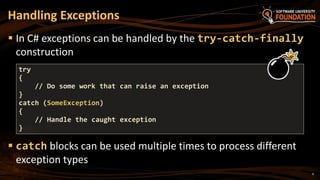
ď‚§ In C# exceptions can be handled by the try-catch-finally
construction
ď‚§ catch blocks can be used multiple times to process different
exception types
Handling Exceptions
try
{
// Do some work that can raise an exception
}
catch (SomeException)
{
// Handle the caught exception
}
7
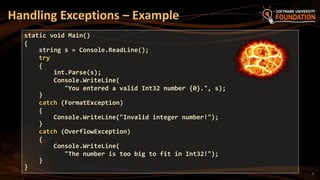
Handling Exceptions – Example
static void Main()
{
string s = Console.ReadLine();
try
{
int.Parse(s);
Console.WriteLine(
"You entered a valid Int32 number {0}.", s);
}
catch (FormatException)
{
Console.WriteLine("Invalid integer number!");
}
catch (OverflowException)
{
Console.WriteLine(
"The number is too big to fit in Int32!");
}
}
Handling Exceptions
Live Demo
9
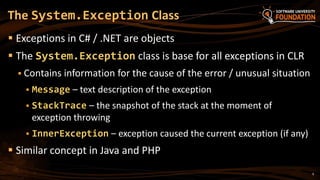
ď‚§ Exceptions in C# / .NET are objects
ď‚§ The System.Exception class is base for all exceptions in CLR
ď‚§ Contains information for the cause of the error / unusual situation
 Message – text description of the exception
 StackTrace – the snapshot of the stack at the moment of
exception throwing
 InnerException – exception caused the current exception (if any)
ď‚§ Similar concept in Java and PHP
The System.Exception Class
10
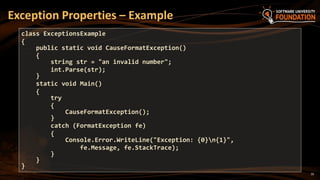
Exception Properties – Example
class ExceptionsExample
{
public static void CauseFormatException()
{
string str = "an invalid number";
int.Parse(str);
}
static void Main()
{
try
{
CauseFormatException();
}
catch (FormatException fe)
{
Console.Error.WriteLine("Exception: {0}n{1}",
fe.Message, fe.StackTrace);
}
}
}
11
ď‚§ The Message property gives a brief description of the problem
ď‚§ The StackTrace property is extremely useful when identifying the
reason that caused the exception
Exception Properties
Exception caught: Input string was not in a correct format.
at System.Number.ParseInt32(String s, NumberStyles style,
NumberFormatInfo info)
at System.Int32.Parse(String s)
at ExceptionsTest.CauseFormatException() in
c:consoleapplication1exceptionstest.cs:line 8
at ExceptionsTest.Main(String[] args) in
c:consoleapplication1exceptionstest.cs:line 15
Exception Properties
Live Demo
The Hierarchy of Exceptions
14
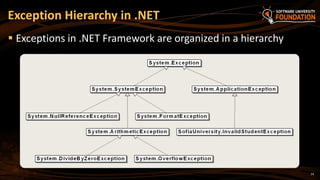
ď‚§ Exceptions in .NET Framework are organized in a hierarchy
Exception Hierarchy in .NET
15
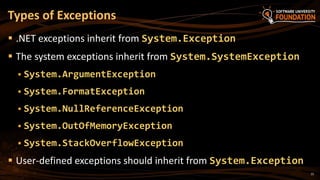
ď‚§ .NET exceptions inherit from System.Exception
ď‚§ The system exceptions inherit from System.SystemException
ď‚§ System.ArgumentException
ď‚§ System.FormatException
ď‚§ System.NullReferenceException
ď‚§ System.OutOfMemoryException
ď‚§ System.StackOverflowException
ď‚§ User-defined exceptions should inherit from System.Exception
Types of Exceptions
16
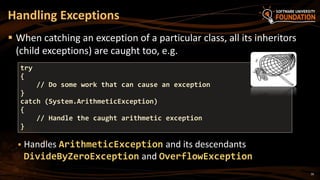
ď‚§ When catching an exception of a particular class, all its inheritors
(child exceptions) are caught too, e.g.
ď‚§ Handles ArithmeticException and its descendants
DivideByZeroException and OverflowException
Handling Exceptions
try
{
// Do some work that can cause an exception
}
catch (System.ArithmeticException)
{
// Handle the caught arithmetic exception
}
17
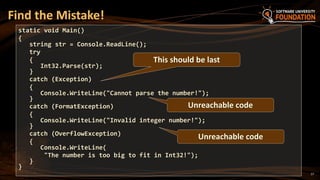
Find the Mistake!
static void Main()
{
string str = Console.ReadLine();
try
{
Int32.Parse(str);
}
catch (Exception)
{
Console.WriteLine("Cannot parse the number!");
}
catch (FormatException)
{
Console.WriteLine("Invalid integer number!");
}
catch (OverflowException)
{
Console.WriteLine(
"The number is too big to fit in Int32!");
}
}
This should be last
Unreachable code
Unreachable code
18
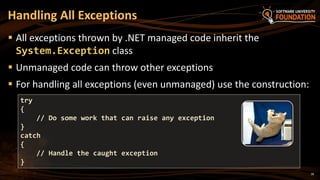
ď‚§ All exceptions thrown by .NET managed code inherit the
System.Exception class
ď‚§ Unmanaged code can throw other exceptions
ď‚§ For handling all exceptions (even unmanaged) use the construction:
Handling All Exceptions
try
{
// Do some work that can raise any exception
}
catch
{
// Handle the caught exception
}
Throwing Exceptions
20
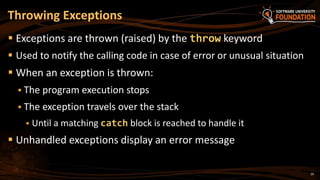
ď‚§ Exceptions are thrown (raised) by the throw keyword
ď‚§ Used to notify the calling code in case of error or unusual situation
ď‚§ When an exception is thrown:
ď‚§ The program execution stops
ď‚§ The exception travels over the stack
ď‚§ Until a matching catch block is reached to handle it
ď‚§ Unhandled exceptions display an error message
Throwing Exceptions
21
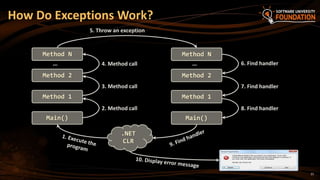
How Do Exceptions Work?
Main()
Method 1
Method 2
Method N
2. Method call
3. Method call
4. Method call…
Main()
Method 1
Method 2
Method N
8. Find handler
7. Find handler
6. Find handler…
5. Throw an exception
.NET
CLR
Call Stack Example
Live Demo
23
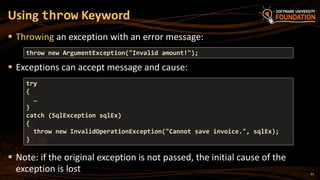
ď‚§ Throwing an exception with an error message:
ď‚§ Exceptions can accept message and cause:
ď‚§ Note: if the original exception is not passed, the initial cause of the
exception is lost
Using throw Keyword
throw new ArgumentException("Invalid amount!");
try
{
…
}
catch (SqlException sqlEx)
{
throw new InvalidOperationException("Cannot save invoice.", sqlEx);
}
24
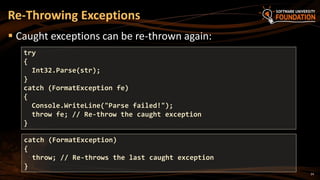
ď‚§ Caught exceptions can be re-thrown again:
Re-Throwing Exceptions
try
{
Int32.Parse(str);
}
catch (FormatException fe)
{
Console.WriteLine("Parse failed!");
throw fe; // Re-throw the caught exception
}
catch (FormatException)
{
throw; // Re-throws the last caught exception
}
25
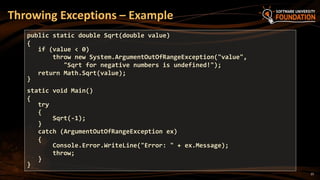
Throwing Exceptions – Example
public static double Sqrt(double value)
{
if (value < 0)
throw new System.ArgumentOutOfRangeException("value",
"Sqrt for negative numbers is undefined!");
return Math.Sqrt(value);
}
static void Main()
{
try
{
Sqrt(-1);
}
catch (ArgumentOutOfRangeException ex)
{
Console.Error.WriteLine("Error: " + ex.Message);
throw;
}
}
Throwing Exceptions
Live Demo
27
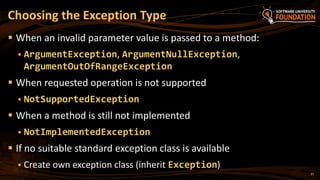
ď‚§ When an invalid parameter value is passed to a method:
ď‚§ ArgumentException, ArgumentNullException,
ArgumentOutOfRangeException
ď‚§ When requested operation is not supported
ď‚§ NotSupportedException
ď‚§ When a method is still not implemented
ď‚§ NotImplementedException
ď‚§ If no suitable standard exception class is available
ď‚§ Create own exception class (inherit Exception)
Choosing the Exception Type
Using Try-Finally Blocks
29
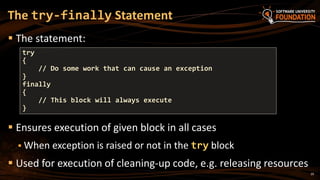
ď‚§ The statement:
ď‚§ Ensures execution of given block in all cases
ď‚§ When exception is raised or not in the try block
ď‚§ Used for execution of cleaning-up code, e.g. releasing resources
The try-finally Statement
try
{
// Do some work that can cause an exception
}
finally
{
// This block will always execute
}
30
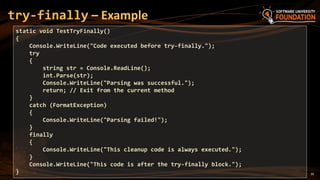
try-finally – Example
static void TestTryFinally()
{
Console.WriteLine("Code executed before try-finally.");
try
{
string str = Console.ReadLine();
int.Parse(str);
Console.WriteLine("Parsing was successful.");
return; // Exit from the current method
}
catch (FormatException)
{
Console.WriteLine("Parsing failed!");
}
finally
{
Console.WriteLine("This cleanup code is always executed.");
}
Console.WriteLine("This code is after the try-finally block.");
}
31
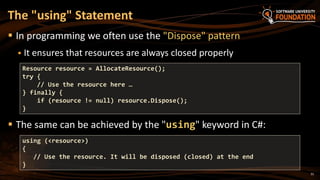
ď‚§ In programming we often use the "Dispose" pattern
ď‚§ It ensures that resources are always closed properly
ď‚§ The same can be achieved by the "using" keyword in C#:
The "using" Statement
using (<resource>)
{
// Use the resource. It will be disposed (closed) at the end
}
Resource resource = AllocateResource();
try {
// Use the resource here …
} finally {
if (resource != null) resource.Dispose();
}
Try-Finally
Live Demo
33
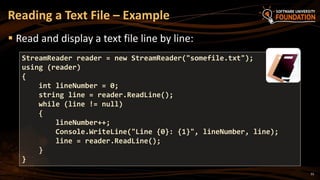
ď‚§ Read and display a text file line by line:
Reading a Text File – Example
StreamReader reader = new StreamReader("somefile.txt");
using (reader)
{
int lineNumber = 0;
string line = reader.ReadLine();
while (line != null)
{
lineNumber++;
Console.WriteLine("Line {0}: {1}", lineNumber, line);
line = reader.ReadLine();
}
}
Reading a Text File
Live Demo
Exceptions: Best Practices
36
ď‚§ catch blocks should begin with the exceptions lowest in the
hierarchy
ď‚§ And continue with the more general exceptions
ď‚§ Otherwise a compilation error will occur
ď‚§ Each catch block should handle only these exceptions which it
expects
ď‚§ If a method is not competent to handle an exception, it should
leave it unhandled
ď‚§ Handling all exceptions disregarding their type is a popular bad
practice (anti-pattern)!
Exceptions – Best Practices
37
ď‚§ When raising an exception always pass to the constructor good
explanation message
ď‚§ When throwing an exception always pass a good description of the
problem
ď‚§ The exception message should explain what causes the problem and
how to solve it
 Good: "Size should be integer in range [1…15]"
ď‚§ Good: "Invalid state. First call Initialize()"
ď‚§ Bad: "Unexpected error"
ď‚§ Bad: "Invalid argument"
Exceptions – Best Practices (2)
38
ď‚§ Exceptions can decrease the application performance
ď‚§ Throw exceptions only in situations which are really exceptional
and should be handled
ď‚§ Do not throw exceptions in the normal program control flow
ď‚§ CLR could throw exceptions at any time with no way to predict
them
ď‚§ E.g. System.OutOfMemoryException
Exceptions – Best Practices (3)
39
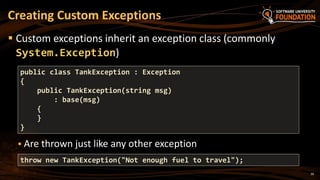
ď‚§ Custom exceptions inherit an exception class (commonly
System.Exception)
ď‚§ Are thrown just like any other exception
Creating Custom Exceptions
public class TankException : Exception
{
public TankException(string msg)
: base(msg)
{
}
}
throw new TankException("Not enough fuel to travel");
40
ď‚§ Exceptions provide a flexible error handling mechanism
ď‚§ Allow errors to be handled at multiple levels
ď‚§ Each exception handler processes only errors
of a particular type (and its child types)
ď‚§ Other types of errors are processed by some
other handlers later
ď‚§ Unhandled exceptions cause error messages
ď‚§ Try-finally ensures given code block is always executed
(even when an exception is thrown)
Summary
?
OOP – Exception Handling
https://softuni.bg/courses/oop/
License
ď‚§ This course (slides, examples, demos, videos, homework, etc.)
is licensed under the "Creative Commons Attribution-
NonCommercial-ShareAlike 4.0 International" license
42
ď‚§ Attribution: this work may contain portions from
ď‚§ "OOP" course by Telerik Academy under CC-BY-NC-SA license
Free Trainings @ Software University
 Software University Foundation – softuni.org
 Software University – High-Quality Education,
Profession and Job for Software Developers
ď‚§ softuni.bg
ď‚§ Software University @ Facebook
ď‚§ facebook.com/SoftwareUniversity
ď‚§ Software University @ YouTube
ď‚§ youtube.com/SoftwareUniversity
 Software University Forums – forum.softuni.bg

12. Exception Handling

  • 1.
    Exception Handling Handling ErrorsDuring the Program Execution SoftUni Team Technical Trainers Software University http://softuni.bg
  • 2.
    2 1. What areExceptions? 2. Handling Exceptions 3. The System.Exception Class 4. Types of Exceptions and their Hierarchy 5. Raising (Throwing) Exceptions 6. Best Practices 7. Creating Custom Exceptions Table of Contents
  • 3.
    What are Exceptions? TheParadigm of Exceptions in OOP
  • 4.
    4 ď‚§ The exceptionsin .NET Framework / Java are a classic implementation of the OOP exception model ď‚§ Deliver powerful mechanism for centralized handling of errors and unusual events ď‚§ Substitute procedure-oriented approach, in which each function returns error code ď‚§ Simplify code construction and maintenance ď‚§ Allow the problematic situations to be processed at multiple levels What are Exceptions?
  • 5.
  • 6.
    6 ď‚§ In C#exceptions can be handled by the try-catch-finally construction ď‚§ catch blocks can be used multiple times to process different exception types Handling Exceptions try { // Do some work that can raise an exception } catch (SomeException) { // Handle the caught exception }
  • 7.
    7 Handling Exceptions –Example static void Main() { string s = Console.ReadLine(); try { int.Parse(s); Console.WriteLine( "You entered a valid Int32 number {0}.", s); } catch (FormatException) { Console.WriteLine("Invalid integer number!"); } catch (OverflowException) { Console.WriteLine( "The number is too big to fit in Int32!"); } }
  • 8.
  • 9.
    9  Exceptions inC# / .NET are objects  The System.Exception class is base for all exceptions in CLR  Contains information for the cause of the error / unusual situation  Message – text description of the exception  StackTrace – the snapshot of the stack at the moment of exception throwing  InnerException – exception caused the current exception (if any)  Similar concept in Java and PHP The System.Exception Class
  • 10.
    10 Exception Properties –Example class ExceptionsExample { public static void CauseFormatException() { string str = "an invalid number"; int.Parse(str); } static void Main() { try { CauseFormatException(); } catch (FormatException fe) { Console.Error.WriteLine("Exception: {0}n{1}", fe.Message, fe.StackTrace); } } }
  • 11.
    11 ď‚§ The Messageproperty gives a brief description of the problem ď‚§ The StackTrace property is extremely useful when identifying the reason that caused the exception Exception Properties Exception caught: Input string was not in a correct format. at System.Number.ParseInt32(String s, NumberStyles style, NumberFormatInfo info) at System.Int32.Parse(String s) at ExceptionsTest.CauseFormatException() in c:consoleapplication1exceptionstest.cs:line 8 at ExceptionsTest.Main(String[] args) in c:consoleapplication1exceptionstest.cs:line 15
  • 12.
  • 13.
    The Hierarchy ofExceptions
  • 14.
    14 ď‚§ Exceptions in.NET Framework are organized in a hierarchy Exception Hierarchy in .NET
  • 15.
    15 ď‚§ .NET exceptionsinherit from System.Exception ď‚§ The system exceptions inherit from System.SystemException ď‚§ System.ArgumentException ď‚§ System.FormatException ď‚§ System.NullReferenceException ď‚§ System.OutOfMemoryException ď‚§ System.StackOverflowException ď‚§ User-defined exceptions should inherit from System.Exception Types of Exceptions
  • 16.
    16 ď‚§ When catchingan exception of a particular class, all its inheritors (child exceptions) are caught too, e.g. ď‚§ Handles ArithmeticException and its descendants DivideByZeroException and OverflowException Handling Exceptions try { // Do some work that can cause an exception } catch (System.ArithmeticException) { // Handle the caught arithmetic exception }
  • 17.
    17 Find the Mistake! staticvoid Main() { string str = Console.ReadLine(); try { Int32.Parse(str); } catch (Exception) { Console.WriteLine("Cannot parse the number!"); } catch (FormatException) { Console.WriteLine("Invalid integer number!"); } catch (OverflowException) { Console.WriteLine( "The number is too big to fit in Int32!"); } } This should be last Unreachable code Unreachable code
  • 18.
    18 ď‚§ All exceptionsthrown by .NET managed code inherit the System.Exception class ď‚§ Unmanaged code can throw other exceptions ď‚§ For handling all exceptions (even unmanaged) use the construction: Handling All Exceptions try { // Do some work that can raise any exception } catch { // Handle the caught exception }
  • 19.
  • 20.
    20 ď‚§ Exceptions arethrown (raised) by the throw keyword ď‚§ Used to notify the calling code in case of error or unusual situation ď‚§ When an exception is thrown: ď‚§ The program execution stops ď‚§ The exception travels over the stack ď‚§ Until a matching catch block is reached to handle it ď‚§ Unhandled exceptions display an error message Throwing Exceptions
  • 21.
    21 How Do ExceptionsWork? Main() Method 1 Method 2 Method N 2. Method call 3. Method call 4. Method call… Main() Method 1 Method 2 Method N 8. Find handler 7. Find handler 6. Find handler… 5. Throw an exception .NET CLR
  • 22.
  • 23.
    23  Throwing anexception with an error message:  Exceptions can accept message and cause:  Note: if the original exception is not passed, the initial cause of the exception is lost Using throw Keyword throw new ArgumentException("Invalid amount!"); try { … } catch (SqlException sqlEx) { throw new InvalidOperationException("Cannot save invoice.", sqlEx); }
  • 24.
    24 ď‚§ Caught exceptionscan be re-thrown again: Re-Throwing Exceptions try { Int32.Parse(str); } catch (FormatException fe) { Console.WriteLine("Parse failed!"); throw fe; // Re-throw the caught exception } catch (FormatException) { throw; // Re-throws the last caught exception }
  • 25.
    25 Throwing Exceptions –Example public static double Sqrt(double value) { if (value < 0) throw new System.ArgumentOutOfRangeException("value", "Sqrt for negative numbers is undefined!"); return Math.Sqrt(value); } static void Main() { try { Sqrt(-1); } catch (ArgumentOutOfRangeException ex) { Console.Error.WriteLine("Error: " + ex.Message); throw; } }
  • 26.
  • 27.
    27 ď‚§ When aninvalid parameter value is passed to a method: ď‚§ ArgumentException, ArgumentNullException, ArgumentOutOfRangeException ď‚§ When requested operation is not supported ď‚§ NotSupportedException ď‚§ When a method is still not implemented ď‚§ NotImplementedException ď‚§ If no suitable standard exception class is available ď‚§ Create own exception class (inherit Exception) Choosing the Exception Type
  • 28.
  • 29.
    29 ď‚§ The statement: ď‚§Ensures execution of given block in all cases ď‚§ When exception is raised or not in the try block ď‚§ Used for execution of cleaning-up code, e.g. releasing resources The try-finally Statement try { // Do some work that can cause an exception } finally { // This block will always execute }
  • 30.
    30 try-finally – Example staticvoid TestTryFinally() { Console.WriteLine("Code executed before try-finally."); try { string str = Console.ReadLine(); int.Parse(str); Console.WriteLine("Parsing was successful."); return; // Exit from the current method } catch (FormatException) { Console.WriteLine("Parsing failed!"); } finally { Console.WriteLine("This cleanup code is always executed."); } Console.WriteLine("This code is after the try-finally block."); }
  • 31.
    31  In programmingwe often use the "Dispose" pattern  It ensures that resources are always closed properly  The same can be achieved by the "using" keyword in C#: The "using" Statement using (<resource>) { // Use the resource. It will be disposed (closed) at the end } Resource resource = AllocateResource(); try { // Use the resource here … } finally { if (resource != null) resource.Dispose(); }
  • 32.
  • 33.
    33  Read anddisplay a text file line by line: Reading a Text File – Example StreamReader reader = new StreamReader("somefile.txt"); using (reader) { int lineNumber = 0; string line = reader.ReadLine(); while (line != null) { lineNumber++; Console.WriteLine("Line {0}: {1}", lineNumber, line); line = reader.ReadLine(); } }
  • 34.
    Reading a TextFile Live Demo
  • 35.
  • 36.
    36  catch blocksshould begin with the exceptions lowest in the hierarchy  And continue with the more general exceptions  Otherwise a compilation error will occur  Each catch block should handle only these exceptions which it expects  If a method is not competent to handle an exception, it should leave it unhandled  Handling all exceptions disregarding their type is a popular bad practice (anti-pattern)! Exceptions – Best Practices
  • 37.
    37  When raisingan exception always pass to the constructor good explanation message  When throwing an exception always pass a good description of the problem  The exception message should explain what causes the problem and how to solve it  Good: "Size should be integer in range [1…15]"  Good: "Invalid state. First call Initialize()"  Bad: "Unexpected error"  Bad: "Invalid argument" Exceptions – Best Practices (2)
  • 38.
    38  Exceptions candecrease the application performance  Throw exceptions only in situations which are really exceptional and should be handled  Do not throw exceptions in the normal program control flow  CLR could throw exceptions at any time with no way to predict them  E.g. System.OutOfMemoryException Exceptions – Best Practices (3)
  • 39.
    39 ď‚§ Custom exceptionsinherit an exception class (commonly System.Exception) ď‚§ Are thrown just like any other exception Creating Custom Exceptions public class TankException : Exception { public TankException(string msg) : base(msg) { } } throw new TankException("Not enough fuel to travel");
  • 40.
    40 ď‚§ Exceptions providea flexible error handling mechanism ď‚§ Allow errors to be handled at multiple levels ď‚§ Each exception handler processes only errors of a particular type (and its child types) ď‚§ Other types of errors are processed by some other handlers later ď‚§ Unhandled exceptions cause error messages ď‚§ Try-finally ensures given code block is always executed (even when an exception is thrown) Summary
  • 41.
    ? OOP – ExceptionHandling https://softuni.bg/courses/oop/
  • 42.
    License ď‚§ This course(slides, examples, demos, videos, homework, etc.) is licensed under the "Creative Commons Attribution- NonCommercial-ShareAlike 4.0 International" license 42 ď‚§ Attribution: this work may contain portions from ď‚§ "OOP" course by Telerik Academy under CC-BY-NC-SA license
  • 43.
    Free Trainings @Software University  Software University Foundation – softuni.org  Software University – High-Quality Education, Profession and Job for Software Developers  softuni.bg  Software University @ Facebook  facebook.com/SoftwareUniversity  Software University @ YouTube  youtube.com/SoftwareUniversity  Software University Forums – forum.softuni.bg

Editor's Notes

  • #3 (c) 2007 National Academy for Software Development - http://academy.devbg.org. All rights reserved. Unauthorized copying or re-distribution is strictly prohibited.*
  • #4 (c) 2007 National Academy for Software Development - http://academy.devbg.org. All rights reserved. Unauthorized copying or re-distribution is strictly prohibited.*
  • #5 (c) 2007 National Academy for Software Development - http://academy.devbg.org. All rights reserved. Unauthorized copying or re-distribution is strictly prohibited.*
  • #6 (c) 2007 National Academy for Software Development - http://academy.devbg.org. All rights reserved. Unauthorized copying or re-distribution is strictly prohibited.*
  • #7 (c) 2007 National Academy for Software Development - http://academy.devbg.org. All rights reserved. Unauthorized copying or re-distribution is strictly prohibited.*
  • #9 (c) 2007 National Academy for Software Development - http://academy.devbg.org. All rights reserved. Unauthorized copying or re-distribution is strictly prohibited.*
  • #12 (c) 2007 National Academy for Software Development - http://academy.devbg.org. All rights reserved. Unauthorized copying or re-distribution is strictly prohibited.*
  • #13 (c) 2007 National Academy for Software Development - http://academy.devbg.org. All rights reserved. Unauthorized copying or re-distribution is strictly prohibited.*
  • #14 (c) 2007 National Academy for Software Development - http://academy.devbg.org. All rights reserved. Unauthorized copying or re-distribution is strictly prohibited.*
  • #15 (c) 2007 National Academy for Software Development - http://academy.devbg.org. All rights reserved. Unauthorized copying or re-distribution is strictly prohibited.*
  • #16 (c) 2007 National Academy for Software Development - http://academy.devbg.org. All rights reserved. Unauthorized copying or re-distribution is strictly prohibited.*
  • #17 (c) 2007 National Academy for Software Development - http://academy.devbg.org. All rights reserved. Unauthorized copying or re-distribution is strictly prohibited.*
  • #18 (c) 2007 National Academy for Software Development - http://academy.devbg.org. All rights reserved. Unauthorized copying or re-distribution is strictly prohibited.*
  • #19 (c) 2007 National Academy for Software Development - http://academy.devbg.org. All rights reserved. Unauthorized copying or re-distribution is strictly prohibited.*
  • #20 (c) 2007 National Academy for Software Development - http://academy.devbg.org. All rights reserved. Unauthorized copying or re-distribution is strictly prohibited.*
  • #21 (c) 2007 National Academy for Software Development - http://academy.devbg.org. All rights reserved. Unauthorized copying or re-distribution is strictly prohibited.*
  • #23 (c) 2007 National Academy for Software Development - http://academy.devbg.org. All rights reserved. Unauthorized copying or re-distribution is strictly prohibited.*
  • #24 (c) 2007 National Academy for Software Development - http://academy.devbg.org. All rights reserved. Unauthorized copying or re-distribution is strictly prohibited.*
  • #25 (c) 2007 National Academy for Software Development - http://academy.devbg.org. All rights reserved. Unauthorized copying or re-distribution is strictly prohibited.*
  • #26 (c) 2007 National Academy for Software Development - http://academy.devbg.org. All rights reserved. Unauthorized copying or re-distribution is strictly prohibited.*
  • #27 (c) 2007 National Academy for Software Development - http://academy.devbg.org. All rights reserved. Unauthorized copying or re-distribution is strictly prohibited.*
  • #29 (c) 2007 National Academy for Software Development - http://academy.devbg.org. All rights reserved. Unauthorized copying or re-distribution is strictly prohibited.*
  • #30 (c) 2007 National Academy for Software Development - http://academy.devbg.org. All rights reserved. Unauthorized copying or re-distribution is strictly prohibited.*
  • #31 (c) 2007 National Academy for Software Development - http://academy.devbg.org. All rights reserved. Unauthorized copying or re-distribution is strictly prohibited.*
  • #33 (c) 2007 National Academy for Software Development - http://academy.devbg.org. All rights reserved. Unauthorized copying or re-distribution is strictly prohibited.*
  • #35 (c) 2007 National Academy for Software Development - http://academy.devbg.org. All rights reserved. Unauthorized copying or re-distribution is strictly prohibited.*
  • #36 (c) 2007 National Academy for Software Development - http://academy.devbg.org. All rights reserved. Unauthorized copying or re-distribution is strictly prohibited.*
  • #37 (c) 2007 National Academy for Software Development - http://academy.devbg.org. All rights reserved. Unauthorized copying or re-distribution is strictly prohibited.*
  • #39 (c) 2007 National Academy for Software Development - http://academy.devbg.org. All rights reserved. Unauthorized copying or re-distribution is strictly prohibited.*