Recursion
Recursive Algorithms
and Backtracking
SoftUni Team
Technical Trainers
Software University
http://softuni.bg
2
1. What is Recursion?
2. Recursive Factorial
3. Generating 0/1 Vectors and Combinations
4. Backtracking
 The 8 Queens Problem
 Finding All Paths in a Labyrinth Recursively
5. Recursion or Iteration?
 Harmful Recursion and Optimizing Bad Recursion
Table of Contents
3
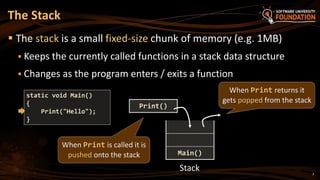
 The stack is a small fixed-size chunk of memory (e.g. 1MB)
 Keeps the currently called functions in a stack data structure
 Changes as the program enters / exits a function
The Stack
static void Main()
{
Print("Hello");
}
Main()
Print()
When Print is called it is
pushed onto the stack
When Print returns it
gets popped from the stack
Stack
Debugging a Program
Call Stack Live Demo
What is Recursion?
6
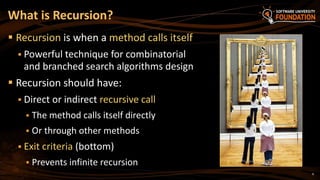
 Recursion is when a method calls itself
 Powerful technique for combinatorial
and branched search algorithms design
 Recursion should have:
 Direct or indirect recursive call
 The method calls itself directly
 Оr through other methods
 Exit criteria (bottom)
 Prevents infinite recursion
What is Recursion?
7
 Recursive definition of n! (n factorial):
Recursive Factorial – Example
n! = n * (n–1)! for n > 0
0! = 1
 5! = 5 * 4! = 5 * 4 * 3 * 2 * 1 * 1 = 120
 4! = 4 * 3! = 4 * 3 * 2 * 1 * 1 = 24
 3! = 3 * 2! = 3 * 2 * 1 * 1 = 6
 2! = 2 * 1! = 2 * 1 * 1 = 2
 1! = 1 * 0! = 1 * 1 = 1
 0! = 1
8
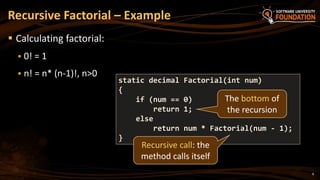
 Calculating factorial:
 0! = 1
 n! = n* (n-1)!, n>0
Recursive Factorial – Example
static decimal Factorial(int num)
{
if (num == 0)
return 1;
else
return num * Factorial(num - 1);
}
The bottom of
the recursion
Recursive call: the
method calls itself
Recursive Factorial
Live Demo
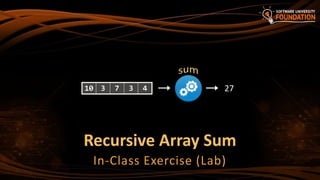
Recursive Array Sum
In-Class Exercise (Lab)
10 3 7 3 4 27
11
 Recursive calls are slightly slower than iteration
 Parameters and return values travel through the stack at each step
 Prefer iteration for linear calculations (without branched calls)
Performance: Recursion vs. Iteration
static long RecurFact(int n)
{
if (n == 0)
return 1;
else
return n * Fact(n - 1);
}
static long IterFact(int num)
{
long result = 1;
for (int i = 1; i <= n; i++)
result *= i;
return result;
}
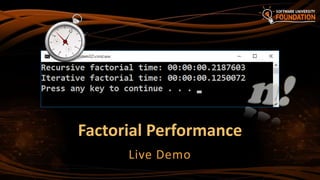
Recursive factorial: Iterative factorial:
Factorial Performance
Live Demo
13
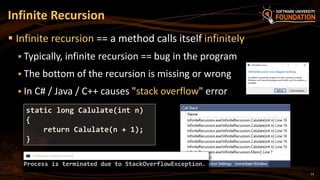
 Infinite recursion == a method calls itself infinitely
 Typically, infinite recursion == bug in the program
 The bottom of the recursion is missing or wrong
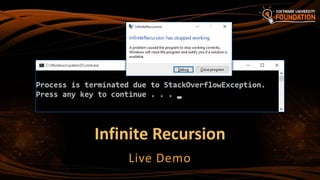
 In C# / Java / C++ causes "stack overflow" error
Infinite Recursion
static long Calulate(int n)
{
return Calulate(n + 1);
}
Infinite Recursion
Live Demo
15
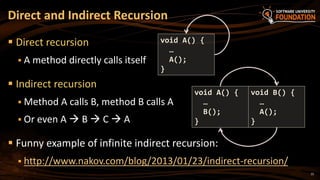
 Direct recursion
 A method directly calls itself
 Indirect recursion
 Method A calls B, method B calls A
 Or even A  B  C  A
 Funny example of infinite indirect recursion:
 http://www.nakov.com/blog/2013/01/23/indirect-recursion/
Direct and Indirect Recursion
void A() {
…
A();
}
void A() {
…
B();
}
void B() {
…
A();
}
16
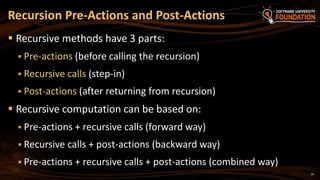
 Recursive methods have 3 parts:
 Pre-actions (before calling the recursion)
 Recursive calls (step-in)
 Post-actions (after returning from recursion)
 Recursive computation can be based on:
 Pre-actions + recursive calls (forward way)
 Recursive calls + post-actions (backward way)
 Pre-actions + recursive calls + post-actions (combined way)
Recursion Pre-Actions and Post-Actions
17
Pre-Actions and Post-Actions – Example
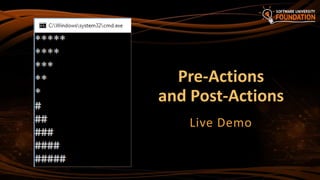
static void PrintFigure(int n)
{
if (n == 0) // Bottom of the recursion
return;
// Pre-action: print n asterisks
Console.WriteLine(new string('*', n));
// Recursive call: print figure of size n-1
PrintFigure(n - 1);
// Post-action: print n hashtags
Console.WriteLine(new string('#', n));
}
Pre-Actions
and Post-Actions
Live Demo
19
 How to generate all 8-bit vectors recursively?
 0 0 0 0 0 0 0 0
 0 0 0 0 0 0 0 1
 ...
 0 1 1 1 1 1 1 1
 1 0 0 0 0 0 0 0
 ...
 1 1 1 1 1 1 1 0
 1 1 1 1 1 1 1 1
 How to generate all n-bit vectors?
Generating 0/1 Vectors
20
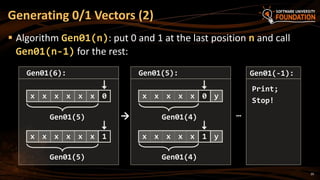
 Algorithm Gen01(n): put 0 and 1 at the last position n and call
Gen01(n-1) for the rest:
Generating 0/1 Vectors (2)
x x x x x x 0
Gen01(6):
Gen01(5)
x x x x x x 1
Gen01(5)
x x x x x 0 y
Gen01(5):
Gen01(4)
x x x x x 1 y
Gen01(4)
…
Gen01(-1):
Print;
Stop!

21
Generating 0/1 Vectors (3)
static void Gen01(int index, int[] vector)
{
if (index < 0)
Print(vector);
else
for (int i = 0; i <= 1; i++)
{
vector[index] = i;
Gen01(index-1, vector);
}
}
static void Main()
{
int n = 8;
int[] vector = new int[n];
Gen01(n-1, vector);
}
Generating 0/1 Vectors
Live Demo
Generating Combinations
Simple Recursive Algorithm
24
 Combinations in math represent all the ways to extract a subset
from a larger set of elements
 Select k members from a set of n elements
 Example: we can select 3 different elements from the set
{4, 5, 6, 7, 8} in 10 different ways:
(4, 5, 6) (4, 5, 7) (4, 5, 8) (4, 6, 7) (4, 6, 8)
(4, 7, 8) (5, 6, 7) (5, 6, 8) (5, 7, 8) (6, 7, 8)
 Combinations with and without repetitions can be easily
generated with recursion
Generating Combinations
25
 Algorithm GenCombs(k): put the numbers [1 … n] at position k
and call GenCombs(k+1) recursively for the rest of the elements:
Generating Combinations (2)
1 x x x x x x
GenCombs(0):
GenCombs(1)
Put all numbers in range
[1..n] at position k
1 1 x x x x x
GenCombs(1):
GenCombs(2)
Put all numbers in range
[1..n] at position k
GenCombs(n):
…
Print;
Stop!
Bottom of
recursion
26
Generating Combinations (3)
static void GenCombs(
int[] arr, int index, int startNum, int endNum)
{
if (index >= arr.Length) // Combination found --> print it
Console.WriteLine("(" + String.Join(", ", arr) + ")");
else
for (int i = startNum; i <= endNum; i++)
{
arr[index] = i;
GenCombs(arr, index + 1,
i + 1, endNum);
}
}
static void Main()
{
int[] arr = new int[3];
GenCombs(arr, 0, 4, 8);
}
Generating Combinations
Live Demo
Backtracking
Solving Computational Problems
by Generating All Candidates
29
 What is backtracking?
 Backtracking is a class of algorithms for finding all solutions to
some combinatorial computational problem
 E.g. find all paths from Sofia to Varna
 How does backtracking work?
 At each step tries all perspective possibilities recursively
 Drop all non-perspective possibilities as early as possible
 Backtracking has exponential running time!
Backtracking
30
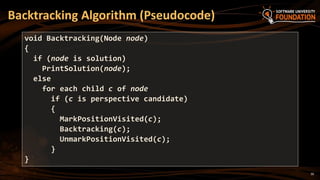
Backtracking Algorithm (Pseudocode)
void Backtracking(Node node)
{
if (node is solution)
PrintSolution(node);
else
for each child c of node
if (c is perspective candidate)
{
MarkPositionVisited(c);
Backtracking(c);
UnmarkPositionVisited(c);
}
}
The "8 Queens" Puzzle
Backtracking in Practice
32
 Write a program to find all
possible placements of
 8 queens on a chessboard
 So that no two queens can
attack each other
 http://en.wikipedia.org/wiki/
Eight_queens_puzzle
The "8 Queens" Puzzle
33
 Backtracking
algorithm
 For finding all
solutions to the
"8 Queens Puzzle"
 At each step:
 Put a queen at
free position
 Recursive call
 Remove the
queen
Solving The "8 Queens" Puzzle
void PutQueens(row)
{
if (row == 8)
PrintSolution();
else
for (col = 0 … 7)
if (CanPlaceQueen(row, col))
{
MarkAllAttackedPositions(row, col);
PutQueens(row + 1);
UnmarkAllAttackedPositions(row, col);
}
}
The "8 Queens" Puzzle
In-Class Exercise (Lab)
35
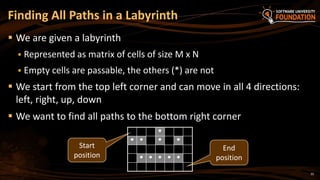
 We are given a labyrinth
 Represented as matrix of cells of size M x N
 Empty cells are passable, the others (*) are not
 We start from the top left corner and can move in all 4 directions:
left, right, up, down
 We want to find all paths to the bottom right corner
Finding All Paths in a Labyrinth
Start
position
End
position
36
 There are 3 different paths from the top left corner to the
bottom right corner:
Finding All Paths in a Labyrinth (2)
0 1 2 *
* * 3 * *
6 5 4
7 * * * * *
8 9 10 11 12 13 14
0 1 2 * 8 9 10
* * 3 * 7 * 11
4 5 6 12
* * * * * 13
14
1) 2)
0 1 2 *
* * 3 * *
4 5 6 7 8
* * * * * 9
10
3)
37
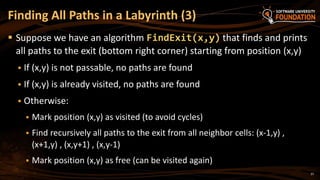
 Suppose we have an algorithm FindExit(x,y) that finds and prints
all paths to the exit (bottom right corner) starting from position (x,y)
 If (x,y) is not passable, no paths are found
 If (x,y) is already visited, no paths are found
 Otherwise:
 Mark position (x,y) as visited (to avoid cycles)
 Find recursively all paths to the exit from all neighbor cells: (x-1,y) ,
(x+1,y) , (x,y+1) , (x,y-1)
 Mark position (x,y) as free (can be visited again)
Finding All Paths in a Labyrinth (3)
38
 Representing the labyrinth as matrix of characters (in this example 5
rows and 7 columns):
 Spaces (' ') are passable cells
 Asterisks ('*') are not passable
 The symbol 'e' is the exit (can occur multiple times)
Find All Paths: Algorithm
static char[,] lab =
{
{' ', ' ', ' ', '*', ' ', ' ', ' '},
{'*', '*', ' ', '*', ' ', '*', ' '},
{' ', ' ', ' ', ' ', ' ', ' ', ' '},
{' ', '*', '*', '*', '*', '*', ' '},
{' ', ' ', ' ', ' ', ' ', ' ', 'е'},
};
39
Find All Paths: Algorithm (2)
static void FindExit(int row, int col)
{
if ((col < 0) || (row < 0) || (col >= lab.GetLength(1))
|| (row >= lab.GetLength(0)))
{
// We are out of the labyrinth -> can't find a path
return;
}
// Check if we have found the exit
if (lab[row, col] == 'е')
{
Console.WriteLine("Found the exit!");
}
if (lab[row, col] != ' ')
{
// The current cell is not free -> can't find a path
return;
}
(example continues)
40
Find All Paths: Algorithm (3)
// Temporaryly mark the current cell as visited
lab[row, col] = 's';
// Invoke recursion to explore all possible directions
FindExit(row, col - 1); // left
FindExit(row - 1, col); // up
FindExit(row, col + 1); // right
FindExit(row + 1, col); // down
// Mark back the current cell as free
lab[row, col] = ' ';
}
static void Main()
{
FindExit(0, 0);
}
Find All Paths in a Labyrinth
Live Demo
42
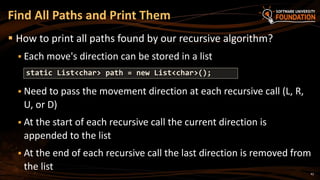
 How to print all paths found by our recursive algorithm?
 Each move's direction can be stored in a list
 Need to pass the movement direction at each recursive call (L, R,
U, or D)
 At the start of each recursive call the current direction is
appended to the list
 At the end of each recursive call the last direction is removed from
the list
Find All Paths and Print Them
static List<char> path = new List<char>();
43
Find All Paths and Print Them (2)
static void FindPathToExit(int row, int col, char direction)
{
...
// Append the current direction to the path
path.Add(direction);
if (lab[row, col] == 'е')
{
// The exit is found -> print the current path
}
...
// Recursively explore all possible directions
FindPathToExit(row, col - 1, 'L'); // left
FindPathToExit(row - 1, col, 'U'); // up
FindPathToExit(row, col + 1, 'R'); // right
FindPathToExit(row + 1, col, 'D'); // down
...
// Remove the last direction from the path
path.RemoveAt(path.Count - 1);
}
Find and Print All Paths
in a Labyrinth
Live Demo
Recursion or Iteration?
When to Use and When to Avoid Recursion?
46
 When used incorrectly recursion could take too much memory and
computing power
 Example:
Recursion Can be Harmful!
static decimal Fibonacci(int n)
{
if ((n == 1) || (n == 2))
return 1;
else
return Fibonacci(n - 1) + Fibonacci(n - 2);
}
static void Main()
{
Console.WriteLine(Fibonacci(10)); // 89
Console.WriteLine(Fibonacci(50)); // This will hang!
}
Harmful Recursion
Live Demo
48
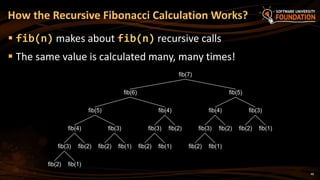
 fib(n) makes about fib(n) recursive calls
 The same value is calculated many, many times!
How the Recursive Fibonacci Calculation Works?
49
 Each Fibonacci
sequence member
 Can be remembered
once it is calculated
 Can be returned
directly when needed
again
Fast Recursive Fibonacci
static decimal[] fib = new decimal[MAX_FIB];
static decimal Fib(int n)
{
if (fib[n] == 0)
{
// fib[n] is still not calculated
if ((n == 1) || (n == 2))
fib[n] = 1;
else
fib[n] = Fib(n - 1) + Fib(n - 2);
}
return fib[n];
}
Fast Recursive Fibonacci
Live Demo
51
 Avoid recursion when an obvious iterative algorithm exists
 Examples: factorial, Fibonacci numbers
 Use recursion for combinatorial algorithms where
 At each step you need to recursively explore more than one
possible continuation
 I.e. for branched recursive algorithms
 Examples: permutations, all paths in a labyrinth
 If you have only one recursive call in the body of a recursive
method, it can directly become iterative (like calculating factorial)
When to Use Recursion?
52
 Recursion means to call a method from itself
 It should always have a bottom at which the recursive calls stop
 Very powerful technique for implementing combinatorial algorithms
 Examples: generating combinatorial configurations like vectors,
permutations, combinations, variations, etc.
 Backtracking finds all solutions / optimal solution of
combinatorial problem by generating all possibilities
 Without non-perspective candidates
 Recursion can be harmful when not used correctly
Summary
?
Recursion
https://softuni.bg/trainings/1331/algorithms-april-2016
License
 This course (slides, examples, labs, videos, homework, etc.)
is licensed under the "Creative Commons Attribution-
NonCommercial-ShareAlike 4.0 International" license
54
 Attribution: this work may contain portions from
 "Fundamentals of Computer Programming with C#" book by Svetlin Nakov & Co. under CC-BY-SA license
 "Data Structures and Algorithms" course by Telerik Academy under CC-BY-NC-SA license
Free Trainings @ Software University
 Software University Foundation – softuni.org
 Software University – High-Quality Education,
Profession and Job for Software Developers
 softuni.bg
 Software University @ Facebook
 facebook.com/SoftwareUniversity
 Software University @ YouTube
 youtube.com/SoftwareUniversity
 Software University Forums – forum.softuni.bg

10. Recursion

  • 1.
    Recursion Recursive Algorithms and Backtracking SoftUniTeam Technical Trainers Software University http://softuni.bg
  • 2.
    2 1. What isRecursion? 2. Recursive Factorial 3. Generating 0/1 Vectors and Combinations 4. Backtracking  The 8 Queens Problem  Finding All Paths in a Labyrinth Recursively 5. Recursion or Iteration?  Harmful Recursion and Optimizing Bad Recursion Table of Contents
  • 3.
    3  The stackis a small fixed-size chunk of memory (e.g. 1MB)  Keeps the currently called functions in a stack data structure  Changes as the program enters / exits a function The Stack static void Main() { Print("Hello"); } Main() Print() When Print is called it is pushed onto the stack When Print returns it gets popped from the stack Stack
  • 4.
    Debugging a Program CallStack Live Demo
  • 5.
  • 6.
    6  Recursion iswhen a method calls itself  Powerful technique for combinatorial and branched search algorithms design  Recursion should have:  Direct or indirect recursive call  The method calls itself directly  Оr through other methods  Exit criteria (bottom)  Prevents infinite recursion What is Recursion?
  • 7.
    7  Recursive definitionof n! (n factorial): Recursive Factorial – Example n! = n * (n–1)! for n > 0 0! = 1  5! = 5 * 4! = 5 * 4 * 3 * 2 * 1 * 1 = 120  4! = 4 * 3! = 4 * 3 * 2 * 1 * 1 = 24  3! = 3 * 2! = 3 * 2 * 1 * 1 = 6  2! = 2 * 1! = 2 * 1 * 1 = 2  1! = 1 * 0! = 1 * 1 = 1  0! = 1
  • 8.
    8  Calculating factorial: 0! = 1  n! = n* (n-1)!, n>0 Recursive Factorial – Example static decimal Factorial(int num) { if (num == 0) return 1; else return num * Factorial(num - 1); } The bottom of the recursion Recursive call: the method calls itself
  • 9.
  • 10.
    Recursive Array Sum In-ClassExercise (Lab) 10 3 7 3 4 27
  • 11.
    11  Recursive callsare slightly slower than iteration  Parameters and return values travel through the stack at each step  Prefer iteration for linear calculations (without branched calls) Performance: Recursion vs. Iteration static long RecurFact(int n) { if (n == 0) return 1; else return n * Fact(n - 1); } static long IterFact(int num) { long result = 1; for (int i = 1; i <= n; i++) result *= i; return result; } Recursive factorial: Iterative factorial:
  • 12.
  • 13.
    13  Infinite recursion== a method calls itself infinitely  Typically, infinite recursion == bug in the program  The bottom of the recursion is missing or wrong  In C# / Java / C++ causes "stack overflow" error Infinite Recursion static long Calulate(int n) { return Calulate(n + 1); }
  • 14.
  • 15.
    15  Direct recursion A method directly calls itself  Indirect recursion  Method A calls B, method B calls A  Or even A  B  C  A  Funny example of infinite indirect recursion:  http://www.nakov.com/blog/2013/01/23/indirect-recursion/ Direct and Indirect Recursion void A() { … A(); } void A() { … B(); } void B() { … A(); }
  • 16.
    16  Recursive methodshave 3 parts:  Pre-actions (before calling the recursion)  Recursive calls (step-in)  Post-actions (after returning from recursion)  Recursive computation can be based on:  Pre-actions + recursive calls (forward way)  Recursive calls + post-actions (backward way)  Pre-actions + recursive calls + post-actions (combined way) Recursion Pre-Actions and Post-Actions
  • 17.
    17 Pre-Actions and Post-Actions– Example static void PrintFigure(int n) { if (n == 0) // Bottom of the recursion return; // Pre-action: print n asterisks Console.WriteLine(new string('*', n)); // Recursive call: print figure of size n-1 PrintFigure(n - 1); // Post-action: print n hashtags Console.WriteLine(new string('#', n)); }
  • 18.
  • 19.
    19  How togenerate all 8-bit vectors recursively?  0 0 0 0 0 0 0 0  0 0 0 0 0 0 0 1  ...  0 1 1 1 1 1 1 1  1 0 0 0 0 0 0 0  ...  1 1 1 1 1 1 1 0  1 1 1 1 1 1 1 1  How to generate all n-bit vectors? Generating 0/1 Vectors
  • 20.
    20  Algorithm Gen01(n):put 0 and 1 at the last position n and call Gen01(n-1) for the rest: Generating 0/1 Vectors (2) x x x x x x 0 Gen01(6): Gen01(5) x x x x x x 1 Gen01(5) x x x x x 0 y Gen01(5): Gen01(4) x x x x x 1 y Gen01(4) … Gen01(-1): Print; Stop! 
  • 21.
    21 Generating 0/1 Vectors(3) static void Gen01(int index, int[] vector) { if (index < 0) Print(vector); else for (int i = 0; i <= 1; i++) { vector[index] = i; Gen01(index-1, vector); } } static void Main() { int n = 8; int[] vector = new int[n]; Gen01(n-1, vector); }
  • 22.
  • 23.
  • 24.
    24  Combinations inmath represent all the ways to extract a subset from a larger set of elements  Select k members from a set of n elements  Example: we can select 3 different elements from the set {4, 5, 6, 7, 8} in 10 different ways: (4, 5, 6) (4, 5, 7) (4, 5, 8) (4, 6, 7) (4, 6, 8) (4, 7, 8) (5, 6, 7) (5, 6, 8) (5, 7, 8) (6, 7, 8)  Combinations with and without repetitions can be easily generated with recursion Generating Combinations
  • 25.
    25  Algorithm GenCombs(k):put the numbers [1 … n] at position k and call GenCombs(k+1) recursively for the rest of the elements: Generating Combinations (2) 1 x x x x x x GenCombs(0): GenCombs(1) Put all numbers in range [1..n] at position k 1 1 x x x x x GenCombs(1): GenCombs(2) Put all numbers in range [1..n] at position k GenCombs(n): … Print; Stop! Bottom of recursion
  • 26.
    26 Generating Combinations (3) staticvoid GenCombs( int[] arr, int index, int startNum, int endNum) { if (index >= arr.Length) // Combination found --> print it Console.WriteLine("(" + String.Join(", ", arr) + ")"); else for (int i = startNum; i <= endNum; i++) { arr[index] = i; GenCombs(arr, index + 1, i + 1, endNum); } } static void Main() { int[] arr = new int[3]; GenCombs(arr, 0, 4, 8); }
  • 27.
  • 28.
  • 29.
    29  What isbacktracking?  Backtracking is a class of algorithms for finding all solutions to some combinatorial computational problem  E.g. find all paths from Sofia to Varna  How does backtracking work?  At each step tries all perspective possibilities recursively  Drop all non-perspective possibilities as early as possible  Backtracking has exponential running time! Backtracking
  • 30.
    30 Backtracking Algorithm (Pseudocode) voidBacktracking(Node node) { if (node is solution) PrintSolution(node); else for each child c of node if (c is perspective candidate) { MarkPositionVisited(c); Backtracking(c); UnmarkPositionVisited(c); } }
  • 31.
    The "8 Queens"Puzzle Backtracking in Practice
  • 32.
    32  Write aprogram to find all possible placements of  8 queens on a chessboard  So that no two queens can attack each other  http://en.wikipedia.org/wiki/ Eight_queens_puzzle The "8 Queens" Puzzle
  • 33.
    33  Backtracking algorithm  Forfinding all solutions to the "8 Queens Puzzle"  At each step:  Put a queen at free position  Recursive call  Remove the queen Solving The "8 Queens" Puzzle void PutQueens(row) { if (row == 8) PrintSolution(); else for (col = 0 … 7) if (CanPlaceQueen(row, col)) { MarkAllAttackedPositions(row, col); PutQueens(row + 1); UnmarkAllAttackedPositions(row, col); } }
  • 34.
    The "8 Queens"Puzzle In-Class Exercise (Lab)
  • 35.
    35  We aregiven a labyrinth  Represented as matrix of cells of size M x N  Empty cells are passable, the others (*) are not  We start from the top left corner and can move in all 4 directions: left, right, up, down  We want to find all paths to the bottom right corner Finding All Paths in a Labyrinth Start position End position
  • 36.
    36  There are3 different paths from the top left corner to the bottom right corner: Finding All Paths in a Labyrinth (2) 0 1 2 * * * 3 * * 6 5 4 7 * * * * * 8 9 10 11 12 13 14 0 1 2 * 8 9 10 * * 3 * 7 * 11 4 5 6 12 * * * * * 13 14 1) 2) 0 1 2 * * * 3 * * 4 5 6 7 8 * * * * * 9 10 3)
  • 37.
    37  Suppose wehave an algorithm FindExit(x,y) that finds and prints all paths to the exit (bottom right corner) starting from position (x,y)  If (x,y) is not passable, no paths are found  If (x,y) is already visited, no paths are found  Otherwise:  Mark position (x,y) as visited (to avoid cycles)  Find recursively all paths to the exit from all neighbor cells: (x-1,y) , (x+1,y) , (x,y+1) , (x,y-1)  Mark position (x,y) as free (can be visited again) Finding All Paths in a Labyrinth (3)
  • 38.
    38  Representing thelabyrinth as matrix of characters (in this example 5 rows and 7 columns):  Spaces (' ') are passable cells  Asterisks ('*') are not passable  The symbol 'e' is the exit (can occur multiple times) Find All Paths: Algorithm static char[,] lab = { {' ', ' ', ' ', '*', ' ', ' ', ' '}, {'*', '*', ' ', '*', ' ', '*', ' '}, {' ', ' ', ' ', ' ', ' ', ' ', ' '}, {' ', '*', '*', '*', '*', '*', ' '}, {' ', ' ', ' ', ' ', ' ', ' ', 'е'}, };
  • 39.
    39 Find All Paths:Algorithm (2) static void FindExit(int row, int col) { if ((col < 0) || (row < 0) || (col >= lab.GetLength(1)) || (row >= lab.GetLength(0))) { // We are out of the labyrinth -> can't find a path return; } // Check if we have found the exit if (lab[row, col] == 'е') { Console.WriteLine("Found the exit!"); } if (lab[row, col] != ' ') { // The current cell is not free -> can't find a path return; } (example continues)
  • 40.
    40 Find All Paths:Algorithm (3) // Temporaryly mark the current cell as visited lab[row, col] = 's'; // Invoke recursion to explore all possible directions FindExit(row, col - 1); // left FindExit(row - 1, col); // up FindExit(row, col + 1); // right FindExit(row + 1, col); // down // Mark back the current cell as free lab[row, col] = ' '; } static void Main() { FindExit(0, 0); }
  • 41.
    Find All Pathsin a Labyrinth Live Demo
  • 42.
    42  How toprint all paths found by our recursive algorithm?  Each move's direction can be stored in a list  Need to pass the movement direction at each recursive call (L, R, U, or D)  At the start of each recursive call the current direction is appended to the list  At the end of each recursive call the last direction is removed from the list Find All Paths and Print Them static List<char> path = new List<char>();
  • 43.
    43 Find All Pathsand Print Them (2) static void FindPathToExit(int row, int col, char direction) { ... // Append the current direction to the path path.Add(direction); if (lab[row, col] == 'е') { // The exit is found -> print the current path } ... // Recursively explore all possible directions FindPathToExit(row, col - 1, 'L'); // left FindPathToExit(row - 1, col, 'U'); // up FindPathToExit(row, col + 1, 'R'); // right FindPathToExit(row + 1, col, 'D'); // down ... // Remove the last direction from the path path.RemoveAt(path.Count - 1); }
  • 44.
    Find and PrintAll Paths in a Labyrinth Live Demo
  • 45.
    Recursion or Iteration? Whento Use and When to Avoid Recursion?
  • 46.
    46  When usedincorrectly recursion could take too much memory and computing power  Example: Recursion Can be Harmful! static decimal Fibonacci(int n) { if ((n == 1) || (n == 2)) return 1; else return Fibonacci(n - 1) + Fibonacci(n - 2); } static void Main() { Console.WriteLine(Fibonacci(10)); // 89 Console.WriteLine(Fibonacci(50)); // This will hang! }
  • 47.
  • 48.
    48  fib(n) makesabout fib(n) recursive calls  The same value is calculated many, many times! How the Recursive Fibonacci Calculation Works?
  • 49.
    49  Each Fibonacci sequencemember  Can be remembered once it is calculated  Can be returned directly when needed again Fast Recursive Fibonacci static decimal[] fib = new decimal[MAX_FIB]; static decimal Fib(int n) { if (fib[n] == 0) { // fib[n] is still not calculated if ((n == 1) || (n == 2)) fib[n] = 1; else fib[n] = Fib(n - 1) + Fib(n - 2); } return fib[n]; }
  • 50.
  • 51.
    51  Avoid recursionwhen an obvious iterative algorithm exists  Examples: factorial, Fibonacci numbers  Use recursion for combinatorial algorithms where  At each step you need to recursively explore more than one possible continuation  I.e. for branched recursive algorithms  Examples: permutations, all paths in a labyrinth  If you have only one recursive call in the body of a recursive method, it can directly become iterative (like calculating factorial) When to Use Recursion?
  • 52.
    52  Recursion meansto call a method from itself  It should always have a bottom at which the recursive calls stop  Very powerful technique for implementing combinatorial algorithms  Examples: generating combinatorial configurations like vectors, permutations, combinations, variations, etc.  Backtracking finds all solutions / optimal solution of combinatorial problem by generating all possibilities  Without non-perspective candidates  Recursion can be harmful when not used correctly Summary
  • 53.
  • 54.
    License  This course(slides, examples, labs, videos, homework, etc.) is licensed under the "Creative Commons Attribution- NonCommercial-ShareAlike 4.0 International" license 54  Attribution: this work may contain portions from  "Fundamentals of Computer Programming with C#" book by Svetlin Nakov & Co. under CC-BY-SA license  "Data Structures and Algorithms" course by Telerik Academy under CC-BY-NC-SA license
  • 55.
    Free Trainings @Software University  Software University Foundation – softuni.org  Software University – High-Quality Education, Profession and Job for Software Developers  softuni.bg  Software University @ Facebook  facebook.com/SoftwareUniversity  Software University @ YouTube  youtube.com/SoftwareUniversity  Software University Forums – forum.softuni.bg

Editor's Notes

  • #9 (c) 2007 National Academy for Software Development - http://academy.devbg.org. All rights reserved. Unauthorized copying or re-distribution is strictly prohibited.*
  • #20 (c) 2007 National Academy for Software Development - http://academy.devbg.org. All rights reserved. Unauthorized copying or re-distribution is strictly prohibited.*
  • #22 (c) 2007 National Academy for Software Development - http://academy.devbg.org. All rights reserved. Unauthorized copying or re-distribution is strictly prohibited.*
  • #27 (c) 2007 National Academy for Software Development - http://academy.devbg.org. All rights reserved. Unauthorized copying or re-distribution is strictly prohibited.*
  • #53 (c) 2007 National Academy for Software Development - http://academy.devbg.org. All rights reserved. Unauthorized copying or re-distribution is strictly prohibited.*