Building Java Programs 
Chapter 3 
Parameters and Objects 
Copyright (c) Pearson 2013. 
All rights reserved.
2 
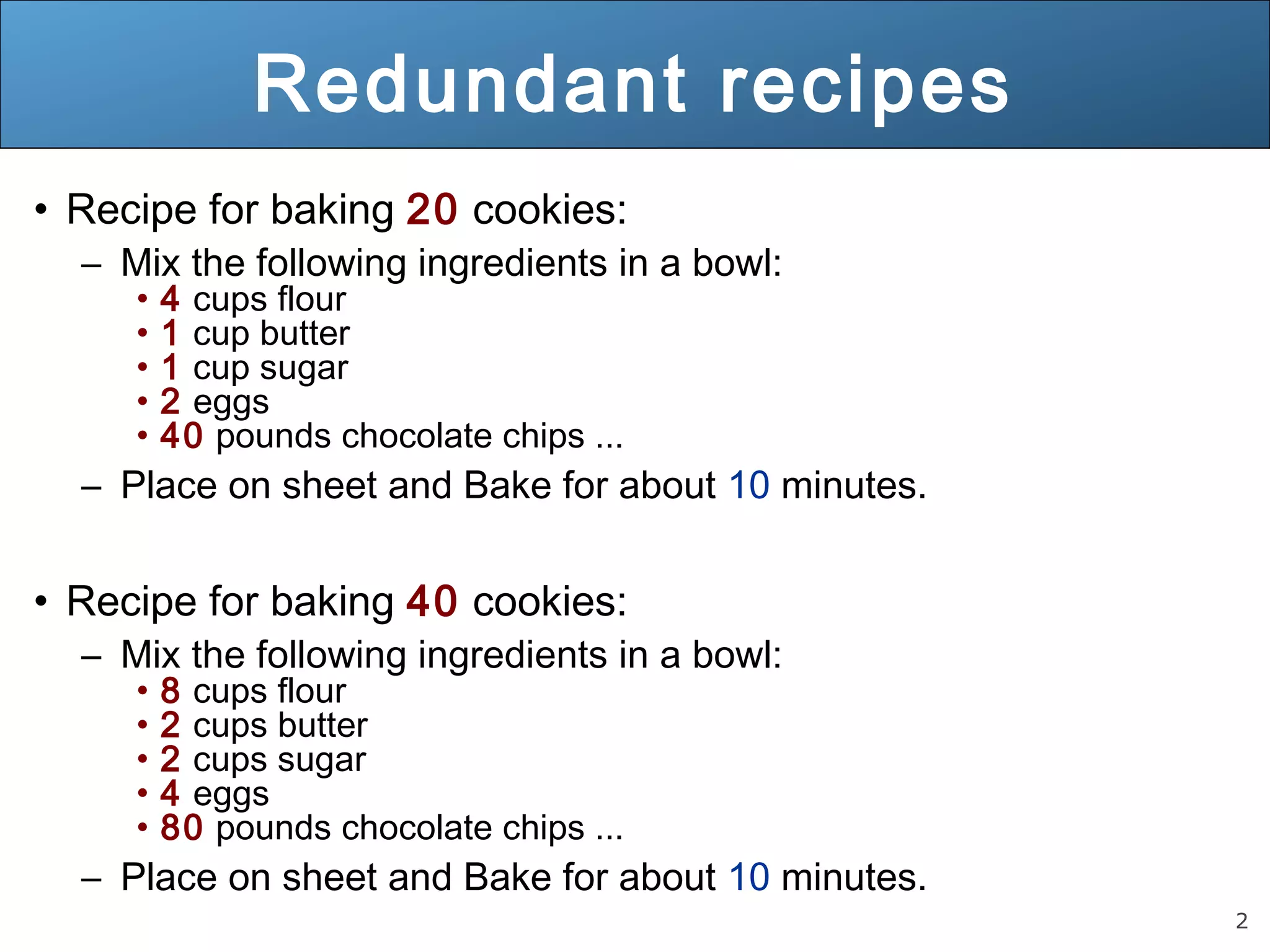
Redundant recipes 
• Recipe for baking 20 cookies: 
– Mix the following ingredients in a bowl: 
• 4 cups flour 
• 1 cup butter 
• 1 cup sugar 
• 2 eggs 
• 40 pounds chocolate chips ... 
– Place on sheet and Bake for about 10 minutes. 
• Recipe for baking 40 cookies: 
– Mix the following ingredients in a bowl: 
• 8 cups flour 
• 2 cups butter 
• 2 cups sugar 
• 4 eggs 
• 80 pounds chocolate chips ... 
– Place on sheet and Bake for about 10 minutes.
3 
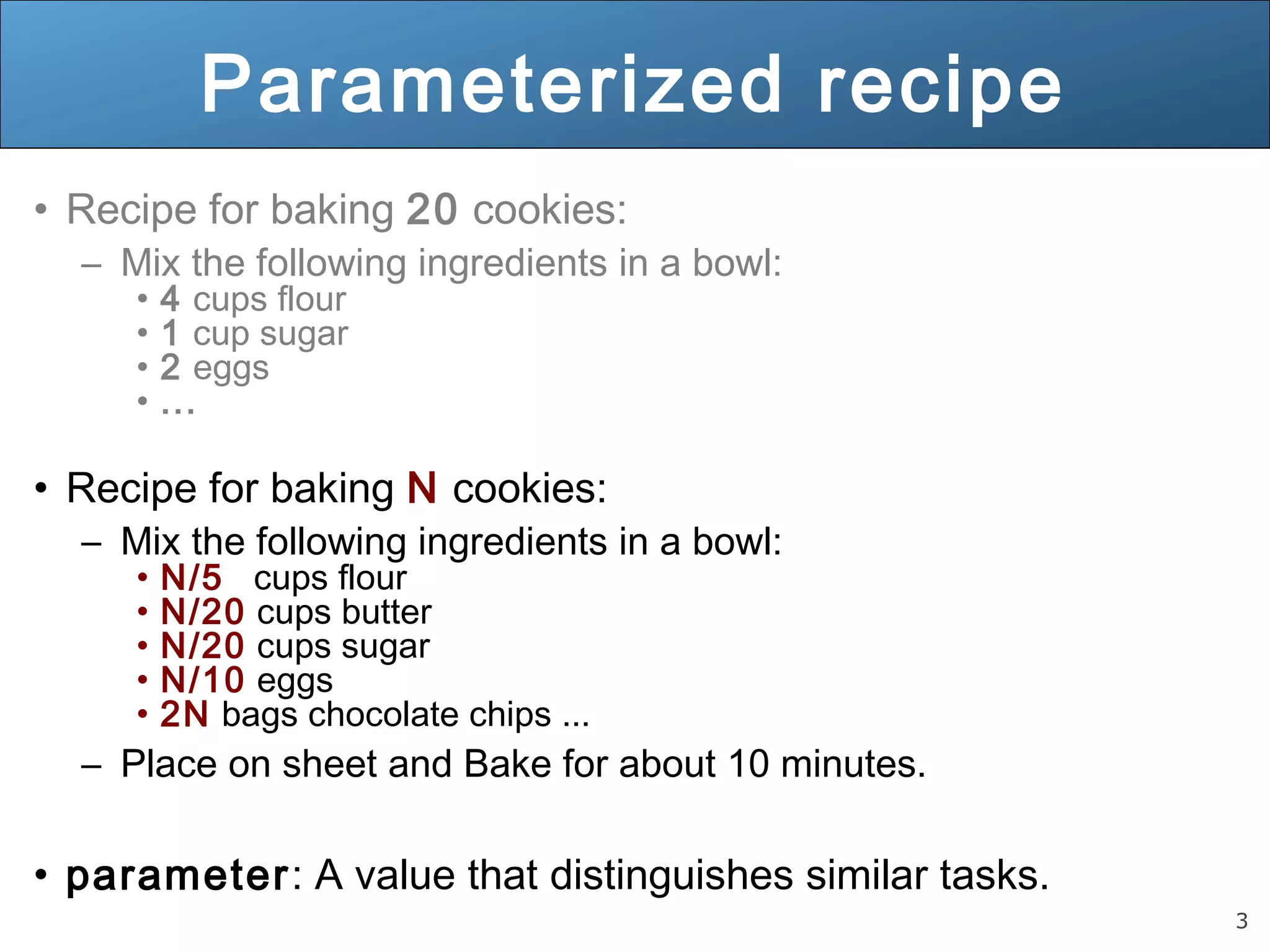
Parameterized recipe 
• Recipe for baking 20 cookies: 
– Mix the following ingredients in a bowl: 
• 4 cups flour 
• 1 cup sugar 
• 2 eggs 
• ... 
• Recipe for baking N cookies: 
– Mix the following ingredients in a bowl: 
• N/5 cups flour 
• N/20 cups butter 
• N/20 cups sugar 
• N/10 eggs 
• 2N bags chocolate chips ... 
– Place on sheet and Bake for about 10 minutes. 
• parameter: A value that distinguishes similar tasks.
4 
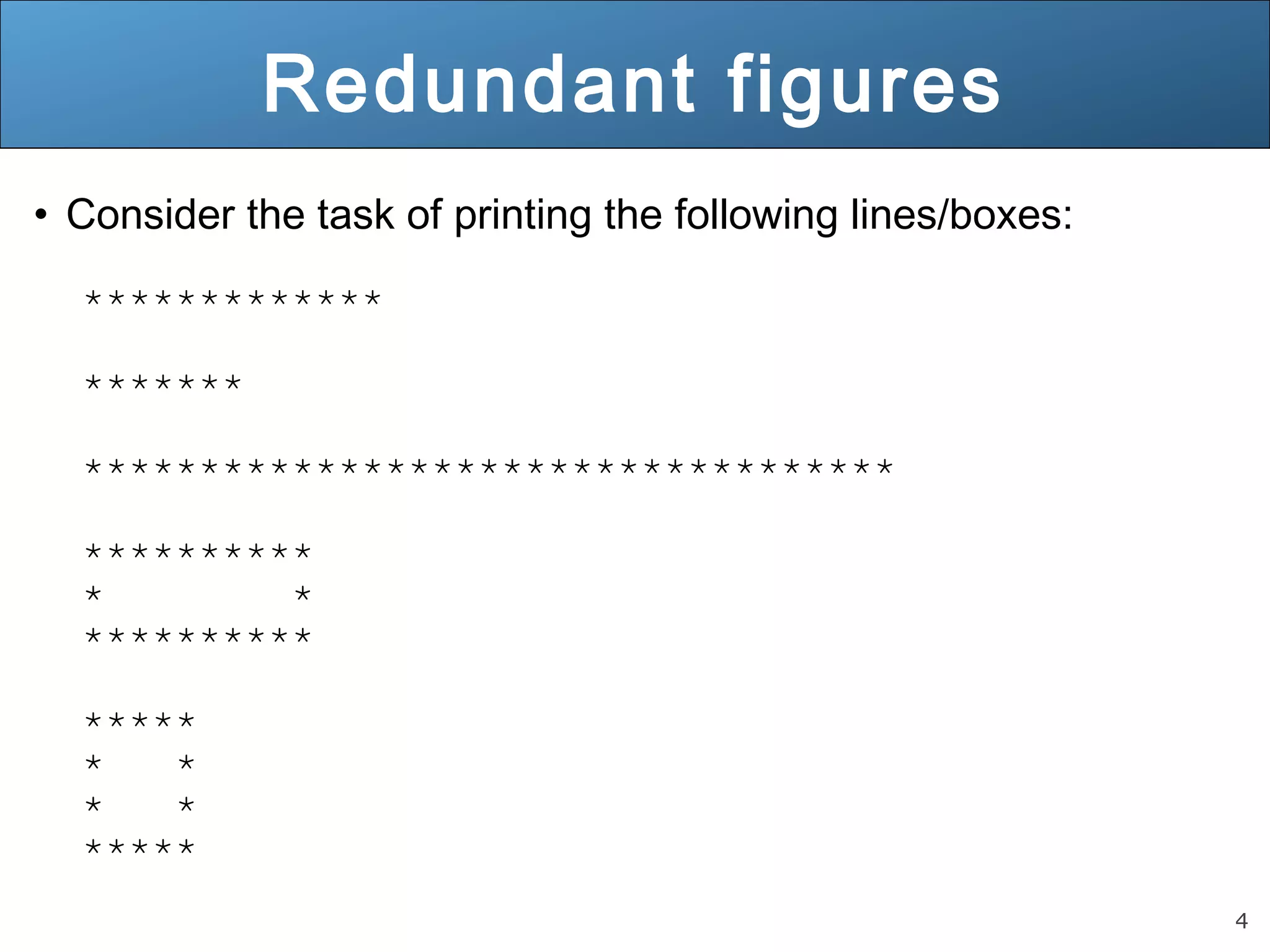
Redundant figures 
• Consider the task of printing the following lines/boxes: 
************* 
******* 
*********************************** 
********** 
* * 
********** 
***** 
* * 
* * 
*****
5 
A redundant solution 
public class Stars1 { 
public static void main(String[] args) { 
lineOf13(); 
lineOf7(); 
lineOf35(); 
box10x3(); 
box5x4(); 
} 
public static void lineOf13() { 
for (int i = 1; i <= 13; i++) { 
System.out.print("*"); 
} 
System.out.println(); 
} 
public static void lineOf7() { 
for (int i = 1; i <= 7; i++) { 
System.out.print("*"); 
} 
System.out.println(); 
} 
public static void lineOf35() { 
for (int i = 1; i <= 35; i++) { 
System.out.print("*"); 
} 
System.out.println(); 
} 
... 
• This code is redundant. 
• Would variables help? 
Would constants help? 
• What is a better solution? 
– line - A method to draw a 
line of any number of stars. 
– box - A method to draw a 
box of any size.
6 
Parameterization 
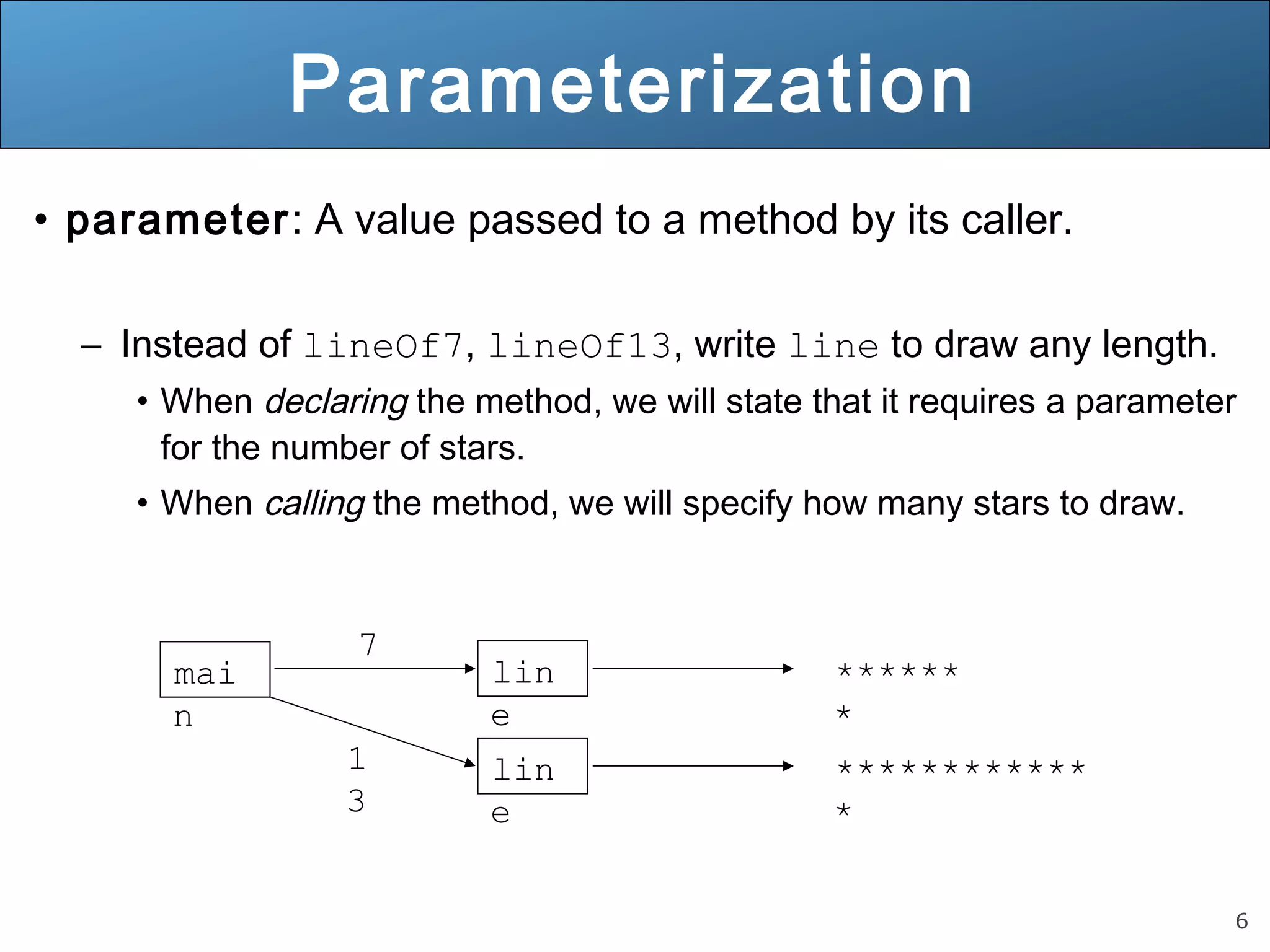
• parameter: A value passed to a method by its caller. 
– Instead of lineOf7, lineOf13, write line to draw any length. 
• When declaring the method, we will state that it requires a parameter 
for the number of stars. 
• When calling the method, we will specify how many stars to draw. 
mai 
n 
lin 
e 
****** 
* 
7 
lin 
e 
************ 
* 
1 
3
7 
Declaring a parameter 
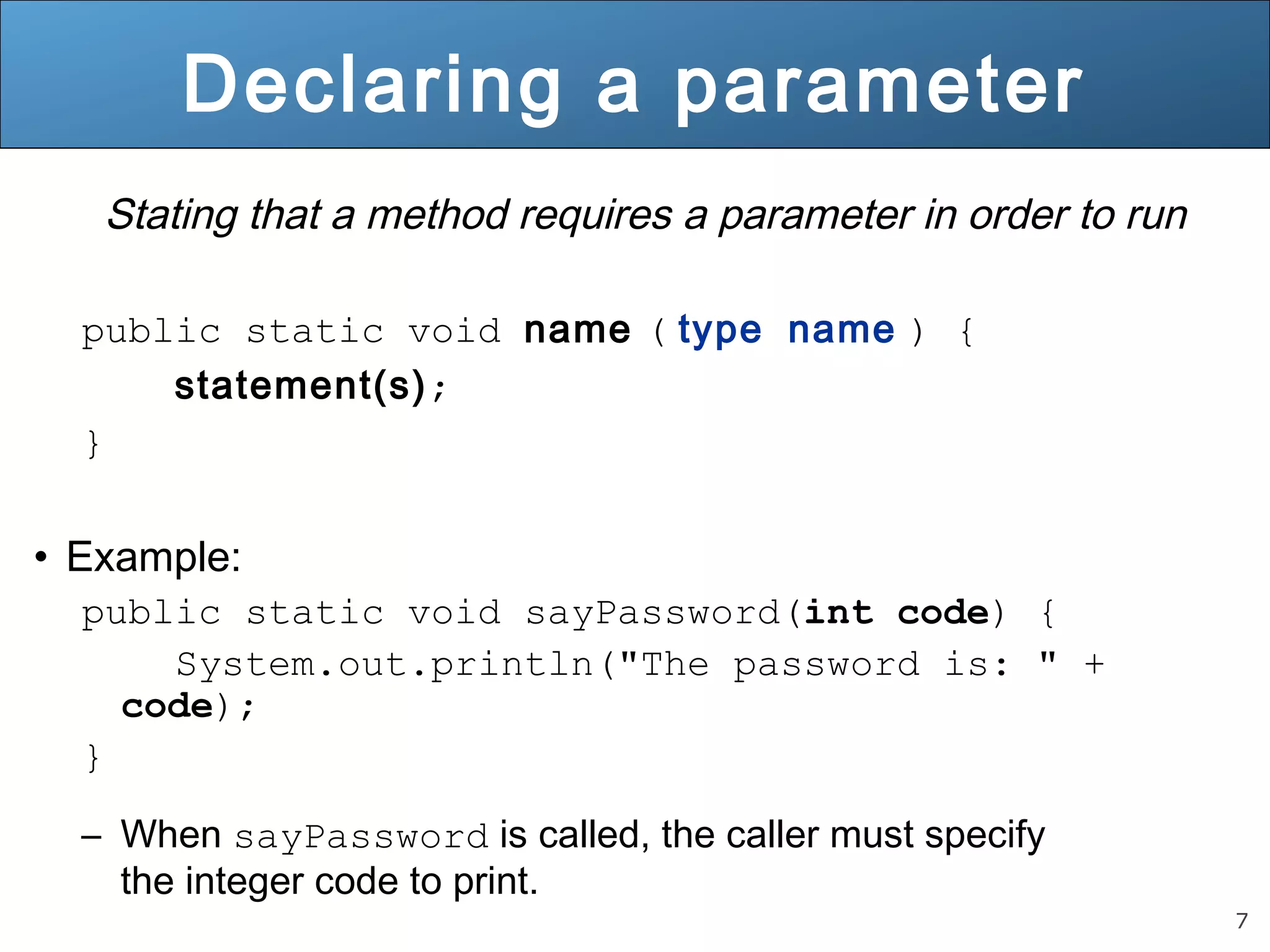
Stating that a method requires a parameter in order to run 
public static void name ( type name ) { 
statement(s); 
} 
• Example: 
public static void sayPassword(int code) { 
System.out.println("The password is: " + 
code); 
} 
– When sayPassword is called, the caller must specify 
the integer code to print.
8 
Passing a parameter 
Calling a method and specifying values for its parameters 
name (expression); 
• Example: 
public static void main(String[] args) { 
sayPassword(42); 
sayPassword(12345); 
} 
Output: 
The password is 42 
The password is 12345
9 
Parameters and loops 
• A parameter can guide the number of repetitions of a loop. 
public static void main(String[] args) { 
chant(3); 
} 
public static void chant(int times) { 
for (int i = 1; i <= times; i++) { 
System.out.println("Just a salad..."); 
} 
} 
Output: 
Just a salad... 
Just a salad... 
Just a salad...
10 
How parameters are 
passed 
• When the method is called: 
– The value is stored into the parameter variable. 
– The method's code executes using that value. 
public static void main(String[] args) { 
chant(3); 
chant(7); 
} 
public static void chant(int times) { 
for (int i = 1; i <= times; i++) { 
System.out.println("Just a salad..."); 
} 
} 
37
11 
Common errors 
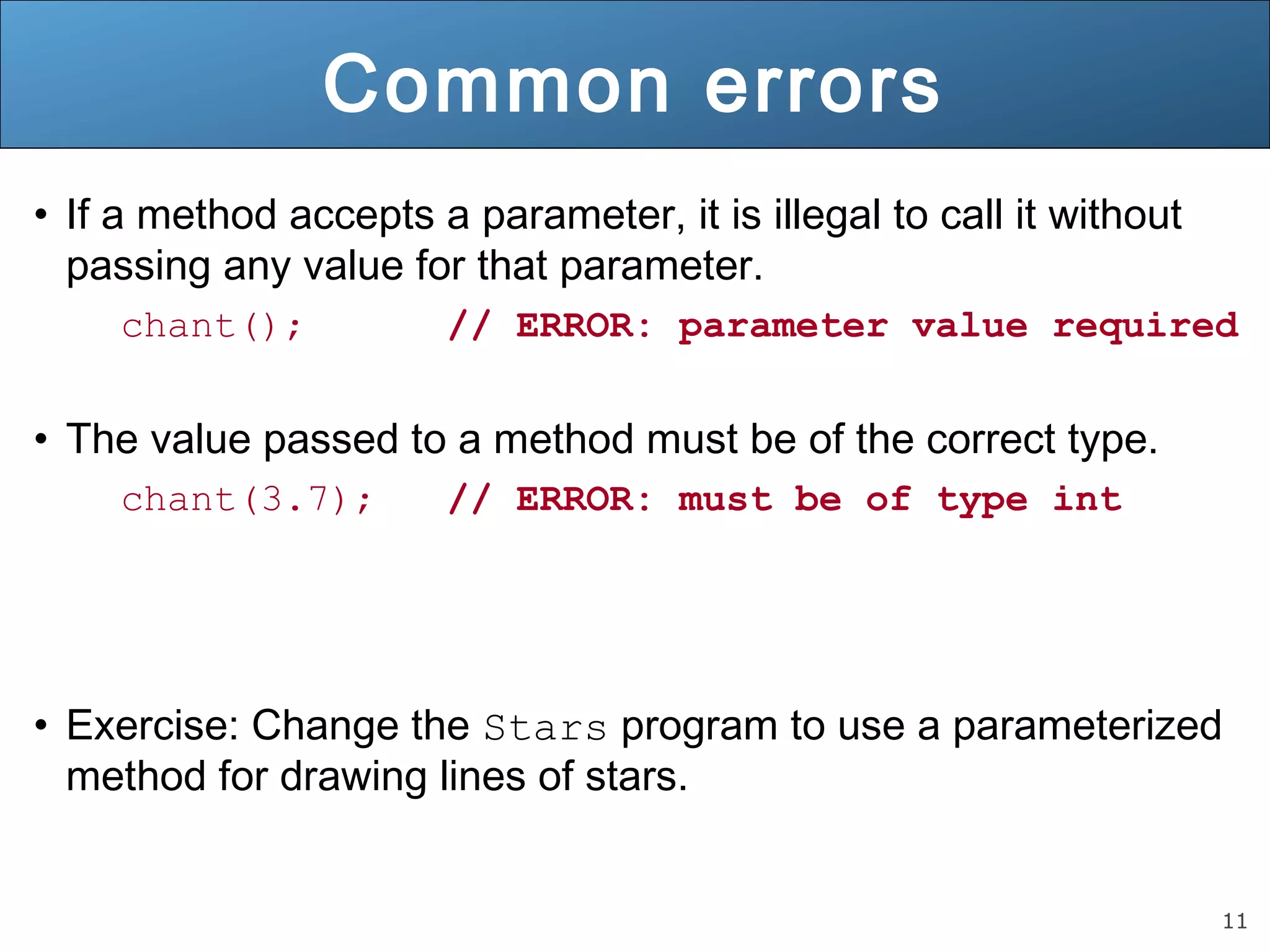
• If a method accepts a parameter, it is illegal to call it without 
passing any value for that parameter. 
chant(); // ERROR: parameter value required 
• The value passed to a method must be of the correct type. 
chant(3.7); // ERROR: must be of type int 
• Exercise: Change the Stars program to use a parameterized 
method for drawing lines of stars.
12 
Stars solution 
// Prints several lines of stars. 
// Uses a parameterized method to remove redundancy. 
public class Stars2 { 
public static void main(String[] args) { 
line(13); 
line(7); 
line(35); 
} 
// Prints the given number of stars plus a line break. 
public static void line(int count) { 
for (int i = 1; i <= count; i++) { 
System.out.print("*"); 
} 
System.out.println(); 
} 
}
13 
Multiple parameters 
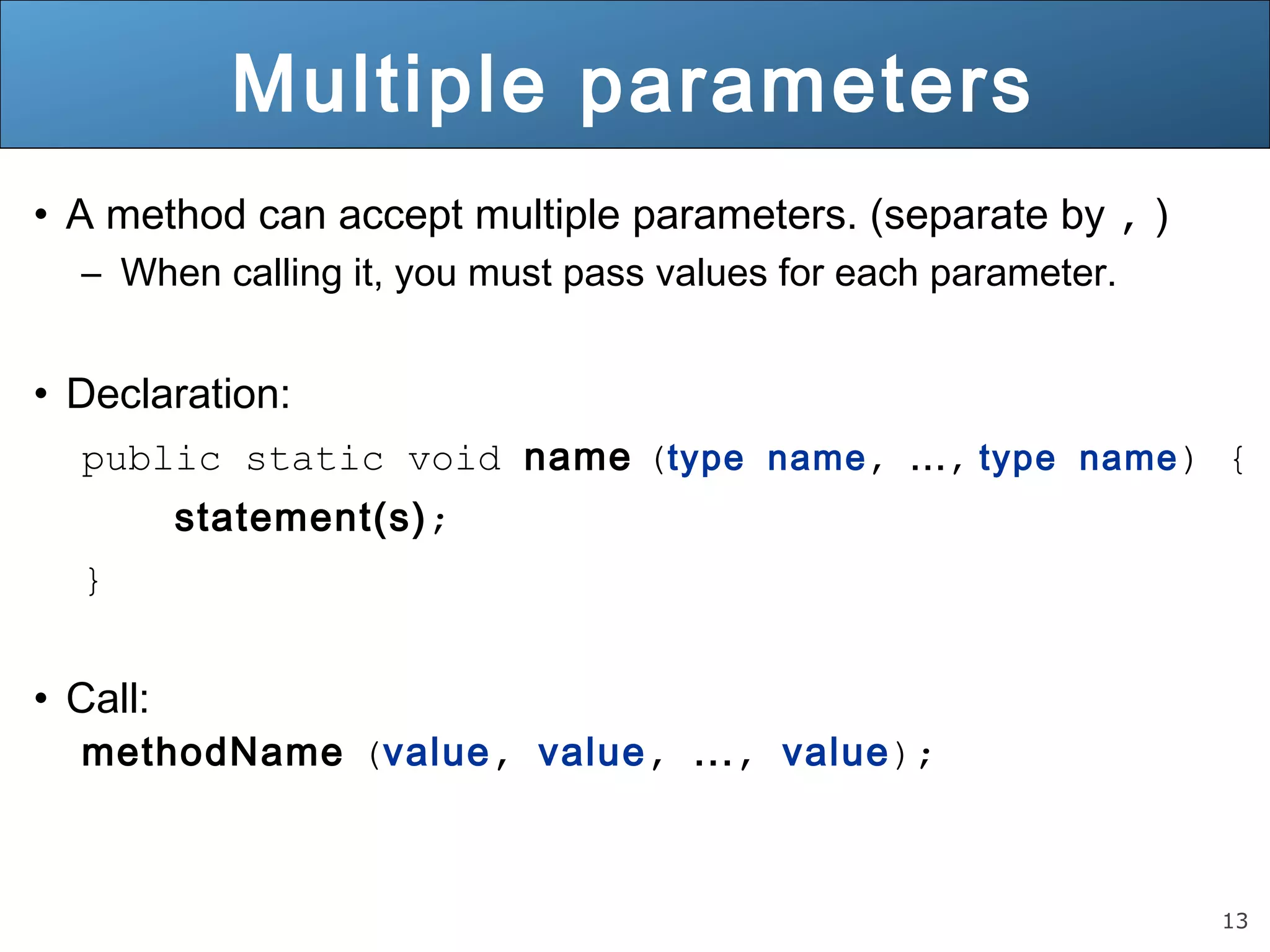
• A method can accept multiple parameters. (separate by , ) 
– When calling it, you must pass values for each parameter. 
• Declaration: 
public static void name (type name, ..., type name) { 
statement(s); 
} 
• Call: 
methodName (value, value, ..., value);
14 
Multiple params example 
public static void main(String[] args) { 
printNumber(4, 9); 
printNumber(17, 6); 
printNumber(8, 0); 
printNumber(0, 8); 
} 
public static void printNumber(int number, int count) { 
for (int i = 1; i <= count; i++) { 
System.out.print(number); 
} 
System.out.println(); 
} 
Output: 
444444444 
171717171717 
00000000 
• Modify the Stars program to draw boxes with parameters.
15 
Stars solution 
// Prints several lines and boxes made of stars. 
// Third version with multiple parameterized methods. 
public class Stars3 { 
public static void main(String[] args) { 
line(13); 
line(7); 
line(35); 
System.out.println(); 
box(10, 3); 
box(5, 4); 
box(20, 7); 
} 
// Prints the given number of stars plus a line break. 
public static void line(int count) { 
for (int i = 1; i <= count; i++) { 
System.out.print("*"); 
} 
System.out.println(); 
} 
...
16 
Stars solution, cont'd. 
... 
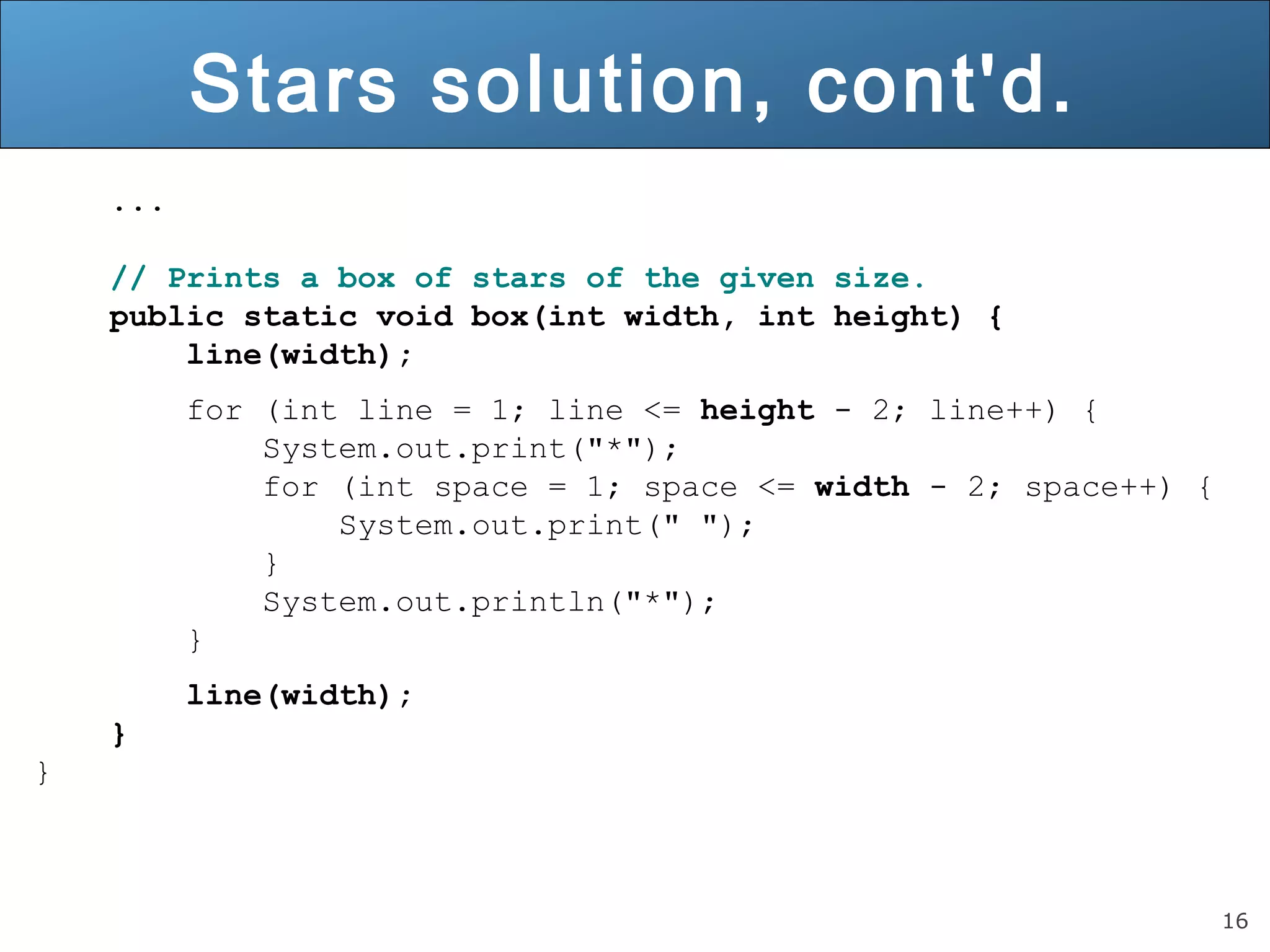
// Prints a box of stars of the given size. 
public static void box(int width, int height) { 
line(width); 
for (int line = 1; line <= height - 2; line++) { 
System.out.print("*"); 
for (int space = 1; space <= width - 2; space++) { 
System.out.print(" "); 
} 
System.out.println("*"); 
} 
line(width); 
} 
}
17 
Value semantics 
• value semantics: When primitive variables (int, double) 
are passed as parameters, their values are copied. 
– Modifying the parameter will not affect the variable passed in. 
public static void strange(int x) { 
x = x + 1; 
System.out.println("1. x = " + x); 
} 
public static void main(String[] args) { 
int x = 23; 
strange(x); 
System.out.println("2. x = " + x); 
... 
} 
Output: 
1. x = 24 
2. x = 23
18 
"Parameter Mystery" problem 
public class ParameterMystery { 
public static void main(String[] args) { 
int x = 9; 
int y = 2; 
int z = 5; 
mystery(z, y, x); 
mystery(y, x, z); 
} 
public static void mystery(int x, int z, int y) { 
System.out.println(z + " and " + (y - x)); 
} 
}
19 
Strings 
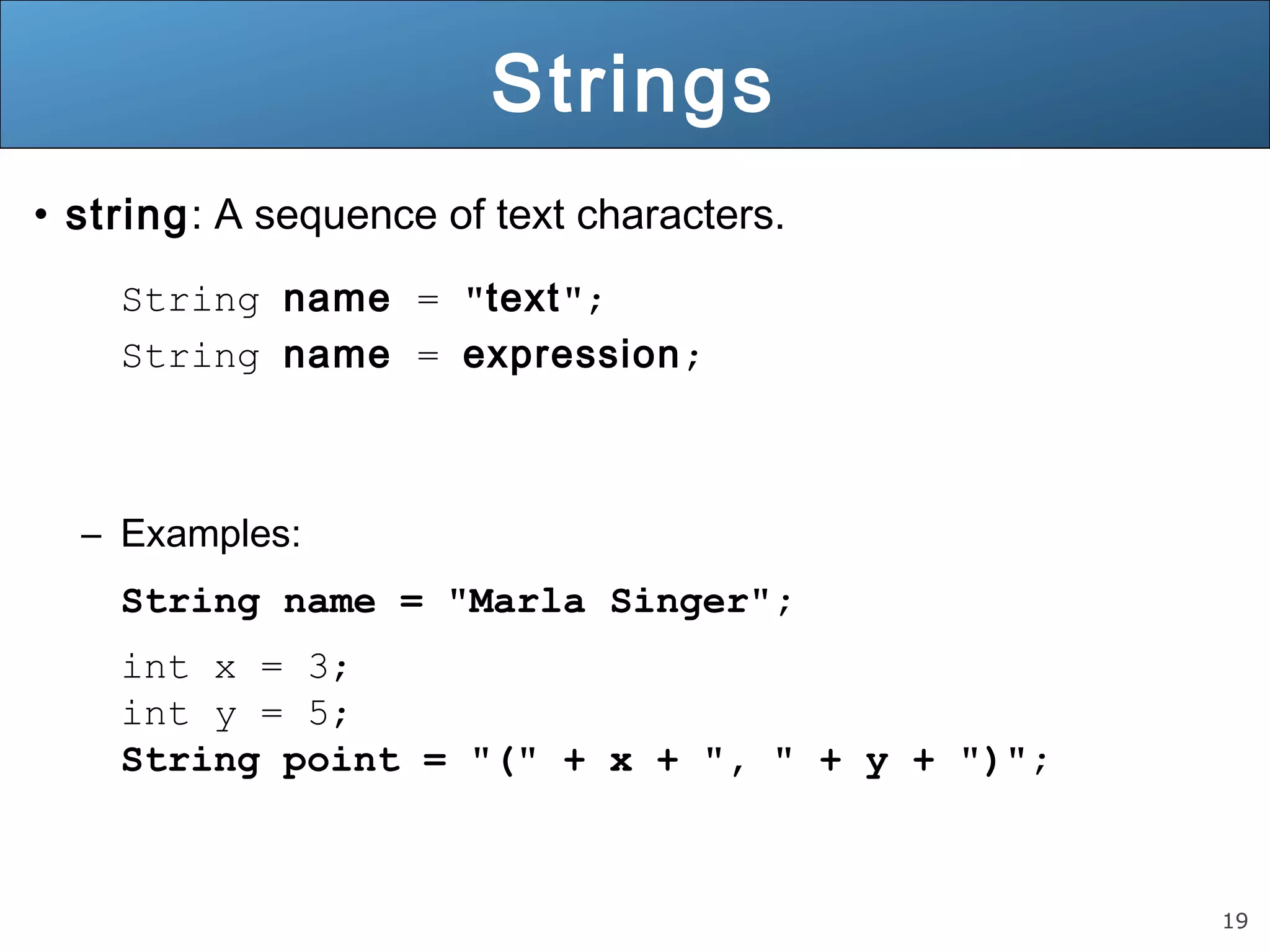
• string: A sequence of text characters. 
String name = "text"; 
String name = expression; 
– Examples: 
String name = "Marla Singer"; 
int x = 3; 
int y = 5; 
String point = "(" + x + ", " + y + ")";
20 
Strings as parameters 
public class StringParameters { 
public static void main(String[] args) { 
sayHello("Marty"); 
String teacher = "Bictolia"; 
sayHello(teacher); 
} 
public static void sayHello(String name) { 
System.out.println("Welcome, " + name); 
} 
} 
Output: 
Welcome, Marty 
Welcome, Bictolia 
• Modify the Stars program to use string parameters. Use a 
method named repeat that prints a string many times.
21 
Stars solution 
// Prints several lines and boxes made of stars. 
// Fourth version with String parameters. 
public class Stars4 { 
public static void main(String[] args) { 
line(13); 
line(7); 
line(35); 
System.out.println(); 
box(10, 3); 
box(5, 4); 
box(20, 7); 
} 
// Prints the given number of stars plus a line break. 
public static void line(int count) { 
repeat("*", count); 
System.out.println(); 
} 
...
22 
Stars solution, cont'd. 
... 
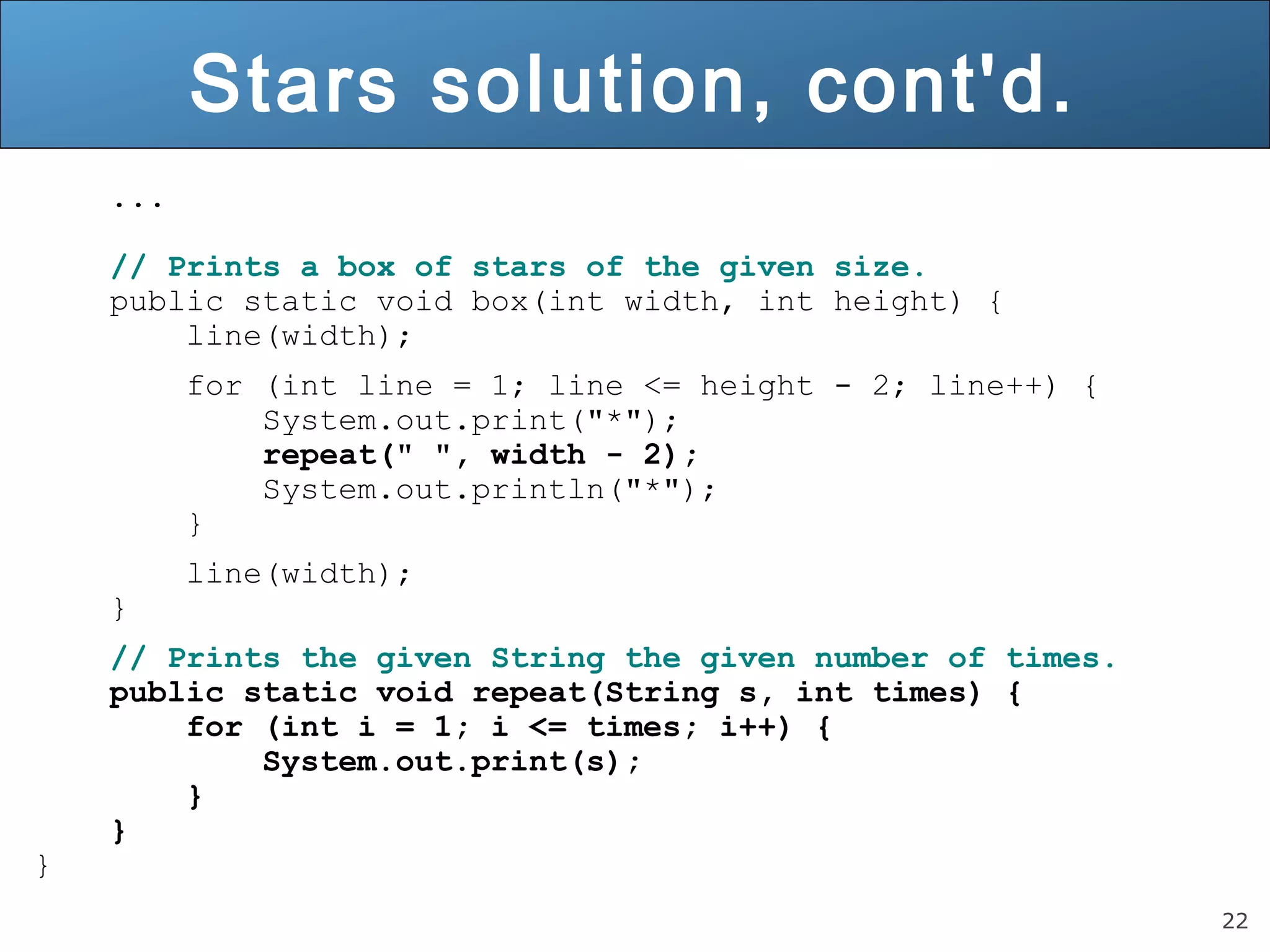
// Prints a box of stars of the given size. 
public static void box(int width, int height) { 
line(width); 
for (int line = 1; line <= height - 2; line++) { 
System.out.print("*"); 
repeat(" ", width - 2); 
System.out.println("*"); 
} 
line(width); 
} 
// Prints the given String the given number of times. 
public static void repeat(String s, int times) { 
for (int i = 1; i <= times; i++) { 
System.out.print(s); 
} 
} 
}
Return values
24 
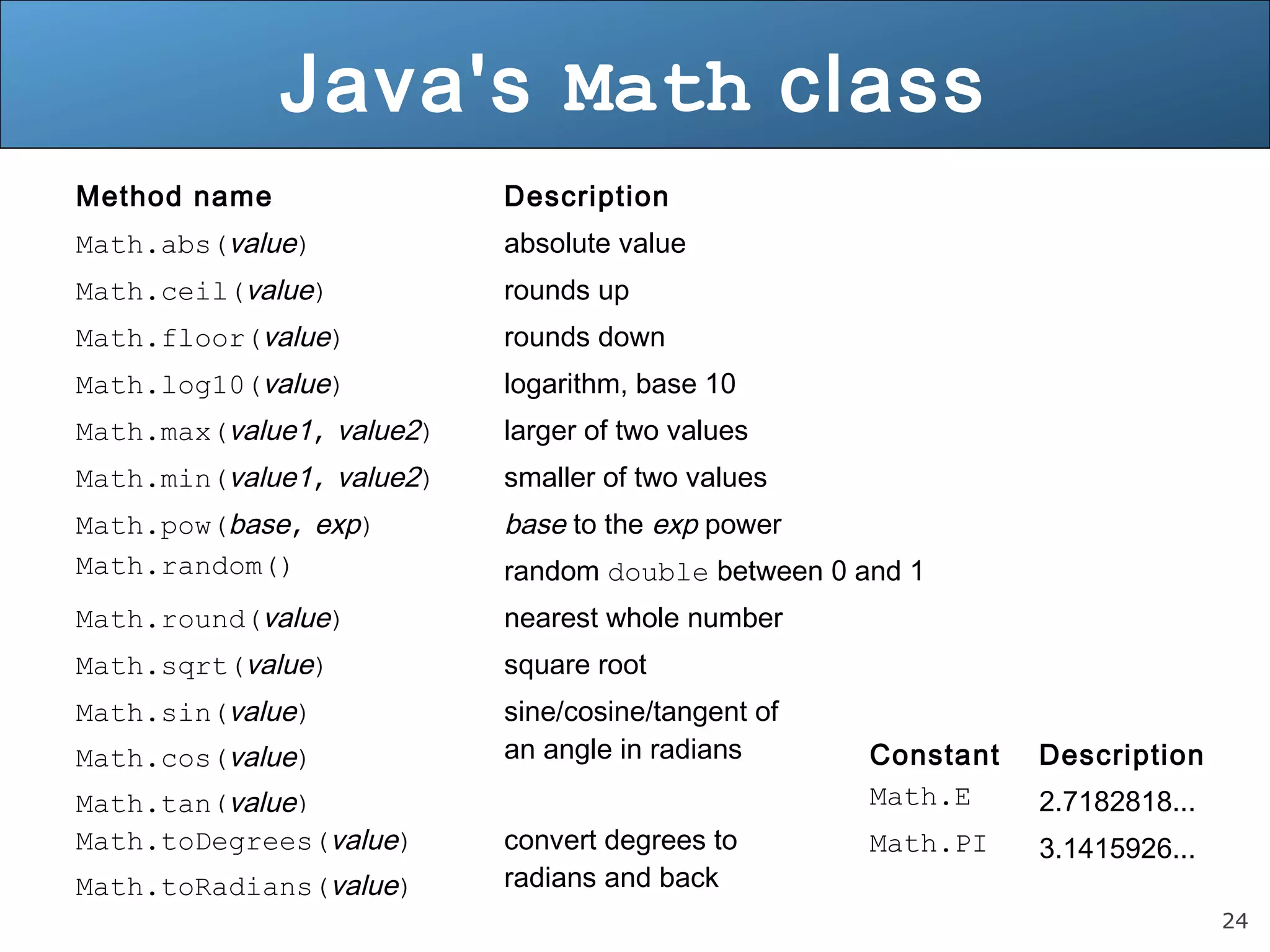
Java's Math class 
Method name Description 
Math.abs(value) absolute value 
Math.ceil(value) rounds up 
Math.floor(value) rounds down 
Math.log10(value) logarithm, base 10 
Math.max(value1, value2) larger of two values 
Math.min(value1, value2) smaller of two values 
Math.pow(base, exp) base to the exp power 
Math.random() random double between 0 and 1 
Math.round(value) nearest whole number 
Math.sqrt(value) square root 
Math.sin(value) 
sine/cosine/tangent of 
Math.cos(value) 
an angle in radians 
Math.tan(value) 
Math.toDegrees(value) 
Math.toRadians(value) 
convert degrees to 
radians and back 
Constant Description 
Math.E 2.7182818... 
Math.PI 3.1415926...
25 
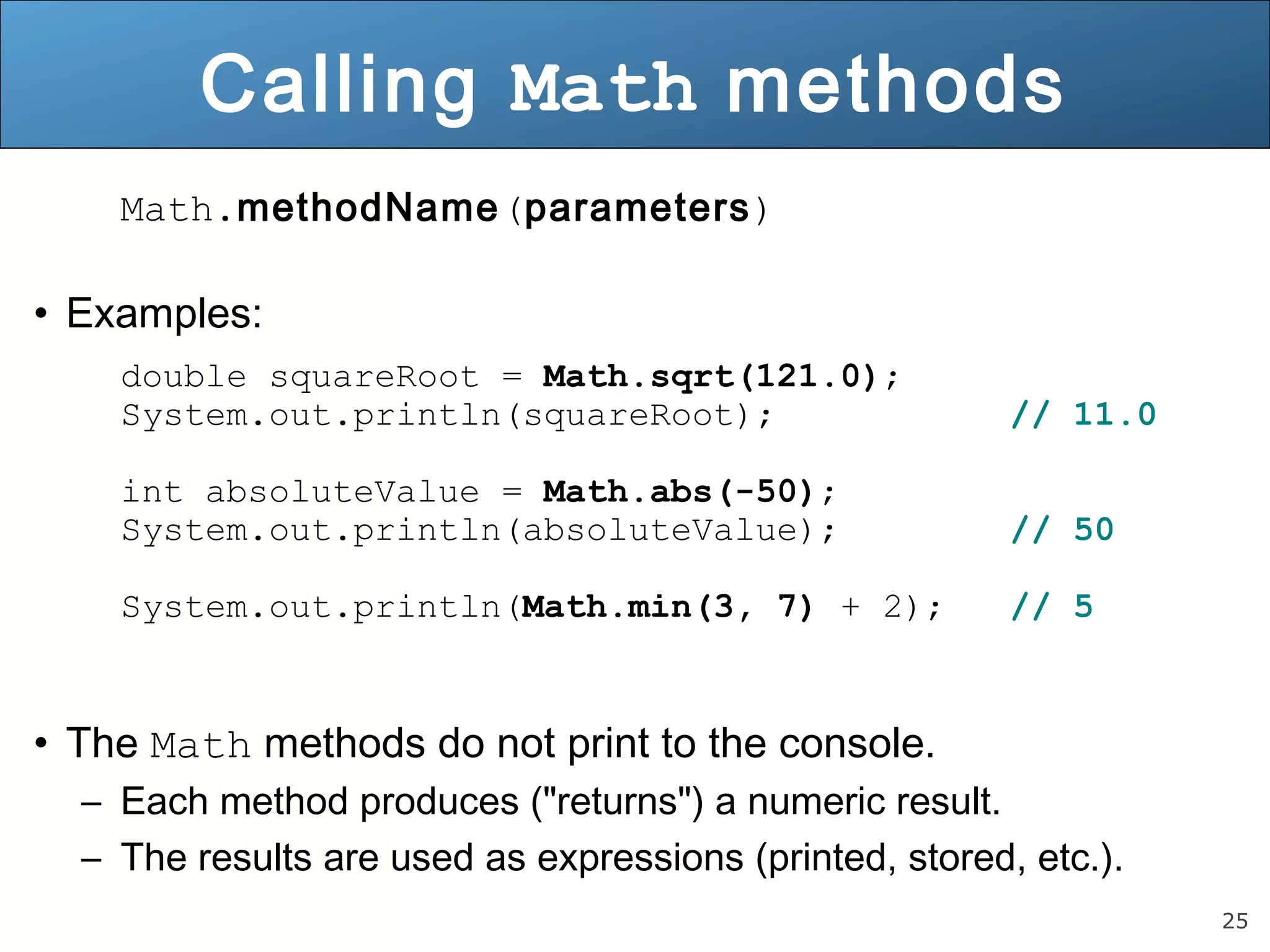
Calling Math methods 
Math.methodName(parameters) 
• Examples: 
double squareRoot = Math.sqrt(121.0); 
System.out.println(squareRoot); // 11.0 
int absoluteValue = Math.abs(-50); 
System.out.println(absoluteValue); // 50 
System.out.println(Math.min(3, 7) + 2); // 5 
• The Math methods do not print to the console. 
– Each method produces ("returns") a numeric result. 
– The results are used as expressions (printed, stored, etc.).
26 
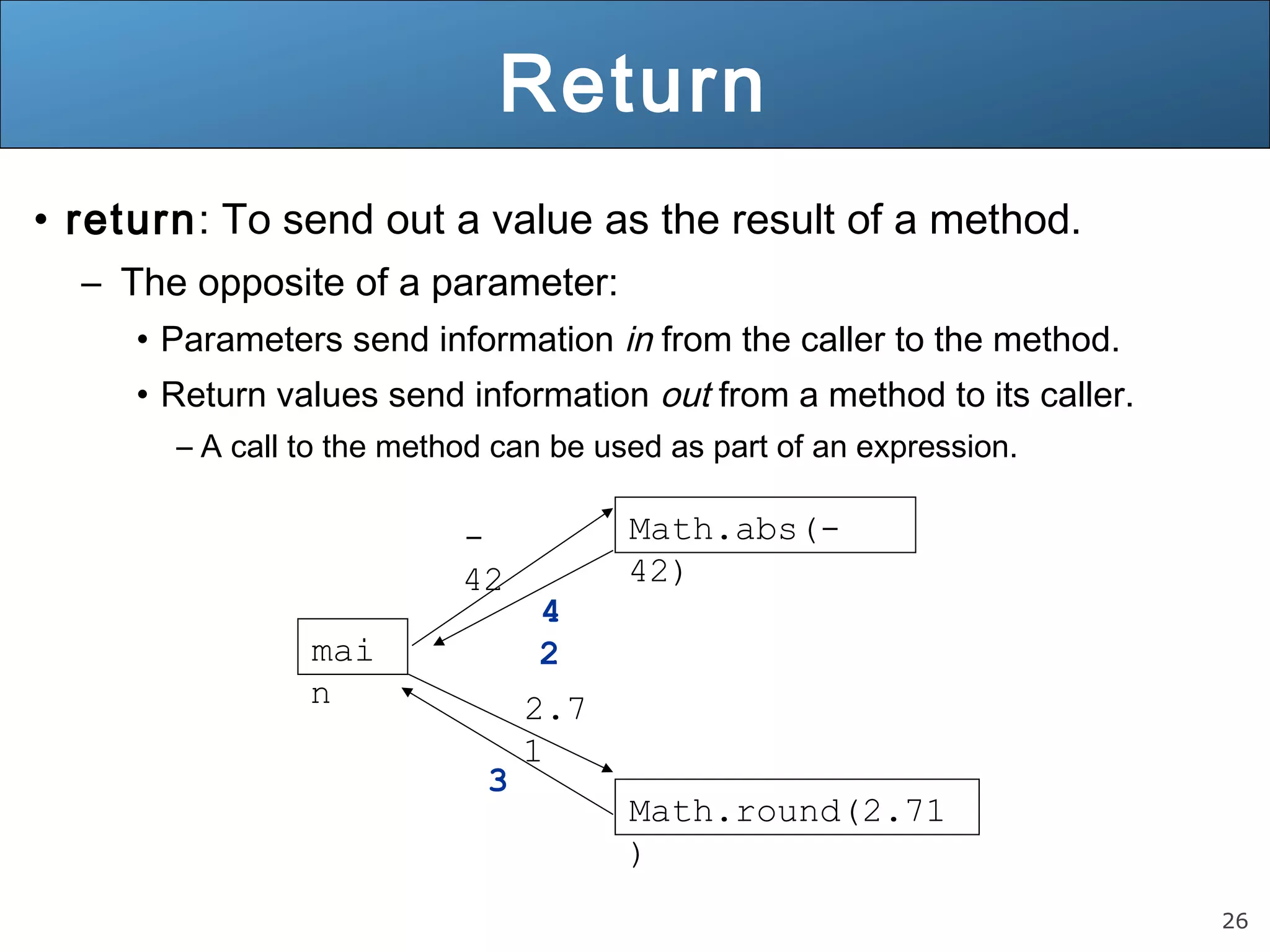
Return 
• return: To send out a value as the result of a method. 
– The opposite of a parameter: 
• Parameters send information in from the caller to the method. 
• Return values send information out from a method to its caller. 
– A call to the method can be used as part of an expression. 
mai 
n 
Math.abs(- 
42) 
- 
42 
Math.round(2.71 
) 
4 
2 
2.7 
1 
3
27 
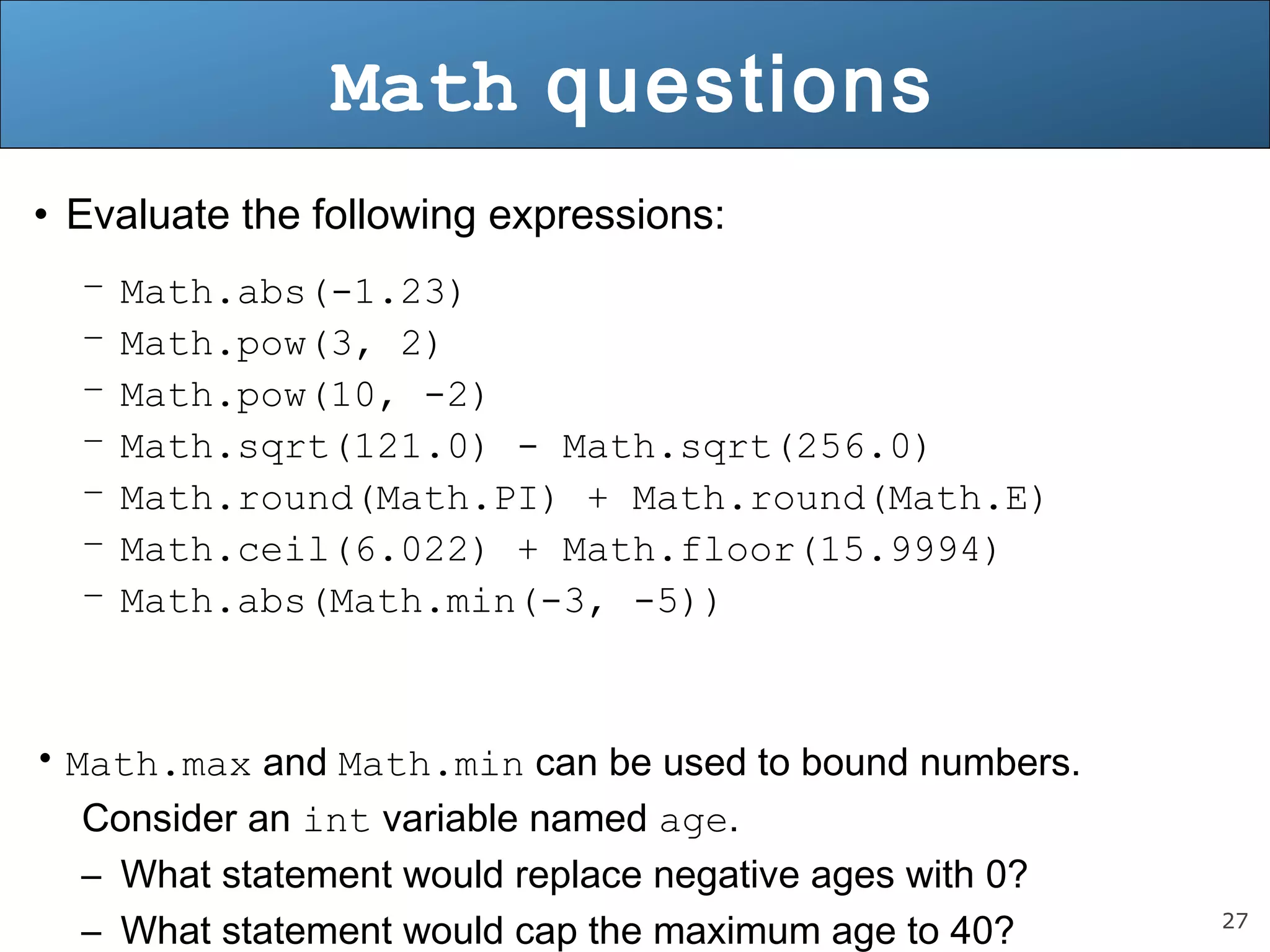
Math questions 
• Evaluate the following expressions: 
– Math.abs(-1.23) 
– Math.pow(3, 2) 
– Math.pow(10, -2) 
– Math.sqrt(121.0) - Math.sqrt(256.0) 
– Math.round(Math.PI) + Math.round(Math.E) 
– Math.ceil(6.022) + Math.floor(15.9994) 
– Math.abs(Math.min(-3, -5)) 
• Math.max and Math.min can be used to bound numbers. 
Consider an int variable named age. 
– What statement would replace negative ages with 0? 
– What statement would cap the maximum age to 40?
28 
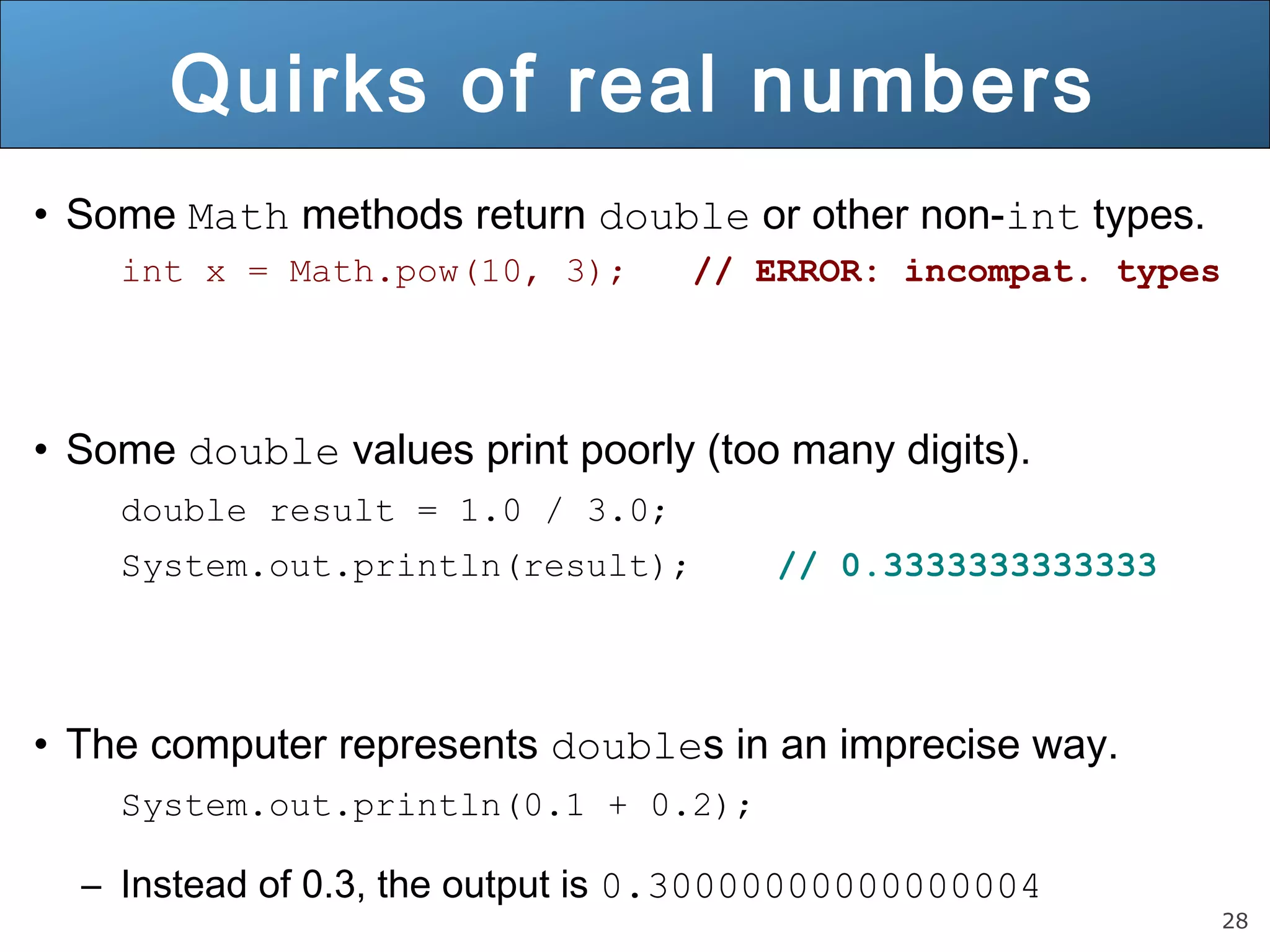
Quirks of real numbers 
• Some Math methods return double or other non-int types. 
int x = Math.pow(10, 3); // ERROR: incompat. types 
• Some double values print poorly (too many digits). 
double result = 1.0 / 3.0; 
System.out.println(result); // 0.3333333333333 
• The computer represents doubles in an imprecise way. 
System.out.println(0.1 + 0.2); 
– Instead of 0.3, the output is 0.30000000000000004
29 
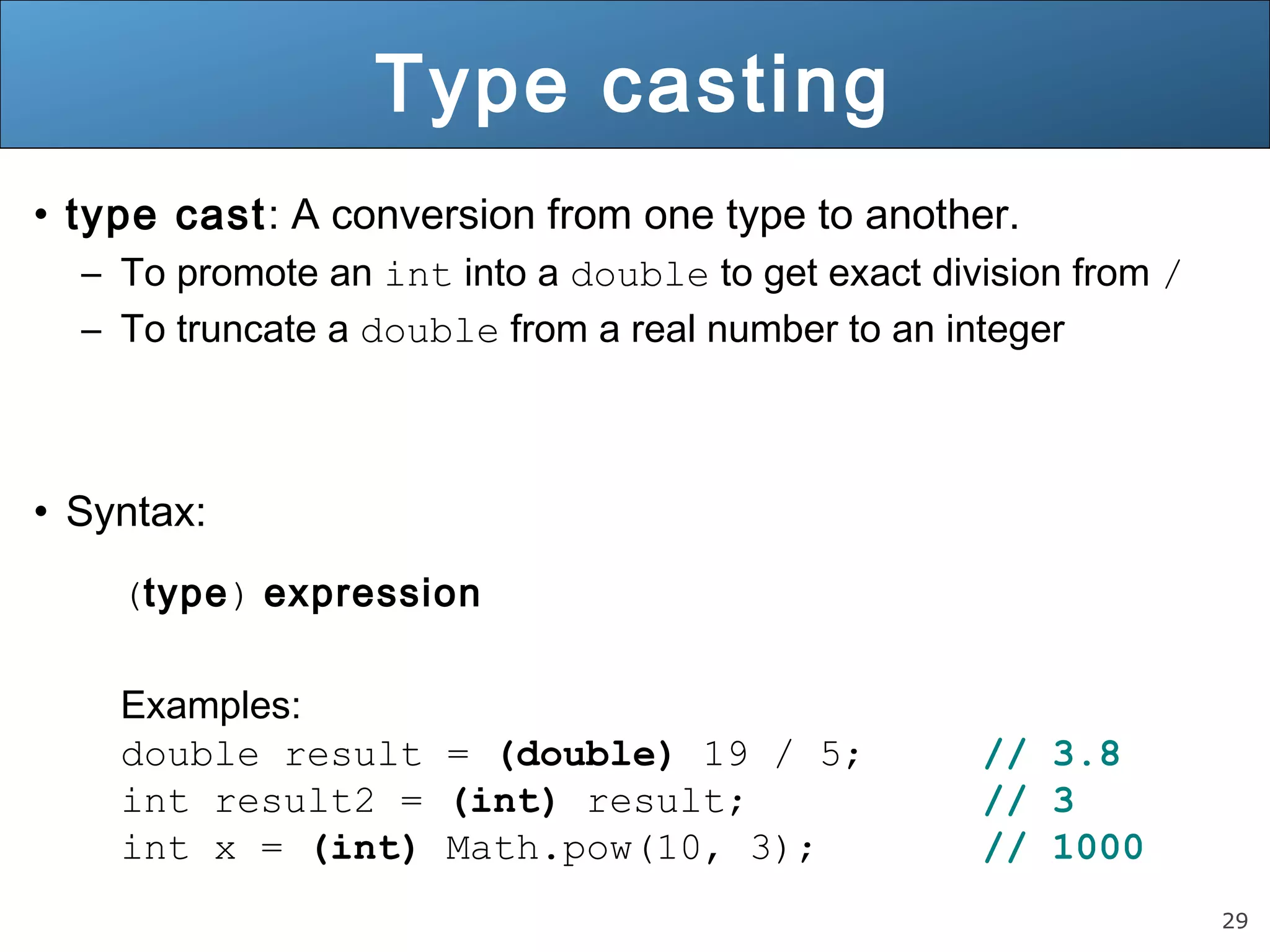
Type casting 
• type cast: A conversion from one type to another. 
– To promote an int into a double to get exact division from / 
– To truncate a double from a real number to an integer 
• Syntax: 
(type) expression 
Examples: 
double result = (double) 19 / 5; // 3.8 
int result2 = (int) result; // 3 
int x = (int) Math.pow(10, 3); // 1000
30 
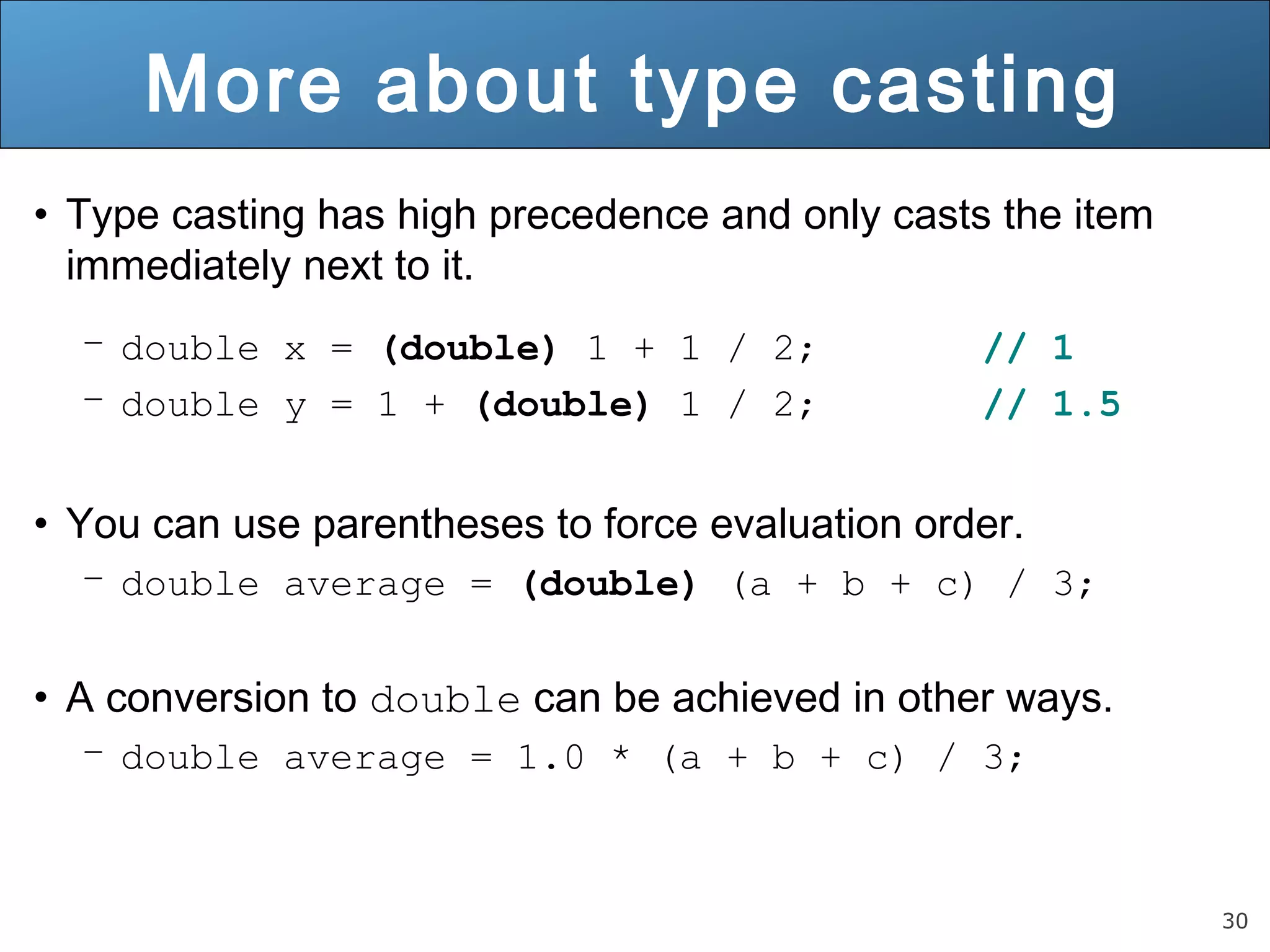
More about type casting 
• Type casting has high precedence and only casts the item 
immediately next to it. 
– double x = (double) 1 + 1 / 2; // 1 
– double y = 1 + (double) 1 / 2; // 1.5 
• You can use parentheses to force evaluation order. 
– double average = (double) (a + b + c) / 3; 
• A conversion to double can be achieved in other ways. 
– double average = 1.0 * (a + b + c) / 3;
31 
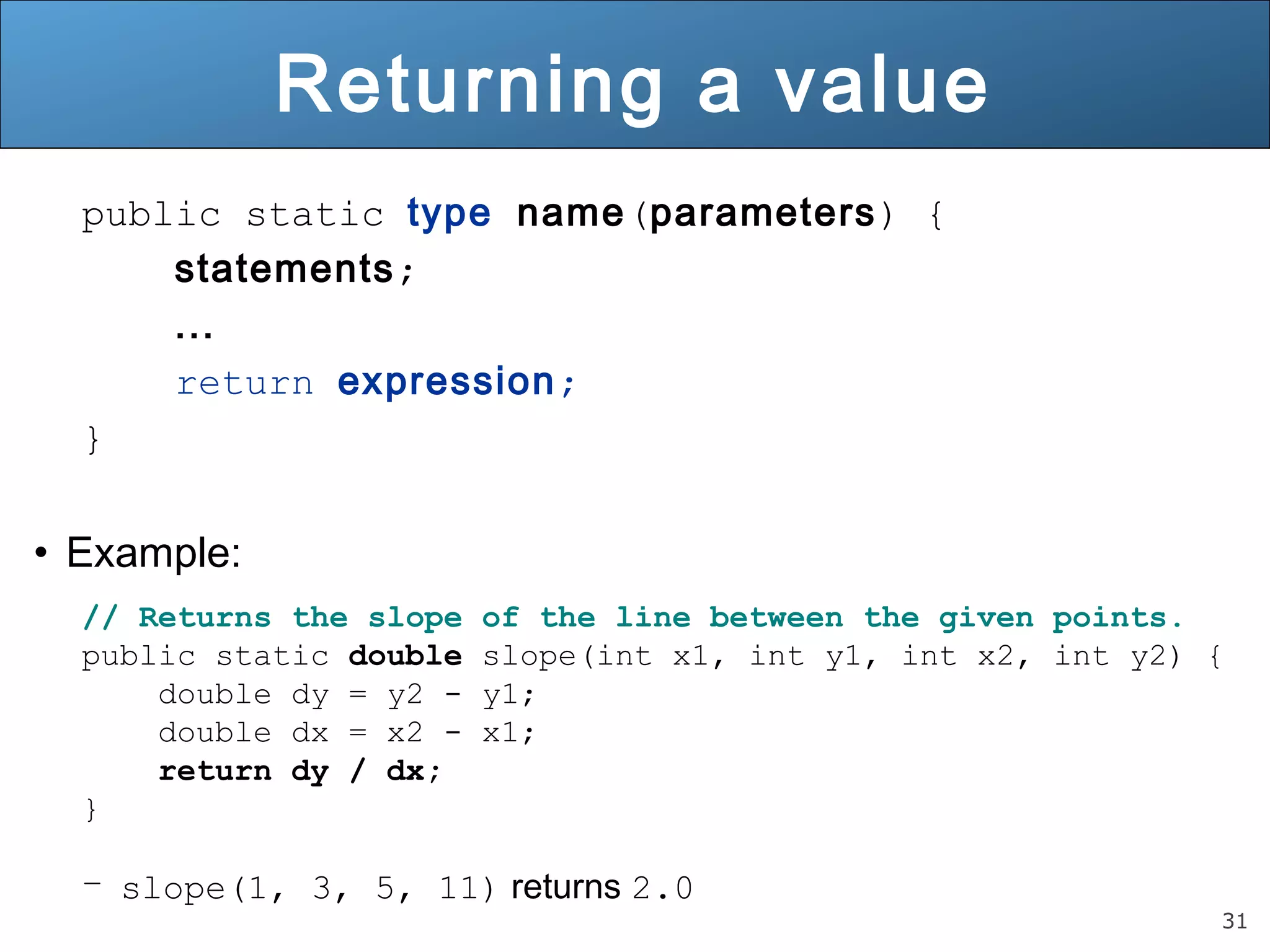
Returning a value 
public static type name(parameters) { 
statements; 
... 
return expression; 
} 
• Example: 
// Returns the slope of the line between the given points. 
public static double slope(int x1, int y1, int x2, int y2) { 
double dy = y2 - y1; 
double dx = x2 - x1; 
return dy / dx; 
} 
– slope(1, 3, 5, 11) returns 2.0
32 
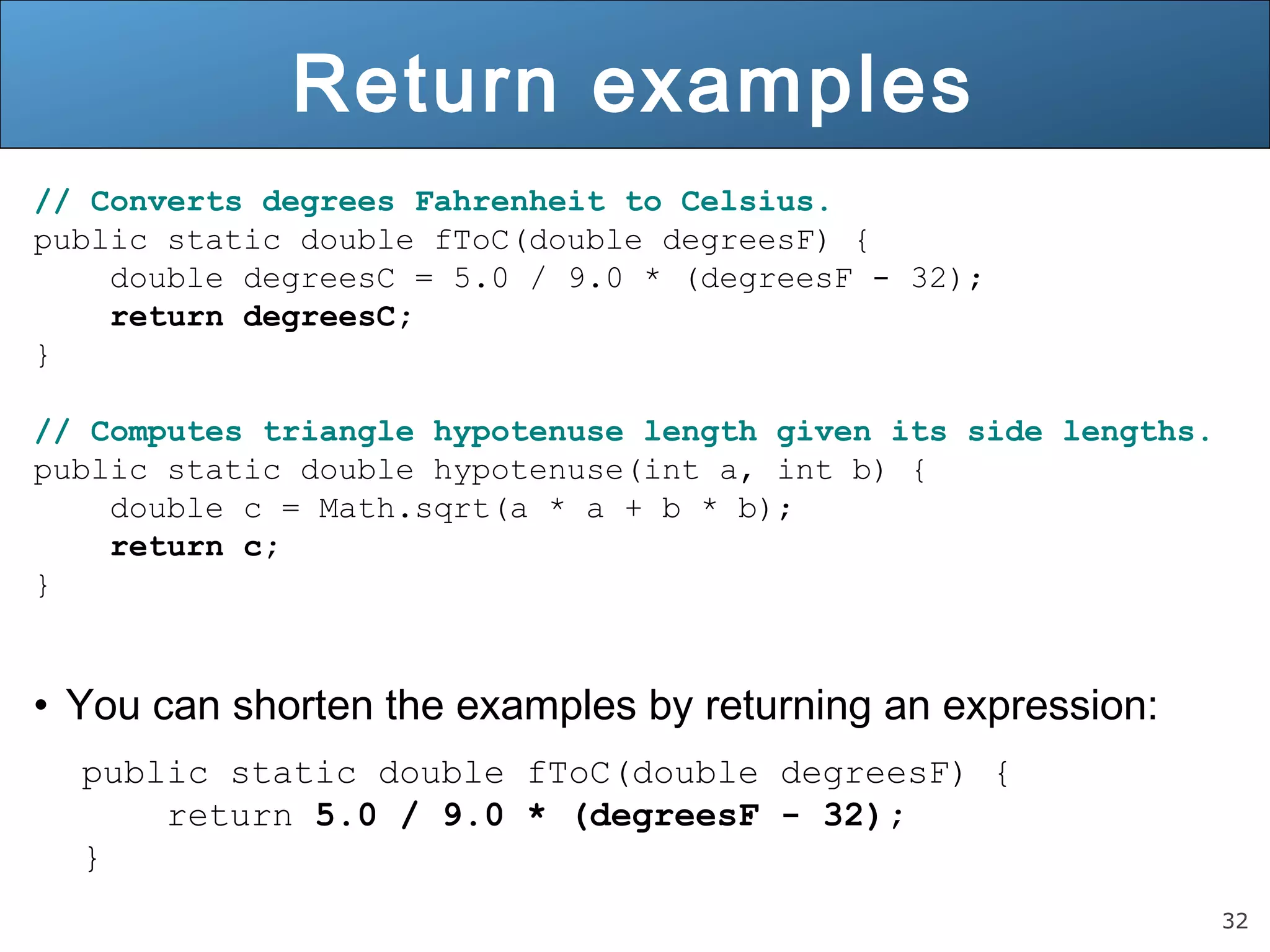
Return examples 
// Converts degrees Fahrenheit to Celsius. 
public static double fToC(double degreesF) { 
double degreesC = 5.0 / 9.0 * (degreesF - 32); 
return degreesC; 
} 
// Computes triangle hypotenuse length given its side lengths. 
public static double hypotenuse(int a, int b) { 
double c = Math.sqrt(a * a + b * b); 
return c; 
} 
• You can shorten the examples by returning an expression: 
public static double fToC(double degreesF) { 
return 5.0 / 9.0 * (degreesF - 32); 
}
33 
Common error: Not storing 
• Many students incorrectly think that a return statement sends 
a variable's name back to the calling method. 
public static void main(String[] args) { 
slope(0, 0, 6, 3); 
System.out.println("The slope is " + result); // ERROR: 
} // result not defined 
public static double slope(int x1, int x2, int y1, int y2) { 
double dy = y2 - y1; 
double dx = x2 - x1; 
double result = dy / dx; 
return result; 
}
34 
Fixing the common error 
• Instead, returning sends the variable's value back. 
– The returned value must be stored into a variable or used in an 
expression to be useful to the caller. 
public static void main(String[] args) { 
double s = slope(0, 0, 6, 3); 
System.out.println("The slope is " + s); 
} 
public static double slope(int x1, int x2, int y1, int y2) { 
double dy = y2 - y1; 
double dx = x2 - x1; 
double result = dy / dx; 
return result; 
}
Objects and Classes; 
Strings
36 
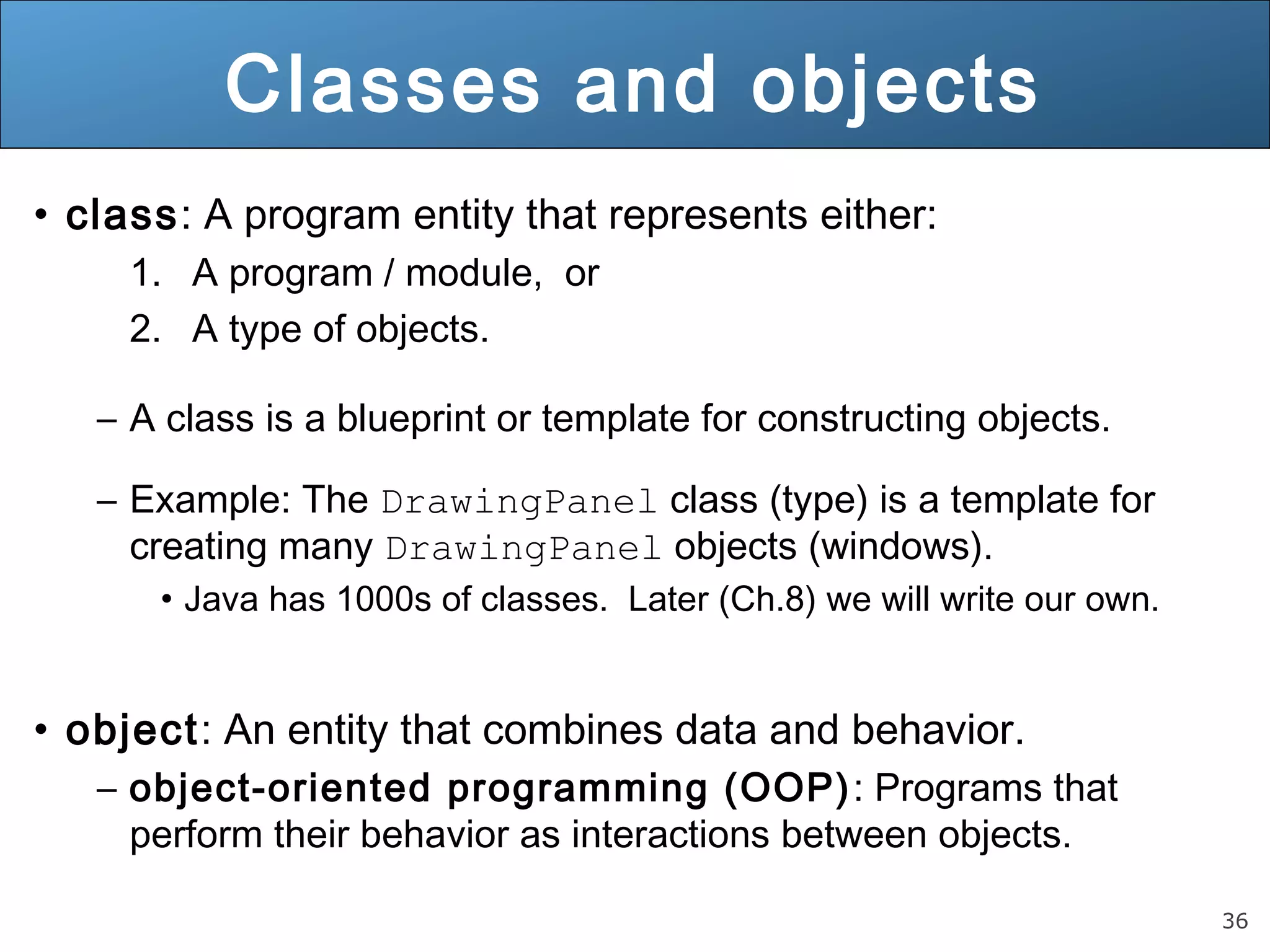
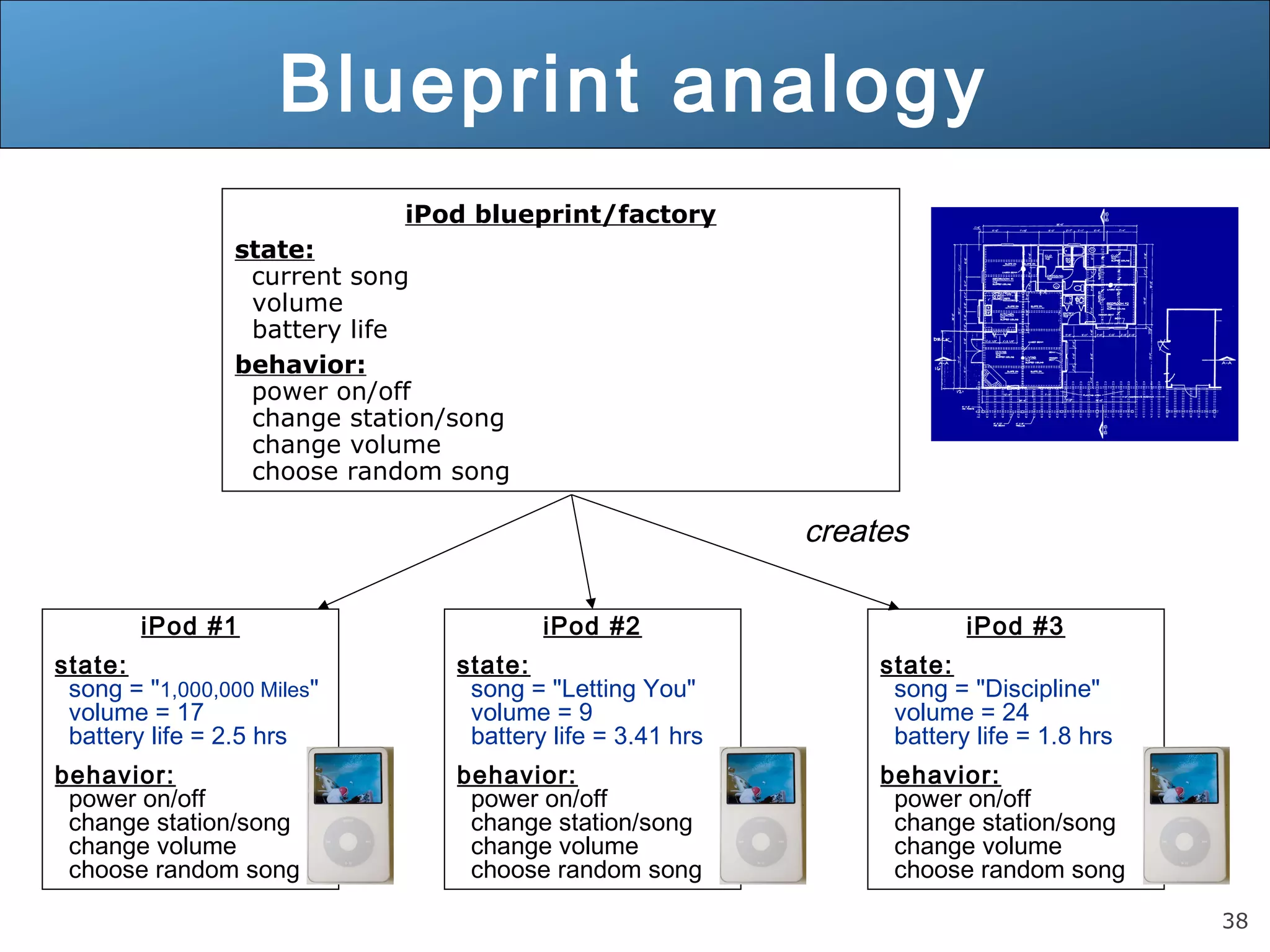
Classes and objects 
• class: A program entity that represents either: 
1. A program / module, or 
2. A type of objects. 
– A class is a blueprint or template for constructing objects. 
– Example: The DrawingPanel class (type) is a template for 
creating many DrawingPanel objects (windows). 
• Java has 1000s of classes. Later (Ch.8) we will write our own. 
• object: An entity that combines data and behavior. 
– object-oriented programming (OOP): Programs that 
perform their behavior as interactions between objects.
37 
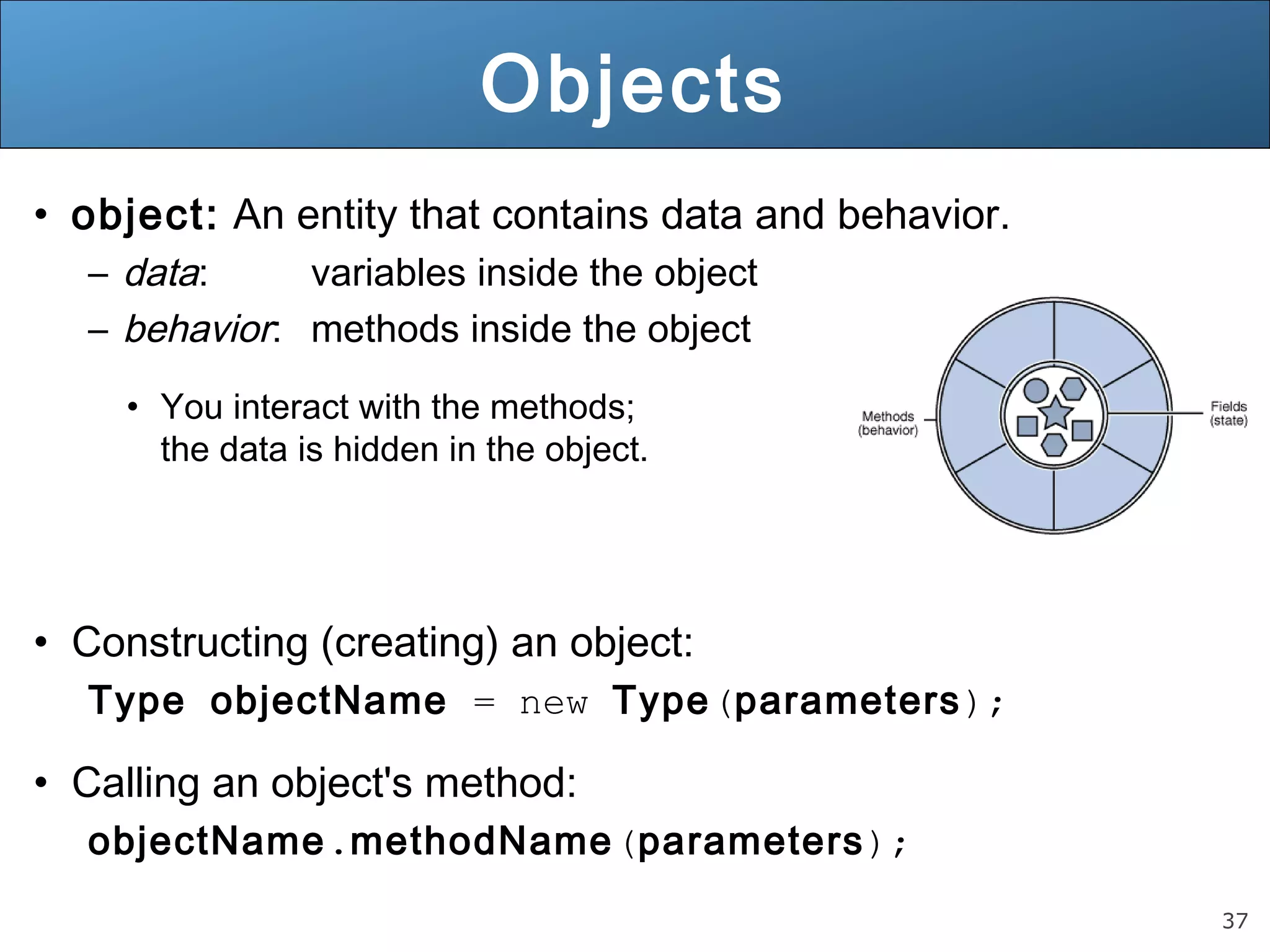
Objects 
• object: An entity that contains data and behavior. 
– data: variables inside the object 
– behavior: methods inside the object 
• You interact with the methods; 
the data is hidden in the object. 
• Constructing (creating) an object: 
Type objectName = new Type(parameters); 
• Calling an object's method: 
objectName.methodName(parameters);
38 
Blueprint analogy 
iPod blueprint/factory 
state: 
current song 
volume 
battery life 
behavior: 
power on/off 
change station/song 
change volume 
choose random song 
iPod #1 
state: 
song = "1,000,000 Miles" 
volume = 17 
battery life = 2.5 hrs 
behavior: 
power on/off 
change station/song 
change volume 
choose random song 
iPod #2 
state: 
song = "Letting You" 
volume = 9 
battery life = 3.41 hrs 
behavior: 
power on/off 
change station/song 
change volume 
choose random song 
iPod #3 
creates 
state: 
song = "Discipline" 
volume = 24 
battery life = 1.8 hrs 
behavior: 
power on/off 
change station/song 
change volume 
choose random song
39 
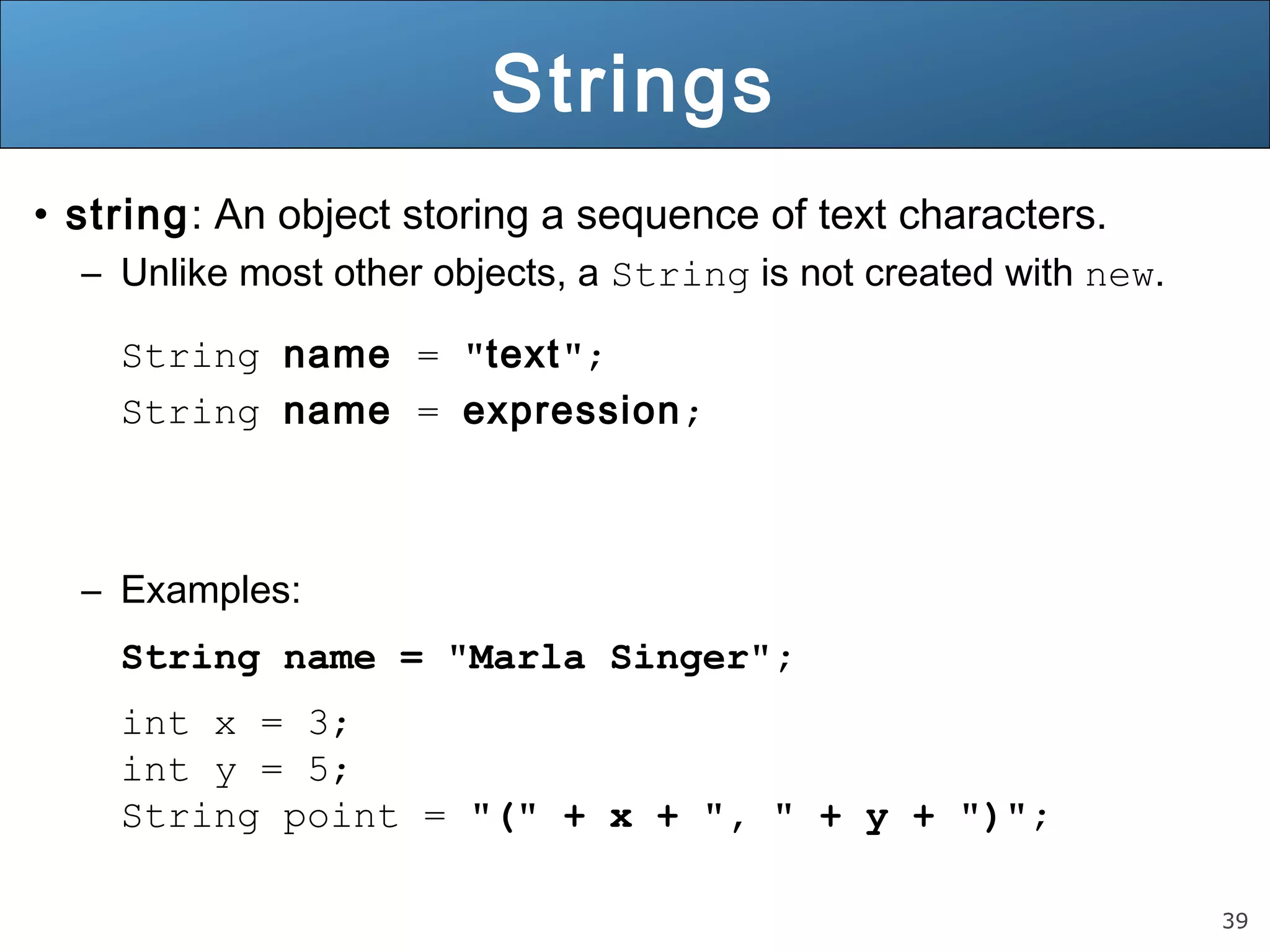
Strings 
• string: An object storing a sequence of text characters. 
– Unlike most other objects, a String is not created with new. 
String name = "text"; 
String name = expression; 
– Examples: 
String name = "Marla Singer"; 
int x = 3; 
int y = 5; 
String point = "(" + x + ", " + y + ")";
40 
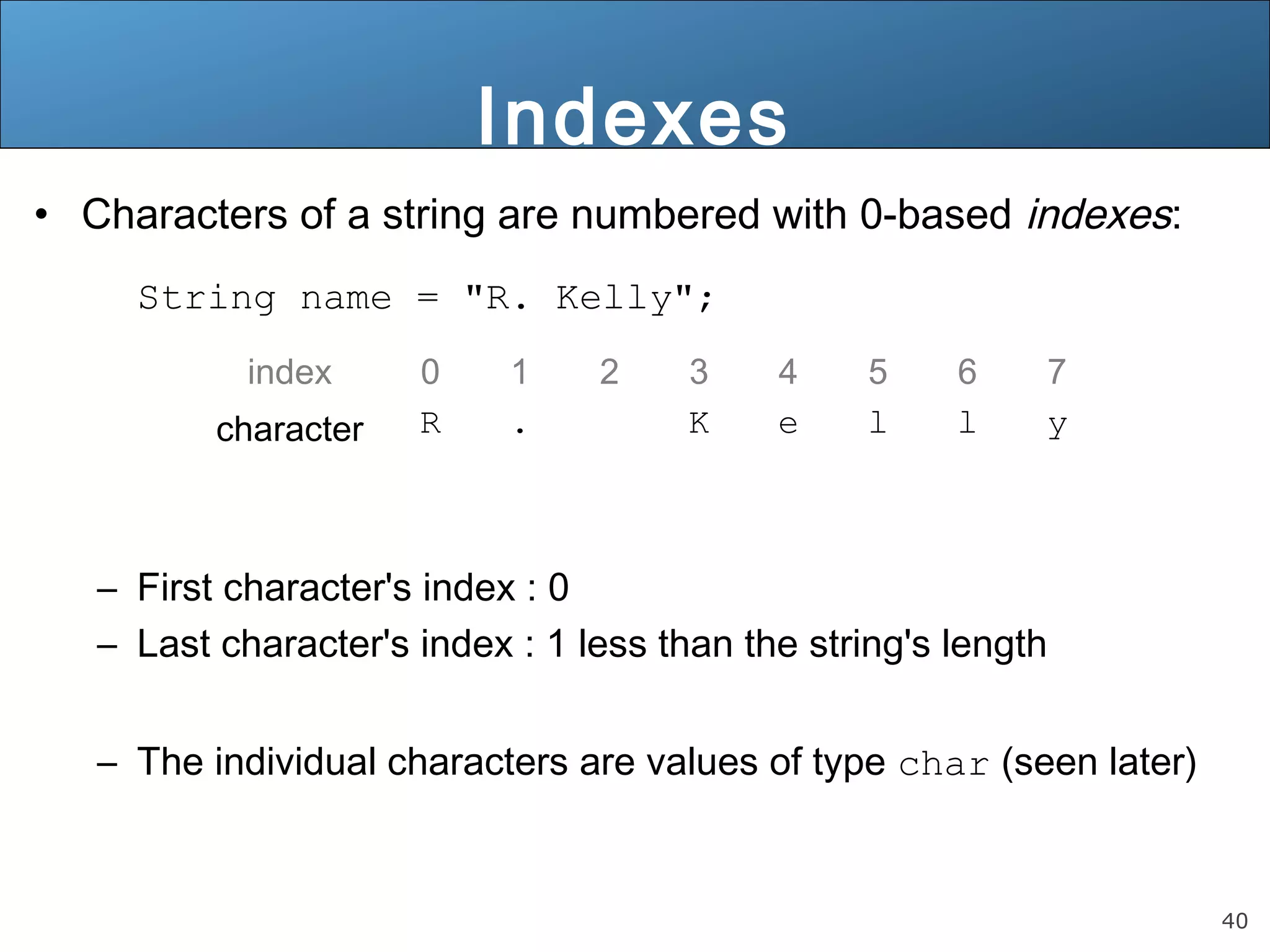
Indexes 
• Characters of a string are numbered with 0-based indexes: 
String name = "R. Kelly"; 
index 0 1 2 3 4 5 6 7 
character R . K e l l y 
– First character's index : 0 
– Last character's index : 1 less than the string's length 
– The individual characters are values of type char (seen later)
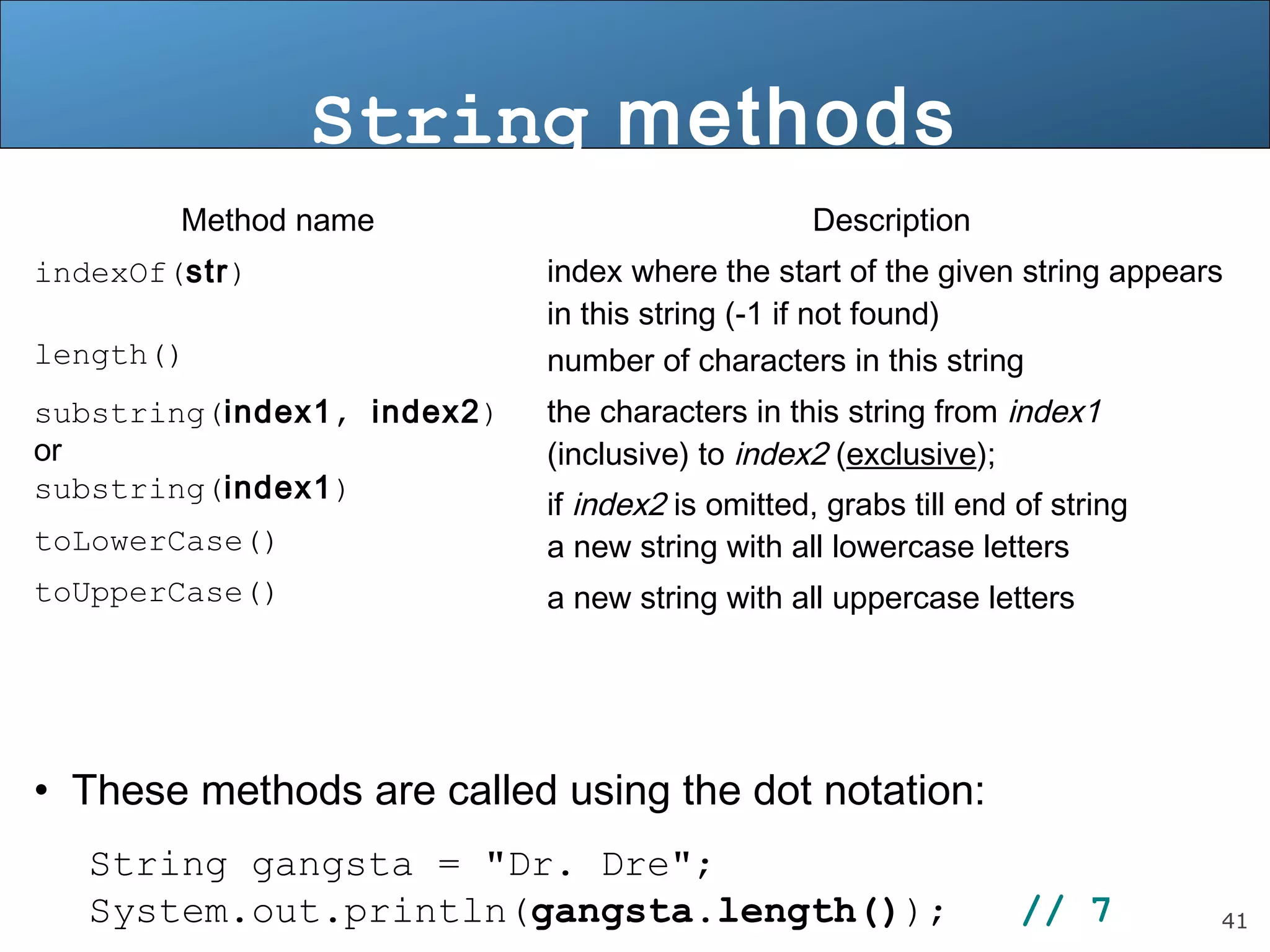
indexOf(str) index where the start of the given string appears 
41 
String methods 
Method name Description 
in this string (-1 if not found) 
length() number of characters in this string 
substring(index1, index2) 
or 
substring(index1) 
the characters in this string from index1 
(inclusive) to index2 (exclusive); 
if index2 is omitted, grabs till end of string 
toLowerCase() a new string with all lowercase letters 
toUpperCase() a new string with all uppercase letters 
• These methods are called using the dot notation: 
String gangsta = "Dr. Dre"; 
System.out.println(gangsta.length()); // 7
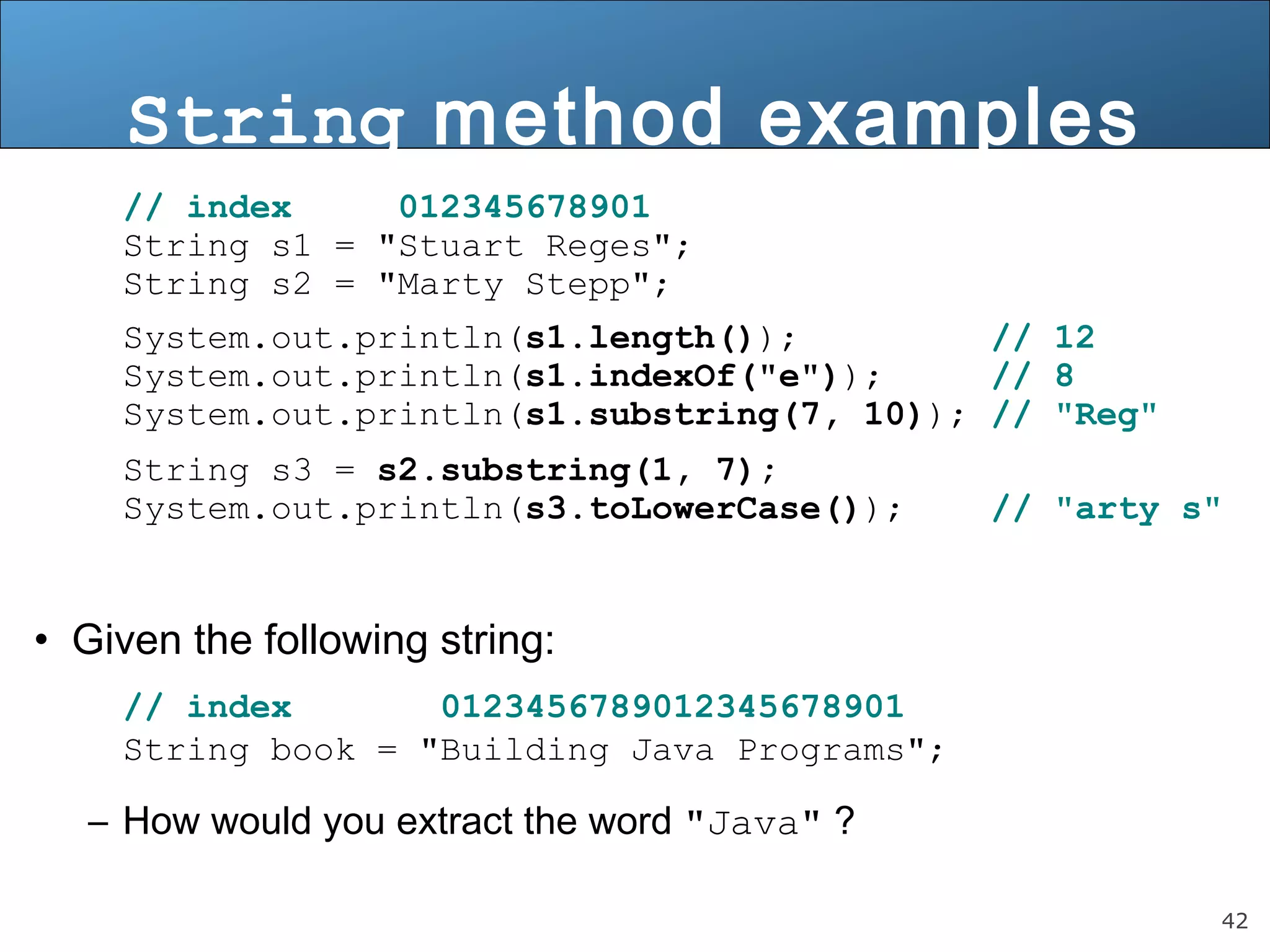
String method examples 
// index 012345678901 
String s1 = "Stuart Reges"; 
String s2 = "Marty Stepp"; 
System.out.println(s1.length()); // 12 
System.out.println(s1.indexOf("e")); // 8 
System.out.println(s1.substring(7, 10)); // "Reg" 
String s3 = s2.substring(1, 7); 
System.out.println(s3.toLowerCase()); // "arty s" 
42 
• Given the following string: 
// index 0123456789012345678901 
String book = "Building Java Programs"; 
– How would you extract the word "Java" ?
43 
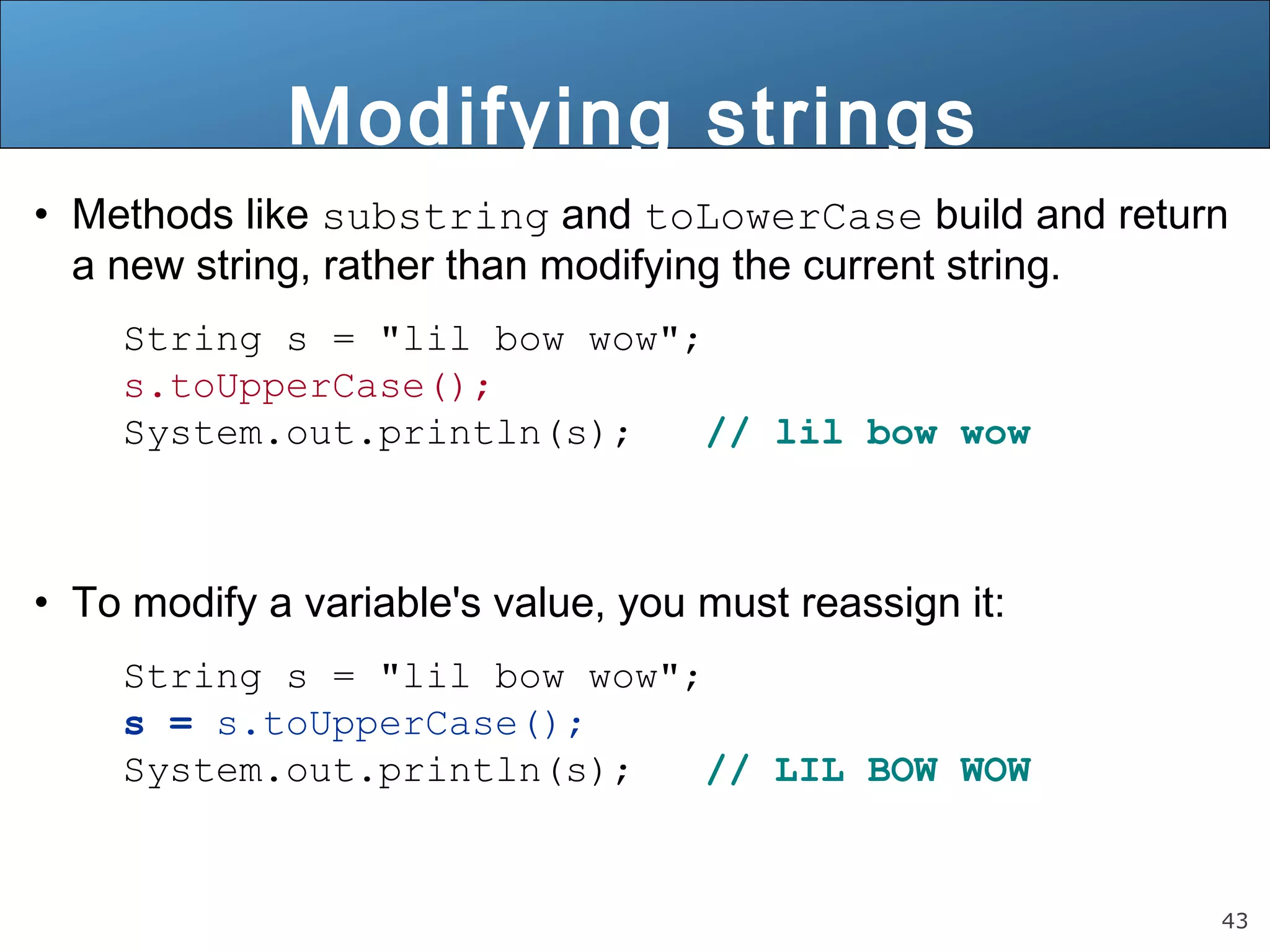
Modifying strings 
• Methods like substring and toLowerCase build and return 
a new string, rather than modifying the current string. 
String s = "lil bow wow"; 
s.toUpperCase(); 
System.out.println(s); // lil bow wow 
• To modify a variable's value, you must reassign it: 
String s = "lil bow wow"; 
s = s.toUpperCase(); 
System.out.println(s); // LIL BOW WOW
Interactive Programs with 
Scanner
45 
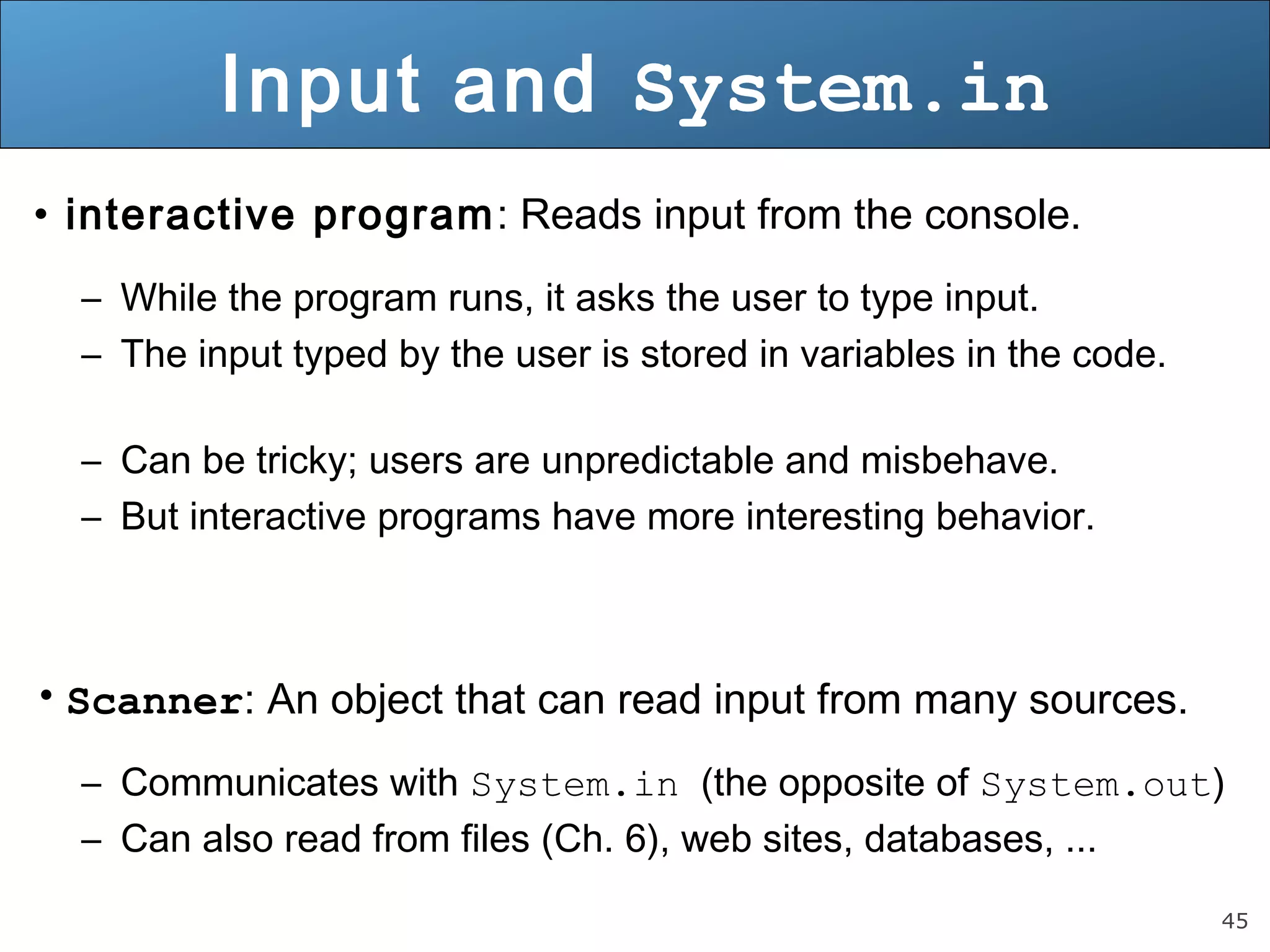
Input and System.in 
• interactive program: Reads input from the console. 
– While the program runs, it asks the user to type input. 
– The input typed by the user is stored in variables in the code. 
– Can be tricky; users are unpredictable and misbehave. 
– But interactive programs have more interesting behavior. 
• Scanner: An object that can read input from many sources. 
– Communicates with System.in (the opposite of System.out) 
– Can also read from files (Ch. 6), web sites, databases, ...
46 
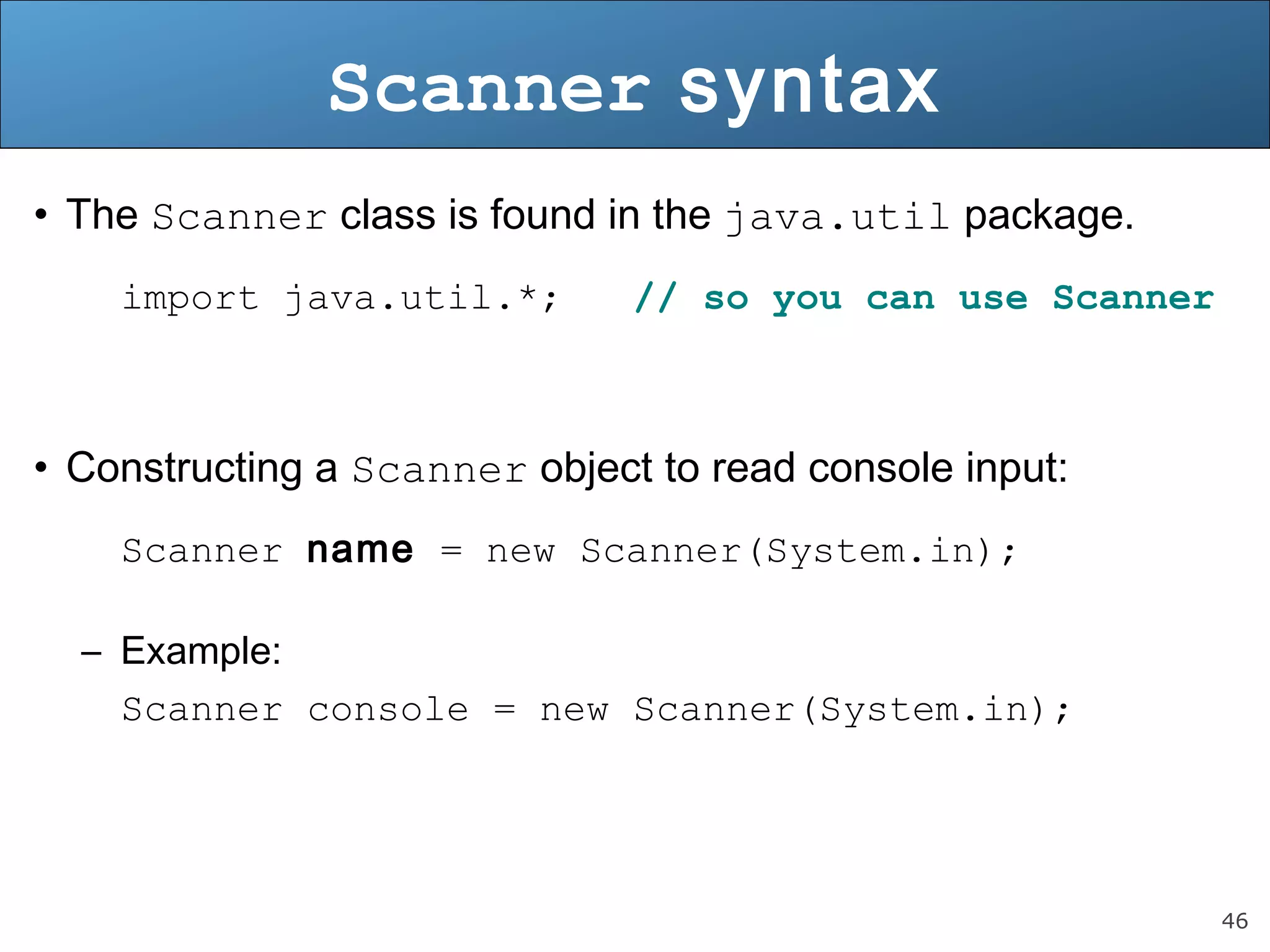
Scanner syntax 
• The Scanner class is found in the java.util package. 
import java.util.*; // so you can use Scanner 
• Constructing a Scanner object to read console input: 
Scanner name = new Scanner(System.in); 
– Example: 
Scanner console = new Scanner(System.in);
47 
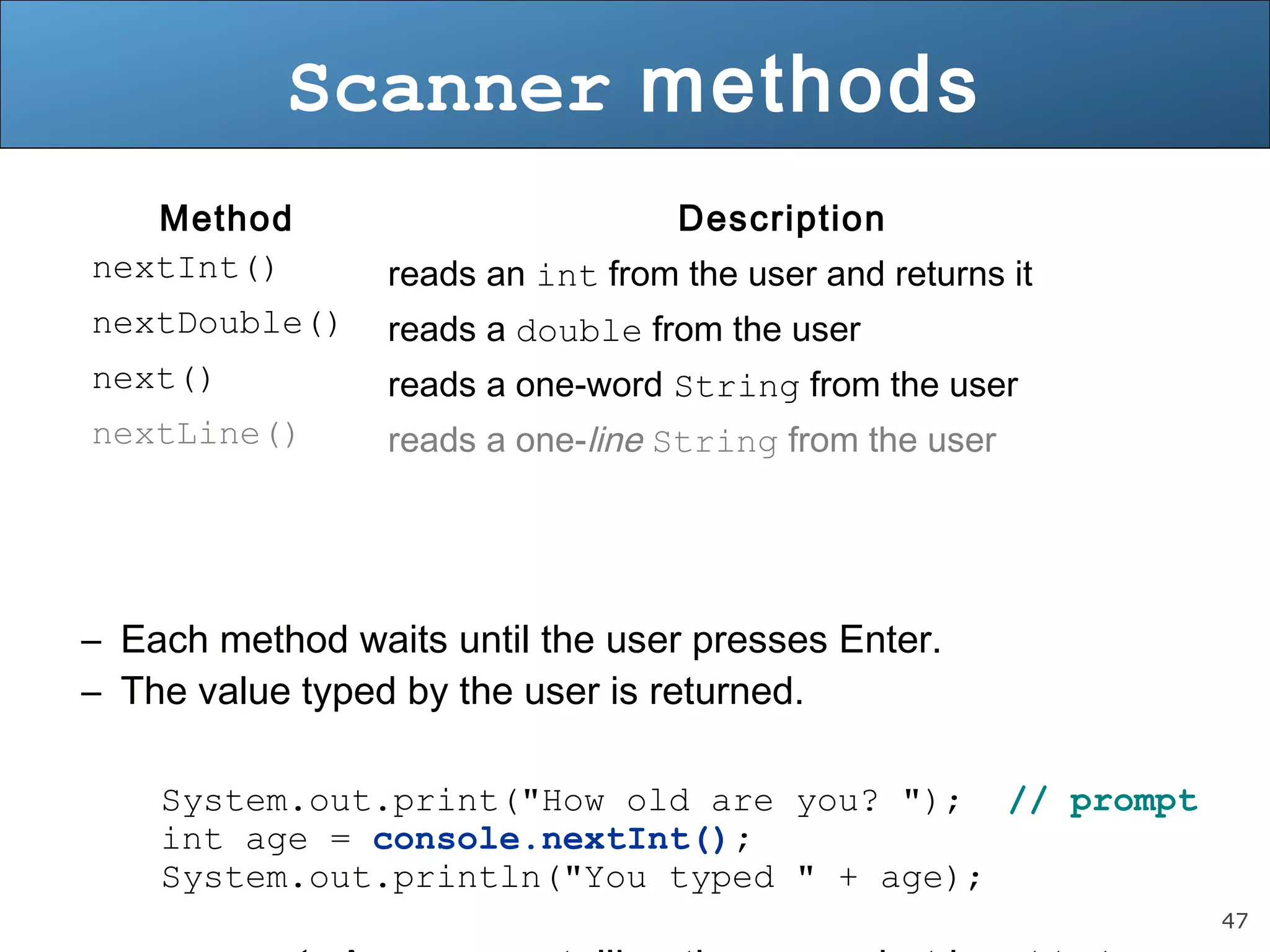
Scanner methods 
Method Description 
nextInt() reads an int from the user and returns it 
nextDouble() reads a double from the user 
next() reads a one-word String from the user 
nextLine() reads a one-line String from the user 
– Each method waits until the user presses Enter. 
– The value typed by the user is returned. 
System.out.print("How old are you? "); // prompt 
int age = console.nextInt(); 
System.out.println("You typed " + age); 
• prompt: A message telling the user what input to type.
48 
Scanner example 
import java.util.*; // so that I can use Scanner 
public class UserInputExample { 
public static void main(String[] args) { 
Scanner console = new Scanner(System.in); 
System.out.print("How old are you? "); 
int age = console.nextInt(); 
int years = 65 - age; 
System.out.println(years + " years to retirement!"); 
} 
} 
• Console (user input underlined): 
29 
How old are you? 
36 years until retirement! 
age 29 
years 36
49 
Scanner example 2 
import java.util.*; // so that I can use Scanner 
public class ScannerMultiply { 
public static void main(String[] args) { 
Scanner console = new Scanner(System.in); 
System.out.print("Please type two numbers: "); 
int num1 = console.nextInt(); 
int num2 = console.nextInt(); 
int product = num1 * num2; 
System.out.println("The product is " + product); 
} 
} 
• Output (user input underlined): 
Please type two numbers: 8 6 
The product is 48 
– The Scanner can read multiple values from one line.
50 
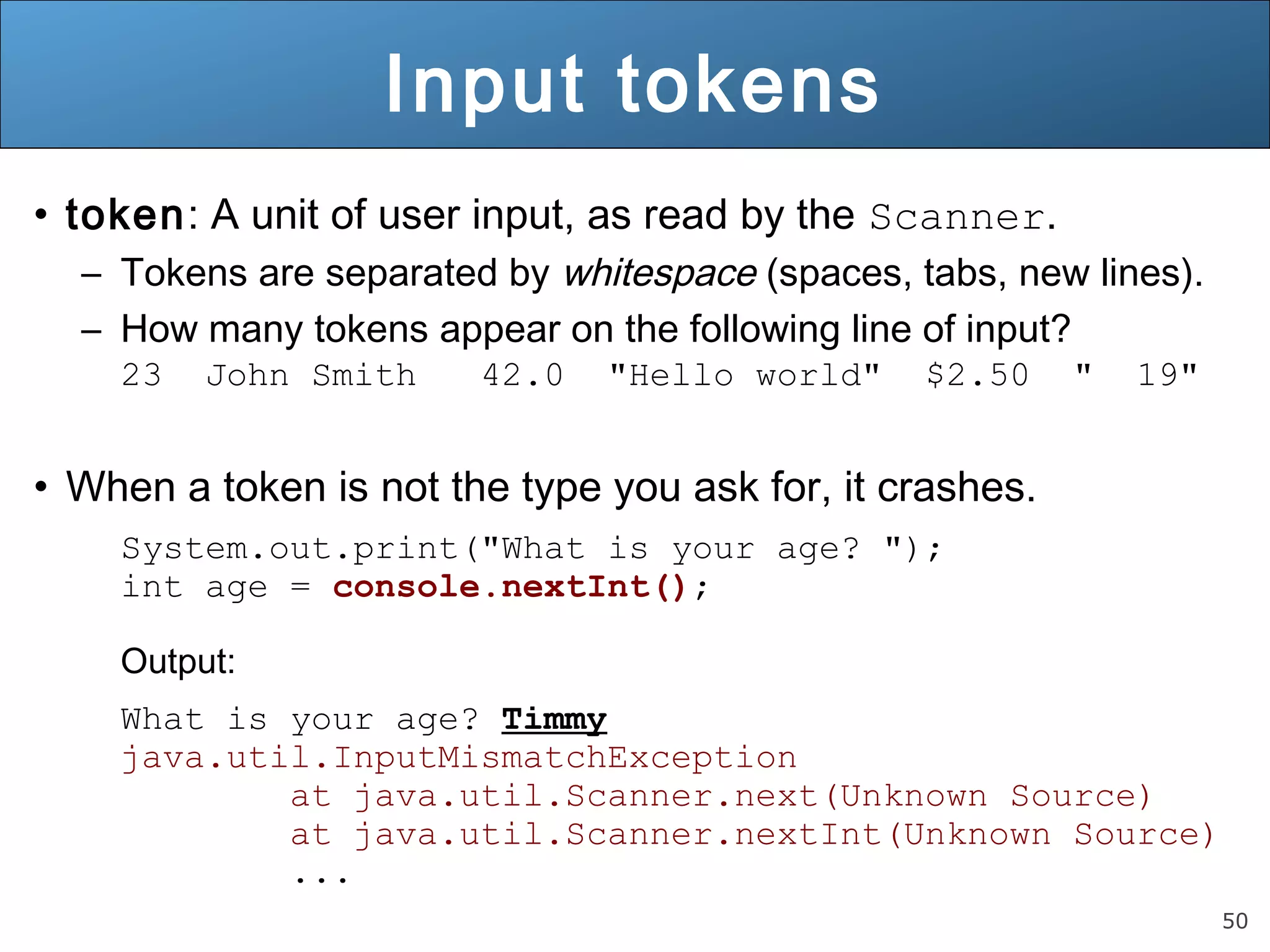
Input tokens 
• token: A unit of user input, as read by the Scanner. 
– Tokens are separated by whitespace (spaces, tabs, new lines). 
– How many tokens appear on the following line of input? 
23 John Smith 42.0 "Hello world" $2.50 " 19" 
• When a token is not the type you ask for, it crashes. 
System.out.print("What is your age? "); 
int age = console.nextInt(); 
Output: 
What is your age? Timmy 
java.util.InputMismatchException 
at java.util.Scanner.next(Unknown Source) 
at java.util.Scanner.nextInt(Unknown Source) 
...
51 
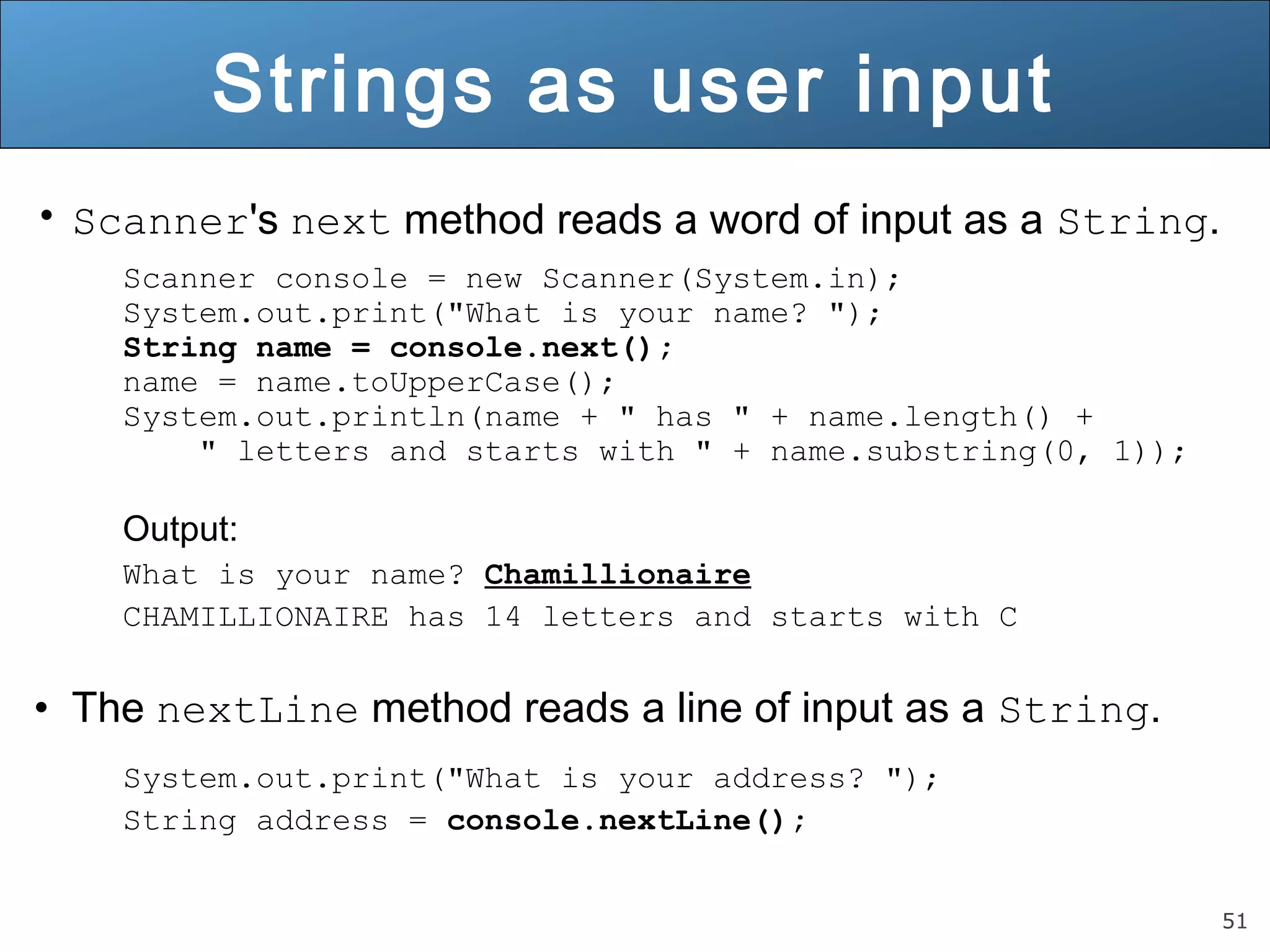
Strings as user input 
• Scanner's next method reads a word of input as a String. 
Scanner console = new Scanner(System.in); 
System.out.print("What is your name? "); 
String name = console.next(); 
name = name.toUpperCase(); 
System.out.println(name + " has " + name.length() + 
" letters and starts with " + name.substring(0, 1)); 
Output: 
What is your name? Chamillionaire 
CHAMILLIONAIRE has 14 letters and starts with C 
• The nextLine method reads a line of input as a String. 
System.out.print("What is your address? "); 
String address = console.nextLine();
52 
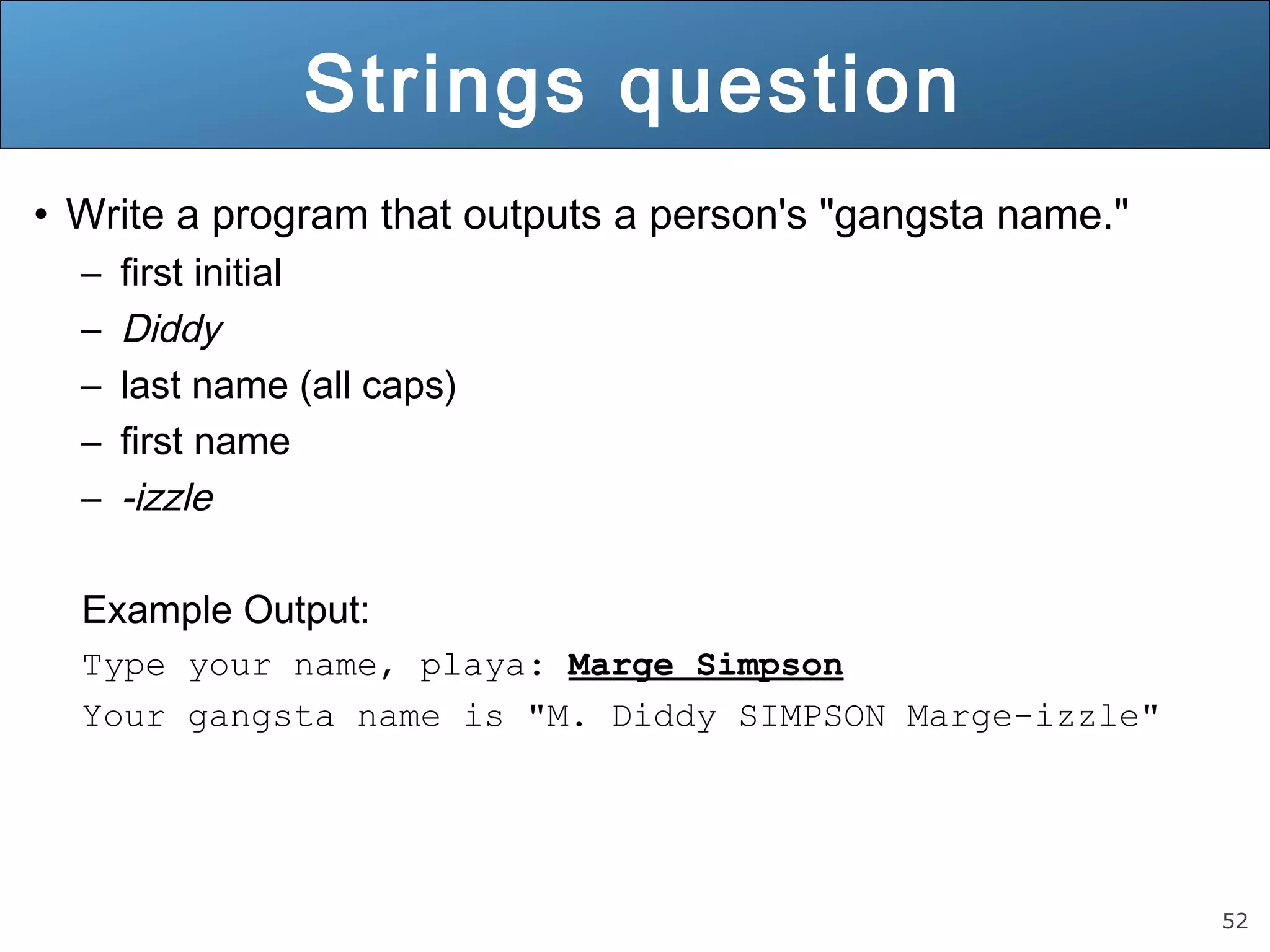
Strings question 
• Write a program that outputs a person's "gangsta name." 
– first initial 
– Diddy 
– last name (all caps) 
– first name 
– -izzle 
Example Output: 
Type your name, playa: Marge Simpson 
Your gangsta name is "M. Diddy SIMPSON Marge-izzle"
53 
Strings answer 
// This program prints your "gangsta" name. 
import java.util.*; 
public class GangstaName { 
public static void main(String[] args) { 
Scanner console = new Scanner(System.in); 
System.out.print("Type your name, playa: "); 
String name = console.nextLine(); 
// split name into first/last name and initials 
String first = name.substring(0, name.indexOf(" ")); 
String last = name.substring(name.indexOf(" ") + 1); 
last = last.toUpperCase(); 
String fInitial = first.substring(0, 1); 
System.out.println("Your gangsta name is "" + fInitial + 
". Diddy " + last + " " + first + "-izzle""); 
} 
}

Parameters

  • 1.
    Building Java Programs Chapter 3 Parameters and Objects Copyright (c) Pearson 2013. All rights reserved.
  • 2.
    2 Redundant recipes • Recipe for baking 20 cookies: – Mix the following ingredients in a bowl: • 4 cups flour • 1 cup butter • 1 cup sugar • 2 eggs • 40 pounds chocolate chips ... – Place on sheet and Bake for about 10 minutes. • Recipe for baking 40 cookies: – Mix the following ingredients in a bowl: • 8 cups flour • 2 cups butter • 2 cups sugar • 4 eggs • 80 pounds chocolate chips ... – Place on sheet and Bake for about 10 minutes.
  • 3.
    3 Parameterized recipe • Recipe for baking 20 cookies: – Mix the following ingredients in a bowl: • 4 cups flour • 1 cup sugar • 2 eggs • ... • Recipe for baking N cookies: – Mix the following ingredients in a bowl: • N/5 cups flour • N/20 cups butter • N/20 cups sugar • N/10 eggs • 2N bags chocolate chips ... – Place on sheet and Bake for about 10 minutes. • parameter: A value that distinguishes similar tasks.
  • 4.
    4 Redundant figures • Consider the task of printing the following lines/boxes: ************* ******* *********************************** ********** * * ********** ***** * * * * *****
  • 5.
    5 A redundantsolution public class Stars1 { public static void main(String[] args) { lineOf13(); lineOf7(); lineOf35(); box10x3(); box5x4(); } public static void lineOf13() { for (int i = 1; i <= 13; i++) { System.out.print("*"); } System.out.println(); } public static void lineOf7() { for (int i = 1; i <= 7; i++) { System.out.print("*"); } System.out.println(); } public static void lineOf35() { for (int i = 1; i <= 35; i++) { System.out.print("*"); } System.out.println(); } ... • This code is redundant. • Would variables help? Would constants help? • What is a better solution? – line - A method to draw a line of any number of stars. – box - A method to draw a box of any size.
  • 6.
    6 Parameterization •parameter: A value passed to a method by its caller. – Instead of lineOf7, lineOf13, write line to draw any length. • When declaring the method, we will state that it requires a parameter for the number of stars. • When calling the method, we will specify how many stars to draw. mai n lin e ****** * 7 lin e ************ * 1 3
  • 7.
    7 Declaring aparameter Stating that a method requires a parameter in order to run public static void name ( type name ) { statement(s); } • Example: public static void sayPassword(int code) { System.out.println("The password is: " + code); } – When sayPassword is called, the caller must specify the integer code to print.
  • 8.
    8 Passing aparameter Calling a method and specifying values for its parameters name (expression); • Example: public static void main(String[] args) { sayPassword(42); sayPassword(12345); } Output: The password is 42 The password is 12345
  • 9.
    9 Parameters andloops • A parameter can guide the number of repetitions of a loop. public static void main(String[] args) { chant(3); } public static void chant(int times) { for (int i = 1; i <= times; i++) { System.out.println("Just a salad..."); } } Output: Just a salad... Just a salad... Just a salad...
  • 10.
    10 How parametersare passed • When the method is called: – The value is stored into the parameter variable. – The method's code executes using that value. public static void main(String[] args) { chant(3); chant(7); } public static void chant(int times) { for (int i = 1; i <= times; i++) { System.out.println("Just a salad..."); } } 37
  • 11.
    11 Common errors • If a method accepts a parameter, it is illegal to call it without passing any value for that parameter. chant(); // ERROR: parameter value required • The value passed to a method must be of the correct type. chant(3.7); // ERROR: must be of type int • Exercise: Change the Stars program to use a parameterized method for drawing lines of stars.
  • 12.
    12 Stars solution // Prints several lines of stars. // Uses a parameterized method to remove redundancy. public class Stars2 { public static void main(String[] args) { line(13); line(7); line(35); } // Prints the given number of stars plus a line break. public static void line(int count) { for (int i = 1; i <= count; i++) { System.out.print("*"); } System.out.println(); } }
  • 13.
    13 Multiple parameters • A method can accept multiple parameters. (separate by , ) – When calling it, you must pass values for each parameter. • Declaration: public static void name (type name, ..., type name) { statement(s); } • Call: methodName (value, value, ..., value);
  • 14.
    14 Multiple paramsexample public static void main(String[] args) { printNumber(4, 9); printNumber(17, 6); printNumber(8, 0); printNumber(0, 8); } public static void printNumber(int number, int count) { for (int i = 1; i <= count; i++) { System.out.print(number); } System.out.println(); } Output: 444444444 171717171717 00000000 • Modify the Stars program to draw boxes with parameters.
  • 15.
    15 Stars solution // Prints several lines and boxes made of stars. // Third version with multiple parameterized methods. public class Stars3 { public static void main(String[] args) { line(13); line(7); line(35); System.out.println(); box(10, 3); box(5, 4); box(20, 7); } // Prints the given number of stars plus a line break. public static void line(int count) { for (int i = 1; i <= count; i++) { System.out.print("*"); } System.out.println(); } ...
  • 16.
    16 Stars solution,cont'd. ... // Prints a box of stars of the given size. public static void box(int width, int height) { line(width); for (int line = 1; line <= height - 2; line++) { System.out.print("*"); for (int space = 1; space <= width - 2; space++) { System.out.print(" "); } System.out.println("*"); } line(width); } }
  • 17.
    17 Value semantics • value semantics: When primitive variables (int, double) are passed as parameters, their values are copied. – Modifying the parameter will not affect the variable passed in. public static void strange(int x) { x = x + 1; System.out.println("1. x = " + x); } public static void main(String[] args) { int x = 23; strange(x); System.out.println("2. x = " + x); ... } Output: 1. x = 24 2. x = 23
  • 18.
    18 "Parameter Mystery"problem public class ParameterMystery { public static void main(String[] args) { int x = 9; int y = 2; int z = 5; mystery(z, y, x); mystery(y, x, z); } public static void mystery(int x, int z, int y) { System.out.println(z + " and " + (y - x)); } }
  • 19.
    19 Strings •string: A sequence of text characters. String name = "text"; String name = expression; – Examples: String name = "Marla Singer"; int x = 3; int y = 5; String point = "(" + x + ", " + y + ")";
  • 20.
    20 Strings asparameters public class StringParameters { public static void main(String[] args) { sayHello("Marty"); String teacher = "Bictolia"; sayHello(teacher); } public static void sayHello(String name) { System.out.println("Welcome, " + name); } } Output: Welcome, Marty Welcome, Bictolia • Modify the Stars program to use string parameters. Use a method named repeat that prints a string many times.
  • 21.
    21 Stars solution // Prints several lines and boxes made of stars. // Fourth version with String parameters. public class Stars4 { public static void main(String[] args) { line(13); line(7); line(35); System.out.println(); box(10, 3); box(5, 4); box(20, 7); } // Prints the given number of stars plus a line break. public static void line(int count) { repeat("*", count); System.out.println(); } ...
  • 22.
    22 Stars solution,cont'd. ... // Prints a box of stars of the given size. public static void box(int width, int height) { line(width); for (int line = 1; line <= height - 2; line++) { System.out.print("*"); repeat(" ", width - 2); System.out.println("*"); } line(width); } // Prints the given String the given number of times. public static void repeat(String s, int times) { for (int i = 1; i <= times; i++) { System.out.print(s); } } }
  • 23.
  • 24.
    24 Java's Mathclass Method name Description Math.abs(value) absolute value Math.ceil(value) rounds up Math.floor(value) rounds down Math.log10(value) logarithm, base 10 Math.max(value1, value2) larger of two values Math.min(value1, value2) smaller of two values Math.pow(base, exp) base to the exp power Math.random() random double between 0 and 1 Math.round(value) nearest whole number Math.sqrt(value) square root Math.sin(value) sine/cosine/tangent of Math.cos(value) an angle in radians Math.tan(value) Math.toDegrees(value) Math.toRadians(value) convert degrees to radians and back Constant Description Math.E 2.7182818... Math.PI 3.1415926...
  • 25.
    25 Calling Mathmethods Math.methodName(parameters) • Examples: double squareRoot = Math.sqrt(121.0); System.out.println(squareRoot); // 11.0 int absoluteValue = Math.abs(-50); System.out.println(absoluteValue); // 50 System.out.println(Math.min(3, 7) + 2); // 5 • The Math methods do not print to the console. – Each method produces ("returns") a numeric result. – The results are used as expressions (printed, stored, etc.).
  • 26.
    26 Return •return: To send out a value as the result of a method. – The opposite of a parameter: • Parameters send information in from the caller to the method. • Return values send information out from a method to its caller. – A call to the method can be used as part of an expression. mai n Math.abs(- 42) - 42 Math.round(2.71 ) 4 2 2.7 1 3
  • 27.
    27 Math questions • Evaluate the following expressions: – Math.abs(-1.23) – Math.pow(3, 2) – Math.pow(10, -2) – Math.sqrt(121.0) - Math.sqrt(256.0) – Math.round(Math.PI) + Math.round(Math.E) – Math.ceil(6.022) + Math.floor(15.9994) – Math.abs(Math.min(-3, -5)) • Math.max and Math.min can be used to bound numbers. Consider an int variable named age. – What statement would replace negative ages with 0? – What statement would cap the maximum age to 40?
  • 28.
    28 Quirks ofreal numbers • Some Math methods return double or other non-int types. int x = Math.pow(10, 3); // ERROR: incompat. types • Some double values print poorly (too many digits). double result = 1.0 / 3.0; System.out.println(result); // 0.3333333333333 • The computer represents doubles in an imprecise way. System.out.println(0.1 + 0.2); – Instead of 0.3, the output is 0.30000000000000004
  • 29.
    29 Type casting • type cast: A conversion from one type to another. – To promote an int into a double to get exact division from / – To truncate a double from a real number to an integer • Syntax: (type) expression Examples: double result = (double) 19 / 5; // 3.8 int result2 = (int) result; // 3 int x = (int) Math.pow(10, 3); // 1000
  • 30.
    30 More abouttype casting • Type casting has high precedence and only casts the item immediately next to it. – double x = (double) 1 + 1 / 2; // 1 – double y = 1 + (double) 1 / 2; // 1.5 • You can use parentheses to force evaluation order. – double average = (double) (a + b + c) / 3; • A conversion to double can be achieved in other ways. – double average = 1.0 * (a + b + c) / 3;
  • 31.
    31 Returning avalue public static type name(parameters) { statements; ... return expression; } • Example: // Returns the slope of the line between the given points. public static double slope(int x1, int y1, int x2, int y2) { double dy = y2 - y1; double dx = x2 - x1; return dy / dx; } – slope(1, 3, 5, 11) returns 2.0
  • 32.
    32 Return examples // Converts degrees Fahrenheit to Celsius. public static double fToC(double degreesF) { double degreesC = 5.0 / 9.0 * (degreesF - 32); return degreesC; } // Computes triangle hypotenuse length given its side lengths. public static double hypotenuse(int a, int b) { double c = Math.sqrt(a * a + b * b); return c; } • You can shorten the examples by returning an expression: public static double fToC(double degreesF) { return 5.0 / 9.0 * (degreesF - 32); }
  • 33.
    33 Common error:Not storing • Many students incorrectly think that a return statement sends a variable's name back to the calling method. public static void main(String[] args) { slope(0, 0, 6, 3); System.out.println("The slope is " + result); // ERROR: } // result not defined public static double slope(int x1, int x2, int y1, int y2) { double dy = y2 - y1; double dx = x2 - x1; double result = dy / dx; return result; }
  • 34.
    34 Fixing thecommon error • Instead, returning sends the variable's value back. – The returned value must be stored into a variable or used in an expression to be useful to the caller. public static void main(String[] args) { double s = slope(0, 0, 6, 3); System.out.println("The slope is " + s); } public static double slope(int x1, int x2, int y1, int y2) { double dy = y2 - y1; double dx = x2 - x1; double result = dy / dx; return result; }
  • 35.
  • 36.
    36 Classes andobjects • class: A program entity that represents either: 1. A program / module, or 2. A type of objects. – A class is a blueprint or template for constructing objects. – Example: The DrawingPanel class (type) is a template for creating many DrawingPanel objects (windows). • Java has 1000s of classes. Later (Ch.8) we will write our own. • object: An entity that combines data and behavior. – object-oriented programming (OOP): Programs that perform their behavior as interactions between objects.
  • 37.
    37 Objects •object: An entity that contains data and behavior. – data: variables inside the object – behavior: methods inside the object • You interact with the methods; the data is hidden in the object. • Constructing (creating) an object: Type objectName = new Type(parameters); • Calling an object's method: objectName.methodName(parameters);
  • 38.
    38 Blueprint analogy iPod blueprint/factory state: current song volume battery life behavior: power on/off change station/song change volume choose random song iPod #1 state: song = "1,000,000 Miles" volume = 17 battery life = 2.5 hrs behavior: power on/off change station/song change volume choose random song iPod #2 state: song = "Letting You" volume = 9 battery life = 3.41 hrs behavior: power on/off change station/song change volume choose random song iPod #3 creates state: song = "Discipline" volume = 24 battery life = 1.8 hrs behavior: power on/off change station/song change volume choose random song
  • 39.
    39 Strings •string: An object storing a sequence of text characters. – Unlike most other objects, a String is not created with new. String name = "text"; String name = expression; – Examples: String name = "Marla Singer"; int x = 3; int y = 5; String point = "(" + x + ", " + y + ")";
  • 40.
    40 Indexes •Characters of a string are numbered with 0-based indexes: String name = "R. Kelly"; index 0 1 2 3 4 5 6 7 character R . K e l l y – First character's index : 0 – Last character's index : 1 less than the string's length – The individual characters are values of type char (seen later)
  • 41.
    indexOf(str) index wherethe start of the given string appears 41 String methods Method name Description in this string (-1 if not found) length() number of characters in this string substring(index1, index2) or substring(index1) the characters in this string from index1 (inclusive) to index2 (exclusive); if index2 is omitted, grabs till end of string toLowerCase() a new string with all lowercase letters toUpperCase() a new string with all uppercase letters • These methods are called using the dot notation: String gangsta = "Dr. Dre"; System.out.println(gangsta.length()); // 7
  • 42.
    String method examples // index 012345678901 String s1 = "Stuart Reges"; String s2 = "Marty Stepp"; System.out.println(s1.length()); // 12 System.out.println(s1.indexOf("e")); // 8 System.out.println(s1.substring(7, 10)); // "Reg" String s3 = s2.substring(1, 7); System.out.println(s3.toLowerCase()); // "arty s" 42 • Given the following string: // index 0123456789012345678901 String book = "Building Java Programs"; – How would you extract the word "Java" ?
  • 43.
    43 Modifying strings • Methods like substring and toLowerCase build and return a new string, rather than modifying the current string. String s = "lil bow wow"; s.toUpperCase(); System.out.println(s); // lil bow wow • To modify a variable's value, you must reassign it: String s = "lil bow wow"; s = s.toUpperCase(); System.out.println(s); // LIL BOW WOW
  • 44.
  • 45.
    45 Input andSystem.in • interactive program: Reads input from the console. – While the program runs, it asks the user to type input. – The input typed by the user is stored in variables in the code. – Can be tricky; users are unpredictable and misbehave. – But interactive programs have more interesting behavior. • Scanner: An object that can read input from many sources. – Communicates with System.in (the opposite of System.out) – Can also read from files (Ch. 6), web sites, databases, ...
  • 46.
    46 Scanner syntax • The Scanner class is found in the java.util package. import java.util.*; // so you can use Scanner • Constructing a Scanner object to read console input: Scanner name = new Scanner(System.in); – Example: Scanner console = new Scanner(System.in);
  • 47.
    47 Scanner methods Method Description nextInt() reads an int from the user and returns it nextDouble() reads a double from the user next() reads a one-word String from the user nextLine() reads a one-line String from the user – Each method waits until the user presses Enter. – The value typed by the user is returned. System.out.print("How old are you? "); // prompt int age = console.nextInt(); System.out.println("You typed " + age); • prompt: A message telling the user what input to type.
  • 48.
    48 Scanner example import java.util.*; // so that I can use Scanner public class UserInputExample { public static void main(String[] args) { Scanner console = new Scanner(System.in); System.out.print("How old are you? "); int age = console.nextInt(); int years = 65 - age; System.out.println(years + " years to retirement!"); } } • Console (user input underlined): 29 How old are you? 36 years until retirement! age 29 years 36
  • 49.
    49 Scanner example2 import java.util.*; // so that I can use Scanner public class ScannerMultiply { public static void main(String[] args) { Scanner console = new Scanner(System.in); System.out.print("Please type two numbers: "); int num1 = console.nextInt(); int num2 = console.nextInt(); int product = num1 * num2; System.out.println("The product is " + product); } } • Output (user input underlined): Please type two numbers: 8 6 The product is 48 – The Scanner can read multiple values from one line.
  • 50.
    50 Input tokens • token: A unit of user input, as read by the Scanner. – Tokens are separated by whitespace (spaces, tabs, new lines). – How many tokens appear on the following line of input? 23 John Smith 42.0 "Hello world" $2.50 " 19" • When a token is not the type you ask for, it crashes. System.out.print("What is your age? "); int age = console.nextInt(); Output: What is your age? Timmy java.util.InputMismatchException at java.util.Scanner.next(Unknown Source) at java.util.Scanner.nextInt(Unknown Source) ...
  • 51.
    51 Strings asuser input • Scanner's next method reads a word of input as a String. Scanner console = new Scanner(System.in); System.out.print("What is your name? "); String name = console.next(); name = name.toUpperCase(); System.out.println(name + " has " + name.length() + " letters and starts with " + name.substring(0, 1)); Output: What is your name? Chamillionaire CHAMILLIONAIRE has 14 letters and starts with C • The nextLine method reads a line of input as a String. System.out.print("What is your address? "); String address = console.nextLine();
  • 52.
    52 Strings question • Write a program that outputs a person's "gangsta name." – first initial – Diddy – last name (all caps) – first name – -izzle Example Output: Type your name, playa: Marge Simpson Your gangsta name is "M. Diddy SIMPSON Marge-izzle"
  • 53.
    53 Strings answer // This program prints your "gangsta" name. import java.util.*; public class GangstaName { public static void main(String[] args) { Scanner console = new Scanner(System.in); System.out.print("Type your name, playa: "); String name = console.nextLine(); // split name into first/last name and initials String first = name.substring(0, name.indexOf(" ")); String last = name.substring(name.indexOf(" ") + 1); last = last.toUpperCase(); String fInitial = first.substring(0, 1); System.out.println("Your gangsta name is "" + fInitial + ". Diddy " + last + " " + first + "-izzle""); } }

Editor's Notes

  • #9 You have already called System.out.println and passed parameters to it.
  • #19 Output: 2 and 4 9 and 3
  • #49 It&amp;apos;s also useful to write a program that prompts for multiple values, both on the same line or each on its own line.
  • #50 It&amp;apos;s also useful to write a program that prompts for multiple values, both on the same line or each on its own line.