







High-Quality Programming Code
Code Correctness, Readability,
Maintainability
Svetlin Nakov
Technical Trainer
www.nakov.com
Software University
http://softuni.bg
2
 Why Quality Is Important?
 Software Quality: External and Internal
 What is High-Quality Code?
 Code Conventions
 Managing Complexity
 Characteristics of Quality Code
Table of Contents
What is High-Quality
Programming Code?
4
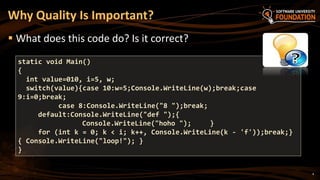
 What does this code do? Is it correct?
Why Quality Is Important?
static void Main()
{
int value=010, i=5, w;
switch(value){case 10:w=5;Console.WriteLine(w);break;case
9:i=0;break;
case 8:Console.WriteLine("8 ");break;
default:Console.WriteLine("def ");{
Console.WriteLine("hoho "); }
for (int k = 0; k < i; k++, Console.WriteLine(k - 'f'));break;}
{ Console.WriteLine("loop!"); }
}
5
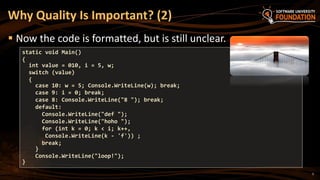
 Now the code is formatted, but is still unclear.
Why Quality Is Important? (2)
static void Main()
{
int value = 010, i = 5, w;
switch (value)
{
case 10: w = 5; Console.WriteLine(w); break;
case 9: i = 0; break;
case 8: Console.WriteLine("8 "); break;
default:
Console.WriteLine("def ");
Console.WriteLine("hoho ");
for (int k = 0; k < i; k++,
Console.WriteLine(k - 'f')) ;
break;
}
Console.WriteLine("loop!");
}
6
 External quality
 Does the software behave correctly?
 Are the produced results correct?
 Does the software run fast?
 Is the software UI easy-to-use?
 Is the code secure enough?
 Internal quality
 Is the code easy to read and understand?
 Is the code well structured?
 Is the code easy to modify?
Software Quality
7
 High-quality programming code:
 Easy to read and understand
 Easy to modify and maintain
 Correct behavior in all cases
 Well tested
 Well architectured and designed
 Well documented
 Self-documenting code
 Well formatted
What is High-Quality Programming Code?
8
 High-quality programming code:
 Strong cohesion at all levels: modules, classes, methods, etc.
 Single unit is responsible for single task
 Loose coupling between modules, classes, methods, etc.
 Units are independent one of another
 Good formatting
 Good names for classes, methods, variables, etc.
 Self-documenting code style
What is High-Quality Programming Code? (2)
Code Conventions
10
 Code conventions are formal guidelines about the style of the source
code:
 Code formatting conventions
 Indentation, whitespace, etc.
 Naming conventions
 PascalCase or camelCase, prefixes, suffixes, etc.
 Best practices
 Classes, interfaces, enumerations, structures, inheritance,
exceptions, properties, events, constructors, fields, operators, etc.
Code Conventions
11
 Microsoft official C# code conventions
 Design Guidelines for Developing Class Libraries:
http://msdn.microsoft.com/en-us/library/ms229042.aspx
 Java official code conventions
 http://www.oracle.com/technetwork/java/codeconvtoc-136057.html
 Semi-official JavaScript code conventions
 http://javascript.crockford.com/code.html,
http://google-styleguide.googlecode.com/svn/trunk/javascriptguide.xml
 Semi-official PHP conventions
 http://www.php-fig.org/psr/psr-1/
Code Conventions (2)
Managing Complexity
13
 Managing complexity has central role in software construction
 Minimize the amount of complexity that anyone’s brain has to deal with at
certain time
 Architecture and design challenges
 Design modules and classes to reduce complexity
 Code construction challenges
 Apply good software construction practices: classes, methods, variables,
naming, statements, error handling, formatting, comments, etc.
Managing Complexity
14
 Key to being an effective programmer:
 Maximizing the portion of a program that you can safely ignore
 While working on any one section of code
 Most practices discussed later propose ways to achieve this
important goal
Managing Complexity (2)
Code Quality: Characteristics
16
 Correct behavior
 Conforming to the requirements
 Stable, no hangs, no crashes
 Bug free – works as expected
 Correct response to incorrect usage
 Readable – easy to read
 Understandable – self-documenting
 Maintainable – easy to modify when required
Key Characteristics of High-Quality Code
17
 Good identifiers names
 Good names for variables, constants, methods, parameters,
classes, structures, fields, properties, interfaces, structures,
enumerations, namespaces,
 High-quality classes, interfaces and class hierarchies
 Good abstraction and encapsulation
 Simplicity, reusability, minimal complexity
 Strong cohesion, loose coupling
Key Characteristics of High-Quality Code (2)
18
 High-quality methods
 Reduced complexity, improved readability
 Good method names and parameter names
 Strong cohesion, loose coupling
 Variables, data, expressions and constants
 Minimal variable scope, span, live time
 Simple expressions
 Correctly used constants
 Correctly organized data
Key Characteristics of High-Quality Code (3)
19
 Correctly used control structures
 Simple statements
 Simple conditional statements and simple conditions
 Well organized loops without deep nesting
 Good code formatting
 Reflecting the logical structure of the program
 Good formatting of classes, methods, blocks, whitespace, long
lines, alignment, etc.
Key Characteristics of High-Quality Code (4)
20
 High-quality documentation and comments
 Effective comments
 Self-documenting code
 Defensive programming and exceptions
 Ubiquitous use of defensive programming
 Well organized exception handling
 Code tuning and optimization
 Quality code instead of good performance
 Code performance when required
Key Characteristics of High-Quality Code (5)
21
 Following the corporate code conventions
 Formatting and style, naming, etc.
 Domain-specific best practices
 Well tested and reviewed
 Testable code
 Well designed unit tests
 Tests for all scenarios
 High code coverage
 Passed code reviews and inspections
Key Characteristics of High-Quality Code (6)
22
1. Classes define specific structure for objects
 Objects are particular instances of a class
2. Classes define fields, methods, constructors,
3. properties and other members
 Access modifiers limit the access to class members
4. Constructors are invoked when creating new class instances and
initialize the object's internal state
5. Properties expose the class data in safe, controlled way
Summary
?
https://softuni.bg/courses/high-quality-code/
High-Quality Programming Code
License
 This course (slides, examples, demos, videos, homework, etc.)
is licensed under the "Creative Commons Attribution-
NonCommercial-ShareAlike 4.0 International" license
24
 Attribution: this work may contain portions from
 "High Quality Code" course by Telerik Academy under CC-BY-NC-SA license
Free Trainings @ Software University
 Software University Foundation – softuni.org
 Software University – High-Quality Education,
Profession and Job for Software Developers
 softuni.bg
 Software University @ Facebook
 facebook.com/SoftwareUniversity
 Software University @ YouTube
 youtube.com/SoftwareUniversity
 Software University Forums – forum.softuni.bg

21. High-Quality Programming Code

  • 1.
    High-Quality Programming Code CodeCorrectness, Readability, Maintainability Svetlin Nakov Technical Trainer www.nakov.com Software University http://softuni.bg
  • 2.
    2  Why QualityIs Important?  Software Quality: External and Internal  What is High-Quality Code?  Code Conventions  Managing Complexity  Characteristics of Quality Code Table of Contents
  • 3.
  • 4.
    4  What doesthis code do? Is it correct? Why Quality Is Important? static void Main() { int value=010, i=5, w; switch(value){case 10:w=5;Console.WriteLine(w);break;case 9:i=0;break; case 8:Console.WriteLine("8 ");break; default:Console.WriteLine("def ");{ Console.WriteLine("hoho "); } for (int k = 0; k < i; k++, Console.WriteLine(k - 'f'));break;} { Console.WriteLine("loop!"); } }
  • 5.
    5  Now thecode is formatted, but is still unclear. Why Quality Is Important? (2) static void Main() { int value = 010, i = 5, w; switch (value) { case 10: w = 5; Console.WriteLine(w); break; case 9: i = 0; break; case 8: Console.WriteLine("8 "); break; default: Console.WriteLine("def "); Console.WriteLine("hoho "); for (int k = 0; k < i; k++, Console.WriteLine(k - 'f')) ; break; } Console.WriteLine("loop!"); }
  • 6.
    6  External quality Does the software behave correctly?  Are the produced results correct?  Does the software run fast?  Is the software UI easy-to-use?  Is the code secure enough?  Internal quality  Is the code easy to read and understand?  Is the code well structured?  Is the code easy to modify? Software Quality
  • 7.
    7  High-quality programmingcode:  Easy to read and understand  Easy to modify and maintain  Correct behavior in all cases  Well tested  Well architectured and designed  Well documented  Self-documenting code  Well formatted What is High-Quality Programming Code?
  • 8.
    8  High-quality programmingcode:  Strong cohesion at all levels: modules, classes, methods, etc.  Single unit is responsible for single task  Loose coupling between modules, classes, methods, etc.  Units are independent one of another  Good formatting  Good names for classes, methods, variables, etc.  Self-documenting code style What is High-Quality Programming Code? (2)
  • 9.
  • 10.
    10  Code conventionsare formal guidelines about the style of the source code:  Code formatting conventions  Indentation, whitespace, etc.  Naming conventions  PascalCase or camelCase, prefixes, suffixes, etc.  Best practices  Classes, interfaces, enumerations, structures, inheritance, exceptions, properties, events, constructors, fields, operators, etc. Code Conventions
  • 11.
    11  Microsoft officialC# code conventions  Design Guidelines for Developing Class Libraries: http://msdn.microsoft.com/en-us/library/ms229042.aspx  Java official code conventions  http://www.oracle.com/technetwork/java/codeconvtoc-136057.html  Semi-official JavaScript code conventions  http://javascript.crockford.com/code.html, http://google-styleguide.googlecode.com/svn/trunk/javascriptguide.xml  Semi-official PHP conventions  http://www.php-fig.org/psr/psr-1/ Code Conventions (2)
  • 12.
  • 13.
    13  Managing complexityhas central role in software construction  Minimize the amount of complexity that anyone’s brain has to deal with at certain time  Architecture and design challenges  Design modules and classes to reduce complexity  Code construction challenges  Apply good software construction practices: classes, methods, variables, naming, statements, error handling, formatting, comments, etc. Managing Complexity
  • 14.
    14  Key tobeing an effective programmer:  Maximizing the portion of a program that you can safely ignore  While working on any one section of code  Most practices discussed later propose ways to achieve this important goal Managing Complexity (2)
  • 15.
  • 16.
    16  Correct behavior Conforming to the requirements  Stable, no hangs, no crashes  Bug free – works as expected  Correct response to incorrect usage  Readable – easy to read  Understandable – self-documenting  Maintainable – easy to modify when required Key Characteristics of High-Quality Code
  • 17.
    17  Good identifiersnames  Good names for variables, constants, methods, parameters, classes, structures, fields, properties, interfaces, structures, enumerations, namespaces,  High-quality classes, interfaces and class hierarchies  Good abstraction and encapsulation  Simplicity, reusability, minimal complexity  Strong cohesion, loose coupling Key Characteristics of High-Quality Code (2)
  • 18.
    18  High-quality methods Reduced complexity, improved readability  Good method names and parameter names  Strong cohesion, loose coupling  Variables, data, expressions and constants  Minimal variable scope, span, live time  Simple expressions  Correctly used constants  Correctly organized data Key Characteristics of High-Quality Code (3)
  • 19.
    19  Correctly usedcontrol structures  Simple statements  Simple conditional statements and simple conditions  Well organized loops without deep nesting  Good code formatting  Reflecting the logical structure of the program  Good formatting of classes, methods, blocks, whitespace, long lines, alignment, etc. Key Characteristics of High-Quality Code (4)
  • 20.
    20  High-quality documentationand comments  Effective comments  Self-documenting code  Defensive programming and exceptions  Ubiquitous use of defensive programming  Well organized exception handling  Code tuning and optimization  Quality code instead of good performance  Code performance when required Key Characteristics of High-Quality Code (5)
  • 21.
    21  Following thecorporate code conventions  Formatting and style, naming, etc.  Domain-specific best practices  Well tested and reviewed  Testable code  Well designed unit tests  Tests for all scenarios  High code coverage  Passed code reviews and inspections Key Characteristics of High-Quality Code (6)
  • 22.
    22 1. Classes definespecific structure for objects  Objects are particular instances of a class 2. Classes define fields, methods, constructors, 3. properties and other members  Access modifiers limit the access to class members 4. Constructors are invoked when creating new class instances and initialize the object's internal state 5. Properties expose the class data in safe, controlled way Summary
  • 23.
  • 24.
    License  This course(slides, examples, demos, videos, homework, etc.) is licensed under the "Creative Commons Attribution- NonCommercial-ShareAlike 4.0 International" license 24  Attribution: this work may contain portions from  "High Quality Code" course by Telerik Academy under CC-BY-NC-SA license
  • 25.
    Free Trainings @Software University  Software University Foundation – softuni.org  Software University – High-Quality Education, Profession and Job for Software Developers  softuni.bg  Software University @ Facebook  facebook.com/SoftwareUniversity  Software University @ YouTube  youtube.com/SoftwareUniversity  Software University Forums – forum.softuni.bg