Dining Philosophers and
the Deadlock Concept
Announcements
• Homework 2 and Project 2 Design Doc due Today
– Make sure to look at the lecture schedule to keep up with
due dates!
• Prelim coming up in two and a half weeks:
– Thursday March 8th
, 7:30—9:00pm, 1½ hour exam
– 203 Phillips
– Closed book, no calculators/PDAs/…
– Bring ID
– Topics: Everything up to (and including) Monday, March 5th
• Lectures 1-18, chapters 1-9 (7th
ed)
– Review Session: Scheduling either night of Monday, March
5th or Tuesday, March 6th
So far…
• We’ve focused on two styles of
communication
• Bounded buffer: sits between producers
and consumers
– Used widely in O/S to smooth out rate
mismatches and to promote modularity
• Readers and writers
– Models idea of a shared data object that
threads read and sometimes update
Dining Philosophers
• A problem that was invented to illustrate a
different aspect of communication
• Our focus here is on the notion of sharing
resources that only one user at a time can
own
– Such as a keyboard on a machine with many
processes active at the same time
– Or a special disk file that only one can write at
a time (bounded buffer is an instance)
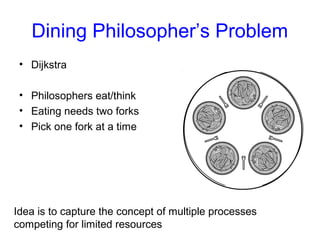
Dining Philosopher’s Problem
• Dijkstra
• Philosophers eat/think
• Eating needs two forks
• Pick one fork at a time
Idea is to capture the concept of multiple processes
competing for limited resources
Rules of the Game
• The philosophers are very logical
– They want to settle on a shared policy that all
can apply concurrently
– They are hungry: the policy should let
everyone eat (eventually)
– They are utterly dedicated to the proposition
of equality: the policy should be totally fair
What can go wrong?
• Primarily, we worry about:
– Starvation: A policy that can leave some
philosopher hungry in some situation (even
one where the others collaborate)
– Deadlock: A policy that leaves all the
philosophers “stuck”, so that nobody can do
anything at all
– Livelock: A policy that makes them all do
something endlessly without ever eating!
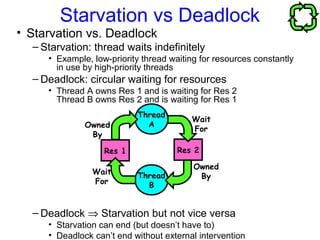
Starvation vs Deadlock
• Starvation vs. Deadlock
– Starvation: thread waits indefinitely
• Example, low-priority thread waiting for resources constantly
in use by high-priority threads
– Deadlock: circular waiting for resources
• Thread A owns Res 1 and is waiting for Res 2
Thread B owns Res 2 and is waiting for Res 1
– Deadlock ⇒ Starvation but not vice versa
• Starvation can end (but doesn’t have to)
• Deadlock can’t end without external intervention
Res 2Res 1
Thread
B
Thread
A
Wait
For
Wait
For
Owned
By
Owned
By
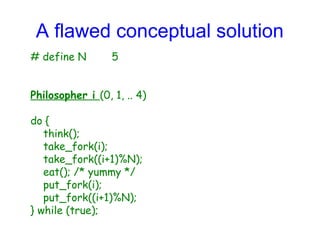
A flawed conceptual solution
# define N 5
Philosopher i (0, 1, .. 4)
do {
think();
take_fork(i);
take_fork((i+1)%N);
eat(); /* yummy */
put_fork(i);
put_fork((i+1)%N);
} while (true);
Coding our flawed solution?
Shared: semaphore fork[5];
Init: fork[i] = 1 for all i=0 .. 4
Philosopher i
do {
P(fork[i]);
P(fork[i+1]);
/* eat */
V(fork[i]);
V(fork[i+1]);
/* think */
} while(true);
Oops! Subject
to deadlock if
they all pick up
their “right” fork
simultaneously!
Dining Philosophers Solutions
• Allow only 4 philosophers to sit simultaneously
• Asymmetric solution
– Odd philosopher picks left fork followed by right
– Even philosopher does vice versa
• Pass a token
• Allow philosopher to pick fork only if both available
One Possible Solution
• Introduce state variable
– enum {thinking, hungry, eating}
• Philosopher i can set the variable state[i]
only if neighbors not eating
– (state[(i+4)%5] != eating) and (state[(i+1)%5]!
= eating
• Also, need to declare semaphore self,
where philosopher i can delay itself.
One possible solution
Shared: int state[5], semaphore s[5], semaphore mutex;
Init: mutex = 1; s[i] = 0 for all i=0 .. 4
Philosopher i
do {
take_fork(i);
/* eat */
put_fork(i);
/* think */
} while(true);
take_fork(i) {
P(mutex);
state[i] = hungry;
test(i);
V(mutex);
P(s[i]);
}
put_fork(i) {
P(mutex);
state[i] = thinking;
test((i+1)%N);
test((i-1+N)%N);
V(mutex);
}
test(i) {
if(state[i] == hungry
&& state[(i+1)%N] != eating
&& state[(i-1+N)%N != eating)
{
state[i] = eating;
V(s[i]);
}
Solutions are less interesting than
the problem itself!
• In fact the problem statement is why
people like to talk about this problem!
• Rather than solving Dining Philosophers,
we should use it to understand properties
of solutions that work and of solutions that
can fail!
Cyclic wait
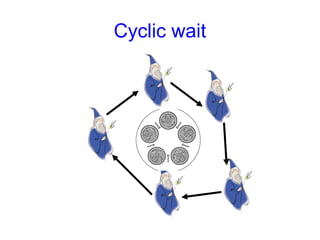
• For example… consider a deadlock
– Each philosopher is holding one fork
– … and each is waiting for a neighbor to
release one fork
• We can represent this as a graph in which
– Nodes represent philosophers
– Edges represent waiting-for
Cyclic wait
Cyclic wait
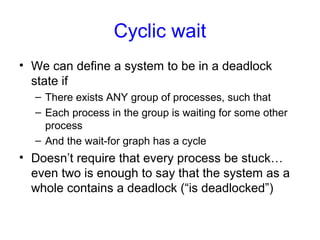
• We can define a system to be in a deadlock
state if
– There exists ANY group of processes, such that
– Each process in the group is waiting for some other
process
– And the wait-for graph has a cycle
• Doesn’t require that every process be stuck…
even two is enough to say that the system as a
whole contains a deadlock (“is deadlocked”)
What about livelock?
• This is harder to express
– The issue is that processes may be active and yet are
“actually” waiting for one-another in some sense
– Need to talk about whether or not processes make
progress
– Once we do this, starvation can also be formalized
• These problems can be solved… but not today
• In CS414 we’ll limit ourselves to deadlock
– Detection: For example, build a graph and check for
cycles (not hard to do)
– Avoidance – we’ll look at several ways to avoid
getting into trouble in the first place!
Real World Deadlocks?
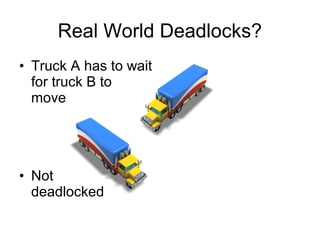
• Truck A has to wait
for truck B to
move
• Not
deadlocked
Real World Deadlocks?
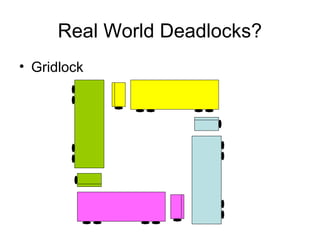
• Gridlock
Real World Deadlocks?
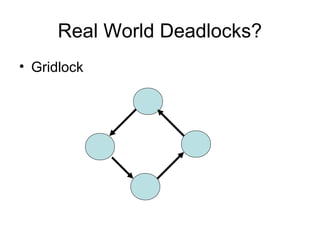
• Gridlock
The strange story of “priorité a droite”
• France has many traffic circles…
– … normally, the priority rule is that a vehicle trying to enter must
yield to one trying to exit
– Can deadlock occur in this case?
• But there are two that operate differently
– Place Etoile and Place Victor Hugo, in Paris
– What happens in practice?
• In Belgium, all incoming roads from the right have priority
unless otherwise marked, even if the incoming road is
small and you are on a main road.
– This is useful to remember.
– Is the entire country deadlock-prone?
Testing for deadlock
• Steps
– Collect “process state” and use it to build a
graph
• Ask each process “are you waiting for anything”?
• Put an edge in the graph if so
– We need to do this in a single instant of time,
not while things might be changing
• Now need a way to test for cycles in our
graph
Testing for deadlock
• How do cars do it?
– Never block an intersection
– Must back up if you find yourself doing so
• Why does this work?
– “Breaks” a wait-for relationship
– Illustrates a sense in which intransigent
waiting (refusing to release a resource) is one
key element of true deadlock!
Testing for deadlock
• One way to find cycles
– Look for a node with no outgoing edges
– Erase this node, and also erase any edges
coming into it
• Idea: This was a process people might have been
waiting for, but it wasn’t waiting for anything else
– If (and only if) the graph has no cycles, we’ll
eventually be able to erase the whole graph!
• This is called a graph reduction algorithm
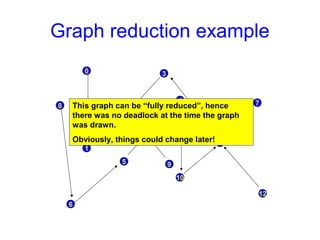
Graph reduction example
8
10
4
11
7
12
5
6
1
0
2
3
9
This graph can be “fully reduced”, hence
there was no deadlock at the time the graph
was drawn.
Obviously, things could change later!
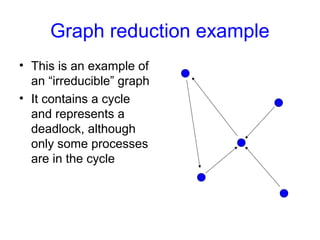
Graph reduction example
• This is an example of
an “irreducible” graph
• It contains a cycle
and represents a
deadlock, although
only some processes
are in the cycle
What about “resource” waits?
• When dining philosophers wait for one-
another, they don’t do so directly
– Erasmus doesn’t “wait” for Ptolemy
• Instead, they wait for resources
– Erasmus waits for a fork… which Ptolemy
exclusively holds
• Can we extend our graphs to represent
resource wait?
Resource-wait graphs
• We’ll use two kinds of nodes
• A process: P3 will be represented as:
• A resource: R7 will be represented as:
– A resource often has multiple identical
units, such as “blocks of memory”
– Represent these as circles in the box
• Arrow from a process to a resource: “I want
k units of this resource.” Arrow to a process:
this process holds k units of the resource
– P3 wants 2 units of R7
3
7
2
A tricky choice…
• When should resources be treated as “different
classes”?
– To be in the same class, resources do need to be
equivalent
• “memory pages” are different from “forks”
– But for some purposes, we might want to split
memory pages into two groups
• The main group of forks. The extra forks
– Keep this in mind next week when we talk about ways
of avoiding deadlock.
• It proves useful in doing “ordered resource allocation”
Resource-wait graphs
1
1
4
2
2
2
3
1
4
1
1
5
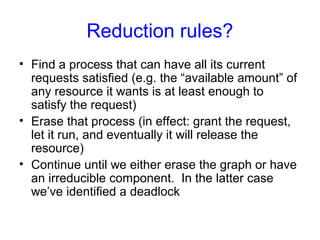
Reduction rules?
• Find a process that can have all its current
requests satisfied (e.g. the “available amount” of
any resource it wants is at least enough to
satisfy the request)
• Erase that process (in effect: grant the request,
let it run, and eventually it will release the
resource)
• Continue until we either erase the graph or have
an irreducible component. In the latter case
we’ve identified a deadlock
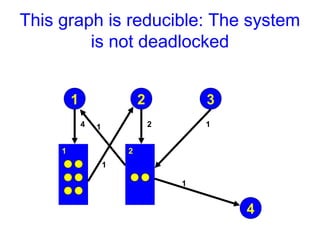
This graph is reducible: The system
is not deadlocked
1
1
4
2
2
2
3
1
4
1
1
1
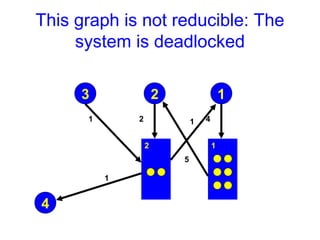
This graph is not reducible: The
system is deadlocked
1
1
4
2
2
2
3
1
4
1
1
5
Comments
• It isn’t common for systems to actually
implement this kind of test
• However, we’ll use a version of the
resource reduction graph as part of an
algorithm called the “Banker’s Algorithm”
later in the week
• Idea is to schedule the granting of
resources so as to avoid potentially
deadlock states
Some questions you might ask
• Does the order in which we do the
reduction matter?
– Answer: No. The reason is that if a node is a
candidate for reduction at step i, and we don’t
pick it, it remains a candidate for reduction at
step i+1
– Thus eventually, no matter what order we do it
in, we’ll reduce by every node where
reduction is feasible
Some questions you might ask
• If a system is deadlocked, could this go away?
– No, unless someone kills one of the threads or
something causes a process to release a resource
– Many real systems put time limits on “waiting”
precisely for this reason. When a process gets a
timeout exception, it gives up waiting and this also
can eliminate the deadlock
– But that process may be forced to terminate itself
because often, if a process can’t get what it needs,
there are no other options available!
Some questions you might ask
• Suppose a system isn’t deadlocked at
time T.
• Can we assume it will still be free of
deadlock at time T+1?
– No, because the very next thing it might do is
to run some process that will request a
resource…
… establishing a cyclic wait
… and causing deadlock

12 deadlock concept

  • 1.
  • 2.
    Announcements • Homework 2and Project 2 Design Doc due Today – Make sure to look at the lecture schedule to keep up with due dates! • Prelim coming up in two and a half weeks: – Thursday March 8th , 7:30—9:00pm, 1½ hour exam – 203 Phillips – Closed book, no calculators/PDAs/… – Bring ID – Topics: Everything up to (and including) Monday, March 5th • Lectures 1-18, chapters 1-9 (7th ed) – Review Session: Scheduling either night of Monday, March 5th or Tuesday, March 6th
  • 3.
    So far… • We’vefocused on two styles of communication • Bounded buffer: sits between producers and consumers – Used widely in O/S to smooth out rate mismatches and to promote modularity • Readers and writers – Models idea of a shared data object that threads read and sometimes update
  • 4.
    Dining Philosophers • Aproblem that was invented to illustrate a different aspect of communication • Our focus here is on the notion of sharing resources that only one user at a time can own – Such as a keyboard on a machine with many processes active at the same time – Or a special disk file that only one can write at a time (bounded buffer is an instance)
  • 5.
    Dining Philosopher’s Problem •Dijkstra • Philosophers eat/think • Eating needs two forks • Pick one fork at a time Idea is to capture the concept of multiple processes competing for limited resources
  • 6.
    Rules of theGame • The philosophers are very logical – They want to settle on a shared policy that all can apply concurrently – They are hungry: the policy should let everyone eat (eventually) – They are utterly dedicated to the proposition of equality: the policy should be totally fair
  • 7.
    What can gowrong? • Primarily, we worry about: – Starvation: A policy that can leave some philosopher hungry in some situation (even one where the others collaborate) – Deadlock: A policy that leaves all the philosophers “stuck”, so that nobody can do anything at all – Livelock: A policy that makes them all do something endlessly without ever eating!
  • 8.
    Starvation vs Deadlock •Starvation vs. Deadlock – Starvation: thread waits indefinitely • Example, low-priority thread waiting for resources constantly in use by high-priority threads – Deadlock: circular waiting for resources • Thread A owns Res 1 and is waiting for Res 2 Thread B owns Res 2 and is waiting for Res 1 – Deadlock ⇒ Starvation but not vice versa • Starvation can end (but doesn’t have to) • Deadlock can’t end without external intervention Res 2Res 1 Thread B Thread A Wait For Wait For Owned By Owned By
  • 9.
    A flawed conceptualsolution # define N 5 Philosopher i (0, 1, .. 4) do { think(); take_fork(i); take_fork((i+1)%N); eat(); /* yummy */ put_fork(i); put_fork((i+1)%N); } while (true);
  • 10.
    Coding our flawedsolution? Shared: semaphore fork[5]; Init: fork[i] = 1 for all i=0 .. 4 Philosopher i do { P(fork[i]); P(fork[i+1]); /* eat */ V(fork[i]); V(fork[i+1]); /* think */ } while(true); Oops! Subject to deadlock if they all pick up their “right” fork simultaneously!
  • 11.
    Dining Philosophers Solutions •Allow only 4 philosophers to sit simultaneously • Asymmetric solution – Odd philosopher picks left fork followed by right – Even philosopher does vice versa • Pass a token • Allow philosopher to pick fork only if both available
  • 12.
    One Possible Solution •Introduce state variable – enum {thinking, hungry, eating} • Philosopher i can set the variable state[i] only if neighbors not eating – (state[(i+4)%5] != eating) and (state[(i+1)%5]! = eating • Also, need to declare semaphore self, where philosopher i can delay itself.
  • 13.
    One possible solution Shared:int state[5], semaphore s[5], semaphore mutex; Init: mutex = 1; s[i] = 0 for all i=0 .. 4 Philosopher i do { take_fork(i); /* eat */ put_fork(i); /* think */ } while(true); take_fork(i) { P(mutex); state[i] = hungry; test(i); V(mutex); P(s[i]); } put_fork(i) { P(mutex); state[i] = thinking; test((i+1)%N); test((i-1+N)%N); V(mutex); } test(i) { if(state[i] == hungry && state[(i+1)%N] != eating && state[(i-1+N)%N != eating) { state[i] = eating; V(s[i]); }
  • 14.
    Solutions are lessinteresting than the problem itself! • In fact the problem statement is why people like to talk about this problem! • Rather than solving Dining Philosophers, we should use it to understand properties of solutions that work and of solutions that can fail!
  • 15.
    Cyclic wait • Forexample… consider a deadlock – Each philosopher is holding one fork – … and each is waiting for a neighbor to release one fork • We can represent this as a graph in which – Nodes represent philosophers – Edges represent waiting-for
  • 16.
  • 17.
    Cyclic wait • Wecan define a system to be in a deadlock state if – There exists ANY group of processes, such that – Each process in the group is waiting for some other process – And the wait-for graph has a cycle • Doesn’t require that every process be stuck… even two is enough to say that the system as a whole contains a deadlock (“is deadlocked”)
  • 18.
    What about livelock? •This is harder to express – The issue is that processes may be active and yet are “actually” waiting for one-another in some sense – Need to talk about whether or not processes make progress – Once we do this, starvation can also be formalized • These problems can be solved… but not today • In CS414 we’ll limit ourselves to deadlock – Detection: For example, build a graph and check for cycles (not hard to do) – Avoidance – we’ll look at several ways to avoid getting into trouble in the first place!
  • 19.
    Real World Deadlocks? •Truck A has to wait for truck B to move • Not deadlocked
  • 20.
  • 21.
  • 22.
    The strange storyof “priorité a droite” • France has many traffic circles… – … normally, the priority rule is that a vehicle trying to enter must yield to one trying to exit – Can deadlock occur in this case? • But there are two that operate differently – Place Etoile and Place Victor Hugo, in Paris – What happens in practice? • In Belgium, all incoming roads from the right have priority unless otherwise marked, even if the incoming road is small and you are on a main road. – This is useful to remember. – Is the entire country deadlock-prone?
  • 23.
    Testing for deadlock •Steps – Collect “process state” and use it to build a graph • Ask each process “are you waiting for anything”? • Put an edge in the graph if so – We need to do this in a single instant of time, not while things might be changing • Now need a way to test for cycles in our graph
  • 24.
    Testing for deadlock •How do cars do it? – Never block an intersection – Must back up if you find yourself doing so • Why does this work? – “Breaks” a wait-for relationship – Illustrates a sense in which intransigent waiting (refusing to release a resource) is one key element of true deadlock!
  • 25.
    Testing for deadlock •One way to find cycles – Look for a node with no outgoing edges – Erase this node, and also erase any edges coming into it • Idea: This was a process people might have been waiting for, but it wasn’t waiting for anything else – If (and only if) the graph has no cycles, we’ll eventually be able to erase the whole graph! • This is called a graph reduction algorithm
  • 26.
    Graph reduction example 8 10 4 11 7 12 5 6 1 0 2 3 9 Thisgraph can be “fully reduced”, hence there was no deadlock at the time the graph was drawn. Obviously, things could change later!
  • 27.
    Graph reduction example •This is an example of an “irreducible” graph • It contains a cycle and represents a deadlock, although only some processes are in the cycle
  • 28.
    What about “resource”waits? • When dining philosophers wait for one- another, they don’t do so directly – Erasmus doesn’t “wait” for Ptolemy • Instead, they wait for resources – Erasmus waits for a fork… which Ptolemy exclusively holds • Can we extend our graphs to represent resource wait?
  • 29.
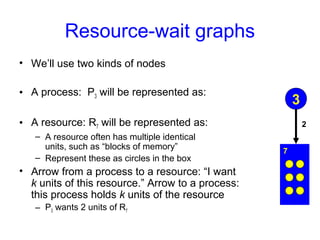
    Resource-wait graphs • We’lluse two kinds of nodes • A process: P3 will be represented as: • A resource: R7 will be represented as: – A resource often has multiple identical units, such as “blocks of memory” – Represent these as circles in the box • Arrow from a process to a resource: “I want k units of this resource.” Arrow to a process: this process holds k units of the resource – P3 wants 2 units of R7 3 7 2
  • 30.
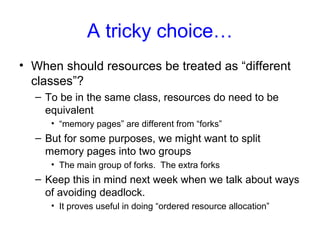
    A tricky choice… •When should resources be treated as “different classes”? – To be in the same class, resources do need to be equivalent • “memory pages” are different from “forks” – But for some purposes, we might want to split memory pages into two groups • The main group of forks. The extra forks – Keep this in mind next week when we talk about ways of avoiding deadlock. • It proves useful in doing “ordered resource allocation”
  • 31.
  • 32.
    Reduction rules? • Finda process that can have all its current requests satisfied (e.g. the “available amount” of any resource it wants is at least enough to satisfy the request) • Erase that process (in effect: grant the request, let it run, and eventually it will release the resource) • Continue until we either erase the graph or have an irreducible component. In the latter case we’ve identified a deadlock
  • 33.
    This graph isreducible: The system is not deadlocked 1 1 4 2 2 2 3 1 4 1 1 1
  • 34.
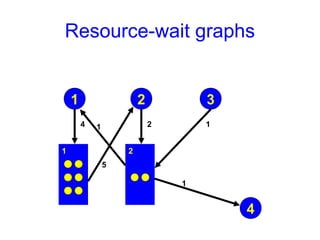
    This graph isnot reducible: The system is deadlocked 1 1 4 2 2 2 3 1 4 1 1 5
  • 35.
    Comments • It isn’tcommon for systems to actually implement this kind of test • However, we’ll use a version of the resource reduction graph as part of an algorithm called the “Banker’s Algorithm” later in the week • Idea is to schedule the granting of resources so as to avoid potentially deadlock states
  • 36.
    Some questions youmight ask • Does the order in which we do the reduction matter? – Answer: No. The reason is that if a node is a candidate for reduction at step i, and we don’t pick it, it remains a candidate for reduction at step i+1 – Thus eventually, no matter what order we do it in, we’ll reduce by every node where reduction is feasible
  • 37.
    Some questions youmight ask • If a system is deadlocked, could this go away? – No, unless someone kills one of the threads or something causes a process to release a resource – Many real systems put time limits on “waiting” precisely for this reason. When a process gets a timeout exception, it gives up waiting and this also can eliminate the deadlock – But that process may be forced to terminate itself because often, if a process can’t get what it needs, there are no other options available!
  • 38.
    Some questions youmight ask • Suppose a system isn’t deadlocked at time T. • Can we assume it will still be free of deadlock at time T+1? – No, because the very next thing it might do is to run some process that will request a resource… … establishing a cyclic wait … and causing deadlock