A SURVEY OF
AMERICAN HISTORY
Unit 1: Colonialism and Nationhood

Part 12: Building a Shadow Government
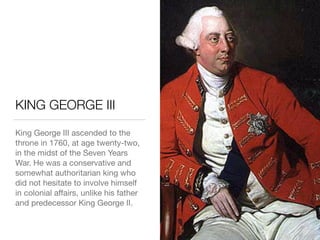
KING GEORGE III
King George III ascended to the
throne in 1760, at age twenty-two,
in the midst of the Seven Years
War. He was a conservative and
somewhat authoritarian king who
did not hesitate to involve himself
in colonial affairs, unlike his father
and predecessor King George II.
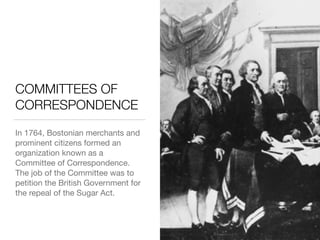
COMMITTEES OF
CORRESPONDENCE
In 1764, Bostonian merchants and
prominent citizens formed an
organization known as a
Committee of Correspondence.
The job of the Committee was to
petition the British Government for
the repeal of the Sugar Act.
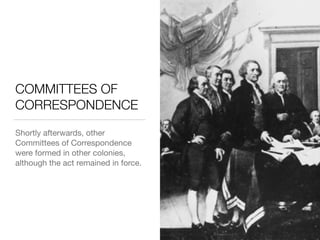
COMMITTEES OF
CORRESPONDENCE
Shortly afterwards, other
Committees of Correspondence
were formed in other colonies,
although the act remained in force.
THE STAMP ACT
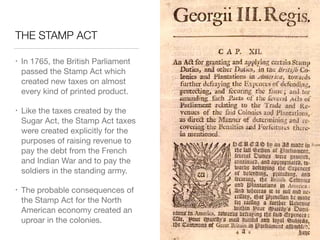
• In 1765, the British Parliament
passed the Stamp Act which
created new taxes on almost
every kind of printed product.

• Like the taxes created by the
Sugar Act, the Stamp Act taxes
were created explicitly for the
purposes of raising revenue to
pay the debt from the French
and Indian War and to pay the
soldiers in the standing army.

• The probable consequences of
the Stamp Act for the North
American economy created an
uproar in the colonies.
PATRICK HENRY
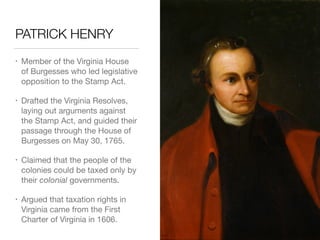
• Member of the Virginia House
of Burgesses who led legislative
opposition to the Stamp Act.

• Drafted the Virginia Resolves,
laying out arguments against
the Stamp Act, and guided their
passage through the House of
Burgesses on May 30, 1765.

• Claimed that the people of the
colonies could be taxed only by
their colonial governments.

• Argued that taxation rights in
Virginia came from the First
Charter of Virginia in 1606.
JAMES OTIS
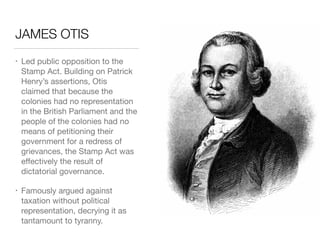
• Led public opposition to the
Stamp Act. Building on Patrick
Henry’s assertions, Otis
claimed that because the
colonies had no representation
in the British Parliament and the
people of the colonies had no
means of petitioning their
government for a redress of
grievances, the Stamp Act was
effectively the result of
dictatorial governance.

• Famously argued against
taxation without political
representation, decrying it as
tantamount to tyranny.
SAMUEL ADAMS
• Beer brewer and newspaper
columnist in Boston. Provoked
popular uprisings against the
Stamp Act and the authorities
responsible for enforcing it.

• On August 14, 1765, a mob in
Boston hung an effigy of
Andrew Oliver, the distributor of
stamps for Massachusetts.

• This event marked the creation
of the Sons of Liberty, an
underground organization of
resistance to perceived acts of
British tyranny. Adams exerted
strong influence over them.
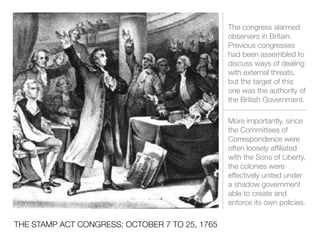
THE STAMP ACT CONGRESS: OCTOBER 7 TO 25, 1765
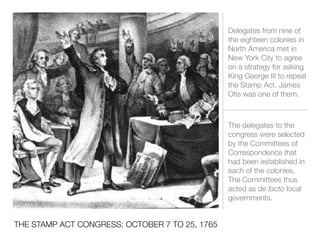
Delegates from nine of
the eighteen colonies in
North America met in
New York City to agree
on a strategy for asking
King George III to repeal
the Stamp Act. James
Otis was one of them.
The delegates to the
congress were selected
by the Committees of
Correspondence that
had been established in
each of the colonies.
The Committees thus
acted as de facto local
governments.
The congress alarmed
observers in Britain.
Previous congresses
had been assembled to
discuss ways of dealing
with external threats,
but the target of this
one was the authority of
the British Government.
More importantly, since
the Committees of
Correspondence were
often loosely affiliated
with the Sons of Liberty,
the colonies were
effectively united under
a shadow government
able to create and
enforce its own policies.
THE STAMP ACT CONGRESS: OCTOBER 7 TO 25, 1765
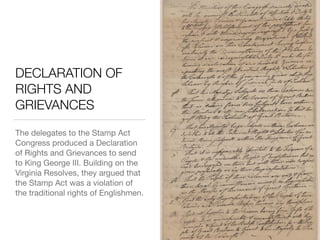
DECLARATION OF
RIGHTS AND
GRIEVANCES
The delegates to the Stamp Act
Congress produced a Declaration
of Rights and Grievances to send
to King George III. Building on the
Virginia Resolves, they argued that
the Stamp Act was a violation of
the traditional rights of Englishmen.
THE RIGHTS OF
ENGLISHMEN
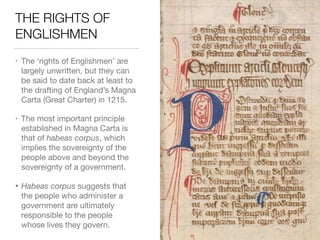
• The ‘rights of Englishmen’ are
largely unwritten, but they can
be said to date back at least to
the drafting of England’s Magna
Carta (Great Charter) in 1215.

• The most important principle
established in Magna Carta is
that of habeas corpus, which
implies the sovereignty of the
people above and beyond the
sovereignty of a government.

• Habeas corpus suggests that
the people who administer a
government are ultimately
responsible to the people
whose lives they govern.
THE RIGHTS OF
ENGLISHMEN
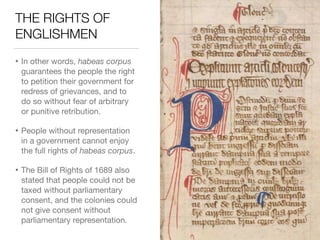
• In other words, habeas corpus
guarantees the people the right
to petition their government for
redress of grievances, and to
do so without fear of arbitrary
or punitive retribution.

• People without representation
in a government cannot enjoy
the full rights of habeas corpus.

• The Bill of Rights of 1689 also
stated that people could not be
taxed without parliamentary
consent, and the colonies could
not give consent without
parliamentary representation.
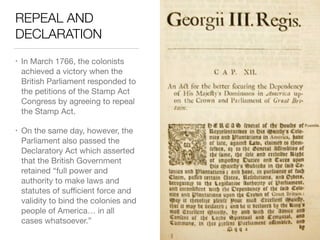
REPEAL AND
DECLARATION
• In March 1766, the colonists
achieved a victory when the
British Parliament responded to
the petitions of the Stamp Act
Congress by agreeing to repeal
the Stamp Act.

• On the same day, however, the
Parliament also passed the
Declaratory Act which asserted
that the British Government
retained “full power and
authority to make laws and
statutes of sufficient force and
validity to bind the colonies and
people of America… in all
cases whatsoever.”
A SURVEY OF
AMERICAN HISTORY
Unit 1: Colonialism and Nationhood

Part 12: Building a Shadow Government

12 Building a Shadow Government

  • 1.
    A SURVEY OF AMERICANHISTORY Unit 1: Colonialism and Nationhood Part 12: Building a Shadow Government
  • 2.
    KING GEORGE III KingGeorge III ascended to the throne in 1760, at age twenty-two, in the midst of the Seven Years War. He was a conservative and somewhat authoritarian king who did not hesitate to involve himself in colonial affairs, unlike his father and predecessor King George II.
  • 3.
    COMMITTEES OF CORRESPONDENCE In 1764,Bostonian merchants and prominent citizens formed an organization known as a Committee of Correspondence. The job of the Committee was to petition the British Government for the repeal of the Sugar Act.
  • 4.
    COMMITTEES OF CORRESPONDENCE Shortly afterwards,other Committees of Correspondence were formed in other colonies, although the act remained in force.
  • 5.
    THE STAMP ACT •In 1765, the British Parliament passed the Stamp Act which created new taxes on almost every kind of printed product. • Like the taxes created by the Sugar Act, the Stamp Act taxes were created explicitly for the purposes of raising revenue to pay the debt from the French and Indian War and to pay the soldiers in the standing army. • The probable consequences of the Stamp Act for the North American economy created an uproar in the colonies.
  • 6.
    PATRICK HENRY • Memberof the Virginia House of Burgesses who led legislative opposition to the Stamp Act. • Drafted the Virginia Resolves, laying out arguments against the Stamp Act, and guided their passage through the House of Burgesses on May 30, 1765. • Claimed that the people of the colonies could be taxed only by their colonial governments. • Argued that taxation rights in Virginia came from the First Charter of Virginia in 1606.
  • 7.
    JAMES OTIS • Ledpublic opposition to the Stamp Act. Building on Patrick Henry’s assertions, Otis claimed that because the colonies had no representation in the British Parliament and the people of the colonies had no means of petitioning their government for a redress of grievances, the Stamp Act was effectively the result of dictatorial governance. • Famously argued against taxation without political representation, decrying it as tantamount to tyranny.
  • 8.
    SAMUEL ADAMS • Beerbrewer and newspaper columnist in Boston. Provoked popular uprisings against the Stamp Act and the authorities responsible for enforcing it. • On August 14, 1765, a mob in Boston hung an effigy of Andrew Oliver, the distributor of stamps for Massachusetts. • This event marked the creation of the Sons of Liberty, an underground organization of resistance to perceived acts of British tyranny. Adams exerted strong influence over them.
  • 9.
    THE STAMP ACTCONGRESS: OCTOBER 7 TO 25, 1765 Delegates from nine of the eighteen colonies in North America met in New York City to agree on a strategy for asking King George III to repeal the Stamp Act. James Otis was one of them. The delegates to the congress were selected by the Committees of Correspondence that had been established in each of the colonies. The Committees thus acted as de facto local governments.
  • 10.
    The congress alarmed observersin Britain. Previous congresses had been assembled to discuss ways of dealing with external threats, but the target of this one was the authority of the British Government. More importantly, since the Committees of Correspondence were often loosely affiliated with the Sons of Liberty, the colonies were effectively united under a shadow government able to create and enforce its own policies. THE STAMP ACT CONGRESS: OCTOBER 7 TO 25, 1765
  • 11.
    DECLARATION OF RIGHTS AND GRIEVANCES Thedelegates to the Stamp Act Congress produced a Declaration of Rights and Grievances to send to King George III. Building on the Virginia Resolves, they argued that the Stamp Act was a violation of the traditional rights of Englishmen.
  • 12.
    THE RIGHTS OF ENGLISHMEN •The ‘rights of Englishmen’ are largely unwritten, but they can be said to date back at least to the drafting of England’s Magna Carta (Great Charter) in 1215. • The most important principle established in Magna Carta is that of habeas corpus, which implies the sovereignty of the people above and beyond the sovereignty of a government. • Habeas corpus suggests that the people who administer a government are ultimately responsible to the people whose lives they govern.
  • 13.
    THE RIGHTS OF ENGLISHMEN •In other words, habeas corpus guarantees the people the right to petition their government for redress of grievances, and to do so without fear of arbitrary or punitive retribution. • People without representation in a government cannot enjoy the full rights of habeas corpus. • The Bill of Rights of 1689 also stated that people could not be taxed without parliamentary consent, and the colonies could not give consent without parliamentary representation.
  • 14.
    REPEAL AND DECLARATION • InMarch 1766, the colonists achieved a victory when the British Parliament responded to the petitions of the Stamp Act Congress by agreeing to repeal the Stamp Act. • On the same day, however, the Parliament also passed the Declaratory Act which asserted that the British Government retained “full power and authority to make laws and statutes of sufficient force and validity to bind the colonies and people of America… in all cases whatsoever.”
  • 15.
    A SURVEY OF AMERICANHISTORY Unit 1: Colonialism and Nationhood Part 12: Building a Shadow Government