For CBSE as well GSEB Board
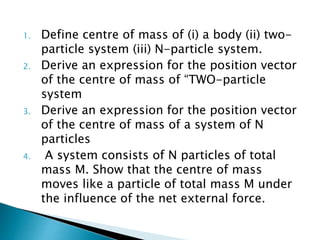
1. Define centre of mass of (i) a body (ii) two-
particle system (iii) N-particle system.
2. Derive an expression for the position vector
of the centre of mass of “TWO-particle
system
3. Derive an expression for the position vector
of the centre of mass of a system of N
particles
4. A system consists of N particles of total
mass M. Show that the centre of mass
moves like a particle of total mass M under
the influence of the net external force.
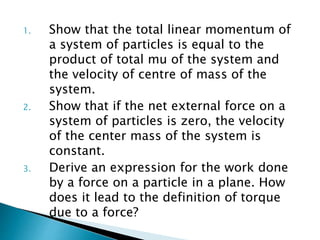
1. Show that the total linear momentum of
a system of particles is equal to the
product of total mu of the system and
the velocity of centre of mass of the
system.
2. Show that if the net external force on a
system of particles is zero, the velocity
of the center mass of the system is
constant.
3. Derive an expression for the work done
by a force on a particle in a plane. How
does it lead to the definition of torque
due to a force?
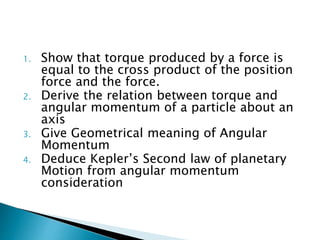
1. Show that torque produced by a force is
equal to the cross product of the position
force and the force.
2. Derive the relation between torque and
angular momentum of a particle about an
axis
3. Give Geometrical meaning of Angular
Momentum
4. Deduce Kepler’s Second law of planetary
Motion from angular momentum
consideration
1. Define and explain moment of inertia of a
body about an axis of rotation.
2. What is radius of gyration of a body? What is
its significance?
3. State and prove theorem of parallel axes.
4. State and prove theorem of perpendicular
axes.
5. Derive an expression for the moment of
inertia of a uniform thin rod about an axis
through its centre and perpendicular to its
length.
1. Derive an expression for the moment of
inertia of a uniform ring about an axis
passing through the centre of the ring and
perpendicular to the plane of the ring.
2. Derive an expression for the moment of
inertia of a uniform disc about an axis
through the centre of the disc and
perpendicular to the plane of the disc.
3. Obtain an expression for the kinetic
energy of a rotating body
1. Derive the relation between angular
momentum and moment of inertia of a body
about the axis of rotation.
2. Prove the relation τ = lα where the symbols
have their usual meanings.
3. State and explain principle of conservation
of angular momentum. Give two practical
examples.

11th science physics chapter 7

  • 1.
    For CBSE aswell GSEB Board
  • 2.
    1. Define centreof mass of (i) a body (ii) two- particle system (iii) N-particle system. 2. Derive an expression for the position vector of the centre of mass of “TWO-particle system 3. Derive an expression for the position vector of the centre of mass of a system of N particles 4. A system consists of N particles of total mass M. Show that the centre of mass moves like a particle of total mass M under the influence of the net external force.
  • 3.
    1. Show thatthe total linear momentum of a system of particles is equal to the product of total mu of the system and the velocity of centre of mass of the system. 2. Show that if the net external force on a system of particles is zero, the velocity of the center mass of the system is constant. 3. Derive an expression for the work done by a force on a particle in a plane. How does it lead to the definition of torque due to a force?
  • 4.
    1. Show thattorque produced by a force is equal to the cross product of the position force and the force. 2. Derive the relation between torque and angular momentum of a particle about an axis 3. Give Geometrical meaning of Angular Momentum 4. Deduce Kepler’s Second law of planetary Motion from angular momentum consideration
  • 5.
    1. Define andexplain moment of inertia of a body about an axis of rotation. 2. What is radius of gyration of a body? What is its significance? 3. State and prove theorem of parallel axes. 4. State and prove theorem of perpendicular axes. 5. Derive an expression for the moment of inertia of a uniform thin rod about an axis through its centre and perpendicular to its length.
  • 6.
    1. Derive anexpression for the moment of inertia of a uniform ring about an axis passing through the centre of the ring and perpendicular to the plane of the ring. 2. Derive an expression for the moment of inertia of a uniform disc about an axis through the centre of the disc and perpendicular to the plane of the disc. 3. Obtain an expression for the kinetic energy of a rotating body
  • 7.
    1. Derive therelation between angular momentum and moment of inertia of a body about the axis of rotation. 2. Prove the relation τ = lα where the symbols have their usual meanings. 3. State and explain principle of conservation of angular momentum. Give two practical examples.