PRIMARY HEALTH CARE
(PHC)
Objectives
• At the end of this chapter, the student will able
to
• Describe the historical development of PHC.
• Identify the philosophy, principles, components
and strategies of PHC.
• Analyze the situation in the Ethiopian context.
Definition
• The international conference on PHC, held At ALMA-ATA
in 1978 defines as :
• PHC is Essential Health Care based on practical,
scientifically sound, socially acceptable methods and
technology made universally accessible to individual and
families in the community through their full participation
• At a cost that the community and country can afford to
maintain at every stage of their development in the spirit
of self reliance and self determination.
Cont….
• It forms an integral part of both the country's
health system, and main focus overall social and
economic development of the community.
• It forms the first level of contact of individual,
the family and the community with the national
health system.
• It brining health care as close as possible to
where people live.
HISTORICAL DEVELOPMENT
• WHO which was established in 1948, has always
had as a major objective the attainment by all
people of the highest possible level of health.
• However due to political and socio-economic
factors ,between 1948 and 1978 WHO not meet
the stated objective.
Cont….
• In the 1950s the vertical health service strategy was implemented.( which
included mass campaigns and specialised disease control programmes for
selected communicable diseases).
such as control of malaria, tuberculosis and venereal diseases.
• However the delivery of vertical programmes was found to be expensive
and unsuccessful.
• Later in the mid 1950s the concept/strategy of Basic health Service came
into being.
• This approach gave more attention to rural areas through construction of
health centres and health station providing both preventive and curative
care.
Cont…..
• In the early 1970sintegration of the specialised disease control
programmes with the basic health services was emphasised.
• All these approaches were disease oriented based on high cost
• Health institutions requiring advanced technology to solve the
health needs of the people. thus ultimately failed to reach the
desired goal.
• Specially in developing countries where their health problems
required emphasising health promotion and preventive care.
PHC PRINCIPLES
– Inter-sectoral collaboration
– Community participation
– Appropriate technology
– Equity
– Focus on prevention and health promotion
– Decentralization
Inter-sectoral Collaboration
• It means a joint concern and responsibility of
sectors responsible for development in
identifying problems
• All those sectors involved in the development
process such as Health, Agriculture, Education,
Information, transport and communication and
NGOs.
Community Involvement
• Communities should not be passive recipients of
services.
• Every body should be involved according to his/her
ability
• The communities should be actively involved
– In the assessment of the situation
– Problem identification
– Priority setting and making decisions
– Sharing responsibility in the planning, implementing,
monitoring and evaluation.
Appropriate Technology
• Take account of both the health care needs and the
socio-economic context of a country.
• This must include consideration of:-
– Costs (both capital and recurrent). Appropriate
technology does not necessarily mean low cost.
– Efficiency and effectiveness in dealing with health
problems.
– The sustainability including the capacity to maintain
equipment.
Criteria for Appropriateness
• To be appropriate, a technology must be:-
– Effective - it must work & fulfil its purpose in which it
needs to be .
– Culturally acceptable and valuable.
– Affordable i.e. cost effective.
– Locally Sustainable.:-We should not be over dependent
on imported,.
– Environmentally accountable.
– Measurable:-The impact and performance of any
technology need proper and continuing evaluation
Equity
• Universal coverage of the population with care
provided according to need is the call for equity.
• If all cannot be served, those most in need
should have priority.
• Possible definition of equity include:-
– Equal health
– Equal access to health care
– Equal utilization of health care
– Equal access to health care according to need
– Equal utilization of health care according to need
Cont….
• Focus on Prevention and Promotive
Decentralization:-After the Alma-Ata conference, a
sixth theme has emerged, that of decentralization,
• reflecting the two key principles ;- community
participation and multisectorialism
PHILOSOPHY of PHC
1. Equity and Justice -equitable distribution of
services, resources and health care.
– Effective PHC makes an important contribution to
greater social justice and equity by reducing the gap
between the "have's and the "have not's
2. Individual and community self-reliance -personal
responsibility for their own and their families
health.
3. Inter-relationship of health and development.
STRATEGY of PHC
1. Change In the Health Care System
– Total coverage with essential health care
– Integrated systems
– Involvement of communities
– Use and control of resources
– Redistribution of existing resources
– Reorientation of human resources
– Legislative changes
– Design, Planning & management of health system
2 Individual and Collective Responsibility for Health
• First aspect- is a political issue:-Decentralization
of decision-making.
• Second aspect:- self-realization personal
responsibility for their own and their families’
health.
• For both aspects it is important to have Informed
and motivated public
3 Inter-sectoral Action for Health Practical Action
• Attention of over all economic development.
• More consciously and directly towards the
maximization of health
• Sharpening awareness:-At the community
level, District, Regional etc
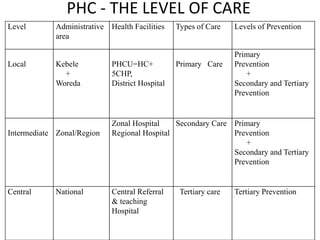
PHC - THE LEVEL OF CARE
Level Administrative
area
Health Facilities Types of Care Levels of Prevention
Local Kebele
+
Woreda
PHCU=HC+
5CHP,
District Hospital
Primary Care
Primary
Prevention
+
Secondary and Tertiary
Prevention
Intermediate Zonal/Region
Zonal Hospital
Regional Hospital
Secondary Care Primary
Prevention
+
Secondary and Tertiary
Prevention
Central National Central Referral
& teaching
Hospital
Tertiary care Tertiary Prevention
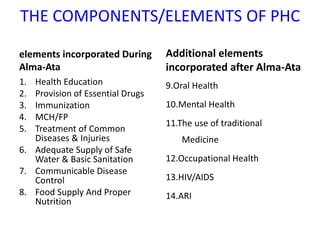
THE COMPONENTS/ELEMENTS OF PHC
elements incorporated During
Alma-Ata
1. Health Education
2. Provision of Essential Drugs
3. Immunization
4. MCH/FP
5. Treatment of Common
Diseases & Injuries
6. Adequate Supply of Safe
Water & Basic Sanitation
7. Communicable Disease
Control
8. Food Supply And Proper
Nutrition
Additional elements
incorporated after Alma-Ata
9.Oral Health
10.Mental Health
11.The use of traditional
Medicine
12.Occupational Health
13.HIV/AIDS
14.ARI
PHC IN ETHIOPIA
• PHC activities in Ethiopia, which formally began
in 1980s, include the following
– Education on the existing health problems and
methods of preventing and controlling them.
– Locally endemic diseases prevention and control.
– Expanded program on Immunization
– Maternal and child health including family planning
– Essential drugs provision
– Nutrition promotion of food supply
– Treatment of common diseases and injuries
– Sanitation and safe water supply
Cont….
• Since 1980 PHC has been the main strategy on which
the health policy has been based.
• The 1985 review of PHC revealed the following
achievements.
– Expansion of health services to the broad masses
especially by establishing new health station and health
posts.
– Expansion of Immunization programmes against six major
communicable disease.
– Increasing number of medical and paramedical personnel.
– Increased health propaganda attempts to improve health
consciousness of the population.
– Established PHC committees at the lowest local
administrative level.
Cont….
• The health policy which was established in 1976 by the
ministry of health includes
– Emphasis on disease prevention
– Priority to rural health service
– Promotion of self reliance and community involvement
• The health policy has been further consolidated by the
adoption of PHC as a strategy.
• Failures to implement these policies due to several factors
(including low government attention and support to the health
sector.
• The transitional government of Ethiopia also
further strengthened PHC strategy for delivery of
health services by giving due emphasis to the
development of preventive and promotive
component of health care and by strengthening
inter-sectoral activities.
Major problems in the implementation of PHC in Ethiopia
– Absence of infrastructure at the district level.
– Difficulty in achieving inter-sectoral collaboration.
– Inadequate health service coverage and mal-
distribution for available health services.
– Inadequate resource allocation.
– PHC is not as cheap as some people think.
– Absence of clear guidelines or directives on how to
implement PHC.
– PHC is a very wide concept, subjects needs various
interpretations &specific guidelines.
– Presence of culturally dictated harmful traditional
practices.
APPROACHES IN PRIMARY HEALTH CARE
• Countries and individual interpreted PHC
according to their perceptions, and variations
were marked in their approaches.
• In 1979/80 two distinct approaches in PHC
implementation were grounds .
• The two main approaches are
– Comprehensive PHC (cPHC)
– Selective PHC (sPHC)
Cont….
• The selective PHC approach states "with the limited
human and financial resources” available, to be
most effective, health services should be directed
toward controlling those diseases producing the
largest number of deaths and disability
• And care should be made accessible to the greater
number, using criteria of prevalence, morbidity or
severity and disability, risk of mortality and
feasibility of control, including relative efficacy and
cost of intervention.“
Cont…
• SPHC views health as the absence of disease.
• It measures achievements in terms of reducing
those diseases which are the most harmful and
also are the most feasible to control
Cont…
• The low cost strategy of SPHC is to treat and
prevent few selected diseases which have great
impact to mortality: GOBI -FF
– G = Growth monitoring through the use of growth
charts for promotion of
– child health and nutrition
– O= Oral rehydration
– B= Breast feeding
– I = Immunization
– F= Female education
– F= Family planning
Advantage of sPHC approach
–Decision making is easier
–Results are achieved faster
–It gives more satisfaction
Cont….
• Disadvantages of the sPHC approach
– Limited scope of activities
– it is disease oriented. (treats who are sick)
– doesn't address the general health problems of the
community
– It doesn't address priorities of the community
– It doesn't made self-reliance i.e it causes the patient
to be dependent on the doctor, rather than capabling
the community to look after themselves.
– It doesn't recognize contribution and co-operation by
other sectors
Cont….
• The cPHC on the other hand focus on a positive state
of well being i.e. a more holistic approach.
• Advantage of the cPHC approach
– It looks at health holistically
– The approach is development oriented and sees health as
part of the development
– It involves people and leads to empowerment
– It promotes equity
– It advocates multi-sectoral collaborations
– It deals with priorities of the community
Cont…
• Disadvantages of the cPHC approach
– it is expensive initially to set up an infrastructure
– It requires conscious planning
– Results are gradual
– It is a long process
– It is a complex process
thanks

11 PRIMARY HEALTH CARE (PHC).pptx

  • 1.
  • 2.
    Objectives • At theend of this chapter, the student will able to • Describe the historical development of PHC. • Identify the philosophy, principles, components and strategies of PHC. • Analyze the situation in the Ethiopian context.
  • 3.
    Definition • The internationalconference on PHC, held At ALMA-ATA in 1978 defines as : • PHC is Essential Health Care based on practical, scientifically sound, socially acceptable methods and technology made universally accessible to individual and families in the community through their full participation • At a cost that the community and country can afford to maintain at every stage of their development in the spirit of self reliance and self determination.
  • 4.
    Cont…. • It formsan integral part of both the country's health system, and main focus overall social and economic development of the community. • It forms the first level of contact of individual, the family and the community with the national health system. • It brining health care as close as possible to where people live.
  • 5.
    HISTORICAL DEVELOPMENT • WHOwhich was established in 1948, has always had as a major objective the attainment by all people of the highest possible level of health. • However due to political and socio-economic factors ,between 1948 and 1978 WHO not meet the stated objective.
  • 6.
    Cont…. • In the1950s the vertical health service strategy was implemented.( which included mass campaigns and specialised disease control programmes for selected communicable diseases). such as control of malaria, tuberculosis and venereal diseases. • However the delivery of vertical programmes was found to be expensive and unsuccessful. • Later in the mid 1950s the concept/strategy of Basic health Service came into being. • This approach gave more attention to rural areas through construction of health centres and health station providing both preventive and curative care.
  • 7.
    Cont….. • In theearly 1970sintegration of the specialised disease control programmes with the basic health services was emphasised. • All these approaches were disease oriented based on high cost • Health institutions requiring advanced technology to solve the health needs of the people. thus ultimately failed to reach the desired goal. • Specially in developing countries where their health problems required emphasising health promotion and preventive care.
  • 8.
    PHC PRINCIPLES – Inter-sectoralcollaboration – Community participation – Appropriate technology – Equity – Focus on prevention and health promotion – Decentralization
  • 9.
    Inter-sectoral Collaboration • Itmeans a joint concern and responsibility of sectors responsible for development in identifying problems • All those sectors involved in the development process such as Health, Agriculture, Education, Information, transport and communication and NGOs.
  • 10.
    Community Involvement • Communitiesshould not be passive recipients of services. • Every body should be involved according to his/her ability • The communities should be actively involved – In the assessment of the situation – Problem identification – Priority setting and making decisions – Sharing responsibility in the planning, implementing, monitoring and evaluation.
  • 11.
    Appropriate Technology • Takeaccount of both the health care needs and the socio-economic context of a country. • This must include consideration of:- – Costs (both capital and recurrent). Appropriate technology does not necessarily mean low cost. – Efficiency and effectiveness in dealing with health problems. – The sustainability including the capacity to maintain equipment.
  • 12.
    Criteria for Appropriateness •To be appropriate, a technology must be:- – Effective - it must work & fulfil its purpose in which it needs to be . – Culturally acceptable and valuable. – Affordable i.e. cost effective. – Locally Sustainable.:-We should not be over dependent on imported,. – Environmentally accountable. – Measurable:-The impact and performance of any technology need proper and continuing evaluation
  • 13.
    Equity • Universal coverageof the population with care provided according to need is the call for equity. • If all cannot be served, those most in need should have priority. • Possible definition of equity include:- – Equal health – Equal access to health care – Equal utilization of health care – Equal access to health care according to need – Equal utilization of health care according to need
  • 14.
    Cont…. • Focus onPrevention and Promotive Decentralization:-After the Alma-Ata conference, a sixth theme has emerged, that of decentralization, • reflecting the two key principles ;- community participation and multisectorialism
  • 15.
    PHILOSOPHY of PHC 1.Equity and Justice -equitable distribution of services, resources and health care. – Effective PHC makes an important contribution to greater social justice and equity by reducing the gap between the "have's and the "have not's 2. Individual and community self-reliance -personal responsibility for their own and their families health. 3. Inter-relationship of health and development.
  • 16.
    STRATEGY of PHC 1.Change In the Health Care System – Total coverage with essential health care – Integrated systems – Involvement of communities – Use and control of resources – Redistribution of existing resources – Reorientation of human resources – Legislative changes – Design, Planning & management of health system
  • 17.
    2 Individual andCollective Responsibility for Health • First aspect- is a political issue:-Decentralization of decision-making. • Second aspect:- self-realization personal responsibility for their own and their families’ health. • For both aspects it is important to have Informed and motivated public
  • 18.
    3 Inter-sectoral Actionfor Health Practical Action • Attention of over all economic development. • More consciously and directly towards the maximization of health • Sharpening awareness:-At the community level, District, Regional etc
  • 19.
    PHC - THELEVEL OF CARE Level Administrative area Health Facilities Types of Care Levels of Prevention Local Kebele + Woreda PHCU=HC+ 5CHP, District Hospital Primary Care Primary Prevention + Secondary and Tertiary Prevention Intermediate Zonal/Region Zonal Hospital Regional Hospital Secondary Care Primary Prevention + Secondary and Tertiary Prevention Central National Central Referral & teaching Hospital Tertiary care Tertiary Prevention
  • 20.
    THE COMPONENTS/ELEMENTS OFPHC elements incorporated During Alma-Ata 1. Health Education 2. Provision of Essential Drugs 3. Immunization 4. MCH/FP 5. Treatment of Common Diseases & Injuries 6. Adequate Supply of Safe Water & Basic Sanitation 7. Communicable Disease Control 8. Food Supply And Proper Nutrition Additional elements incorporated after Alma-Ata 9.Oral Health 10.Mental Health 11.The use of traditional Medicine 12.Occupational Health 13.HIV/AIDS 14.ARI
  • 21.
    PHC IN ETHIOPIA •PHC activities in Ethiopia, which formally began in 1980s, include the following – Education on the existing health problems and methods of preventing and controlling them. – Locally endemic diseases prevention and control. – Expanded program on Immunization – Maternal and child health including family planning – Essential drugs provision – Nutrition promotion of food supply – Treatment of common diseases and injuries – Sanitation and safe water supply
  • 22.
    Cont…. • Since 1980PHC has been the main strategy on which the health policy has been based. • The 1985 review of PHC revealed the following achievements. – Expansion of health services to the broad masses especially by establishing new health station and health posts. – Expansion of Immunization programmes against six major communicable disease. – Increasing number of medical and paramedical personnel. – Increased health propaganda attempts to improve health consciousness of the population. – Established PHC committees at the lowest local administrative level.
  • 23.
    Cont…. • The healthpolicy which was established in 1976 by the ministry of health includes – Emphasis on disease prevention – Priority to rural health service – Promotion of self reliance and community involvement • The health policy has been further consolidated by the adoption of PHC as a strategy. • Failures to implement these policies due to several factors (including low government attention and support to the health sector.
  • 24.
    • The transitionalgovernment of Ethiopia also further strengthened PHC strategy for delivery of health services by giving due emphasis to the development of preventive and promotive component of health care and by strengthening inter-sectoral activities.
  • 25.
    Major problems inthe implementation of PHC in Ethiopia – Absence of infrastructure at the district level. – Difficulty in achieving inter-sectoral collaboration. – Inadequate health service coverage and mal- distribution for available health services. – Inadequate resource allocation. – PHC is not as cheap as some people think. – Absence of clear guidelines or directives on how to implement PHC. – PHC is a very wide concept, subjects needs various interpretations &specific guidelines. – Presence of culturally dictated harmful traditional practices.
  • 26.
    APPROACHES IN PRIMARYHEALTH CARE • Countries and individual interpreted PHC according to their perceptions, and variations were marked in their approaches. • In 1979/80 two distinct approaches in PHC implementation were grounds . • The two main approaches are – Comprehensive PHC (cPHC) – Selective PHC (sPHC)
  • 27.
    Cont…. • The selectivePHC approach states "with the limited human and financial resources” available, to be most effective, health services should be directed toward controlling those diseases producing the largest number of deaths and disability • And care should be made accessible to the greater number, using criteria of prevalence, morbidity or severity and disability, risk of mortality and feasibility of control, including relative efficacy and cost of intervention.“
  • 28.
    Cont… • SPHC viewshealth as the absence of disease. • It measures achievements in terms of reducing those diseases which are the most harmful and also are the most feasible to control
  • 29.
    Cont… • The lowcost strategy of SPHC is to treat and prevent few selected diseases which have great impact to mortality: GOBI -FF – G = Growth monitoring through the use of growth charts for promotion of – child health and nutrition – O= Oral rehydration – B= Breast feeding – I = Immunization – F= Female education – F= Family planning
  • 30.
    Advantage of sPHCapproach –Decision making is easier –Results are achieved faster –It gives more satisfaction
  • 31.
    Cont…. • Disadvantages ofthe sPHC approach – Limited scope of activities – it is disease oriented. (treats who are sick) – doesn't address the general health problems of the community – It doesn't address priorities of the community – It doesn't made self-reliance i.e it causes the patient to be dependent on the doctor, rather than capabling the community to look after themselves. – It doesn't recognize contribution and co-operation by other sectors
  • 32.
    Cont…. • The cPHCon the other hand focus on a positive state of well being i.e. a more holistic approach. • Advantage of the cPHC approach – It looks at health holistically – The approach is development oriented and sees health as part of the development – It involves people and leads to empowerment – It promotes equity – It advocates multi-sectoral collaborations – It deals with priorities of the community
  • 33.
    Cont… • Disadvantages ofthe cPHC approach – it is expensive initially to set up an infrastructure – It requires conscious planning – Results are gradual – It is a long process – It is a complex process
  • 34.