Primary Health Care
Introduction
• Health has been declared as a fundamental human
right.
• Hence, the governments all over the world strive to
expand and improve their healthcare services.
• What is Health Care …?! These are the services
provided to individuals or communities by agents of
the health services or professions, for the purpose of
promoting, maintaining, monitoring or restoring health.
• ‘HEALTH CARE IMPLIES MORE THAN MEDICAL CARE’
LEVELS OF HEALTH CARE
PRIMARY HEALTH CARE
• It’s the first level of contact between the
recipient of care and health care delivery system.
• Majority of the problems are dealt at this level.
• primary health care service is provided by
primary health centres and their subcentres .
• In urban areas, the services are given by maternal
child health and family welfare centres , and
dispensaries.
SECONDARY LEVEL HEALTH CARE
• At this level, more complex problems are
taken care which require secondary level of
preventive services and curative services.
• These services are provided at district
hospitals and community health centres.
• The cases which cannot be handled at PHC
are referred over here .
TERTIARY LEVEL HEALTH CARE
• This level of health care is provided at the
state/regional/central level institutions. E.g.
Medical College Hospitals, Regional Hospitals.
• It is more specialized level, requires specific
facilities and attention of highly specialized health
workers.
• These institutions serve as referral units for
primary and secondary levels.
• They also serve as teaching institution for
education and training of various categories of
health care professionals.
Definition
• PHC :
• “Essential health care based on practical,
scientifically sound and socially acceptable
methods and technology made universally
accessible to individuals and families in the
community through their full participation and at
a cost that the community and the country can
afford to maintain at every stage of their
development in the spirit of self-determination.
Concept of phc
• The concept of primary health care came into existence
on September 12, 1978, following a Joint WHO-UNICEF
International Conference at Alma-Ata (USSR).
• Earlier synonyms: “basic health services”, “first contact
care”, “easily accessible care”, ”services provided by
generalists”.
• •The services provided are:
1. Simple and efficient with regard to cost, techniques,
and organization.
2. Readily accessible to those concerned and contributes
to improving the living conditions.
• It is the first level of contact of individuals and
the family with the national health system
bringing health care as close as possible to
where people live and work and establishes
the first element of a continuing care process.
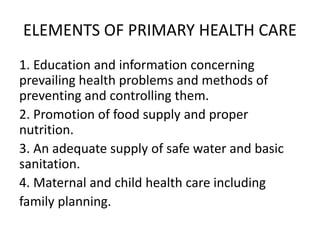
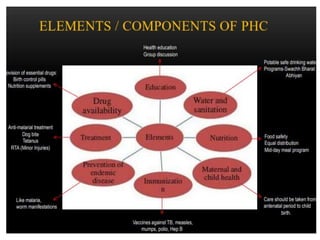
ELEMENTS OF PRIMARY HEALTH CARE
1. Education and information concerning
prevailing health problems and methods of
preventing and controlling them.
2. Promotion of food supply and proper
nutrition.
3. An adequate supply of safe water and basic
sanitation.
4. Maternal and child health care including
family planning.
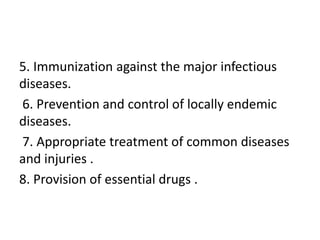
5. Immunization against the major infectious
diseases.
6. Prevention and control of locally endemic
diseases.
7. Appropriate treatment of common diseases
and injuries .
8. Provision of essential drugs .
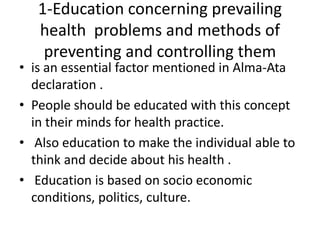
1-Education concerning prevailing
health problems and methods of
preventing and controlling them
• is an essential factor mentioned in Alma-Ata
declaration .
• People should be educated with this concept
in their minds for health practice.
• Also education to make the individual able to
think and decide about his health .
• Education is based on socio economic
conditions, politics, culture.
2-Promotion of food supply and
proper
nutrition
• Why there is importance is given to nutrition?
• Nutrition is a basic factor influencing the
quality of human life.
• Under nutrition is still one of the greatest
health hazards.
• Child and maternal malnutrition is
widespread.
• Community health workers should be
responsible: for
A. the promotion of better nutrition.
B. Correction of faulty feeding practices and
prevention of infectious diseases which are
nutrition related e.g., diarrhea.
3-An adequate supply of safe water and
basic sanitation
• the foremost (principle) in primary health care is: Safe, adequate
and accessible supplies of water together with proper sanitation.
• What is the main objectives of this PHC elements? And by what?
1. to prevent diseases and
2. improve the quality of life and well-being of population
By:
1. promoting personal and community hygiene, ensuring the
availability of safe water supply and sanitation facilities through
independent community action and
2. also by associating water supply and sanitation with
other health and / or development programs.
4-Maternal and child health care including
family
planning
• aims at:
• promoting and protecting the health of children
and women of childbearing age,
• Why:
1. so that all children have the possibility for
healthy growth and development .
2. 2. and so that the reproductive life of women is
compatible with a state of health and well being.
• MCH/FP care includes at least five main
functions:
1. Antenatal care
2. Delivery care
3. Postnatal care
4. Child care
5. family planning care
5-Immunization against the major
infectious diseases
• What does immunization program is initiated? And by what?
And How?
• reduce morbidity and mortality by providing immunization
against the major killers of children.
• When does immunization is given?
• In addition children are protected in the first year of life. Also
tetanus immunization is given
for pregnant mothers
For which diseases does developing
world gave priority?
• is usually given to the following diseases.
• a) Diphtheria
• b) Whooping cough
• c) Tetanus
• d)Measles and Rubella
• e) Poliomyelitis
• f) Tuberculosis
• g) Hepatitis B
• h) Mumps
• i) Pneumococcal.
6-Prevention and control of locally
endemic
diseases
• Ex : Malaria
• Strategies applied were: vector control,
mainly larviciding, and early case detection
and prompt radical treatment.
7- Appropriate treatment of common
diseases and injuries
A. Diarrheal diseases
• Prevention of diarrheal morbidity and mortality is
a vital part of national strategies of PHC.
• Diarrheal disease control itself includes three
main functions (objectives) namely:
a. Diagnosis of diarrheal disease
b. Provision of appropriate treatment (plan A, plan
B, plan C)
c. Management of outbreaks of diarrheal diseases
and its prevention
• How to achieve these objectives?
• In order to achieve the above objectives
support is required in terms of appropriate
information, appropriate technologies,
equipment and supplies, improved
communication, supervision and technical
support.
B. Common Accidents in the home:
• Accidents are among the highest causes of death in most
countries.
• The aim therefore must be:
1. not only to provide first aid on the spot and adequate
treatment at the appropriate level of care, but
2. also to prevent the occurrence of similar accidents in the
future and
3. provide programs for active rehabilitation of disabled
persons, children as well as adults.
• Three types of home accidents have been chosen as
• examples, namely;
a) Cuts b) Burns & Scalds c) Poisoning
8-Provision of essential
drugs
• aims at making these drugs available to all over
the country at all times.
• How to make drugs available to all over the
country at all times?
• by instituting an efficient system of drug
acquisition , storage, distribution, and utilization.
• To achieve this, all persons concerned with
primary health care should participate actively
in the management of drugs at their own level.
• How to make drugs available to all over the
country at all times?
• Is there any relation between availability of
drugs at one center and in any other center in
the county?
• Yes, Drug management in primary health care
is an integral part of the overall drug
management plan for a country wide health
system.
PRINCIPLES OF PHC
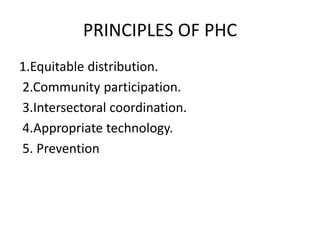
1.Equitable distribution.
2.Community participation.
3.Intersectoral coordination.
4.Appropriate technology.
5. Prevention
PRINCIPLES OF PHC
1. EQUITABLE DISTRIBUTION
• It means that health care services must be shared equally by all
people irrespective of their ability to pay, and all must have access to it
(be it rich/poor, urban/rural).
• ‘Social Injustice’: At present, health services are mainly
concentrated in major towns and cities resulting in inequality of
care to the people in rural areas and urban slums.
• This failure is due to inaccessibility.
• Thus, PHC aims to redress this imbalance by shifting the centre of
gravity of health care system from cities (where 3/4th health
budget is spent) to the rural areas ( where 3/4th of the population
• lives)
• 2. COMMUNITY PARTICIPATION
• Essential ingredient of PHC – involvement of individuals, families
and communities in promotion of their own health and welfare.
• In India, this has been tried successfully using village health guides
and trained dais.
• They provide primary health care by overcoming cultural and
communication barriers, in ways that are acceptable to community.
• This was greatly influenced by experience in China where
community participation was in the form of bare-foot doctors.
• 3. INTERSECTORAL COORDINATION
• It is necessary to coordinate with other sectors for
achieving goals because no sector can achieve its
goals in isolation.
• An important element of intersectoral approach is
planning – planning with other sectors to avoid
unnecessary duplication of activities..
• This requires a strong political will.
• 4. APPROPRIATE TECHNOLOGY
• It implies the use of appropriate methods,
techniques and equipments which are
scientifically sound and simple, and adaptable
to local needs.
• E.g. Neem stick and mango leaf for tooth
brushing are effective when used in a proper
way.
• 5. FOCUS ON PREVENTION
• Health services should not be only curative
but should also promote health and healthy
lifestyles with emphasis on prevention.
1-Primary Health Care.pdf 1-Primary Health Care.pdf