The Architecture of the
Next Generation DNS
Server: BIND 10
Shane Kerr
shane@isc.org
DNS? BIND?
• DNS: convert names into numbers
– www.isc.org → 149.20.64.42
– www.isc.org → 2001:4f8:0:2::d
• BIND: DNS server software
– Runs on about 80% of DNS servers
BIND 9. BIND 10!
• BIND 9: current version of BIND
– 9.0.0 released in 2000-09-16
– Now at 9.7.2-P2
• BIND 10: next version of BIND
– 5 year project to re-implement BIND
– Currently in year 2
– Sponsored development
Today's Topic:
Architecture
'To date there is still no agreement on
the precise definition of the term
“software architecture”.'
– Wikipedia article on
“Software architecture”
Today's Topic:
Architecture... Defined!
'I know it when I see it.'
- Potter Stewart,
United States Supreme Court
Goals that Affect
Architecture I
• Customization “out-of-the-box”
– authoritative-only, recursive-only
– slave-only, master-only
– enable/disable dynamic DNS
– support favorite SQL backend
• Customization via code changes
– non-ISC modules, or modifications
– bespoke or in-house development
Goals that Affect
Architecture II
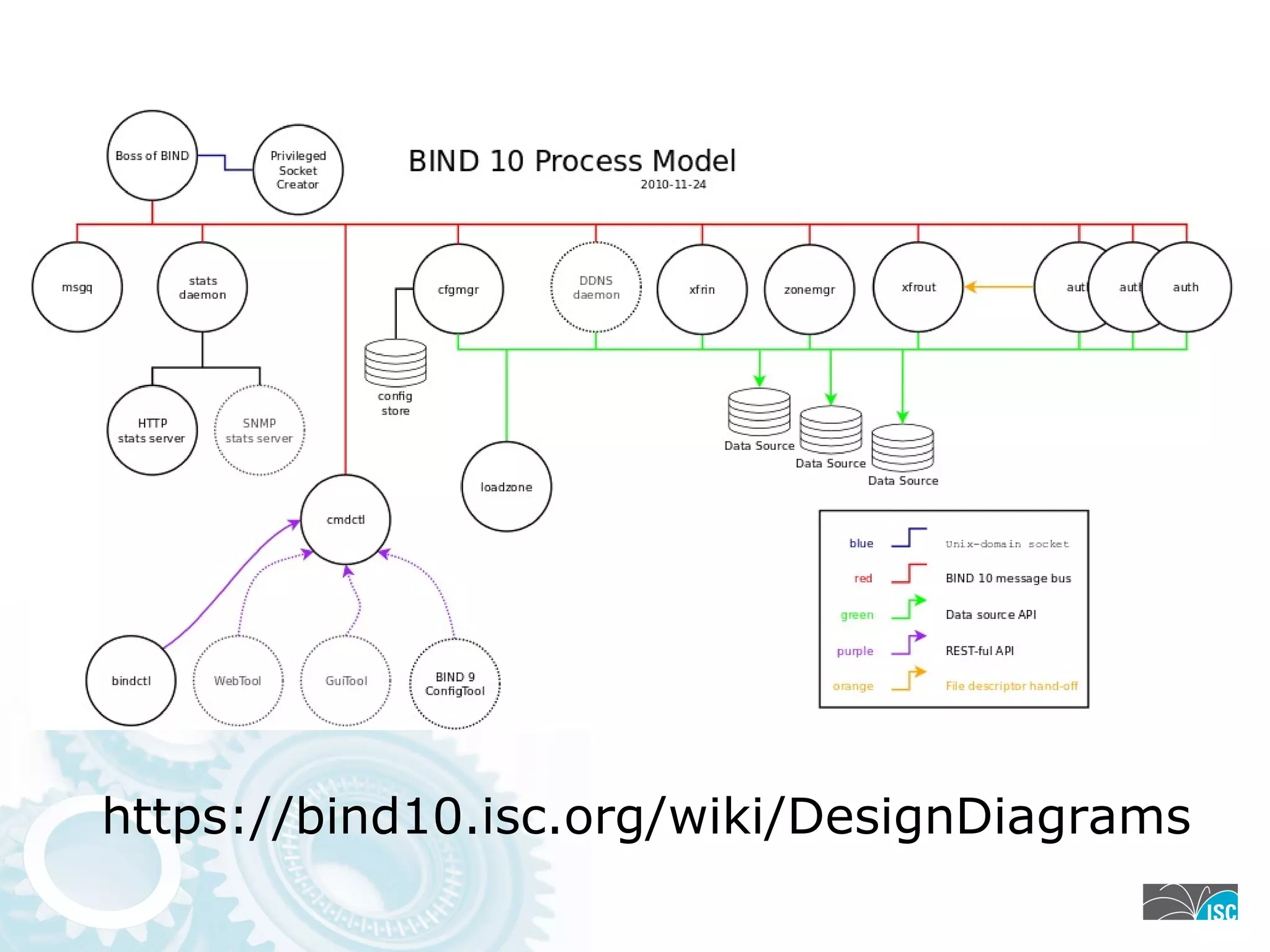
• Scalability
– BIND 8: single core (“CPU” then)
– BIND 9: multiple cores (4-6 or so)
– BIND 10: 10's or 100's of cores,
multiple machines (clustered)
• Robustness
– Reduce serious software bugs
– Minimize impact of bugs
– Reduce “fate sharing”
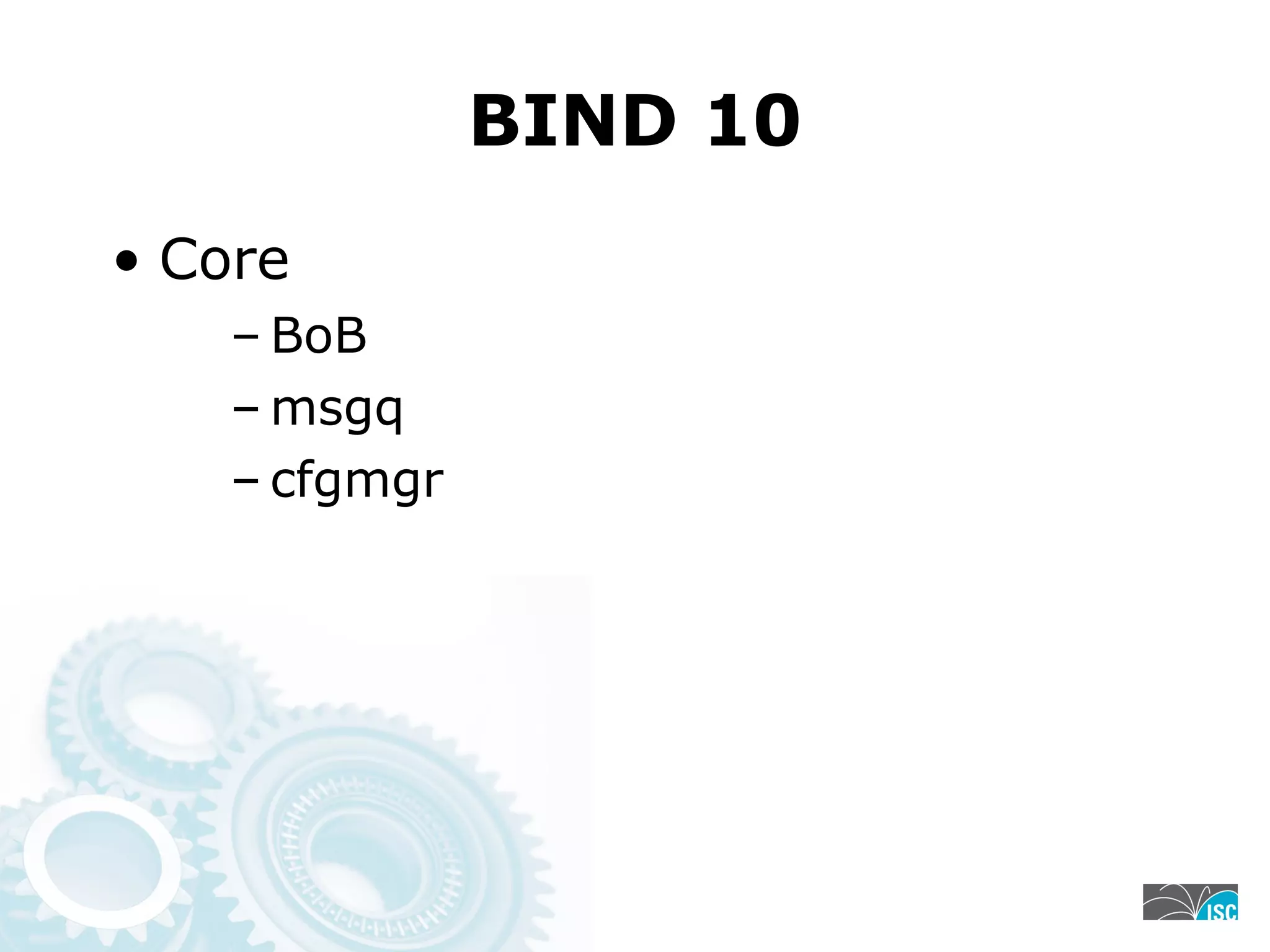
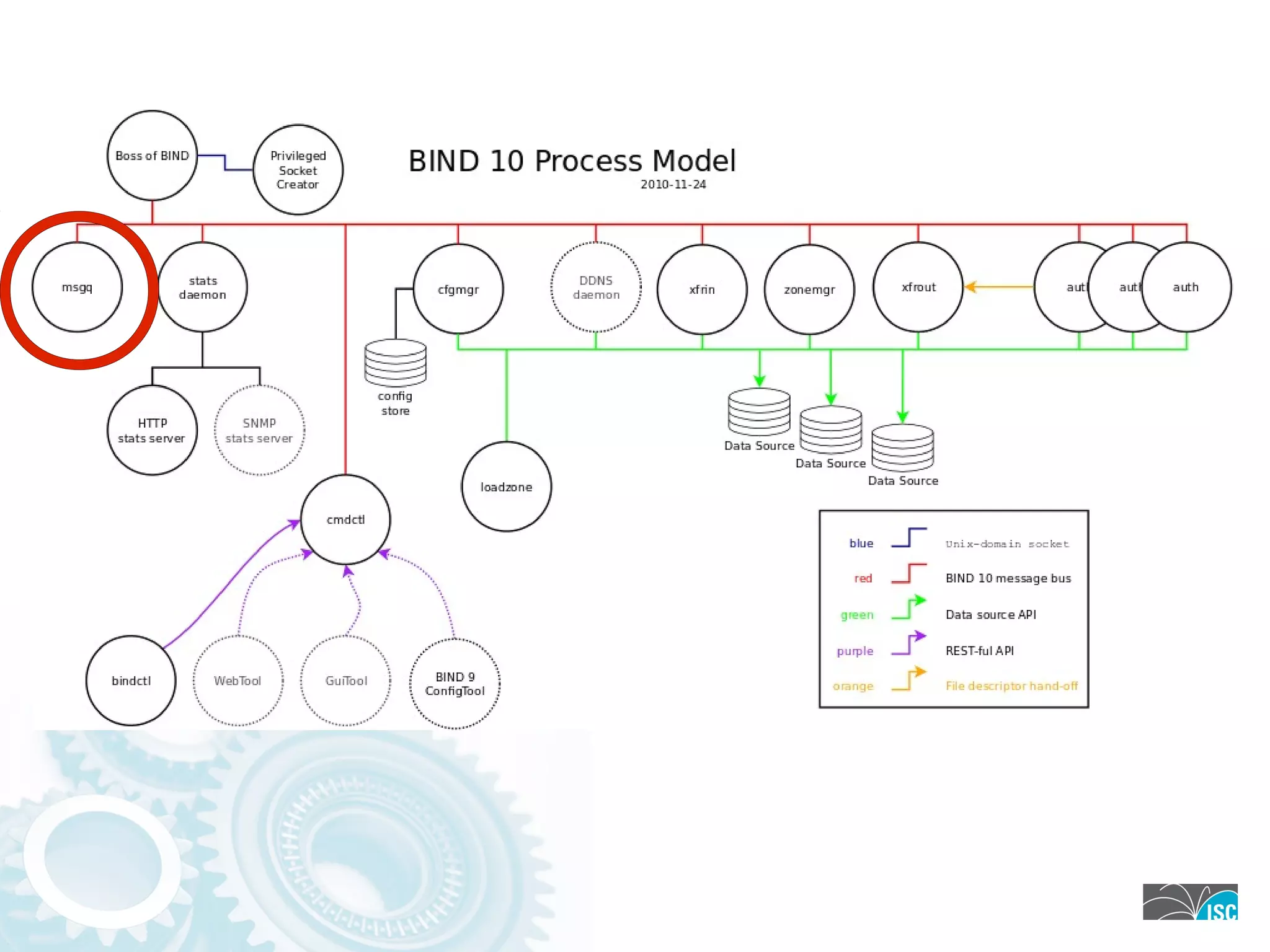
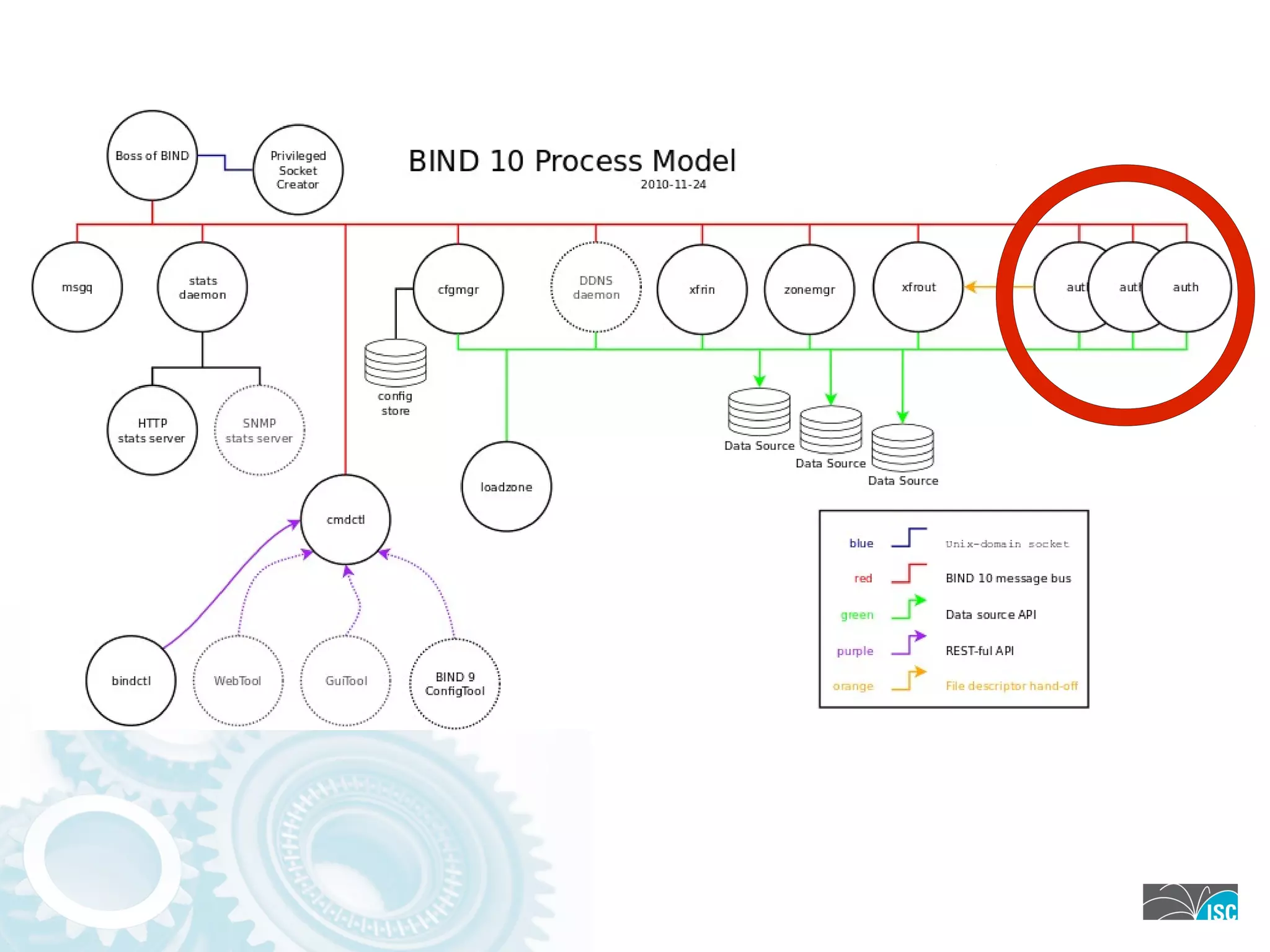
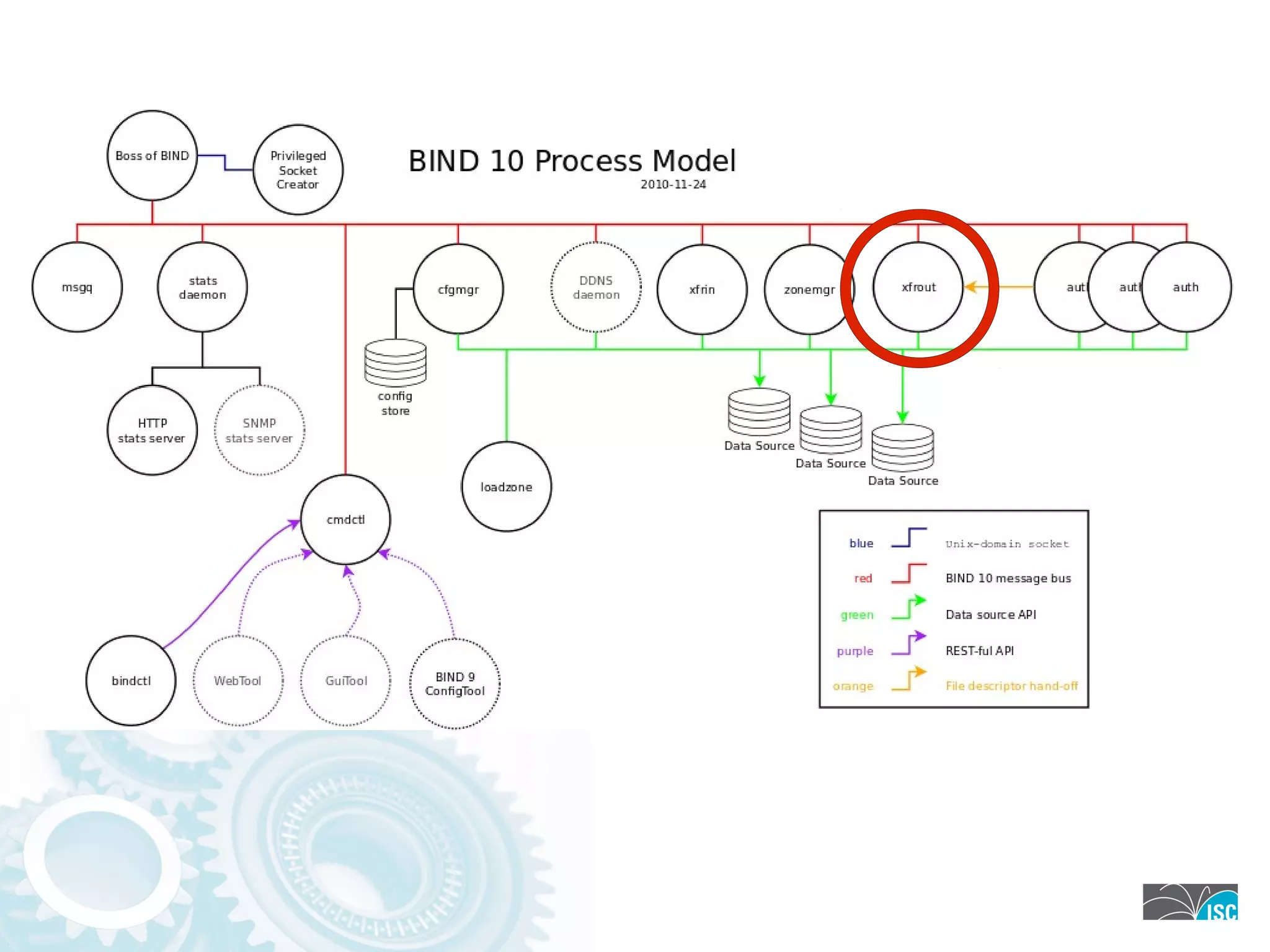
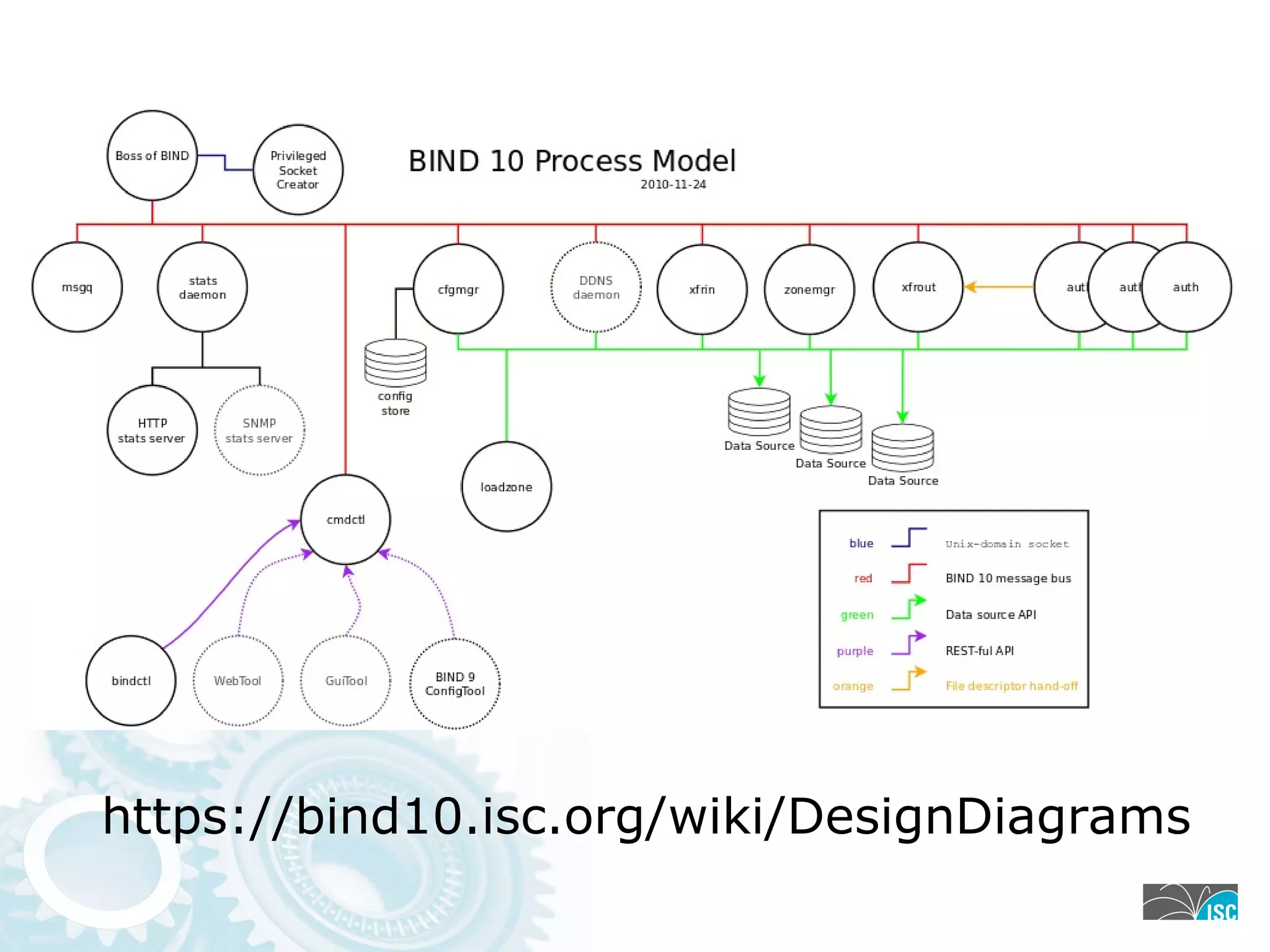
https://bind10.isc.org/wiki/DesignDiagrams
BIND 10
• Core
– BoB
– msgq
– cfgmgr
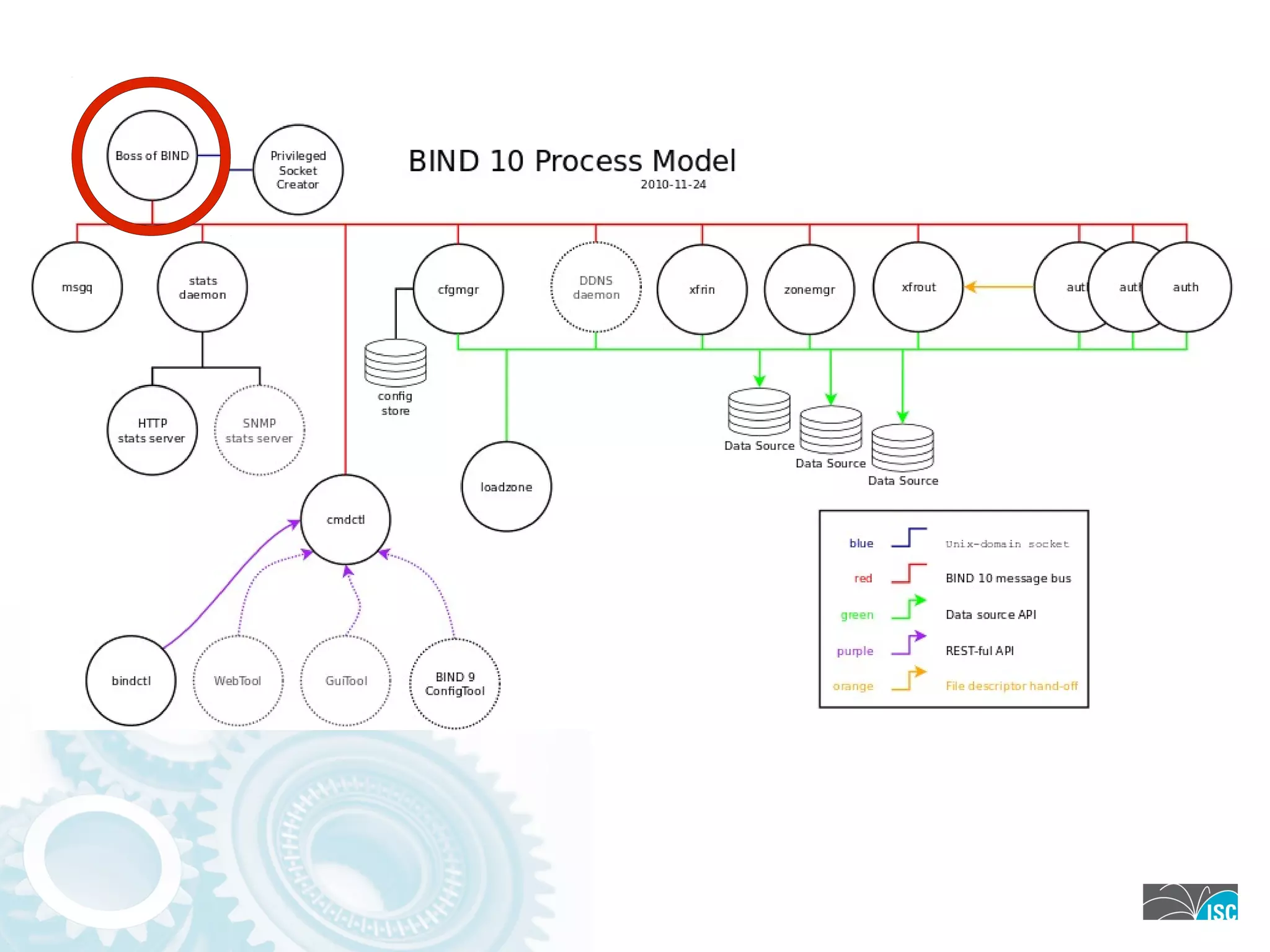
Master^WBoss of BIND
• Handles startup, shutdown
• Restarts processes that die
• Written in Python
An Aside:
BIND 10 Languages
• C++ for performance critical parts
– Modern compiled language
– Widely used
• Python for... everything else
– Modern scripting language
– Widely used
– Chose Python 3.x
– Best. Language. Ever.
msgq
• Inter-process message bus
• Needed for extensibility
• Like d-bus, but also inter-machine
• Message format: JSON
• Unix domain socket connections
• No security
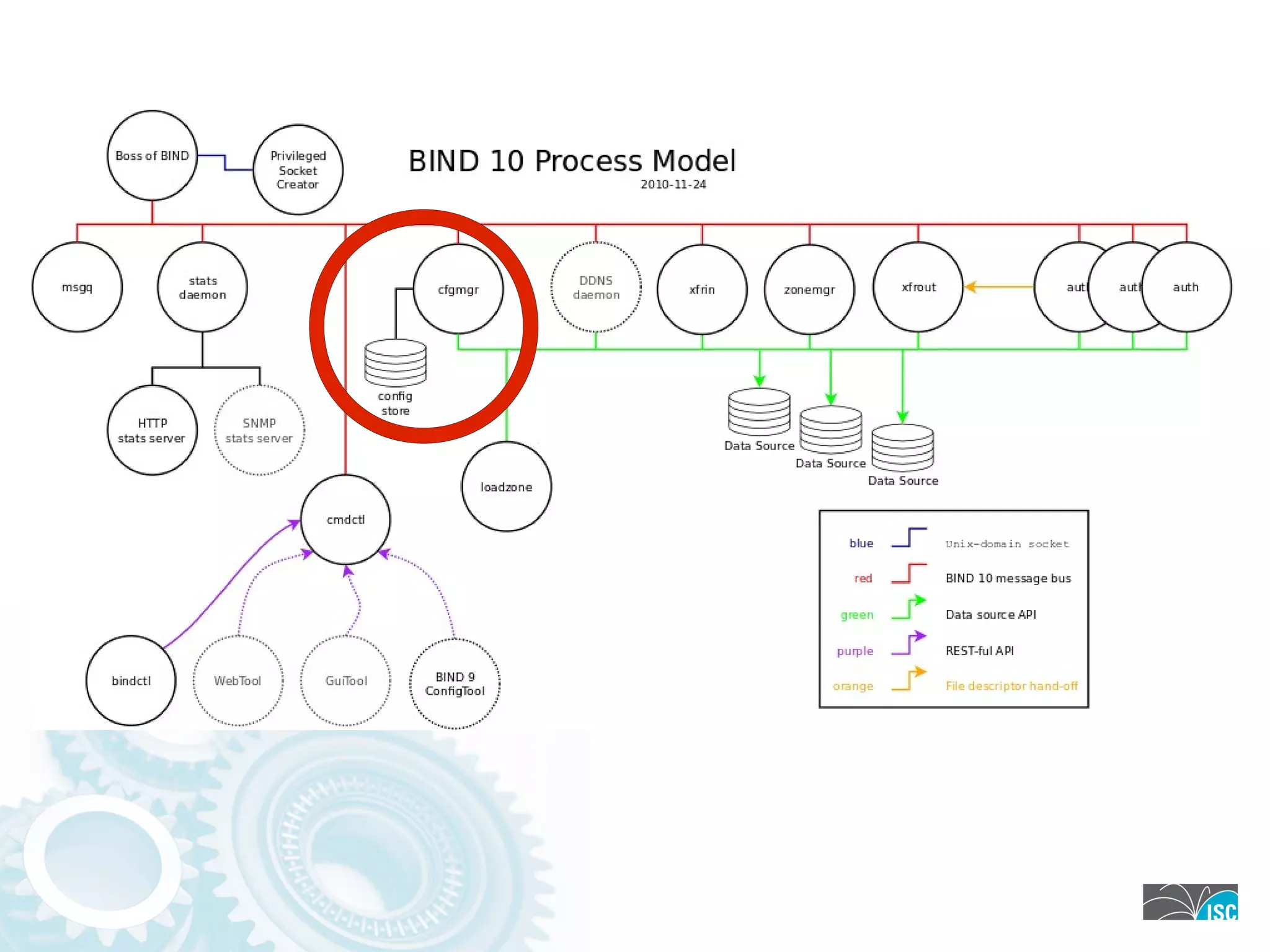
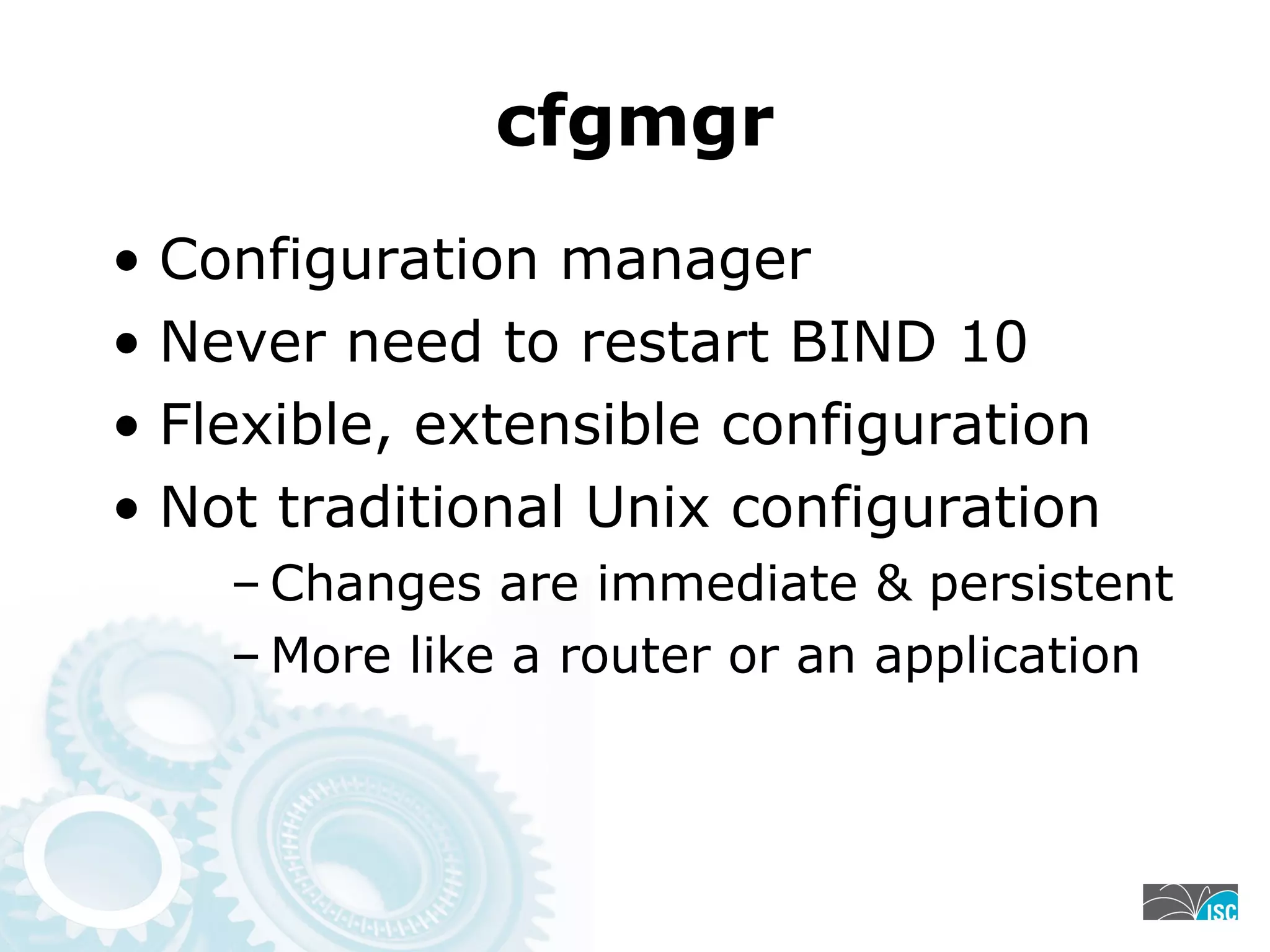
cfgmgr
• Configuration manager
• Never need to restart BIND 10
• Flexible, extensible configuration
• Not traditional Unix configuration
– Changes are immediate & persistent
– More like a router or an application
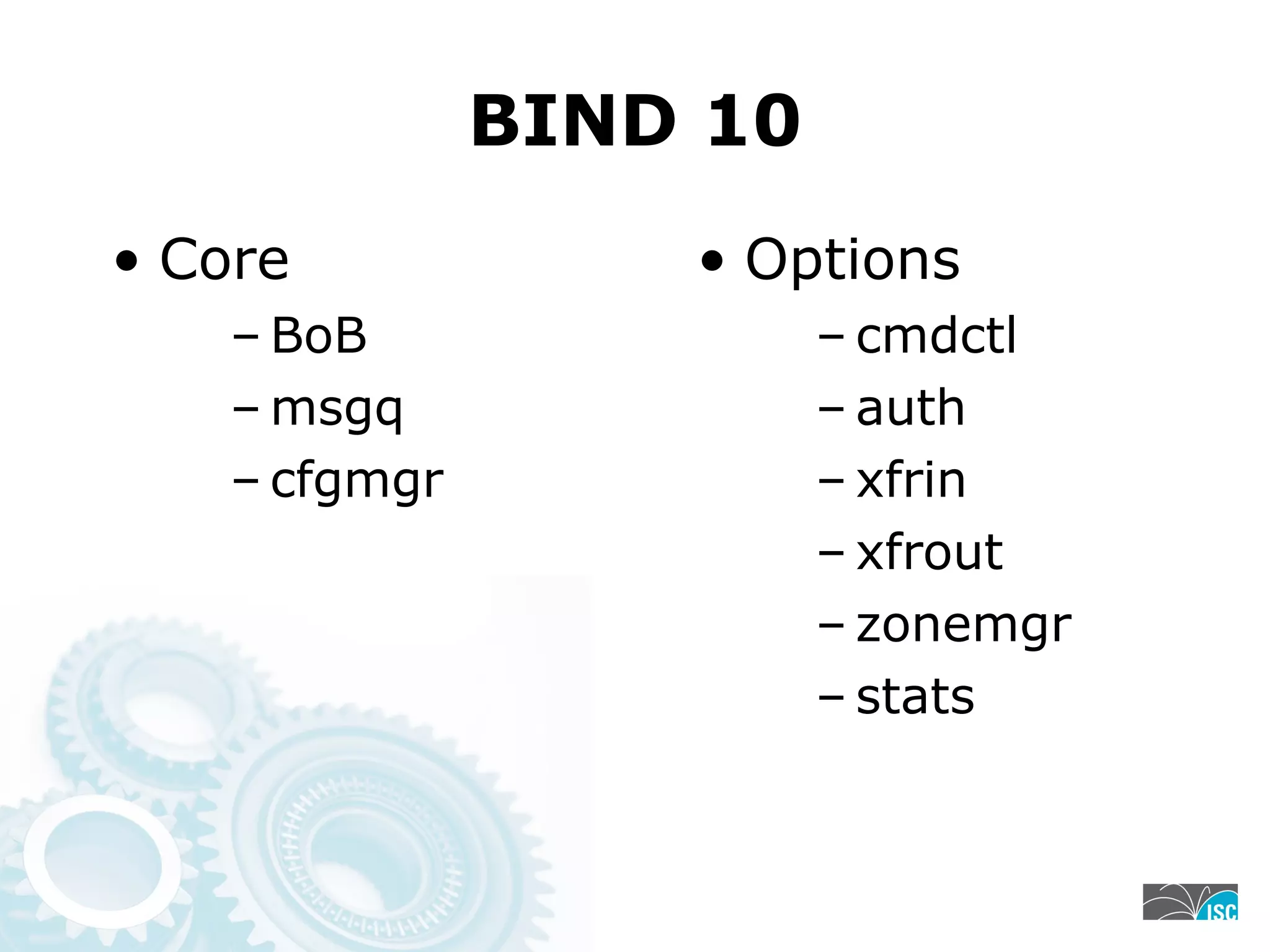
BIND 10
• Core
– BoB
– msgq
– cfgmgr
• Options
– cmdctl
– auth
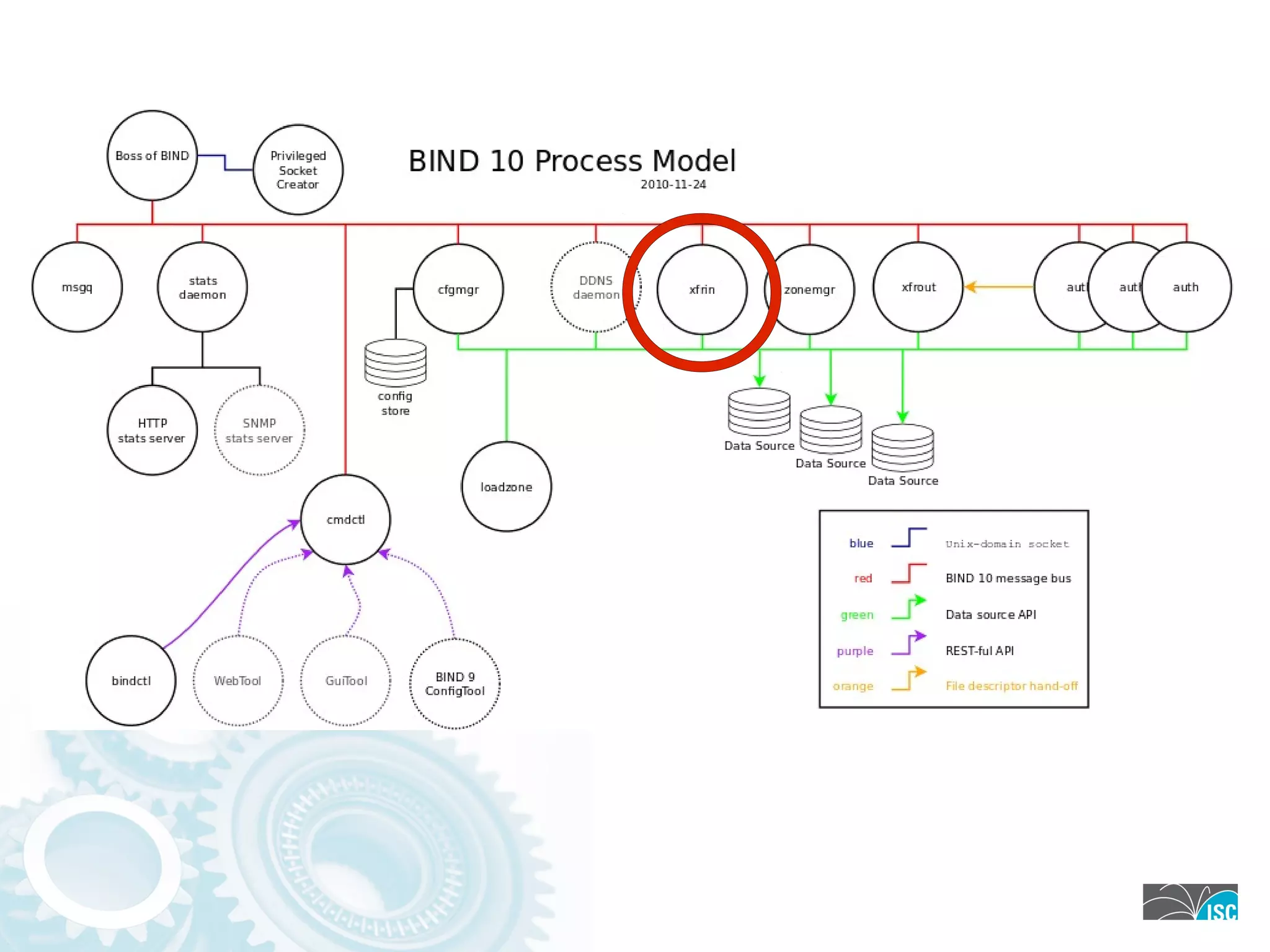
– xfrin
– xfrout
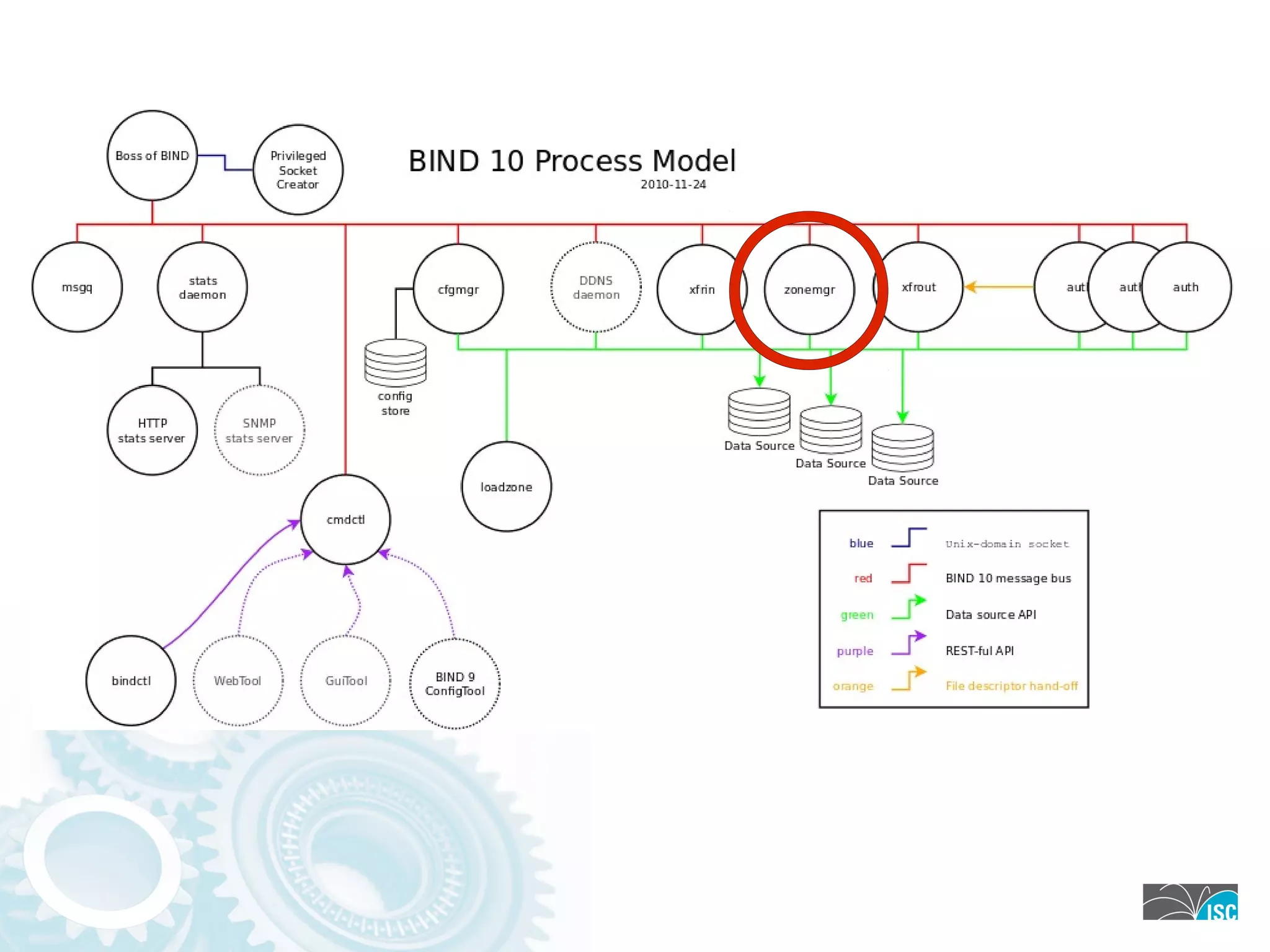
– zonemgr
– stats
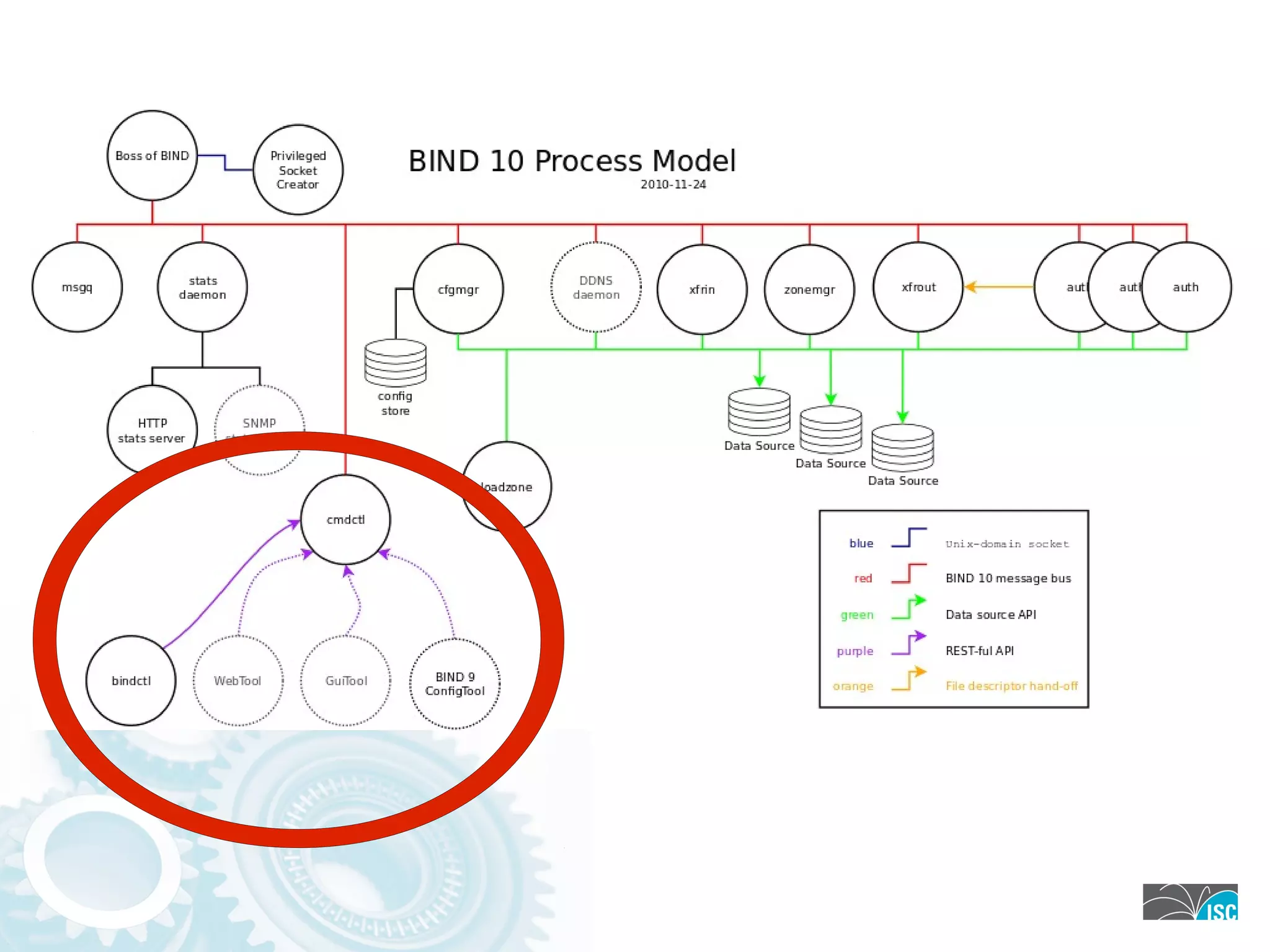
cmdctl
• Used to control the server
• Authenticates users
• Interacts with cfgmgr
– Gets per-module options
• Interacts with modules
– Commands like “refresh zone”
• Current client: bindctl (CLI)
• Future clients: web, GUI, new CLI
Supporting Library:
Data Sources
• Idea stolen from PowerDNS
• Back-end for authoritative DNS
• Currently SQLite
• Plans:
– MySQL, PostgreSQL
– Berkeley DB
– In-memory data structure(s)
• Used by auth, xfrin, xfrout, loadzone
Supporting Library:
DNS Message
• Low-level DNS messages (packets)
• New C++ implementation
• Python wrapper
auth
• Authoritative DNS server
• DNS library
+ data sources
+ I/O
+ bit of logic
• Scales via multiple processes
– Idea stolen from NSD
xfrout
• AXFR out, to act as a master server
• DNS library
+ data sources
+ I/O
+ bit of logic
• Scales via multiple threads
A Final Aside:
Passing Around Open Files
• AXFR messages come to auth
• UDP packets can be forwarded
• TCP connections must go to xfrout
• Send file descriptor via sendmsg():
– SOL_SOCKET, SCM_RIGHTS
• Works on Linux, Solaris, BSD
xfrin
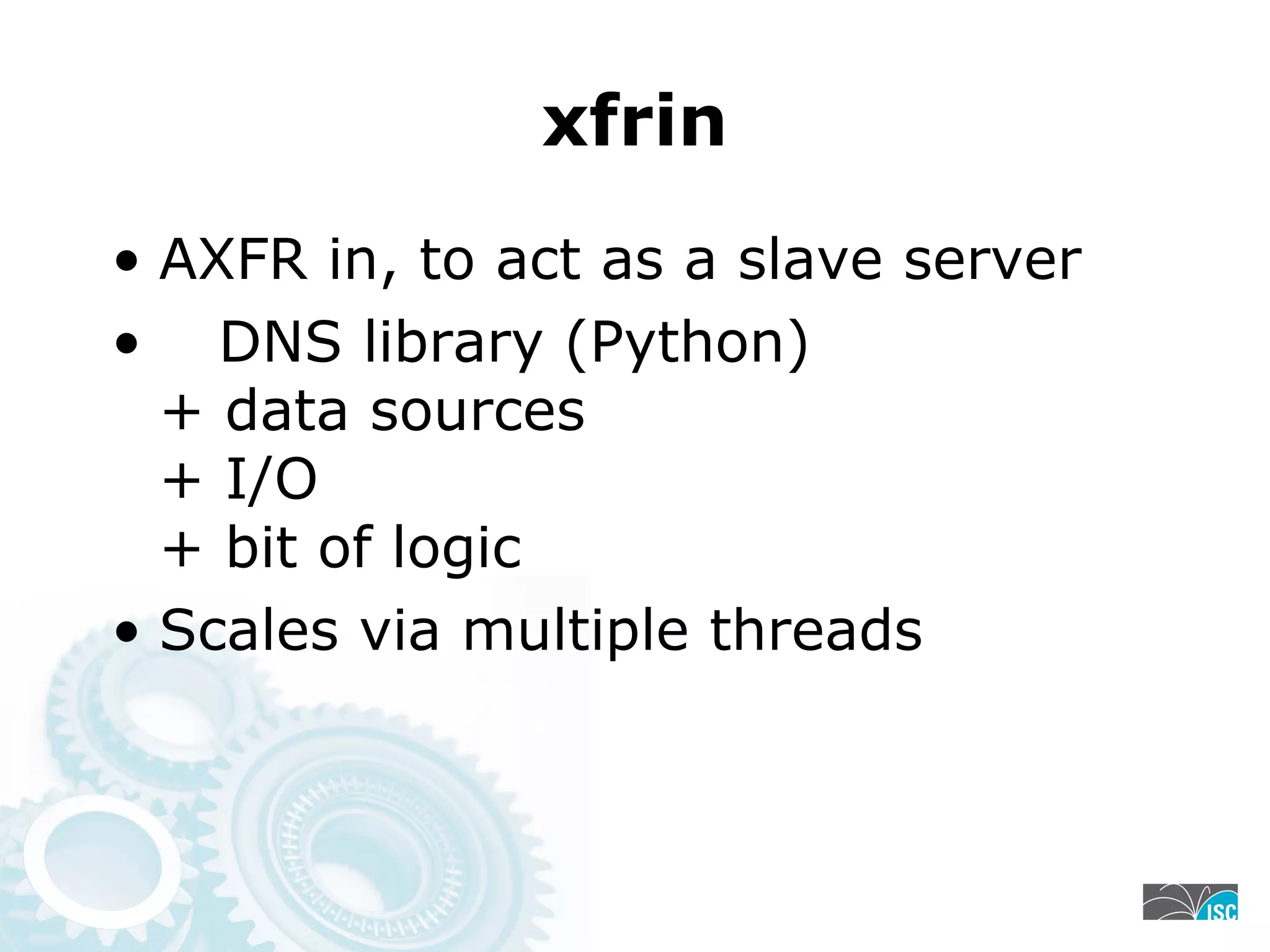
• AXFR in, to act as a slave server
• DNS library (Python)
+ data sources
+ I/O
+ bit of logic
• Scales via multiple threads
zonemgr
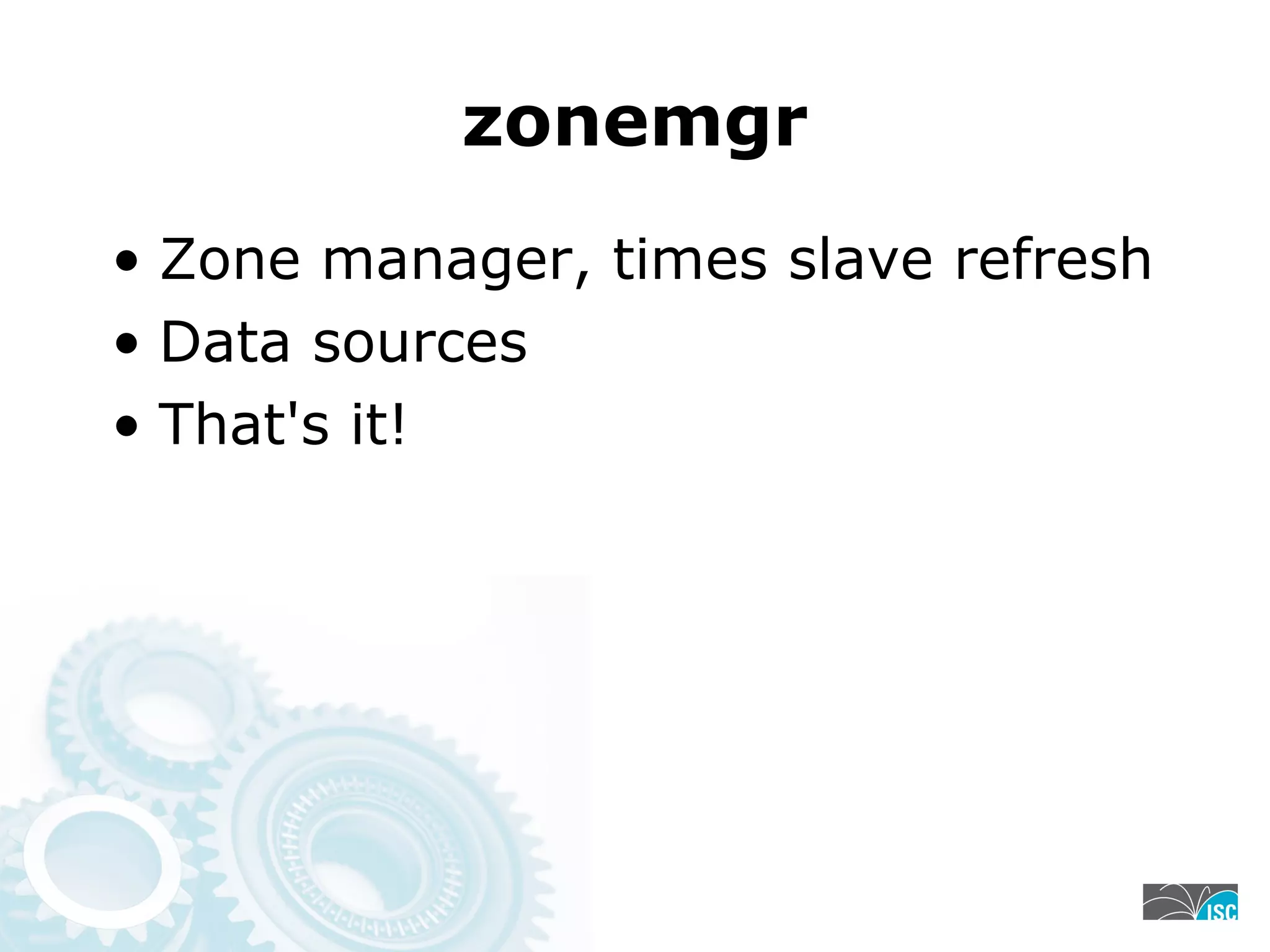
• Zone manager, times slave refresh
• Data sources
• That's it!
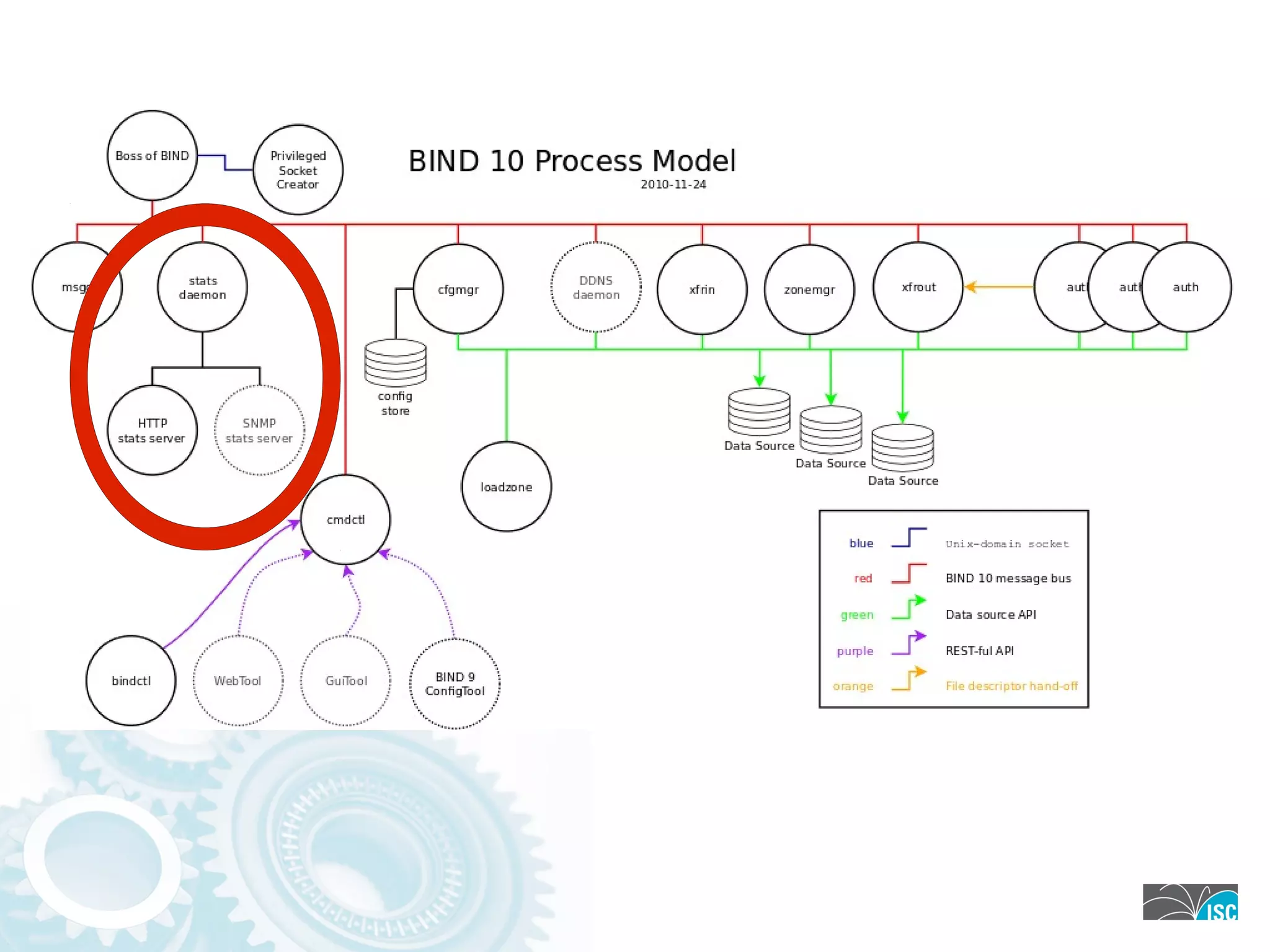
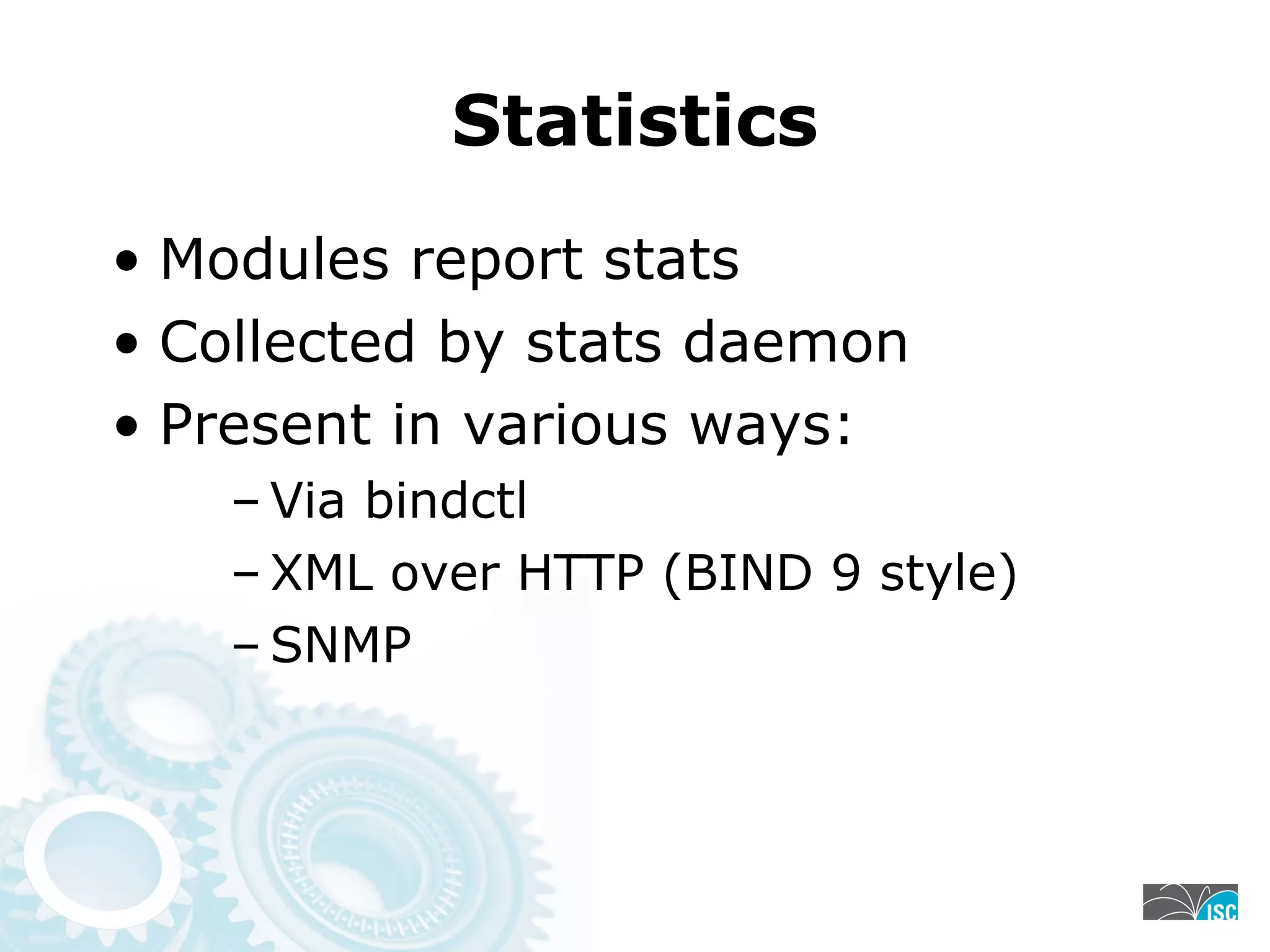
Statistics
• Modules report stats
• Collected by stats daemon
• Present in various ways:
– Via bindctl
– XML over HTTP (BIND 9 style)
– SNMP
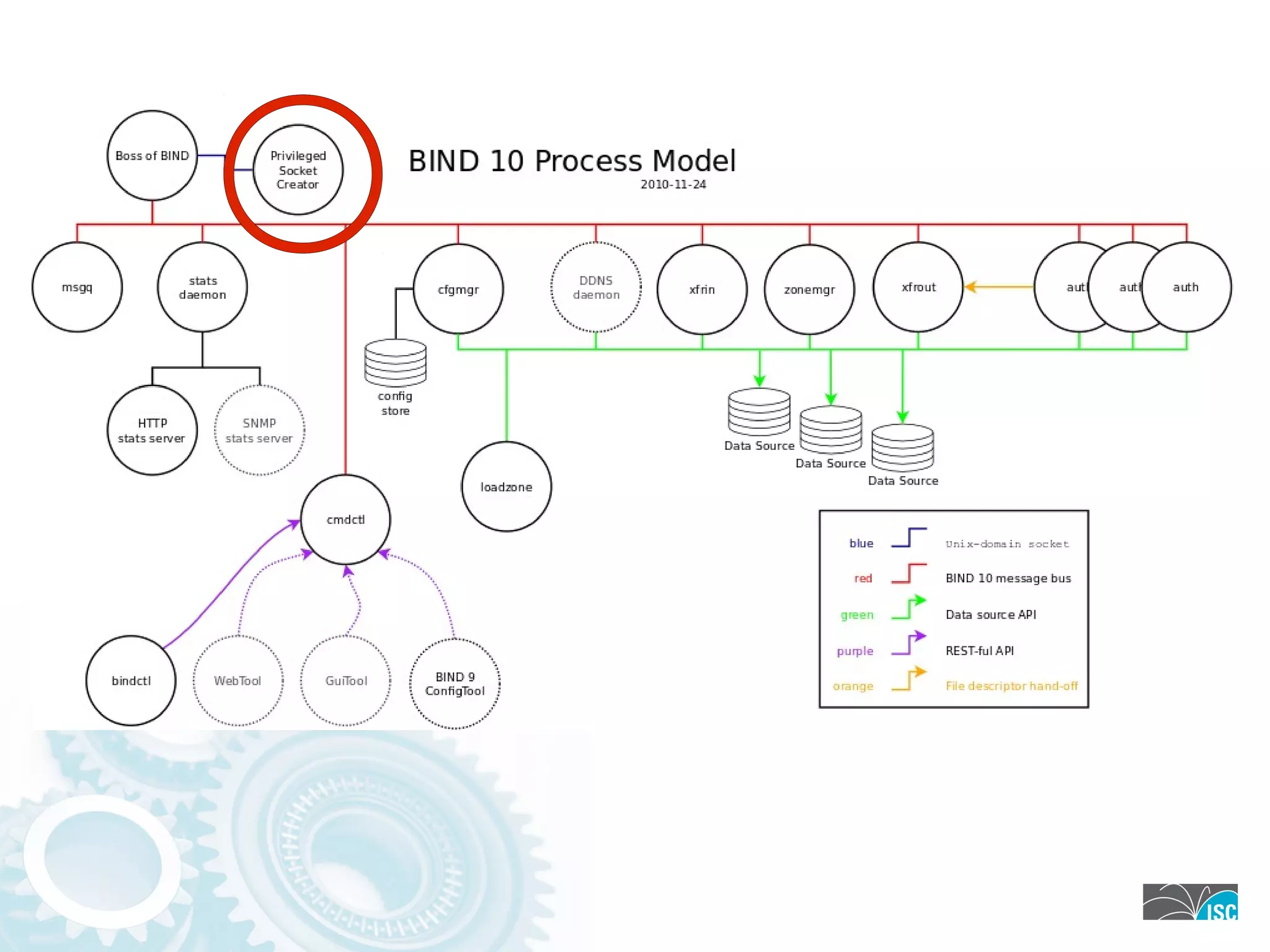
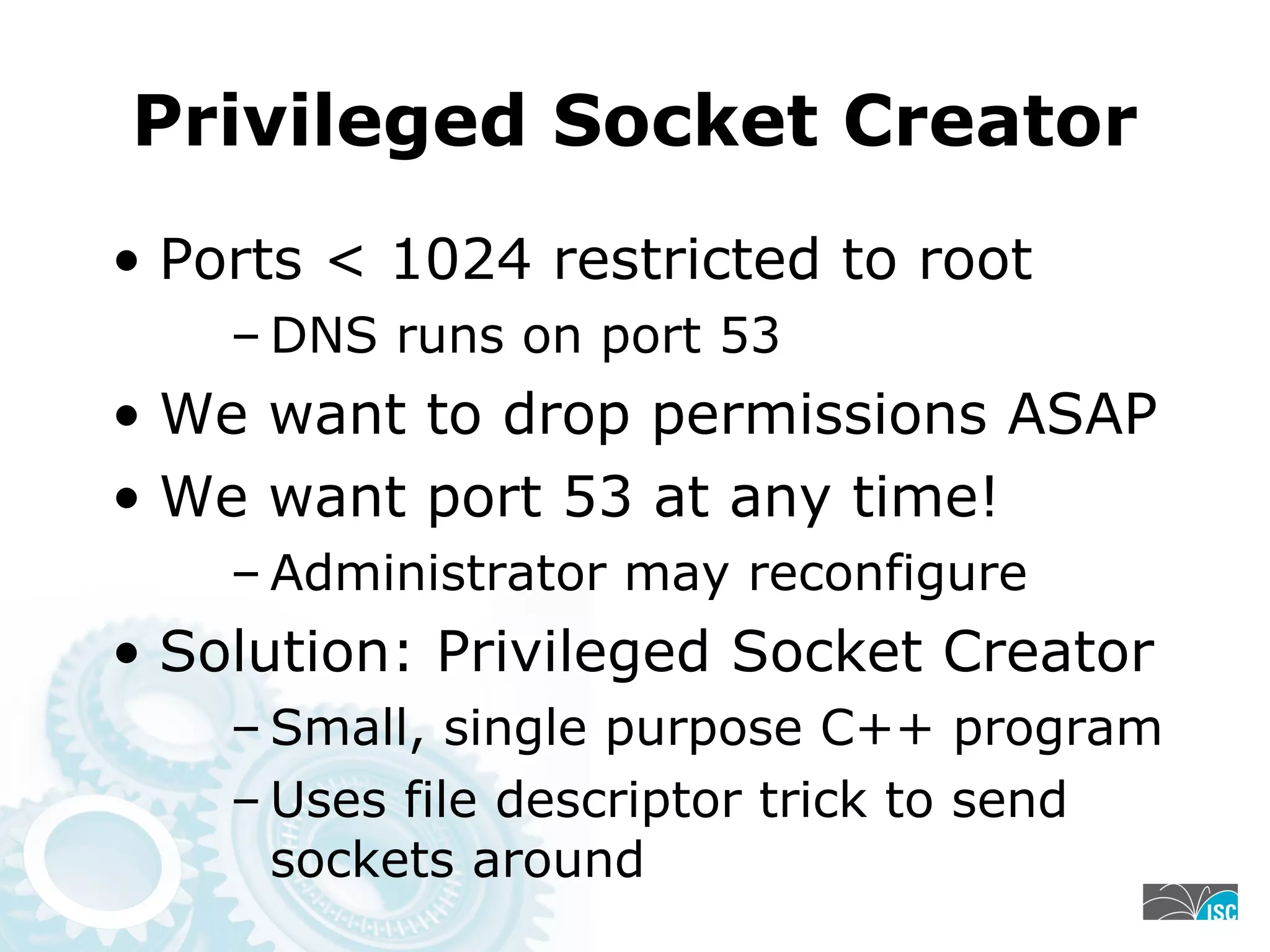
Privileged Socket Creator
• Ports < 1024 restricted to root
– DNS runs on port 53
• We want to drop permissions ASAP
• We want port 53 at any time!
– Administrator may reconfigure
• Solution: Privileged Socket Creator
– Small, single purpose C++ program
– Uses file descriptor trick to send
sockets around
https://bind10.isc.org/wiki/DesignDiagrams
Sponsors

10-BIND10-TheArcNextGenDNS.pdf

  • 1.
    The Architecture ofthe Next Generation DNS Server: BIND 10 Shane Kerr shane@isc.org
  • 2.
    DNS? BIND? • DNS:convert names into numbers – www.isc.org → 149.20.64.42 – www.isc.org → 2001:4f8:0:2::d • BIND: DNS server software – Runs on about 80% of DNS servers
  • 3.
    BIND 9. BIND10! • BIND 9: current version of BIND – 9.0.0 released in 2000-09-16 – Now at 9.7.2-P2 • BIND 10: next version of BIND – 5 year project to re-implement BIND – Currently in year 2 – Sponsored development
  • 4.
    Today's Topic: Architecture 'To datethere is still no agreement on the precise definition of the term “software architecture”.' – Wikipedia article on “Software architecture”
  • 5.
    Today's Topic: Architecture... Defined! 'Iknow it when I see it.' - Potter Stewart, United States Supreme Court
  • 6.
    Goals that Affect ArchitectureI • Customization “out-of-the-box” – authoritative-only, recursive-only – slave-only, master-only – enable/disable dynamic DNS – support favorite SQL backend • Customization via code changes – non-ISC modules, or modifications – bespoke or in-house development
  • 7.
    Goals that Affect ArchitectureII • Scalability – BIND 8: single core (“CPU” then) – BIND 9: multiple cores (4-6 or so) – BIND 10: 10's or 100's of cores, multiple machines (clustered) • Robustness – Reduce serious software bugs – Minimize impact of bugs – Reduce “fate sharing”
  • 8.
  • 9.
    BIND 10 • Core –BoB – msgq – cfgmgr
  • 11.
    Master^WBoss of BIND •Handles startup, shutdown • Restarts processes that die • Written in Python
  • 12.
    An Aside: BIND 10Languages • C++ for performance critical parts – Modern compiled language – Widely used • Python for... everything else – Modern scripting language – Widely used – Chose Python 3.x – Best. Language. Ever.
  • 14.
    msgq • Inter-process messagebus • Needed for extensibility • Like d-bus, but also inter-machine • Message format: JSON • Unix domain socket connections • No security
  • 16.
    cfgmgr • Configuration manager •Never need to restart BIND 10 • Flexible, extensible configuration • Not traditional Unix configuration – Changes are immediate & persistent – More like a router or an application
  • 17.
    BIND 10 • Core –BoB – msgq – cfgmgr • Options – cmdctl – auth – xfrin – xfrout – zonemgr – stats
  • 19.
    cmdctl • Used tocontrol the server • Authenticates users • Interacts with cfgmgr – Gets per-module options • Interacts with modules – Commands like “refresh zone” • Current client: bindctl (CLI) • Future clients: web, GUI, new CLI
  • 20.
    Supporting Library: Data Sources •Idea stolen from PowerDNS • Back-end for authoritative DNS • Currently SQLite • Plans: – MySQL, PostgreSQL – Berkeley DB – In-memory data structure(s) • Used by auth, xfrin, xfrout, loadzone
  • 21.
    Supporting Library: DNS Message •Low-level DNS messages (packets) • New C++ implementation • Python wrapper
  • 23.
    auth • Authoritative DNSserver • DNS library + data sources + I/O + bit of logic • Scales via multiple processes – Idea stolen from NSD
  • 25.
    xfrout • AXFR out,to act as a master server • DNS library + data sources + I/O + bit of logic • Scales via multiple threads
  • 26.
    A Final Aside: PassingAround Open Files • AXFR messages come to auth • UDP packets can be forwarded • TCP connections must go to xfrout • Send file descriptor via sendmsg(): – SOL_SOCKET, SCM_RIGHTS • Works on Linux, Solaris, BSD
  • 28.
    xfrin • AXFR in,to act as a slave server • DNS library (Python) + data sources + I/O + bit of logic • Scales via multiple threads
  • 30.
    zonemgr • Zone manager,times slave refresh • Data sources • That's it!
  • 32.
    Statistics • Modules reportstats • Collected by stats daemon • Present in various ways: – Via bindctl – XML over HTTP (BIND 9 style) – SNMP
  • 34.
    Privileged Socket Creator •Ports < 1024 restricted to root – DNS runs on port 53 • We want to drop permissions ASAP • We want port 53 at any time! – Administrator may reconfigure • Solution: Privileged Socket Creator – Small, single purpose C++ program – Uses file descriptor trick to send sockets around
  • 35.
  • 36.