Biopython
1
What is Biopython?
• tools for computational molecular biology
• to program in python and want to make it as
easy as possible to use python for bioinformatics
by creating high-quality, reusable modules and
scripts
2
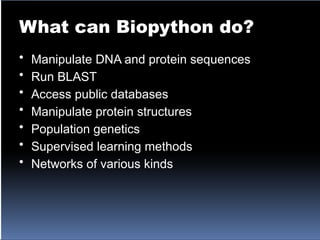
What can Biopython do?
• Manipulate DNA and protein sequences
• Run BLAST
• Access public databases
• Manipulate protein structures
• Population genetics
• Supervised learning methods
• Networks of various kinds
Obtaining Biopython
• http://www.biopython.org
4
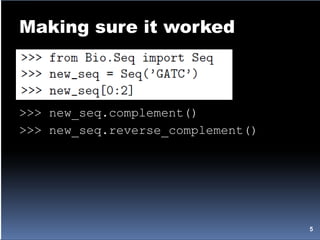
Making sure it worked
>>> new_seq.complement()
>>> new_seq.reverse_complement()
5
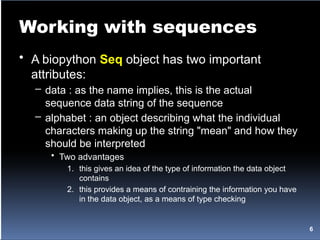
Working with sequences
• A biopython Seq object has two important
attributes:
– data : as the name implies, this is the actual
sequence data string of the sequence
– alphabet : an object describing what the individual
characters making up the string "mean" and how they
should be interpreted
• Two advantages
1. this gives an idea of the type of information the data object
contains
2. this provides a means of contraining the information you have
in the data object, as a means of type checking
6
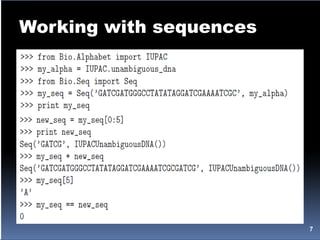
Working with sequences
7
Working with sequences
>>> protein_seq = Seq('EVRNAK', IUPAC.protein)
>>> dna_seq = Seq('ACGT', IUPAC.unambiguous_dna)
>>> protein_seq + dna_seq
>>> my_seq.tostring()
>>> my_seq[5] = 'G
>>> mutable_seq = my_seq.tomutable()
>>> print mutable_seq
>>> mutable_seq[5] = 'T'
>>> print mutable_seq
>>> mutable_seq.remove('T')
>>> print mutable_seq
>>> mutable_seq.reverse()
>>> print mutable_seq
8
Parsing biological file formats
>gi|6273290|gb|AF191664.1|AF191664 Opuntia clavata rpl16 gene; chloroplast
gene for...
TATACATTAAAGGAGGGGGATGCGGATAAATGGAAAGGCGAAAGAAAGAAAAAAATGAA
TCTAAATGATATAGGATTCCACTATGTAAGGTCTTTGAATCATATCATAAAAGACAATGTAAT
AAA...
import string
from Bio.ParserSupport import AbstractConsumer
class SpeciesExtractor(AbstractConsumer):
def __init__(self):
self.species_list = []
def title(self, title_info):
title_atoms = string.split(title_info)
new_species = title_atoms[1]
if new_species not in self.species_list:
self.species_list.append(new_species)
9
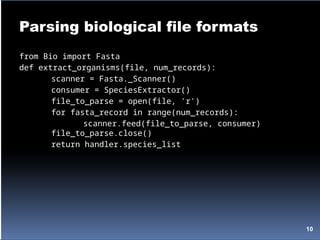
Parsing biological file formats
from Bio import Fasta
def extract_organisms(file, num_records):
scanner = Fasta._Scanner()
consumer = SpeciesExtractor()
file_to_parse = open(file, 'r')
for fasta_record in range(num_records):
scanner.feed(file_to_parse, consumer)
file_to_parse.close()
return handler.species_list
10
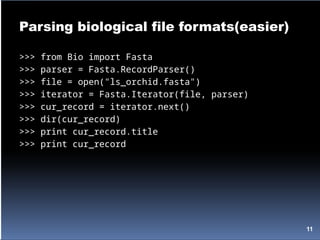
Parsing biological file formats(easier)
>>> from Bio import Fasta
>>> parser = Fasta.RecordParser()
>>> file = open("ls_orchid.fasta")
>>> iterator = Fasta.Iterator(file, parser)
>>> cur_record = iterator.next()
>>> dir(cur_record)
>>> print cur_record.title
>>> print cur_record
11
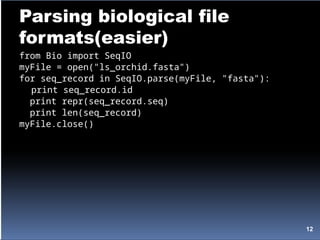
Parsing biological file
formats(easier)
from Bio import SeqIO
myFile = open("ls_orchid.fasta")
for seq_record in SeqIO.parse(myFile, "fasta"):
print seq_record.id
print repr(seq_record.seq)
print len(seq_record)
myFile.close()
12
FASTA files as Dictionaries
import string
def get_accession_num(fasta_record):
title_atoms = string.split(fasta_record.title)
# all of the accession number information is stuck
in the first element
# and separated by '|'s
accession_atoms = string.split(title_atoms[0], '|')
# the accession number is the 4th element
gb_name = accession_atoms[3]
# strip the version info before returning
return gb_name[:-2]
13
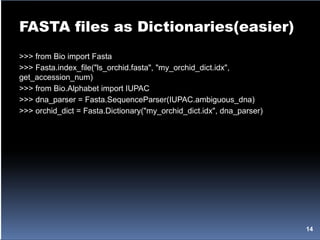
FASTA files as Dictionaries(easier)
>>> from Bio import Fasta
>>> Fasta.index_file("ls_orchid.fasta", "my_orchid_dict.idx",
get_accession_num)
>>> from Bio.Alphabet import IUPAC
>>> dna_parser = Fasta.SequenceParser(IUPAC.ambiguous_dna)
>>> orchid_dict = Fasta.Dictionary("my_orchid_dict.idx", dna_parser)
14
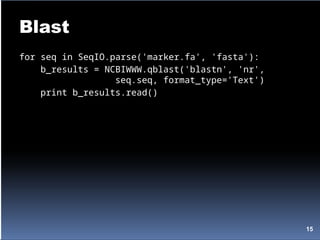
Blast
for seq in SeqIO.parse('marker.fa', 'fasta'):
b_results = NCBIWWW.qblast('blastn', 'nr',
seq.seq, format_type='Text')
print b_results.read()
15
More information
http://www.biopython.org
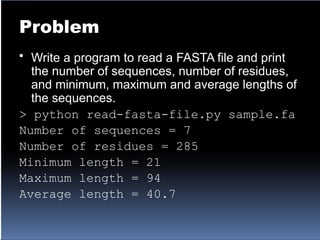
Problem
• Write a program to read a FASTA file and print
the number of sequences, number of residues,
and minimum, maximum and average lengths of
the sequences.
> python read-fasta-file.py sample.fa
Number of sequences = 7
Number of residues = 285
Minimum length = 21
Maximum length = 94
Average length = 40.7

10518261_biopython_python_slides_notes.ppt

  • 1.
  • 2.
    What is Biopython? •tools for computational molecular biology • to program in python and want to make it as easy as possible to use python for bioinformatics by creating high-quality, reusable modules and scripts 2
  • 3.
    What can Biopythondo? • Manipulate DNA and protein sequences • Run BLAST • Access public databases • Manipulate protein structures • Population genetics • Supervised learning methods • Networks of various kinds
  • 4.
  • 5.
    Making sure itworked >>> new_seq.complement() >>> new_seq.reverse_complement() 5
  • 6.
    Working with sequences •A biopython Seq object has two important attributes: – data : as the name implies, this is the actual sequence data string of the sequence – alphabet : an object describing what the individual characters making up the string "mean" and how they should be interpreted • Two advantages 1. this gives an idea of the type of information the data object contains 2. this provides a means of contraining the information you have in the data object, as a means of type checking 6
  • 7.
  • 8.
    Working with sequences >>>protein_seq = Seq('EVRNAK', IUPAC.protein) >>> dna_seq = Seq('ACGT', IUPAC.unambiguous_dna) >>> protein_seq + dna_seq >>> my_seq.tostring() >>> my_seq[5] = 'G >>> mutable_seq = my_seq.tomutable() >>> print mutable_seq >>> mutable_seq[5] = 'T' >>> print mutable_seq >>> mutable_seq.remove('T') >>> print mutable_seq >>> mutable_seq.reverse() >>> print mutable_seq 8
  • 9.
    Parsing biological fileformats >gi|6273290|gb|AF191664.1|AF191664 Opuntia clavata rpl16 gene; chloroplast gene for... TATACATTAAAGGAGGGGGATGCGGATAAATGGAAAGGCGAAAGAAAGAAAAAAATGAA TCTAAATGATATAGGATTCCACTATGTAAGGTCTTTGAATCATATCATAAAAGACAATGTAAT AAA... import string from Bio.ParserSupport import AbstractConsumer class SpeciesExtractor(AbstractConsumer): def __init__(self): self.species_list = [] def title(self, title_info): title_atoms = string.split(title_info) new_species = title_atoms[1] if new_species not in self.species_list: self.species_list.append(new_species) 9
  • 10.
    Parsing biological fileformats from Bio import Fasta def extract_organisms(file, num_records): scanner = Fasta._Scanner() consumer = SpeciesExtractor() file_to_parse = open(file, 'r') for fasta_record in range(num_records): scanner.feed(file_to_parse, consumer) file_to_parse.close() return handler.species_list 10
  • 11.
    Parsing biological fileformats(easier) >>> from Bio import Fasta >>> parser = Fasta.RecordParser() >>> file = open("ls_orchid.fasta") >>> iterator = Fasta.Iterator(file, parser) >>> cur_record = iterator.next() >>> dir(cur_record) >>> print cur_record.title >>> print cur_record 11
  • 12.
    Parsing biological file formats(easier) fromBio import SeqIO myFile = open("ls_orchid.fasta") for seq_record in SeqIO.parse(myFile, "fasta"): print seq_record.id print repr(seq_record.seq) print len(seq_record) myFile.close() 12
  • 13.
    FASTA files asDictionaries import string def get_accession_num(fasta_record): title_atoms = string.split(fasta_record.title) # all of the accession number information is stuck in the first element # and separated by '|'s accession_atoms = string.split(title_atoms[0], '|') # the accession number is the 4th element gb_name = accession_atoms[3] # strip the version info before returning return gb_name[:-2] 13
  • 14.
    FASTA files asDictionaries(easier) >>> from Bio import Fasta >>> Fasta.index_file("ls_orchid.fasta", "my_orchid_dict.idx", get_accession_num) >>> from Bio.Alphabet import IUPAC >>> dna_parser = Fasta.SequenceParser(IUPAC.ambiguous_dna) >>> orchid_dict = Fasta.Dictionary("my_orchid_dict.idx", dna_parser) 14
  • 15.
    Blast for seq inSeqIO.parse('marker.fa', 'fasta'): b_results = NCBIWWW.qblast('blastn', 'nr', seq.seq, format_type='Text') print b_results.read() 15
  • 16.
  • 17.
    Problem • Write aprogram to read a FASTA file and print the number of sequences, number of residues, and minimum, maximum and average lengths of the sequences. > python read-fasta-file.py sample.fa Number of sequences = 7 Number of residues = 285 Minimum length = 21 Maximum length = 94 Average length = 40.7