Bioinformatics in Python
In this presentation, we will explore the fascinating world of bioinformatics
and how Python can revolutionize data extraction, analysis, modeling, and
visualization.
by Prince
PRESENTAION TOPIC:-
Name: Nafizal Arafat Prine
StudentCode: BWU/BTA/22/381
Semester: 3rd
Section: G
Programme Name:: B.Tech CSE (AI&ML)
Course Code: ESCM 303
Course Name: Introduction to Python Programming
BRAINWARE
UNIVERSITY
What is Bioinformatics?
Bioinformatics is the interdisciplinary field that combines biology,
computer science, and statistics to analyze biological data, such
as DNA sequences, protein structures, and gene expressions,
using computational methods.
Why use Python in Bioinformatics?
1 Flexible and Efficient
Python's simplicity and extensive libraries make it ideal for handling
large-scale biological datasets and performing complex computations
with ease.
2 Integration and Interoperability
Python seamlessly integrates with popular bioinformatics tools and
frameworks, enabling efficient data exchange and integration across
different platforms.
3 Community Support
Python has a vibrant and active community, constantly developing new
bioinformatics libraries, tools, and workflows, fostering collaboration
and innovation.
Data Extraction and Processing in
Python
1 Retrieve Data
Python provides powerful
libraries like Biopython and
Pandas for acquiring
biological data from public
databases, publications, and
experimental results.
2
Preprocessing
With Python, you can clean
and transform raw
biological data, removing
noise, handling missing
values, and performing
statistical normalization.
3 Data Integration
Python enables the merging
and integration of multiple
datasets, allowing researchers
to identify complex
relationships and patterns in
biological data.
Sequence Analysis using Python
Sequence Alignment
Python facilitates the alignment of biological sequences, like DNA, RNA,
and proteins, highlighting similarities, differences, and evolutionary
relationships.
Motif Identification
With Python, you can identify conserved patterns and motifs in biological
sequences, revealing important functional and structural characteristics.
Phylogenetic Analysis
Python enables the construction of evolutionary trees, inferring the
ancestral relationships between organisms based on sequence
comparisons.
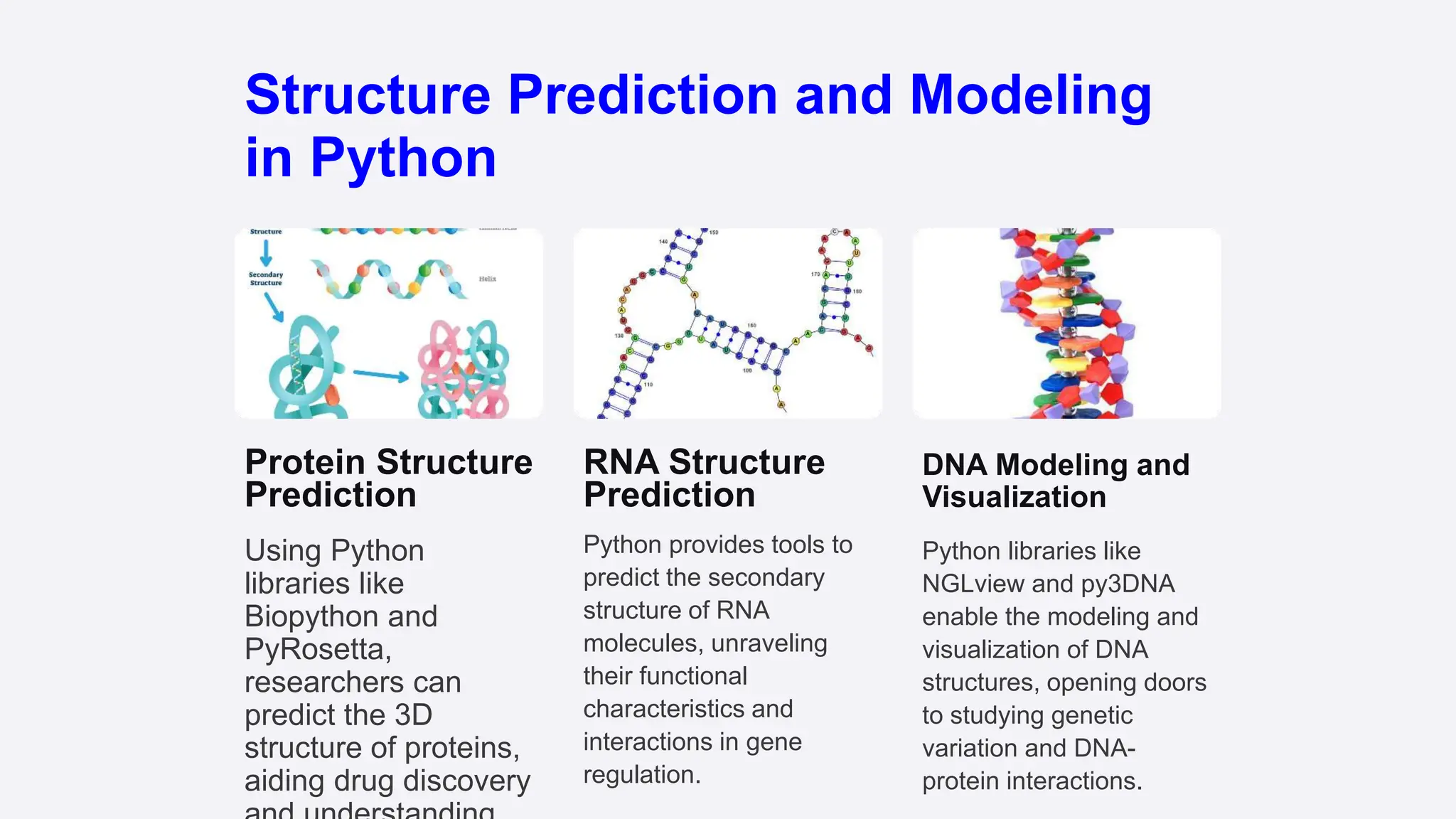
Structure Prediction and Modeling
in Python
Protein Structure
Prediction
Using Python
libraries like
Biopython and
PyRosetta,
researchers can
predict the 3D
structure of proteins,
aiding drug discovery
RNA Structure
Prediction
Python provides tools to
predict the secondary
structure of RNA
molecules, unraveling
their functional
characteristics and
interactions in gene
regulation.
DNA Modeling and
Visualization
Python libraries like
NGLview and py3DNA
enable the modeling and
visualization of DNA
structures, opening doors
to studying genetic
variation and DNA-
protein interactions.
Visualization and Data Presentation
with Python
Interactive Plots
Python's matplotlib and
Plotly libraries allow
researchers to create
dynamic and visually
appealing plots, charts,
and interactive
visualizations of biological
data.
Network and
Graph
Visualization
With Python, you can
analyze and visualize
complex biological
networks, including
protein-protein
interactions, gene
regulatory networks, and
metabolic pathways.
Publication-
Quality Graphics
Python facilitates the
generation of high-quality
images and figures for
scientific articles,
presentations, and
posters, enhancing the
visual communication of
research findings.
Challenges and Future Developments
in Bioinformatics and Python
• Handling "big data" in bioinformatics and developing efficient algorithms for data analysi
• Improving machine learning and AI techniques to extract hidden
patterns and insights from biological data.
• Ensuring data privacy, security, and ethical use of sensitive biological information.
• Advancing integrative systems biology to achieve a comprehensive
understanding of complex biological systems.
Recap the key points discussed throughout the presentation, emphasizing the
importance of bioinformatics in advancing scientific knowledge. Encourage further
exploration and utilization of Python in bioinformatics research.
Conclusion:
Thank You,,!¡

BWU_BTA_22_381.ppt

  • 1.
    Bioinformatics in Python Inthis presentation, we will explore the fascinating world of bioinformatics and how Python can revolutionize data extraction, analysis, modeling, and visualization. by Prince PRESENTAION TOPIC:- Name: Nafizal Arafat Prine StudentCode: BWU/BTA/22/381 Semester: 3rd Section: G Programme Name:: B.Tech CSE (AI&ML) Course Code: ESCM 303 Course Name: Introduction to Python Programming BRAINWARE UNIVERSITY
  • 2.
    What is Bioinformatics? Bioinformaticsis the interdisciplinary field that combines biology, computer science, and statistics to analyze biological data, such as DNA sequences, protein structures, and gene expressions, using computational methods.
  • 3.
    Why use Pythonin Bioinformatics? 1 Flexible and Efficient Python's simplicity and extensive libraries make it ideal for handling large-scale biological datasets and performing complex computations with ease. 2 Integration and Interoperability Python seamlessly integrates with popular bioinformatics tools and frameworks, enabling efficient data exchange and integration across different platforms. 3 Community Support Python has a vibrant and active community, constantly developing new bioinformatics libraries, tools, and workflows, fostering collaboration and innovation.
  • 4.
    Data Extraction andProcessing in Python 1 Retrieve Data Python provides powerful libraries like Biopython and Pandas for acquiring biological data from public databases, publications, and experimental results. 2 Preprocessing With Python, you can clean and transform raw biological data, removing noise, handling missing values, and performing statistical normalization. 3 Data Integration Python enables the merging and integration of multiple datasets, allowing researchers to identify complex relationships and patterns in biological data.
  • 5.
    Sequence Analysis usingPython Sequence Alignment Python facilitates the alignment of biological sequences, like DNA, RNA, and proteins, highlighting similarities, differences, and evolutionary relationships. Motif Identification With Python, you can identify conserved patterns and motifs in biological sequences, revealing important functional and structural characteristics. Phylogenetic Analysis Python enables the construction of evolutionary trees, inferring the ancestral relationships between organisms based on sequence comparisons.
  • 6.
    Structure Prediction andModeling in Python Protein Structure Prediction Using Python libraries like Biopython and PyRosetta, researchers can predict the 3D structure of proteins, aiding drug discovery RNA Structure Prediction Python provides tools to predict the secondary structure of RNA molecules, unraveling their functional characteristics and interactions in gene regulation. DNA Modeling and Visualization Python libraries like NGLview and py3DNA enable the modeling and visualization of DNA structures, opening doors to studying genetic variation and DNA- protein interactions.
  • 7.
    Visualization and DataPresentation with Python Interactive Plots Python's matplotlib and Plotly libraries allow researchers to create dynamic and visually appealing plots, charts, and interactive visualizations of biological data. Network and Graph Visualization With Python, you can analyze and visualize complex biological networks, including protein-protein interactions, gene regulatory networks, and metabolic pathways. Publication- Quality Graphics Python facilitates the generation of high-quality images and figures for scientific articles, presentations, and posters, enhancing the visual communication of research findings.
  • 8.
    Challenges and FutureDevelopments in Bioinformatics and Python • Handling "big data" in bioinformatics and developing efficient algorithms for data analysi • Improving machine learning and AI techniques to extract hidden patterns and insights from biological data. • Ensuring data privacy, security, and ethical use of sensitive biological information. • Advancing integrative systems biology to achieve a comprehensive understanding of complex biological systems.
  • 9.
    Recap the keypoints discussed throughout the presentation, emphasizing the importance of bioinformatics in advancing scientific knowledge. Encourage further exploration and utilization of Python in bioinformatics research. Conclusion:
  • 10.