Study Guide
Music Appreciation
By
Eric Swanson
About the Author
Eric Swanson is a graduate of Yale University and The Juilliard
School.
He is the author of What the Lotus Said: A Journey to Tibet and
Back
and the novels The Greenhouse Effect and The Boy in the Lake.
He
has also written a set of thirty-five essays on the lives of com-
posers of classical music for the LaserLight CD-ROM label.
Copyright © 2014 by Penn Foster, Inc.
All rights reserved. No part of the material protected by this
copyright may be
reproduced or utilized in any form or by any means, electronic
or mechanical,
including photocopying, recording, or by any information
storage and retrieval
system, without permission in writing from the copyright owner.
Requests for permission to make copies of any part of the work
should be
mailed to Copyright Permissions, Penn Foster, 925 Oak Street,
Scranton,
Pennsylvania 18515.
Printed in the United States of America
All terms mentioned in this text that are known to be trademarks
or service
marks have been appropriately capitalized. Use of a term in this
text should not be
regarded as affecting the validity of any trademark or service
mark.
INSTRUCTIONS TO STUDENTS 1
LESSON ASSIGNMENTS 7
LESSON 1: THE MIDDLE AGES AND
THE RENAISSANCE 9
LESSON 2: THE BAROQUE ERA 18
LESSON 3: THE CLASSICAL ERA 23
LESSON 4: THE NINETEENTH CENTURY, PART 1 27
LESSON 5: THE NINETEENTH CENTURY, PART 2 32
LESSON 6: THE TWENTIETH CENTURY, PART 1 37
LESSON 7: THE TWENTIETH CENTURY, PART 2 44
SELF-CHECK ANSWERS 50
iii
C
o
n
t
e
n
t
s
C
o
n
t
e
n
t
s
YOUR COURSE
Your music appreciation course is designed to offer you a
solid foundation in the history of Western music, as well as
an introduction to music from cultures around the world.
As you make your way through this fascinating course, you’ll
listen to a broad selection of musical works and learn about
the people and cultures that created them.
While reading your textbook and listening to the accompa-
nying musical selections, you’ll experience the unique ways in
which composers communicate to listeners. You’ll also
begin to appreciate music on a new, more personal level as you
focus on the artistic value and cultural importance of musical
masterpieces. In the end, you’ll find yourself listening to
music with a deeper level of attention than ever before.
OBJECTIVES
When you complete this course, you’ll be able to
n Identify the basic principles of music theory, including
melody, harmony, dynamics, and timbre
n Name the main types of musical instruments
n Distinguish between different forms of musical
composition
n Differentiate the major periods of Western musical
history
n Identify influential composers of various periods of
musical history
n Identify representative modern musical compositions
and the movements associated with their creation
1
In
s
t
r
u
c
t
io
n
s
In
s
t
r
u
c
t
io
n
s
COURSE MATERIALS
Your music course provides you with the following materials:
1. This study guide, which includes an introduction to your
course, plus
n A lesson assignments page with a schedule of study
assignments and lesson exams, which you’ll complete
as you progress through the course
n Explanatory material that emphasizes the main
points of each lesson
n Suggestions on what to take note of as you read and
listen to the required material
n Self-checks and answers to help you to assess your
understanding of the material
2. Your textbook, Listen to This, which contains your
assigned readings
3. Accompanying music tracks that illustrate the points
addressed in the reading assignments
KNOW YOUR TEXTBOOK
Your textbook, Listen to This, offers a complete overview of
the history of music from ancient times to the modern era.
The lessons in your textbook are grouped into seven major
parts that are comprised of several chapters each.
Before you begin your first lesson, spend a little time skim-
ming your textbook to become familiar with its basic design
and organization. Your textbook is organized in such a way
so you get the most out of your studies, and its features
include profile sidebars that focus on key moments in com-
posers’ lives and work; music timelines; and sections titled
Historical Context, which place the music in the context of
the social history of each era, and A Closer Look, which delve
into detail about objects and events that shaped the history
of music.
Instructions to Students2
Since experiencing music is vital to music appreciation, every
chapter includes a supplemental listening assignment that
can be accessed online. Listening guides are provided in each
chapter to help you focus on the important details of each
selection, as are the sections titled Listen To This First,
which highlight what important aspects of the track you
should listen for.
The back portion of your textbook includes two useful study
resources: a glossary that contains an alphabetized list of
definitions of important musical terms and a detailed index of
the subjects discussed in your textbook. Once you complete
your study of the textbook, you can use these resources to
refer to topics you may wish to review.
Listen to This provides a complete overview of music history
and theory. Each reading assignment is geared to assist you
in exploring specific periods, styles, or forms of music. To
complete the course quickly and easily, schedule time to read
your textbook and complete the recommended listening exer-
cises several times each week.
As you progress through the course, you’ll soon discover the
rewards of the effort you put into your study.
YOUR STUDY GUIDE
This study guide is a companion to your textbook and provides
a lesson plan that will help you explore the history and theory
of music. The guide is broken down into seven lessons. Each
lesson in the study guide provides a practical overview of the
areas covered, as well as several reading and listening
assignments. After you finish each assignment in the study
guide, complete the short self-check to help measure your
progress. For every lesson, you must also complete a
multiple-choice examination.
Instructions to Students 3
ACCOMPANYING
MUSIC SELECTIONS
Your study of music would be incomplete without hearing
the selections you’re studying. Therefore, you’re encouraged to
access and listen to the music tracks that exemplify the
information from your reading assignments.
To listen to the music selections, go to http://listening-
guide.pearsoncmg.com/webroot/index.php/Collection/index/
id/8.
The few tracks for which streaming audio rights haven’t been
secured may be found by searching online or accessing music
sites you’re already familiar with.
Use the Listen To This First and Listening Guide sections in
your textbook to identify the selections’ key attributes. Listen
to each selection several times, both before and after reading
the chapter in the textbook.
A STUDY PLAN
Work through this study guide one assignment at a time. After
reading the assigned pages in your textbook and listening to
the corresponding audio selections, you’ll have a chance to
review the concepts and skills you’ve learned by completing
the self-checks. Once you’ve finished all the assignments
included in each lesson, you’ll be ready to complete the
examination for the lesson. Before you attempt to take an
exam, make sure you’ve read all the assigned material and
completed all the self-checks.
To get the most out of your studies, follow these steps to
complete your assigned work:
Step 1: Skim through the assigned pages in both the study
guide and the textbook to get a general idea of their
contents. Try to develop an overall perspective on
the concepts and skills you’ll be studying.
Instructions to Students4
Step 2: Carefully read through the introductory material in
the study guide, then read the assigned pages in
your textbook and listen to the audio selections.
Take notes on any important points or terms that
you feel are especially significant and reread or
replay selections you need to review.
Step 3: Complete the self-checks after each assignment in
your study guide and compare your answers with
those given at the back of the guide. The self-checks
are intended for your personal use in evaluating
and directing your progress. If you answer any self-
check questions incorrectly, review the assigned
materials until you have a thorough understanding.
Step 4: When you feel you’ve mastered all the material in
the first assignment, proceed to your next assign-
ment. Repeat Steps 1–3 for the remaining
assignments in each lesson.
Step 5: Once you’ve finished all of the assignments and
self-checks in Lesson 1, complete the multiple-
choice examination for the lesson. Take your time
with the exam, and feel free to refer to your text-
book, the study guide, and any notes you may have
taken.
Step 6: When you’ve completed the assignments, self-
checks, and examination for Lesson 1, proceed to
the next lesson. Repeat Steps 1–5 for the remaining
lessons in your study guide.
Remember: At any point in your studies, you can email your
instructor for further information or clarification. Your
instructor
can answer questions, provide additional information, and
explain any of your study materials. You should find your
instructor’s guidance and suggestions very helpful.
You’re now ready to begin your study of music.
Good luck!
Instructions to Students 5
Instructions to Students6
NOTES
Lesson 1: The Middle Ages and the Renaissance
For: Read in the Read in the
study guide: textbook:
Assignment 1 Assignment 1 Pages 1–15
Assignment 2 Assignment 2 Pages 16–53
Assignment 3 Assignment 3 Pages 54–84
Examination 007409 Material in Lesson 1
Lesson 2: The Baroque Era
For: Read in the Read in the
study guide: textbook:
Assignment 4 Assignment 4 Pages 85–110
Assignment 5 Assignment 5 Pages 111–132
Assignment 6 Assignment 6 Pages 133–159
Examination 007410 Material in Lesson 2
Lesson 3: The Classical Era
For: Read in the Read in the
study guide: textbook:
Assignment 7 Assignment 7 Pages 160–190
Assignment 8 Assignment 8 Pages 191–226
Examination 007411 Material in Lesson 3
Lesson 4: The Nineteenth Century, Part 1
For: Read in the Read in the
study guide: textbook:
Assignment 9 Assignment 9 Pages 227–254
Assignment 10 Assignment 10 Pages 255–271
Examination 007412 Material in Lesson 4
7
A
s
s
ig
n
m
e
n
t
s
A
s
s
ig
n
m
e
n
t
s
Lesson 5: The Nineteenth Century, Part 2
For: Read in the Read in the
study guide: textbook:
Assignment 11 Assignment 11 Pages 272–301
Assignment 12 Assignment 12 Pages 302–328
Examination 007413 Material in Lesson 5
Lesson 6: The Twentieth Century, Part 1
For: Read in the Read in the
study guide: textbook:
Assignment 13 Assignment 13 Pages 329–351
Assignment 14 Assignment 14 Pages 352–376
Assignment 15 Assignment 15 Pages 377–407
Examination 007414 Material in Lesson 6
Lesson 7: The Twentieth Century, Part 2
For: Read in the Read in the
study guide: textbook:
Assignment 16 Assignment 16 Pages 408–447
Assignment 17 Assignment 17 Pages 448–471
Assignment 18 Assignment 18 Pages 472–511
Examination 007415 Material in Lesson 7
Lesson Assignments8
9
L
e
s
s
o
n
1
L
e
s
s
o
n
1
The Middle Ages and
the Renaissance
INTRODUCTION
Lesson 1 is your introduction to some of the basic elements
of music that will be discussed throughout your course. In
addition, this lesson offers you an opportunity to explore the
music of two of the earliest periods of Western music: the
Middle Ages and the Renaissance in Europe.
ASSIGNMENT 1:
ELEMENTS OF MUSIC
Read the following introductory material for this assignment.
Then, read the section “The Elements of Music: A Brief
Introduction” in your textbook.
In this assignment, you’ll explore the elements of music and
learn to listen for thow they’re used in composition. You’ll be
introduced to the nine elements of music, which are discussed
in further detail in the introduction. Make sure you fully
understand each of these terms, since they’re used throughout
the course. The listening assignments included in the reading
will give you examples of how each is used.
Melody and Harmony
In music, the relative highness or lowness of a sound is referred
to as pitch. A series of pitches combined in a logical or self-
contained unit is commonly referred to as a melody, tune, or
theme. Melodies are typically distinguished from one another
by several factors, such as length, the range of high and low
pitches, and the overall musical shape, or contour, made by the
sequence of sounds. The musical effect created by multiple
sounds playing simultaneously is commonly known as
harmony. Composers typically use harmony to support the
melody and create a richer, fuller sound. Three or more notes
played or sung at the same time are referred to as a chord.
Rhythm
Rhythm is composed of three essential elements:
1. Beat, a recurring pulse that drives through a segment
of music
2. Meter, the organization of beats into recognizable or
repeating patterns
3. Tempo, the speed at which beats are played; the tempo of
various passages in a musical work is often indicated by
Italian words such as presto (very fast) and largo (very
slow).
Texture
The texture of music describes a composition’s combined
melodic, harmonic, and rhythmic elements. If you think of
music as a fabric, the interwoven instruments and voices
provide the texture to the fabric. There could be a prominent
thread that stands out among the others, or the “fabric” of the
piece could be smooth and all one color. Make sure you under-
stand the differences among the three major textures below,
and try to distinguish each type as you listen to different
kinds of music, especially your listening assignments.
n Monophonic texture contains a single melody, whether
it’s performed by one soloist or a group of singers or
instruments in unison (all together).
n Homophonic texture, the most common type, features a
prominent melody that’s backed by the accompaniment
of either music or voices.
n Polyphonic texture includes several voices or instruments
playing the melody, with none prominent.
Music Appreciation10
Timbre, Dynamics, and Form
Another essential element of music involves the way in which
sounds are produced. For example, sounds may be produced
softly or loudly. The term dynamics describes the relative loud-
ness of sound. The quality of sound—such as its depth,
richness, or sharpness—is referred to as its timbre.
Musical instruments, as well as human voices, produce sounds
of widely varying timbre and pitch. Composers use the tonal
characteristics of different instruments in a variety of ways to
achieve specific musical effects. Composers may have instru-
ments played simultaneously or separately, depending on the
effect they wish to achieve. For example, one instrument may
play the melody by itself, or a group of instruments may carry
the melody while others contribute to the harmony.
Word-Music Relationships
When you pay attention to the score of a movie, you find a
direct relationship between the music and what’s happening on
the screen. During the exciting parts, the music becomes faster
and louder, while during tender moments, it’s more hushed and
soothing. The same is true of any composition and its style. The
words—even if it’s only the title—provide guidance for what to
expect from the music. A suite representing the seasons will
have
four distinct moods that represent different times of the year,
from a light, airy spring sound complete with chirping birds to
a turbulent, menacing winter tone that gives the listener chills.
Genre
You’re already aware of some of the genres, or categories, of
music. You would have no trouble telling a symphony from a
show tune, a Chinese folk song from American rock ’n’ roll, or
an
acoustic piece from an electric one. But as you become more
familiar with the elements of music, consider how they work
together to create music of different styles and how exactly
they’re distinguished from one another. In this course, you’ll
study various types, including classical and experimental
types of art music; pop music, which is mainly created for
Lesson 1 11
Music Appreciation12
entertainment purposes; and traditional music, which is
handed down orally and contains elements from the culture
in which it developed. While there’s some crossover among
the genres, most music fits fairly comfortably into one group
or another.
Musical Instruments
The instruments in an orchestra are typically organized into
four distinct groups, or families:
1. String instruments produce sounds through the vibration
of strings pulled tightly across a hollow wooden case.
Examples are the violin and cello.
2. Woodwinds are tubelike instruments that produce sounds
when air is blown across a wooden reed attached to the
mouthpiece. Examples include the oboe and clarinet.
3. Brass instruments, as the name implies, are typically
made of brass and produce sounds when air is blown
through a cupped mouthpiece. The trumpet and French
horn are brass instruments.
4. Percussion instruments produce sounds when struck or
rattled. Examples include drums, cymbals,a nd even
keyboard instruments.
In addition, keyboard instruments, such as the piano and
pipe organ, produce sounds when fingers depress keys on the
outside of the case. Even the human voice is considered a
musical instrument.
Other categories of musical instruments include folk, popular,
and electronic instruments. Folk instruments are typically
associated with the various ethnic groups and cultures that
develop them. Popular instruments include the guitar, the
banjo, and the accordion. Finally, the family of electronic
instruments includes the electronic guitar, the sound of which
is amplified or subtly altered electronically, and the synthe-
sizer, which produces sound entirely by electronic means.
Lesson 1 13
To be truly considered music, a piece must combine all the
various elements (melody, rhythm, and dynamics) within a
definite structure, or pattern. These patterns are typically
referred to as forms. Composers have developed quite a variety
of musical forms, all of which use one or more of three basic
principles of organization: repetition, variation, and contrast.
Once you’ve finished studying Assignment 1 and listening to
the music assignments, complete Self-Check 1. Answers to
these questions are at the end of this study guide.
Self-Check 1
At the end of each section of Music Appreciation, you’ll be
asked to pause and check
your understanding of what you’ve just read by completing a
self-check exercise.
Answering these questions will help you review what you’ve
studied so far. Please
complete Self-Check 1 now.
Questions 1–10: Match the term in the left-hand column with its
definition in the right-
hand column.
Term Definition
______ 1. Timbre
______ 2. Octave
______ 3. Major mode
______ 4. Minor key
______ 5. Acoustics
______ 6. Rhythm
______ 7. Dynamics
______ 8. Genre
______ 9. Pitch
______ 10. Monophonic
Check your answers with those given on page 50.
a. Category
b. Somber sound
c. Volume
d. Highness or lowness of sound
e. Science of sound
f. Eight notes
g. Happy music
h. Containing a single melody
i. Ordering of music through time
j. Color of music
Music Appreciation14
ASSIGNMENT 2:
THE MIDDLE AGES
Read the following introductory material for this assignment.
Then, read the introduction to Part 1 and Chapters 1–5 in your
textbook. Listen to the accompanying music selections to
further your understanding.
Like all other aspects of Western culture, music has changed
a great deal throughout the centuries. Sweeping political and
social events have influenced composers and listeners alike.
At the same time, creative innovations that developed in one
European country influenced the artists and audience
members of neighboring countries.
As a practical means of examining the way music has devel-
oped, critics and scholars have divided the history of music
into chronological periods. These divisions aren’t arbitrary.
The music of each period is closely linked, in form and con-
tent, to events of the day. As you’ll see, significant changes in
the style of composition correspond fairly closely with major
political or cultural developments occurring within the same
time frame.
Songs and Chants
For centuries after the fall of the Roman Empire (A.D. 476),
religious institutions functioned as the main centers of read-
ing and writing in Western Europe. Accordingly, much of the
music preserved from the Middle Ages is religious in tone and
content. Both sacred and secular music of the time had
songs, music involving words as its most basic element. One
of the most typical forms of religious music of the early
Middle Ages was the Gregorian chant, or plainchant, which
was characterized by a single melodic line and a rather
solemn tone.
Once you’ve finished the reading assignments and have
listened to the music selections in Assignment 2, complete
Self-Check 2.
Lesson 1 15
Self-Check 2
Questions 1–7: Match the term in the left-hand column with its
definition in the right-hand
column.
Term Definition
______ 1. Polyphony
______ 2. Plainchant
______ 3. Melisma
______ 4. Vocables
______ 5. Heterophony
______ 6. Strophe
______ 7. Terraced melody
Check your answers with those given on page 50.
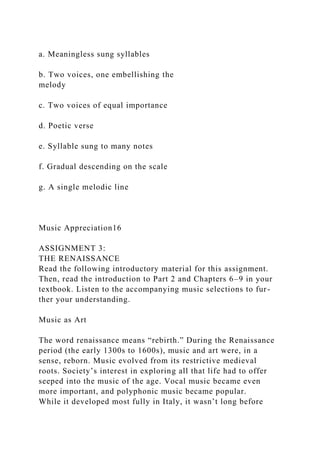
a. Meaningless sung syllables
b. Two voices, one embellishing the
melody
c. Two voices of equal importance
d. Poetic verse
e. Syllable sung to many notes
f. Gradual descending on the scale
g. A single melodic line
Music Appreciation16
ASSIGNMENT 3:
THE RENAISSANCE
Read the following introductory material for this assignment.
Then, read the introduction to Part 2 and Chapters 6–9 in your
textbook. Listen to the accompanying music selections to fur-
ther your understanding.
Music as Art
The word renaissance means “rebirth.” During the Renaissance
period (the early 1300s to 1600s), music and art were, in a
sense, reborn. Music evolved from its restrictive medieval
roots. Society’s interest in exploring all that life had to offer
seeped into the music of the age. Vocal music became even
more important, and polyphonic music became popular.
While it developed most fully in Italy, it wasn’t long before
people throughout Western Europe began to view music—as
well as other kinds of art—as a means of expressing purely
human values and emotions. New forms of nonreligious
music were created as composers began to experiment with
complex melodies, harmonies, and rhythmic patterns. The same
energy and creativity also influenced the style of religious
music of the period. Overall, restraint and balance were the
defining characteristics of Renaissance music.
Once you’ve finished the reading assignments and have
listened to the music selections in Assignment 3, complete
Self-Check 3.
Lesson 1 17
After you’ve finished Self-Check 3, take time to review all the
assignments in the lesson. Then complete the examination
for Lesson 1.
Self-Check 3
1. What are the four registers of the human voice?
_____________________________________________________
_____
_____________________________________________________
_____
2. Writing a new melody against an existing one is the first step
in _______.
3. A musical setting of a text in a single strophe is called a/an
_______.
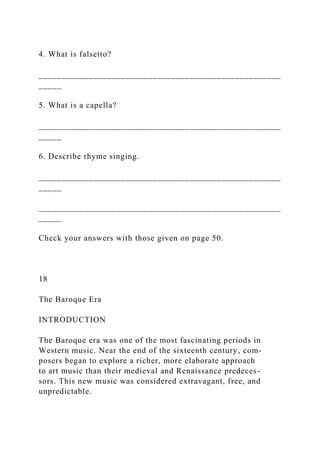
4. What is falsetto?
_____________________________________________________
_____
5. What is a capella?
_____________________________________________________
_____
6. Describe rhyme singing.
_____________________________________________________
_____
_____________________________________________________
_____
Check your answers with those given on page 50.
18
The Baroque Era
INTRODUCTION
The Baroque era was one of the most fascinating periods in
Western music. Near the end of the sixteenth century, com-
posers began to explore a richer, more elaborate approach
to art music than their medieval and Renaissance predeces-
sors. This new music was considered extravagant, free, and
unpredictable.
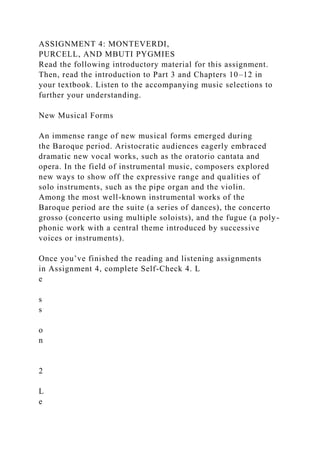
ASSIGNMENT 4: MONTEVERDI,
PURCELL, AND MBUTI PYGMIES
Read the following introductory material for this assignment.
Then, read the introduction to Part 3 and Chapters 10–12 in
your textbook. Listen to the accompanying music selections to
further your understanding.
New Musical Forms
An immense range of new musical forms emerged during
the Baroque period. Aristocratic audiences eagerly embraced
dramatic new vocal works, such as the oratorio cantata and
opera. In the field of instrumental music, composers explored
new ways to show off the expressive range and qualities of
solo instruments, such as the pipe organ and the violin.
Among the most well-known instrumental works of the
Baroque period are the suite (a series of dances), the concerto
grosso (concerto using multiple soloists), and the fugue (a poly-
phonic work with a central theme introduced by successive
voices or instruments).
Once you’ve finished the reading and listening assignments
in Assignment 4, complete Self-Check 4. L
e
s
s
o
n
2
L
e
s
s
o
n
2
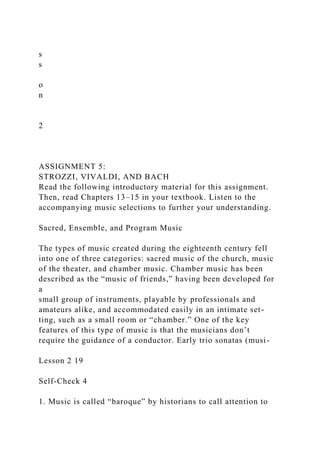
ASSIGNMENT 5:
STROZZI, VIVALDI, AND BACH
Read the following introductory material for this assignment.
Then, read Chapters 13–15 in your textbook. Listen to the
accompanying music selections to further your understanding.
Sacred, Ensemble, and Program Music
The types of music created during the eighteenth century fell
into one of three categories: sacred music of the church, music
of the theater, and chamber music. Chamber music has been
described as the “music of friends,” having been developed for
a
small group of instruments, playable by professionals and
amateurs alike, and accommodated easily in an intimate set-
ting, such as a small room or “chamber.” One of the key
features of this type of music is that the musicians don’t
require the guidance of a conductor. Early trio sonatas (musi-
Lesson 2 19
Self-Check 4
1. Music is called “baroque” by historians to call attention to
the _______ and
_______ qualities of the music.
2. A drama sung from beginning to end is a/an _______.
3. The musical term for “continuous bass” is _______.
4. One of the first operas ever written in English was _______.
5. What does “opera seria” mean?
_____________________________________________________
_____
Check your answers with those given on page 51.
Music Appreciation20
cal pieces written for two solo instruments along with an
underlying continuous bass line and harmonies, or a basso
continuo line) are attributed to Johann Sebastian Bach,
among others. Later in the Baroque period, these pieces were
taken on by larger groups of instruments.
Once you’ve finished the reading assignments and have
listened to the music selections in Assignment 5, complete
Self-Check 5.
Self-Check 5
1. Repeating the same words with the same basic melody at
intervals during the course of a
work is called the _______.
2. What is trio-sonata texture?
_____________________________________________________
_____
3. What is the maximum number of parts allowed in chamber
music?
_____________________________________________________
_____
4. A polyphonic work based on a central theme is called a/an
_______.
5. More than half the women who published music in Italy
between the mid-sixteenth century
and the eighteenth century were _______.
6. How is chamber music similar to jazz?
_____________________________________________________
_____
_____________________________________________________
_____
Check your answers with those given on page 51.
Lesson 2 21
ASSIGNMENT 6:
BACH AND HANDEL
Read the following introductory material for this assignment.
Then, read Chapters 16–18 in your textbook. Listen to the
accompanying music selections to further your understanding.
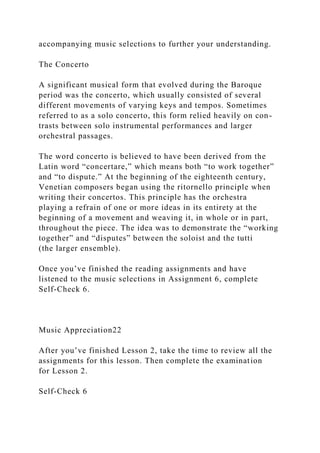
The Concerto
A significant musical form that evolved during the Baroque
period was the concerto, which usually consisted of several
different movements of varying keys and tempos. Sometimes
referred to as a solo concerto, this form relied heavily on con-
trasts between solo instrumental performances and larger
orchestral passages.
The word concerto is believed to have been derived from the
Latin word “concertare,” which means both “to work together”
and “to dispute.” At the beginning of the eighteenth century,
Venetian composers began using the ritornello principle when
writing their concertos. This principle has the orchestra
playing a refrain of one or more ideas in its entirety at the
beginning of a movement and weaving it, in whole or in part,
throughout the piece. The idea was to demonstrate the “working
together” and “disputes” between the soloist and the tutti
(the larger ensemble).
Once you’ve finished the reading assignments and have
listened to the music selections in Assignment 6, complete
Self-Check 6.
Music Appreciation22
After you’ve finished Lesson 2, take the time to review all the
assignments for this lesson. Then complete the examination
for Lesson 2.
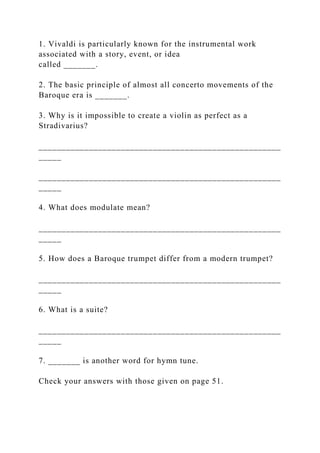
Self-Check 6
1. Vivaldi is particularly known for the instrumental work
associated with a story, event, or idea
called _______.
2. The basic principle of almost all concerto movements of the
Baroque era is _______.
3. Why is it impossible to create a violin as perfect as a
Stradivarius?
_____________________________________________________
_____
_____________________________________________________
_____
4. What does modulate mean?
_____________________________________________________
_____
5. How does a Baroque trumpet differ from a modern trumpet?
_____________________________________________________
_____
6. What is a suite?
_____________________________________________________
_____
7. _______ is another word for hymn tune.
Check your answers with those given on page 51.
23
The Classical Era
INTRODUCTION
In Lesson 3, you’ll explore the beauty and power of the music
of the Classical period, which lasted from about 1750 until
approximately 1820. Although the timespan may seem brief,
many of the best-known and best-loved art music heard around
the world today was written during the Classical period. In
this lesson, you’ll explore the unique approach to music used
by Classical composers, as well as the various musical forms
they developed.
ASSIGNMENT 7: HAYDN AND
MUSICIANS OF JAPAN
Read the following introductory material for this assignment.
Then, read the introduction to Part 4 and Chapters 19–21 in
your textbook. Listen to the accompanying music selections to
further your understanding.
The Classical Period
The Classical period in music coincided with a social period
marked by widespread interest in logic, science, and
philosophy.
Classical composers abandoned the dramatic excesses of the
Baroque period in favor of a more formal, elegant approach.
The
melodic line of Classical music became clear and simple, rarely
overshadowed by ornamentation, counterpoint, or harmony.
Classical composers brought a new sense of elegance, bal-
ance, and proportion to opera. Perhaps for this reason, many
of the operatic works performed today are from the Classical,
rather than the Baroque, period. Two different approaches to
the opera form also emerged during the Classical era. Opera
buffa was lighter and more comic in style and content. Opera
seria retained the more dramatic, often tragic, function that
characterized operas of the Baroque period.
L
e
s
s
o
n
3
L
e
s
s
o
n
3
Music Appreciation24
Music of Asia
The Asian continent includes a wide range of cultures, many
of which developed in isolation from one another. It’s difficult,
therefore, to find a common thread among the various styles
of Asian music. Chinese music is somewhat formal, and built
around a pentatonic scale, and consists primarily of melodic
lines. Harmony plays a rather small role in Chinese music.
Native Japanese music was strongly influenced by Chinese
and Korean styles, and many Japanese musical compositions
are also similarly based on a pentatonic scale.
Once you’ve finished the reading assignments and have
listened to the music selections in Assignment 7, complete
Self-Check 7.
Self-Check 7
1. Another term for comic opera is _______.
2. _______ is the use or adaptation of a work to serve
something other than its original
purpose.
3. What is the name of the plucked stringed instrument from
Japan with 13 silk strings?
_____________________________________________________
_____
4. A lively, stylized dance in triple meter and in the tonic key is
called a/an _______.
5. An Italian word for “round dance” is _______.
6. Why were Haydn’s later symphonies missing the basso
continuo?
_____________________________________________________
_____
Check your answers with those given on page 51.
Lesson 3
ASSIGNMENT 8:
MOZART AND BILLINGS
Read the following introductory material for this assignment.
Then, read Chapters 22–25 in your textbook. Listen to the
accompanying music selections to further your understanding.
The Sonata
Probably the most significant development of the Classical
period was the sonata form. The sonata form elaborates the
musical theme into three distinct movements. The first move-
ment, or exposition, introduces the main theme. The second
movement, commonly called the development, introduces
themes
related to the main theme. These variations may appear as
counterpoints or variations on the principal theme. The third
movement, known as the recapitulation, returns to the esposi-
tion and often expands it into a richly expressive finale. Since
the mid-eighteenth century, the sonata form has been used
as the framework for thousands of works. It was embraced
most thoroughly by Mozart and is evident in his many sym-
phonies.
Mozart
There’s a reason that several chapters of your textbook are
dedicated to Mozart. Wolfgang Amadeus Mozart is one of the
world’s best-known and most respected Classical composers.
In spite of his personal eccentricity, he wrote graceful music
that revealed both brilliance and passion. He composed more
than 600 pieces, including concertos, operas, and sym-
phonies, as well as Masses and dance and choral pieces. He
played piano and violin as a very young child and began
composing on the keyboard when he was five years old. His
father took him and his sister on performance tours through-
out Europe when they were children. At 17, Mozart won a
position as court musician in his native city of Salzburg,
Austria. Eventually, he moved to Vienna, where his genius
was appreciated and he made a good living writing and per-
forming music. However, he went into debt and died at the
age of 35.
25
Music Appreciation26
Once you’ve finished the reading assignments and have
listened to the music selections in Assignment 8, complete
Self-Check 8.
After you’ve finished Lesson 3, take the time to review all the
assignments for this lesson. Then complete the examination for
Lesson 3.
Self-Check 8
1. What is the exposition?
_____________________________________________________
_____
_____________________________________________________
_____
2. What is the driving force behind the concerto?
_____________________________________________________
_____
_____________________________________________________
_____
3. What are the differences between the standard sonata form
and the double-exposition
concerto form?
_____________________________________________________
_____
_____________________________________________________
_____
_____________________________________________________
_____
4. What is the difference between accompanied recitative and
standard recitative accompaniment?
_____________________________________________________
_____
_____________________________________________________
_____
Check your answers with those given on page 52.
The Nineteenth Century,
Part 1
INTRODUCTION
The Romantic period in music history spans nearly the entire
nineteenth century, a period of great social change across
Europe. The Industrial Revolution, which began in the early
part of the century, completely transformed everyday life.
Factories sprang up in towns and cities, and thousands of
rural laborers abandoned their farms to work in urban areas.
Pollution, along with the construction of new industrial
centers, altered the European landscape in ways still evident
today. As you’ll see in this lesson, many of the period’s artists
responded to the rapid changes around them by adopting a
reverent attitude toward nature and a longing for the past.
ASSIGNMENT 9: BEETHOVEN,
SCHUBERT, AND MENDELSSOHN
Read the following introductory material for this assignment.
Then, read the introduction to Part 5 and Chapters 26–28 in
your textbook. Listen to the accompanying music selections
to further your understanding.
Science and Style
Classical composers had a somewhat mathematical approach
to creating music. Of all of the composers of the Classical
period, few have made as great an impact on the history and
development of music as Ludwig van Beethoven. Beethoven
composed a tremendous variety of musical works. Most schol-
ars agree, however, that his most profound contribution lay in
the musical form known as the symphony, a long orchestral
composition organized into several movements.
27
L
e
s
s
o
n
4
L
e
s
s
o
n
4
Music Appreciation28
Beethoven was particularly interested in the expressive range
and capabilities of the piano. Some of his most interesting
and dynamic works were written for that instrument. The
changes he brought to piano compositions reflect the stylistic
influence of the Classical period.
Later, Romantic composers of the nineteenth century gradu-
ally abandoned the Classical composers’ approach to music.
While they continued to use many of the forms developed
during the Classical period, Romantic composers turned their
attention to the emotional power of music. They adopted more
fluid melodies with complex harmonies. Their rhythms, too,
were more varied than those of the Classical period.
Many Romantic-era composers looked beyond Classical
forms for other means of musical expression. One new form
developed during the Romantic period was program music.
Instead of the traditional structure of theme and development,
program music was based on associations with nonmusical
ideas, such as a story, a person, or an event.
Once you’ve finished the reading assignments and have
listened to the music selections in Assignment 9, complete
Self-Check 9.
Lesson 4 29
Self-Check 9
1. How many symphonies were written by Beethoven?
_____________________________________________________
_____
2. Define the term cyclic.
_____________________________________________________
_____
3. A poem that tells a story is known as a/an _______.
4. Schubert set Goethe’s ballad “Erlkönig” into the musical
form Lied, which is comprised of a/an
_______.
5. A type of music that’s purely instrumental and openly linked
to some object, story, or idea
outside the music is called _______.
6. Which play by William Shakespeare was adapted to music by
Felix Mendelssohn?
_____________________________________________________
_____
Check your answers with those given on page 52.
Music Appreciation30
ASSIGNMENT 10: BERLIOZ,
HENSEL, AND SCHUMANN
Read the following introductory material for this assignment.
Then, read Chapters 29–31 in your textbook. Listen to the
accompanying music selections to further your understanding.
Stories in Music
Romantic composers are known for developing new musical
forms to convey a more personal, intimate experience to
listeners. One of these forms, known as the art song,
consisted of a poem sung to music. The music itself was
deliberately crafted to reflect the overall tone and feeling of
the poem. You’ll study an example of program music, Hector
Berlioz’s emotional Symphonie fantastique, which he also
related through a detailed written program.
In addition, composers of this era developed new instrumental
forms. For example, the ballade and the berceuse were song-
like compositions. The prelude and the nocturne were short,
solo instrumental works. Songs without words, which used
meter to imply a voice, were created by Fanny Hensel.
Once you’ve finished the reading assignments and have
listened to the music selections in Assignment 10, complete
Self-Check 10.
After you’ve finished Self-Check 10, take time to review all the
assignments in the lesson. Then complete the examination for
Lesson 4.
Lesson 4 31
Self-Check 10
1. The art of arranging music for orchestral instruments is
called _______.
2. Define tetrameter.
_____________________________________________________
_____
3. What is a piano trio?
_____________________________________________________
_____
4. A group of unaccompanied voices is called a/an _______
chorus.
5. _______ was the brother of Fanny Hensel.
Check your answers with those given on page 52.
32
The Nineteenth Century,
Part 2
INTRODUCTION
Many Romantic composers chose to break with the past by
bringing a new sense of freedom and lyricism to existing
musical forms. For example, in the hands of Russian com-
poser Pyotr Tchaikovsky, ballet music attained a stunning
level of beauty and emotional power.
ASSIGNMENT 11: CHOPIN,
GOTTSCHALK, SHANKAR,
AND VERDI
Read the following introductory material for this assignment.
Then, read Chapters 32–35 in your textbook. Listen to the
accompanying music selections to further your understanding.
The Ballade
One of the true masters of the Romantic music of the nineteenth
century was Frédéric Chopin. Although most of his composi-
tions were written as solo piano pieces, he was credited with
inventing a musical form called the instrumental ballade. Like
other ballad forms, the instrumental ballade suggests a narra-
tive; Chopin’s ballads were inspired by the poems of Adam
Mickiewicz. He was also responsible for the innovation of the
piano sonata, the etude (a short, solo piece for the piano requir-
ing technical virtuosity), and the mazurka, a Polish folk dance
in triple meter that served as a salute to his Polish heritage.
Louis Moreau Gottschalk was the first American pianist to be
recognized internationally and has been referred to as both
the American Chopin and the “First Gershwin.” It has also
been said that without Gottschalk, there would be no jazz;
his use of syncopation influenced ragtime music, which also
drew on the “ragged” rhythms of African and Caribbean music.
L
e
s
s
o
n
5
L
e
s
s
o
n
5
Lesson 5 33
He was the first American composer to be consciously guided
by the folk themes of Latin American and Creole cultures,
African American rhythms, and classic European form. This
was probably due to his heritage: his mother was Haitian-
Creole and his father was a German Jewish man who grew
up in London. He had a business relationship with
Chickering, the piano manufacturer, and endorsed their
instruments by playing them whenever possible. Gottschalk
also always made a show of removing his white gloves before
a performance.
Ravi Shankar
While the other three composers featured in this assignment
lived and worked in the nineteenth century, Chapter 34 intro-
duces Ravi Shankar, a famous twentieth-century sitarist and
composer. His performance of the traditional raga, which
includes mood or color in music performance, will acquaint
you with North Indian classical music and the tonal contrast
with European classical music. The raga also includes
improvisation, which was a prominent feature of nineteenth-
century virtuoso performances.
Once you’ve finished the reading assignments and have
listened to the music selections in Assignment 11, complete
Self-Check 11.
Music Appreciation34
Self-Check 11
1. The nineteenth century composer _______ was known for a
repertory consisting primarily of
character pieces.
2. A Polish folk dance in triple meter, with heavy accent on the
second or third beat of each
measure, is called the _______.
3. _______ was the first American-born piano virtuoso to
achieve international fame.
4. What are the three types of melody used by Verdi in La
Traviata?
_____________________________________________________
_____
5. Define diva.
_____________________________________________________
_____
Check your answers with those given on page 53.
Lesson 5 35
ASSIGNMENT 12: WAGNER,
BRAHMS, AND DVOŘÁK
Read the following introductory material for this assignment.
Then, read Chapters 36–38 in your textbook. Listen to the
accompanying music selections to further your understanding.
Drama and Counterpoint
Operatic composers reached new heights of dramatic
intensity with technically demanding arias and a richer
orchestration. Richard Wagner’s operas took a different
approach to the relationship between music and drama. He
developed the technique of leitmotif, a musical phrase
connected
with a character, event, or theme in the drama.
Composers such as Brahms and Dvořák (pronounced
DVOR-zhak) brought fresh ideas to established forms such
as the symphony and the string quartet. Sometimes linked
with Bach and Beethoven to make the “Three B’s” of music,
Johannes Brahms was a nineteenth-century composer of piano
and chorale music as well as music for chamber ensembles
and symphony orchestras. Firmly rooted in the technique
and structure of the Baroque and Classical musical periods,
he was also a master of counterpoint, a style of musical
writing that’s basic to the polyphonic texture and in which
every voice is a melody and all voices work together.
Brahms greatly influenced Antonín Dvořák, and the two
became friends. Dvořák was a professor of musical composi-
tion and instrumentation at the Prague Conservatory. In
1892, he gave up his position and moved to the United
States, where he became convinced that the country’s
nationalist music should grow from African American and
Native American roots. Dvořák returned his birth country of
Bohemia, now called the Czech Republic, in 1895.
Once you’ve finished the reading assignments and have
listened to the music selections in Assignment 12, complete
Self-Check 12.
Music Appreciation36
After you’ve finished Self-Check 12, take time to review all the
assignments in the lesson. Then complete the examination for
Lesson 5.
Self-Check 12
1. Darth Vader’s theme music in Star Wars is an example of
_______.
2. If a piece of music is considered “chromatic,” what does that
music include?
_____________________________________________________
_____
3. In his earlier career, Dvořák was a/an _______.
4. Define scherzo and explain what it means musically.
_____________________________________________________
_____
5. Dvořák was inspired by _______.
6. Who are the “three B’s” of German music?
_____________________________________________________
_____
Check your answers with those given on page 53.
The Twentieth Century,
Part 1
INTRODUCTION
It’s much more difficult to characterize the music of the
twentieth century than that of earlier periods in music
history. Part of the difficulty stems from the enormous amount
and variety of music produced during the past hundred or so
years. Composers from around the world have contributed a
broad array of national and ethnic influences.
During the nineteenth century, many European composers
and musicians moved to America, bringing with them their
skills, talents, and ambitions. These individuals powerfully
influenced American composers, who began to produce music
based on European models. Then, during the twentieth
century, art music began to reflect a distinctively American
character, which embraced both patriotic themes and the
polytonal and polyrhythmic elements of modern music. In
addition, twentieth-century inventions such as radio,
television, computers, and portable music devices made it
possible to share musical ideas and innovations more rapidly
than at any earlier point in history.
To better explore some of the ways in which modern musical
principles were put into practice, you’ll examine several cate-
gories of modern music. The mainstream category includes
modern variations on traditional forms, such as the sym-
phony, the aria, and the Mass. Neoclassicism, the return to
the more formal, intellectual approach that characterized the
works of the Classical period, became a prevalent style.
Expressionism is an artistic movement that reflected the grief
and anxiety underlying the early decades of the century.
Fianlly, folk music has a long history in the United States and
around the world.
37
L
e
s
s
o
n
6
L
e
s
s
o
n
6
Music Appreciation38
ASSIGNMENT 13:
DEBUSSY AND IVES
Read the following introductory material for this assignment.
Then, read the introduction to Part 6 and Chapters 39 and 40
in your textbook. Listen to the accompanying music selections
to further your understanding.
Impressionism and Transcendentalism
While use of the whole-tone scale among Western musical
pieces can be traced back to the works of Mozart, Claude
Debussy was one composer of the twentieth century who
used the whole-tone scale extensively in his compositions.
Debussy, a Russian-born composer, was very much like
other impressionist composers of the time who emphasized
timbre over melody in their compositions.
Charles Ives was educated in many types of music, including
church hymns, band music, and orchestral works. He incor-
porated all these idioms into his own music, which was also
influenced by the American transcendental movement in New
England. During this movement, writers and thinkers like
Ralph Waldo Emerson, Henry David Thoreau, and Bronson
Alcott questioned the intellectual status quo of the mid-
nineteenth century. Emerson described their philosophy as
looking at the world with new eyes and asking “What is
truth? What is good?” Ives both absorbed and rebelled
against tradition, and by challenging conventional ideas of
what was true or good in music, he pioneered modern music
in America, and his Piano Sonata no. 2, Concord, Mass.,
1840–60 was a direct interpretation of the transcendentalist
philosophy.
Once you’ve finished the reading assignments and have
listened to the music selections in Assignment 13, complete
Self-Check 13.
Lesson 6 39
ASSIGNMENT 14: SCHOENBERG,
STRAVINSKY, AND JOPLIN
Read the following introductory material for this assignment.
Then, read Chapters 41–43 in your textbook. Listen to the
accompanying music selections to further your understanding.
Primitive Influences
The music of Africa is extremely complex, characterized by the
simultaneous playing of several different rhythmic patterns
filled out with trills, slides, and other improvised melodic
elements. Much African music serves a functional role. For
example, it may be played at ceremonies or special events, or
it may tell the story of an important historic or social event.
Listeners often participate with the performers in a call-and-
response fashion. Primitivism celebrated the liveliness and
Self-Check 13
1. The quality of suggesting rather than stating is known as
_______.
2. A move from F# to G# would be considered a/an _______.
3. In Debussy’s time, the primary system of organizing pitch
was _______.
4. Debussy’s music is usually associated with _______.
5. When all the instruments in an orchestra are playing the same
rhythm, the ensemble is
playing in _______.
6. The clashing sounds of atonal music are called _______.
Check your answers with those given on page 53.
Music Appreciation40
color of Polynesian and African cultures. During the early
years of the twentieth century, African American composers
began to have an impact on popular music. Ragtime, with its
upbeat, syncopated tempo, quickly captured public attention.
During the years between World War I and World War II,
composers produced a slower, more melancholy style of music
referred to as blues. Jazz, a somewhat improvisational,
syncopated musical style that incorporates elements of
African American, Latin American, and French Creole
music, also emerged during this period.
Until the end of the nineteenth century, the traditional
approach to pitch was based on the principle of a tonal
center. In the twentieth century, a number of composers
abandoned the traditional tonal system and invented new
ways to craft melodic lines. One of the more important
systems, known as the tone row, was based on a set of 12
pitches unrelated to any tonal center. Other composers
extended the tone row system by incorporating one or more
series of pitches within a single tone row. This approach to
composition is referred to as serialism.
Once you’ve finished the reading assignments and have
listened to the music selections in Assignment 14, complete
Self-Check 14.
Lesson 6 41
Self-Check 14
Questions 1–10: Match the term in the left-hand column with its
definition in the right-
hand column.
Term Definition
______ 1. Expressionism
______ 2. Commedia dell’arte
______ 3. Pierrot lunaire
______ 4. Sprechstimme
______ 5. Atonal
______ 6. Pentatonic scale
______ 7. Ostinato
______ 8. Scenario
______ 9. Le Sacre du printemps
______ 10. Syncopation
Check your answers with those given on page 54.
a. Lacking tonal center
b. Repeated rhythmic gesture
c. Twentieth-century artistic movement
d. Cycle of poems
e. The use of rhythmic accents that oppose the
beat
f. Improvisational theater
g. Story line
h. Five-note scale
i. Slow recitative
j. Discordant composition
Music Appreciation42
ASSIGNMENT 15: JOHNSON,
ELLINGTON, PARKER, AND
CRAWFORD
Read the following introductory material for this assignment.
Then, read Chapters 44–47 in your textbook. Listen to the
accompanying music selections to further your understanding.
New Forms and Styles
A wide variety of musical styles and forms emerged in the
twentieth century. Many twentieth-century composers aban-
doned the traditional approach to rhythm and explored ways
to create fascinating—and sometimes startling—effects. They
also abandoned the traditional approach to melody, creating
melodic lines characterized by unexpected leaps, dips, and
other changes. Their harmonies became more complex and
variable, often composed without reference to tonal centers.
Once you’ve finished the reading assignments and have
listened to the music selections in Assignment 15, complete
Self-Check 15.
After you’ve finished Self-Check 15, take time to review all the
assignments in the lesson. Then complete the examination
for Lesson 6.
Lesson 6 43
Self-Check 15
1. Raw, authentic, and noisy describe the _______ of a historic
blues recording.
2. Downhome blues songs are often marked by _______ as well
as woe.
3. _______ notes are generally about a half step lower than the
standard major scale.
4. The _______ is one of the most common chord patterns in big
band jazz.
5. A/An _______ occurs when as many individual notes of a
chord as possible are played within
the same octave.
6. When shorter notes continually propel music toward the
longer notes, the result is the
rhythmic groove called _______.
7. After World War II, the musical craze that infiltrated the jazz
world was known as _______.
8. The range in which music is presented is the _______.
9. The AABA pattern is called the _______ because it was used
so pervasively in popular hits of
the 1920s and 1930s.
10. The compositions of _______ challenged the divisions
between jazz and classical music.
Check your answers with those given on page 54.
44
The Twentieth Century,
Part 2
ASSIGNMENT 16: TAILLEFERRE,
STILL, COPLAND, BARTOK,
BERNSTEIN, AND CAGE
Read the following introductory material for this assignment.
Then, read Chapters 48–53 in your textbook. Listen to the
accompanying music selections to further your understanding.
Experimentation and Roots
Composers in the latter part of the twentieth century experi-
mented even more widely with musical form. The English
composer John Cage, for example, incorporated elements of
chance and unpredictability into his work. Sometimes he even
based the structure of a melodic line on a random throw of
dice. Other composers explored new electronic means of
producing music thanks to breakthroughs in technology.
Twentieth-century music also drew on its roots in folk music.
As you may recall from Lesson 6, folk music refers to the
music created and refined during a long period of time by a
group of people who share a similar cultural heritage. Ethnic
music shares many characteristics with folk music, but it’s
typically produced by a small or specialized segment of a par-
ticular culture. Both types tend to be created spontaneously
through improvisation. The individuals or groups who produce
such songs rarely invest the same degree of planning and
organization demonstrated by composers of art music. Yet,
even classical composers often have been influenced in subtle
ways by the music of their cultures. Aaron Copland’s compo-
sitions are distinctly American, reflecting both the openness
of the West and the country’s folk music heritage.
American folk music incorporates the ballad form, but also
includes a number of other forms. The subject matter
frequently revolves around a story, such as an account of a
L
e
s
s
o
n
7
L
e
s
s
o
n
7
Lesson 7 45
heroic battle or a tragic love affair. This type of folk music is
often referred to as a ballad and ranges from square-dance
music to occupational songs, which focus on the lives of cow-
boys, railroad workers, or wagon train drivers.
Once you’ve finished the reading assignments and have
listened to the music selections in Assignment 16, complete
Self-Check 16.
Self-Check 16
1. A tonal scale consisting entirely of half-steps is said to be
_______.
2. The first African American composer to win a Pulitzer Prize
in music was _______.
3. Western square dancing is an energetic dance in _______
meter.
4. Another word for small opera is _______.
5. John Cage’s 4�33� consists of three movements during
which the musician plays _______.
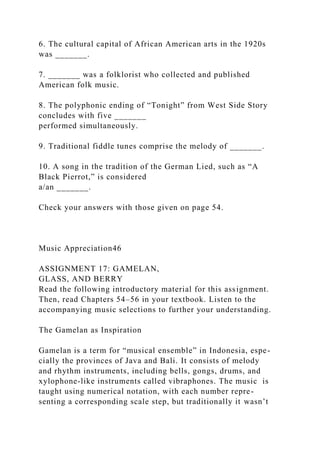
6. The cultural capital of African American arts in the 1920s
was _______.
7. _______ was a folklorist who collected and published
American folk music.
8. The polyphonic ending of “Tonight” from West Side Story
concludes with five _______
performed simultaneously.
9. Traditional fiddle tunes comprise the melody of _______.
10. A song in the tradition of the German Lied, such as “A
Black Pierrot,” is considered
a/an _______.
Check your answers with those given on page 54.
Music Appreciation46
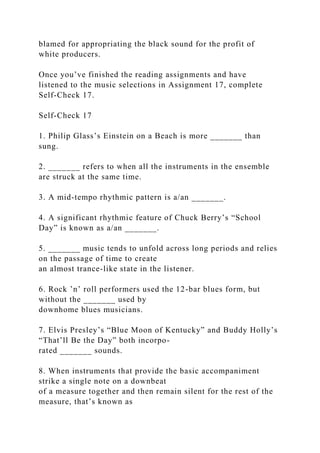
ASSIGNMENT 17: GAMELAN,
GLASS, AND BERRY
Read the following introductory material for this assignment.
Then, read Chapters 54–56 in your textbook. Listen to the
accompanying music selections to further your understanding.
The Gamelan as Inspiration
Gamelan is a term for “musical ensemble” in Indonesia, espe-
cially the provinces of Java and Bali. It consists of melody
and rhythm instruments, including bells, gongs, drums, and
xylophone-like instruments called vibraphones. The music is
taught using numerical notation, with each number repre-
senting a corresponding scale step, but traditionally it wasn’t
notated and players had to learn their parts by rote. Gamelan
compositions are built on a series of ostinatos—repeated
musical patterns. Each ostinato has a different length and is
set in a different tempo. Musicians inspired by gamelan
music include Claude Debussy, John Cage, and Philip Glass,
all whom are mentioned in the textbook.
Technology and Rebellion
Increasingly sophisticated recording technology has made it
possible for people to listen to and share music of widely
varied form and content. As a result, composers from diverse
musical backgrounds have influenced each other in countless
ways. Country music, rock music, Latin American music, and
music for live theater and films are just a few types of music
that became popular during the twentieth century. While
live performances have always been an important part of
experiencing music, new sounds were created by playing with
technology and creating sounds that couldn’t be reproduced
in a live performance, at least without some kind of electronic
augmentation.
A great example of this is Chuck Berry, who pioneered the
combination of songwriting, guitar playing, and singing,
effective for both recordings and live performances. While
songs like “School Day” and “Rock Around the Clock” seem
Lesson 7 47
tame by today’s standards, they were a shocking combination
of rebellious attitude, black rhythm and blues, and youthful
sound that many adults found threatening. Elvis Presley is
considered a crossover, credited with introducing white audi-
ences to black music— or, depending on your point of view,
blamed for appropriating the black sound for the profit of
white producers.
Once you’ve finished the reading assignments and have
listened to the music selections in Assignment 17, complete
Self-Check 17.
Self-Check 17
1. Philip Glass’s Einstein on a Beach is more _______ than
sung.
2. _______ refers to when all the instruments in the ensemble
are struck at the same time.
3. A mid-tempo rhythmic pattern is a/an _______.
4. A significant rhythmic feature of Chuck Berry’s “School
Day” is known as a/an _______.
5. _______ music tends to unfold across long periods and relies
on the passage of time to create
an almost trance-like state in the listener.
6. Rock ’n’ roll performers used the 12-bar blues form, but
without the _______ used by
downhome blues musicians.
7. Elvis Presley’s “Blue Moon of Kentucky” and Buddy Holly’s
“That’ll Be the Day” both incorpo-
rated _______ sounds.
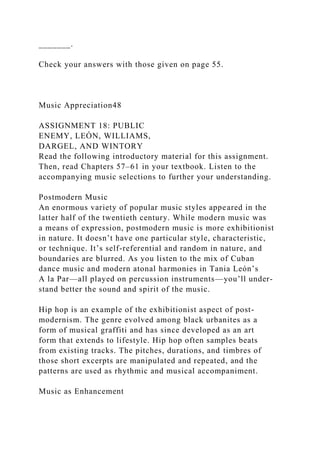
8. When instruments that provide the basic accompaniment
strike a single note on a downbeat
of a measure together and then remain silent for the rest of the
measure, that’s known as
_______.
Check your answers with those given on page 55.
Music Appreciation48
ASSIGNMENT 18: PUBLIC
ENEMY, LEÓN, WILLIAMS,
DARGEL, AND WINTORY
Read the following introductory material for this assignment.
Then, read Chapters 57–61 in your textbook. Listen to the
accompanying music selections to further your understanding.
Postmodern Music
An enormous variety of popular music styles appeared in the
latter half of the twentieth century. While modern music was
a means of expression, postmodern music is more exhibitionist
in nature. It doesn’t have one particular style, characteristic,
or technique. It’s self-referential and random in nature, and
boundaries are blurred. As you listen to the mix of Cuban
dance music and modern atonal harmonies in Tania León’s
A la Par—all played on percussion instruments—you’ll under-
stand better the sound and spirit of the music.
Hip hop is an example of the exhibitionist aspect of post-
modernism. The genre evolved among black urbanites as a
form of musical graffiti and has since developed as an art
form that extends to lifestyle. Hip hop often samples beats
from existing tracks. The pitches, durations, and timbres of
those short excerpts are manipulated and repeated, and the
patterns are used as rhythmic and musical accompaniment.
Music as Enhancement
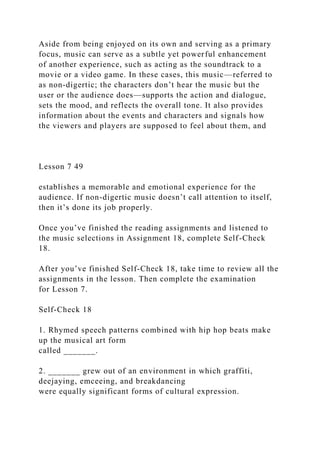
Aside from being enjoyed on its own and serving as a primary
focus, music can serve as a subtle yet powerful enhancement
of another experience, such as acting as the soundtrack to a
movie or a video game. In these cases, this music—referred to
as non-digertic; the characters don’t hear the music but the
user or the audience does—supports the action and dialogue,
sets the mood, and reflects the overall tone. It also provides
information about the events and characters and signals how
the viewers and players are supposed to feel about them, and
Lesson 7 49
establishes a memorable and emotional experience for the
audience. If non-digertic music doesn’t call attention to itself,
then it’s done its job properly.
Once you’ve finished the reading assignments and listened to
the music selections in Assignment 18, complete Self-Check
18.
After you’ve finished Self-Check 18, take time to review all the
assignments in the lesson. Then complete the examination
for Lesson 7.
Self-Check 18
1. Rhymed speech patterns combined with hip hop beats make
up the musical art form
called _______.
2. _______ grew out of an environment in which graffiti,
deejaying, emceeing, and breakdancing
were equally significant forms of cultural expression.
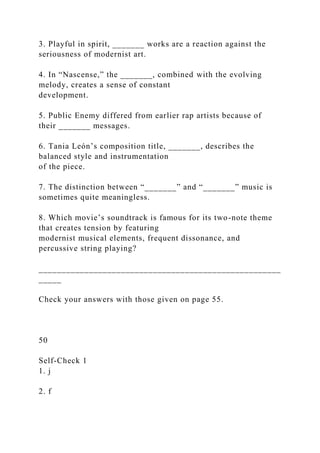
3. Playful in spirit, _______ works are a reaction against the
seriousness of modernist art.
4. In “Nascense,” the _______, combined with the evolving
melody, creates a sense of constant
development.
5. Public Enemy differed from earlier rap artists because of
their _______ messages.
6. Tania León’s composition title, _______, describes the
balanced style and instrumentation
of the piece.
7. The distinction between “_______” and “_______” music is
sometimes quite meaningless.
8. Which movie’s soundtrack is famous for its two-note theme
that creates tension by featuring
modernist musical elements, frequent dissonance, and
percussive string playing?
_____________________________________________________
_____
Check your answers with those given on page 55.
50
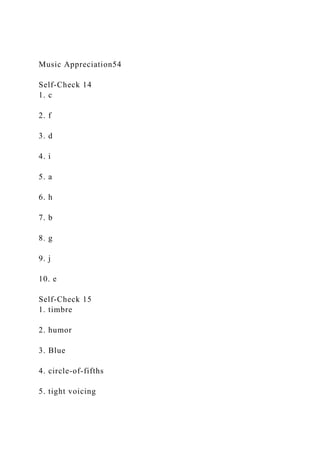
Self-Check 1
1. j
2. f
3. g
4. b
5. e
6. i
7. c
8. a
9. d
10. h
Self-Check 2
1. c
2. g
3. e
4. a
5. b
6. d
7. f
Self-Check 3
1. Soprano, alto, tenor, bass
2. counterpoint
3. madrigal
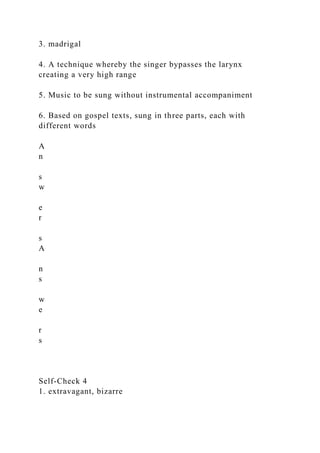
4. A technique whereby the singer bypasses the larynx
creating a very high range
5. Music to be sung without instrumental accompaniment
6. Based on gospel texts, sung in three parts, each with
different words
A
n
s
w
e
r
s
A
n
s
w
e
r
s
Self-Check 4
1. extravagant, bizarre
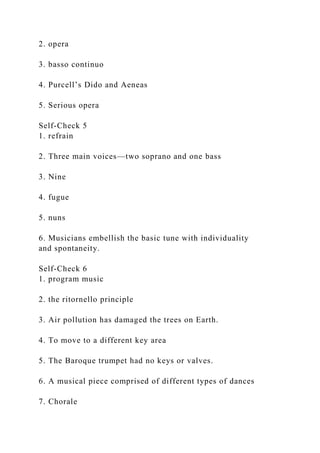
2. opera
3. basso continuo
4. Purcell’s Dido and Aeneas
5. Serious opera
Self-Check 5
1. refrain
2. Three main voices—two soprano and one bass
3. Nine
4. fugue
5. nuns
6. Musicians embellish the basic tune with individuality
and spontaneity.
Self-Check 6
1. program music
2. the ritornello principle
3. Air pollution has damaged the trees on Earth.
4. To move to a different key area
5. The Baroque trumpet had no keys or valves.
6. A musical piece comprised of different types of dances
7. Chorale
Self-Check 7
1. opera buffa
2. Musical appropriation
3. Koto
Self-Check Answers 51
Music Appreciation52
4. minuet
5. rondo
6. The voices were sufficiently full without it.
Self-Check 8
1. The introduction to a movement’s thematic idea
2. The dramatic tension between soloist and orchestra
3. Standard sonata form has one literally repeated exposition
that modulates from the tonic. There is no cadenza.
Double-exposition concerto form has two different expo-
sitions. The first exposition (for the orchestra alone)
stays in the tonic, while the second (for the soloist and
orchestra together) modulates to a new key area. At the
end of the recapitulation, the soloist plays a cadenza.
4. An accompanied recitative accompanied by the orchestra
A standard recitative accompanied by basso continuo
alone.
Self-Check 9
1. Nine
2. Individual movements linked in a tangible and
distinctive way
3. ballad
4. solo voice and piano accompaniment
5. program music
6. A Midsummer Night’s Dream
Self-Check 10
1. orchestration
2. Each line has four basic units.
3. An ensemble made up of violin, piano, and cello
Self-Check Answers 53
4. a capella
5. Felix Mendelssohn
Self-Check 11
1. Chopin
2. mazurka
3. Gottschalk
4. Declamatory, virtuosic, lyrical
5. Goddess; a female singer/phenomenon whose life story
is as fascinating as her artistic accomplishments
Self-Check 12
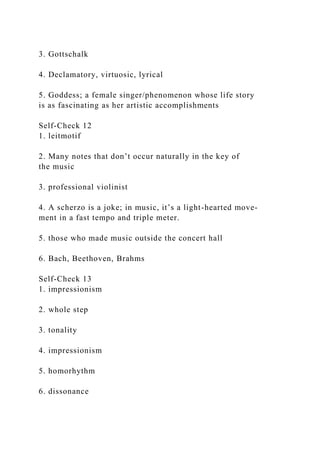
1. leitmotif
2. Many notes that don’t occur naturally in the key of
the music
3. professional violinist
4. A scherzo is a joke; in music, it’s a light-hearted move-
ment in a fast tempo and triple meter.
5. those who made music outside the concert hall
6. Bach, Beethoven, Brahms
Self-Check 13
1. impressionism
2. whole step
3. tonality
4. impressionism
5. homorhythm
6. dissonance
Music Appreciation54
Self-Check 14
1. c
2. f
3. d
4. i
5. a
6. h
7. b
8. g
9. j
10. e
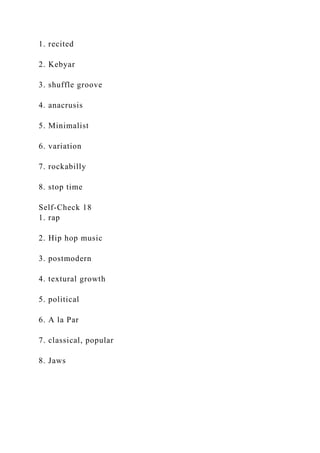
Self-Check 15
1. timbre
2. humor
3. Blue
4. circle-of-fifths
5. tight voicing
6. swing
7. bebop
8. register
9. Standard Song Form
10. Duke Ellington
Self-Check 16
1. chromatic
2. George Walker
3. duple
4. operetta
Self-Check Answers 55
5. nothing
6. Harlem
7. Alan Lomax
8. monologues
9. “Hoe-Down”
10. art song
Self-Check 17
1. recited
2. Kebyar
3. shuffle groove
4. anacrusis
5. Minimalist
6. variation
7. rockabilly
8. stop time
Self-Check 18
1. rap
2. Hip hop music
3. postmodern
4. textural growth
5. political
6. A la Par
7. classical, popular
8. Jaws
Study GuideMusic AppreciationByEric SwansonA.docx

Study GuideMusic AppreciationByEric SwansonA.docx

  • 1.
    Study Guide Music Appreciation By EricSwanson About the Author Eric Swanson is a graduate of Yale University and The Juilliard School. He is the author of What the Lotus Said: A Journey to Tibet and Back and the novels The Greenhouse Effect and The Boy in the Lake. He has also written a set of thirty-five essays on the lives of com- posers of classical music for the LaserLight CD-ROM label. Copyright © 2014 by Penn Foster, Inc. All rights reserved. No part of the material protected by this copyright may be reproduced or utilized in any form or by any means, electronic or mechanical, including photocopying, recording, or by any information storage and retrieval system, without permission in writing from the copyright owner. Requests for permission to make copies of any part of the work should be
  • 2.
    mailed to CopyrightPermissions, Penn Foster, 925 Oak Street, Scranton, Pennsylvania 18515. Printed in the United States of America All terms mentioned in this text that are known to be trademarks or service marks have been appropriately capitalized. Use of a term in this text should not be regarded as affecting the validity of any trademark or service mark. INSTRUCTIONS TO STUDENTS 1 LESSON ASSIGNMENTS 7 LESSON 1: THE MIDDLE AGES AND THE RENAISSANCE 9 LESSON 2: THE BAROQUE ERA 18 LESSON 3: THE CLASSICAL ERA 23 LESSON 4: THE NINETEENTH CENTURY, PART 1 27 LESSON 5: THE NINETEENTH CENTURY, PART 2 32 LESSON 6: THE TWENTIETH CENTURY, PART 1 37 LESSON 7: THE TWENTIETH CENTURY, PART 2 44 SELF-CHECK ANSWERS 50
  • 3.
    iii C o n t e n t s C o n t e n t s YOUR COURSE Your musicappreciation course is designed to offer you a solid foundation in the history of Western music, as well as an introduction to music from cultures around the world. As you make your way through this fascinating course, you’ll listen to a broad selection of musical works and learn about
  • 4.
    the people andcultures that created them. While reading your textbook and listening to the accompa- nying musical selections, you’ll experience the unique ways in which composers communicate to listeners. You’ll also begin to appreciate music on a new, more personal level as you focus on the artistic value and cultural importance of musical masterpieces. In the end, you’ll find yourself listening to music with a deeper level of attention than ever before. OBJECTIVES When you complete this course, you’ll be able to n Identify the basic principles of music theory, including melody, harmony, dynamics, and timbre n Name the main types of musical instruments n Distinguish between different forms of musical composition n Differentiate the major periods of Western musical history n Identify influential composers of various periods of musical history n Identify representative modern musical compositions and the movements associated with their creation 1 In s
  • 5.
    t r u c t io n s In s t r u c t io n s COURSE MATERIALS Your musiccourse provides you with the following materials: 1. This study guide, which includes an introduction to your course, plus
  • 6.
    n A lessonassignments page with a schedule of study assignments and lesson exams, which you’ll complete as you progress through the course n Explanatory material that emphasizes the main points of each lesson n Suggestions on what to take note of as you read and listen to the required material n Self-checks and answers to help you to assess your understanding of the material 2. Your textbook, Listen to This, which contains your assigned readings 3. Accompanying music tracks that illustrate the points addressed in the reading assignments KNOW YOUR TEXTBOOK Your textbook, Listen to This, offers a complete overview of the history of music from ancient times to the modern era. The lessons in your textbook are grouped into seven major parts that are comprised of several chapters each. Before you begin your first lesson, spend a little time skim- ming your textbook to become familiar with its basic design and organization. Your textbook is organized in such a way so you get the most out of your studies, and its features include profile sidebars that focus on key moments in com- posers’ lives and work; music timelines; and sections titled Historical Context, which place the music in the context of the social history of each era, and A Closer Look, which delve into detail about objects and events that shaped the history of music.
  • 7.
    Instructions to Students2 Sinceexperiencing music is vital to music appreciation, every chapter includes a supplemental listening assignment that can be accessed online. Listening guides are provided in each chapter to help you focus on the important details of each selection, as are the sections titled Listen To This First, which highlight what important aspects of the track you should listen for. The back portion of your textbook includes two useful study resources: a glossary that contains an alphabetized list of definitions of important musical terms and a detailed index of the subjects discussed in your textbook. Once you complete your study of the textbook, you can use these resources to refer to topics you may wish to review. Listen to This provides a complete overview of music history and theory. Each reading assignment is geared to assist you in exploring specific periods, styles, or forms of music. To complete the course quickly and easily, schedule time to read your textbook and complete the recommended listening exer- cises several times each week. As you progress through the course, you’ll soon discover the rewards of the effort you put into your study. YOUR STUDY GUIDE This study guide is a companion to your textbook and provides a lesson plan that will help you explore the history and theory of music. The guide is broken down into seven lessons. Each lesson in the study guide provides a practical overview of the
  • 8.
    areas covered, aswell as several reading and listening assignments. After you finish each assignment in the study guide, complete the short self-check to help measure your progress. For every lesson, you must also complete a multiple-choice examination. Instructions to Students 3 ACCOMPANYING MUSIC SELECTIONS Your study of music would be incomplete without hearing the selections you’re studying. Therefore, you’re encouraged to access and listen to the music tracks that exemplify the information from your reading assignments. To listen to the music selections, go to http://listening- guide.pearsoncmg.com/webroot/index.php/Collection/index/ id/8. The few tracks for which streaming audio rights haven’t been secured may be found by searching online or accessing music sites you’re already familiar with. Use the Listen To This First and Listening Guide sections in your textbook to identify the selections’ key attributes. Listen to each selection several times, both before and after reading the chapter in the textbook. A STUDY PLAN Work through this study guide one assignment at a time. After reading the assigned pages in your textbook and listening to the corresponding audio selections, you’ll have a chance to
  • 9.
    review the conceptsand skills you’ve learned by completing the self-checks. Once you’ve finished all the assignments included in each lesson, you’ll be ready to complete the examination for the lesson. Before you attempt to take an exam, make sure you’ve read all the assigned material and completed all the self-checks. To get the most out of your studies, follow these steps to complete your assigned work: Step 1: Skim through the assigned pages in both the study guide and the textbook to get a general idea of their contents. Try to develop an overall perspective on the concepts and skills you’ll be studying. Instructions to Students4 Step 2: Carefully read through the introductory material in the study guide, then read the assigned pages in your textbook and listen to the audio selections. Take notes on any important points or terms that you feel are especially significant and reread or replay selections you need to review. Step 3: Complete the self-checks after each assignment in your study guide and compare your answers with those given at the back of the guide. The self-checks are intended for your personal use in evaluating and directing your progress. If you answer any self- check questions incorrectly, review the assigned materials until you have a thorough understanding. Step 4: When you feel you’ve mastered all the material in the first assignment, proceed to your next assign-
  • 10.
    ment. Repeat Steps1–3 for the remaining assignments in each lesson. Step 5: Once you’ve finished all of the assignments and self-checks in Lesson 1, complete the multiple- choice examination for the lesson. Take your time with the exam, and feel free to refer to your text- book, the study guide, and any notes you may have taken. Step 6: When you’ve completed the assignments, self- checks, and examination for Lesson 1, proceed to the next lesson. Repeat Steps 1–5 for the remaining lessons in your study guide. Remember: At any point in your studies, you can email your instructor for further information or clarification. Your instructor can answer questions, provide additional information, and explain any of your study materials. You should find your instructor’s guidance and suggestions very helpful. You’re now ready to begin your study of music. Good luck! Instructions to Students 5 Instructions to Students6 NOTES
  • 11.
    Lesson 1: TheMiddle Ages and the Renaissance For: Read in the Read in the study guide: textbook: Assignment 1 Assignment 1 Pages 1–15 Assignment 2 Assignment 2 Pages 16–53 Assignment 3 Assignment 3 Pages 54–84 Examination 007409 Material in Lesson 1 Lesson 2: The Baroque Era For: Read in the Read in the study guide: textbook: Assignment 4 Assignment 4 Pages 85–110 Assignment 5 Assignment 5 Pages 111–132 Assignment 6 Assignment 6 Pages 133–159 Examination 007410 Material in Lesson 2 Lesson 3: The Classical Era For: Read in the Read in the study guide: textbook: Assignment 7 Assignment 7 Pages 160–190 Assignment 8 Assignment 8 Pages 191–226 Examination 007411 Material in Lesson 3
  • 12.
    Lesson 4: TheNineteenth Century, Part 1 For: Read in the Read in the study guide: textbook: Assignment 9 Assignment 9 Pages 227–254 Assignment 10 Assignment 10 Pages 255–271 Examination 007412 Material in Lesson 4 7 A s s ig n m e n t s A s s ig n
  • 13.
    m e n t s Lesson 5: TheNineteenth Century, Part 2 For: Read in the Read in the study guide: textbook: Assignment 11 Assignment 11 Pages 272–301 Assignment 12 Assignment 12 Pages 302–328 Examination 007413 Material in Lesson 5 Lesson 6: The Twentieth Century, Part 1 For: Read in the Read in the study guide: textbook: Assignment 13 Assignment 13 Pages 329–351 Assignment 14 Assignment 14 Pages 352–376 Assignment 15 Assignment 15 Pages 377–407 Examination 007414 Material in Lesson 6 Lesson 7: The Twentieth Century, Part 2
  • 14.
    For: Read inthe Read in the study guide: textbook: Assignment 16 Assignment 16 Pages 408–447 Assignment 17 Assignment 17 Pages 448–471 Assignment 18 Assignment 18 Pages 472–511 Examination 007415 Material in Lesson 7 Lesson Assignments8 9 L e s s o n 1 L e s s o
  • 15.
    n 1 The Middle Agesand the Renaissance INTRODUCTION Lesson 1 is your introduction to some of the basic elements of music that will be discussed throughout your course. In addition, this lesson offers you an opportunity to explore the music of two of the earliest periods of Western music: the Middle Ages and the Renaissance in Europe. ASSIGNMENT 1: ELEMENTS OF MUSIC Read the following introductory material for this assignment. Then, read the section “The Elements of Music: A Brief Introduction” in your textbook. In this assignment, you’ll explore the elements of music and learn to listen for thow they’re used in composition. You’ll be introduced to the nine elements of music, which are discussed in further detail in the introduction. Make sure you fully understand each of these terms, since they’re used throughout the course. The listening assignments included in the reading will give you examples of how each is used. Melody and Harmony In music, the relative highness or lowness of a sound is referred to as pitch. A series of pitches combined in a logical or self- contained unit is commonly referred to as a melody, tune, or theme. Melodies are typically distinguished from one another
  • 16.
    by several factors,such as length, the range of high and low pitches, and the overall musical shape, or contour, made by the sequence of sounds. The musical effect created by multiple sounds playing simultaneously is commonly known as harmony. Composers typically use harmony to support the melody and create a richer, fuller sound. Three or more notes played or sung at the same time are referred to as a chord. Rhythm Rhythm is composed of three essential elements: 1. Beat, a recurring pulse that drives through a segment of music 2. Meter, the organization of beats into recognizable or repeating patterns 3. Tempo, the speed at which beats are played; the tempo of various passages in a musical work is often indicated by Italian words such as presto (very fast) and largo (very slow). Texture The texture of music describes a composition’s combined melodic, harmonic, and rhythmic elements. If you think of music as a fabric, the interwoven instruments and voices provide the texture to the fabric. There could be a prominent thread that stands out among the others, or the “fabric” of the piece could be smooth and all one color. Make sure you under- stand the differences among the three major textures below, and try to distinguish each type as you listen to different
  • 17.
    kinds of music,especially your listening assignments. n Monophonic texture contains a single melody, whether it’s performed by one soloist or a group of singers or instruments in unison (all together). n Homophonic texture, the most common type, features a prominent melody that’s backed by the accompaniment of either music or voices. n Polyphonic texture includes several voices or instruments playing the melody, with none prominent. Music Appreciation10 Timbre, Dynamics, and Form Another essential element of music involves the way in which sounds are produced. For example, sounds may be produced softly or loudly. The term dynamics describes the relative loud- ness of sound. The quality of sound—such as its depth, richness, or sharpness—is referred to as its timbre. Musical instruments, as well as human voices, produce sounds of widely varying timbre and pitch. Composers use the tonal characteristics of different instruments in a variety of ways to achieve specific musical effects. Composers may have instru- ments played simultaneously or separately, depending on the effect they wish to achieve. For example, one instrument may play the melody by itself, or a group of instruments may carry the melody while others contribute to the harmony. Word-Music Relationships
  • 18.
    When you payattention to the score of a movie, you find a direct relationship between the music and what’s happening on the screen. During the exciting parts, the music becomes faster and louder, while during tender moments, it’s more hushed and soothing. The same is true of any composition and its style. The words—even if it’s only the title—provide guidance for what to expect from the music. A suite representing the seasons will have four distinct moods that represent different times of the year, from a light, airy spring sound complete with chirping birds to a turbulent, menacing winter tone that gives the listener chills. Genre You’re already aware of some of the genres, or categories, of music. You would have no trouble telling a symphony from a show tune, a Chinese folk song from American rock ’n’ roll, or an acoustic piece from an electric one. But as you become more familiar with the elements of music, consider how they work together to create music of different styles and how exactly they’re distinguished from one another. In this course, you’ll study various types, including classical and experimental types of art music; pop music, which is mainly created for Lesson 1 11 Music Appreciation12 entertainment purposes; and traditional music, which is handed down orally and contains elements from the culture in which it developed. While there’s some crossover among the genres, most music fits fairly comfortably into one group or another.
  • 19.
    Musical Instruments The instrumentsin an orchestra are typically organized into four distinct groups, or families: 1. String instruments produce sounds through the vibration of strings pulled tightly across a hollow wooden case. Examples are the violin and cello. 2. Woodwinds are tubelike instruments that produce sounds when air is blown across a wooden reed attached to the mouthpiece. Examples include the oboe and clarinet. 3. Brass instruments, as the name implies, are typically made of brass and produce sounds when air is blown through a cupped mouthpiece. The trumpet and French horn are brass instruments. 4. Percussion instruments produce sounds when struck or rattled. Examples include drums, cymbals,a nd even keyboard instruments. In addition, keyboard instruments, such as the piano and pipe organ, produce sounds when fingers depress keys on the outside of the case. Even the human voice is considered a musical instrument. Other categories of musical instruments include folk, popular, and electronic instruments. Folk instruments are typically associated with the various ethnic groups and cultures that develop them. Popular instruments include the guitar, the banjo, and the accordion. Finally, the family of electronic instruments includes the electronic guitar, the sound of which is amplified or subtly altered electronically, and the synthe- sizer, which produces sound entirely by electronic means.
  • 20.
    Lesson 1 13 Tobe truly considered music, a piece must combine all the various elements (melody, rhythm, and dynamics) within a definite structure, or pattern. These patterns are typically referred to as forms. Composers have developed quite a variety of musical forms, all of which use one or more of three basic principles of organization: repetition, variation, and contrast. Once you’ve finished studying Assignment 1 and listening to the music assignments, complete Self-Check 1. Answers to these questions are at the end of this study guide. Self-Check 1 At the end of each section of Music Appreciation, you’ll be asked to pause and check your understanding of what you’ve just read by completing a self-check exercise. Answering these questions will help you review what you’ve studied so far. Please complete Self-Check 1 now. Questions 1–10: Match the term in the left-hand column with its definition in the right- hand column. Term Definition ______ 1. Timbre ______ 2. Octave ______ 3. Major mode
  • 21.
    ______ 4. Minorkey ______ 5. Acoustics ______ 6. Rhythm ______ 7. Dynamics ______ 8. Genre ______ 9. Pitch ______ 10. Monophonic Check your answers with those given on page 50. a. Category b. Somber sound c. Volume d. Highness or lowness of sound e. Science of sound f. Eight notes g. Happy music h. Containing a single melody i. Ordering of music through time j. Color of music
  • 22.
    Music Appreciation14 ASSIGNMENT 2: THEMIDDLE AGES Read the following introductory material for this assignment. Then, read the introduction to Part 1 and Chapters 1–5 in your textbook. Listen to the accompanying music selections to further your understanding. Like all other aspects of Western culture, music has changed a great deal throughout the centuries. Sweeping political and social events have influenced composers and listeners alike. At the same time, creative innovations that developed in one European country influenced the artists and audience members of neighboring countries. As a practical means of examining the way music has devel- oped, critics and scholars have divided the history of music into chronological periods. These divisions aren’t arbitrary. The music of each period is closely linked, in form and con- tent, to events of the day. As you’ll see, significant changes in the style of composition correspond fairly closely with major political or cultural developments occurring within the same time frame. Songs and Chants For centuries after the fall of the Roman Empire (A.D. 476), religious institutions functioned as the main centers of read- ing and writing in Western Europe. Accordingly, much of the music preserved from the Middle Ages is religious in tone and content. Both sacred and secular music of the time had songs, music involving words as its most basic element. One
  • 23.
    of the mosttypical forms of religious music of the early Middle Ages was the Gregorian chant, or plainchant, which was characterized by a single melodic line and a rather solemn tone. Once you’ve finished the reading assignments and have listened to the music selections in Assignment 2, complete Self-Check 2. Lesson 1 15 Self-Check 2 Questions 1–7: Match the term in the left-hand column with its definition in the right-hand column. Term Definition ______ 1. Polyphony ______ 2. Plainchant ______ 3. Melisma ______ 4. Vocables ______ 5. Heterophony ______ 6. Strophe ______ 7. Terraced melody Check your answers with those given on page 50.
  • 24.
    a. Meaningless sungsyllables b. Two voices, one embellishing the melody c. Two voices of equal importance d. Poetic verse e. Syllable sung to many notes f. Gradual descending on the scale g. A single melodic line Music Appreciation16 ASSIGNMENT 3: THE RENAISSANCE Read the following introductory material for this assignment. Then, read the introduction to Part 2 and Chapters 6–9 in your textbook. Listen to the accompanying music selections to fur- ther your understanding. Music as Art The word renaissance means “rebirth.” During the Renaissance period (the early 1300s to 1600s), music and art were, in a sense, reborn. Music evolved from its restrictive medieval roots. Society’s interest in exploring all that life had to offer seeped into the music of the age. Vocal music became even more important, and polyphonic music became popular. While it developed most fully in Italy, it wasn’t long before
  • 25.
    people throughout WesternEurope began to view music—as well as other kinds of art—as a means of expressing purely human values and emotions. New forms of nonreligious music were created as composers began to experiment with complex melodies, harmonies, and rhythmic patterns. The same energy and creativity also influenced the style of religious music of the period. Overall, restraint and balance were the defining characteristics of Renaissance music. Once you’ve finished the reading assignments and have listened to the music selections in Assignment 3, complete Self-Check 3. Lesson 1 17 After you’ve finished Self-Check 3, take time to review all the assignments in the lesson. Then complete the examination for Lesson 1. Self-Check 3 1. What are the four registers of the human voice? _____________________________________________________ _____ _____________________________________________________ _____ 2. Writing a new melody against an existing one is the first step in _______. 3. A musical setting of a text in a single strophe is called a/an _______.
  • 26.
    4. What isfalsetto? _____________________________________________________ _____ 5. What is a capella? _____________________________________________________ _____ 6. Describe rhyme singing. _____________________________________________________ _____ _____________________________________________________ _____ Check your answers with those given on page 50. 18 The Baroque Era INTRODUCTION The Baroque era was one of the most fascinating periods in Western music. Near the end of the sixteenth century, com- posers began to explore a richer, more elaborate approach to art music than their medieval and Renaissance predeces- sors. This new music was considered extravagant, free, and unpredictable.
  • 27.
    ASSIGNMENT 4: MONTEVERDI, PURCELL,AND MBUTI PYGMIES Read the following introductory material for this assignment. Then, read the introduction to Part 3 and Chapters 10–12 in your textbook. Listen to the accompanying music selections to further your understanding. New Musical Forms An immense range of new musical forms emerged during the Baroque period. Aristocratic audiences eagerly embraced dramatic new vocal works, such as the oratorio cantata and opera. In the field of instrumental music, composers explored new ways to show off the expressive range and qualities of solo instruments, such as the pipe organ and the violin. Among the most well-known instrumental works of the Baroque period are the suite (a series of dances), the concerto grosso (concerto using multiple soloists), and the fugue (a poly- phonic work with a central theme introduced by successive voices or instruments). Once you’ve finished the reading and listening assignments in Assignment 4, complete Self-Check 4. L e s s o n 2 L e
  • 28.
    s s o n 2 ASSIGNMENT 5: STROZZI, VIVALDI,AND BACH Read the following introductory material for this assignment. Then, read Chapters 13–15 in your textbook. Listen to the accompanying music selections to further your understanding. Sacred, Ensemble, and Program Music The types of music created during the eighteenth century fell into one of three categories: sacred music of the church, music of the theater, and chamber music. Chamber music has been described as the “music of friends,” having been developed for a small group of instruments, playable by professionals and amateurs alike, and accommodated easily in an intimate set- ting, such as a small room or “chamber.” One of the key features of this type of music is that the musicians don’t require the guidance of a conductor. Early trio sonatas (musi- Lesson 2 19 Self-Check 4 1. Music is called “baroque” by historians to call attention to
  • 29.
    the _______ and _______qualities of the music. 2. A drama sung from beginning to end is a/an _______. 3. The musical term for “continuous bass” is _______. 4. One of the first operas ever written in English was _______. 5. What does “opera seria” mean? _____________________________________________________ _____ Check your answers with those given on page 51. Music Appreciation20 cal pieces written for two solo instruments along with an underlying continuous bass line and harmonies, or a basso continuo line) are attributed to Johann Sebastian Bach, among others. Later in the Baroque period, these pieces were taken on by larger groups of instruments. Once you’ve finished the reading assignments and have listened to the music selections in Assignment 5, complete Self-Check 5. Self-Check 5 1. Repeating the same words with the same basic melody at intervals during the course of a work is called the _______.
  • 30.
    2. What istrio-sonata texture? _____________________________________________________ _____ 3. What is the maximum number of parts allowed in chamber music? _____________________________________________________ _____ 4. A polyphonic work based on a central theme is called a/an _______. 5. More than half the women who published music in Italy between the mid-sixteenth century and the eighteenth century were _______. 6. How is chamber music similar to jazz? _____________________________________________________ _____ _____________________________________________________ _____ Check your answers with those given on page 51. Lesson 2 21 ASSIGNMENT 6: BACH AND HANDEL Read the following introductory material for this assignment. Then, read Chapters 16–18 in your textbook. Listen to the
  • 31.
    accompanying music selectionsto further your understanding. The Concerto A significant musical form that evolved during the Baroque period was the concerto, which usually consisted of several different movements of varying keys and tempos. Sometimes referred to as a solo concerto, this form relied heavily on con- trasts between solo instrumental performances and larger orchestral passages. The word concerto is believed to have been derived from the Latin word “concertare,” which means both “to work together” and “to dispute.” At the beginning of the eighteenth century, Venetian composers began using the ritornello principle when writing their concertos. This principle has the orchestra playing a refrain of one or more ideas in its entirety at the beginning of a movement and weaving it, in whole or in part, throughout the piece. The idea was to demonstrate the “working together” and “disputes” between the soloist and the tutti (the larger ensemble). Once you’ve finished the reading assignments and have listened to the music selections in Assignment 6, complete Self-Check 6. Music Appreciation22 After you’ve finished Lesson 2, take the time to review all the assignments for this lesson. Then complete the examination for Lesson 2. Self-Check 6
  • 32.
    1. Vivaldi isparticularly known for the instrumental work associated with a story, event, or idea called _______. 2. The basic principle of almost all concerto movements of the Baroque era is _______. 3. Why is it impossible to create a violin as perfect as a Stradivarius? _____________________________________________________ _____ _____________________________________________________ _____ 4. What does modulate mean? _____________________________________________________ _____ 5. How does a Baroque trumpet differ from a modern trumpet? _____________________________________________________ _____ 6. What is a suite? _____________________________________________________ _____ 7. _______ is another word for hymn tune. Check your answers with those given on page 51.
  • 33.
    23 The Classical Era INTRODUCTION InLesson 3, you’ll explore the beauty and power of the music of the Classical period, which lasted from about 1750 until approximately 1820. Although the timespan may seem brief, many of the best-known and best-loved art music heard around the world today was written during the Classical period. In this lesson, you’ll explore the unique approach to music used by Classical composers, as well as the various musical forms they developed. ASSIGNMENT 7: HAYDN AND MUSICIANS OF JAPAN Read the following introductory material for this assignment. Then, read the introduction to Part 4 and Chapters 19–21 in your textbook. Listen to the accompanying music selections to further your understanding. The Classical Period The Classical period in music coincided with a social period marked by widespread interest in logic, science, and philosophy. Classical composers abandoned the dramatic excesses of the Baroque period in favor of a more formal, elegant approach. The melodic line of Classical music became clear and simple, rarely overshadowed by ornamentation, counterpoint, or harmony. Classical composers brought a new sense of elegance, bal- ance, and proportion to opera. Perhaps for this reason, many
  • 34.
    of the operaticworks performed today are from the Classical, rather than the Baroque, period. Two different approaches to the opera form also emerged during the Classical era. Opera buffa was lighter and more comic in style and content. Opera seria retained the more dramatic, often tragic, function that characterized operas of the Baroque period. L e s s o n 3 L e s s o n 3 Music Appreciation24 Music of Asia
  • 35.
    The Asian continentincludes a wide range of cultures, many of which developed in isolation from one another. It’s difficult, therefore, to find a common thread among the various styles of Asian music. Chinese music is somewhat formal, and built around a pentatonic scale, and consists primarily of melodic lines. Harmony plays a rather small role in Chinese music. Native Japanese music was strongly influenced by Chinese and Korean styles, and many Japanese musical compositions are also similarly based on a pentatonic scale. Once you’ve finished the reading assignments and have listened to the music selections in Assignment 7, complete Self-Check 7. Self-Check 7 1. Another term for comic opera is _______. 2. _______ is the use or adaptation of a work to serve something other than its original purpose. 3. What is the name of the plucked stringed instrument from Japan with 13 silk strings? _____________________________________________________ _____ 4. A lively, stylized dance in triple meter and in the tonic key is called a/an _______. 5. An Italian word for “round dance” is _______. 6. Why were Haydn’s later symphonies missing the basso continuo?
  • 36.
    _____________________________________________________ _____ Check your answerswith those given on page 51. Lesson 3 ASSIGNMENT 8: MOZART AND BILLINGS Read the following introductory material for this assignment. Then, read Chapters 22–25 in your textbook. Listen to the accompanying music selections to further your understanding. The Sonata Probably the most significant development of the Classical period was the sonata form. The sonata form elaborates the musical theme into three distinct movements. The first move- ment, or exposition, introduces the main theme. The second movement, commonly called the development, introduces themes related to the main theme. These variations may appear as counterpoints or variations on the principal theme. The third movement, known as the recapitulation, returns to the esposi- tion and often expands it into a richly expressive finale. Since the mid-eighteenth century, the sonata form has been used as the framework for thousands of works. It was embraced most thoroughly by Mozart and is evident in his many sym- phonies. Mozart There’s a reason that several chapters of your textbook are
  • 37.
    dedicated to Mozart.Wolfgang Amadeus Mozart is one of the world’s best-known and most respected Classical composers. In spite of his personal eccentricity, he wrote graceful music that revealed both brilliance and passion. He composed more than 600 pieces, including concertos, operas, and sym- phonies, as well as Masses and dance and choral pieces. He played piano and violin as a very young child and began composing on the keyboard when he was five years old. His father took him and his sister on performance tours through- out Europe when they were children. At 17, Mozart won a position as court musician in his native city of Salzburg, Austria. Eventually, he moved to Vienna, where his genius was appreciated and he made a good living writing and per- forming music. However, he went into debt and died at the age of 35. 25 Music Appreciation26 Once you’ve finished the reading assignments and have listened to the music selections in Assignment 8, complete Self-Check 8. After you’ve finished Lesson 3, take the time to review all the assignments for this lesson. Then complete the examination for Lesson 3. Self-Check 8 1. What is the exposition? _____________________________________________________ _____
  • 38.
    _____________________________________________________ _____ 2. What isthe driving force behind the concerto? _____________________________________________________ _____ _____________________________________________________ _____ 3. What are the differences between the standard sonata form and the double-exposition concerto form? _____________________________________________________ _____ _____________________________________________________ _____ _____________________________________________________ _____ 4. What is the difference between accompanied recitative and standard recitative accompaniment? _____________________________________________________ _____ _____________________________________________________ _____ Check your answers with those given on page 52.
  • 39.
    The Nineteenth Century, Part1 INTRODUCTION The Romantic period in music history spans nearly the entire nineteenth century, a period of great social change across Europe. The Industrial Revolution, which began in the early part of the century, completely transformed everyday life. Factories sprang up in towns and cities, and thousands of rural laborers abandoned their farms to work in urban areas. Pollution, along with the construction of new industrial centers, altered the European landscape in ways still evident today. As you’ll see in this lesson, many of the period’s artists responded to the rapid changes around them by adopting a reverent attitude toward nature and a longing for the past. ASSIGNMENT 9: BEETHOVEN, SCHUBERT, AND MENDELSSOHN Read the following introductory material for this assignment. Then, read the introduction to Part 5 and Chapters 26–28 in your textbook. Listen to the accompanying music selections to further your understanding. Science and Style Classical composers had a somewhat mathematical approach to creating music. Of all of the composers of the Classical period, few have made as great an impact on the history and development of music as Ludwig van Beethoven. Beethoven composed a tremendous variety of musical works. Most schol- ars agree, however, that his most profound contribution lay in the musical form known as the symphony, a long orchestral composition organized into several movements.
  • 40.
    27 L e s s o n 4 L e s s o n 4 Music Appreciation28 Beethoven wasparticularly interested in the expressive range and capabilities of the piano. Some of his most interesting and dynamic works were written for that instrument. The changes he brought to piano compositions reflect the stylistic influence of the Classical period.
  • 41.
    Later, Romantic composersof the nineteenth century gradu- ally abandoned the Classical composers’ approach to music. While they continued to use many of the forms developed during the Classical period, Romantic composers turned their attention to the emotional power of music. They adopted more fluid melodies with complex harmonies. Their rhythms, too, were more varied than those of the Classical period. Many Romantic-era composers looked beyond Classical forms for other means of musical expression. One new form developed during the Romantic period was program music. Instead of the traditional structure of theme and development, program music was based on associations with nonmusical ideas, such as a story, a person, or an event. Once you’ve finished the reading assignments and have listened to the music selections in Assignment 9, complete Self-Check 9. Lesson 4 29 Self-Check 9 1. How many symphonies were written by Beethoven? _____________________________________________________ _____ 2. Define the term cyclic. _____________________________________________________ _____
  • 42.
    3. A poemthat tells a story is known as a/an _______. 4. Schubert set Goethe’s ballad “Erlkönig” into the musical form Lied, which is comprised of a/an _______. 5. A type of music that’s purely instrumental and openly linked to some object, story, or idea outside the music is called _______. 6. Which play by William Shakespeare was adapted to music by Felix Mendelssohn? _____________________________________________________ _____ Check your answers with those given on page 52. Music Appreciation30 ASSIGNMENT 10: BERLIOZ, HENSEL, AND SCHUMANN Read the following introductory material for this assignment. Then, read Chapters 29–31 in your textbook. Listen to the accompanying music selections to further your understanding. Stories in Music Romantic composers are known for developing new musical forms to convey a more personal, intimate experience to listeners. One of these forms, known as the art song, consisted of a poem sung to music. The music itself was deliberately crafted to reflect the overall tone and feeling of the poem. You’ll study an example of program music, Hector
  • 43.
    Berlioz’s emotional Symphoniefantastique, which he also related through a detailed written program. In addition, composers of this era developed new instrumental forms. For example, the ballade and the berceuse were song- like compositions. The prelude and the nocturne were short, solo instrumental works. Songs without words, which used meter to imply a voice, were created by Fanny Hensel. Once you’ve finished the reading assignments and have listened to the music selections in Assignment 10, complete Self-Check 10. After you’ve finished Self-Check 10, take time to review all the assignments in the lesson. Then complete the examination for Lesson 4. Lesson 4 31 Self-Check 10 1. The art of arranging music for orchestral instruments is called _______. 2. Define tetrameter. _____________________________________________________ _____ 3. What is a piano trio? _____________________________________________________ _____
  • 44.
    4. A groupof unaccompanied voices is called a/an _______ chorus. 5. _______ was the brother of Fanny Hensel. Check your answers with those given on page 52. 32 The Nineteenth Century, Part 2 INTRODUCTION Many Romantic composers chose to break with the past by bringing a new sense of freedom and lyricism to existing musical forms. For example, in the hands of Russian com- poser Pyotr Tchaikovsky, ballet music attained a stunning level of beauty and emotional power. ASSIGNMENT 11: CHOPIN, GOTTSCHALK, SHANKAR, AND VERDI Read the following introductory material for this assignment. Then, read Chapters 32–35 in your textbook. Listen to the accompanying music selections to further your understanding. The Ballade One of the true masters of the Romantic music of the nineteenth century was Frédéric Chopin. Although most of his composi- tions were written as solo piano pieces, he was credited with inventing a musical form called the instrumental ballade. Like other ballad forms, the instrumental ballade suggests a narra-
  • 45.
    tive; Chopin’s balladswere inspired by the poems of Adam Mickiewicz. He was also responsible for the innovation of the piano sonata, the etude (a short, solo piece for the piano requir- ing technical virtuosity), and the mazurka, a Polish folk dance in triple meter that served as a salute to his Polish heritage. Louis Moreau Gottschalk was the first American pianist to be recognized internationally and has been referred to as both the American Chopin and the “First Gershwin.” It has also been said that without Gottschalk, there would be no jazz; his use of syncopation influenced ragtime music, which also drew on the “ragged” rhythms of African and Caribbean music. L e s s o n 5 L e s s o n 5
  • 46.
    Lesson 5 33 Hewas the first American composer to be consciously guided by the folk themes of Latin American and Creole cultures, African American rhythms, and classic European form. This was probably due to his heritage: his mother was Haitian- Creole and his father was a German Jewish man who grew up in London. He had a business relationship with Chickering, the piano manufacturer, and endorsed their instruments by playing them whenever possible. Gottschalk also always made a show of removing his white gloves before a performance. Ravi Shankar While the other three composers featured in this assignment lived and worked in the nineteenth century, Chapter 34 intro- duces Ravi Shankar, a famous twentieth-century sitarist and composer. His performance of the traditional raga, which includes mood or color in music performance, will acquaint you with North Indian classical music and the tonal contrast with European classical music. The raga also includes improvisation, which was a prominent feature of nineteenth- century virtuoso performances. Once you’ve finished the reading assignments and have listened to the music selections in Assignment 11, complete Self-Check 11. Music Appreciation34
  • 47.
    Self-Check 11 1. Thenineteenth century composer _______ was known for a repertory consisting primarily of character pieces. 2. A Polish folk dance in triple meter, with heavy accent on the second or third beat of each measure, is called the _______. 3. _______ was the first American-born piano virtuoso to achieve international fame. 4. What are the three types of melody used by Verdi in La Traviata? _____________________________________________________ _____ 5. Define diva. _____________________________________________________ _____ Check your answers with those given on page 53. Lesson 5 35 ASSIGNMENT 12: WAGNER, BRAHMS, AND DVOŘÁK Read the following introductory material for this assignment. Then, read Chapters 36–38 in your textbook. Listen to the accompanying music selections to further your understanding.
  • 48.
    Drama and Counterpoint Operaticcomposers reached new heights of dramatic intensity with technically demanding arias and a richer orchestration. Richard Wagner’s operas took a different approach to the relationship between music and drama. He developed the technique of leitmotif, a musical phrase connected with a character, event, or theme in the drama. Composers such as Brahms and Dvořák (pronounced DVOR-zhak) brought fresh ideas to established forms such as the symphony and the string quartet. Sometimes linked with Bach and Beethoven to make the “Three B’s” of music, Johannes Brahms was a nineteenth-century composer of piano and chorale music as well as music for chamber ensembles and symphony orchestras. Firmly rooted in the technique and structure of the Baroque and Classical musical periods, he was also a master of counterpoint, a style of musical writing that’s basic to the polyphonic texture and in which every voice is a melody and all voices work together. Brahms greatly influenced Antonín Dvořák, and the two became friends. Dvořák was a professor of musical composi- tion and instrumentation at the Prague Conservatory. In 1892, he gave up his position and moved to the United States, where he became convinced that the country’s nationalist music should grow from African American and Native American roots. Dvořák returned his birth country of Bohemia, now called the Czech Republic, in 1895. Once you’ve finished the reading assignments and have listened to the music selections in Assignment 12, complete Self-Check 12.
  • 49.
    Music Appreciation36 After you’vefinished Self-Check 12, take time to review all the assignments in the lesson. Then complete the examination for Lesson 5. Self-Check 12 1. Darth Vader’s theme music in Star Wars is an example of _______. 2. If a piece of music is considered “chromatic,” what does that music include? _____________________________________________________ _____ 3. In his earlier career, Dvořák was a/an _______. 4. Define scherzo and explain what it means musically. _____________________________________________________ _____ 5. Dvořák was inspired by _______. 6. Who are the “three B’s” of German music? _____________________________________________________ _____ Check your answers with those given on page 53.
  • 50.
    The Twentieth Century, Part1 INTRODUCTION It’s much more difficult to characterize the music of the twentieth century than that of earlier periods in music history. Part of the difficulty stems from the enormous amount and variety of music produced during the past hundred or so years. Composers from around the world have contributed a broad array of national and ethnic influences. During the nineteenth century, many European composers and musicians moved to America, bringing with them their skills, talents, and ambitions. These individuals powerfully influenced American composers, who began to produce music based on European models. Then, during the twentieth century, art music began to reflect a distinctively American character, which embraced both patriotic themes and the polytonal and polyrhythmic elements of modern music. In addition, twentieth-century inventions such as radio, television, computers, and portable music devices made it possible to share musical ideas and innovations more rapidly than at any earlier point in history. To better explore some of the ways in which modern musical principles were put into practice, you’ll examine several cate- gories of modern music. The mainstream category includes modern variations on traditional forms, such as the sym- phony, the aria, and the Mass. Neoclassicism, the return to the more formal, intellectual approach that characterized the works of the Classical period, became a prevalent style. Expressionism is an artistic movement that reflected the grief and anxiety underlying the early decades of the century. Fianlly, folk music has a long history in the United States and around the world.
  • 51.
    37 L e s s o n 6 L e s s o n 6 Music Appreciation38 ASSIGNMENT 13: DEBUSSYAND IVES Read the following introductory material for this assignment. Then, read the introduction to Part 6 and Chapters 39 and 40 in your textbook. Listen to the accompanying music selections
  • 52.
    to further yourunderstanding. Impressionism and Transcendentalism While use of the whole-tone scale among Western musical pieces can be traced back to the works of Mozart, Claude Debussy was one composer of the twentieth century who used the whole-tone scale extensively in his compositions. Debussy, a Russian-born composer, was very much like other impressionist composers of the time who emphasized timbre over melody in their compositions. Charles Ives was educated in many types of music, including church hymns, band music, and orchestral works. He incor- porated all these idioms into his own music, which was also influenced by the American transcendental movement in New England. During this movement, writers and thinkers like Ralph Waldo Emerson, Henry David Thoreau, and Bronson Alcott questioned the intellectual status quo of the mid- nineteenth century. Emerson described their philosophy as looking at the world with new eyes and asking “What is truth? What is good?” Ives both absorbed and rebelled against tradition, and by challenging conventional ideas of what was true or good in music, he pioneered modern music in America, and his Piano Sonata no. 2, Concord, Mass., 1840–60 was a direct interpretation of the transcendentalist philosophy. Once you’ve finished the reading assignments and have listened to the music selections in Assignment 13, complete Self-Check 13. Lesson 6 39
  • 53.
    ASSIGNMENT 14: SCHOENBERG, STRAVINSKY,AND JOPLIN Read the following introductory material for this assignment. Then, read Chapters 41–43 in your textbook. Listen to the accompanying music selections to further your understanding. Primitive Influences The music of Africa is extremely complex, characterized by the simultaneous playing of several different rhythmic patterns filled out with trills, slides, and other improvised melodic elements. Much African music serves a functional role. For example, it may be played at ceremonies or special events, or it may tell the story of an important historic or social event. Listeners often participate with the performers in a call-and- response fashion. Primitivism celebrated the liveliness and Self-Check 13 1. The quality of suggesting rather than stating is known as _______. 2. A move from F# to G# would be considered a/an _______. 3. In Debussy’s time, the primary system of organizing pitch was _______. 4. Debussy’s music is usually associated with _______. 5. When all the instruments in an orchestra are playing the same rhythm, the ensemble is playing in _______. 6. The clashing sounds of atonal music are called _______. Check your answers with those given on page 53.
  • 54.
    Music Appreciation40 color ofPolynesian and African cultures. During the early years of the twentieth century, African American composers began to have an impact on popular music. Ragtime, with its upbeat, syncopated tempo, quickly captured public attention. During the years between World War I and World War II, composers produced a slower, more melancholy style of music referred to as blues. Jazz, a somewhat improvisational, syncopated musical style that incorporates elements of African American, Latin American, and French Creole music, also emerged during this period. Until the end of the nineteenth century, the traditional approach to pitch was based on the principle of a tonal center. In the twentieth century, a number of composers abandoned the traditional tonal system and invented new ways to craft melodic lines. One of the more important systems, known as the tone row, was based on a set of 12 pitches unrelated to any tonal center. Other composers extended the tone row system by incorporating one or more series of pitches within a single tone row. This approach to composition is referred to as serialism. Once you’ve finished the reading assignments and have listened to the music selections in Assignment 14, complete Self-Check 14. Lesson 6 41 Self-Check 14
  • 55.
    Questions 1–10: Matchthe term in the left-hand column with its definition in the right- hand column. Term Definition ______ 1. Expressionism ______ 2. Commedia dell’arte ______ 3. Pierrot lunaire ______ 4. Sprechstimme ______ 5. Atonal ______ 6. Pentatonic scale ______ 7. Ostinato ______ 8. Scenario ______ 9. Le Sacre du printemps ______ 10. Syncopation Check your answers with those given on page 54. a. Lacking tonal center b. Repeated rhythmic gesture c. Twentieth-century artistic movement d. Cycle of poems
  • 56.
    e. The useof rhythmic accents that oppose the beat f. Improvisational theater g. Story line h. Five-note scale i. Slow recitative j. Discordant composition Music Appreciation42 ASSIGNMENT 15: JOHNSON, ELLINGTON, PARKER, AND CRAWFORD Read the following introductory material for this assignment. Then, read Chapters 44–47 in your textbook. Listen to the accompanying music selections to further your understanding. New Forms and Styles A wide variety of musical styles and forms emerged in the twentieth century. Many twentieth-century composers aban- doned the traditional approach to rhythm and explored ways to create fascinating—and sometimes startling—effects. They also abandoned the traditional approach to melody, creating melodic lines characterized by unexpected leaps, dips, and other changes. Their harmonies became more complex and variable, often composed without reference to tonal centers.
  • 57.
    Once you’ve finishedthe reading assignments and have listened to the music selections in Assignment 15, complete Self-Check 15. After you’ve finished Self-Check 15, take time to review all the assignments in the lesson. Then complete the examination for Lesson 6. Lesson 6 43 Self-Check 15 1. Raw, authentic, and noisy describe the _______ of a historic blues recording. 2. Downhome blues songs are often marked by _______ as well as woe. 3. _______ notes are generally about a half step lower than the standard major scale. 4. The _______ is one of the most common chord patterns in big band jazz. 5. A/An _______ occurs when as many individual notes of a chord as possible are played within the same octave. 6. When shorter notes continually propel music toward the longer notes, the result is the rhythmic groove called _______. 7. After World War II, the musical craze that infiltrated the jazz world was known as _______.
  • 58.
    8. The rangein which music is presented is the _______. 9. The AABA pattern is called the _______ because it was used so pervasively in popular hits of the 1920s and 1930s. 10. The compositions of _______ challenged the divisions between jazz and classical music. Check your answers with those given on page 54. 44 The Twentieth Century, Part 2 ASSIGNMENT 16: TAILLEFERRE, STILL, COPLAND, BARTOK, BERNSTEIN, AND CAGE Read the following introductory material for this assignment. Then, read Chapters 48–53 in your textbook. Listen to the accompanying music selections to further your understanding. Experimentation and Roots Composers in the latter part of the twentieth century experi- mented even more widely with musical form. The English composer John Cage, for example, incorporated elements of chance and unpredictability into his work. Sometimes he even based the structure of a melodic line on a random throw of dice. Other composers explored new electronic means of producing music thanks to breakthroughs in technology.
  • 59.
    Twentieth-century music alsodrew on its roots in folk music. As you may recall from Lesson 6, folk music refers to the music created and refined during a long period of time by a group of people who share a similar cultural heritage. Ethnic music shares many characteristics with folk music, but it’s typically produced by a small or specialized segment of a par- ticular culture. Both types tend to be created spontaneously through improvisation. The individuals or groups who produce such songs rarely invest the same degree of planning and organization demonstrated by composers of art music. Yet, even classical composers often have been influenced in subtle ways by the music of their cultures. Aaron Copland’s compo- sitions are distinctly American, reflecting both the openness of the West and the country’s folk music heritage. American folk music incorporates the ballad form, but also includes a number of other forms. The subject matter frequently revolves around a story, such as an account of a L e s s o n 7 L e s s
  • 60.
    o n 7 Lesson 7 45 heroicbattle or a tragic love affair. This type of folk music is often referred to as a ballad and ranges from square-dance music to occupational songs, which focus on the lives of cow- boys, railroad workers, or wagon train drivers. Once you’ve finished the reading assignments and have listened to the music selections in Assignment 16, complete Self-Check 16. Self-Check 16 1. A tonal scale consisting entirely of half-steps is said to be _______. 2. The first African American composer to win a Pulitzer Prize in music was _______. 3. Western square dancing is an energetic dance in _______ meter. 4. Another word for small opera is _______. 5. John Cage’s 4�33� consists of three movements during which the musician plays _______.
  • 61.
    6. The culturalcapital of African American arts in the 1920s was _______. 7. _______ was a folklorist who collected and published American folk music. 8. The polyphonic ending of “Tonight” from West Side Story concludes with five _______ performed simultaneously. 9. Traditional fiddle tunes comprise the melody of _______. 10. A song in the tradition of the German Lied, such as “A Black Pierrot,” is considered a/an _______. Check your answers with those given on page 54. Music Appreciation46 ASSIGNMENT 17: GAMELAN, GLASS, AND BERRY Read the following introductory material for this assignment. Then, read Chapters 54–56 in your textbook. Listen to the accompanying music selections to further your understanding. The Gamelan as Inspiration Gamelan is a term for “musical ensemble” in Indonesia, espe- cially the provinces of Java and Bali. It consists of melody and rhythm instruments, including bells, gongs, drums, and xylophone-like instruments called vibraphones. The music is taught using numerical notation, with each number repre- senting a corresponding scale step, but traditionally it wasn’t
  • 62.
    notated and playershad to learn their parts by rote. Gamelan compositions are built on a series of ostinatos—repeated musical patterns. Each ostinato has a different length and is set in a different tempo. Musicians inspired by gamelan music include Claude Debussy, John Cage, and Philip Glass, all whom are mentioned in the textbook. Technology and Rebellion Increasingly sophisticated recording technology has made it possible for people to listen to and share music of widely varied form and content. As a result, composers from diverse musical backgrounds have influenced each other in countless ways. Country music, rock music, Latin American music, and music for live theater and films are just a few types of music that became popular during the twentieth century. While live performances have always been an important part of experiencing music, new sounds were created by playing with technology and creating sounds that couldn’t be reproduced in a live performance, at least without some kind of electronic augmentation. A great example of this is Chuck Berry, who pioneered the combination of songwriting, guitar playing, and singing, effective for both recordings and live performances. While songs like “School Day” and “Rock Around the Clock” seem Lesson 7 47 tame by today’s standards, they were a shocking combination of rebellious attitude, black rhythm and blues, and youthful sound that many adults found threatening. Elvis Presley is considered a crossover, credited with introducing white audi- ences to black music— or, depending on your point of view,
  • 63.
    blamed for appropriatingthe black sound for the profit of white producers. Once you’ve finished the reading assignments and have listened to the music selections in Assignment 17, complete Self-Check 17. Self-Check 17 1. Philip Glass’s Einstein on a Beach is more _______ than sung. 2. _______ refers to when all the instruments in the ensemble are struck at the same time. 3. A mid-tempo rhythmic pattern is a/an _______. 4. A significant rhythmic feature of Chuck Berry’s “School Day” is known as a/an _______. 5. _______ music tends to unfold across long periods and relies on the passage of time to create an almost trance-like state in the listener. 6. Rock ’n’ roll performers used the 12-bar blues form, but without the _______ used by downhome blues musicians. 7. Elvis Presley’s “Blue Moon of Kentucky” and Buddy Holly’s “That’ll Be the Day” both incorpo- rated _______ sounds. 8. When instruments that provide the basic accompaniment strike a single note on a downbeat of a measure together and then remain silent for the rest of the measure, that’s known as
  • 64.
    _______. Check your answerswith those given on page 55. Music Appreciation48 ASSIGNMENT 18: PUBLIC ENEMY, LEÓN, WILLIAMS, DARGEL, AND WINTORY Read the following introductory material for this assignment. Then, read Chapters 57–61 in your textbook. Listen to the accompanying music selections to further your understanding. Postmodern Music An enormous variety of popular music styles appeared in the latter half of the twentieth century. While modern music was a means of expression, postmodern music is more exhibitionist in nature. It doesn’t have one particular style, characteristic, or technique. It’s self-referential and random in nature, and boundaries are blurred. As you listen to the mix of Cuban dance music and modern atonal harmonies in Tania León’s A la Par—all played on percussion instruments—you’ll under- stand better the sound and spirit of the music. Hip hop is an example of the exhibitionist aspect of post- modernism. The genre evolved among black urbanites as a form of musical graffiti and has since developed as an art form that extends to lifestyle. Hip hop often samples beats from existing tracks. The pitches, durations, and timbres of those short excerpts are manipulated and repeated, and the patterns are used as rhythmic and musical accompaniment. Music as Enhancement
  • 65.
    Aside from beingenjoyed on its own and serving as a primary focus, music can serve as a subtle yet powerful enhancement of another experience, such as acting as the soundtrack to a movie or a video game. In these cases, this music—referred to as non-digertic; the characters don’t hear the music but the user or the audience does—supports the action and dialogue, sets the mood, and reflects the overall tone. It also provides information about the events and characters and signals how the viewers and players are supposed to feel about them, and Lesson 7 49 establishes a memorable and emotional experience for the audience. If non-digertic music doesn’t call attention to itself, then it’s done its job properly. Once you’ve finished the reading assignments and listened to the music selections in Assignment 18, complete Self-Check 18. After you’ve finished Self-Check 18, take time to review all the assignments in the lesson. Then complete the examination for Lesson 7. Self-Check 18 1. Rhymed speech patterns combined with hip hop beats make up the musical art form called _______. 2. _______ grew out of an environment in which graffiti, deejaying, emceeing, and breakdancing were equally significant forms of cultural expression.
  • 66.
    3. Playful inspirit, _______ works are a reaction against the seriousness of modernist art. 4. In “Nascense,” the _______, combined with the evolving melody, creates a sense of constant development. 5. Public Enemy differed from earlier rap artists because of their _______ messages. 6. Tania León’s composition title, _______, describes the balanced style and instrumentation of the piece. 7. The distinction between “_______” and “_______” music is sometimes quite meaningless. 8. Which movie’s soundtrack is famous for its two-note theme that creates tension by featuring modernist musical elements, frequent dissonance, and percussive string playing? _____________________________________________________ _____ Check your answers with those given on page 55. 50 Self-Check 1 1. j 2. f
  • 67.
    3. g 4. b 5.e 6. i 7. c 8. a 9. d 10. h Self-Check 2 1. c 2. g 3. e 4. a 5. b 6. d 7. f Self-Check 3 1. Soprano, alto, tenor, bass 2. counterpoint
  • 68.
    3. madrigal 4. Atechnique whereby the singer bypasses the larynx creating a very high range 5. Music to be sung without instrumental accompaniment 6. Based on gospel texts, sung in three parts, each with different words A n s w e r s A n s w e r s Self-Check 4 1. extravagant, bizarre
  • 69.
    2. opera 3. bassocontinuo 4. Purcell’s Dido and Aeneas 5. Serious opera Self-Check 5 1. refrain 2. Three main voices—two soprano and one bass 3. Nine 4. fugue 5. nuns 6. Musicians embellish the basic tune with individuality and spontaneity. Self-Check 6 1. program music 2. the ritornello principle 3. Air pollution has damaged the trees on Earth. 4. To move to a different key area 5. The Baroque trumpet had no keys or valves. 6. A musical piece comprised of different types of dances 7. Chorale
  • 70.
    Self-Check 7 1. operabuffa 2. Musical appropriation 3. Koto Self-Check Answers 51 Music Appreciation52 4. minuet 5. rondo 6. The voices were sufficiently full without it. Self-Check 8 1. The introduction to a movement’s thematic idea 2. The dramatic tension between soloist and orchestra 3. Standard sonata form has one literally repeated exposition that modulates from the tonic. There is no cadenza. Double-exposition concerto form has two different expo- sitions. The first exposition (for the orchestra alone) stays in the tonic, while the second (for the soloist and orchestra together) modulates to a new key area. At the end of the recapitulation, the soloist plays a cadenza. 4. An accompanied recitative accompanied by the orchestra
  • 71.
    A standard recitativeaccompanied by basso continuo alone. Self-Check 9 1. Nine 2. Individual movements linked in a tangible and distinctive way 3. ballad 4. solo voice and piano accompaniment 5. program music 6. A Midsummer Night’s Dream Self-Check 10 1. orchestration 2. Each line has four basic units. 3. An ensemble made up of violin, piano, and cello Self-Check Answers 53 4. a capella 5. Felix Mendelssohn Self-Check 11 1. Chopin 2. mazurka
  • 72.
    3. Gottschalk 4. Declamatory,virtuosic, lyrical 5. Goddess; a female singer/phenomenon whose life story is as fascinating as her artistic accomplishments Self-Check 12 1. leitmotif 2. Many notes that don’t occur naturally in the key of the music 3. professional violinist 4. A scherzo is a joke; in music, it’s a light-hearted move- ment in a fast tempo and triple meter. 5. those who made music outside the concert hall 6. Bach, Beethoven, Brahms Self-Check 13 1. impressionism 2. whole step 3. tonality 4. impressionism 5. homorhythm 6. dissonance
  • 73.
    Music Appreciation54 Self-Check 14 1.c 2. f 3. d 4. i 5. a 6. h 7. b 8. g 9. j 10. e Self-Check 15 1. timbre 2. humor 3. Blue 4. circle-of-fifths 5. tight voicing
  • 74.
    6. swing 7. bebop 8.register 9. Standard Song Form 10. Duke Ellington Self-Check 16 1. chromatic 2. George Walker 3. duple 4. operetta Self-Check Answers 55 5. nothing 6. Harlem 7. Alan Lomax 8. monologues 9. “Hoe-Down” 10. art song Self-Check 17
  • 75.
    1. recited 2. Kebyar 3.shuffle groove 4. anacrusis 5. Minimalist 6. variation 7. rockabilly 8. stop time Self-Check 18 1. rap 2. Hip hop music 3. postmodern 4. textural growth 5. political 6. A la Par 7. classical, popular 8. Jaws