Name: Raktim Barua
ID no.: 10.01.03.123
Course no.: CE 416
Course title: Pre-stressed concrete lab.
Torsion
Force
Objectives
1. Define torsion force and applications,
2. Explain some formulas for torsion
force,
3. Importance of torsion in pre-stressing.
4. Analysis of torsion.
What is
torsion force
and it’s
applications
?????
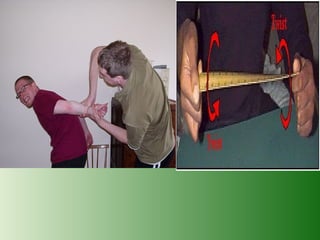
Torsion force is a twisting force that is
applied on an object by twisting one end
when the other is held in position or twisted
in the opposite direction. Different materials
have a different way of responding to
torsion. Some will deform, crack or even
break depending on the type of material.
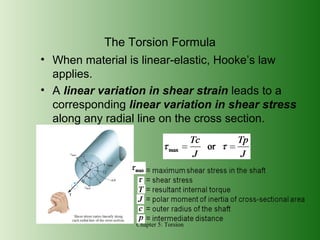
The Torsion Formula
• When material is linear-elastic, Hooke’s law
applies.
• A linear variation in shear strain leads to a
corresponding linear variation in shear stress
along any radial line on the cross section.

Chapter 5: Torsion
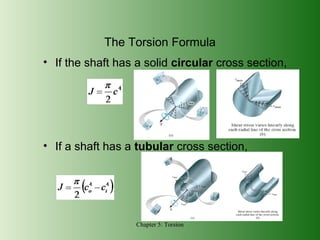
The Torsion Formula
• If the shaft has a solid circular cross section,

• If a shaft has a tubular cross section,

Chapter 5: Torsion
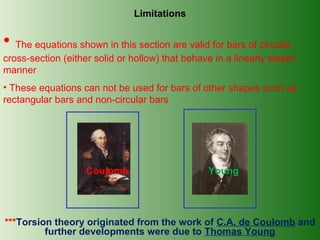
Limitations

• The equations shown in this section are valid for bars of circular
cross-section (either solid or hollow) that behave in a linearly elastic
manner
• These equations can not be used for bars of other shapes such as
rectangular bars and non-circular bars

Coulomb

Young

***Torsion theory originated from the work of C.A. de Coulomb and
further developments were due to Thomas Young
Why do we need to
understand torsion in
pre stressed concrete
lab course?????
• One of the primary reasons for this
recent desire for an understanding of
the effects of torsion is that modern
structures tend to be of higher
degrees of statical indeterminacy
and continuity, thereby incurring
combined stress states which
regularly include torsion.
• The second reason is found in those
instances in which torsion cannot be
eliminated, not even on paper.
In the past this was either ignored
or taken care of by reducing the
permissible stresses.
Analysis of
torsion
The analysis of reinforced concrete
and pre-stressed concrete members
for torsion is more difficult
compared to the analysis for axial
loads or flexure.
The conventional analysis for
reinforced concrete and prestressed concrete members for
torsion is based on the equilibrium
of forces by simple equations. The
compatibility of strains in concrete
and steel reinforcement is not
considered.
Torsion generated in a member can be
classified into two types based on the necessity
of the analysis and design for torsion.

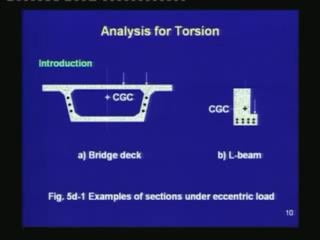
1.Equilibrium torsion: This is generated due to
loading eccentric to the centroidal axis. For
example:
(a) in a beam supporting cantilever slab or
precast slab or floor joists on one side,
(b) in a (curved) bridge deck subjected to
eccentric live load,
(c) in an electric pole subjected to loads from
wires on one side.
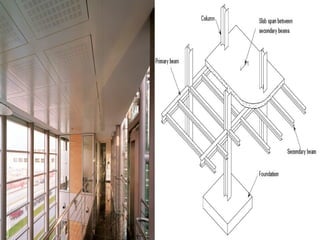
2.Compatibility torsion : This is generated by
twisting to maintain compatibility in
deformation with connected member. This type
of torsion generates in a primary beam
supporting secondary beam. For example: grid
beam system.
The primary beam need not be analyzed and
designed for torsion if secondary beams are
designed as simply supported.
The code allows us to neglect torsion if it is in
the case of compatibility torsion.

Here the emphasis is laid on equilibrium
torsion. The behavior of a beam under torsion

can be understood by these following
sequences.
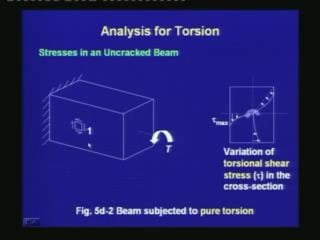
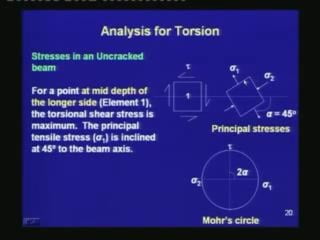
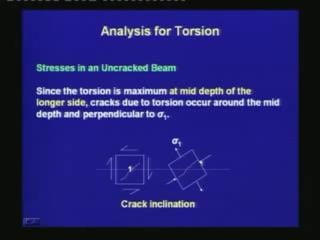
(1)stresses in an uncracked (homogeneous)
rectangular beam without pre-stressing due to
pure torsion (in absence of flexure),with
constant torque along the span.
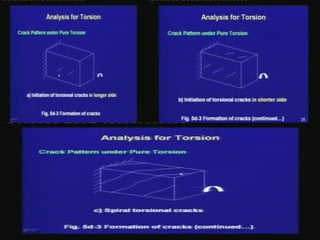
(2)Crack pattern under pure torsion;
(3)components of resistance for pure torsion;
(4)Modes of failure under combined torsion
and flexure;
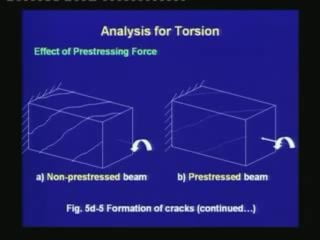
(5)Effect of pre-stressing force.
What is pure
torsion?????
The theory of pure torsion is used to find
out the value of shear stresses at various
distances from the centre of the shaft.
Under pure torsion the cross section of
the shaft is only under pure shear stress.
Although pure torsion is absent in
structures, understanding the behavior
under pure torsion helps to analyze
under combined torsion, flexure and
shear.
Certain assumptions are made to work
out this theory.
No more to
discuss.
Sorry to make anyone
bored or for wrong
information…..
Thank you

10.01.03.123 CE 416

  • 1.
    Name: Raktim Barua IDno.: 10.01.03.123 Course no.: CE 416 Course title: Pre-stressed concrete lab.
  • 2.
  • 3.
    Objectives 1. Define torsionforce and applications, 2. Explain some formulas for torsion force, 3. Importance of torsion in pre-stressing. 4. Analysis of torsion.
  • 4.
    What is torsion force andit’s applications ?????
  • 5.
    Torsion force isa twisting force that is applied on an object by twisting one end when the other is held in position or twisted in the opposite direction. Different materials have a different way of responding to torsion. Some will deform, crack or even break depending on the type of material.
  • 7.
    The Torsion Formula •When material is linear-elastic, Hooke’s law applies. • A linear variation in shear strain leads to a corresponding linear variation in shear stress along any radial line on the cross section. Chapter 5: Torsion
  • 8.
    The Torsion Formula •If the shaft has a solid circular cross section, • If a shaft has a tubular cross section, Chapter 5: Torsion
  • 9.
    Limitations • The equationsshown in this section are valid for bars of circular cross-section (either solid or hollow) that behave in a linearly elastic manner • These equations can not be used for bars of other shapes such as rectangular bars and non-circular bars Coulomb Young ***Torsion theory originated from the work of C.A. de Coulomb and further developments were due to Thomas Young
  • 10.
    Why do weneed to understand torsion in pre stressed concrete lab course?????
  • 11.
    • One ofthe primary reasons for this recent desire for an understanding of the effects of torsion is that modern structures tend to be of higher degrees of statical indeterminacy and continuity, thereby incurring combined stress states which regularly include torsion. • The second reason is found in those instances in which torsion cannot be eliminated, not even on paper. In the past this was either ignored or taken care of by reducing the permissible stresses.
  • 12.
  • 13.
    The analysis ofreinforced concrete and pre-stressed concrete members for torsion is more difficult compared to the analysis for axial loads or flexure. The conventional analysis for reinforced concrete and prestressed concrete members for torsion is based on the equilibrium of forces by simple equations. The compatibility of strains in concrete and steel reinforcement is not considered.
  • 14.
    Torsion generated ina member can be classified into two types based on the necessity of the analysis and design for torsion. 1.Equilibrium torsion: This is generated due to loading eccentric to the centroidal axis. For example: (a) in a beam supporting cantilever slab or precast slab or floor joists on one side, (b) in a (curved) bridge deck subjected to eccentric live load, (c) in an electric pole subjected to loads from wires on one side.
  • 16.
    2.Compatibility torsion :This is generated by twisting to maintain compatibility in deformation with connected member. This type of torsion generates in a primary beam supporting secondary beam. For example: grid beam system. The primary beam need not be analyzed and designed for torsion if secondary beams are designed as simply supported. The code allows us to neglect torsion if it is in the case of compatibility torsion.
  • 18.
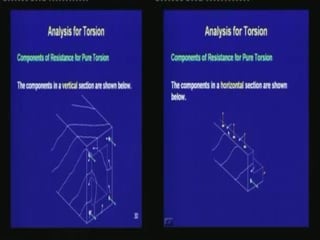
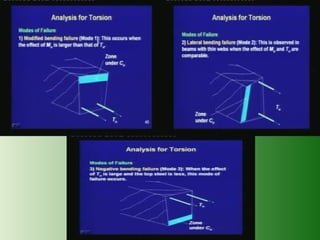
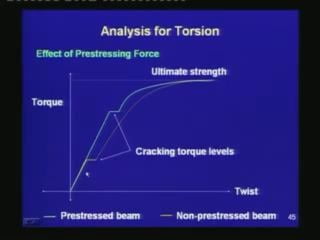
    Here the emphasisis laid on equilibrium torsion. The behavior of a beam under torsion can be understood by these following sequences. (1)stresses in an uncracked (homogeneous) rectangular beam without pre-stressing due to pure torsion (in absence of flexure),with constant torque along the span. (2)Crack pattern under pure torsion; (3)components of resistance for pure torsion; (4)Modes of failure under combined torsion and flexure; (5)Effect of pre-stressing force.
  • 19.
  • 20.
    The theory ofpure torsion is used to find out the value of shear stresses at various distances from the centre of the shaft. Under pure torsion the cross section of the shaft is only under pure shear stress. Although pure torsion is absent in structures, understanding the behavior under pure torsion helps to analyze under combined torsion, flexure and shear. Certain assumptions are made to work out this theory.
  • 31.
  • 32.
    Sorry to makeanyone bored or for wrong information…..
  • 33.